Economy. A Master’s Paper for the M.S. in I.S. degree. November, 2019. 74 pages. Advisor: Mohammad Hossein Jarrahi
The digitally-enabled gig economy is characterized by a precarious and flexible lifestyle in which online freelancers must continuously secure gigs in order to ensure a livable income. Consequently, their self-presentation is crucial as they must differentiate themselves from competitors. By analyzing 39 interviews from digital workers on the freelancing platform Upwork, we identified five key self-branding strategies: boosting a profile via algorithmic manipulation, showcasing skills, expanding presence, maintaining relationships with clients, and individualizing brand. These strategies were analyzed using Goffman’s dramaturgical theory. Lastly, we conclude that the primary goal of personal branding directly challenged the very nature of precarity and anonymity that comes with being a digital worker, as the majority of participants chose to self-brand themselves in order to be recognized — and perhaps even appreciated by — clients.
Headings:
Self-Branding
Digital Work
Online Labor Platforms
Gig Economy
SELF-BRANDING PRACTICES OF DIGITAL WORKERS IN A RESURGING GIG ECONOMY
by Dottie L. Blyth
A Master’s paper submitted to the faculty of the School of Information and Library Science of the University of North Carolina at Chapel Hill
in partial fulfillment of the requirements for the degree of Master of Science in
Information Science.
Chapel Hill, North Carolina November, 2019
Approved by
Table of Contents
Table of Contents ... 1
Acknowledgements ... 3
1. Introduction ... 4
2. Literature Review ... 8
2.1. Digital Work ... 8
2.1.1. A Resurging Gig Economy ... 8
2.1.2. Digitally-Enabled Knowledge Work... 11
2.1.3. Digital Labor Platforms ... 16
2.2. Self-Presentation ... 19
2.2.1. Self-Branding in the Work Environment ... 19
2.2.2. Digital Labor Platforms and Self-Branding ... 23
3. Theoretical Framework: Goffman’s Dramaturgy and Impression Management 26 4. Method ... 30
4.1. Upwork ... 30
4.2. Participants ... 31
4.3. Design ... 32
4.4. Procedure ... 32
5. Findings ... 34
5.1. Platform-Afforded Reputation... 34
5.2. Key Self-Branding Strategies ... 37
5.2.2 Showcasing Skills ... 41
5.2.3 Expanding Presence ... 45
5.2.4 Maintaining Relationships with Clients ... 47
5.2.5 Individualizing Brand... 50
6. Discussion ... 53
6.1. Dramaturgical Analysis... 53
6.1.1. Front Stage ... 55
6.1.2. Setting... 55
6.1.4. Manner... 57
6.1.5. Back Stage ... 58
6.2. Self-Branding as a Performance ... 59
6.3. Implications ... 62
6.4. Limitations and Future Research ... 63
7. Conclusion... 65
Appendix ... 66
Acknowledgements
This paper would not have been possible without the support of my friends,
family, professors, and mentors during my time here at SILS.
I would like to especially thank my faculty supervisor, Dr. Mohammad Hossein
Jarrahi, for his expertise, guidance, and belief in me throughout the entire master’s paper
writing process and beyond.
I would also like to thank the professors and faculty who have helped me navigate
my professional and academic career over the past several years, with a few special
shoutouts to Dr. Ron Bergquist, Dr. David Clarke, and Laura Ruel for helping me explore
my passions and to Tiffany Harris, Lara Bailey, and Lori Haight for always being willing
to answer my many questions.
Lastly, I want to thank my family and friends for their continued love, support,
1. Introduction
A new type of work characterized by an unprecedented reliance on technology is
emerging in part due to advancements in digital platforms and a resurging gig economy.
Although technology’s integration into the workplace has always played a major factor in
how efficient and effective work processes are, we are seeing an even bigger shift in the
21st century for knowledge workers: technology is now becoming the milieu for their work. In other words, knowledge work, defined as labor where the main capital is
formalized and applied skilled knowledge (Drucker, 1993), is increasingly moving
toward more dependency on digital tools and infrastructures — namely online platforms,
algorithms, and data (Orlikowski & Scott, 2016). This phenomenon, known as “digital
work,” is a topic of interest in several research communities, including but not limited to
economics, marketing, organization science, information systems, and sociology.
By making use of the various technologies mentioned above, digital workers are
afforded several distinct characteristics which give them the possibility of untethering
themselves from the traditional “nine-to-five” white collar lifestyle; perhaps most notable
is the trait of mobility since their work is location-independent (Ens et al., 2018). This
freedom of not being constrained to an office environment greatly attracts people to
digital work and has simultaneously helped grow an economy in which people are
choosing to become their own bosses, free of office politics and bureaucratic setbacks
(Nash et. al, 2018). Self-presenting oneself then becomes a crucial skill for digital
seek to differentiate — and essentially sell — themselves to future employers. Their
brand and reputation is often deemed essential to the success of their business, which for
many acts as their primary source of income.
However, due to not having a long-standing traditional employee-employer
relationship, digital work, often manifesting in the form of gig and freelancing work, can
be inherently precarious in nature and presents new challenges for these workers such as
continuously finding new clients in order to ensure a steady income and creating a
versatile image online. As such, a key element of digital work has to do with the
capacities of independent workers in developing a viable online brand (Gandini, 2015). A
common trend for self-branding is using online methods to secure jobs as opposed to
more traditional networking strategies, such as word-of-mouth marketing, CV circulation,
and classified advertising.
While some professional platforms like Twitter and LinkedIn are known for their
superior social networking abilities, specialized labor or gig platforms like Upwork and
Fiverr are designed to enable independent digital work using algorithms and also include
additional affordances like rating and review features which further contribute to an
individual’s online persona (Mrass et al, 2018). These digital labor platforms are
becoming especially accepted and adopted throughout the freelancing community as they
facilitate communication between the worker and client while providing both parties with
mutually beneficial information — the worker is able to create and personalize an
outward-facing public user profile page (i.e. they can self-brand themselves) and the
Self-branding (used synonymously with the termpersonal branding for the
purpose of this paper) in itself is not a novel concept as it has been widely investigated in
the fields of sociology and psychology, as well as the fields of marketing and business
since the emergence of the Internet and more recently social media. There remains,
however, a gap in research carried out in the context of digital work and the gig
economy. Particularly, while the topic of personal branding is of high interest in the
industry, there still remains relatively few studies in academia which revolve around how
contractors and independent workers effectively choose to self-present themselves for
clients. Additionally, past studies involving self-branding have tended to focus only on
the workers; however, it is worth studying how the target audience (in our case, clients on
Upwork) perceives these self-presentational strategies.
The overarching purpose and objective of this paper is to explore the idea of
self-presentation as an integrated characteristic of digital work and to pursue three specific
research questions:
1. What are the perceptions of self-presentation commonly held by digital workers
on digital labor platforms?
2. What considerations do digital workers take when choosing to brand themselves?
3. What affordances and constraints do online platforms hold for digital workers in
the context of self-branding?
This master’s thesis approaches this gap by focusing on the common affordances
and constraints of digital labor platforms,and by applying Erving Goffman’s sociological
framework of dramaturgical analysis and impression management theory to our findings
The research study addresses the questions listed above by providing a qualitative
analysis of 39 semi-structured interviews of online freelancers and clients registered on
the website Upwork, the largest online freelancing platforms used by millions. More
specifically, as of 2016, the platform hosts more than 9.3 million freelancers and 3.7
million employers (Popiel, 2017).
From our analysis, we found that Upwork emphasized its online social reputation
system for its freelancers who were usually judged by clients through their user profile
page. More specifically, we learned about the different reputation metrics the platform
incorporates (e.g. job success score, ratings) and how Upwork users respond — and act
— accordingly. We conclude the paper by describing five specific self-branding
strategies digital workers used, which were then described and categorized using
Goffman’s dramaturgical analysis rhetoric of self-presentation. The five self-branding
strategies we observed were: boosting a profile via algorithmic manipulation, showcasing
skills, expanding online and offline presence, maintaining relationships, and
individualizing brand. By incorporating a sociological lens, this paper seeks to
2. Literature Review
The research topic lies at the intersection of two topical areas, digital work and
self-branding, which this literature review addresses below. The first section of the
literature review focuses on the concepts of digital work and digital labor platforms
within the context of the gig economy; and the second section discusses the importance
of self-branding within the context of independent worker environments. This literature
review subsequently concludes by providing an overview of current research regarding
self-branding for digital workers in the gig economy.
2.1. Digital Work
2.1.1. A Resurging Gig Economy
The gig economy, also known as the “sharing economy,” “freelance economy,”
“platform economy,” and “crowdworking” amongst other terms, refers to work
characterized by short-term engagements, self-employment, and contract work (Kalleberg
& Dunn, 2016; Lewchuk, 2017). The Bureau of Labor Statistics (BLS) states that there is
no official definition of a gig economy, but that a gig is typically defined as “a single
project or task for which a worker is hired, often through a digital marketplace, to work
on demand” (Torpey & Hogan, 2016). The same article published by the BLS also lists
several pros and cons of taking on this non-traditional work; with advantages including
flexibility, variety, and passion, and disadvantages being inconsistency, scheduling, and a
Despite this economic model being around for some time now, digital technology
is now playing an active role in how people find work by mediating gigs, though
economist Jim Stanford maintains alongside other skeptics that gig work should be
thought of as “resurgent” rather than new (Collins et al., 2019, Stanford, 2017). Stanford
furthermore implies that the rising trend of precarious work might be a result of “the
evolution of broad social relationships and power balances, as much as technological
innovation in its own right” and that online gig platforms should be thought of as “simply
facilitating the application of long-standing management labour extraction strategies that
are as old as capitalism” (Stanford, 2017).
In his essay, Stanford explores this concept by listing five features of
digitally-enabled gig work (an evolution of gig work we previously knew): (a) work is performed
on an on-demand basis; (b) workers are compensated for their task and/or product, not
their time; (c) workers supply their own resources, including their physical working
environment; (d) there is a third actor in the work process different than client or worker
which organizes the work; and (e) there is digital intermediation in the process.
According to this definition, digital work is inherently part of the gig economy ecosystem
given that there is a digital intermediary (e.g. online labor platform) which organizes the
work between the freelancer and client. By analyzing this resurgent economy in
conjunction with online platforms, we are able to conceptualize the large-scale effects it
has for the future of work practices.
Needless to say, there has been a dramatic increase in independent,
self-employed, contract, and short-term work for the past decade. According to Ellen Harpel,
estimated 30 to 40% of workers in the United States currently or have previously
freelanced or worked independently in their lifetime as either a primary or secondary job,
and that approximately 10% have worked independently as part of temporary or contract
work. She also notes that an estimated one percent of workers are engaged in “online
platform work” (e.g. Uber, Airbnb), insinuating that the workers in this category
primarily engage with this digital work as a “supplemental income to other sources”
(Harpel, 2019). Nevertheless, Harpel’s research highlights the importance and prevalence
of independent gig work in an evolving economy and concludes that the type of gig work
ranges by industry and skill-level.
In fact, according to a study commissioned by Upwork and the Freelancers Union,
57 million Americans (i.e. 35% Americans) freelanced in 2019 and 53% of Gen Z (ages
18-22) have freelanced in 2019, which suggests that we will only continue to see a rise in
the upcoming years. The majority of work includes creative work (e.g. design, arts,
entertainment) and roughly half of gig work is skilled, knowledge work. Additionally,
this groundbreaking study shows that the majority of these workers do not self-describe
themselves as "gig workers"; instead, they prefer to identify as "independent workers"
and "self-employed,” which could potentially point to why there remains a gap in
literature concerning the subject (“Freelancing in America,” 2019).
Contrarily, while evident that digital technology is helping facilitate work
practices in today’s society, there are still critics who doubt the usefulness or
effectiveness of gig work. Some reasons for their criticisms include poor working
conditions, lack of control, anxiety, and insecurity — all of which are characteristics of
Furthermore, not everyone participating in the gig economy does so by choice, as 40%
take on this precarious and temporary work out of necessity (“Freelancing in America,”
2019; Harpel, 2019). Critics, like Stephen Barley, argue that that there is a lack of
research being conducted on the changing nature of work in organizational studies. On
one hand, while he acknowledges the decrease in manufacturing jobs and increase in
contingent, or task-specific work, Barley also warns that gig work is not always the most
cost-effective option for a company, reinforcing the value and need for continuous
research in the field (Barley et al., 2017).
2.1.2. Digitally-Enabled Knowledge Work
The new emphasis on work which is mediated through technology and online
platforms calls for a new category of work: a phenomenon researchers are now calling
“digital work.” Research regarding digital work is relatively new and is of high interest in
both academia and industry and in both cases, there is an understanding that the work
economy is adapting with technological advancements.
While there is no unanimous agreement on how this is exactly defined, Table 1
Reference Definition
Orlikowski, 2016 “Work practices that are being reconfigured through the operation of digital platforms, algorithms, and the processing of multiple, diverse kinds of data” Durward, Blohm, &
Leimeister, 2016 “An effort to create digital goods or that makes substantial use of digital tools”
Wang et al., 2018 “Work in which digital technology has transformed factors of production”
Fuchs & Sevignani, 2013 “The organisation of human experiences with the help of the human brain, digital media and speech in such a way that new products are created”
Nash et al., 2018 “[Work] that [creates] digital goods using digital tools”
Table 1: Descriptions of Digital Work in the Previous Literature
All of the definitions above use an economic discourse (i.e. “factors of production” and
“goods”) and explain how the work process and its product(s) are being transformed by
technology. More specifically, characteristics of digital work include
location-independent work practices, digital platforms, and Internet dependencies (Nash et al.,
2018).
A related topic to digital work is considered knowledge work(and vice versa),
where someone’s main asset and capital is their skilled knowledge. The knowledge
economy — and therefore advanced research in economics — rose after the industrial
revolution and the rise of capitalism and was studied closely by German theorist Karl
Marx, who attempted to breakdown the meaning of work. In order to do so, Marx
conceptualized the idea of “labor-power,” a term which is used to contrast physical,
purposes” (Marx et al., 1990). By doing so, he consequently laid a foundation for
analyzing current-day economics and the study of work. Marx furthermore stressed a
worker’s skill and training as being especially valuable in this labor-power exchange,
indirectly alluding to what we now refer to as knowledge work (Schatzkin, 1978).
Knowledge work describes any type of work where there is an emphasis on
higher-level thinking, problem-solving, and analytical skills, typically obtained through
formalized training. As a result of knowledge work reaching nearly every industry and
access to digital technology is starting to become more accessible, digital work is
becoming a disruptive force in the working economy. Several examples of knowledge
workers in today’s society include: creative writers, computer programmers, accountants,
educators, physicians, architects, and interior designers.
One way to explore characteristics of digital work is through sociologist Anselm
Strauss’ theoretical perspective of work. By studying work as a process, Strauss was able
to identify and articulate several key attributes of what working entails. Widely known
for his grounded theory in qualitative research, Strauss conducted a plethora of studies in
the 1980’s and 1990’s in an attempt to comprehend organizational practices during a time
where digital technologies were transforming the way people perform routine tasks in
businesses and organizations, such as automated invoices and payroll (McAfee &
Brynjolfsson, 2017). Strauss’ findings, which date decades prior to the Internet era,
remain undoubtedly pertinent for today’s society and can be used to exemplify the new
phenomenon of digital work.
One of his major findings was an articulation of actors, a commonly referenced
connotations depending on the applied theoretical lens. By his definition, actors are of
units of any size (i.e. a person, team, organizational unit) which have accountability and
freedom to work either collaboratively or independently in order to achieve a goal
(Strauss, 1985). In the context of digital work, the primary actors involved are referred to
as “digital workers,” “clients,” and “online platforms” (Mrass et al., 2017). For the
purpose of this paper, the terms “digital workers” and “online freelancers” are used
interchangeably.
Strauss, along with his colleague Juliet Corbin, promoted the idea of actors ever
further, arguing that actors have stance when it comes to work, or a “position taken by
each participant toward both the work and the working-out process” (Corbin & Strauss,
1993). This emphasis should be highlighted as it gives actors some type of social agency
when it comes to working, contradicting Marx’s technological deterministic viewpoint
that technology has agency in society as opposed to humans (Matthewman, 2011). These
findings align with recent research which suggests that digital nomads — a large subset
of digital workers — are part of a “lifehacking subculture” characterized by “an affinity
for autonomy, proactivity, and [self-actualization] fulfilled through technical
competence,” thus giving a degree of independence and agency to the actor (Nash et al.,
2018; Wang et al., 2018). An article written in 2018 also reaffirms this by narrowing
down three specific traits for “decent digital work,” which is an adaption of the United
Nations’Sustainable Development Goal #8: Decent Work and Economic Growth. The
traits identified in the study were: autonomy, belonging, and competence (Ens et al.,
A third concept of work Strauss elaborated on along with colleague Susan Leigh
Star is the visibility of work, providing a framework for analyzing both the workers and
the work product itself. The fact that work may be “invisible” provides two important
considerations for this paper: first, it provides a framework for focusing on both the
actors and their work (i.e. digital goods); and second, it brings frame of reference to the
forefront, accepting that the definition of work is instinctively relative and changes
depending on who is defining it (Star & Strauss, 1999). In the context of digital work,
this means that clients and freelancers might have very different connotations of what
“work” entails.
One example which exemplifies this idea of relativity is Strauss’ 1982 medical
case study which looked at the work processes patients with chronic illnesses must
perform — some of which is necessary, expected, and/or supplementary to their
caregivers’ own work. Strauss’ study of hospitalized patients and their invisible work
demonstrates the interaction and cooperation actors must have together, despite some
work being seen as expected or invisible by the other party (Strauss, 1982). This
characteristic of visibility and invisibility is extremely important to understand because it
reminds us that instead of work being limited to a certain population, invisible work
reaches everyone, albeit in varying degrees. It likewise entails that there is a physical
and/or mental labor demand actors have and must perform without being directly
acknowledged for it.
A fourth finding from Strauss’ research is the idea that work is constantly moving,
meaning that unplanned events should be accounted for and expected from the beginning
Information Systems Engineering Journal about the future of work, researchers
strengthen this argument by declaring that future systems must be designed for “usable,
useful, and malleable digital solutions that can be adopted easily and flexibility,
according to [a worker’s] specific needs” (Richter et al., 2018; Richter & Riemer, 2013).
By articulating these anticipated contingencies, along with the visibility of work, Strauss
incidentally advances the argument that work should be dynamically studied through a
variety of lenses and perspectives in order to paint a more holistic understanding
(Orlikowski, 2016). Ultimately, digital knowledge workers are characterized by
flexibility, autonomy, and a dependency for online platforms which serve as a mediator.
2.1.3. Digital Labor Platforms
Best-selling authors Andrew McAfee and Erik Brynjolfsson mention in their
novel Machine | Platform | Crowds: Harnessing Our Digital Future that we are at a point in time where “technologies are demonstrating that they can do work that we’ve never
thought of as preprogrammed or ‘routine’” (Brynjolfsson & McAfee, 2018). Online tools
and services are rapidly changing both the economy (e.g. a digitally-enabled gig
economy) and entire industry infrastructures (e.g. electronic health records in healthcare,
distance/e-learning in education), and can be partly credited due to widespread
standardization and pushes for technological intertwinement within quotidian life. In fact,
according to the Internet World Stats, over half of the world's population (51.7%) became
Internet users as of June 2017, and accessibility is only continuing to increase (“Internet
Uncoincidentally, there is an increasing trend in research showing how online
platforms are being used in the context of gig and contingency work (Barley et al., 2017).
These specific online platforms — referred to as digital labor platforms — mediate the
relationship between employers and workers and are estimated to have an annual growth
rate of 26% (Kässi & Lehdonvirta, 2016). Ellie Harmon and Michael Silberman express
that these “digital labor platforms appear to be a permanent fixture of a ‘new world of
work’ that is flexible, digital, and globally networked” (Harmon & Silberman, 2018).
Harmon and Silberman furthermore contribute a categorization system of three
significant types of digital labor platforms: microtask platforms for lower-level skill jobs
(e.g. data entry), freelance platforms which “distribute larger tasks or projects” (e.g.
Upwork), and platforms which facilitate in-person work(e.g. Uber and Lyft for
transportation).
The International Labour Organization adapts a similar categorization system,
grouping commercial digital labor platforms into two distinct groups — web-based and
location-based — which are further divided by the worker audience (i.e. tasks given to
selected individuals versus tasks given to the crowd). In their system, there are eight
unique types of commercial digital labor platforms: freelance marketplaces, microtasking
crowdwork, contest-based creative crowdwork, accommodation, transportation, delivery,
household services, and local microtasking. The ILO also outlined in the same report 18
proposed criteria to ensure decent work on digital labor platforms, which includes criteria
such as workers having a right to decline tasks and workers being informed on why they
In particular, the subcategory of online freelance platforms are of interest to us for
this study as they facilitate knowledge work mentioned in the previous section and are
typically understudied compared to other platforms such as Airbnb and Uber (Sutherland
& Jarrahi, 2018). Categorized by Kalleberg & Dunn (2016) as having negotiable wages,
and greater autonomy, these freelance labor platforms are greatly attractive for
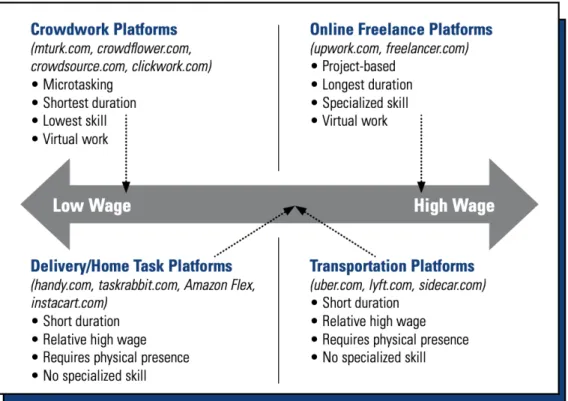
knowledge workers seeking a more flexible and independent lifestyle. View Figure 1 for
an overview of Kalleberg & Dunn’s categorization of digital labor platforms.
Figure 1: Wage Continuum of Online Platforms (Kalleberg & Dunn, 2016)
Ultimately, all digital labor platforms help facilitate the connection between
workers and clients by creating a new type of social interaction which occurs online. It
should be noted that each platform holds specific affordances and constraints, such as
Gig workers are also “usually identified by the platform they’re associated with” (e.g. we
commonly refer to someone as an Uber driver as opposed to a rideshare driver), which
again highlights the importance of the platform and its perceived brand and ecosystem in
the sharing economy (Kalleberg & Dunn, 2016; Kinder et al., 2019).
2.2. Self-Presentation
2.2.1. Self-Branding in the Work Environment
In the case of independent contractors and self-employed workers, the nature of
self-branding is an extremely vital facet of their job as it becomes a primary way of
finding and securing work (Gandini, 2015). Also known as personal branding, this action
of adopting certain traditional marketing practices found traditionally in larger
organizations has found its way into the lives of independent workers as a form offree
and invisible labor (Gandini, 2016).
Self-branding in the context of the freelance economy also has two principal traits
which should be highlighted; first, “professionally sociality, online or offline, is
compulsory to get visibility and recognition” and “professional sociality is performative”
as an “act of self-construction” (Gandini, 2016; Moriset, 2017). These two characteristics
describe the necessity of self-branding as a digital worker since self-presentation is
necessary to be noticeable on platforms. Some experts believe that self-branding differs
slightly from managing one’s self-reputation (although these are usually used
interchangeably), primarily because there are specific steps and strategies people may
reputation can be equated to the term “social capital” (taken from social theory), as it
becomes a valuable intangible resource for independent workers (Gandini, 2016).
In a recent systematic review of personal branding of 100 articles, researchers
found that there is “no commonly accepted academic definition” nor theoretical model
which currently exists for personal branding, which presents a large obstacle for research
in this field as the evidence for this is substantial (i.e. there is a large disconnect amongst
the reviewed papers) (Gorbatov et al., 2018). This review mentioned many different
theoretical frameworks in which self-branding is studied in — sociology (e.g.
dramaturgical perspective, impression management), marketing (e.g. human branding,
branding services), psychology (e.g. identity formation, self-development), and economic
(e.g. macro-environment studies, reputation economy) — although the majority of papers
analyzed referred specifically a sociological framework.
Regardless of the topic spanning a number of disciplines, the authors identified
several attributes of personal branding and attempted to create their own definition of
self-branding, which can help guide us moving forward: “Personal branding is a strategic
process of creating, positioning, and maintaining a positive impression of oneself, based
in a unique combination of individual characteristics, which signal a certain promise to
the target audience through a differentiated narrative and imagery” (Gorbatov et al.,
2018).
Seeing that the primary goal of traditional branding is to stand out against
competitors and be unique, it should be clear that these marketing strategies would soon
be adapted on a small and individual level, especially amidst the rise of self-employed
be explained via Borman-Shoap et al.’s chart (Table 2), which indicates that a brand is
determined externally (as opposed to mission, vision, and values which are all determined
internally).
Table 2: Mission, Vision, Values, and Brand (Borman-Shoap et al., 2019)
In Borman-Shoap et al.’s interactive self-branding workshop, the researchers
phrased self-branding as answering the question “what does my work say about me?”
which was later compared with their work and/or CV by a peer reviewer (hence the
“determined externally” characteristic of branding). Examples of single-word brands
(which was a large focus for this workshop) found in larger-scale, traditional
organizations and institutions include Apple’s creativity, Volvo’s safety, and Ralph
Lauren Polo’s preppy(Borman-Shoap et al., 2019).
According to Joel R. Evans, distinguished business professor at Hofstra
University, there are eight specific steps in the self-branding process (Evans, 2017).
Evans states that the first steps of any self-branding strategy should begin with a critical
self-assessment of oneself (analyzing both strengths and weaknesses, sometimes achieved
in the form of a “strengths, weaknesses, opportunities and threats analysis” — or “SWOT
analysis” for short). Second to a self-assessment, research on job and market trends —
alongside research pertaining to a specific career path or industry — should follow suite,
which in turn helps the worker determine their own career goals. Once a worker has a
improve on their strengths. Next steps include creating, maintaining, and communicating
the brand, which is an iterative process, changing according to feedback and an
individual’s goal. Evan states that the last step of the self-branding process encompasses
finding a job that fits the need and skill-level of the worker which can lead them to
further enhance their own brand. In this way, we can see self-branding not only as
externally motivated (e.g. getting hired), but also as internally motivated (e.g.
professional development, self-fulfillment). Self-branding should be considered
successful when “people are supposed to sense the words that underlie your personal
brand without explicitly being told what these words are” (Gershon, 2017).
Current research in the field shows that self-branding is a familiar concept for
most freelancers, although the reception toward it is mixed. In one study, researchers
surveyed a total of 163 knowledge workers (101 freelance journalists in New York and
Paris and 62 “white-collar” workers in Boston) and found that workers view
self-branding as a “natural feature of any modern economy,” insinuating that it is expected to
have as an independent worker (Vallas & Christin, 2017).
Additionally, findings from this study show that while some independent workers
embraced self-branding, others resented or rejected it, viewing it as inauthentic and
performative. On the same note, the study showed that there are also some groups of
populations who are more inclined to view self-branding in a positive light than others.
For example, American workers were more accepting of the idea of self-branding than
their European counterparts; likewise, workers whose professions were either freelancing
or in information technology were more in favor of self-branding practices than people
2.2.2. Digital Labor Platforms and Self-Branding
Personal branding in the work environment is not new per se, though online
technology and big data are helping exemplify these practices on a larger scale. Digital
labor platforms play a major role in self-branding practices for both workers and clients,
since creating a cyberidentity (i.e. an online persona) is almost always a requirement
necessary to make use of the website. For instance, the platform Uber is rendered
essentially useless if there is no account/profile for either a rider or driver; in order for the
work process to materialize, both parties must have an account. It is additionally not
uncommon for workers to extend their online persona to multiple platforms, which is
usually done in order to reach a wider network and acquire more job opportunities. For
example, an Uber driver might also work for Lyft and vice versa; and, in the same light,
clients might have both applications on their phone to compare prices on a given day.
Another common feature for online platforms is having in-house communication tools
and features. Some platforms, like Uber, also include off-platform communication
features (e.g. an Uber driver can be provided a passenger’s phone number and call them
using their mobile phone if lost), whereas others demand that users perform all
communication on the platform (e.g. an in-house instant messaging service), primarily for
liability reasons.
For people looking for work on online freelancing platforms, having a good
profile reputation is critical as they want to present their best selves to potential
employers. Successful online freelancers who use online platforms to find and promote
their work must also accept and embrace them, even if that means taking advantage of
workers used and included frequent buzzwords in their profile simply to bump up their
profile on LinkedIn (Gandini, 2016). This algorithmic phenomenon is at the heart of
freelance labor platforms as it matches clients and workers entirely via platform-based
rating and reputation systems (Wood et al., 2018). As platform companies are quickly
embracing their importance in the work ecosystem, features like ratings and written
testimonials are starting to appear as industry standards to confirm a worker’s reputation
in addition to features like a biography and skills section — all of which help paint a
more holistic picture of a user’s identity. Additionally, these “reputation-signaling
mechanisms” further “maximize the likelihood of a successful transaction” which
incentivizes platforms for providing such affordances (Abrate & Viglia, 2017).
Moreover, research shows that platforms matter when it comes to self-branding
for an independent worker and can be seen as a “working tool” for digital workers
(Gandini, 2016). Backing this up, researchers interviewed freelancers and found that the
“platform-specific self-brand is based upon ‘imagined affordances’ of individual
platforms and their placement within the larger social media ecology,” which are
influenced by platform features, audience assumptions, and worker’s own self-concept
(Duffy et al., 2017). This implies that workers consider the platform(s) they chose to
self-brand on; for example, a musician might choose to self-self-brand on platforms that have
specific multimedia features like YouTube, whereas a creative designer might choose a
platform like Squarespace which can easily host an art portfolio.
To refer back to Evans’ self-branding model, these online platforms help ease the
creation, maintenance, and communication of brands on a large-scale network as they
2019). As suspected, the ideal setting would be that both authenticity and transparency
are prevalent in people’s self-branding practices as well as the platform they choose to
use. However, we see that this is far from the case as Erving Goffman’s impression
management theory (detailed in the following section) states that people will always seek
to self-present themselves with some kind of interior motive and online labor platforms
tend to hide their algorithms from the public. Because of this, investigating a platform’s
perceived agency is also of interest for future research as that digital work will only
continue to grow. In Duffy et al.’s research, we are able to recognize that platforms are in
fact not neutral as they each provide different affordances; therefore, to better understand
how technology is disrupting what “work” connotes, it is worth gathering a holistic
perspective encompassing all perspectives of information technology, work, and actors.
Currently, most research on personal branding in the work environment
investigates either social media or online gig platforms like ride-sharing (e.g. Lyft) and
microtasking (e.g. Amazon Mechanical Turk); however, past studies suggest that there
still remains a gap regarding online freelancing platforms which help facilitate
knowledge work. Other studies also fail to show both perspectives of the working
employer-employee relationship, as previous literature tends to focus solely on the
3. Theoretical Framework: Goffman’s Dramaturgy and
Impression Management
The idea of self-branding can trace back to the field of sociology through the
theoretical framework of dramaturgical analysisand impression management, first
conceptualized by pioneer Erving Goffman in 1958 whose contributions to sociology
cannot be understated. In a Times Higher Education article published in 2007, Goffman
was the sixth most cited book author in the humanities and social sciences and in 1998,
his grossly influential book, The Presentation of Self in Everyday Life, was named as the 10th most important sociology book of the twentieth century by the International
Sociological Association in 1998 (ISA Congress Programme Committee, 1998; McKie et
al., 2015). Accolades such as these put Goffman in the same category as Pierre Bourdieu
and Anthony Giddens, other leaders in the field. In support of this, a systematic review of
personal branding also shows that Goffman’s dramaturgical analysis perspective was the
most-referenced theoretical framework (used 19 times out of the 100 analyzed papers) to
explain self-branding (Gorbatov et al., 2018).
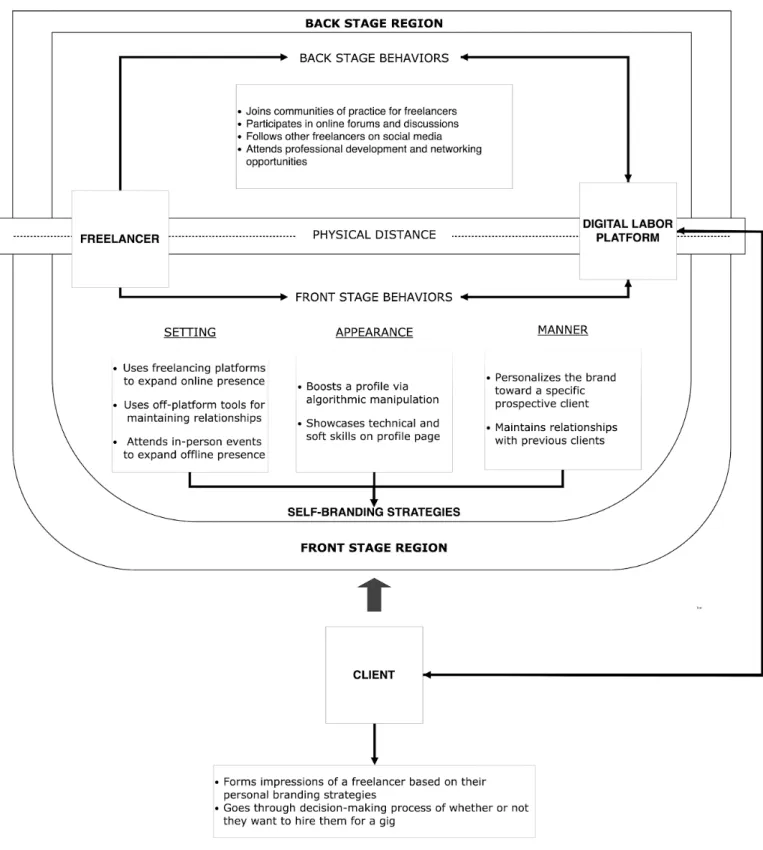
In summary, Goffman’s dramaturgical analysis perspective refers to an
individual’s self-presentation — or “behavior that attempts to convey some information
about oneself or some image of oneself to other people” — by using theater as a
metaphor for life (Baumeister & Hutton, 1987). Goffman attentively explored different
features which make up a person’s “front stage” performance, contending that every
of which can be analyzed both literally in a theater and metaphorically in a self-branding
context. In this case, setting describes a person’s physical environment location where an
interaction may take place; moreover, as different settings may have different types of
audiences, the interactions the actor has also change, depending on the audience. The
second attribute, appearance, typically refers to the clothes an actor is wearing, which can
portray their social status, work occupation, and age. Lastly, manner alludes to the types
of behaviors an actor presents (Goffman, 1958). It is during this front stage performance
that “performers typically conceal behaviors, attitudes, and emotions that can be
expressed in the backstage,” which is the second structural feature of dramaturgy
characterized by being away from the audience (Houts, 2004).
This idea of presenting oneself outwardly toward others stem from two primary
causes. The first cause for self-presentation is “audience pleasing,” which occurs as
peoples’ fronts tend to be selected rather than suddenly created, because when “an actor
takes on an established social role, usually [they find] that a particular front has already
been established for it” due to social interactions with and toward a certain audience
(Goffman, 1958). Besides enabling social interaction and communication, a second
external factor for putting on a front (this time typically in a positive manner) is that the
actor can expect to gain some type of reward — both material and/or social — by doing
so (Baumeister & Hutton, 1987; Brown 2015).
Based on previous literature, researchers have attempted to categorize and define
trends in self-presentation while also recognizing that everyone may act differently even
in the same circumstance. Research shows that successful self-presentation is composed
awareness and knowledge of what traits should be presented, and an ability to present
themselves (Brown, 2015). In another study (Jones & Pittman, 1982), common
self-presentation strategies were divided into five unique categories, along with a respective
impression and risk. The five self-presentation strategies they found were: ingratiation,
self-promotion, intimidation, exemplification, and supplication. To view the Jones &
Pittman’s full table, refer to the Appendix. These frameworks for self-presentation were
referred to in-depth during the data analysis for this study and provide powerful
foundations for future research — especially as we spearhead our way into the realm of
digital work.
Even so, one large limitation with Goffman’s dramaturgical perspective is that it
does not explicitly deal with digital contexts, although some people argue that it can be
extended to electronic communication as well (Miller, 1990). To combat this, his
framework was later expanded by Joshua Meyrowitz in 1990 to account for these
changes by looking at the evolving media and how they might affect our interactions with
the world (Meyrowitz, 1990) and then again by evolving into impression management
theory, defined as “any behavior by a person that has the purpose of controlling or
manipulating the attributions and impressions formed of that person by others” (Tedeschi,
1984). Amongst the rise of social media platforms, there has been active discussion in
how people choose to present themselves via computer-mediated communication (CMC)
and the social implications of doing so compared to self-presenting in a physical,
face-to-face setting. One result of self-presenting using CMC is that people thus have
“cyberidentities,” or online presentations of themselves, and that these cyberidentities
communication with CMC, aspects of traditional impression management such as
physical body language and behavior are remediated through other types of media, such
as photos, videos, text, and any other types of multimedia afforded by the technology at
hand.
According to Goran Bubaš, impression management on the Internet and via CMC
is “simplified in situations when someone is (a) trying to transmit socially favorable
[information] while omitting socially disadvantageous personal data; or (b) or engaging
in social deception by conveying socially agreeable but untrue or incorrect personal information” — in other words, impression management encompasses adding, removing,
and/or altering specific information about oneself for favorable gain (Bubaš, 2001). Other
studies have been carried out in specific areas of impression management. For example,
one researcher looked at the popular Estonian social networking site rate.ee and found that visual impression management (e.g. profile pictures) varies depending on the
audience and that “profile images . . . are constructed and reconstructed based on the
values associated with ‘the ideal self’” (Siibak, 2009).
To conclude this section, this master’s paper expands on concepts from
Goffman’s self-presentation theories of impression management and dramaturgical
analysis by applying them to the digital work environment and to the different types of
personal branding strategies digital workers use. By applying a sociological framework,
we can grasp a better understanding of digital workers and their interactions, influences,
4. Method
4.1. Upwork
Online freelancing was chosen as a focus for this study compared to other types of
gig work (e.g. rideshare, microtasking, delivery), as it has been “typically understudied in
the past” (Sutherland et al., 2019). The digital labor platform Upwork was chosen for this
study as it is considered a leader in the online freelancing world and is known for
promoting and facilitating knowledge work via computer-mediated communication
amongst a large network. Also, as all users on the website are either associated as a
freelancer or client account, it helps give us a literacy around digital freelance work (in
comparison to other professional platforms like LinkedIn, which is not limited to
freelancing). Furthermore, Upwork was selected as it is not tied down to one single
domain or skill, and therefore is able to span across many industries.
The website divides knowledge work into eight broad categories (Web
Development, Mobile Development, Design, Writing, Administrative Support, Customer
Service, Marketing, Accounting) and has two distinct user groups as its main audience
(freelancers and clients). As a facilitator and mediator, the platform also incorporates
several distinct features as it “embraces the value of reputation and trust as currency,”
which include: time and project management tracking tools, job success scores, user
4.2. Participants
Participants in this study included 39 users who had an account on Upwork,
including 20 freelancers and 19 clients (n = 39) between the ages of 20 to 59. In this
paper, the 20 freelancers are identified as F1-F20 and the 19 clients are identified as
C1-C19. Participants were recruited through social networking sites (i.e. Twitter, Reddit,
Quora), personal and professional websites, and Upwork. It was not uncommon to see a
client who also had a freelancing account (13 of the 19 clients had also used the platform
as a worker); however, for the purposes of the study we categorized them into two
separate user groups (freelancers and clients) which were based on the participant’s
primary actions and activities associated with the platform. While there may be a nuanced
distinction since some users have multiple accounts, the analysis takes this approach of
dividing them out since the client perspective of the platform differs than that of a
freelancer’s.
Regarding employment type, 22 out of the 39 participants interviewed in this
study identified as a full-time freelancer, 7 as a business owner, 7 as both a business
owner and freelancer, and 3 as hired by larger organizations. Likewise, their experience
with Upwork was skewed given that 31 participants were long-time users of the platform
and only 8 were new. And, when asked about their reliance on Upwork, 28 participants
said that they mostly get hired/hire through the platform, 9 responded that they rely on
the platform “some,” and 2 replied that they rely little on Upwork. Industry and
professions ranged greatly and included fields such as creative writing, marketing, web
design, user experience design, information technology, 3D art, voice acting, industrial
4.3. Design
The methodology for this master’s thesis drew heavily from Wanda Orlikowski’s
research agenda for studying digital work, which included shifting the research focus
away from work as a series of tasks and products found in previous literature to instead
viewing work as “dynamic and situated activities that constitute working” and away from
human-centered studies toward focusing on the material enactments of work (Orlikowski
2016; Weick 1969).
This research study sought to investigate the many different thoughts, behaviors,
and activities digital workers showed with a special emphasis on the actions and
strategiesthey took. A formal, semi-structured interview protocol was chosen for this
study as questions specific to personal branding were selected ahead of time. Predefined
questions asked during the interviews include: what led them to freelancing, their
perceptions of the platform’s algorithm and reputation system, how they find
gigs/projects, etc. By using a semi-structured interview method, participants were also
allowed to express their views and opinions in their own terms.
4.4. Procedure
After being recruited, participants scheduled a meeting time for an interview. On
average, interviews lasted between 30 and 60 minutes and were all conducted remotely
using Skype or telephone using semi-structured methodology. Interviews were then
recorded, transcribed, and stored in a secure Dropbox folder accessible only to the
were the primary data source for the analysis of this project. Through an axial coding
5. Findings
By analyzing the interview transcripts from 18 clients and 20 freelancers on the
platform Upwork, we have identified several emerging trends and patterns of personal
branding within the context of digital work. Specifically, we had two significant findings
from this study. First, we observed discourse revolving around Upwork’s rating and
reputation system and how it affects individuals looking for work. Secondly, we found
that freelancers on the platform engaged in particular self-branding strategies in order to
be recognized by clients.
5.1. Platform-Afforded Reputation
Almost every participant mentioned the website’s five-star rating system (the
average of client ratings) and job success score system (a calculation by Upwork),
suggesting that platform-afforded reputation was extremely important to them. Along
these same lines, participants also mentioned how their reputation acted as a motivator
for their work. For example, when talking about the nature of the gig economy and what
it was like being a digital worker, F20 organically brought up how building a reputation
can make the job more enjoyable:
F5 echoed this sentiment of being motivated for keeping a good reputation on the
platform (which was also unprompted by the interviewers), except this time from a
perspective induced more by precautionary anxiety rather than excitement:
The other thing is I have to worry about my reputation on Upwork. So, I’m somewhat motivated to make sure that I find a solution that both of us agree to because I don’t want the bad rating.
Their comment about not wanting a “bad” rating was common amongst other freelancers
since current and prospective clients form initial impressions from these ratings and
reviews. One client, C13, highlighted the importance of these reputation metrics which
are afforded by Upwork, and said that a user’s job success score “is the first thing [they]
look at” when on a profile determining whether or not to hire them.
This complex power dynamic between the client and freelancer was a common
topic of discussion in the interviews, since a big portion of the freelancer’s reputation lies
entirely in the hands of the client. F3 reinforced this idea that work is usually initiated by
the client rather than the freelancer, stating “probably two-thirds of the work that I get
from the platform is work where the client contacted me” and not the other way around.
In addition, we saw that participants somewhat agreed that Upwork tends to favor the
client, who many viewed as being the ones “in control.” We also noted that reputation
tends to matter less to those hiring and more to those looking for work; a good example
of this can be seen in the explanation C10 gave regarding ratings and impact — or
lack-thereof — for clients:
However, while these reputation metrics might be one of the first measures of
judgment on a profile, responses varied when participants were asked whether they
thought these ratings accurately reflected and conveyed the quality of work freelancers
delivered. For the most part, freelancers agreed that the rating system helped distinguish
their profile amongst other workers who might have a lower rating or score than them,
although they also agreed that the reviews tended to be inflated and were not always the
most accurate, nor the most informative. For example, F3 perceived that “great reviews
… don’t really have much substance to them.”
While some participants were satisfied with Upwork’s reputation system, the
most common patterns regarding quantitative measures of reputation were criticisms
centered around rating inflation, client subjectivity, and lack of transparency. We found
subjective variability in client feedback, ranging from inflated to overly-critical reviews.
Consequently, just one “bad” rating on a freelancer’s profile could grossly influence
whether or not they are chosen for a job. In the words of F18, “You need to get five-star
ratings or it doesn’t count; it’s as simple as that.” F13 also detailed their expectations
about the inflated ratings:
The clients always pick five star [sic] . . . I don’t know if all rating systems online are like this, but they just seem to be weighted like super high. If I didn’t do a great job, they give me a four star [sic], so I’m like what do I have to do to get a one star? Probably not show up . . . If you meet minimum expectations, you’re going to get a five star [sic] from most clients I think, and then if there were some problems, you get four.
The Upwork-specific reputation scores were not perceived as being transparent by
freelancers since they did not always understand why their ratings went down. F3 told us
could see” which affected their job success score significantly (they later mentioned they
could see their rating — which was a mere 2.7 stars — after the platform’s two-week
window policy). The limitations of these ratings and reviews mentioned in this section
point to the importance of specific self-branding strategies workers can utilize in order to
be recognized and picked up on the platform.
5.2. Key Self-Branding Strategies
More specifically, while participants felt that clients held more power in the
client-freelancer relationship, there were several recurring self-presentational strategies
which were found in the data that suggest how digital workers chose to self-brand
themselves. In the semi-structured interviews, participants were asked how they found
freelancing work. In most cases, they described various practices and behaviors used
which involved both the platform and client. In conjunction with the findings mentioned
in the previous section, we were able to categorize these personal branding strategies into
the following five categories:
1. boosting a profile via algorithmic manipulation,
2. showcasing hard and soft skills both implicitly and explicitly,
3. expanding presence,
4. pursuing relationships with clients outside the platform,
5. and individualizing brand.
To describe and present these categories in greater detail, we adopted key
elements of self-presentational strategies articulated by Jones & Pittman (1982) in their
elements based off of Goffman’s’ impression management model as they argued that
strategic self-presentation “is to arouse particular impression-management motives” (see
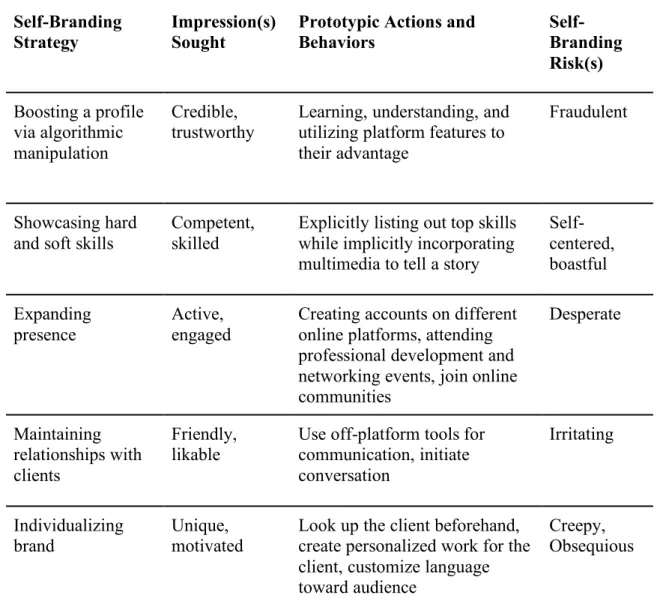
Appendix for Jones & Pittman’s original table) (Jones & Pittman, 1982). Table 3 outlines
the five branding strategies we observed, along with a proposed taxonomy of
self-branding strategies for digital workers.
Self-Branding
Strategy Impression(s) Sought Prototypic Actions and Behaviors Self-Branding Risk(s)
Boosting a profile via algorithmic manipulation
Credible,
trustworthy Learning, understanding, and utilizing platform features to their advantage
Fraudulent
Showcasing hard and soft skills
Competent, skilled
Explicitly listing out top skills while implicitly incorporating multimedia to tell a story
Self-centered, boastful Expanding presence Active, engaged
Creating accounts on different online platforms, attending professional development and networking events, join online communities Desperate Maintaining relationships with clients Friendly, likable
Use off-platform tools for communication, initiate conversation
Irritating
Individualizing
brand Unique, motivated Look up the client beforehand, create personalized work for the client, customize language toward audience
Creepy, Obsequious
5.2.1 Boosting a Profile via Algorithmic Manipulation
One of the most common strategies mentioned was one that involved building and
growing a positive reputation on the platform via working with and around algorithmic
management of the rating systems. Most freelancers responded that when first starting
out, they performed various work-arounds to quickly boost their profile visibility on the
website (i.e. in the recommended workers list that clients see). Prototypic actions of this
strategy include learning and understanding the platform, its algorithm, and features for
maximized profile visibility.
The impressions sought from working around the system included wanting to
seem credible and trustworthy to potential clients, traits clients expressed wanting to have
in a worker. However, if this strategy is pursued too vigorously, the freelancer could
potentially risk seeming like a fraudulent account, a scammer, and/or an Internet bot if
the client does not necessarily believe these reviews to be true. For example, one client
(C2) questioned whether they are “actually communicating with the person who’s doing
the work,” because they sometimes “get the feeling [they’re] communicating through an
intermediary.” And while we found that freelancers were fairly curious about the
feedback they received from their clients, there was consensus that they were more
concerned with getting top scores in order to maintain a competitive advantage, rather
than truly wanting constructive feedback.
One of the most common workarounds was finding and taking up jobs they felt
confident in — usually for cheap. In this same instance, we also observed a shift in the
client in search for smaller jobs. F15 gives an example of how they secured their first job
— and first five-star rating — in a way that was mutually beneficial to themselves, as
well as their client:
...A lot of people feel that they charge a really low rate to get started, but what I did was I went and set my rate higher, and then I went and I specifically looked for people who were new on the platform too who needed something short — something quick that I could hammer out in a day. So, my first job was I [sic] wound up rewriting somebody’s about me page for the company that they were starting. I did it in one afternoon. I think I got paid like $25 or something ridiculously low, but it got me my first completed job and first five-star review.
F5 reiterated a similar idea of taking on projects that are short-term, cheap, and
small in order to build a positive reputation on the site. F5 also noted that it became easier
to find jobs after the first initial ones were completed (a process which again required
more effort on the freelancer side):
Go in cheap, start off cheap, start getting small projects. Do the little one- and two-hour ones, get them knocked out — especially if you can get them done pretty quickly . . . Get it turned around in less than three days and those usually will be something that gets you at least a good rating. As long as you have a rating and you’re starting to get some of those, and you get more, and they’re not bad, it’s easier to start getting things a little bit bigger, a little bit bigger, a little bit bigger and at that point you can turn around and start raising your rate.
Conversely, platform work-arounds like lowering rates also reflected a larger problem
within the freelance economy. F1 believed that “not charging enough for [a freelancer’s]
service . . . devalues the rest of us and it devalues art and design . . . I see it all the time
and it breaks my heart.”
On another note, Upwork’s ranking algorithm for suggesting the relevancy of
freelancers given a specific query is more complicated than simply going by one’s job
success score and rating. When asked about their knowledge on what brings a profile up
know. Their unfamiliarity could potentially explain why we saw such a large focus on the
visible metrics since those were more apparent to a user. And because of this lack of
transparency, many freelancers had negative reactions to the algorithm (e.g. F1 used
adjectives like “horrible” and “terrible” to describe it). All the while, F7 mentions that the
rating as being an important aspect of their Upwork profile, suggesting that their 100%
job success score and top-rated status helped their profile “get bumped up to the top”
when applying for projects.
Lastly, one significant finding regarding freelancers wanting to algorithmically
boost their profile to the top included a strategy of personally reaching out to clients after
completing a job. In many cases, Upwork freelancers mentioned that they would
periodically remind clients who they felt they had a positive experience with to leave
them a review, yet they would forego this action if they had a negative experience with
them. Some freelancers even decided that if they were in a situation where they feared a
client would leave them a bad review, they would turn to tactics like negotiation (e.g. F6
said “instead of trying to fight with [the client], I just said ‘Fine, I’ll refund your money’
because I don’t want to risk getting negative feedback on my profile).
5.2.2 Showcasing Skills
A second emerging theme throughout the interviews was an emphasis on
showcasing hard and soft skills to clients — both implicitly and explicitly. Second to
Upwork’s rating and job success score, skills seemed to be the primary way clients
searched for freelancers on the platform. Many clients, like C2, said that they would start
occurred by using keywords or Upwork’s filtering tool. Prototypic behaviors freelancer’s
took for showcasing their skills included listing their self-perceived top technical skills
(e.g. programming, design) on their profile while also incorporating multimedia (mostly,
but not limited to text) to showcase their soft skills (e.g. communication, work ethic). In
both cases, this was observed both implicitly and explicitly as the workers attempted to
give off an impression of being competent and skilled in specific areas. One caution with
this self-presentation strategy, however, is that too much showcasing could potentially be
perceived by clients as boastful and self-centered (i.e. being a “show-off”) and therefore
could minimize gig opportunities.
We found that most of the freelancers we interviewed had personal portfolios of
their work they created to explicitly showcase their technical skills (this was more
common in creative fields like design and art). For example, one freelancer (F15) who
takes on diverse gigs (including copywriting, branding, event planning, and graphic
design) told us how they strategically showcase writing on their portfolio; in this case,
instead of simply showing examples of work, they showed the impact they had on
previous clients. F15’s portfolio strategy acts much like a traditional CV where workers
are encouraged to quantitatively highlight their strengths; although F15 utilizes digital
tools (i.e. screenshots) to showcase their influence.
F10, a voice artist, also explained how they showcase their multimedia skills on their
personal website:
I have a website … It features several videos I’ve done. It also features a couple links to different sound cloud files that I’ve worked on. I also if I happen to content them via e-mail I’ll just send them an MP3 of my demo.
One client, C8, noted that when hiring, past background experience did not
necessarily help a candidate stand out when there are many others who also possess a
relevant background. And that instead, portfolios which showed technical skills in
practice were ways people could highlight their strengths. Calling this idea “marketing
101,” C8 explained how understanding one’s competitive advantages must be showcased:
I could care less about what the educational background is . . . If I’m hiring a web designer I don’t care, show me your websites you’ve done . . . Show me your logo’s. I had somebody who had, no, not even a grade 12 education, somebody who had a degree from a university in web design and I liked the portfolio from the guy who didn’t even finish high school; that’s the guy I’m going with. So, the portfolio is critical and most people don’t put any time in their portfolio. So, the writing has to be there in the portfolio.
In addition to personal portfolios, other ways freelancers showcased their hard
skills included utilizing different Upwork features — such as the “skills” section which is
dedicated to test results in different subject areas. There was evidence, however, that
freelancers were somewhat skeptical of Upwork’s skills list on a user’s profile; in most
cases, freelancers who decided to showcase skills did so primarily to have a complete
profile. F18 said that they completed the sections when first joining Upwork as part of the
profile-building process: “I started taking the Upwork tests, that was the first thing I did .
. . to complete my profile as much as I can basically.” F4 also suggested that filling out
the skills section and completing quizzes/tests and certificates would be a good way to