THE GENETICS OF ADAPTATION IN DROSOPHILA SECHELLIA
Eric Jay Earley
A dissertation submitted to the faculty of the University of North Carolina at Chapel Hill in partial fulfillment of the requirements for the degree of Doctor of Philosophy in the
Department of Biology (Molecular, Cellular, and Developmental).
Chapel Hill 2013
Approved by,
Dr. Stephen Crews
Dr. Corbin D. Jones
Dr. Joel Kingsolver
Dr. Pelin Cayirlioglu Volkan
ABSTRACT
ERIC JAY EARLEY: The Genetics of Adaptation in Drosophila sechellia (Under the direction of Dr. Corbin D. Jones)
Drosophila sechellia, an ecological specialist on the ripe fruit of Morinda
citrifolia (Morinda), displays a suite of adaptations which allow it to both prefer and
tolerate Morinda and its toxic compounds. Other Drosophilids, like D. melanogaster, find
Morinda repellent and toxic. Despite years of effort to dissect the genetic basis of this
behavioral and physiological divergence, we still do not understand what genes allow D.
sechellia to prefer and tolerate Morinda and what genes drive aversion in other species.
In this dissertation I dissect the genetic basis of preference and tolerance using both
traditional genetic and molecular tools along with new whole genome sequencing
methods. I find that preference is genetically complex (Chapter Two), requiring up to 27
different genetic loci (Chapter Three). At the same time, however, a gene expressed in
the fly’s peripheral nervous system, gustatory receptor 22c, Gr22c, is responsible for
nearly 50% of the transition between aversion and preference (Chapter Four).
Surprisingly, extant D. sechellia Gr22c is likely a pseudogene, suggesting that preference
evolution proceeded in two steps: loss of aversion then gain of preference. Finally, I,
along with collaborators, introgress D. sechellia Morinda tolerance factors into a D.
simulans genome and identify 17 candidate genes, among then three Odorant binding
would evolve to be genetically linked. In sum, this dissertation shows that the genetic
basis of D. sechellia specialism on Morinda is complex and suggests that the evolution of
preference and tolerance occurred in multiple steps: loss of aversion, gain of tolerance,
ACKNOWLEDGEMENTS
This work would not have been possible without the extraordinary help of so many
people. First, thanks to my adviser Corbin Jones for his time, energy, and passion. Thank
you for the journal clubs, lab meetings, and cheap beer. For the hundreds of hours of
practice talks, manuscript edits, meetings, working groups, and – most importantly – the
flies.
Thanks to all my lab mates (and recent pod mates) who have listened to me bitch, given
edits on writing, listened to practice talks, consulted on projects, and generally enhanced
my work, in particular Anais Monroy, Alicia Brandt, and Sophia Shih. Thanks especially
to Josie Reinhardt, Cass Jabara, and Artur Romanchuk who have helped me in so many
tangible and intangible ways.
Thanks to my amazing undergraduate assistants, Brooke Wolford and Betty Wanjiru, for
their tireless help, and thanks to my collaborator Eric Hungate for letting work on his
great project.
This work would not have been possible without funding from the National Science
Foundation (Pre-Doctoral Fellowship and NSF#MCB0920196) and NIDDK grant
TABLE OF CONTENTS!
LIST OF TABLES...ix!
LIST OF FIGURES...x!
LIST OF ABBREVIATIONS AND SYMBOLS...xii!
I. INTRODUCTION...1
II. NEXT-GENERATION MAPPING OF COMPLEX TRAITS WITH PHENOTYPE-BASED SELECTION AND INTROGRESSION...22!
ABSTRACT ...22!
INTRODUCTION...23!
MATERIALS AND METHODS ...24!
RESULTS...29!
DISCUSSION ...34!
REFERENCES...37!
III. HIGH RESOLUTION GENETIC ANALYSIS OF THE DIFFERENCE IN HOST PREFERENCE BEHAVIOR BETWEEN DROSOPHILA SIMULANS AND D. SECHELLIA...44!
ABSTRACT ...44!
INTRODUCTION...45!
MATERIALS AND METHODS ...47!
RESULTS...51!
REFERENCES...63!
IV. FIRST STEP TO SPECIALISM: PSEUDOGENIZATION OF A GUSTATORY RECEPTOR WAS KEY INNOVATION DURING EVOLUTION OF SUPERSPECIALISM IN DROSOPHILA SECHELLIA...72!
ABSTRACT ...72!
RESULTS/DISCUSSION ...73!
MATERIALS AND METHODS ...86!
REFERENCES...89!
V. LOCUS IN DROSOPHILA SECHELLIA CONTRIBUTING TO TOLRANCE OF A HOST PLANT TOXIN DOES NOT AFFECT HOST PREFERENCE...98!
ABSTRACT ...98!
INTRODUCTION...99!
MATERIALS AND METHODS ...103!
RESLUTS...108!
DISCUSSION ...115!
REFERENCES...125!
VI. CONCLUSIONS...138!
REFERENCES...145!
APPENDIX A: SUPPLEMENTARY MATERIAL FOR CHAPTER TWO...147!
APPENDIX B: SUPPLEMENTARY MATERIAL FOR CHAPTER FOUR...148!
LIST OF TABLES
3.1 Count of loci across studies, biological and technical replications ... 69!
3.2 Regions with significantly high D. simulans SNP content in the current study ... 70!
3.3 Chemosensory disruption results in D. melanogaster... 71!
5.1 Welch's t-test P-values for comparisons of KD50 between lines and sexes ... 138!
5.2 Wilcox rank-sum tests... 138!
C.1 KD50 values for D. sim, High 10, and Low 10 for both sexes ... 162!
C.2 Mean KD50 for males for 36 recombinant lines of unknown tolerance... 163!
C.3 Gene ontology of genes in tolerance region... 165!
C.4 Number of non-synonymous and syntenic sites for genes... 166!
LIST OF FIGURES
2.1 Fifteen generations of introgression show D. simulans enrichment for six regions
across autosomes... 40!
2.2 Mean size of candidate chromosomal region... 41!
2.3 Ability to detect D. simulans enrichment with dynamic binning ... 42!
2.4 Dynamic binning on 2R ... 43!
3.1 Creating hybrid introgressions and informatic pipeline... 66!
3.2 Genome map of introgression break points ... 67!
3.3 Independent backcross testing specific D. simulans regions ... 68!
4.1 Wild-type behavior of Drosophila towards Morinda and its compounds ... 94!
4.2 Tarsal taste necessary for OA:HA aversion... 95!
4.3 Gr22c necessary for OA:HA aversion... 96!
4.4 Gr22c locus confers oviposition avoidance in D. melanogaster and hybrids ... 97!
5.1 Description of OIL genotypes and the cross to construct additional recombinants . 131! 5.2 Map of CAPS markers ... 132!
5.3 Diagram of OA tolerance test setup... 133!
5.4 OA tolerance for gold standard and 36 unknown lines... 134!
5.5 M. citrifolia tolerance assay... 135!
5.6 Tolerance alleles in the 18-gene region do not affect behavior in heterozygotes... 136!
5.7 D. sechellia recessive alleles have no effect on behavior... 137!
B.1 Confirmations of Orco disruptions ... 148!
B.2 RAL437 behaves similarly to other RAL lines on alternate chemicals... 149!
B.3 RNAi on Gr22c using a Gr22c-GAL4 driver ... 150!
B.5 Gr22c loss does not affect Morinda tolerance ... 152!
C.1 Plot of cumulative distribution of OA tolerance of all replicates ... 158!
C.2 Comparison of flow rate on tolerance... 158!
C.3 Plot of cumulative distribution of OA tolerance... 159!
C.4 Cumulative distributions of percent knockdown over time for males ... 160!
LIST OF ABBREVIATIONS AND SYMBOLS
Morinda: Morinda citrifolia fruit
OA: Octanoic Acid
HA: Hexanoic Acid
MeHex: Methyl hexanoate
bp: base pair
GFP: Green fluorescent protein
SNP: Single nucleotride polymorphism
Indel: Insertion/deletion
Or: Olfactory receptor
Gr: Gustatory receptor
Obp: Odorant binding protein
Ir: Ionotropic receptor
Orco: Odorant co-receptor
poxn: pox-neuro
PSIseq: Phenotype-based Selection and Introgression with Whole genome sequencing
ORN: Olfactory receptor neuron
I. INTRODUCTION
Animals live in a world of chemicals. To find mates, food, and avoid life
threatening situations, animals must process information from chemical signals into
action. At the simplest level, toxic chemicals should be avoided, and beneficial chemicals
should be preferred. Innate behaviors, those controlled primarily by genetic factors,
ensure that organisms respond appropriately to novel chemicals with minimal risk. This
is especially relevant for organisms that must chose regularly between beneficial and
toxic food resources.
While we are beginning to understand how animals sense their chemical world
and how chemical information is translated into electrical information within the brain
(MONTELL 2009; SU et al. 2009; TOUHARA and VOSSHALL 2009), we do not yet
understand how this information ultimately transforms into a behavior. More broadly, we
do not know why some organisms prefer specific chemicals while others avoid them.
What suite of genetic changes must occur for an individual to avoid or prefer? Is this
transition genetically easy, or does it require many genetic modifications? An ideal
system to study this question would be a group of related species with members
expressing clear preference and clear avoidance of a specific chemical(s), and is
amenable to genetic dissection.
two species are closely related (~0.5 MYA since most recent common ancestor (KLIMAN
et al. 2000) and exhibit clearly divergent behavior toward the ripe fruit of Morinda
citrifolia (Morinda, (AMLOU et al. 1998a; LEGAL et al. 1992; R'KHA et al. 1991). D.
sechellia prefers Morinda and has evolved a suite of behavioral and physiological
adaptations that enable it to consume and oviposit upon it (JONES 2005). D. simulans, on
the other hand, avoids Morinda and finds it highly toxic (AMLOU et al. 1998a; AMLOU et
al. 1998b; JONES 1998; R'KHA et al. 1991). This divergence appears to be driven in part
by toxic fatty acids, Octanoic acid (OA) and Hexanoic acid (HA), abundant in Morinda
(AMLOU et al. 1998a; FARINE et al. 1996; HIGA and FUYAMA 1993; PINO et al. 2010).
Both fly species are also close relatives of D. melanogaster, which behaves like D.
simulans, and provides access to an array of genetic, molecular, and cellular tools.
Finally, all three species possess fully sequenced and annotated genomes (CLARK et al.
2007).
In the 30 years since its discovery (TSACAS and BACHLI 1981) studies of D.
sechellia have shed some light on the genetic basis of its specialism on Morinda, yet there
are gaping holes in our knowledge (RAMDYA and BENTON 2010; WHITEMAN and PIERCE
2008). We do not yet know, for example, what specific genetic modifications allowed the
transition from Morinda aversion to Morinda to preference. Given Morinda’s toxic
potential for non-sechellia species, we do not know if behavior toward Morinda is
genetically linked to or a pleiotropic consequence of tolerance of Morinda. Finally, we
would like to identify general patterns in this genetic transition, if any exist. That is,
(deletions, duplications, etc.) and should we expect certain classes of genes to evolve
more than others (e.g., genes functioning in the peripheral or central nervous system)?
Combining all that we know about D. sechellia preference and tolerance for
Morinda, we can begin to test hypotheses on how the transition toward specialism took
place. In the current work, I propose three. First, behavioral specialism in D. sechellia
involves multiple genes but not many genes of infinitesimally small effect size.
Additionally, tolerance and preference are genetically correlated and likely require
separate loci. Second, the evolution of D. sechellia specialism likely took place in a
step-wise manner. Preference and tolerance appears to have evolved separately, and
preference itself likely evolved in multiple steps—i.e. ancestral and aversive D. sechellia
evolved indifference for Morinda followed by subsequent gain of preference. Third, D.
sechellia possesses an unusually large number of pseudogenes (MCBRIDE 2007;
MCBRIDE et al. 2007), and that some of these loss of function mutations contributed to
specialized preference and are not simply a consequence of specialism itself.
Natural history
Drosophila sechellia is an island endemic species of the Seychelles archipelago, a
granitic island chain off the coast of east Africa. D. sechellia is found throughout the
archipelago, including Mahé, Frigate, Praslin, and Cousin islands, consuming and
ovipositing upon ripe fruit of Morinda citrifolia (Morinda, (TSACAS and BACHLI 1981).
While humans may have visited the islands much earlier, permanent settlement did not
occur until roughly 400 years ago, and with them arrived many alien species of animals
from its close relative D. simulans—on the islands long before humans arrived (KLIMAN
et al. 2000).
D. sechellia’s host plant, Morinda, is found throughout the archipelago as well as
across the entire southeastern Pacific and Indian Ocean (BAKER 1970; ROBERTSON 1989;
SAUER 1967). Its seeds can survive on salt water for more than a year, so Morinda may
have floated from other locales. However, some controversy exists over its colonization
on the Seychelles. Lachaise and Silvain (LACHAISE and SILVAIN 2004) argue that
Morinda was most likely introduced recently by humans and that D. sechellia could have
evolved its specialist lifestyle on chemically related plants (e.g., species within the
Pandanus genus or coconuts) and shifted to Morinda after its introduction. If Morinda
was not the original host for D. sechellia’s evolved specialism, we can at least be sure
that D. sechellia evolved preference and tolerance for the specific chemicals that are
abundant in Morinda..
D. sechellia specialization of Morinda and/or its chemicals could have been
driven by a number of genetic and ecological factors. Given the high rate of gene loss in
its genome (CLARK et al. 2007; MCBRIDE 2007), and the paucity of genetic variation
across its range (LEGRAND et al. 2009), ancestral D. sechellia, like other island endemic
species, probably experienced a severe genetic bottleneck during colonization. Today D.
sechellia’s range includes a number of sympatric non-specialist Drosophila, including D.
simulans and D. malerkotliana (LOUIS and DAVID 1986; R'KHA et al. 1997). These
species are strong competitors. One model of adaptive radiation on islands is that founder
populations diverge allopatrically from mainland populations, evolving intrinsic
onto the island facilitates adaptive character displacement between these two groups
since gene flow is reduced or absent (LOSOS and RICKLEFS 2009). Thus, competition with
other species could have contributed to character displacement in nascent D. sechellia
and pushed it to consume non-optimal food sources. If this food was only weakly toxic –
or toxic for a short time – then its caloric benefit could have outweighed the risk of lethal
exposure. Other ecological drivers of specialism could have also included escape from
predators, such as the parasitoid wasp Leptopilina boulardini (LOUIS and DAVID 1986).
By ovipositing on toxic Morinda, female D. sechellia could have ensured an
“enemy-free” environment.
D. sechellia is resistant to Morinda and its toxins
Morinda fruit have a distinctive smell and are avoided by other Drosophilids
(DEKKER et al. 2006; JONES 2005; R'KHA et al. 1991). Gas chromatography of Morinda
headspace at various ripening stages identified 96 volatile compounds emanating from
the fruit, including organic acids, alcohols, esters, ketones, and lactones (FARINE et al.
1996; PINO et al. 2010). However, the most abundant of Morinda volatiles are Octanoic
and Hexanoic Acids (OA, 58-70% and HA, 8-19%) and their ester derivatives, and these
components give Morinda its characteristic “rancid cheese” smell. Ripe M. citrifolia fruit
has the highest concentration of these acids and is highly toxic to Drosophilids except D.
sechellia (JONES 2005; R'KHA et al. 1991). OA and HA are the main causes of the
toxicity (AMLOU et al. 1998a). However, this toxic effect appears limited to just a few
days after dropping from its tree. Pre-ripe (green) and rotten fruits (dark brown) are not
D. sechellia is tolerant of Morinda and its predominant toxic compounds, OA and
HA (AMLOU et al. 1998a; AMLOU et al. 1997; JONES 1998; JONES 2005; LEGAL et al.
1994; LEGAL et al. 1992; LEGAL et al. 1999; R'KHA et al. 1991). Other Drosophilids,
among them D. melanogaster, D. simulans, and D. mauritiana, are sensitive to Morinda
and OA in particular. Both sensitivity and tolerance are consistent throughout all life
history stages.
Adult Tolerance
Sensitivity studies of flies exposed either directly to Morinda, indirectly via its
vapor, or pure OA have shown non-sechellia flies are knocked down (a prelude to death)
within 30 minutes, whereas D. sechellia remains unaffected for the duration of tests
(JONES 1998). The physiological effects of Morinda and its compounds are currently
unknown. Flies exposed to Morinda or OA exhibit stereotypical symptoms –
hyper-grooming, loss of equilibrium, and finally irreversible coma – which resemble the effects
of neurotoxins (LEGAL et al. 1992).
Interestingly, while D. sechellia is highly tolerant of OA, HA, and Morinda, it is
less tolerant of common rotten fruit volatiles, including ethanol (MERCOT et al. 1994).
This is surprising, given that Drosophilids in general have evolved a saprophagous diet
and often prefer volatiles associated with rotten fruit. D. sechellia is thus unusual in that
it appears to have evolved preference and tolerance for a ripe fruit, that is only available
during a narrow time frame. This may explain why D. sechellia preference is so sensitive
Early genetic studies of D. sechellia tolerance to Morinda and its compounds
discovered that tolerance is dominant in interspecific hybrids (AMLOU et al. 1997) and
biometric analysis estimated at least three genetic factors were involved (R'KHA et al.
1991). More recent studies have relied upon marker assisted backcross experiments with
visibly marked D. simulans. Jones (1998) first reported that D. sechellia OA tolerance
was oligogenic and factors were present across all major chromosomes. At least two
factors were present on the X, one on the 2nd, and the two strongest factors near the centromere of the 3rd, with epistatic interactions present between all chromosomes.
Larval Tolerance
D. sechellia larvae tolerate Morinda toxins, while eggs and larvae of other
Drosophilids are highly sensitive (JONES 2005; R'KHA et al. 1991). Initial work by
AMLOU,MORETEAU,andDAVID (AMLOU et al. 1998b) investigating the genetic basis of
OA and HA tolerance discovered that D. simulans, D. melanogaster, and D. mauritiana
all exhibited delayed larval development at low doses of OA and HA, whereas D.
sechellia development was only affected at higher concentrations. The authors also found
evidence that D. sechellia tolerance was recessive; however, previous work by others had
shown that tolerance was dominant (R'KHA et al. 1991). One explanation for this
discrepancy is that AMLOU,MORETEAU,andDAVID (AMLOU ET AL.1998B) only used D. simulans mothers in their crosses, allowing for the possibility that maternal effects were
blocking dominant zygotic tolerance. JONES (2001) accounted for this effect by repeating
chromosomes. In this case, D. sechellia tolerance was semi-dominant and did involve a
maternal effect.
JONES (2001) also dissected the genetic basis of larval tolerance in finer detail.
Using 11 genetic markers and reciprocal hybridization with D. simulans, the author found
tolerance to be oligogenic with no effect of the fourth or X chromosomes. The third
chromosome harbored at least one intermediately dominant factor, and the second
chromosome harbored at least two mostly dominant factors. These factors are likely a
subset of those important for adult resistance.
Chemotaxis and Oviposition Behavior
In addition to its tolerance to Morinda, D. sechellia has also evolved high
sensitivity and preference for Morinda (R'KHA et al. 1991) and its compounds (AMLOU et
al. 1998a; DWORKIN and JONES 2009; EARLEY and JONES 2011; MATSUO et al. 2007).
Other Drosophilids actively avoid ripe Morinda and several of its constitutive compounds
(AMLOU et al. 1998a; EARLEY and JONES 2011; LEGAL et al. 1992; MATSUO et al. 2007;
R'KHA et al. 1991). The common ancestor between D. simulans, D. mauritiana, and D.
sechellia was probably aversive to Morinda. How ancestral aversion evolved to
preference, and what genetic mechanisms drove this transition, remains an unanswered
question.
Work in the last 20 years has begun to uncover potential genetic drivers of the
transition between aversion and preference. Early studies showed that D. sechellia
preference for Morinda was recessive within interspecific hybrids with D. simulans
with D. simulans posessing visible markers uncovered one locus on the second
chromosome controlling behavior to HA (HIGA and FUYAMA 1993). A similar study of
OA on egg laying behavior also using a backcross with D. simulans, but this time with
more markers, discovered a locus on the left arm of chromsome two and the right of
chromosome three (JONES 2005). No study found any effect of the X chromosome.
Role of Chemosensory System in the Behavior of D. sechellia.
The genetic basis of how D. sechellia finds and chooses Morinda or how D.
melanogaster avoids this fruit remains unknown. A fly’s chemosensory system, however,
is a promising starting point for finding genes influencing D. sechellia’s behavior
(RAMDYA and BENTON 2010; WHITEMAN and PIERCE 2008). The past two decades have
provided new insight into the molecular and genetic mechanisms of Drosophila olfactory
and gustatory response (BENTON et al. 2009; MONTELL 2009; VOSSHALL and STOCKER
2007). Fly chemosensation is first processed by sensory neurons for taste (gustatory
receptor neurons, GRNs) or smell (olfactory receptor neurons, ORNs) which are housed
within sensory hairs (“sensilla”), scattered across the fly’s antennae, proboscis, maxillary
palps, legs, wings, and ovipositor. These neurons express seven-pass transmembrane
receptor proteins which bind chemicals. These molecular receptors are coded for by three
families of genes: Olfactory receptors (Ors), Ionotropic receptors (Irs, another set of
olfaction genes), and Gustatory receptors (Grs). A fourth class of proteins, Odorant
binding proteins (coded by Obps), appear to aid in the transport of organic chemicals
through the aqueous lymph surrounding the sensory receptor neurons and enhance the
neural signals are transmitted to the brain via the antennal lobe (olfaction) or the
suboesophageal ganglion (SOG, gustation). ORNs expressing the same receptor type
transmit signal to the same glomerulus within the antennal lobe. GRNs, however,
transmit signal to a variety of locations scattered across the SOG. From these regions,
taste and smell signals are transmitted into higher order brain neurons and processed
ultimately into behavior in ways not fully understood.
Recent work by a number of groups have mapped Morinda behavior genome
wide, queried specific genes, and have identified specific olfactory and gustatory
responses elicited by Morinda in D. sechellia. STENSMYR et al. (2003) and DEKKER et al.
(2006) identified specific antennal sensilla which respond neurophysiologically to
Morinda vapor. D. sechellia is 10 times more sensitive to the Morinda volatile methyl
hexanoate relative to D. melanogaster. The ab3A type sensilla, located on the antennae,
respond to methyl hexanoate (MeHex), and D. sechellia has an unusually large number of
these sensilla relative to D. melanogaster. Supporting this model, experiments genetically
perturbing the numbers and types of sensilla using alleles of lozenge (lz) affect how D.
melanogaster responds to OA (JONES 2007). Similarly, the glomerulus receiving signal
from these neurons is also enlarged in D. sechellia (IBBA et al. 2010). It appears that D.
sechellia is hypersensitive to methyl hexanoate, and hence Morinda, because of this
morphological transition.
However, several complications of this model prevent it from completely
explaining D. sechellia preference for Morinda. D. simulans, which is strongly aversive
to Morinda, also harbors ab3A sensilla which are highly sensitive to methyl hexanoate
to respond to methyl hexanoate in D. melanogaster (HALLEM and CARLSON 2006), but
their differential expression across species cannot fully explain Morinda behavior. Or22a
is upregulated in both D. simulans and D. sechellia relative to D. melanogaster (which
itself has highly variable expression uncorrelated with ab3A density), and the combined
high expression of Or22a and Or85b in D. sechellia should promote heightened
sensitivity to ethyl-hexanoate rather than methyl-hexanoate (KOPP et al. 2008), but this is
the opposite of what is observed (STENSMYR et al. 2003). Direct genetic tests, for
example by knockouts of Or22a and Or85b within D. sechellia itself, are needed to know
for sure whether these genes actually mediate preference.
MATSUO and colleagues (MATSUO et al. 2007) through direct genetic tests
discovered that a coexpressed pair of odorant binding proteins, Obp57d/e, mediated
oviposition behavior to OA and HA in D. melanogaster. D. sechellia’s ortholog
(Dsech/Obp57d/e) harbors a 4bp insertion just upstream of the shared Obp57d and
Obp57e transcription start site relative to other members of the D. melanogaster species
complex, and this insertion appeared to disrupt expression of Dsech/Obp57d/e, but only
in the tarsi. D. melanogaster females with knocked-in Dsech/Obp57d/e preferred
ovipositing on high concentrations of HA and OA, a similar preference in D. sechellia.
Given its presumed role as a chemical chaperone (GALINDO and SMITH 2001), OBP57d/e
could act as a facilitator to nearby chemosensory receptors and enhance sensitivity to
Morinda compounds.
In parallel with the anotomaical and gene-specific search above, multiple studies
have correlated patterns of molecular evolution with D. sechellia preference. MCBRIDE
chemosensory genes – almost 10 times faster than D. simulans. Given its small
population size, D. sechellia could have many pseudogenes because of genetic drift, but
the rate of chemosensory pseudogene fixation in D. sechellia is significantly higher than
its non-chemosensory genomic background. Chemosensory genes in D. sechellia also
show signatures of positive natural selection relative to the genome average. Grs in
particular appear to be evolving faster than Ors in D. sechellia. Compared to D. simulans,
D. sechellia has more Gr pseudogenes than Or pseudogenes (17.8% vs. 9.5%) and mean
Ka/Ks ratios, a test for positive selection, increased by 94% in Grs compared to only 67%
increase in Ors. Thus, evidence points to positive selection acting on both Ors and Grs
within D. sechellia, although recent relaxation of selection could also explain these
patterns. In a separate study MCBRIDE and ARGUELLO (2007) expanded their focus to
more species, including another specialist D. erecta, which specializes seasonally on
members of the Pandanus family (LACHAISE and TSACAS 1974). D. erecta also
experienced an increased rate of Gr family contraction, and both D. sechellia and D.
erecta show strong signatures of positive selection (LINZ et al. 2013). Ka/Ks in larval
expressed Ors are higher than expected, and Ka/Ks is particularly high within specialist
lineages in Grs responding to sweet compounds compared to Grs responding to bitter
compounds.
DWORKIN and JONES (2009) measured whole genome expression differences
between D. simulans and D. sechellia both before and after being exposed to Morinda
compounds (OA/HA mixture). A variety of chemosensory genes were strongly up- and
down-regulated in D. sechellia relative to D. simulans including Or22a (up in D.
D. sechellia). These results match the over representation of ab3A sensilla in D.
sechellia, as both Or22a and Or85b are expressed within these sensilla in D.
melanogaster. Obp56e was particularly interesting for a few reasons. It was down
regulated in D. sechellia relative to D. simulans, but after exposure to Morinda
compounds its expression increased significantly in D. sechellia. This pattern is
surprising given that Obp56e in D. sechellia is likely a pseudogene as it harbors a stop
codon roughly 50% through its open reading frame relative to D. simulans. When
Obp56e was knocked down in D. melanogaster, flies lost some aversion to Morinda
compounds. How a putative pseudogene could influence D. sechellia preference is not
clear. One possibility is that the shared ancestor of D. melanogaster and D. sechellia used
up-regulation of Obp56e to avoid Morinda-like plants emiting OA or HA and a deletion
leading to a premature stop codon in the D. sechellia lineage shut this aversive process
down, and remnant up-regulation of Obp56e in D. sechellia remains despite the protein’s
putative loss of function.
Combining all findings to date, we are beginning to piece together the
evolutionary history of D. sechellia and its behavioral adaptation toward Morinda fruit.
The trait involves at least a handful of genes, two of which are are known—Obp57d/e
and Obp56e. Loss of the activity of these genes in D. sechellia’s progenitor likely
contributed to the reduction of ancestral aversion of Morinda. However, neither of these
genes alone, or presumably in combination, appears sufficient to remove aversion in D.
melanogaster or reconstitute D. sechellia like preference. Similarly, while the
morphological evolution of ab3A sensilla in D. sechellia could contribute to D.
It must also be noted that specializing on Morinda must have required a suite of
traits, including behavioral preference and physiological tolerance. Any behavioral
adaptation toward Morinda in adults must have required eggs and larvae to survive on the
fruit. One of two conditions could have allowed this: pre-existing tolerance for octanoic
acid in eggs and larvae or behavioral indifference in adults manifested only toward
over-ripe Morinda which was not toxic to eggs and larvae.
Evolution to Preference: One step or two?
How many mutations were initially needed to transition from aversion to
preference? The simplest model predicts one mutation. While unlikely, this model is not
outside the realm of possibility. At least two separate transgenic experiments in mice
(MUELLER et al. 2005) and C. elegans (TROEMEL et al. 1997) show how changes in
chemosensory regulation, and where expression occurs in space, can instantly toggle
behavior between preference and aversion for the same compound. A slightly more
complicated model, involving two separate mutations, is more likely.
In the two step model (first articulated by (MATSUO et al. 2007), aversion is first
lost in D. sechellia’s ancestor, leading to behavioral indifference. If this food is not toxic
(or only mildly toxic), then indifferent flies could benefit from its consumption. Resource
competion or heavy predation load could enhance this benefit. Subsequent mutations
solifidy this benefit through gain of preference alleles (and perhaps tolerance alleles),
which then allow the fly to actively seek the unused food.
This two step model is possible in D. sechellia. Multiple Drosophila species have
al. 1991; R'KHA et al. 1997), showing that Morinda is a rich resource and accessible to
flies expressing aversion. Flies that could accommodate Morinda at earlier ripening
stages (more toxic) would gain . Similarly, flies that were able to oviposit on the ripe
fruits could ensure a safe and abundant resource for their offspring and only larvae would
have to be strongly resistant. The main difference between the one and two step models
of preference evolution is that in the two step model, tolerance could evolve within an
organism that is regularly exposed to Morinda toxin hence providing immediate benefit.
In the one step model, flies would have to either possess a pre-adapted tolerance or
evolve tolerance and preference in synchrony.
The current work
My goal is to reveal the genetic basis of host specialization in D. sechellia and
uncover whether this process required multiple genetic steps. We know that specializing
on Morinda required at least two traits - preference and tolerance – but we do not know if
these traits are controlled by the same gene, nor if they arose in multiple steps. Genetic
complexity in this system would contradict a number of studies showing that new host
specializations can evolve “easily” from changes at relatiely few loci. I show that these
two traits, preference and tolerance, are required to consume Morinda, and these traits
evolved from separate genetic factors. Preference alone likely evolved gradually in at
least two steps – loss of ancestral aversion and gain of preference. I support this model by
identifying genetic factors affecting behavior and tolerance and ruling out alternative
In Chapter Two, I present a method of mapping genome-wide the genetic basis of
additive traits. This method links classical genetic techniques – artificial selection and
backcrossing – with modern whole-genome sequencing to track in high resolution the
introgression of chromosomal elements from one background into another a known
gemomic background. I test this method by introgression D. simulans genes contributing
to Morinda aversion into a D. sechellia background and sequencing the genomes of the
the resulting flies at low coverage to map introgression break points. Results show at
least six factors contribute to aversion behavior.
In Chapter Three, I repeat this process with more biological and technical
replication and with higher sequencing coverage. I find that some regions introgress
repeatedly, while other regions introgress with more difficulty. I verify certain
introgressions by functionally testing specific genes located within introgression
breakpoints and by creating independent backcrosses of D. simulans and D. sechellia and
track the influence of D. simulans chromosomal regions on hybrid Morinda behavior. I
compliment this mapping screen with a candidate gene approach. Surprisingly, there was
little overlap between these two approaches. These results suggest that Morinda behavior
is genetically complex, likely requiring at least nine and up to 27 separate factors.
In Chapter Four, I show that D. melanogaster lacking Gustatory receptor Gr22c,
Gr22c, lose aversion. This factor explains roughly 40-50% of the behavioral transition
between aversion and preference, and a pseudogene of Gr22c is segrating in extant
populations of D. melanogaster. D. sechellia itself harbors a loss of function allele for
this gene, which suggests that loss of Gr22c could have been an intermediate step
transition to specializing on Morinda genetically complex, as seen in Chapters Two and
Three, but evolving from aversion to preference alone likely required multiple steps.
In Chapter Five I, along with my collaborators, fine-map the genetic basis of OA
tolerance within interspecific hybrids of D. simulans and D. sechellia and test whether
tolerance alone is enough to alter behavior. We identify a small candidate region of 18
genes, three of which are Obps. We show that innate tolerance to OA and Morinda does
not modify innate preference for the same chemical. This again confirms that multiple
genetic steps were necessary for D. sechellia to specialize on Morinda.
Finally, in Chapter 6, I lay out my conclusions from this series of studies and
REFERENCES
AMLOU,!M.,!B.!MORETEAU!and!J.!R.!DAVID,!1998a!Genetic!analysis!of!Drosophila! sechellia!specialization:!oviposition!behavior!toward!the!major!aliphatic! acids!of!its!host!plant.!Behav!Genet!28:!455M464.!
AMLOU,!M.,!B.!MORETEAU!and!J.!R.!DAVID,!1998b!Larval!tolerance!in!the!Drosophila! melanogaster!species!complex!toward!the!two!toxic!acids!of!the!D.!sechellia! host!plant.!Hereditas!129:!7M14.!
AMLOU,!M.,!E.!PLA,!B.!MORETEAU!and!J.!R.!DAVID,!1997!Genetic!analysis!by!interspecific! crosses!of!the!tolerance!of!Drosophila*sechellia!to!major!aliphatic!acids!of!its! host!plant.!Genet.!Sel.!Evol.!29:!511M522.!
BENTON,!R.,!K.!S.!VANNICE,!C.!GOMEZMDIAZ!and!L.!B.!VOSSHALL,!2009!Variant!ionotropic! glutamate!receptors!as!chemosensory!receptors!in!Drosophila.!Cell!136:!149M 162.!
CLARK,!A.!G.,!M.!B.!EISEN,!D.!R.!SMITH,!C.!M.!BERGMAN,!B.!OLIVER*et*al.,!2007!Evolution!of! genes!and!genomes!on!the!Drosophila!phylogeny.!Nature!450:!203M218.! DEKKER,!T.,!I.!IBBA,!K.!P.!SIJU,!M.!C.!STENSMYR!and!B.!S.!HANSSON,!2006!Olfactory!shifts!
parallel!superspecialism!for!toxic!fruit!in!Drosophila!melanogaster!sibling,!D.! sechellia.!Curr!Biol!16:!101M109.!
DWORKIN,!I.,!and!C.!D.!JONES,!2009!Genetic!changes!accompanying!the!evolution!of! host!specialization!in!Drosophila!sechellia.!Genetics!181:!721M736.!
EARLEY,!E.!J.,!and!C.!D.!JONES,!2011!NextMgeneration!mapping!of!complex!traits!with! phenotypeMbased!selection!and!introgression.!Genetics!189:!1203M1209.! FARINE,!J.!P.,!L.!LEGAL,!B.!MORETEAU!and!J.!L.!LEQUERE,!1996!Volatile!components!of!
ripe!fruits!of!Morinda!citrifolia!and!their!effects!on!Drosophila.! Phytochemistry!41:!433M438.!
GALINDO,!K.,!and!D.!P.!SMITH,!2001!A!large!family!of!divergent!Drosophila!odorantM binding!proteins!expressed!in!gustatory!and!olfactory!sensilla.!Genetics!159:! 1059M1072.!
HALLEM,!E.!A.,!and!J.!R.!CARLSON,!2006!Coding!of!odors!by!a!receptor!repertoire.!Cell! 125:!143M160.!
IBBA,!I.,!A.!M.!ANGIOY,!B.!S.!HANSSON!and!T.!DEKKER,!2010!Macroglomeruli!for!fruit! odors!change!blend!preference!in!Drosophila.!Naturwissenschaften!97:! 1059M1066.!
JONES,!C.!D.,!1998!The!genetic!basis!of!Drosophila!sechellia's!resistance!to!a!host! plant!toxin.!Genetics!149:!1899M1908.!
JONES,!C.!D.,!2001!The!genetic!basis!of!larval!resistance!to!a!host!plant!toxin!in! Drosophila!sechellia.!Genet!Res!78:!225M233.!
JONES,!C.!D.,!2005!The!genetics!of!adaptation!in!Drosophila!sechellia.!Genetica!123:! 137M145.!
JONES,!C.!D.,!2007!Genetic!ablation!of!antennae!or!basiconic!sensilla!reduces!
Drosophila*melanogaster's!ability!to!perceive!odors!from!the!fruit!of!Morinda* citrifolia.!Drosophila!Information!Service!90:!45M49.!
KLIMAN,!R.!M.,!P.!ANDOLFATTO,!J.!A.!COYNE,!F.!DEPAULIS,!M.!KREITMAN*et*al.,!2000!The! population!genetics!of!the!origin!and!divergence!of!the!Drosophila!simulans! complex!species.!Genetics!156:!1913M1931.!
KOPP,!A.,!O.!BARMINA,!A.!M.!HAMILTON,!L.!HIGGINS,!L.!M.!MCINTYRE*et*al.,!2008!Evolution! of!gene!expression!in!the!Drosophila!olfactory!system.!Mol!Biol!Evol!25:! 1081M1092.!
LACHAISE,!D.,!and!J.!F.!SILVAIN,!2004!How!two!Afrotropical!endemics!made!two!
cosmopolitan!human!commensals:!the!Drosophila!melanogasterMD.!simulans! palaeogeographic!riddle.!Genetica!120:!17M39.!
LACHAISE,!D.,!and!L.!TSACAS,!1974!Les!drosophilidae!des!savanes!preforestieres!de!la! region!tropicale!de!Lamto!(Cote!d’Ivoire).!II.!Le!peuplement!des!fruits!de! Pandanus*candelabrum!(Pandanacees).!Ann.!Univ.!Abidjan!Ser.!E!Ecol.!7:!153M 192.!
LEGAL,!L.,!B.!CHAPPE!and!J.!M.!JALLON,!1994!Molecular!Basis!of!Morinda*citrifolia*(L.):! Toxicity!on!Drosophila.!Journal!of!Chemical!Ecology!20:!1931M1943.!
LEGAL,!L.,!J.!R.!DAVID!and!J.!M.!JALLON,!1992!Toxicity!and!attraction!effects!produced! by!Morinda*citrifolia!fruits!on!the!Drosophila*melanogaster!complex!of! species.!Chemoecology!3:!125M129.!
LEGRAND,!D.,!M.!I.!TENAILLON,!P.!MATYOT,!J.!GERLACH,!D.!LACHAISE*et*al.,!2009!SpeciesM wide!genetic!variation!and!demographic!history!of!Drosophila!sechellia,!a! species!lacking!population!structure.!Genetics!182:!1197M1206.!
LINZ,!J.,!A.!BASCHWITZ,!A.!STRUTZ,!H.!K.!DWECK,!S.!SACHSE*et*al.,!2013!Host!plantMdriven! sensory!specialization!in!Drosophila!erecta.!Proc!Biol!Sci!280:!20130626.! LOSOS,!J.!B.,!and!R.!E.!RICKLEFS,!2009!Adaptation!and!diversification!on!islands.!Nature!
457:!830M836.!
LOUIS,!J.,!and!J.!R.!DAVID,!1986!Ecological!Specialization!in!the!Drosophila*
melanogaster!species!subgroup:!A!case!study!of!D.*sechellia.!Acta!Oecologica,! Oecological!Generalis:!215M219.!
MATSUO,!T.,!S.!SUGAYA,!J.!YASUKAWA,!T.!AIGAKI!and!Y.!FUYAMA,!2007!OdorantMbinding! proteins!OBP57d!and!OBP57e!affect!taste!perception!and!hostMplant! preference!in!Drosophila!sechellia.!PLoS!Biol!5:!e118.!
MCBRIDE,!C.!S.,!2007!Rapid!evolution!of!smell!and!taste!receptor!genes!during!host! specialization!in!Drosophila!sechellia.!Proc!Natl!Acad!Sci!U!S!A!104:!4996M 5001.!
MCBRIDE,!C.!S.,!J.!R.!ARGUELLO!and!B.!C.!O'MEARA,!2007!Five!Drosophila!genomes! reveal!nonneutral!evolution!and!the!signature!of!host!specialization!in!the! chemoreceptor!superfamily.!Genetics!177:!1395M1416.!
MERCOT,!H.,!D.!DEFAYE,!P.!CAPY,!E.!PLA!and!J.!R.!DAVID,!1994!Alcohol!Tolerance,!ADH! Activity,!and!Ecological!Niche!of!Drosophila!Species.!Evolution!48:!746M757.! MONTELL,!C.,!2009!A!taste!of!the!Drosophila!gustatory!receptors.!Curr!Opin!Neurobiol!
19:!345M353.!
MUELLER,!K.!L.,!M.!A.!HOON,!I.!ERLENBACH,!J.!CHANDRASHEKAR,!C.!S.!ZUKER*et*al.,!2005!The! receptors!and!coding!logic!for!bitter!taste.!Nature!434:!225M229.!
PINO,!J.!A.,!E.!MARQUEZ,!C.!E.!QUIJANO!and!D.!CASTRO,!2010!Volatile!compounds!in!noni! (Morinda!citrifolia!L.)!at!two!ripening!stages.!Ciencia!E!Tecnologia!De! Alimentos!30:!183M187.!
R'KHA,!S.,!P.!CAPY!and!J.!R.!DAVID,!1991!HostMplant!specialization!in!the!Drosophila! melanogaster!species!complex:!a!physiological,!behavioral,!and!genetical! analysis.!Proc!Natl!Acad!Sci!U!S!A!88:!1835M1839.!
RAMDYA,!P.,!and!R.!BENTON,!2010!Evolving!olfactory!systems!on!the!fly.!Trends!Genet! 26:!307M316.!
STENSMYR,!M.!C.,!T.!DEKKER!and!B.!S.!HANSSON,!2003!Evolution!of!the!olfactory!code!in! the!Drosophila!melanogaster!subgroup.!Proc!Biol!Sci!270:!2333M2340.! SU,!C.!Y.,!K.!MENUZ!and!J.!R.!CARLSON,!2009!Olfactory!perception:!receptors,!cells,!and!
circuits.!Cell!139:!45M59.!
TOUHARA,!K.,!and!L.!B.!VOSSHALL,!2009!Sensing!odorants!and!pheromones!with! chemosensory!receptors.!Annu!Rev!Physiol!71:!307M332.!
TROEMEL,!E.!R.,!B.!E.!KIMMEL!and!C.!I.!BARGMANN,!1997!Reprogramming!chemotaxis! responses:!sensory!neurons!define!olfactory!preferences!in!C.!elegans.!Cell! 91:!161M169.!
TSACAS,!L.,!and!G.!BACHLI,!1981!Drosophila*sechellia,!n.sp.,!huitieme!espece!du!sousM goupe!melanogaster!des!Iles!Sechelles![Diptera,!Drosophilidae].!Revue!Fr.! Ent.!NS:!146M150.!
VOSSHALL,!L.!B.,!and!R.!F.!STOCKER,!2007!Molecular!architecture!of!smell!and!taste!in! Drosophila.!Annu!Rev!Neurosci!30:!505M533.!
II. NEXT-GENERATION MAPPING OF COMPLEX TRAITS WITH PHENOTYPE-BASED SELECTION AND INTROGRESSION
Authors: Eric Jay Earley and Corbin D. Jones
Published in Genetics, Vol. 189, 1203-1209, December 2011
ABSTRACT
Finding the genes underlying complex traits is difficult. We show that new
sequencing technology combined with traditional genetic techniques can efficiently identify genetic regions underlying a complex and quantitative behavioral trait. As a proof of concept we used phenotype-based introgression to backcross loci that control
innate food preference in Drosophila simulans into the genomic background of D. sechellia, which expresses the opposite preference. We successfully mapped D. simulans introgression regions in a small mapping population (30 flies) with whole-genome resequencing using light coverage (~1x). We found six loci contributing to D. simulans food preference, one of which overlaps a previously discovered allele. This approach is
applicable to many systems, does not rely on laborious marker development or genotyping, does not require existing high quality reference genomes, and needs only
in contrast to more widely used mapping techniques like F2 bulk-segregant analysis, our method produces near isogenic lines that can be kept and re-used indefinitely.
INTRODUCTION
Complex traits are inherently difficult to dissect genetically. Quantitative Trait Loci (QTL) studies, Genome-Wide Association Studies (GWAS), forward- and reverse-genetics are all powerful tools; however, each technique has inherent weaknesses that limit ability to find causal loci (MACKAY et al. 2009; MANOLIO et al. 2009). New
methods using next-generation sequencing (NGS) technology have successfully captured single loci underlying Mendelian traits generated from mutagenesis screens
(BLUMENSTIEL et al. 2009; FLIBOTTE et al. 2010; LAITINEN et al. 2010; SARIN et al. 2010; SARIN et al. 2008; XIA et al. 2010; ZURYN et al. 2010); recombinant inbred lines, RILs (HUANG et al. 2009; SCHNEEBERGER et al. 2009); and backcross populations using dominant markers (ANDOLFATTO et al. 2011). However, we lack a time- and cost-effective method that maps multiple loci simultaneously without a priori knowledge of their location, number or effect size.
mapping on bulk segregant populations (MICHELMORE et al. 1991). These methods require large mapping populations to detect multiple loci of weak effect
(e.g.,EHRENREICH et al. 2010). ANDOLFATTO et al. (2011) developed a “multiplex
shotgun genotyping” (MSG) method, yet MSG also relies on large backcross populations, and it is not clear if their approach can track quantitative or additive loci of relatively weak effect or if closely linked loci can be isolated.
We have developed a new approach that efficiently maps multiple loci contributing to a complex trait. Our method uses phenotype-based selection and introgression followed by whole-genome resequencing (PSIseq). Our method can be easily scaled from rough mapping of a single small population to fine-scale mapping of large and replicated populations. With minimal replication, low cost, and few genomic resources, we can map any complex trait divergent between any two inter-fertile populations. This approach takes advantage of the statistical power of window-based mapping algorithms on NGS data (HUANG et al. 2009) and the ease of using relatively small mapping populations. Because introgression is used instead of F2 bulk segregant analysis, mapping populations can be treated as near isogenic lines and be re-used indefinitely.
MATERIALS AND METHODS Overview
The trait of interest is selected for each generation, and offspring are mated to the other parental line expressing the unselected phenotype (introgression and backcrossing). Over multiple generations of selection and backcrossing this hybrid population becomes homozygous for the majority of the unselected parent’s genome while loci from the selected parent, which contribute to the selected trait, remain. Using high throughput sequencing, we map the breakpoints of these introgressions and, therefore, map the regions harboring genes influencing the trait. This scheme is analogous to introgression based mapping approaches that use marked transposable elements or molecular markers (DESJARDINS et al. 2010; LAURIE et al. 1997; TRUE et al. 1996). A recessive trait may also be introgressed, although this would require an extra inbreeding step following each backcross.
Phenotype-based Selection and Introgression
We tested our method on a putative complex behavioral trait divergent between two Drosophila sister species: D. simulans (c167.4) and D. sechellia (SynA). D. sechellia is an island endemic and phytophagous specialist that prefers the smell and taste of Morinda citrifolia (Morinda) fruit (JONES 2005; MATSUO et al. 2007; R'KHA et al. 1991). D. simulans, avoids the fruit and dies when in proximity to it and its constituent organic acids (JONES 1998; R'KHA et al. 1991). As a proof of concept, we introgressed D.
simulans Morinda aversion behavior into the D. sechellia genome over 15 generations of backcrossing and selection. For systems with longer generation times where 10+
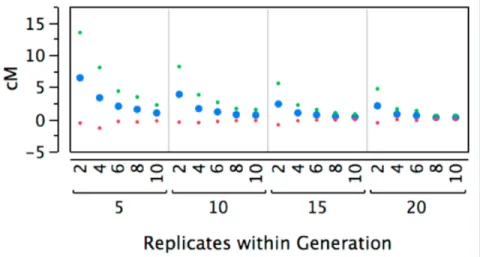
and Figure 2.2 for a discussion of how to balance replication size versus backcross generation number).
Virgin D. simulans females were mated to D. sechellia males to create a large population of fertile F1 females. These hybrids express D. simulans behavior and were backcrossed to D. sechellia males. Roughly 30 F2 females were subjected to our behavioral assay, and individuals displaying D. simulans behavior were collected and backcrossed to D. sechellia males. The assay is identical to that described in DWORKIN & JONES (2009). Briefly, octanoic (45ul) and hexanoic (15ul) acids were added to instant Drosophila media (4.1g + 22mL diH20; Carolina Biological Supply), or not, to create test and control food, respectively. Flies had 48 hrs to chose a medium. Flies settled on control media were considered D. simulans phenotype. This cycle – an assay of ~30 females then backcrossing – continued for 15 generations. The final generation was inbred for 2-3 generations to ensure that introgressed loci were mostly in a homozygous state. Thirty females were pooled for Illumina library preparation.
Introgression Mapping
We found on average one SNP per 100bp (1% divergence, compared to the reported 2% from KLIMAN et al. 2000). Because these SNPs represented genetic changes between these species, markers may have also contributed to phenotypic divergence. To create our species-specific SNP map, we aligned the D. simulans and D. sechellia
reference genome sequences (r1.3) reciprocally using BWA (LI and DURBIN 2009). Small insertion-deletion (indels) and microsatellites could also be used, though we did not use them in this study. We also showed that the genome of D. melanogaster can be used as a proxy for a reference genome and showed that SNPs distinguishing D. simulans and D. sechellia could be identified by aligning short sequencing reads from these species to the D. melanogaster reference using a high mismatch tolerance in the alignment (data not shown). In non-model systems this could be particularly beneficial. If neither parental line possessed an assembled genome or transcriptome, a closely related model-system assembly could be used.
Individual flies from this 15th generation introgression (BC15) lineage were pooled and sequenced en masse using one lane of Illumina Genome Analyzer 1.0. Sequences were deposited in the NCBI Short Read Archive (SRA) database
(SRA039418.2). High quality reads were aligned via BWA to both D. sechellia and D. simulans reference genomes (84% and 72% mapped, respectively). A mismatch call required at least two confirming reads. Hybrid-parent mismatches were correlated to our parent SNP database. All hybrid-parent mismatches also present in the parent-parent SNP database were considered true hybrid-parent-parent SNPs. Despite quality filtering hybrid-parent SNPs through these two processes (multiple confirming reads and
due to sequencing and mapping errors. To overcome this, we mapped introgression breakpoints using a window approach (as described in HUANG et al. 2009). Any individual mis-called SNP had minimal effect on our search for large-scale SNP enrichment. Every 1,000 parent-parent SNPs were considered a “bin,” and we counted the number of parent SNPs within this bin. Our null expectation was that hybrid-parent SNPs were binomially distributed within each bin. Any bin that harbored a significant enrichment of D. simulans SNPs over the chromosomal mean D. simulans SNP content was considered an introgression block member (Student’s t-test). This window approach required multiple independent significance tests, which we corrected for via a false discovery rate (FDR) calculation.
Confirmation of X Chromosome Effect
D. sechellia males with recessive genetic markers evenly spaced along the X chromosome -- zn (1-25) and f (1-56) -- were mated to D. simulans females. The resulting F1 females were backcrossed to males from the D. sechellia parent. Thus, we can distinguish D. sechellia X chromosomes from D. simulans X chromosomes. We compared the influence these two classes of chromosomes have on adult food preference using a single fly two-choice oviposition assay (MATSUO et al. 2007). Prior work has shown that bulk population assays produce similar results to individual fly assays (AMLOU et al. 1998; MATSUO et al. 2007). The single fly assay was simpler for
media (above). Preference was determined by which medium received the most eggs. All assays were conducted at 20°C with relative humidity 50-70%.
RESULTS
In our proof of concept study where D. simulans preference loci were introgressed into the D. sechellia genome over15 generations within one lineage, we found that our hybrids chose non-Morinda medium 71% of the time, comparable to D. simulans
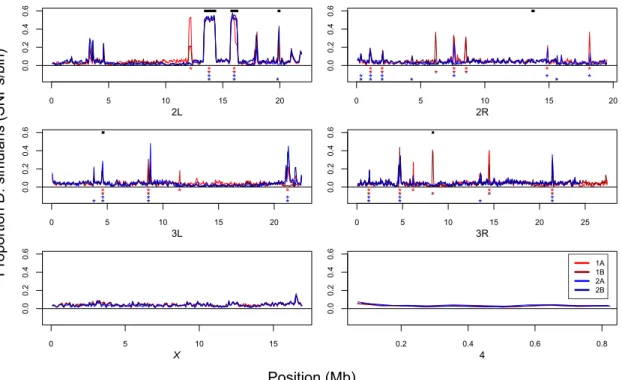
behavior (94%), and in contrast to D. sechellia (18%). We found six bins showing significant D. simulans identity (Figure 2.1; P < 0.0002). Two of these bins were relatively large (1-1.5 Mb), whereas four others were smaller (20-200 Kb). Three
independent introgression loci on chromosome arm 2L were found within a 7 Mb region, illustrating the power of our method in resolving closely linked loci. We pinpointed a small region on 2R that contains a gene for Odorant Binding Protein 56e previously shown to weakly affect preference (DWORKIN & JONES 2009). Combined, these six loci
account for 75% of D. simulans aversive behavior. Our bins harbored genes underlying diverse traits: fatty-acid metabolism (bubblegum), cuticle tanning (rickets), vision-directed behavior (black), insecticide response (nAcRα-30D), temperature-directed behavior (pickpocket), antennal development (elbow B), and olfaction-directed behavior (Smi35a).
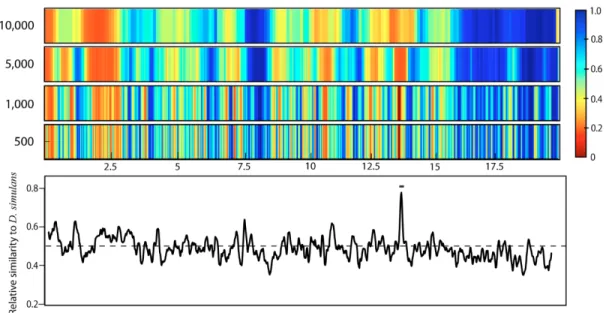
simulation to estimate the size and frequency of non-backcross parental blocks remaining after 15 generations of backcrossing without selection – that is, how often would we expect to see introgression blocks by chance alone. Finally, to ensure that D. simulans enrichment was not simply an artifact of bin size, we re-binned chromosomes at fewer (500) and greater (10,000) SNPs per bin (Figures 2.3 & 2.4).
Introgression Modeling
To confirm that our method mapped regions of an appropriate size, we created a forward simulation to estimate the mean and variance of donor introgression block sizes (Figure 2.2). Our model uses recombination rates from Drosophila (TRUE et al. 1996) within the recombination model of FOSS et al. (1993), which incorporates crossover interference. We assumed a D. simulans genetic map of 460 cM and relatively simple interference (a non-crossover event must occur between adjacent crossovers, m = 1 from FOSS et al. 1993). Over multiple backcross generations, an introgressed block size decreases asymptotically to zero cM. With multiple independent introgressed replicates, the variance in block size also decreases asymptotically to 0. In our case, one replicate over 15 generations is expected to have a block size of ~5±5cM. Our experimentally observed blocks were roughly 0.5cM to 1cM, falling well within the expected block size. In Drosophila, 1cM is roughly equivalent to 0.5 Mb, depending on chromosomal
position.
D. simulans enriched regions could also remain due to drift alone. To reveal the variation of introgression size by chance (that is, without selection), we performed a simulation of introgression with backcrossing. We populated a virtual pool of chromosomes made up of two parental genotypes, A and B. Each generation an A
chromosome was recombined with a B chromosome, experiencing one crossover event at a random position. Each event created two daughter chromosomes that received
reciprocal products. To maintain a stable population size, one daughter from each
crossover was picked at random to propagate the next generation. This daughter was then “backcrossed” to a B chromosome. This cycle – recombination to B (the “backcross”) followed by randomly choosing daughter recombinants (“drift”) – was repeated 15 times with two levels of replication (2,000 and 20,000; see below). We tracked the size of A chromosome blocks maintained at each generation and calculated the population-wide A allele content after 15 generations.
In infinitely large populations, theory predicts that, on average, half of the A alleles will remain after each cycle of recombination and drift. In non-infinite
Disregarding the low probability (1 in 2,000) of introgression by chance alone, we measured the variation in A frequency under a selection-free scenario. Simulations were repeated until 14 independent A blocks were found (20,600 replicates). Conditioning on an A block persisting (N = 14), sizes ranged from 0.7% to 27% of one chromosome (avg = 6.1±7.4%). At a population level (N = 20,600), sizes ranged from 3.4 x 10⁻⁷ % to 1.3 x 10⁻⁵ %. In our pilot experiment, we introgressed one lineage with selection and found at least 6 blocks ranging in size from 20Kb to 1.5Mb (0.1-7.5% of a 20Mb chromosome).
Binning Effect
In our effort to find regions of the 15th generation hybrid genome enriched for D. simulans, we binned chromosomes into overlapping 1,000 SNP (~100kb) sections. This size was chosen primarily with consideration of Drosophila genic density. However, choice of bin size influences one’s ability to detect significant SNP enrichment. For example, picking a large bin size will mask enriched regions by including adjacent non-enriched regions. A bin size that is too small will force many comparisons and the corrected α threshold will be too low. Ultimately, bin size determines one’s ability to detect enrichment.
(hence the number of significance tests), the threshold of significance according to a False Discovery Rate (FDR) changes.
Figures 2.3 & 2.4 show data from chromosome arms 2L and 2R, respectively, produced by four sample bin sizes. The two large regions on 2L showing significant D. simulans SNP enrichment maintained this significance under all bin sizes. As expected, regions are not identified as significant for all bin sizes. As arm 2R (Figure 2.4) shows, while regions harboring sharp peaks in D. simulans enrichment stand out, large regions with relatively shallow enrichment can still approach significance (e.g. centromeric region of 2R). One’s ability to detect significance at a given bin size is influenced by the physical size of the introgression block and the magnitude of SNP enrichment, thus it is difficult to predict what is the “right” bin size. When choosing a bin size it is more important to consider the biological and experimental conditions: recombination rate, generation number, gene density, influence of recombination hotspots, etc.
Independent Confirmation of the Effect of the X chromosomes.
The X chromosome appeared not to harbor any genes affecting aversion behavior. An alternate explanation for this pattern is that our single introgression did not capture all regions affecting aversion. (As noted above, we only captured about ¾ of the D. simulans phenotype with this single introgression line.) This will most likely occur within
chromosomes where local recombination landscape can affect the efficacy of selection. We did not expect this problem within an independent linkage group.
confirmed the absence of its effect. Of the 169 flies with D. sechellia X, 77% avoided the Morinda medium. Of the 202 flies with D. simulans X, 73% avoided the Morinda
medium. This pattern goes in the opposite direction predicted and is not statistically significant (P = 0.4229).
DISCUSSION
We have shown that PSIseq can efficiently map the genetic basis of a complex trait. This method can find multiple loci with small mapping populations that remain usable beyond mapping experiments. Other NGS methods rely on transient F2 mapping populations which are irrevocably lost once nucleic acids are extracted. On the other hand, introgression stocks can be tested in future assays to further resolve candidate regions. Only low sequencing coverage is needed for rough mapping, and replicate populations can be created over time. We found at least six loci contributing to D. simulans aversion of Morinda compounds, and we confirmed the influence on behavior of an odorant binding protein locus discovered previously (Obp56e; DWORKIN and JONES 2009).
NGS mapping is typically composed of three main steps: 1) create a mapping population, 2) extract DNA and prepare libraries, 3) assemble short reads and genotype. PSIseq improves the first and third steps. First, PSIseq uses introgression lines
propagated for more generations instead of an F2 backcross line because this allows mapping of smaller candidate regions. Closely linked loci can be decoupled and mapped separately, especially if multiple replicate introgressions are made. For example,
al. (2009), SARIN et al. (2008), SCHNEEBERGER et al. 2009, and ZURYN et al. (2010) all used F2 backcross populations and successfully mapped single loci from mutagenesis screens or dominant marker mapping. PSIseq was able to isolate at least six distinct loci in our pilot study, three of which occurred within a 7 Mb region (See Figure 2.1).
PSIseq also improves the third step in NGS mapping: genotyping. Instead of using only common SNPs (a la GWAS), PSIseq uses all possible SNPs and avoids potential bias in mapping to particular regions. A major issue with current short read technology is the high per base sequencing and mapping error rates. PSIseq overcomes this by using a window-based mapping approach, as described by Huang et al. (2009). A group of SNPs are collected into bins (“windows”), and statistical tests are performed on these bins. Thus, while a small percentage of SNPs may be inaccurate, these false SNPs are engulfed by surrounding populations of true SNPs. This method works particularly well when mapped regions are fixed for one parent and contain few polymorphisms (eg. RILs), and for rough mapping of hybrid genomes sequenced lightly. As an alternative to the window approach, Andolfatto et al. (2011) developed a customized Hidden-Markov Model (HMM) to assign the probability of a SNP’s ancestry. The power of this method lies in its ability to map with high resolution the boundaries surrounding the
recombination breakpoint itself. We take a more simplistic approach in identifying ancestry by measuring SNP enrichment under a binomial expectation.
the quality and number of phenotypic measurements. Second, like sequenced RILS (HUANG et al. 2009), these selected introgression lines are potentially shelf stable and can be used in future experiments. Third, complex traits can be mapped in organisms lacking a high quality genome assembly. For example, with transcriptome sequence from parental and introgression lines one could identify gene transcripts enriched for alleles from the selected parent. Finally, in addition to being flexible and extensible, our approach only needs low sequence coverage (~1X) for rough mapping, given enough SNPs (e.g. ~100kb resolution). To increase resolution of candidate regions one could replicate introgression crosses (see Figure 2.2) or take advantage of new targeted enrichment sequencing (ALBERT et al. 2007; ANTSON et al. 2000) to increase coverage for only interesting regions. This strategy would be particularly useful for regions with repetitive elements, duplications, pseudogenes, and other elements difficult to align at lower coverage.
REFERENCES
ALBERT,T. J., M. N. MOLLA, D. M. MUZNY, L. NAZARETH, D. WHEELER et al., 2007
Direct selection of human genomic loci by microarray hybridization. Nat Methods
4: 903-905.
AMLOU,M., B. MORETEAU and J. R. DAVID, 1998 Genetic analysis of Drosophila
sechellia specialization: oviposition behavior toward the major aliphatic acids of its host plant. Behav Genet 28: 455-464.
ANDOLFATTO,P., D. DAVISON, D. EREZYILMAZ, T. T. HU, J. MAST et al., 2011
Multiplexed shotgun genotyping for rapid and efficient genetic mapping. Genome Res 21: 610-617.
ANTSON,D. O., A. ISAKSSON, U. LANDEGREN and M. NILSSON, 2000 PCR-generated
padlock probes detect single nucleotide variation in genomic DNA. Nucleic Acids Res 28: E58.
BAIRD,N. A., P. D. ETTER, T. S. ATWOOD, M. C. CURREY, A. L. SHIVER et al., 2008
Rapid SNP discovery and genetic mapping using sequenced RAD markers. PLoS One 3: e3376.
BLUMENSTIEL,J. P., A. C. NOLL, J. A. GRIFFITHS, A. G. PERERA, K. N. WALTON et al.,
2009 Identification of EMS-induced mutations in Drosophila melanogaster by whole-genome sequencing. Genetics 182: 25-32.
DESJARDINS,C. A., F. PERFECTTI, J. D. BARTOS, L. S. ENDERS and J. H. WERREN, 2010
The genetic basis of interspecies host preference differences in the model parasitoid Nasonia. Heredity 104: 270-277.
DWORKIN,I., and C. D. JONES, 2009 Genetic changes accompanying the evolution of host
specialization in Drosophila sechellia. Genetics 181: 721-736.
EHRENREICH,I. M., N. TORABI, Y. JIA, J. KENT, S. MARTIS et al., 2010 Dissection of
genetically complex traits with extremely large pools of yeast segregants. Nature
464: 1039-1042.
FLIBOTTE,S., M. L. EDGLEY, I. CHAUDHRY, J. TAYLOR, S. E. NEIL et al., 2010
Whole-genome profiling of mutagenesis in Caenorhabditis elegans. Genetics 185: 431-441.
HUANG,X., Q. FENG, Q. QIAN, Q. ZHAO, L. WANG et al., 2009 High-throughput
genotyping by whole-genome resequencing. Genome Res 19: 1068-1076. JONES,C. D., 1998 The genetic basis of Drosophila sechellia's resistance to a host plant
JONES, C. D., 2005 The genetics of adaptation in Drosophila sechellia. Genetica 123: 137-145.
KLIMAN, R. M., P. ANDOLFATTO, J. A. COYNE, F. DEPAULIS, M. KREITMAN et al., 2000 The population genetics of the origin and divergence of the Drosophila simulans complex species. Genetics 156: 1913-1931.
LAITINEN, R. A., K. SCHNEEBERGER, N. S. JELLY, S. OSSOWSKI and D. WEIGEL, 2010 Identification of a spontaneous frame shift mutation in a nonreference
Arabidopsis accession using whole genome sequencing. Plant Physiol 153: 652-654.
LAURIE, C. C., J. R. TRUE, J. LIU and J. M. MERCER, 1997 An introgression analysis of quantitative trait loci that contribute to a morphological difference between Drosophila simulans and D. mauritiana. Genetics 145: 339-348.
LI, H., and R. DURBIN, 2009 Fast and accurate short read alignment with Burrows-Wheeler transform. Bioinformatics 25: 1754-1760.
MACKAY, T. F., E. A. STONE and J. F. AYROLES, 2009 The genetics of quantitative traits: challenges and prospects. Nat Rev Genet 10: 565-577.
MANOLIO, T. A., F. S. COLLINS, N. J. COX, D. B. GOLDSTEIN, L. A. HINDORFF et al., 2009 Finding the missing heritability of complex diseases. Nature 461: 747-753. MATSUO, T., S. SUGAYA, J. YASUKAWA, T. AIGAKI and Y. FUYAMA, 2007
Odorant-binding proteins OBP57d and OBP57e affect taste perception and host-plant preference in Drosophila sechellia. PLoS Biol 5: e118.
MICHELMORE, R. W., I. PARAN and R. V. KESSELI, 1991 Identification of Markers Linked to Disease-Resistance Genes by Bulked Segregant Analysis - a Rapid Method to Detect Markers in Specific Genomic Regions by Using Segregating Populations. Proceedings of the National Academy of Sciences of the United States of America 88: 9828-9832.
R'KHA, S., P. CAPY and J. R. DAVID, 1991 Host-plant specialization in the Drosophila melanogaster species complex: a physiological, behavioral, and genetical analysis. Proc Natl Acad Sci U S A 88: 1835-1839.
SARIN, S., V. BERTRAND, H. BIGELOW, A. BOYANOV, M. DOITSIDOU et al., 2010
Analysis of multiple ethyl methanesulfonate-mutagenized Caenorhabditis elegans strains by whole-genome sequencing. Genetics 185: 417-430.
SCHNEEBERGER, K., S. OSSOWSKI, C. LANZ, T. JUUL, A. H. PETERSEN et al., 2009 SHOREmap: simultaneous mapping and mutation identification by deep sequencing. Nat Methods 6: 550-551.
TRUE, J. R., J. M. MERCER and C. C. LAURIE, 1996 Differences in crossover frequency and distribution among three sibling species of Drosophila. Genetics 142: 507-523.
XIA, Y., S. WON, X. DU, P. LIN, C. ROSS et al., 2010 Bulk segregation mapping of mutations in closely related strains of mice. Genetics 186: 1139-1146.