Assessing the Association of Mitochondrial Genetic
Variation With Primary Open-Angle Glaucoma Using
Gene-Set Analyses
Anthony P. Khawaja,
1Jessica N. Cooke Bailey,
2Jae Hee Kang,
3R. Rand Allingham,
4Michael A.
Hauser,
4,5Murray Brilliant,
6Donald L. Budenz,
7William G. Christen,
8John Fingert,
9,10Douglas
Gaasterland,
11Terry Gaasterland,
12Peter Kraft,
13,14Richard K. Lee,
15Paul R. Lichter,
16Yutao
Liu,
17,18Felipe Medeiros,
19Syoko E. Moroi,
16Julia E. Richards,
16,20Tony Realini,
21Robert
Ritch,
22Joel S. Schuman,
23William K. Scott,
24Kuldev Singh,
25Arthur J. Sit,
26Douglas Vollrath,
27Gadi Wollstein,
28Donald J. Zack,
29Kang Zhang,
19Margaret Pericak-Vance,
24Robert N.
Weinreb,
19Jonathan L. Haines,
2Louis R. Pasquale,
3,30and Janey L. Wiggs
301National Institute for Health Research (NIHR) Biomedical Research Centre, Moorfields Eye Hospital National Health Service (NHS)
Foundation Trust, and University College London (UCL) Institute of Ophthalmology, London, United Kingdom
2Department of Epidemiology and Biostatistics, Institute for Computational Biology, Case Western Reserve University School of
Medicine, Cleveland, Ohio, United States
3Channing Division of Network Medicine, Brigham and Women’s Hospital, Harvard Medical School, Boston, Massachusetts, United
States
4Department of Ophthalmology, Duke University Medical Center, Durham, North Carolina, United States 5Department of Medicine, Duke University Medical Center, Durham, North Carolina, United States 6Marshfield Clinic Research Foundation, Marshfield, Wisconsin, United States
7Department of Ophthalmology, University of North Carolina, Chapel Hill, North Carolina, United States
8Division of Preventive Medicine, Brigham and Women’s Hospital, Harvard Medical School, Boston, Massachusetts, United States 9Department of Ophthalmology, University of Iowa, College of Medicine, Iowa City, Iowa, United States
10Stephen A. Wynn Institute for Vision Research, Iowa City, Iowa, United States 11The Emmes Corporation, Rockville, Maryland, United States
12Scripps Genome Center, University of California at San Diego, San Diego, California, United States
13Department of Epidemiology, Harvard T. H. Chan School of Public Health, Boston, Massachusetts, United States
14Program in Genetic Epidemiology and Statistical Genetics, Harvard School of Public Health, Boston, Massachusetts, United States 15Bascom Palmer Eye Institute, University of Miami Miller School of Medicine, Miami, Florida, United States
16Department of Ophthalmology and Visual Sciences, University of Michigan, Ann Arbor, Michigan, United States
17Department of Cellular Biology and Anatomy, Medical College of Georgia, Augusta University, Augusta, Georgia, United States 18James and Jean Culver Vision Discovery Institute, Medical College of Georgia, Augusta University, Augusta, Georgia, United States 19Hamilton Glaucoma Center, Shiley Eye Institute, University of California, San Diego, San Diego, California, United States 20Department of Epidemiology, University of Michigan, Ann Arbor, Michigan, United States
21Department of Ophthalmology, West Virginia University Eye Institute, Morgantown, West Virginia, United States
22Einhorn Clinical Research Center, Department of Ophthalmology, New York Eye and Ear Infirmary of Mount Sinai, New York,
New York, United States
23Department of Ophthalmology, New York University, New York, New York, United States
24Institute for Human Genomics, University of Miami Miller School of Medicine, Miami, Florida, United States 25Department of Ophthalmology, Stanford University School of Medicine, Palo Alto, California, United States 26Department of Ophthalmology, Mayo Clinic, Rochester, Minnesota, United States
27Department of Genetics, Stanford University School of Medicine, Palo Alto, California, United States 28Department of Ophthalmology, University of Pittsburgh, Pittsburgh, Pennsylvania, United States 29Wilmer Eye Institute, Johns Hopkins University Hospital, Baltimore, Maryland, United States
30Department of Ophthalmology, Harvard Medical School, Massachusetts Eye and Ear Infirmary, Boston, Massachusetts, United States
iovs.arvojournals.orgjISSN: 1552-5783 5046
Correspondence: Janey L. Wiggs, Paul Austin Chandler Professor of Ophthalmology, Department of Ophthalmology, Harvard Medical School, Massachusetts Eye and Ear, Boston, MA 02114, USA;
[email protected]. Submitted: May 27, 2016 Accepted: July 27, 2016
Citation: Khawaja AP, Cooke Bailey JN, Kang JH, et al. Assessing the association of mitochondrial genetic variation with primary open-angle glaucoma using gene-set analyses.
Invest Ophthalmol Vis Sci. 2016;57:5046–5052. DOI:10.1167/ iovs.16-20017
PURPOSE. Recent studies indicate that mitochondrial proteins may contribute to the pathogenesis of primary open-angle glaucoma (POAG). In this study, we examined the association between POAG and common variations in gene-encoding mitochondrial proteins.
METHODS.We examined genetic data from 3430 POAG cases and 3108 controls derived from the combination of the GLAUGEN and NEIGHBOR studies. We constructed biological-system coherent mitochondrial nuclear-encoded protein gene-sets by intersecting the MitoCarta database with the Kyoto Encyclopedia of Genes and Genomes (KEGG) database. We examined the mitochondrial gene-sets for association with POAG and with normal-tension glaucoma (NTG) and high-tension glaucoma (HTG) subsets using Pathway Analysis by Randomization Incorporating Structure.
RESULTS.We identified 22 KEGG pathways with significant mitochondrial protein-encoding gene enrichment, belonging to six general biological classes. Among the pathway classes, mitochondrial lipid metabolism was associated with POAG overall (P¼0.013) and with NTG (P¼ 0.0006), and mitochondrial carbohydrate metabolism was associated with NTG (P¼ 0.030). Examining the individual KEGG pathway mitochondrial gene-sets, fatty acid elongation and synthesis and degradation of ketone bodies, both lipid metabolism pathways, were significantly associated with POAG (P¼0.005 andP¼0.002, respectively) and NTG (P ¼0.0004 andP<0.0001, respectively). Butanoate metabolism, a carbohydrate metabolism pathway, was significantly associated with POAG (P¼0.004), NTG (P¼0.001), and HTG (P ¼0.010).
CONCLUSIONS. We present an effective approach for assessing the contributions of mitochondrial genetic variation to open-angle glaucoma. Our findings support a role for mitochondria in POAG pathogenesis and specifically point to lipid and carbohydrate metabolism pathways as being important.
Keywords: glaucoma, genetics, mitochondria
A
lthough raised intraocular pressure (IOP) is a key risk factor for primary open-angle glaucoma (POAG), only a fraction of individuals with elevated IOP develop POAG, and approximately one-third of Caucasian (European ancestry) POAG patients have normal IOP levels (normal-tension glaucoma [NTG]) suggesting that other factors can influence susceptibility to optic nerve degeneration. There is growing evidence for mitochondrial dysfunction in optic nerve susceptibility to glaucoma.1–4 The characteristic visual field loss seen in glaucoma locates the site of retinal ganglion cell (RGC) injury to the optic nerve head. RGC axons coursing through the retina and into the prelaminar cribrosa optic nerve are not myelinated, providing the necessary transparency to incident light on its route to the retinal photoreceptors. This unmyelinated axonal segment represents the longest node of Ranvier in the body and to sustain action potentials is endowed with an ample supply of mitochondria necessary to generate sufficient adenosine triphosphate (ATP) to sustain action potential propagation in the absence of myelin.5 Because of this high energy requirement, the optic nerve head is a region that is particularly susceptible to mitochondrial dysfunction. For example, RGC loss or dysfunction is a feature of diseases caused by mitochondrial DNA mutations, including Leber’s hereditary optic neuropathy and is also a common manifesta-tion of many other mitochondrial disease syndromes.5 Mito-chondrial dysfunction has been increasingly shown to play a role in other age-related neurodegenerative conditions such as Parkinson’s disease and Alzheimer’s disease.6Genetic studies have suggested that nuclear genes encoding mitochondrial proteins may contribute to POAG risk.7 Recent-ly, a large genome-wide association study identified significant association of POAG with single nucleotide polymorphisms (SNPs) in the TXNRD2 genomic region, a nuclear-encoded mitochondrial protein that functions to maintain redox homeostasis.4 In this study, we examined the association between genetic variation in a comprehensive set of nuclear-encoded mitochondrial proteins and POAG in a large case-control dataset. We conducted gene-set analyses of
mitochon-dria-enriched biological pathways, examining the association with POAG as well as NTG and high-tension glaucoma (HTG) subgroups.
M
ETHODSParticipants and Definitions
in those participants with IOP data available. Visual field loss was required to be reproduced in the same region on a subsequent test, or if these data were not available, then the case definition required signs suggestive of glaucomatous optic neuropathy, namely a vertical cup-to-disc ratio>0.7. Control participants were required to have a vertical cup-to-disc ratio< 0.6 and IOP<22 mm Hg as evidenced at an eye examination during the 2 years prior to study enrollment.
Genotyping and Association Analysis
The Illumina Human 660WQuadv1C BeadChip array (Illumina, San Diego, CA, USA) was used to genotype all participants. GLAUGEN study samples were processed at the Broad Institute (Cambridge, MA, USA), and NEIGHBOR samples were pro-cessed at the Center for Inherited Disease Research (Baltimore, MD, USA). Details regarding data cleaning and quality control have been published previously.10The association analyses of genotypes with POAG were carried out with logistic regression assuming an additive model using PLINK v1.07 (http://pngu. mgh.harvard.edu/~purcell/plink/, in the public domain).11 Analyses were conducted separately for GLAUGEN and NEIGHBOR (genomic inflation factors were 1.009 and 1.034, respectively) and then meta-analyzed, weighting by inverse variance using METAL.12GLAUGEN analyses were adjusted for age, sex, study site, DNA source, DNA extraction method, and three principal components; NEIGHBOR analyses were adjust-ed for age, sex, study site, and two principal components.
Defining the Mitochondriome and Mitochondria-Enriched Biological Pathways
The mitochondrial proteome consists of more than 1000 proteins, only 13 of which are encoded by mitochondrial DNA; the vast majority of proteins that are important for mitochondrial structure and function are encoded by nuclear DNA.13For the purpose of the current study, we confined our analysis to nuclear genes encoding the mitochondrial proteome because the platform used for genotyping does not include a sufficient number of mitochondrial DNA variants for analysis using pathway software programs, including the program Pathway Analysis by Randomization Incorporating Structure (PARIS; http://csg.sph.umich.edu/abecasis/metal/index.html, in the public domain) used for this study.14We identified 1010 nuclear-encoded mitochondria genes using the Human Mito-Carta database (www.broadinstitute.org/pubs/MitoMito-Carta, in the public domian)15 and refer to these genes as the mitochon-driome(Supplementary Fig. S1). In addition to the production of ATP by oxidative phosphorylation, mitochondria are essential for a diverse range of biological processes, and different genes in the mitochondriome may be responsible for contrasting biological pathways. We therefore identified subsets of the mitochondriome that were important for different biological pathways by intersecting the Human MitoCarta database with the Kyoto Encyclopedia of Genes and Genomes (KEGG) biological pathway database (version 58.1).16 We considered KEGG pathways to have a significant mitochondrial component if the gene enrichmentPvalue of the MitoCarta genes in the overall pathway was significant using the hypergeometric test with Bonferroni correction (209 pathways yielded a significance threshold of 2.43104).
Mitochondria-Enriched Biological Pathway Analyses
For each mitochondria-enriched biological pathway we iden-tified, we defined a gene-set that consisted of only the MitoCarta genes within the pathway, aiming to represent the
mitochondrial component of the biological process. We tested for association between these gene-sets and POAG overall, NTG and HTG using PARIS (version 1.1.1).14An advantage of a pathway or gene-set approach is that variants of smaller effect sizes that individually did not meet strict multiple comparison criteria for genome-wide association may in aggregate show significant association with disease as a result of the overall effect of the cumulative variation of a pathway or set of genes. The approach used by PARIS has been described in detail previously14and has been used successfully for examining the association between the estrogen metabolism pathway and POAG17as well as for examining the association of all KEGG pathways with POAG.18 Briefly, PARIS divides the specified gene-set into linkage disequilibrium (LD) blocks, and randomly selects similarly sized LD blocks from the rest of the genome for comparison. The number of LD blocks with at least one SNP significant atP<0.05 is compared between the gene-set in question and the randomly selected set of LD blocks. This process is repeated a user-defined number of times (we completed 10,000 permutations per test), and a permuted P value is calculated based on the number of times the gene-set in question had more significant LD blocks than the randomly selected comparison.
PARIS also calculates gene P values by repeating the randomization and permutation process using just the LD blocks within each gene. Single nucleotide polymorphisms from the GWAS were considered to reside in a pathway gene if the SNP fell within the ENSEMBL genomic interval650 kb to either side of the gene. If the overlap included another gene in the pathway, the overlapping SNP(s) were counted once. Examining genePvalues helps identify which parts of a larger pathway are driving an association. However, caution is required when interpreting genePvalues, especially if only a small number of LD blocks are represented by the gene.14 Consider an extreme example of a gene with just one LD block, and that LD block has a SNP P < 0.05. PARIS will always produce a significant genePvalue for such genes. We therefore only examined genePvalues for genes represented by at least five LD blocks from our genotyping data.
We set a threshold for a single-allele P value of<0.05 as nominally significant for use within the PARIS analysis and used a permutation test of 10,000 permutations to determine the significance of the pathway analyses. A KEGG pathway was considered to be significant at theP<0.0001 level if none of the 10,000 randomized pathways had more significant SNP signals than the actual pathway.
R
ESULTSWe examined genetic data from 3,430 POAG cases (mean age 65.2 years, 54% women) and 3,108 controls (mean age 67.5 years, 56% women). For these cases, IOP data were available from 2354 participants (67%); 717 were classified as NTG and 1637 as HTG.
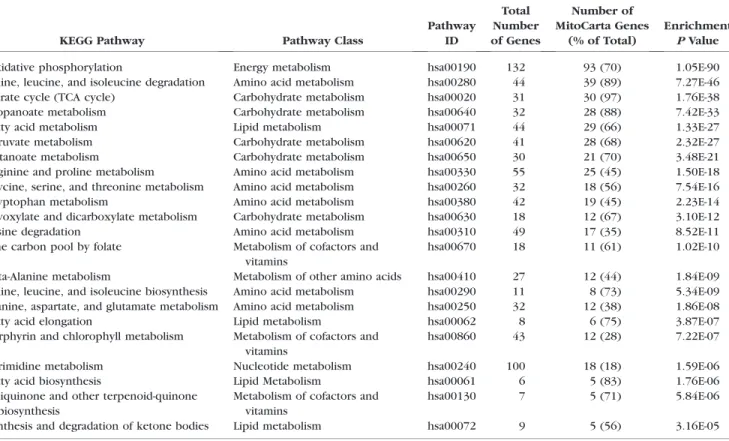
We identified 22 KEGG pathways with significant mito-chondrial gene enrichment, belonging to six pathway classes: amino acid metabolism, carbohydrate metabolism, energy metabolism, lipid metabolism, metabolism of cofactors and vitamins, and nucleotide metabolism (Table 1). Pathway-specific mitochondrial gene-sets were created using these data; 6 sets relating to the pathway classes and 22 gene-sets relating to the individual pathways within the classes (Supplementary Table S1). We excluded genes not present in the Human MitoCarta database from the gene sets.
involved in lipid metabolism was nominally associated with POAG overall (P ¼ 0.013); this association appeared to be driven by a significant association with NTG (P¼0.0006), with no significant association seen with HTG (P¼0.15). A nominal association was also observed between the carbohydrate metabolism mitochondrial gene-set and NTG and the nucleo-tide metabolism gene-set (that includesTXNRD2) with POAG overall (bothP<0.05).
Table 3 presents the associations for the 22 individual KEGG pathway-defined mitochondrial gene-sets and POAG, NTG, and HTG. As expected, some lipid metabolism class gene-sets were significantly associated with POAG, and particularly with NTG. Specifically, the mitochondrial components of fatty acid elongation and synthesis and degradation of ketone bodies
were significantly associated with POAG overall (P¼0.005 and P¼0.002), and significantly associated with NTG (P¼0.0004 andP<0.0001). The mitochondrial component of fatty acid metabolism was nominally associated with POAG overall (P¼ 0.023). There was also evidence of association between the carbohydrate metabolism class gene-sets and NTG, especially the butanoate metabolism gene-set, which was significantly associated with NTG (P¼0.001) in addition to an interesting association between NTG and propanoate metabolism (P¼ 0.002) and pyruvate metabolism (P¼0.01).
We examined the component gene P values for the lipid metabolism and carbohydrate metabolism gene-sets (Supple-mentary Tables S2, S3). Genes driving both lipid and carbohydrate metabolism associations with POAG and NTG wereBDH1(POAG and NTGP<0.0001),EHHADH(POAGP ¼0.044, NTGP¼0.0009), andECHS1(POAGP¼0.004, NTG P¼0.002). In addition,ACAA2 (POAG P¼0.024, NTG P¼ 0.0008) from the lipid metabolism gene-set andME3(POAGP ¼0.0003, NTGP¼0.30),ACYP2(POAGP¼0.001, NTGP¼ 0.43), LDHD (POAG P¼ 1.00, NTGP¼0.004), and LDHB (POAG P ¼ 1.00, NTG P ¼ 0.003) from the carbohydrate metabolism gene-set were significantly associated with POAG and/or NTG. The gene Pvalues forTXNRD2were significant for an association with POAG overall (P<0.001).
D
ISCUSSIONIn this large case-control study, we demonstrated significant associations between POAG and groups of nuclear genes important for specific aspects of mitochondrial function, namely, lipid metabolism (fatty acid elongation and synthesis and degradation of ketone bodies) and carbohydrate metabo-TABLE1. KEGG Pathways With Significant Enrichment of MitoCarta Genes
KEGG Pathway Pathway Class
Pathway ID
Total Number of Genes
Number of MitoCarta Genes
(% of Total)
Enrichment PValue
Oxidative phosphorylation Energy metabolism hsa00190 132 93 (70) 1.05E-90 Valine, leucine, and isoleucine degradation Amino acid metabolism hsa00280 44 39 (89) 7.27E-46 Citrate cycle (TCA cycle) Carbohydrate metabolism hsa00020 31 30 (97) 1.76E-38 Propanoate metabolism Carbohydrate metabolism hsa00640 32 28 (88) 7.42E-33 Fatty acid metabolism Lipid metabolism hsa00071 44 29 (66) 1.33E-27 Pyruvate metabolism Carbohydrate metabolism hsa00620 41 28 (68) 2.32E-27 Butanoate metabolism Carbohydrate metabolism hsa00650 30 21 (70) 3.48E-21 Arginine and proline metabolism Amino acid metabolism hsa00330 55 25 (45) 1.50E-18 Glycine, serine, and threonine metabolism Amino acid metabolism hsa00260 32 18 (56) 7.54E-16 Tryptophan metabolism Amino acid metabolism hsa00380 42 19 (45) 2.23E-14 Glyoxylate and dicarboxylate metabolism Carbohydrate metabolism hsa00630 18 12 (67) 3.10E-12 Lysine degradation Amino acid metabolism hsa00310 49 17 (35) 8.52E-11 One carbon pool by folate Metabolism of cofactors and
vitamins
hsa00670 18 11 (61) 1.02E-10
beta-Alanine metabolism Metabolism of other amino acids hsa00410 27 12 (44) 1.84E-09 Valine, leucine, and isoleucine biosynthesis Amino acid metabolism hsa00290 11 8 (73) 5.34E-09 Alanine, aspartate, and glutamate metabolism Amino acid metabolism hsa00250 32 12 (38) 1.86E-08 Fatty acid elongation Lipid metabolism hsa00062 8 6 (75) 3.87E-07 Porphyrin and chlorophyll metabolism Metabolism of cofactors and
vitamins
hsa00860 43 12 (28) 7.22E-07
Pyrimidine metabolism Nucleotide metabolism hsa00240 100 18 (18) 1.59E-06 Fatty acid biosynthesis Lipid Metabolism hsa00061 6 5 (83) 1.76E-06 Ubiquinone and other terpenoid-quinone
biosynthesis
Metabolism of cofactors and vitamins
hsa00130 7 5 (71) 5.84E-06
Synthesis and degradation of ketone bodies Lipid metabolism hsa00072 9 5 (56) 3.16E-05
KEGG pathway ID and class are presented as well as the total number of genes in the KEGG pathway and the proportion of genes that are listed in the Human MitoCarta database. Pathways are in descending order of mitochondrial enrichment. ID, identification; TCA, tricarboxylic acid.
TABLE2. Associations Between the Six Main Pathway Class Mitochon-drial Gene-Sets and Primary Open-Angle Glaucoma (POAG, 3430 Cases), Normal Tension Glaucoma (NTG, 717 Cases), and High Tension Glaucoma (HTG, 1637 Cases) Versus Controls (3108) in the Combined GLAUGEN–NEIGHBOR Dataset
Mitochondrial Gene-Set
PermutedPValue for Association
POAG NTG HTG
Amino acid metabolism 0.76 0.12 0.86 Carbohydrate metabolism 0.05 0.030 0.20 Energy metabolism 0.60 0.15 0.09 Lipid metabolism 0.013 0.0006 0.15 Metabolism of cofactors and vitamins 0.56 0.97 0.65 Nucleotide metabolism 0.025 0.77 0.10
lism (butanoate metabolism). These associations were partic-ularly apparent for the NTG subgroup.
Mitochondria serve many diverse biological roles, including generation of ATP, cellular homeostasis, signaling, neuronal excitability, and apoptosis.19Challenges exist in examining the role of mitochondria in disease. It seems likely that for any particular disease, only specific mitochondrial functions may impact disease pathogenesis. For example, oxidative phos-phorylation was notably not associated with POAG in our study despite being the pathway with the greatest nuclear-encoded mitochondrial gene enrichment. In our study, we present an effective approach to examining the role of mitochondria in disease by using variation in the mitochondriome as a proxy for mitochondrial function. After dividing the mitochondriome into biological system coherent gene-sets and examining each
gene-set for collective association with disease, we demon-strated a significant association between POAG and mitochon-drial gene-sets that are involved in lipid and carbohydrate metabolism. Our results were especially significant in the NTG subgroup, suggesting that the observed association is more likely to influence optic nerve susceptibility rather than elevated IOP.
The mechanisms by which mitochondrial impairment in these pathways may contribute to glaucoma are not clear, although our results suggest that they may be related to fatty acid metabolism and elongation, synthesis and degradation of ketone bodies, and butanoate and pyruvate metabolism. The association of the whole butanoate KEGG pathway (including nonmitochondrial genes) with POAG in our study population has been previously reported.18 Genes in the butanoate metabolism pathway contribute to the formation of 4-amino-butanoate (GABA). GABA plays an important role in the visual response, and the inhibition of GABA transaminase by the antiepileptic medication vigabatrin can result in visual field defects.20Our gene-set analysis results are in agreement with a study that examined 65 candidate POAG genes using the Ingenuity knowledge database (www.ingenuity.com, in the public domain); the investigators reported that the genes take part in only four common functional molecular networks corresponding to lipid metabolism, developmental function, and inflammatory processes.21 Also consistent with our findings is a GWAS of NTG in Japanese patients that found an interesting association withELOVL5, a gene involved in long-chain polyunsaturated fatty acid synthesis.22 Abnormal lip-id23,24and carbohydrate25metabolism has been demonstrated in glaucomatous eyes, as observed in the trabecular meshwork and aqueous humor. These data are consistent with our pathway analysis data, although our results are stronger with NTG rather than POAG overall or HTG. Our study also identified nominal association with the pyrimidine pathway that includes TXNRD2, coding for a mitochondrial protein involved in managing mitochondrial oxidative stress. A KEGG pathway specifically including mitochondrial redox homeosta-sis proteins does not exist and therefore could not be evaluated in this study.
Using PARIS to evaluate individual constituent genes of a pathway helps identify any genes associated with the outcome, which may be the main drivers of the entire pathway association. We found strong signals of association with POAG forBDH1,EHHADH,ACAA2, andME3. These genes have not been previously reported to be associated with POAG in other studies, and further work seeking replication of the associa-tions in other populaassocia-tions would be of interest.
Our results could have important implications for future study of the role of mitochondria in the pathogenesis of glaucoma. Patients with an excess of risk alleles influencing mitochondrial proteins could have a unique natural history when compared with POAG overall and may have a different response to treatment. Resveratrol, caloric restriction, and physical activity have been suggested as interventions to improve mitochondrial function, and evidence exists for potential benefit in animal models of retinal ischaemia and acute intraocular pressure injury.26–28 One approach to identifying POAG patients with a mitochondrial component to their disease would be a genetic analysis of their mitochondriome. A genetic risk score (GRS) based on these gene-set analyses could be used in future studies to investigate the phenotypic features of glaucoma patients with an excess of mitochondrial risk variants. The GRS could also be used to examine interactions with other genetic or environmental factors. For example, no effect of dietary antioxidants was found on the development of POAG in a subset of the current study29; it would be of interest to know if an effect is evident TABLE3. Associations Between KEGG Pathway-Defined Mitochondrial
Gene-Sets and Primary Open-Angle Glaucoma (POAG, 3430 Cases), Normal Tension Glaucoma (NTG, 717 Cases), and High Tension Glaucoma (HTG, 1637 Cases) Versus Controls (3108) in the Combined GLAUGEN–NEIGHBOR Dataset
Mitochondrial Gene-Set
PermutedPValue for Association
POAG NTG HTG
Amino acid metabolism
Alanine, aspartate, and glutamate
metabolism 0.18 0.33 0.17
Arginine and proline metabolism 0.43 0.08 0.94 Glycine, serine, and threonine
metabolism 0.26 0.94 0.83
Lysine degradation 0.13 0.10 0.20 Tryptophan metabolism 0.18 0.14 0.36 Valine, leucine, and isoleucine
biosynthesis 0.98 0.04 0.51 Valine, leucine, and isoleucine
degradation 0.60 0.35 0.23
Carbohydrate metabolism
Butanoate metabolism 0.004 0.0011 0.010
Citrate cycle (TCA cycle) 0.74 0.99 0.73 Glyoxylate and dicarboxylate
metabolism 0.73 0.69 0.72
Propanoate metabolism 0.67 0.002 0.42 Pyruvate metabolism 0.006 0.011 0.05 Energy metabolism
Oxidative phosphorylation 0.60 0.15 0.09 Lipid metabolism
Fatty acid biosynthesis 0.83 0.12 0.65 Fatty acid elongation 0.005 0.0004 0.23 Fatty acid metabolism 0.023 0.12 0.29 Synthesis and degradation of
ketone bodies 0.002 <0.0001 0.021
Metabolism of cofactors and vitamins
One carbon pool by folate 0.57 0.86 0.31 Porphyrin and chlorophyll
metabolism 0.29 0.87 0.78
Ubiquinone and other
terpenoid-quinone biosynthesis 0.58 0.56 0.57 beta-Alanine metabolism 0.07 0.03 0.20 Nucleotide metabolism
Pyrimidine metabolism 0.025 0.77 0.10
when only examining participants with a high mitochondrial GRS score, especially considering the potential contributions ofTXNRD2.
A significant strength of our study is the large sample size and number of POAG cases (both HTG and NTG), which provided the necessary power for our analyses. Our approach of testing mitochondrial genes in biological system groups collectively is novel and appears to be a useful method for probing specific hypotheses. There are some limitations to our approach. The completeness and accuracy of the gene-sets we tested were limited by the completeness of the MitoCarta and KEGG databases and current knowledge. We did not consider variation in mitochondrial DNA because of limited information for mitochondrial DNA variants in our genotype data. However, mitochondria DNA encode only 13 proteins and therefore represents a minor fraction of the overall mitochondrial proteome. Nevertheless, further study of mitochondrial DNA variants in glaucoma is warranted using other datasets. It is also not currently possible to replicate our findings in another population; our strongest findings were in NTG patients and there are no other similarly sized Caucasian NTG case-control datasets with genetic data available. Further work is required to determine the precise role of the pathways and genes we described in POAG.
In summary, we present evidence supporting a role for mitochondria in POAG pathogenesis. Specifically, genes encoding mitochondrial proteins that are involved in lipid and carbohydrate metabolism were found to be associated with POAG, and in particular NTG. Future studies stratifying POAG patients according to genetic variation in mitochondrial genes may help identify a pathologically distinct POAG subset related to mitochondrial dysfunction.
Acknowledgments
The MitoCarta KEGG pathway datasets were kindly provided by Sarah E. Calvo (Broad Institute, Harvard, and MIT). LRP and JLW are supported by the Harvard Glaucoma Center of Excellence and Margolis fund (Boston, MA, USA). DLB, LRP, JER, RNW, and JLW are also supported by Research to Prevent Blindness, Inc. (New York, NY, USA). The Arthur Ashley Foundation also supports LRP. The Glaucoma Research Foundation (San Francisco, CA, USA), Bright Focus Foundation (formerly called American Health Assistance Foundation; Clarksburg, MD, USA), the Glaucoma Foundation (New York, NY, USA), and National Eye Institute Grant R01EY023242 support YL. MB is supported by National Institutes of Health Grants UL1TR000427 and 1U01HG006389. National Institutes of Health/National Eye Institute Grant R01EY022305 supports the NEIGHBORHOOD consortium. The following grants from the National Human Genome Research Institute (Bethesda, MD, USA) supported GLAUGEN: HG004728 (LRP), HG004424 (Broad Institute to support genotyping), HG004446 (C. Laurie, University of Washington, to support genotype data cleaning and analysis). The National Eye Institute supported the formation of the Nurses’ Health Study and Health Professional Follow-up Study subset of GLAUGEN (EY015473; LRP). Genotyping services for the NEIGHBOR study were provided by the Center for Inherited Disease Research and were supported by the National Eye Institute through Grant HG005259-01 (JLW). In addition, the Center for Inherited Disease Research is funded through a federal contract from the National Institutes of Health to The Johns Hopkins University, Contract HHSN268200782096C. The National Eye Institute (Bethesda, MD, USA) through American Recovery and Reinvestment Act (ARRA) Grants EY015872 (JLW) and EY019126 (MAH) supported the collection and processing of samples for the NEIGHBOR dataset. APK received support from the Berkeley Fellowship and the Wellcome Trust (094791/Z/10/Z).
Disclosure:A.P. Khawaja, None;J.N. Cooke Bailey, None;J.H. Kang, None; R.R. Allingham, None; M.A. Hauser, None; M.
Brilliant, None; D.L. Budenz, None; W.G. Christen, None;J. Fingert, None;D. Gaasterland, None;T. Gaasterland, None;P. Kraft, None;R.K. Lee, None;P.R. Lichter, None;Y. Liu, None;F. Medeiros, None; S.E. Moroi, None; J.E. Richards, None; T. Realini, None;R. Ritch, None;J.S. Schuman, None;W.K. Scott, None; K. Singh, None; A.J. Sit, None; D. Vollrath, None; G. Wollstein, None;D.J. Zack, None;K. Zhang, None;M. Pericak-Vance, None; R.N. Weinreb, None; J.L. Haines, None; L.R. Pasquale, None;J.L. Wiggs, None
References
1. Lee S, Van Bergen NJ, Kong GY, et al. Mitochondrial dysfunction in glaucoma and emerging bioenergetic therapies.
Exp Eye Res. 2011;93:204–212.
2. Chrysostomou V, Rezania F, Trounce IA, Crowston JG. Oxidative stress and mitochondrial dysfunction in glaucoma.
Curr Opin Pharmacol. 2013;13:12–15.
3. Osborne NN, del Olmo-Aguado S. Maintenance of retinal ganglion cell mitochondrial functions as a neuroprotective strategy in glaucoma.Curr Opin Pharmacol. 2013;13:16–22. 4. Bailey JNC, Loomis SJ, Kang JH, et al. Genome-wide association analysis identifies TXNRD2, ATXN2 and FOXC1 as suscepti-bility loci for primary open-angle glaucoma.Nat Genet. 2016; 48:189–194.
5. Carelli V, Ross-Cisneros FN, Sadun AA. Mitochondrial dysfunc-tion as a cause of optic neuropathies. Prog Retin Eye Res. 2004;23:53–89.
6. Lin MT, Beal MF. Mitochondrial dysfunction and oxidative stress in neurodegenerative diseases.Nature. 2006;443:787– 795.
7. Lascaratos G, Garway-Heath DF, Willoughby CE, Chau K-Y, Schapira AH. Mitochondrial dysfunction in glaucoma: under-standing genetic influences. Mitochondrion. 2012;12:202– 212.
8. Cornelis MC, Agrawal A, Cole JW, et al. The Gene, Environment Association Studies consortium (GENEVA): maximizing the knowledge obtained from GWAS by collabo-ration across studies of multiple conditions.Genet Epidemiol. 2010;34:364–372.
9. Wiggs JL, Hauser MA, Abdrabou W, et al. The NEIGHBOR consortium primary open-angle glaucoma genome-wide asso-ciation study: rationale, study design, and clinical variables.J Glaucoma. 2013;22:517–525.
10. Wiggs JL, Yaspan BL, Hauser MA, et al. Common variants at 9p21 and 8q22 are associated with increased susceptibility to optic nerve degeneration in glaucoma.PLoS Genet. 2012;8: e1002654.
11. Purcell S, Neale B, Todd-Brown K, et al. PLINK: a tool set for whole-genome association and population-based linkage anal-yses.Am J Hum Genet. 2007;81:559–575.
12. Willer CJ, Li Y, Abecasis GR. METAL: fast and efficient meta-analysis of genomewide association scans. Bioinformatics. 2010;26:2190–2191.
13. Calvo SE, Mootha VK. The mitochondrial proteome and human disease.Annu Rev Genomics Hum Genet. 2010;11:25–44. 14. Yaspan BL, Bush WS, Torstenson ES, et al. Genetic analysis of
biological pathway data through genomic randomization.
Hum Genet. 2011;129:563–571.
15. Pagliarini DJ, Calvo SE, Chang B, et al. A mitochondrial protein compendium elucidates complex I disease biology.Cell. 2008; 134:112–123.
16. Kanehisa M, Goto S. KEGG: kyoto encyclopedia of genes and genomes.Nucleic Acids Res. 2000;28:27–30.
18. Bailey JNC, Yaspan BL, Pasquale LR, et al. Hypothesis-independent pathway analysis implicates GABA and Acetyl-CoA metabolism in primary open-angle glaucoma and normal-pressure glaucoma.Hum Genet. 2014;133:1319–1330. 19. Alberts B, Johnson A, Lewis J, Raff M, Roberts K, Walter P.
Molecular Biology of the Cell. 5th ed. New York, NY: Garland Science; 2008.
20. Clayton LM, Stern WM, Newman WD, Sander JW, Acheson J, Sisodiya SM. Evolution of visual field loss over ten years in individuals taking vigabatrin.Epilepsy Res. 2013;105:262–271. 21. Janssen SF, Gorgels TGMF, Ramdas WD, et al. The vast complexity of primary open angle glaucoma: disease genes, risks, molecular mechanisms and pathobiology. Prog Retin Eye Res. 2013;37:31–67.
22. Meguro A, Inoko H, Ota M, Mizuki N, Bahram S. Genome-wide association study of normal tension glaucoma: common variants in SRBD1 and ELOVL5 contribute to disease suscep-tibility.Ophthalmology2010;117:1331–1338.e5.
23. Babizhayev MA, Bunin AYA. Lipid peroxidation in open-angle glaucoma.Acta Ophthalmol. 1989;67:371–377.
24. Aljohani AJ, Munguba GC, Guerra Y, Lee RK, Bhattacharya SK. Sphingolipids and ceramides in human aqueous humor.Mol Vis. 2013;19:1966–1984.
25. Junk AK, Goel M, Mundorf T, Rockwood EJ, Bhattacharya SK. Decreased carbohydrate metabolism enzyme activities in the glaucomatous trabecular meshwork.Mol Vis. 2010;16:1286– 1291.
26. Kong YX, van Bergen N, Bui BV, et al. Impact of aging and diet restriction on retinal function during and after acute intraocular pressure injury. Neurobiol Aging. 2012;33: 1126.e15–e25.
27. Chrysostomou V, Kezic JM, Trounce IA, Crowston JG. Forced exercise protects the aged optic nerve against intraocular pressure injury.Neurobiol Aging. 2014;35:1722–1725. 28. Liu X-Q, Wu B-J, Pan WHT, et al. Resveratrol mitigates rat
retinal ischemic injury: the roles of matrix metalloproteinase-9, inducible nitric oxide, and heme oxygenase-1. J Ocul Pharmacol Ther. 2013;29:33–40.