Statin adherence and risk of acute
cardiovascular events among women:
a cohort study accounting for
time-dependent confounding affected
by previous adherence
Piia Lavikainen,1,2Arja Helin-Salmivaara,1,3Mervi Eerola,4Gang Fang,5 Juha Hartikainen,6,7Risto Huupponen,1,8Maarit Jaana Korhonen1,5
To cite:Lavikainen P, Helin-Salmivaara A, Eerola M,et al. Statin adherence and risk of acute cardiovascular events among women: a cohort study accounting for time-dependent confounding affected by previous adherence.BMJ Open 2016;6:e011306.
doi:10.1136/bmjopen-2016-011306
▸ Prepublication history and additional material is available. To view please visit the journal (http://dx.doi.org/ 10.1136/bmjopen-2016-011306).
Received 27 January 2016 Revised 19 April 2016 Accepted 22 April 2016
For numbered affiliations see end of article.
Correspondence to Piia Lavikainen; [email protected]
ABSTRACT
Objectives:Previous studies on the effect of statin adherence on cardiovascular events in the primary prevention of cardiovascular disease have adjusted for time-dependent confounding, but potentially
introduced bias into their estimates as adherence and confounders were measured simultaneously. We aimed to evaluate the effect when accounting for time-dependent confounding affected by previous adherence as well as time sequence between factors.
Design:Retrospective cohort study. Setting:Finnish healthcare registers.
Participants:Women aged 45–64 years initiating statin use for primary prevention of cardiovascular disease in 2001–2004 (n=42 807).
Outcomes:Acute cardiovascular event defined as a composite of acute coronary syndrome and acute ischaemic stroke was our primary outcome. Low-energy fractures were used as a negative control outcome to evaluate the healthy-adherer effect. Results:During the 3-year follow-up, 474 women experienced the primary outcome event and 557 suffered a low-energy fracture. The causal HR estimated with marginal structural model for acute cardiovascular events for all the women who remained adherent ( proportion of days covered≥80%) to statin therapy during the previous adherence assessment year was 0.78 (95% CI: 0.65 to 0.94) when compared with everybody remaining non-adherent ( proportion of days covered <80%). The result was robust against alternative model
specifications. Statin adherers had a potentially reduced risk of experiencing low-energy fractures compared with non-adherers (HR 0.90, 95% CI 0.76 to 1.07).
Conclusions:Our study, which took into account the time dependence of adherence and confounders, as well as temporal order between these factors, is support for the concept that adherence to statins in women in primary prevention decreases the risk of acute cardiovascular events by about one-fifth in comparison to non-adherence. However, part of the observed effect of statin adherence on acute cardiovascular events may be due to the healthy-adherer effect.
INTRODUCTION
Several population-based studies have investi-gated associations between adherence to statin therapy, defined typically as proportion of days covered1 (PDC) or medication pos-session ratio1(MPR)≥80%, and cardiovascu-lar morbidity in primary prevention of cardiovascular disease (CVD).2–8 Uniformly, these studies have reported reductions in the risk of cardiovascular events in association with adherence when compared with non-adherence. Previous studies have also shown that patients’ adherence to statin therapy varies over time,7 9 and transitions to lower adherence levels may be associated with an increased risk of cardiovascular events.7 Our recent study examined adherence with two different approaches: first as afixed variable measured during the first year since initi-ation and second as a time-dependent vari-able measured at 1-year intervals since therapy initiation; comparable reductions in the risk of various cardiovascular events were observed with both approaches.8
Strengths and limitations of this study
▪ Large population-based register study covering all female statin initiators in primary prevention of cardiovascular disease in 2001–2004. ▪ This study expanded on previous studies by
allowing for time dependence of adherence and confounders as well as accounting for time-dependent confounders which could have been affected by previous adherence.
▪ Sensitivity analyses to account for a potential selection bias as well as healthy-adherer effect were conducted.
Most prior studies have used cohort5–8 and nested case–control designs2–4to assess the effect of adherence on cardiovascular morbidity. Typically, adherence has been measured as a single,fixed average throughout the follow-up.2–6 As follow-up periods have varied from 3 to 12 years at maximum, very different adherence patterns may have led to the same values of PDC or MPR.2–6 Confounders have been assessed at baseline and some also time-dependently during the follow-up, that is, during the same period as adherence.2–6 Consequently, the values of these confounders (eg, switching to a more potent statin in this case) may have been affected by prior adherence. Conditioning on intermediate variables that lie on the causal pathway between adherence and outcome blocks some of the adherence effect, and may introduce a collider-stratification bias if there are unmeasured confounders that predict both the inter-mediate variable and the outcome.10 11In addition, one
major concern in observational studies is
healthy-adherer bias emerging from differences in unmeasured health-seeking behaviours between the groups to be compared.12–14 Employment of negative control outcomes that reflect unhealthy behaviours unrelated to medication effect is one way to evaluate the role of such bias in the study results.15
Inverse probability of treatment weighted estimation of marginal structural models (MSMs) can be employed to overcome the problems caused by time-dependent confounding affected by prior exposure in observational studies.10 16 17 This study employed the MSM approach to extend previous studies by now accounting for time-dependent confounding affected by prior adherence when estimating the effect of statin adherence on the incidence of acute cardiovascular events. We compared the results with those obtained with conventional models. We accounted for the time-varying nature of adherence by measuring it in yearly periods, and adjusted for several time-dependent confounders. In addition, we used low-energy fractures as the negative control outcome to examine the impact of unmeasured confounding on the effect estimates.
METHODS
The data originated from multiple administrative health-care registers. The Finnish Prescription Register main-tained by the Social Insurance Institution (SII) catalogues information on reimbursed medications, such as dispensing date, Anatomical Therapeutic Chemical (ATC) classification code,18 strength and the quantity dispensed, for all Finnish residents. The Special Reimbursement Register, also maintained by the SII, contains information on entitlements to higher medica-tion reimbursement due to specific chronic diseases such as diabetes and coronary heart disease (CHD). Patients staying at public nursing homes or hospitalised for over 90 consecutive days are not eligible for reim-bursement, and their purchases are not registered.
These long-term institutionalised patients can be identi-fied from a separate SII register. The Finnish Care Register maintained by the National Institute for Health and Welfare covers all Finnish hospitals and includes information on primary and secondary discharge diag-noses, surgical procedures and admission and discharge dates. The 10th revision of the International Classification of Diseases (ICD-10) was in use during the study period. Statistics Finland compiles information from many sources such as the Register of Completed Education and Degrees, the Population Information System of the Population Register Centre, and the Finnish Tax Administration. All register data were linked using personal identification numbers unique to every Finnish resident.
Ethics, consent and permissions
Permissions were obtained from the register holders (the SII, the National Institute for Health and Welfare, and the Statistics Finland). Ethical approval was not needed as we did not contact the patients and used de-identified data. No written consent was required nor sought.
Study population
A cohort of women initiating statins (ATC codes: C10AA01-C10AA07) in 2001–2004 and aged 45–64 years was created from the Prescription Register. A new user was defined as an individual who had not been dis-pensed with statins in the time period after 1994, when the register was established. The date of the first statin purchase was defined as the cohort entry date. Patients who were long-term institutionalised within 3 years prior to or at statin initiation were excluded as were those whosefirst purchase was cerivastatin (C10AA06), a medi-cation withdrawn from the market in 2001.
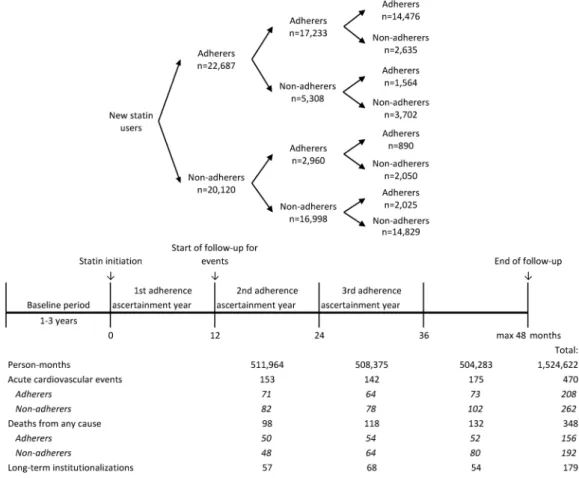
The outcome follow-up started 1 year after the statin initiation (figure 2) because computation of adherence for time periods shorter than 1 year may be unstable,19 and to exclude early outcomes that occurred before the therapeutic response to statin therapy could be estab-lished.20–24 The follow-up lasted up to 3 years (from 12 to 48 months after statin initiation). We followed patients until they experienced the outcome of interest, died, were long-term institutionalised (adherence cannot be defined during the long-term care) or 48 months was reached, whichever occurredfirst.
Adherence to statin therapy
Statin adherence was measured from the Finnish Prescription Register as PDC19 25at 1-year intervals since statin initiation (figure 2). Using a validated dosage assumption of one tablet per day,26 we calculated the number of days covered by dispensed statin tablets during each 1-year period and divided it by 365. When a refill overlapped with the previous dispensing, the new dispensing was assumed to start the day after the end of the prior dispensing. Switching between statins was con-sidered as a continuation of therapy. Denominators were corrected for days in hospital because medications during hospitalisation are provided by the service pro-vider. Finally, women were classified as adherent or non-adherent by applying the conventional cut-off value of PDC≥80%.27 28
Outcomes
The outcome was a composite of an acute cardiovascular event defined as a hospitalisation for an acute coronary syndrome (ACS) (ICD-10 codes: I20.0, I21-I22) or an acute ischaemic stroke (I63) as a primary diagnosis in
the Finnish Care Register (see online supplementary table S2).
Confounders
In the construction of inverse probability of treatment weights (IPTWs), adherence models should include common causes of adherence and outcome (confoun-ders), and pure risk factors.29 30 After reviewing the lit-erature23 and receiving expert opinions about associations with the outcome, we identified several potential confounders. Directed acyclic graphs were used to describe the relationships between adherence, outcome events and confounders (figure 3) when making decisions about the need for adjustments in the statistical analyses.
Baseline confounders measured prior to or at statin initiation included sociodemographic and socio-economic factors, type and intensity of the initial statin therapy (modified from Stoneet al31), year of statin initi-ation, cardiac comorbidity factors (such as diabetes, hypertensive diseases, heart failure/chronic cardiac insufficiency, cardiac arrhythmias, dysfunctions of lipid metabolism, number of cardiovascular medications in use and Charlson Comorbidity Index32) and non-cardiac comorbidity factors (such as rheumatoid arthritis and depression). Detailed definitions and classifications of baseline confounders are presented in online supple-mentary table S3.
After statin initiation, we measured cardiac and non-cardiac confounders as well as marital status, income, labour market status and any increase in the intensity of statin therapy on an annual basis. In addition, we treated chronic forms of atherosclerotic CVD, such as chronic CHD, CABG/PTCA, chronic cerebrovascular disease or transient ischaemic attack, atherosclerosis and use of nitrates, appearing after statin initiation as time-dependent confounders. Detailed definitions and classi-fications of time-dependent confounders are presented in online supplementary table S4.
Statistical modelling
We compared the results from conventional discrete-time hazards models with those estimated from MSMs. Both models were estimated with a pooled log-binomial regression model to produce a collapsible effect measure33 for the comparison purpose (conditional vs marginal effect estimate). Outcome was assessed at monthly intervals so that each person-month was treated as an observation. First, we examined a discrete-time hazards model with time dependent dichotomous adherence to produce a crude HR (model 1) for the effect of statin adherence on acute cardiovascular events. Next, we adjusted the crude effect estimate for baseline confounders (model 2). Finally, we used MSMs to adjust for time-dependent confounding affected by prior adherence.17 In MSMs, the study population is weighted to produce a pseudo-population in which con-founders are balanced between the adherence groups,
but the causal effect of the adherence on the outcome is preserved.17
We derived year-specific IPTWs for MSMs by applying logistic regression models as adherence models to esti-mate each individual’s probability of having the observed adherence at three time points; at 12, 24 and 36 months since statin initiation (figure 2). At 12 months after statin initiation,we calculated IPTW as an inverse prob-ability of the observed first-year adherence conditional on baseline confounders. The IPTW was stabilised with the prevalence of observed first-year adherence to increase the precision of the MSM estimator (see online supplementary appendix 1). At 24 and 36 months after statin initiation, the inverse probability of adherence
observed over the previous year was calculated condi-tional on adherence history, baseline confounders, and lagged time-dependent confounders that were measured prior to that adherence assessment period (figure 3) to ensure conditioning only on prior values of confoun-ders.34 At 24 and 36 months after statin initiation, the probabilities of observed adherences conditional on adherence histories were used to stabilise the inverse probabilities. The stabilised IPTWs at 24 and 36 months after statin initiation were calculated cumulatively by multiplying the stabilised inverse probabilities from pre-vious time points up to the specific time point. The bal-ancing properties of the stabilised IPTWs were checked by using standardised difference (SD) to compare con-founder distributions between the two adherence groups in each of the yearly periods. An SD value >0.1 was considered as an indication of a meaningful differ-ence between the groups.35
MSMs were estimated using pooled log-binomial regression models weighted with stabilised IPTWs for person-month data (see online supplementary appen-dix 1). We examined the average causal effect of adher-ence (PDC ≥80%) versus non-adherence (PDC <80%) during the previous adherence ascertainment year on the hazard of acute cardiovascular events using MSM (model 3). To test the robustness of our results against extreme weights, we examined the effect of truncating32the stabi-lised IPTWs at the 1st and 99th centiles (model 4).
Figure 3 Directed acyclic graph for time-dependent adherence and confounding structure. B, baseline characteristics; A12–A36, time-dependent adherences
measured at months 12, 24 and 36; L12–L24,time-dependent
confounders measured at months 12 and 24; Y, outcome.
We performed several sensitivity analyses. First, we used time-dependent confounders measured simultan-eously with adherence in adherence models to demon-strate the impact of the miss-specified time sequence on the effect estimate (see online supplementary appendix 2 andfigure S1 for more information on sensitivity ana-lyses). Second, we added medical procedures (CABG/ PTCA) and death from any cause into the composite outcome to evaluate the effect of potential selection bias as these events may be viewed as competing risks.36 Third, we compared patients who had at least once refilled their statin prescription (at least slight adher-ence) to those with no refills after the first dispensation (extreme non-adherence) (see online supplementary appendix 2 and figure S2). We assumed that patients with only the initial dispensation during the follow-up would mimic those with the same indication but no statin exposure, that is, a placebo group in randomised controlled trials.
Finally, we wanted to evaluate the healthy-adherer effect as an alternative explanation for our observations (models 5 and 6).15 For that, we used low-energy frac-tures as a negative control outcome that could reflect unhealthy behaviours, but is unrelated to statin effect.37 Fractures were identified as the first hospital visit for a low-energy fracture of hip (ICD-10 codes S32.1-S32.4, S72.0-S72.8 as a primary or secondary diagnosis), wrist (S52.0, S62.4), ankle (S82.1-S82.7, S92.0, S92.3), or forearm (S42.2-S42.4) (see online supplementary table S2). We used the same adherence models as in models 3 and 4 to derive IPTWs for MSM.
The analyses were performed using SAS software V.9.4 (SAS Institute Inc, Cary, North Carolina, USA), see SAS syntax for the primary analysis in online supplementary appendix 1. Missing values in variables measured after statin initiation (120.03% patients missed data on both marital status and labour market status) were imputed with the last observation carried forward technique.
RESULTS
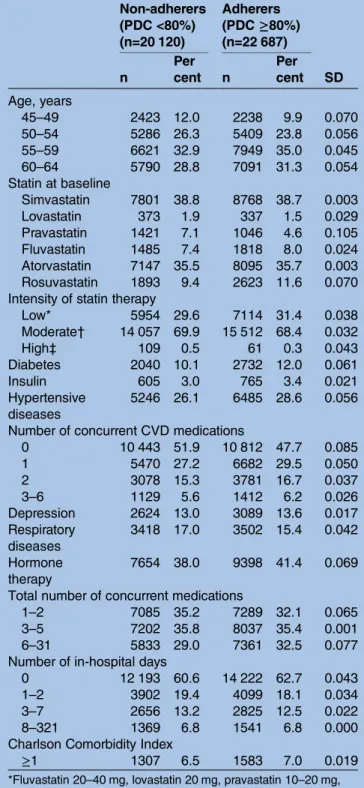
We identified 52 215 women aged 45–64 years who initiated statin therapy during 2001–2004. After exclu-sions, our final cohort consisted of 42 807 women (figure 1). The mean age was 56.2 years (SD: 4.9) and 53.0% were adherent to statin therapy (PDC ≥80%) during the first year after initiation (table 1). Baseline confounders were well balanced between the adherent and non-adherent women (table 1 and online supple-mentary table S5). The mean PDC was 94.0% among adherers, and 43.7% among non-adherers during the first assessment year. Of those who were adherent during the first year, 76.0% remained adherent in the second year, and 63.8% remained in this state for 3 years. Of the non-adherers during the first year, 84.5% remained non-adherent for 2 years and 73.7% for 3 years after statin initiation (figure 2). At baseline, agents acting on the renin-angiotensin system were being used by 26.4%
of the women, β blocking agents by 25.8%, diuretics by 13.0%, calcium channel blockers by 11.2% and antith-rombotic agents by 1.8%.
During the follow-up, 470 women experienced an acute cardiovascular event (ACS, n=256, or acute
Table 1 Selected baseline characteristics according to adherence during the first adherence ascertainment year
Non-adherers (PDC <80%) (n=20 120)
Adherers (PDC≥80%) (n=22 687)
n
Per
cent n
Per
cent SD
Age, years
45–49 2423 12.0 2238 9.9 0.070
50–54 5286 26.3 5409 23.8 0.056
55–59 6621 32.9 7949 35.0 0.045
60–64 5790 28.8 7091 31.3 0.054
Statin at baseline
Simvastatin 7801 38.8 8768 38.7 0.003
Lovastatin 373 1.9 337 1.5 0.029
Pravastatin 1421 7.1 1046 4.6 0.105
Fluvastatin 1485 7.4 1818 8.0 0.024
Atorvastatin 7147 35.5 8095 35.7 0.003 Rosuvastatin 1893 9.4 2623 11.6 0.070 Intensity of statin therapy
Low* 5954 29.6 7114 31.4 0.038
Moderate† 14 057 69.9 15 512 68.4 0.032
High‡ 109 0.5 61 0.3 0.043
Diabetes 2040 10.1 2732 12.0 0.061
Insulin 605 3.0 765 3.4 0.021
Hypertensive diseases
5246 26.1 6485 28.6 0.056
Number of concurrent CVD medications
0 10 443 51.9 10 812 47.7 0.085
1 5470 27.2 6682 29.5 0.050
2 3078 15.3 3781 16.7 0.037
3–6 1129 5.6 1412 6.2 0.026
Depression 2624 13.0 3089 13.6 0.017
Respiratory diseases
3418 17.0 3502 15.4 0.042
Hormone therapy
7654 38.0 9398 41.4 0.069
Total number of concurrent medications
1–2 7085 35.2 7289 32.1 0.065
3–5 7202 35.8 8037 35.4 0.001
6–31 5833 29.0 7361 32.5 0.077
Number of in-hospital days
0 12 193 60.6 14 222 62.7 0.043
1–2 3902 19.4 4099 18.1 0.034
3–7 2656 13.2 2825 12.5 0.022
8–321 1369 6.8 1541 6.8 0.000
Charlson Comorbidity Index
≥1 1307 6.5 1583 7.0 0.019
*Fluvastatin 20–40 mg, lovastatin 20 mg, pravastatin 10–20 mg, simvastatin 5–10 mg.
†Atorvastatin 10–20 mg, fluvastatin 80 mg, lovastatin 40 mg, pravastatin 40 mg, rosuvastatin 10 mg, simvastatin 20–40 mg. ‡Atorvastatin 40–80 mg, rosuvastatin 20–40 mg, simvastatin 80 mg.
ischaemic stroke, n=214) (figure 2). The study popula-tion produced 753 796 adherent person-months and 770 826 non-adherent person-months with 208 and 262 acute cardiovascular events. Discrete-time hazards model with time-dependent adherence and time as predictors resulted in a crude HR of 0.82 (95% CI 0.68 to 0.98) for the effect of adherence on acute cardiovascular events (model 1, table 2). When the model was adjusted for baseline confounders, HR decreased to 0.76 (95% CI 0.63 to 0.91) (model 2,table 2).
The estimated HR of the MSM was 0.78 (95% CI 0.65 to 0.94); thus, an average of 22% reduction in the hazard of acute cardiovascular events had all the women remained adherent during the previous adherence ascer-tainment year when compared with if all of them had stayed non-adherent (model 3,table 2). According to SD values, the ability of the stabilised IPTWs to balance the baseline and time-dependent confounders between adherers and non-adherers was good (see online supple-mentary table S6). The means of the stabilised IPTWs were equal to 1 (table 3). In order to eliminate the effect of observations with extreme weights, we truncated the stabilised IPTWs at the 1st and 99th centiles (range of the truncated stabilised IPTWs: 0.66, 1.59); this did not alter the estimation results (model 4,table 2).
In the sensitivity analyses, replacing time-dependent confounders that were measured prior to the adherence assessment period with the values measured concur-rently with adherence in the adherence models reduced the HR estimate to 0.74 (95% CI 0.61 to 0.89) (see online supplementary appendix 2 and table S7). Addition of CABG/PTCA and death from any cause to the composite outcome resulted in a HR 0.79 (95% CI 0.69 to 0.90) when estimated with the MSM (see online supplementary appendix 2 and table S7). Those women who were at least slightly adherent (refilled once or more) had a potentially reduced risk of acute cardiovas-cular events (HR: 0.85, 95% CI 0.62 to 1.16) when com-pared with extremely non-adherent patients (no refills) when estimated with MSMs (see online supplementary appendix 2 and table S8).
Lastly, the causal effect of adherence to statins on low-energy fractures was explored. Among 42 301 women without low-energy fractures within 3 years prior to statin initiation as well as during thefirst adherence ascertain-ment year, 557 suffered a low-energy fracture during the 3-year follow-up. Statin adherers had a potentially reduced risk of experiencing fractures compared with non-adherers when estimated with the MSM (HR: 0.90, 95% CI 0.76 to 1.07).
Table 2 Effect of statin adherence on the hazard of an acute cardiovascular event
Adherents vs non-adherents
Model Type of model Variables in adherence model Variables in outcome model HR 95% CI
1 Discrete-time hazards model
Not applicable Time-dependent adherence 0.82 0.68 to 0.98
2 Discrete-time hazards model
Not applicable Time-dependent adherence
and baseline confounders*
0.76 0.63 to 0.91
3 MSM Adherence history, baseline* and
lagged time-dependent† confounders
Adherence during the previous assessment year
0.78 0.65 to 0.94
4 MSM, weights truncated at 1st and 99th centiles
Adherence history, baseline* and lagged time-dependent†
confounders
Adherence during the previous assessment year
0.78 0.65 to 0.94
*Baseline confounders as presented in online supplementary table S5.
†Lagged time-dependent confounders: marital status, income, labour market status, increase in intensity of statin therapy, diabetes, use of insulin, hypertensive diseases, heart failure or chronic cardiac insufficiency, cardiac arrhythmia, dysfunctions of lipid metabolism, number of concurrent cardiovascular medications, Charlson Comorbidity Index, chronic CHD, chronic CHD hospitalisation, medical procedure related to CHD, chronic cerebrovascular diseases and transient ischaemic attack, atherosclerosis, use of nitrates, rheumatoid arthritis, cancer, mental disorders, depression, respiratory diseases, alcohol-related diseases, use of non-steroidal anti-inflammatory medications, anxiolytics, hypnotics and sedatives, corticosteroids for systemic use, and hormone therapy, total number of concurrent medications, number of in-hospital days.
CHD, coronary heart disease; MSM, marginal structural model.
Table 3 Year-specific distributions of stabilised inverse probability of treatment weights
Time since statin initiation (months) Mean Median Minimum Maximum 1st centile 99th centile
12 1.00 0.98 0.57 3.02 0.72 1.47
24 1.00 0.97 0.17 10.47 0.68 1.57
DISCUSSION
When applying MSM methodology, we detected a 22% reduction in the hazard of acute cardiovascular events if every woman had been adherent to statins as compared to them being non-adherent. The result was robust against different specifications of statistical models applied. In our study, measured time-dependent con-founding was obviously not strong because MSMs accounting for it produced effect estimates which were of the same magnitude as the estimates from conven-tional analyses after adjusting only for baseline confoun-ders. Measured baseline confounding was not particularly strong either as the crude HR was very close to the adjusted HRs.
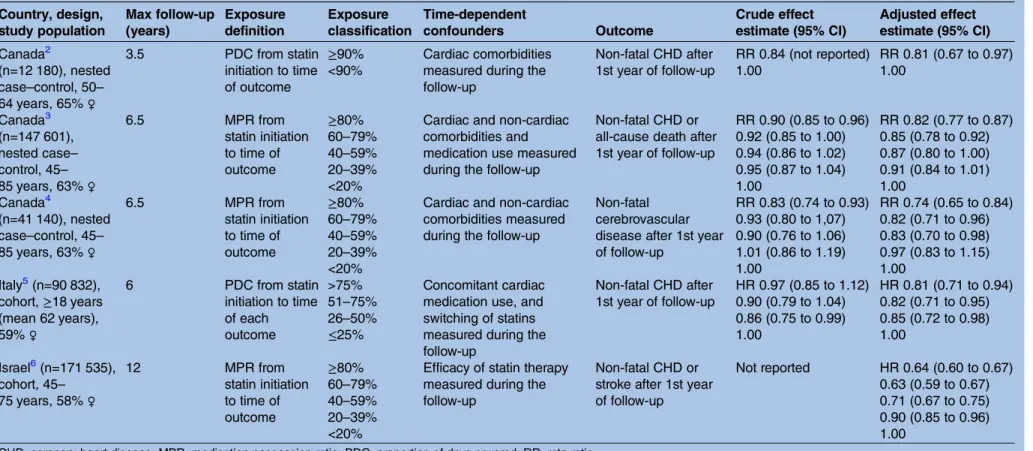
Earlier studies on the relationship between statin adherence and CVD in primary prevention populations have attempted to account for time-dependent con-founding by occurrence of other forms of CVD2–5 or changes in the intensity of statin therapy4 6 during the follow-up (table 4). They have measured adherence and time-dependent confounders at the same time point, and potentially induced bias in the causal analysis. Adjustment for intermediate variables along the causal pathway in addition to different definitions for adher-ence, outcomes and populations in primary prevention (table 4) may be reasons for the differences in the esti-mated reductions in the event incidence when com-pared to our results.10 In our study, addition of time-dependent confounders measured simultaneously with adherence (ie, intermediate variables) to the adher-ence models for MSM produced a slightly stronger asso-ciation between adherence and acute cardiovascular events (HR: 0.74, 95% CI 0.61 to 0.89) than our original MSM (HR: 0.78, 95% CI 0.64 to 0.93). In the presence of unmeasured predictors that are causes both for an intermediate variable and the outcome, conditioning on the intermediate variable may open a non-causal path between adherence and the outcome and may, thereby, create an additional association.10 38Thus, due to adjust-ment for intermediate variables, the apparent effect may be weaker or stronger than the true effect.
In the comparison between individuals who were slightly adherent with the extremely non-adherent, we observed a potential but non-significant effect (HR: 0.85, 95% CI 0.62 to 1.16) on the hazard of acute car-diovascular events. This observed effect for statins is rea-sonable in comparison with the results emerging from primary prevention trials (risk ratios 0.67 for non-fatal myocardial infarction, and 0.69 for non-fatal stroke over a maximum of 5.3 years of follow-up39) as the average adherence level among those with at least one refill was most likely lower than adherence levels in these con-trolled trials.
Our study has several strengths. First, we expanded on the previous studies by accounting for time-dependent confounding affected by previous adherence in addition to the time dependence of adherence.40 Specifically, we used lagged time-dependent confounders in the IPTW
construction to ensure that we had a proper time sequence. Adherence was measured as PDC in yearly periods and dichotomised using 80% as a cut-off value. Although the method improved measurement of adher-ence compared to the earlier studies, where adheradher-ence was typically measured as a fixed value throughout the follow-up,2–7 it produced rough estimates. Recently, Bijlsma et al41 extended the PDC method to quantify adherence in the time intervals between consecutive prescriptions, and the method was shown to produce more precise estimates compared with afixed-time PDC measure. Second, as both medical procedures related to CHD and death from any cause can be regarded as a competing risk for acute cardiovascular events, we formed a new composite end point for the sensitivity analysis to account for the potential selection bias35and observed that these competing risks did not contribute appreciably to the bias. Finally, we used low-energy frac-tures as a negative control outcome, and observed a 10%, non-significant reduction in the hazard of fractures suggesting that part of the observed effect of statin adherence on acute cardiovascular events may be due to the healthy-adherer effect. It is noteworthy, however, that unmeasured confounding by body mass index may have changed the HRs for fractures and CVD events in oppos-ite directions: being overweight and obesity seem to improve statin adherence,42and are known to lower frac-ture risk.43 However, these may increase the risk of CHD.44 Other approaches to adjust effect estimates for unmeasured confounding include, for example, integra-tion of validaintegra-tion data45 and instrumental variable ana-lysis.46 In our recent study,8 healthy-adherer effect was examined using propensity score calibration with an external validation study to adjust for selected lifestyle factors (body mass index, smoking, alcohol use, physical activity) and self-reported health. However, no major effect on the effect estimate was found. Finally, conduct-ing a randomised controlled trial would guarantee exchangeability between the groups at baseline, but the design is not feasible for examining the effects of medi-cation adherence.47
Table 4 Population-based studies on the effect of statin adherence on cardiovascular morbidity in primary prevention of cardiovascular disease that have adjusted for time-dependent confounding
Country, design, study population
Max follow-up (years)
Exposure definition
Exposure classification
Time-dependent
confounders Outcome
Crude effect estimate (95% CI)
Adjusted effect estimate (95% CI)
Canada2
(n=12 180), nested case–control, 50– 64 years, 65%♀
3.5 PDC from statin initiation to time of outcome
≥90% <90%
Cardiac comorbidities measured during the follow-up
Non-fatal CHD after 1st year of follow-up
RR 0.84 (not reported) 1.00
RR 0.81 (0.67 to 0.97) 1.00
Canada3 (n=147 601), nested case– control, 45– 85 years, 63%♀
6.5 MPR from statin initiation to time of outcome
≥80% 60–79% 40–59% 20–39% <20%
Cardiac and non-cardiac comorbidities and medication use measured during the follow-up
Non-fatal CHD or all-cause death after 1st year of follow-up
RR 0.90 (0.85 to 0.96) 0.92 (0.85 to 1.00) 0.94 (0.86 to 1.02) 0.95 (0.87 to 1.04) 1.00
RR 0.82 (0.77 to 0.87) 0.85 (0.78 to 0.92) 0.87 (0.80 to 1.00) 0.91 (0.84 to 1.01) 1.00
Canada4
(n=41 140), nested case–control, 45– 85 years, 63%♀
6.5 MPR from statin initiation to time of outcome
≥80% 60–79% 40–59% 20–39% <20%
Cardiac and non-cardiac comorbidities measured during the follow-up
Non-fatal cerebrovascular disease after 1st year of follow-up
RR 0.83 (0.74 to 0.93) 0.93 (0.80 to 1,07) 0.90 (0.76 to 1.06) 1.01 (0.86 to 1.19) 1.00
RR 0.74 (0.65 to 0.84) 0.82 (0.71 to 0.96) 0.83 (0.70 to 0.98) 0.97 (0.83 to 1.15) 1.00
Italy5(n=90 832), cohort,≥18 years (mean 62 years), 59%♀
6 PDC from statin initiation to time of each outcome
>75% 51–75% 26–50% ≤25%
Concomitant cardiac medication use, and switching of statins measured during the follow-up
Non-fatal CHD after 1st year of follow-up
HR 0.97 (0.85 to 1.12) 0.90 (0.79 to 1.04) 0.86 (0.75 to 0.99) 1.00
HR 0.81 (0.71 to 0.94) 0.82 (0.71 to 0.95) 0.85 (0.72 to 0.98) 1.00
Israel6(n=171 535), cohort, 45–
75 years, 58%♀
12 MPR from
statin initiation to time of outcome
≥80% 60–79% 40–59% 20–39% <20%
Efficacy of statin therapy measured during the follow-up
Non-fatal CHD or stroke after 1st year of follow-up
Not reported HR 0.64 (0.60 to 0.67) 0.63 (0.59 to 0.67) 0.71 (0.67 to 0.75) 0.90 (0.85 to 0.96) 1.00
CHD, coronary heart disease; MPR, medication possession ratio; PDC, proportion of days covered; RR, rate ratio.
La
vikainen
P
,
et
al
.
BMJ
Open
2016;
6
:e011306.
doi:10.1136/
bmjopen-20
16-011306
n
Ac
primary discharge diagnoses in the Finnish Care Register. Validation studies of the register have reported a positive predictive value of 80% for ischaemic stroke among women aged 25 years and older during the years 1993–1998, and that of 69% for ACS among women aged 35–74 years during 1998–2002 when compared with the Finnish population-based stroke and myocardial infarction registers.49 50 The temporal distance between the observed adherence and outcomes of interest was between 1 and 365 days. It is possible that the risk of outcome has been affected by changes in the adherence level during the outcome assessment period. Furthermore, our study population consisted of women who initiated statin use in the early 2000s. Subsequently, there has been a shift towards more intensive statin therapy leading to potentially larger relative benefits associated with adherence.28 Lastly, MSM assumes no unmeasured confounding, but we had no data on some important confounders, such as cholesterol level, blood pressure, smoking or family history of CVD. However, we were able to adjust for presence of the most severe forms of hypertension and dyslipidemia leading to hos-pitalisation or entitlement to special reimbursement, which may have partly controlled for confounding by cholesterol and blood pressure levels.
CONCLUSIONS
This paper supports the earlier results of the beneficial effect of sufficient adherence to statin therapy for patients in primary prevention of CVD. We also showed that accounting for the confounding factors on the causal pathway correctly did not appreciably change this result, presumably because time-dependent confound-ing was not strong.
Author affiliations
1Department of Pharmacology, Drug Development and Therapeutics, University of Turku, Turku, Finland
2Drug Research Doctoral Programme, University of Turku, Turku, Finland 3Unit of Primary Health Care, Hospital District of Helsinki and Uusimaa, Helsinki, Finland
4The Center of Statistics, University of Turku, Turku, Finland
5Division of Pharmaceutical Outcomes and Policy, Eshelman School of Pharmacy, University of North Carolina, Chapel Hill, North Carolina, USA 6Heart Center, Kuopio University Hospital, Kuopio, Finland
7School of Medicine, University of Eastern Finland, Kuopio, Finland 8Department of Clinical Pharmacology, Tykslab, Turku University Hospital, Turku, Finland
Contributors PL participated in conception and design of the study, performed and was responsible for statistical analyses, participated in interpretation of data, and wrote the first version of the manuscript. AH-S participated in the conception and design of the study, and in interpretation of the data, drafted the article and revised it critically for important intellectual content. ME supervised the statistical analyses, participated in interpretation of data and revised the article critically for important intellectual content. GF participated in analyses and interpretation of data, reviewed the article and revised it critically for important intellectual content. JH participated in interpretation of data and revised the article critically for important intellectual content. RH participated in conception and design of the study, and revised the article critically for important intellectual content. MJK participated in conception and design of the study, and was responsible for the acquisition
of data and for statistical analyses, participated in interpretation of data, and drafted the article and revised it critically for important intellectual content. The final approval of the version to be published was approved by all the authors.
Funding The study was funded by the Academy of Finland (http://www.aka.fi, decision number 138255) and the Social Insurance Institution of Finland (decision number 10/26/2007). The Academy of Finland and the Social Insurance Institution had no role in the design, analyses, interpretation of data, writing of the report, or in the decision to submit the manuscript. Competing interests AH-S, MJK and RH have been funded by grants from the Social Insurance Institution and the Academy of Finland. RH is a member of the Advisory Board for Social and Medical Affairs of the Social Insurance Institution of Finland. JH has received research grants from the Finnish Foundation for Cardiovascular Research and the European Union Seventh Framework Programme. He has given lectures for Cardiome, St Jude Medical and Biotronic, and has been a member of the advisory boards for Astra Zeneca, Amgen, and Bayer. GF receives research funding from the US National Institute of Aging, Patient Centered Outcomes Research Institute, and Agency for Healthcare Research and Quality.
Provenance and peer review Not commissioned; externally peer reviewed. Data sharing statement No additional data are available.
Open Access This is an Open Access article distributed in accordance with the Creative Commons Attribution Non Commercial (CC BY-NC 4.0) license, which permits others to distribute, remix, adapt, build upon this work non-commercially, and license their derivative works on different terms, provided the original work is properly cited and the use is non-commercial. See: http:// creativecommons.org/licenses/by-nc/4.0/
REFERENCES
1. Osterberg L, Blaschke T. Adherence to medication.N Engl J Med
2005;353:487–97.
2. Bouchard MH, Dragomir A, Blais J,et al. Impact of adherence to statins on coronary artery disease in primary prevention.Br J Clin Pharmacol2007;63:698–708.
3. Perreault S, Dragomir A, Blais L,et al. Impact of better adherence to statin agents in the primary prevention of coronary artery disease.
Eur J Clin Pharmacol2009;65:1013–24.
4. Perreault S, Ellia L, Dragomir A,et al. Effect of statin adherence on cerebrovascular disease in primary prevention.Am J Med
2009;122:647–55.
5. Corrao G, Conti V, Merlino L,et al. Results of a retrospective database analysis of adherence to statin therapy and risk of nonfatal ischemic heart disease in daily clinical practice in Italy.Clin Ther
2010;32:300–10.
6. Shalev V, Goldshtein I, Porath A,et al. Continuation of statin therapy and primary prevention of nonfatal cardiovascular events.Am J Cardiol2012;110:1779–86.
7. Slejko JF, Ho PM, Anderson HD,et al. Adherence to statins in primary prevention: yearly adherence changes and outcomes.
J Manag Care Pharm2014;20:51–7.
8. Rannanheimo PK, Tiittanen P, Hartikainen J,et al. Impact of statin adherence on cardiovascular morbidity and all-cause mortality in the primary prevention of cardiovascular disease: a population-based cohort study in Finland.Value Health2015;18:896–905. 9. Korhonen MJ, Helin-Salmivaara A, Huupponen R. Dynamics of
long-term statin therapy.Eur J Clin Pharmacol2011;67:925–31. 10. Robins JM, Hernán MA, Brumback B. Marginal structural models
and causal inference in epidemiology.Epidemiology
2000;11:550–60.
11. Daniel RM, Cousens SN, De Stavola BL,et al. Methods for dealing with time-dependent confounding.Statist Med2013;32:1584–618. 12. Brookhart MA, Patrick AR, Dormuth C,et al. Adherence to
lipid-lowering therapy and the use of preventive health services: an investigation of the healthy user effect.Am J Epidemiol
2007;166:348–54.
13. Dormuth CR, Patrick AR, Shrank WH,et al. Statin adherence and risk of accidents: a cautionary tale.Circulation2009;119:2051–7. 14. Patrick AR, Shrank WH, Glynn RJ,et al. The association between
statin use and outcomes potentially attributable to an unhealthy lifestyle in older adults.Value Health2011;14:513–20.
16. Robins JM. Causal models for estimating the effects of weight gain on mortality.Int J Obes (Lond)2008;32:S15–41.
17. Hernán MA, Brumback B, Robins JM. Marginal structural models to estimate the causal effect of zidovudine on the survival of HIV-positive men.Epidemiology2000;11:561–70.
18. About the ATC/DDD system. WHO. http://www.whocc.no/atcddd/ (accessed Jan 2016).
19. Andrade SE, Kahler KH, Frech F,et al. Methods for evaluation of medication adherence and persistence using automated databases.
Pharmacoepidemiol Drug Saf2006;15:565–74.
20. Colhoun HM, Betteridge DJ, Durrington PN,et al. Primary prevention of cardiovascular disease with atorvastatin in type 2 diabetes in the Collaborative Atorvastatin Diabetes Study (CARDS): multicentre randomised placebo-controlled trial.Lancet
2004;364:685–96.
21. Mizuno K, Nakaya N, Ohashi Y,et al. Usefulness of pravastatin in primary prevention of cardiovascular events in women. Analysis of the Management of Elevated Cholesterol in Primary Prevention Group of Adult Japanese (MEGA Study).Circulation
2008;117:494–502.
22. Sever PS, Dahlöf B, Poulter NR,et al. Prevention of coronary and stroke events with atorvastatin in hypertensive patients who have average or lower-than-average cholesterol concentrations, in the Anglo-Scandinavian Cardiac Outcomes Trial–Lipid Lowering Arm (ASCOT-LLA): a multicenter randomized controlled trial.Lancet
2003;361:1149–58.
23. Downs JR, Clearfield M, Weis S,et al. Primary prevention of acute coronary events with lovastatin in men and women with average cholesterol levels. Results of AFCAPS/TexCAPS.JAMA
1998;279:1615–22.
24. Bukkapatnam RN, Gabler NB, Lewis WR. Statins for primary prevention of cardiovascular mortality in women: a systematic review and meta-analysis.Prev Cardiol2010;13:84–90.
25. Leslie SR, Gwadry-Sridhar F, Thiebaud P,et al. Calculating medication compliance, adherence and persistence in administrative pharmacy claims databases.Pharm Program2008;1:13–19. 26. Romppainen T, Rikala M, Aarnio E,et al. Measurement of statin
exposure in the absence of information on prescribed doses.Eur J Clin Pharmacol2014;70:1275–6.
27. Karve S, Cleves MA, Helm M,et al. Good and poor adherence: optimal cut-point for adherence measures using administrative claims data.Curr Med Res Opin2009;25:2303–10.
28. Chowdhury R, Khan H, Heydon E,et al. Adherence to
cardiovascular therapy: a meta-analysis of prevalence and clinical consequences.Eur Heart J2013;34:2940–8.
29. Lefebvre G, Delaney JAC, Platt RW. Impact of mis-specification of the treatment model on estimates from a marginal structural model.
Statist Med2008;27:3629–42.
30. Brookhart MA, Schneeweiss S, Rothman KJ,et al. Variable selection for propensity score models.Am J Epidemiol
2006;163:1149–56.
31. Stone NJ, Robinson J, Lichtenstein AH,et al. ACC/AHA guideline on the treatment of blood cholesterol to reduce atherosclerotic cardiovascular risk in adults: a report of the American College of Cardiology/American Heart Association Task Force on Practice Guidelines.Circulation2013;129:S1–45.
32. Quan H, Sundararajan V, Halfon P,et al. Coding algorithms for defining comorbidities in ICD-9-CM and ICD-10 administrative data.
Med Care2005;43:1130–9.
33. Kaufman J. Marginalia: comparing adjusted effect measures.
Epidemiology2010;21:490–3.
34. Cole SR, Hernán MA. Constructing inverse probability weights for marginal structural models.Am J Epidemiol2008;168:656–64. 35. Austin PC. Goodness-of-fit diagnostics for the propensity score
model when estimating treatment effects using covariate adjustment with the propensity score.Pharmacoepidemiol Drug Saf
2008;17:1202–17.
36. Hernán MA, Schisterman EF, Hernández-Díaz S. Invited commentary: composite outcomes as an attempt to escape from selection bias and related paradoxes.Am J Epidemiol
2014;179:368–70.
37. Peña JM, Aspberg S, MacFadyen J,et al. Statin therapy and risk of fracture. Results from the JUPITER randomized clinical trial.JAMA Intern Med2015;175:171–7.
38. Hernán MA, Hernández-Díaz S, Robins JM. A structural approach to selection bias.Epidemiology2004;15:615–25.
39. Taylor F, Huffman MD, Macedo AF,et al. Statins for the primary prevention of cardiovascular disease.Cochrane Database Syst Rev
2013;1:CD004816.
40. Parienti JJ. The art of modeling adherence: shades or shapes?
Pharmacoepidemiol Drug Saf2015;24:1114–16.
41. Bijlsma MJ, Janssen F, Hak E. Estimating time-varying drug adherence using electronic records: extending the proportion of days covered (PDC) method.Pharmacoepidemiol Drug Saf
2016;25:325–32.
42. Halava H, Korhonen MJ, Huupponen R,et al. Lifestyle factors as predictors of nonadherence to statin therapy among patients with and without cardiovascular comorbidities.CMAJ2014;186:E449–56. 43. Johansson H, Kanis JA, Odén A,et al. A meta-analysis of the
association of fracture risk and body mass index in women.J Bone Miner Res2014;29:223–33.
44. Canoy D, Cairns BJ, Balkwill A,et al. Body mass index and incident coronary heart disease in women: a population-based prospective study.BMC Med2013;11:87–95.
45. Stürmer T, Glynn RJ, Rothman KJ,et al. Adjustments for unmeasured confounders in pharmacoepidemiologic database studies using external information.Med Care2007;45:S158–65. 46. Greenland S. An introduction to instrumental variables for
epidemiology.Int J Epidemiol2000;29:722–9.
47. Choudhry NK, Glynn RJ, Avorn J,et al. Untangling the relationship between medication adherence and post-myocardial infarction outcomes: medication adherence and clinical outcomes.Am Heart J
2014;167:51–8.
48. Cole SR, Platt RW, Schisterman EF,et al. Illustrating bias due to conditioning on a collider.Int J Epidemiol2010;39:417–20. 49. Tolonen H, Salomaa V, Torppa J,et al. The validation of the Finnish
Hospital Discharge Register and Causes of Death Register data on stroke diagnoses.Eur J Cardiovasc Prev Rehabil2007;14:380–5. 50. Pajunen P, Koukkunen H, Ketonen M,et al. The validity of the
Finnish Hospital Discharge Register and Causes of Death Register data on coronary heart disease.Eur J Cardiovasc Prev Rehabil