REVIEW CULTURE AND THE GROWING SIGNIFICANCE OF CUSTOMER EVALUATION IN SERVICE WORK: A QUALITATIVE STUDY OF REAL ESTATE
BROKERS AND THEIR WORK
Alexis Bryson
A dissertation submitted to the faculty at the University of North Carolina at Chapel Hill in partial fulfillment of the requirements for the degree of Doctor of the Philosophy in the
Department of Communication.
Chapel Hill 2017
Approved by: Michele Berger Sarah E. Dempsey Steve May
iii ABSTRACT
Alexis Bryson: Review Culture and the Growing Significance of Customer Evaluation in Service Work: A Qualitative Study of Real Estate Brokers and their Work
(Under the direction of Sarah E. Dempsey)
Review culture, or the recent proliferation of online evaluation and feedback by
customers about their consumptive experiences, places the expectations, desires, and opinions of customers at the forefront of service relations and organizational decision making. This
dissertation investigates how workers experience the demands created by review culture. While customer opinions tend to be framed as valuable for the organization, they can also have serious impacts for workers’ livelihoods. The study is situated in the work of real estate brokers in central North Carolina who are at the forefront of service industries experiencing structural changes stemming from new modes of customer evaluation and participation. Qualitative methods offer insight into experiences of real estate work including the norms of self branding that underlie reviewing trends. Interviews with real estate brokers, observations from meetings, events, and trainings, cultural artifacts, and fieldwork illustrate how customer review practices are transforming work relationships in the real estate context. Drawing upon interview data, the study discusses the conditions under which brokers adopt, disregard, and contest customer’s increasingly public evaluation of their services.
To identify ways that workers perceive and negotiate review culture, each chapter explores a different aspect of worker-customer engagement in person and online. Key
iv
well the mediating role of digital platforms that both facilitate and regulate customer review procedures and everyday work. Taken together, the chapters demonstrate the spread and influence of review culture in real estate work, including the troubling finding that customers’ subjective assessments potentially exacerbate norms and expectations of service workers. As my study suggests, the benefits that result from review culture are unevenly distributed, raising questions about what type of interventions might be needed. Ultimately, this study highlights the ways that review culture, and the proliferate publication, promotion, and protection of consumer voices, impact workers less prepared to mitigate—or capitalize—the effects of customer
v
ACKNOWLEDGEMENTS
First and foremost, I want to thank my advisor, Sarah Dempsey, whose unflagging commitment to nurturing, supporting, and challenging my work has made this dissertation possible. Sarah has been a mentor, teacher, writing partner, and so much more, and I will always be grateful for her contributions to my development as a scholar.
I am deeply thankful for my committee members and their sustained interest and investment in my academic pursuits. Steve May inspired my dedication to studies in
communication, with endless optimism and encouragement. Torin Monahan taught me the art of generous reading, collegiality, and confidence. Dennis Mumby generously shared knowledge that helped frame my understanding of critical organizational communication scholarship.
Michele Berger offered guidance—her course on intersectionality in particular changed the way I think about the role of critical scholars. Many others in the department have gone out of their way to read my work, offer valuable insights, and contribute significantly to my reading, writing, and teaching as pillars of academic scholarship. I could not have accomplished this without all of you and I am sincerely grateful for your support.
As for my colleagues, Jessica Rich, your work will always be my “exemplar.” To my cohort, I was lucky to be paired with you all. I am especially grateful for the kindness and kindred spirit of Lucy Burgchart and Mary Domenico.
vi
TABLE OF CONTENTS
List of Figures……….xi
Chapter 1: Introduction to Review Culture ……….1
The New, Neoliberal Economy and Post-Fordist Work……….6
The Acceptance of Risk……….7
Identity and Authentic Selves………7
Service Work………..8
Emotion Labor………...8
Changing Relations of Control and Resistance……….9
Customer Service Expectations………...10
Study Context: Real Estate Work……….13
Selling Property, Selling Themselves...………...13
Defining Jobs in Real Estate: Agent, Broker, REALTOR®...………15
Demographic Features……….17
Income Potential and Commission Structures……….19
Norms of Professional Networking……….21
Formal Regulation: Fair Housing and “real estate jail”………...22
Chapter Overview……….24
Chapter 2: Developing a Qualitative Study of Real Estate………31
Setting the Scene: North Carolina Real Estate Work………...31
vii
Real Estate Broker Licensing………...33
Professional Training: Learning How to Self-Brand………...35
Role Distinctions………..36
Professional Associations………...……….37
Using a Qualitative Approach………...38
Immersion in the Real Estate Scene………..40
Team Meetings……….41
Open House Observations………....43
Customer Appreciation Events………44
Career Night……….45
Education and Training………....46
Motivational Seminars……….48
Ride Along Interviews………...51
Interview Participants………...53
Locating Industry Discourse: Textual Analysis………55
Interviewing in the Context of Real Estate………...56
Developing Interview Questions………...59
Qualitative Data Analysis and Interpretation………60
Chapter 3: Experiencing Review Culture………..64
The Rise of Online Customer Review Platforms………..66
Online Customer Review Practices in Real Estate………...68
Evaluating Brokers’ Reports of Customer Reviews………68
Contextualizing the Significance of Reviews………..70
viii
The Cost of Review Culture………78
Managing Negative Reviews, Bullying, and False Reports………81
Questioning the Ethics of Review Culture: Gaming the System……….88
Reconfiguring Organizational Responsibilities through Customer Labor………...89
Discussion……….93
Chapter 4: Coached Customer Relations: The Buffini Method……….98
Methods for Studying Career Coaching Discourses………...100
Data Analysis for Understanding the Buffini Method………..102
The Buffini Method………103
Broker Perceptions of Career Coaching……….106
Disidentifying from “Bad” Brokers: “Nobody Else Knows What They’re Doing”……..108
Identifying as “Valuable” ……….112
Creating Intimacy with Customers: Being Your Friend To Get “A Client For Life”…...115
Top of Mind………...118
Pop Bys………..121
Customer Appreciation Events………..124
Practices of Inclusion and Exclusion: Selecting “The Referral Type”………..128
Quantifying Relationships: A+ Customers………132
Managing Social Identity………138
Professional Identity: When the Brand is Your Family……….138
Managing Customer Biases………...140
Discussion………144
ix
Methods for Studying Algorithms………..150
Contextualizing Digital Experiences: Introducing Zillow.com………..153
Evaluating Brokers’ Perceptions of Zillow……….154
Sources of (Mis)Information: Contesting Zillow as Authoritative………157
Discerning Zillow Advertising………..162
Algorithmic Calculations: The Zestimate®………168
Agent Profiles: Sources, Syndication, and Data Management………...172
Displaying Customer Experience………...177
Soliciting Brokers to Solicit Reviews………177
Management Rules, Algorithmic Codes, and Human Intervention………...181
Discussion………...184
Zillow as Active Participant: Mediating Work, Accumulating Capital……….186
Challenging Transparency, Authenticity, and Trustworthiness……….188
Chapter 6: Conclusion: The Future of Service Work……….……….191
Significant Contributions………192
Control and Resistance………..193
Customer Reviews as Prosumption………...195
Emotion Labor and the Commodification of Relationships………..196
Strategies of (Dis)Identification...……….198
(Online) Reputation Management………..198
Reflecting on Study Methods……….199
Future Directions and Questions……….202
Customer Surveillance as Multi-Way Watching………...203
x
Social Identity, Difference, and Intersectionality………..198
Final Thoughts………209
Appendix A: Interview Guide……….210
Appendix B: Review Culture Examples………..…212
xi
LIST OF FIGURES
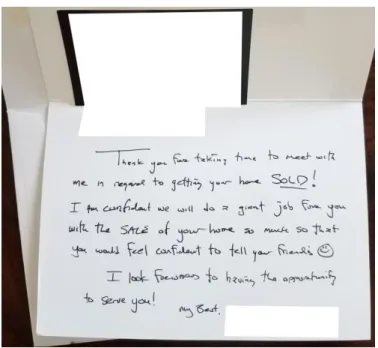
Figure 1 – Hand written thank you note mailed to potential client………...91 Figure 2 – “Happy Mother’s Day” gift mailed by a broker……….118 Figure 3 – Pop By cookie mix and recipe gift, “Don’t get stuck with a
‘crumby’ realtor. Thanks for ‘baking’ the world a better place.”………..….…….122 Figure 4 – “Happy Thanksgiving” pumpkin pie given at a customer appreciation event……...126 Figure 5 – Collage of hand-written customer reviews on display at a restaurant………212 Figure 6 – Facebook post by HGTV stars Drew and Jonathan Scott
requesting customers to review their new book on Amazon….………..213 Figure 7 – Box requesting customer feedback on employee service on
display at a Harris Teeter grocery store………...214 Figure 8 – Personal follow-up email requesting customer survey “they are
my personal report cards… If for any reason at all you feel that you cannot give me a rating of truly exceptional or all 10’s on that survey could you please contact me with feedback so that I may improve and
deliver the level of service that you deserve and expect?”………..215 Figure 9 – Survey request “It will help us to make improvements to our
organization over the coming year” emailed by Operation Warm……….216 Figure 10 – Survey request “As a thank you for your time, at the end of this
survey you will have the option to be entered into our drawing to win
a $250 Staples Gift Card” emailed by Staples……….217 Figure 11 – Customer survey request emailed by Qdoba………218 Figure 12 – Survey request “Just rate your meals, and you’re done!
1
CHAPTER 1: INTRODUCTION TO REVIEW CULTURE
On December 14th, 2016 President Barack Obama signed into law H.R. 5111, the “Consumer Review Fairness Act of 2016.” The Act stipulates that a contract can become void “if it prohibits, or restricts, an individual from engaging in a review of a seller’s goods, services, or conduct” (The White House Office of the Press Secretary, 2016). The Act, passed by unanimous vote in Congress, concretizes review culture, a phenomenon that motivated this study more than two years ago. Review culture characterizes the recent proliferation of online evaluation and feedback by customers about their consumptive experiences.
For just over a decade, since the creation of online venues designed specifically to accumulate and display customer comments and ratings, reading, writing, and sharing customer reviews have grown as significant social, cultural, and economic practices.
According to the Federal Trade Commission, “honest consumer assessments” can be shared “in any form” including “reviews, social media posts, uploaded photos, videos, etc.” (Federal Trade Commission, 2017). Customer review solicitation has become so prevalent that it can be difficult to escape businesses’ requests for reviews following nearly any consumptive experience (Van Ogtrop, 2016). Review culture practices warrant critical attention,
particularly in terms of how they are impacting workers already navigating the emergence of a service-based, post-Fordist economy defined through neoliberal conditions.
2
changes in the (service) workplace and the nature of work and organizing. By focusing on how a specific group of service workers are currently experiencing review culture, the study offers critical examination of changes to organizational life, including how the structures, processes, and sensibilities of customer reviewing shape everyday work lives. At the same time, I offer evidence that not only service professionals, but also customers, are facing a reorganization of responsibilities. Customers produce value poised for corporate capture when engaging in review culture. Performances of emotional expression and intimacy, once relegated to service workers, are a form of customer labor. Regardless of employment status, individuals are increasingly drawn into relationships that generate value through
communicative interactions of opinion and experience sharing available for systematic capture by capital.
3
of defamation, libel, slander, and harassment, as well as accusations of “clearly false or misleading” statements (Investopedia, 2013; Miles, 2015). Following these events, Yelp, Amazon, and other well-known customer review websites that circulate public customer reviews now offer suggestions on how to clarify reviews as opinions rather than statements of fact (Investopedia, 2013). In addition, Yelp instituted a policy to notify website users of recent legal action with an alert that states: “This business may be trying to abuse the legal system in an effort to stifle free speech, including issuing questionable legal threats against reviewers. As a reminder, reviewers who share their experiences have a First Amendment right to express their opinion on Yelp” (Chamlee, 2016). Customer review websites have also brought lawsuits against organizations that offer to publish positive reviews as a service such as Fiverr.com, Freelancer.com, and Buyamazonreviews.com (Greene, 2015; Tuttle, 2015). As they argue, these “fake” reviews can jeopardize the legitimacy of review platforms that advertise access to authentic experience sharing. As recent events indicate, there are significant financial stakes in the presence and content of customer reviews. Business
reputations and finances depend upon positive reviews; websites have a stake in encouraging consumers to continue posting their reviews as valuable website content.
Proponents of the Customer Review Fairness Act frame customer reviews as a form of democratic public participation. The Act has been hailed as “a big step to protect free speech online” because it outlaws the use of “anti-review contracts”—colloquially termed “gag orders”—used to limit “customers’ ability to criticize products and services online” by threat of legal or monetary recourse (Addady, 2016; Harmon, 2016). Online customer
4
personal recommendations (BrightLocal, 2013). Sixty-seven percent of customers in this survey reported forming opinions after reading six reviews or less. Surveys signal how consumers are looking to each other for a perceived sense of honesty, openness, and trustworthiness uniquely available through experience sharing. However, customer evaluations are not simply a form of consumer “empowerment” (Kuehn, 2015), but rather can be subverted as websites monitor and mediate customer input and presence.
While there has been a lot of attention to review practices within ongoing debates over consumer rights and business autonomy, worker protections are not readily apparent as a cause for concern. There is critical need to understand how reviewing is affecting workers. This study contributes to organization and communication analyses of work by asking: How is review culture changing experiences of service work increasingly defined through
customer participation and evaluation? My study builds upon recent findings to illuminate the potential consequences of discourses and practices of customer input and participation in reshaping the landscape of contemporary workplace procedures (Fleming, 2009; Hochschild, 2012; Tracy, 2000, 2005). By examining how workers experience customer service
imperatives and practices of evaluation on an individualized level, I argue that review practices are significant sources of value as well as strain. Workers benefit from the
reputation and brand value of workers’ positive opinions. At the same time, coached methods for acquiring positive reviews inculcate continuous efforts to build lasting relationships with customers by drawing on entrepreneurial abilities and emotional labor (Fleming, 2009, 2013; Fleming & Sturdy, 2011; Hochschild, 2012; Tracy, 2000, 2005). Workers internalize
5
about workers’ reputations, careers, values, personality, personal behavior, social interactions, and overall public image, can affect organizational hiring, firing, and
disciplinary decisions (Berkelaar & Buzzanell, 2014; Berkelaar et al., 2014; Sperber, 2014). Despite efforts to nurture relationships and craft intimacy with customers, however, anxiety over the threat of negative reviews remains as a preoccupying force for many workers. At the same time, through intensive efforts to manage and control customer interactions, workers effectively expand organizational boundaries to integrate customers as members
(Korczynski, 2001; Korczynski & Ott, 2004; Leidner, 1991, 1993; Ritzer, 2013; Sturdy, 2001; Sturdy, Grugulis, & Willmott, 2001). Customers take on the labor of marketing, branding, and generating new business when they write reviews, share opinions, and encourage others to transact with a particular real estate broker. Performances of emotional expression and intimacy, once relegated to service workers, become a form of customer labor. Further, workers, organizations, and corporate entities regulate rules for customers’ emotional display. Brokers direct customers on where, how, and how often to share their opinions while organizational rules and resources support brokers’ efforts to control the emotional responses and direct the behaviors of customers (Leidner, 1999).
6
industry as the primary mode of employment in the U.S. In the following sections, I outline the defining features of work in this new, customer service-oriented economy.
The New, Neoliberal Economy and Post-Fordist Work
Widespread transformations in the conditions and rules governing the employment relationship define the new economy and work under post-Fordist, neoliberal political, social, and economic conditions (Kalleberg, 2009, 2011). The shift from Fordist to post-Fordist organizing is defined by a loss of institutional protections that once safeguarded workers’ rights, wages, benefits, and sense of security. The social contract between workers and employers, or loyalty to a single company in exchange for lifetime employment, is no longer the predominant employment relation. Instead, flexible organizational structures and work processes, together with a shift towards prioritizing short-term returns rather than long-term wellbeing of companies, has led to part-time, temporary, contract employment as the new norm with continuous movement of workers into new, unstable and insecure job roles
7 The Acceptance of Risk
Ideologies of individual ability and self-reliance underlie acceptance of risky work (Gregg, 2011; Kunda et al., 2002; Neff, 2012). In this environment, workers engage in learning, training, and skill development to continually qualify for ‘better’ jobs (Kunda et al., 2002; Lair, 2011). Coached practices of self-selling and personal branding pervade job searches and career aspirations (Lair et al., 2005; Vallas & Cummins, 2015). In exchange for successfully navigating nonstandard employment relations, post-Fordist organizations promise opportunities for personal fulfillment through creativity, innovation, expert knowledge, and continuous improvement (Costea et al., 2008; Ross, 2003). Yet, although workers readily accept individualized financial responsibility and risk, they often fail to recognize larger conditions guiding their decisions (Neff, 2012). Temporary or contact work is believed to be a choice rather than the result of structural conditions such as layoffs (Kunda et al., 2002). These conditions of the acceptance of risk as commonplace in contemporary work arrangements inform the present study.
Identity and Authentic Selves
Although instances of employee empowerment suggest that work enables greater individual freedom (particularly in flexible movement between jobs), recent analyses attest to the transformation to more subtle, disciplinary control mechanisms impacting possibilities for identity and subjectivity (Costea et al., 2008; Gregg, 2011; Lair, 2011). Rather than achieving self-actualization through work, employees who bring their “authentic” selves to the workplace are subject to newer, more covert processes of value capture and
8
employees to share and display their identities, and then capture those identities as a source of value that supports the corporate brand (Land & Taylor, 2010).
The next section details the defining characteristics of the current consumption-based, service society that meaningfully shape experiences of work in the context of post-Fordist organizing, risky work, and identity through work.
Service Work
Service occupations are now the leading form of labor in the U.S. (Macdonald & Sirianni, 1996). They span tourism and transportation services, medicine, finance, arts, entertainment, sales, and recreation. The service industry comprises a wide range of jobs that produce intangible goods such as relations, feelings, ideas, meanings, symbols, emotions, and other intangible qualities, as well as services. Service interactions are fundamentally
communicative and centered on production of relationships, as opposed to products. Service workers, or ‘frontliners,’ engage with customers and clients through face-to-face and/or voice-to-voice contact (Bishop & Hoel, 2008; Leidner, 1993). Service relations can be short term such as when customers order food from a restaurant worker or ask questions of a call center employee. Or they can be long term such as ongoing interactions with a lawyer, financial advisor, or real estate agent. Regardless of the time frame of interaction, customer service relations blur distinctions between product/service and producer/consumer so that production and consumption are simultaneous, inseparable processes (Korczynski, 2001, 2005; Leidner, 1993, 1996).
Emotion Labor
During the service process, workers are responsible for maximizing customer
9
through the conveyance of carefully crafted displays of affect, likability, and comportment (Fleming, 2009; Hochschild, 2012; Tracy, 2000, 2005). A significant feature following the shift to a service society, therefore, is how workers’ moods, expressions, and attitudes increasingly become legitimate areas for customer supervision, intervention, and control (Leidner, 1996). Emotion rules, once developed and regulated by corporations, are now measured by customers as participants in the service relation. For instance, measures of customer satisfaction, including focus groups, written surveys, secret shoppers, and
customer-instigated responses, are used to evaluate, monitor, and discipline workers (Fuller & Smith, 1996). Here, customers become a “boss” when sharing comments regarding thoughts, feelings, and experiences influence workers’ attitudes, interactions, and decisions (Fuller & Smith, 1996, p. 85). Customer influence over subjective work experiences comes to the forefront of this study, particularly when customers direct the emotion labor, behavior, identity, and subjectivity of workers through myriad forms of evaluation including online reviews.
Changing Relations of Control and Resistance
quasi-10
workers, partial employees, or prosumers (Mills & Morris, 1986; Ritzer & Jurgenson, 2010). The term ‘prosumer’ describes when customers are actively engaged in productive capacities that benefit the corporation (Ritzer & Stillman, 2001; Ritzer, 2013). As prosumers, unpaid customer labor produces corporately captured value (Ball et al., 2010; Kitchin & Dodge, 2011; Korczynski, 2005; Leidner, 1996; Mills & Morris, 1986; Ritzer, 2013). For instance, customers perform labor through acts of consumption. Homes, bedrooms, and other nonwork spaces become locations of ‘work’ when customers surf the internet, click on websites, and submit personal information online (Gabriel et al., 2015). Access to individualized products and gaining a sense of enjoyment or empowerment becomes a justification for control over customers’ labor, which is ubiquitously removed from common understandings of what constitutes production (Andrejevic, 2002; Ball et al., 2010; Kitchin & Dodge, 2011). This study offers additional insight into the push-and-pull dynamics of control and resistance among organizations, workers, and customers by demonstrating instances when customers engage as controlling figures and when they contribute as unpaid producers of value. Customer Service Expectations
Structural changes to service work, including transformations in contemporary organizational relations to include the input of customers, customer opinion, influence, and involvement, are resulting in new forms of control and resistance relations unique neoliberal conditions and post-Fordist organizing. As others have recently demonstrated, customer service discourses colonize new domains of work (Sturdy, 2001) and exacerbate
11
12
about how customer review websites, as software systems that merge “traditional business directory information with a search engine, consumer-generated reviews and social
networking features,” take part in shaping how brokers engage with customers (Kuehn, 2015, p. 2). These digital platforms gather, aggregate, and display customer input according to corporate rules and coded procedures that remain opaque. Given these technological aspects, the study explores worker perceptions of opportunities for control in customer relations and review processes.
post-13
Fordist work defined through neoliberal conditions of risk. Imperatives of customer satisfaction, alongside regularized public reprimand for noncompliance, have significant implications for ongoing changes in the nature of work and organizing.
By focusing on how a specific group of service workers are currently experiencing review culture, the study offers critical examination of how the structures, processes, sensibilities of customer reviewing shape everyday work lives. At the same time, I offer evidence that not only service professionals, but also customers, are facing a reorganization of responsibilities. Customers produce value for poised for corporate capture when engaging in review culture via performances of intimacy and emotional expression. Ultimately, my findings point to how individuals are increasingly drawn into relationships that generate value through communicative interactions of opinion and experience sharing available for systematic capture by capital.
Study Context: Real Estate Work Selling Property, Selling Themselves
The unique characteristics of the real estate industry make it a rich site for analysis of how professional service workers are experiencing the increasing significance of customer review practices. Industry norms require that real estate workers brand, market, and sell themselves in order to build a potential customer base (Fodge, 2011; Gandini, 2015; Lair et al.2005). Real estate workers purchase everything from business cards, pens, car decals, nametags, and shopping cart advertisements to memberships and certifications that can be used to publicly demonstrate their services. The vast majority of these marketing items are branded with workers’ names, images, slogans, logos, and other identifying marks.
14
branding and social identity in organizing real estate work (Lair et al., 2005). Norms of marketing, advertising, and branding in real estate command that brokers operate as public figures through the open display of professionalized faces and bodies as standard practice. As one broker retold,
I got a new head shot done and I was choosing between some different facial
expressions and I was talking to the photographer and I said I feel like that one looks warmer… approachable … I paid one of my former clients actually to develop a logo for me and I wanted it to look professional like I take my job seriously and I’m not just packing at it ten hours a week or whatever. So I guess all of that is the image I’m trying to portray.
From photographs to logos, this broker demonstrates the importance of cultivating and displaying the right kind of professional image. Brokers’ photographs are integrated as a prominent feature on display within not only brokerage websites and consumer platforms such as Zillow but also on road signs, print advertisements, business cards, market reports, and myriad other materials that brokers pay to produce as part of their personal marketing and branding efforts. Although my findings draw on the broker photographs and artifacts I gathered over the twelve month study, I was unable to incorporate many of these images. These visuals were so heavily branded with corporate logos, business partners, company slogans, brokers’ names and faces, and other organizational markers that their inclusion risked undermining the confidentiality promised to participants.
15
That little twenty dollar nametag is one of your strongest marketing pieces because if you don’t have it on, nobody knows who you are or what you do. And if you’re at a grocery store, if you’re at Starbucks, nobody knows who you are and what you do…People may see you. They may not talk to you the first time or the second or the third but after a while they get used to seeing you, they get used to seeing you as a REALTOR® and if they’re in line or something they may say ‘so how’s the market?’ When helping mentees develop strategies to market their services, he explains: “kids and dogs are the best things. If you don’t have them, borrow them, and take them to the park, take
them to the dog park. Do whatever, walk the neighborhood. Because people talk to you.” This example captures themes I discuss throughout the dissertation, including the
commodification of relationships, the imperative to sell oneself as a requirement of real estate work, and the ways in which “life itself,” the everyday, extra-work selves, private interests, independent social abilities, personal aptitudes, lifestyle elements, get put to work in the name of authenticity (Fleming, 2009). His recommendations demonstrate the extent to which brokers encourage each other to integrate self-selling tactics into their daily lives. These conditions serve as the backdrop for understanding how workers seek and cultivate customer relationships as a means of establishing and protecting professional reputations. The next section introduces the defining characteristics of the industry in greater detail. Defining Jobs in Real Estate: Agent, Broker, REALTOR®
Real estate workers facilitate the lease, sale, and purchase of real property. Real estate workers are designated by three common titles: “broker,” “agent,” and “REALTOR®.” Regulations for defining each role and advancing from agent to broker status are determined at the state level. Requirements typically include a minimum age, level of education, real estate coursework, and licensing exam. Generally, brokers are licensed to manage all aspects of a real estate transaction and may operate an independent real estate office. Brokers
16
escrow account. Agents are licensed to manage many aspects of a transaction, but are not allowed to handle monetary elements. Agents must work under the supervision and mentorship of a broker during a set period of time during which time agents learn the complex legal, ethical, and practical elements of transacting real estate.
As independent contractors, workers can choose to affiliate with national franchises, local companies, or, with the correct licensure, they may establish an independent real estate company to become self-employed. Real estate workers solicit customers to buy, sell, and lease properties. Workers generally earn a commission based on a percentage of the property sale price. Workers also offer advice on price, mortgage, and market conditions, compare properties to recommend fair market pricing, promote and advertise properties through listing services, prepare documents such as purchase offers, and “stay current” on financing,
government programs, and real estate conditions such as fair housing laws (Bureau of Labor Statistics, 2015). As one broker I interviewed clarified, “We’re independent agents…real estate is like the lowest cost franchise you can get into. Versus buying a McDonalds. It is a franchise. It’s your business…I’m the only one that can downsize myself.” Perceptions of flexibility and control over work infiltrated descriptions of real estate as contract work. For instance, one broker/owner said, “it’s all in my hands in terms of the like income potential” yet he also said, “I have to really make a conscious effort” to stop working at night and on weekends to have “personal time.” Others described feeling underappreciated, underpaid, or overworked when:
17
Brokers’ storytelling demonstrates how navigating conditions of Post-Fordist work, including perceptions of flexibility and control alongside expectations of overwork, are no longer exceptional (Gregg, 2011).
The term REALTOR®/ REALTORS® is a trademark owned by the National Association of REALTORS® (NAR), the largest trade association in the US. The NAR, founded in 1908, grew from 1,646 to over 1.2 million members including “residential and commercial brokers, salespeople, property managers, appraisers, counselors, and others engaged in the real estate industry” (National Association of Realtors, 2017a). According to the NAR, sixty-three percent of all REALTORS® are female with a median age of fifty-three. Ninety-three percent have some formal education beyond a high school diploma. REALTORS® have a median experience of ten years, working four years at their present firm (National Association of Realtors, 2017b). Workers exhibit diverse professional and educational backgrounds with careers “in management, business, and financial professions, followed by sales and retail” with only four percent indicating real estate as a first career (National Association of Realtors, 2017c). Despite high employment rates, the NAR finds that eighty-seven percent of real estate agents “fail in the first 5 years” (Ferry, 2014). Similar to other forms of service work, long-term customer interaction in real estate work can lead to effects of burnout, withdrawal, exhaustion, and absenteeism (Deery, Iverson, & Walsh, 2002; Tracy, 2000).
Demographic Features
18
under ten percent are “Black or African American,” just over four percent are Asian, and almost fifteen percent are “Hispanic or Latino1” (Bureau of Labor Statistics, 2017). According to the NAR, “the majority of members are female homeowners with a college education” (National Association of Realtors, 2017c). The NAR Member Profile provides a more detailed breakdown of race and ethnicity. Eighty-two percent of REALTORS® are white, nine percent are Hispanics/ Latinos account for nine percent of REALTORS®, five percent are Black/ African Americans, and five percent are Asian/Pacific Islanders. Furthermore, according to the report, only twenty-two percent of REALTORS® with two years of experience or less are minorities. Twelve percent of REALTORS® were born outside the U.S. Although these data provide a limited breakdown, they offer some insight into the raced, classed, and gendered dimensions of real estate work as a white, female dominated profession.
Another major implication of the study, therefore, is how workers navigate social difference within review culture. Norms of public display, alongside customer assessments of individuals’ characteristics, heighten the visibility of social differences such as gender, race, sexual identity, or ability. The Consumer Review Fairness Act excludes protection from customer reviews that are “inappropriate with respect to race, gender, sexuality, ethnicity, or other intrinsic characteristic” (Federal Trade Commission, 2017). This is limiting, however, as the initial review of customers’ comments come at the level of commercial customer review platforms. As Chapter Five demonstrates, review websites solicit, vet, and censor customer reviews through unique operational rules, regulations, and procedures that determine which comments to publish and which to reject. Although some filtering occurs
1
19
automatically by algorithms, such as on the Zillow website, review platforms also rely on human intervention to determine what qualifies as “appropriate” content. Cultivating and displaying the right kind of professional image becomes even more paramount when subjectively written, and potentially unevenly reviewed, customer comments determine the visibility and significance of difference in an industry comprised of white, female workers. Income Potential and Commission Structures
According to the NAR, the median gross income of REALTORS® was $42,500 in 2016 (National Association of Realtors, 2017c). The Bureau of Labor Statistics places the national annual mean income of real estate workers slightly higher at $46,410 (Bureau of Labor Statistics, 2015). However, according to the NAR, fifty-six percent of members with two years or less experience earned less than $10,000 in 2016 whereas thirty-eight percent of members with more than sixteen years of experience made more than $100,000 (National Association of Realtors, 2017c). A variety of factors contribute to the gap in income among real estate workers new to the industry and those with more experience and established businesses, reputations, and professional networks. Yearly income depends on not only the number of transactions completed and commission rate but also the split of commission among various parties, as well as business expenses, taxes, and other monetary fees incurred as independent contractors competing for business among the same pool of potential
customers.
20
industry frequently receive a reduced commission split—as low as fifty percent—“while they learn the business.” Brokerages cite the time and resources workers require from the
organization to justify the low split. As one broker lamented, “I wish I got six percent on every deal, you know. Usually we get three percent and then we have to split that with our company and then pay taxes.” In a commission-based industry, when a sale falls through, brokers can “work forever and never get paid.” As the chapters illustrate, real estate workers often seek ways to succeed, and are compelled by coaching, training, and marketing systems that offer strategies for how to become a Top Producer.
21 Norms of Professional Networking
Traditionally, real estate workers have relied on professional networking through regional and national association memberships as well as interpersonal relations within community and family groups who produce referrals (House, 1977). According to one participant in this study, “relationships are huge in this business because it is cut throat. It’s commission based. People can get very hungry on it. And [it can] bring out the worst in people.” One broker explained how he became “an ambassador for the corporate relocations” to a department of a large job recruitment firm in order to develop a professional network for continued referrals. He said, “I just told the HR guy—I made this deal—‘use me and I’ll give you this incredible level of service plus you’ll get some economic advantages as well.’” The broker described “head hunting,” “schmoozing,” and “romancing” customers during tours of “some good restaurants and things” in Raleigh, as well as offering them “discounts” and “concessions.” This example demonstrates the pervasiveness of networking and self-marketing involved in generating real estate referrals. It also demonstrates how brokers capitalize on the flexibility of non-mandated commission rates—the source of discounts and concessions. In these instances, the broker foregoes income from individual transactions in order to secure a steady stream of new customers. Self-made networks are more common as professional associations originally formed to represent worker interests increasingly
22
Formal Regulation: Fair Housing and “real estate jail”
The Fair Housing Act, or Title VIII of the Civil Rights Act of 1968, “prohibits
23
fair housing laws, as well as the repercussions for noncompliance. For instance, if a violation occurs, the real estate agent as well as the real estate brokerage firm may be liable even if there is “no discriminatory intent.” A violation, moreover, can result in suspension or revocation of a real estate license, as well as reprimand for supervisors. As one broker clarified, “if I mess up, it falls to the Broker-in-Charge.” When I asked for clarification on experiences with difficult legal situations, brokers kept descriptions short with statements such as “I have a favorite attorney that I use and I will email him my question.” These responses reinforced the need for professional relations and networks able to support brokers as they navigate formal regulations and procedures in a contemporary work environment that reproduces imperatives of self-reliance and individualized risk (Neff, 2012).
24 Chapter Overview
In the following chapters, I develop a critical, qualitative understanding of the work of real estate brokers. Building on organizational communication theory, sociology of organizations, and code/software studies, my study contributes critical assessment of recent transformations in the nature and experiences of service work that is reliant upon public customer evaluation. My findings are informed by research gathered over the course of a one year investigation. I examine customer relations work using field research, in-depth interview data, and discourse analysis. Analyzing brokers’ accounts of their work, the project
conceptualizes socio-technical relations among workers, customers, and digital review platforms as agentic participants in contemporary service work relations. The chapters weave together findings from micro-level, everyday practices of work with macro-level, societal discourses of customer service expectations.
Chapter Two introduces the qualitative methods of the study, including my methods of conducting interviews, observations, and discourse analysis of cultural artifacts. I
interviewed thirty-four licensed real estate brokers who live and work in the Research
Triangle Park (RTP) metropolitan area of North Carolina. Participants work under the header of national franchises, as team members in local brokerage organizations, and as sole
25
findings at events motivated investigation into discursive trends not initially recognized in initial coding of emerging themes within interview data. My immersion into the world of real estate spanned from participant observations of team meetings at real estate offices, open houses, and client parties to participating in educational events and motivational seminars. Ride along interviews allowed me to better understand the vital role of software programs and digital platforms. They also gave me insight into workplace procedures such as the use of legal documents, sample surveys, and marketing materials. My analysis of industry
discourses offered additional insight into the norms and practices of real estate work, including significant contextualization for my study based in experiences of the NC real estate market. These multiple methods reveal aspects of service work relations, including dimensions of control and resistance, not readily visible through wider social, political, and economic rules and structures (Trethewey, 1997).
In Chapter Three, I discuss how workers account for a contemporary work climate that places the expectations, desires, and opinions of customers at the forefront of
26
I find that customer reviews and referrals function as significant sources of strain as well as potential value. Brokers feel pressure to earn five star reviews, while also benefiting from customer referrals as a significant source of business. In particular, I consider how the growing visibility of customer opinions simultaneously support business growth while also demanding new forms of labor, expense, and interaction from workers as well as customers as co-participants in real estate transactions. Understanding how brokers make sense of customer relations in the context of online review trends provides a useful context to examine how review culture is reshaping organization and labor relations through increased customer input. Therefore, this chapter also highlights how real estate customers engage in
“prosumptive” activities—writing positive reviews, giving personal recommendations, starring in photo or video testimonials, and increasing broker visibility through personal, social networks—that produce value for organizations and workers. In doing so, I contribute to recent investigations that question what qualifies as “work,” or value generating activities, within organization-worker-customer dynamics (Gabriel et al., 2015).
Chapter Four develops a case study of how real estate brokers mobilize popular career coaching discourses. Given popular endorsement and application of career coaching (Gill & Pratt, 2008), this chapter examines how brokers draw on industry-specific
recommendations of reputation management, self-branding, and customer relations
27
forms of digital experience sharing. For instance, this chapter takes into account instances when brokers cultivate networks of friends, family, and acquaintances—what they call their “sphere of influence”—as the primary marketing strategy underlying the culture, norms, and protocols of real estate work.
The principle goal of Chapter Four is to understand the ideologies, justifications, and rationalizations of career coaching discourses as they underlie brokers’ expressions of professional identity. In pursing this goal, the chapter investigates brokers’ endorsement of customer engagement as a key source of reputational value. Specifically, I examine workers’ strategies for developing customer relationships through practices of inclusion and exclusion taught by popular career coaching programs and enabled through customer tracking software systems. Brokers utilize coached methods to not only manage customer relations but also select, integrate, and monitor the “right kind” of customer. While chapter three addresses ways that customers rank workers, this chapter demonstrates instances when workers grade customers.
28
ethnicity, nationality, marital status, and accent—organize work through social, discursive, and material processes.
Chapter Five analyzes brokers’ work practices increasingly mediated through digital platforms as primary sources for self-marketing and customer reviews. In the realm of service industries, algorithmically-supported consumer websites have distinct effects on worker-customer engagement as unique user groups. This chapter draws on broker reports, arguing that digital platforms are not merely facilitators—but also active mediators—of service interactions and labor relations. Even given widespread use of online customer review platforms, very little is known about how these websites function through algorithms, or software programs, which aggregate customer feedback into meaningful data through proprietary data gathering, rating, and display systems. The chapter examines how real estate workers themselves perceive the role of algorithms in constituting service relations. This approach includes qualitative methods of how these workers engage with, are impacted by, and resist the original intent of commercial customer review platforms (Lenglet, 2011). By focusing on the real estate context, this study better addresses the contingent, relational, and situated effects of algorithms on a particular group of workers (Kitchin, 2016, p. 12). The chapter responds to calls to analyze the everyday integration of algorithmic systems into social, cultural, and organizational relations (Gillespie, 2012, 2014). There are many different consumer-driven review platforms with different functions, modes of participation, and effects. Such systems are not neutral. They introduce constraints on customer feedback and interaction above and beyond legal rules put in place at the state and federal level. Some websites solicit, vet, and censor customer reviews through unique operational rules,
29
algorithms of review platforms “make decisions” about how to order, filter, interpret, and display customer feedback (Hallinan & Striphas, 2016, p. 118). The “politics” of these technological systems (Winner, 1980) are important in shaping experience, value, and meaning as they transform user-submitted data into knowledge about consumptive
experiences and service interactions (Ghose et al., 2012; Rieder, 2016). By juxtaposing how brokers articulate everyday experiences with digital platforms alongside corporate discourses dictating their design and use, I argue for the unequal, algorithmic effects of consumer input-driven platforms.
Within the chapter, I develop a case study of Zillow.com, an exemplar customer review website named by twenty-eight of thirty-four participants as the most prominent consumer platform for real estate search. As a leading online home search website with advertising services available to real estate and mortgage professionals, Zillow acts as an agentic participant actively involved in contemporary service labor relations—soliciting engagement, directing interaction, and impacting user behavior. Therefore, I explore brokers’ perceptions around issues of transparency, trustworthiness, and ethics in terms of data
content, display, and circulation when brokers indicate “flaws” stemming from assumptions of online review platforms as transparent systems.
30
rise of customer review. Customer opinions can contribute value and, just as easily, have serious effects for workers’ livelihoods. The case study of real estate is unique in that workers have long integrated customers into processes of marketing, branding, and
employability through word of mouth referrals and networks. Customer evaluations influence the reputation and credibility of professional service providers across industries, from
doctors, dentists, and lawyers, to home maintenance, transportation, and care providers who are subject to seemly endless opportunities for customer review. Ultimately, I hope this work calls attention to the ways that review culture, and proliferate publication, promotion, and protection of consumer voices, may impact workers less prepared to mitigate—or
31
CHAPTER 2: DEVELOPING A QUALITATIVE STUDY OF REAL ESTATE At the outset of this study, I was interested in demonstrating the significance of a cultural and social phenomenon that kept capturing my attention: the rise of review culture. Review culture characterizes the recent proliferation of public evaluation of products, services, and experiences by consumers. As part of my early research into review culture, I gathered cultural artifacts demonstrating its pervasiveness: grocery store receipts touting customer surveys, opinion requests for reviews following a consumer purchase, customer feedback surveys following services and procedures, reports detailing the controversy and public debate over consumer review practices, and numerous other cultural artifacts indicating the contemporary preoccupation with consumer input. See Appendix B for some examples. Review culture is seemingly pervasive within customer service industries and consumer culture, and I wondered how this was impacting workers.
Setting the Scene: North Carolina Real Estate Work
32
costs are ten percent higher than the national average while incomes are nearly twenty percent higher (Christie, 2014). Furthermore, NC has the highest rate of real estate
employment in the United States with 11,320 real estate professionals, over five times the national average per capita. As a Raleigh broker highlighted, “even in 2010 when we were in the middle of the downturn, our company went out and we added 600—some 650, 700 agents at that time.” Furthermore, NC real estate workers earn an annual mean income of $60,132 (Bureau of Labor Statistics, 2017a), almost $14,000 more than the national mean income of $46,410 (Bureau of Labor Statistics, 2015).
Paying to Work
33
(National Association of Realtors, 2017c). Although “businesses expenses” is a vague term, broker reports indicate much higher costs to function effectively in real estate, citing costs of over $6,000 (at $500 per month) in marketing fees alone. Brokers also noted costs related to industry memberships, advertising programs, education and training events, and myriad materials and resources they purchase each month for sales and marketing agendas such as note cards and market reports. I return to this theme later in the chapter when I discuss my use of participant observations of everyday professional practices.
Real Estate Broker Licensing
34
Every applicant for a real estate license has the burden of satisfying the Commission that the applicant possesses the honesty, integrity, good moral character, and general fitness, including mental and emotional fitness, necessary to protect the public interest and promote public confidence in the real estate brokerage business. (North Carolina Real Estate Commission, 2017b)
The NCREC evaluates and determines whether an applicants’ character is “good” or if they have a “character issue” such as “criminal offenses, professional licensure disciplinary actions and liens/unpaid judgments” (North Carolina Real Estate Commission, 2017c). Furthermore, obtaining a license is a costly procedure. Brokers must pay for their criminal record report (the cost varies), the initial application fee ($100) and NCREC’s annual renewal fee ($45), in addition registration fees and materials costs required for course enrollment.
Upon completion of all licensing requirements, NC uses three primary terms to demarcate residential real estate licensing status: Provisional Broker (PB), Broker, and Broker-in-Charge (BIC). The term “agent” does not indicate license status in NC. PBs are entry level licensees and must work under the supervision of a designated Broker-in-Charge. To become a full broker, PBs must satisfy post-licensing education requirements including three 30-hour courses. All brokers must complete a mandatory 4-hour General Update Course and a 4-hour elective developed and approved by the NCREC. According to NC rule, every real estate firm must designate a BIC responsible for supervising all licensees at the firm and maintaining records, in addition to other organizational duties. The BIC is
ultimately responsible for the firm’s adherence to legal and ethical rules. To become a BIC, a broker must have two years of full-time brokerage experience, or equivalent part-time
35
NCREC, and maintain their BIC status through a yearly Broker-in-Charge Update course (BICUP).
Professional Training: Learning How to Self-Brand
To meet the continued rise in demand for broker training, real estate schools offer education courses on the ethical, legal, technical, and marketing dimensions of real estate work. The NCREC provides a schedule of upcoming courses approved for credit including “Trends: The Current and Future Directions of the RE Profession,” “Strategic Pricing Specialist,” and “The Millennials are Here – R U Ready?” (North Carolina Real Estate Commission, 2016). Often, real estate schools are independent organizations such as the Home Coach Real Estate School and Brian Pate Seminars. I attended an online course offered by the Superior School of Real Estate, which offers licensing, post licensing, and continuing education courses in NC. National brokerages such as the Howard Perry and Walston (HPW) Real Estate School and Keller Williams University also offer paid education programs. For instance, the cost for the 75-hour Pre-Licensing course at HPW Real Estate School is $439. Brokerages may offer additional mentoring and teaching programs such as weekly meetings with topics in real estate. Although required education in real estate centers on the legal, ethical, and practical tasks of transacting real property, a significant portion of continuing education courses, online seminars, and weekly meeting topics center on the ‘how to’ of marketing, branding, and customer relations management. The popularity of tactics to secure customer referrals presented within these sources—through online review solicitation as well as in-person testimonial requests—is emblematic of review culture.
36
The NCREC’s Real Estate Manual outlines the laws and regulations governing distinctions among types of broker agency: buyer’s agent, seller’s agent, and dual agent. According to the NCREC, buyer and seller agents must “promote your best interests,” “be loyal to you,” “provide you with all material facts that could influence your decisions,” and keep confidential information private, in addition to following other ethical and legal rules (North Carolina Real Estate Commission, 2013). A dual agent represents the buyer and seller in the same transaction who agree to the “dual agency relationship.” A form of dual agency, “designated agency,” refers to instances when two brokers from the same firm represent the buyer and seller. The NCREC publishes a professional services disclosure brochure to explain these agency roles. NC Brokers are required by law to share the brochure with prospective clients at “first substantial contact” (North Carolina Real Estate Commission, 2017a). As an “attorney state,” moreover, a licensed legal representative oversees real estate transaction closings—the actual settlement of a transaction—rather than NC real estate professionals. The North Carolina Bar Association regulates the forms utilized during real estate transactions. These characteristics of the real estate industry demonstrate just a few of formal procedures that regulate the activities of real estate workers, and give some indication to their lack of control over property sale processes. This complexity of real estate regulation was a cause for concern for some brokers who felt that customers readily blame agents for things beyond their control. For instance, one broker-in-charge described how customers can be “dissatisfied about something that didn’t have anything to do with us but we happened to be the messenger…they were upset about how their closing went, which we have no control over. But we’re the front-line of communication for that kind of stress.” Although
37
aspect of their service work (Leidner, 1993; Hochschild, 2012), they often discounted elevated work efforts as necessary to remain employable in the changing work environment (Gregg, 2011). In this instance, the broker-in-charge described “social media feedback sites” as the preferred locale for customers to vent their stress and frustrations. Similar reports indicate the spread of customer opinion sharing that targets individual workers as the subject of online reviews, an element of Post-Fordist organizing that heightens the responsibility of workers to account for larger structures beyond their control.
Professional Associations
Regional associations and paid membership services support professional tasks and public recognition of real estate workers. The North Carolina Association of REALTORS®, founded in 1921, has a current membership of 39,000 real estate professionals (NC Realtors, 2017). The Top Producers Council, an elite membership status within the Raleigh Regional Association of REALTORS®, supports networking through “a relaxed atmosphere wherein members may socialize, share ‘war stories’ and ideas” at six yearly luncheon events that feature a guest speaker “who presents relevant and beneficial information as it pertains to the real estate industry” such as home inspectors and financial managers (Raleigh Regional Association of Realtors, 2017). Membership to the Top Producers Council requires an annual production of $10 million in gross sales or 50 completed real estate transactions. Two
38
status, certifications, and trainings in their online profiles as credentials to demonstrate their value, experience, and effectiveness to potential customers.
REALTOR® status also permits access to additional resources necessary for real estate work, such as access to the Triangle Multiple Listing Service (TMLS), a paid service that provides access to a searchable database that contains information on all properties listed for sale. Members of the TMLS may display property listing information on their brokerage websites via Internet Data Exchange (IDX) software. The TMLS also generates statistical market trend reports. Brokers use their access to the MLS to “capture” online leads by
requiring customers to submit personal contact information in order to utilize their website to locate property information. For instance, one broker-in-charge stated, “I let people search [the MLS] for—without registering—for a while before I then say ‘hey you’ve been—you’ve saved ten properties or something. Now it’s time to let me know who you are.’” This is a profession distinguished by self-branding and marketing, as well as professional networking efforts, designed to manage customer-dependent, commission-based labor. Brokers are subject to not only customer expectations and significant training and educational requirements, but also strict state and federal licensing and conduct regulations. These characteristics of real estate work emerge through brokers’ storytelling and punctuate the case study chapters.
Using a Qualitative Approach
39
paraphernalia obtained from participants as well as online sources. The strategy of narrative interviewing (Lindlof & Taylor, 2011) helps to effectively demonstrate the worldviews and ideologies most relevant to individuals experiencing contemporary transformations in service work relations that stem, in part, from public avenues of customer opinion sharing. Further, each chapter pays careful attention to depicting brokers’ experiences in their own words.
Interview responses helped me identify significant sites for additional observation. For instance, my attention to exemplar career coaching discourses in Chapter Four was shaped by the unexpected insight from my participants that popular management discourse and coaching programs permeated their decision-making and daily work tasks. Broker reports also drew my attention to particular digital platforms that they framed as significant to their work. Findings in Chapter Five, therefore, focus on brokers’ experiences with Zillow as an important digital location of professional marketing as well as customer interaction. Participant observations also meaningfully shaped my evolving understanding of real estate work. Attending office meetings and customer appreciation events hosted by prominent real estate brokerages confirmed interviewee comments about the role of career success
40 Immersion in the Real Estate Scene
Field research for this project took place over the course of twelve months, April 2016 – March 2017. Rather than limiting my study to a single organization or job, I observed real estate professionals “at work” throughout public and private spaces and events. I audited team meetings at real estate offices, stopped by open houses, attended parties, joined a career night, sat with brokers in their homes, and met at coffee shops. I also participated in
educational events, including three motivational seminars designed to help real estate professionals succeed in sales, two webinars sponsored by marketing firms, and one
continuing education (CE) course. Finally, a handful of participants welcomed me to observe aspects of their work through “ride along” style interviews. I recorded observations through extensive field notes when brokers showed me how they operate software programs and when they demonstrated the function of legal documents, surveys, organizational tracking charts, and marketing materials.
The diversity of field observations strengthened the breadth and depth of information I was able to access. Each experience contributed valuable insight, from exclusive events hosted by local brokerages to public, paid training both in-person and online. My immersion in the world of real estate allowed me to experience aspects of brokers’ work beyond
organizational tasks and customer relations (Lindlof & Taylor, 2011; Tracy, 2013). For instance, by moving in and out of organizations—gaining acceptance that allowed me to return for multiple events in some cases—my field work demonstrates what Tracy (2013) calls the “play participant” (p. 109).
41
I attended three team meetings held at real estate offices in Raleigh and Durham. At each event, brokers introduced me as a Communication student conducting research on real estate work. The first team meeting, held in a large room with whiteboards at the front and rows of tables at the back, began with a presentation by a home inspector who was recently added to the company’s list of “preferred vendors.” This episode introduced me to the vast networks—and exclusivity—of professional relations that brokers cultivate with others in home finance, repair, inspection, and building industries. Throughout the meeting, the broker-in-charge and his team of brokers discussed aspects of their “corporate culture,” including what it “means to be ‘premier’” and why their organization consistently ranks high in independent industry surveys. Self-affirming practices appeared during each team meeting and drew my attention to brokers’ tendency to combat industry stereotypes and negative connotations surrounding their work by reaffirming their value. For instance, the broker-in-charge used the company’s ranking as a top growing real estate company named by the Triangle Business Journal as “a testimonial within itself” to demonstrate their premier status. Moreover, during this meeting, the broker-in-charge reminded attendees to ask the closing attorney to “snap a picture” of you and your clients so that it could be posted on Facebook. These examples further demonstrate the pervasiveness of review culture proclivities— instantiated through publicized rankings and endorsements—naturalized within everyday practices of real estate work.
42
specific to the brokerage. As the meeting coordinator clarified, the goal was to reinforce what makes their policies and core values unique and why their standardized work process of “work by referral” is successful. Immediately following the team meeting, I met with the broker and one of his customer service managers while they coordinated a series of phone calls with industry professionals, including an insurance agent, as well as current clients. This was my most in-depth experience observing brokers’ interaction with organizational support staff. The experience encouraged me to further investigate the complexity of worker roles within real estate organizations.
The final team meeting was themed for the opening of the 2016 Summer Olympics at a large franchised brokerage. The Business Meeting Agenda announced topics for a New Listing Presentation, Featured Agent of the Week, and announcements for upcoming training seminars, social events, and caravans to visit new listings by other brokers at the firm. The meeting included a presentation by a local photographer offering home photography services. After the event organizer introduced me as a visitor, attendees asked questions about my academic and professional goals. Together, these experiences drew my attention to themes of office interaction not present in one-on-one interview settings. For instance, team leaders and brokers-in-charge generated a sense of reassuring optimism, comradery (among brokers as well as vendors), support, and exclusivity by reminding attendees of available resources including access to mentoring, training, and networking opportunities, as well as recent ‘data’ demonstrating the success of the organization especially compared to competing brokerages in the Triangle area. Given trends across team meetings, themes of motivational coaching and professional networking emerge prominently in Chapter Four.