Privacy-Preserving Set Operations
∗
Lea Kissner and Dawn Song
Carnegie Mellon University
Abstract
In many important applications, a collection of mutually distrustful parties must perform private computation over multisets. Each party’s input to the function is his private input mul-tiset. In order to protect these private sets, the players performprivacy-preservingcomputation; that is, no party learns more information about other parties’ private input sets than what can be deduced from the result. In this paper, we propose efficient techniques for privacy-preserving operations on multisets. By employing the mathematical properties of polynomials, we build a framework of efficient, secure, and composable multiset operations: theunion, intersection,and element reductionoperations. We apply these techniques to a wide range of practical problems, achieving more efficient results than those of previous work.
1
Introduction
Private computation over sets and multisets is required in many important applications. In the real world, parties often resort to use of a trusted third party, who computes a fixed function on all parties’ private input multisets, or forgo the application altogether. This unconditional trust is fraught with security risks; the trusted party may be dishonest or compromised, as it is an attractive target. We design efficientprivacy-preservingtechniques and protocols for com-putation over multisets by mutually distrustful parties: no party learns more information about other parties’ private input sets than what can be deduced from the result of the computation. For example, to determine which airline passengers appear on a ‘do-not-fly’ list, the airline must perform a set-intersection operation between its private passenger list and the government’s list. This is an example of the Set-Intersection problem. If a social services organization needs to determine the list of people on welfare who have cancer, the union of each hospital’s lists of cancer patients must be calculated (but not revealed), then an intersection operation between the unrevealed list of cancer patients and the welfare rolls must be performed. This problem may be efficiently solved by composition of our private union and set-intersection techniques. Another example is privacy-preserving distributed network monitoring. In this scenario, each node monitors anomalous local traffic, and a distributed group of nodes collectively identify popular anomalous behaviors: behaviors that are identified by at least a thresholdt number of monitors. This is an example of the Over-Threshold Set-Union problem.
∗A shorter version of this paper appeared in CRYPTO 2005. This research was supported in part by the Center for Computer and Communications Security at Carnegie Mellon under grant DAAD19-02-1-0389 from the Army Research Office. The views and conclusions contained here are those of the authors and should not be interpreted as necessarily representing the official policies or endorsements, either express or implied, of ARO, Carnegie Mellon University, or the U.S. Government or any of its agencies.
Communication
Communication
Communication
Problem
Complexity of
Complexity of
Complexity of
our solution
previous solution
general MPC
Set-Intersection (HBC)
O
(
cnk
lg
|
P
|
)
O
(
n
2k
lg
|
P
|
) [14]
O
(
n
2k
polylog(
k
) lg
|
P
|
)
Set-Intersection (Malicious)
O
(
n
2k
lg
|
P
|
)
none
O
(
n
3k
polylog(
k
) lg
|
P
|
)
Cardinality Set-Intersection (HBC)
O
(
n
2k
lg
|
P
|
)
none
O
(
n
2k
polylog(
k
) lg
|
P
|
)
Over-Threshold Set-Union (HBC)
O
(
n
2k
lg
|
P
|
)
none
O
(
n
2k
polylog(
nk
) lg
|
P
|
)
Threshold Set-Union (HBC)
O
(
n
2k
lg
|
P
|
)
none
O
(
n
2k
polylog(
nk
) lg
|
P
|
)
Subset (HBC)
O
(
k
lg
|
P
|
)
none
O
(
k
polylog(
k
) lg
|
P
|
)
Table 1: Total communication complexity comparison for our multiparty protocols, previous
solu-tions, and general multiparty computation. There are
n
≥
2 players,
c < n
dishonestly colluding,
each with an input multiset of size
k
. The domain of the multiset elements is
P
. Security parameters
are not included in the communication complexity.
Contributions.
In this paper, we propose efficient techniques for privacy-preserving opera-tions on multisets. By building a framework of set operaopera-tions using polynomial representaopera-tions and employing the mathematical properties of polynomials, we design efficient methods to en-able privacy-preserving computation of theunion, intersection, and element reduction1multiset operations.An important feature of our privacy-preserving multiset operations is that they can be com-posed, and thus enable a wide range of applications. To demonstrate the power of our techniques, we apply our operations to solve specific problems, including Intersection, Cardinality Set-Intersection, Over-Threshold Set-Union, and Threshold Set-Union, as well as determining the Subset relation. Furthermore, we show that our techniques can be used to efficiently compute the output of any function over multisets expressed in the following grammar, wheresrepresents any set held by some player andd≥1:
Υ ::=s|Rdd(Υ)|Υ∩Υ|s∪Υ|Υ∪s
Note that any monotonic function over multisets2can be expressed using our grammar, showing that our techniques have truly general applicability. Finally, we show that our techniques are applicable even outside the realm of set computation. As an example, we describe how to utilize our techniques to efficiently and privately evaluate CNF boolean functions.
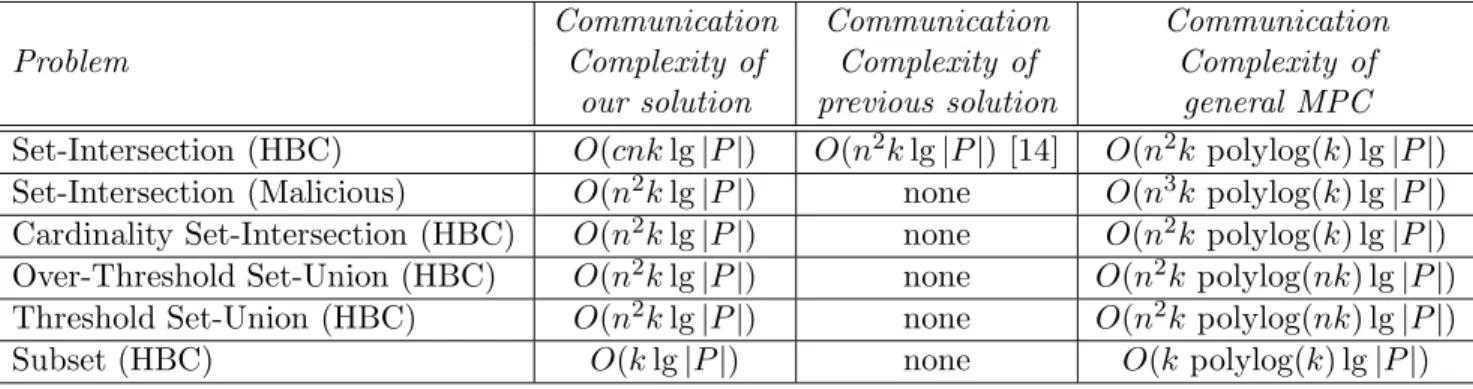
Our protocols are more efficient than the results obtained from previous work. General mul-tiparty computation is the best previous result for most of the problems that we address in this paper. Only the private Set-Intersection problem and two-party Cardinality Set-Intersection problem have been previously studied [14]. However, previous work only provides protocols for 3-or-more-party Set-Intersection secure only against honest-but-curious players; it is not obvious how to extend this work to achieve security against malicious players. Also, previous work focuses on achieving results for the Set-Intersection problem in isolation – these techniques cannot be used to compose set operations. In contrast, we provide efficient solutions for private multi-party Set-Intersection secure against malicious players, and our multiset intersection op-erator can be easily composed with other operations to enable a wide range of efficient private computation over multisets. We compare the communication complexity of our protocols with
1
Theelement reductionbyd, Rdd(A), of a multisetAis the multiset composed of the elements ofAsuch that for
every elementathat appears inAat leastd′> dtimes,ais includedd′
−dtimes in Rdd(A).
2
previous work and solutions based on general multiparty communication in Table 1. Note that the techniques utilized to create the circuits for the general solution are both complex and incur very large constants, on top of the constants inherent in the use of general multiparty computation [2]; we thus achieve greater practical efficiency, as well as asymptotic efficiency.
Our protocols are provably secure in the PPT-bounded adversary model. We consider both standard adversary models: honest-but-curious adversaries (HBC) and malicious adversaries. For protocols secure in the HBC model, we prove that the information learned by any coalition of honest-but-curious players is indistinguishable from the information learned in the ideal model, where a trusted third party (TTP) calculates the function. For protocols secure in the malicious model, we provide simulation proofs showing that for any strategy followed by a malicious coalition Γ in the real protocol, there is a translated strategy they could follow in the ideal model, such that, to Γ, the real execution is computationally indistinguishable from ideal execution.
Outline.
We discuss related work in Section 2. In Section 3, we introduce our adversary models, as well as our cryptographic tools. We describe our privacy-preserving set operation techniques in in Section 4. Section 5 gives protocols, secure against honest-but-curious players, and security analysis for the Set-Intersection and Cardinality Set-Intersection problems. Section 6 gives protocols, secure against honest-but-curious players, and security analysis for the Over-Threshold Set-Union problem, as well for several variants of the Over-Threshold Set-Union problem. We introduce techniques and protocols secure against malicious players for the Set-Intersection, Cardinality Set-Intersection, and Over-Threshold Set-Union problems in Section 7. Finally, we discuss several additional applications of our techniques in Section 8, including the subset protocol, general privacy-preserving computation over sets, and evaluation of CNF boolean formulas.2
Related Work
For most of the privacy-preserving set function problems we address in this paper (except for the Set-Intersection problem), the best previously known results are through general multiparty computation. General two-party computation was introduced by Yao [29], and general compu-tation for multiple parties was introduced in [3]. In general multiparty compucompu-tation, the players share the values of each input, and cooperatively evaluate the circuit. For each multiplication gate, the players must cooperate to securely multiply their inputs and re-share the result, requir-ingO(n) communication for honest-but-curious players andO(n2) communication for malicious players [17]. Recent results that allow non-interactive private multiplication of shares [9] do not extend to our adversary model, in which anyc < nplayers may collude. Our results are more efficient than the general MPC approach; we compare communication complexity in Table 1.
The most relevant work to our paper is by Freedman, Nissim, and Pinkas (FNP) [14] and Rakesh Agrawal and Alexandre Evfimievski and Ramakrishnan Srikant [1]. They proposed protocols for problems related to two party Set-Intersection. FNP’s results are based on the representation of sets as roots of a polynomial [14]. Their work does not utilize properties of polynomials beyond evaluation at given points. We explore the power of polynomial represen-tation of multisets, using operations on polynomials to obtain composable privacy-preserving multisets operations. We give a more detailed comparison of our Set-Intersection protocol with FNP in Table 1 and in Section 1.
Much work has been done in designing solutions for privacy-preserving computation of dif-ferent functions. For example, private equality testing is the problem of set-intersection for the case in which the size of the private input sets is 1. Protocols for this problem are proposed in [11, 25, 23], and fairness is added in [4]. Another related problem is in testing the disjointness of private input sets [21]; a restricted version of the Cardinality Set-Intersection problem. We
do not enumerate the works of privacy-preserving computation of other functions here, as they address drastically different problems and cannot be applied to our setting.
3
Preliminaries
The notation used in this paper is described in Appendix A. In this section, we describe our adversary models and the cryptographic tools used in this paper.
3.1
Adversary Models
In this paper, we consider two standard adversary models: honest-but-curious adversaries and malicious adversaries. We provide intuition and informal definitions of these models; formal definitions of these models can be found in [17].
Honest-But-Curious Adversaries.
In this model, all parties act according to their pre-scribed actions in the protocol. Security in this model is straightforward: no player or coalition ofc < nplayers (who cheat by sharing their private information) gains information about other players’ private input sets, other than what can be deduced from the result of the protocol. This is formalized by considering an ideal implementation where a trusted third party (TTP) receives the inputs of the parties and outputs the result of the defined function. We require that in the real implementation of the protocol—that is, one without a TTP—each party does not learn more information than in the ideal implementation.Malicious Adversaries.
In this model, an adversary may behave arbitrarily. In particular, we cannot hope to prevent malicious parties from refusing to participate in the protocol, choosing arbitrary values for its private input set, or aborting the protocol prematurely. Instead, we focus on the standard security definition (see, e.g., [17]) which captures the correctness and the privacy issues of the protocol. Informally, the security definition is based on a comparison between the ideal model and a TTP, where a malicious party may give arbitrary input to the TTP. The security definition is also limited to the case where at least one of the parties is honest. Let Γ be the set of colluding malicious parties; for any strategy Γ can follow in the real protocol, there is a translated strategy that it could follow in the ideal model, such that, to Γ, the real execution is computationally indistinguishable from execution in the ideal model.3.2
Additively Homomorphic Cryptosystem
In this paper we utilize a semantically secure [18], additively homomorphic public-key cryptosys-tem. LetEpk(·) denote the encryption function with public keypk. The cryptosystem supports the following operations, which can be performed without knowledge of the private key: (1) Given the encryptions ofaandb,Epk(a) andEpk(b), we can efficiently compute the encryption ofa+b, denotedEpk(a+b) :=Epk(a) +hEpk(b); (2) Given a constantcand the encryption of
a,Epk(a), we can efficiently compute the encryption ofca, denotedEpk(c·a) :=c ×h Epk(a). When such operations are performed, we require that the resulting ciphertexts be re-randomized for security. In re-randomization, a ciphertext is transformed so as to form an encryption of the same plaintext, under a different random string than the one originally used. We also require that the homomorphic public-key cryptosystem support secure (n, n)-threshold decryption, i.e., the corresponding private key is shared by a group of nplayers, and decryption must be per-formed by allplayers acting together. We also require that no PPT adversary can recover the sizes of the subfields ofRwith greater than negligible probability.
In our protocols for the malicious case, we require: (1) the decryption protocol be secure against malicious players, typically, this is done by requiring each player to prove in zero-knowledge that he has followed the threshold decryption protocol correctly [16]; (2) efficient construction of zero-knowledge proofs of plaintext knowledge; (3) optionally, efficient construc-tion of certain zero-knowledge proofs, as detailed inSecconstruc-tion 7.1.
Note that Paillier’s cryptosystem [27] satisfies each of our requirements: it is additively homomorphic, supports ciphertexts re-randomization and threshold decryption (secure in the malicious case) [12, 13], and allows certain efficient zero-knowledge proofs (standard construc-tions from [7, 5], and proof of plaintext knowledge [8]).
In the remainder of this paper, we simply use Epk(·) to denote the encryption function of the homomorphic cryptosystem which satisfies all the aforementioned properties.
3.3
Shuffle Protocol
Each player i (1 ≤i ≤ n) has a private input multiset Vi. We define the Shuffle problem as follows: all players learn the joint multisetV1∪· · ·∪Vn, such that no player or coalition of players Γ can gain a non-negligible advantage in distinguishing, for each elementa∈V1∪ · · · ∪Vn, an honest playeri(1≤i≤n,i6∈Γ) such thata∈Vi.
In several protocols in this paper, we will impose an additional privacy condition on the Shuf-fle problem; the multisetsV1, . . . , Vnare composed of ciphertexts, which must be re-randomized so that no player may determine which ciphertexts were part of his private input multiset. The revised problem statement is as follows: all players learn the joint multisetV1∪ · · · ∪Vn, such that no player or coalition of players can gain a non-negligible advantage in distinguishing, for each elementa∈V1∪ · · · ∪Vn, an honest playeri(1≤i≤n) such thata∈Vi.
Both variants of the Shuffle protocol can be easily accomplished with standard techniques [6, 19, 10, 15, 26], with communication complexity at mostO(n2k).
4
Techniques and Mathematical Intuition
In this section, we introduce our techniques for privacy-preserving computation of operations on sets and multisets.
Problem Setting.
Let there benplayers. We denote the private input set of playeriasSi, and|Si|=k (1≤i≤n). We denote the jth element of setias (Si)j. We denote the domain of the elements in these sets asP, (∀i∈[n],j∈[k] (Si)j ∈P).Let Rdenote the plaintext domain Dom(Epk(·)) (in Paillier’s cryptosystem, R isZN). We require thatRbe sufficiently large that an elementadrawn uniformly fromRhas only negligible probability ofrepresenting an element of P, denoteda∈P. For example, we could require that only elements of the formb =a || h(a) could represent an element inP. That is, there exists anaof proper length such thatb=a||h(a). If|h(·)|= lg 1ǫ
, then there is onlyǫprobability thata′←Rrepresents an element inP.
In this section, we first give background on polynomial representation of multisets, as well as the mathematical properties of polynomials that we use in this chapter. We then introduce our privacy-preserving (in a TTP setting) multiset operations using polynomial representations, then show how to achieve privacy in the real setting by computing them using encrypted polynomials. Finally, we overview the applications of these techniques explored in the rest of the chapter.
4.1
Background: Polynomial Rings and Polynomial Representation of
Sets
The polynomial ringR[x] consists of all polynomials with coefficients from R. Let f, g∈R[x], such thatf(x) =Pdeg(f)
i=0 f[i]xi, wheref[i] denotes the coefficient ofxiin the polynomialf. Let
f+gdenote the addition off andg,f∗gdenote the multiplication off andg, andf(d)denote thedth formal derivative off. Note that theformal derivativeoff isPdeg(f)−1
i=0 (i+ 1)f[i+ 1]xi.
Polynomial Representation of Sets.
In this chapter, we use polynomials to represent multisets. Given a multiset S = {Sj}1≤j≤k, we construct a polynomial representation of S,f ∈ R[x], as f(x) = Q
1≤j≤k(x−Sj). On the other hand, given a polynomial f ∈ R[x], we define the multiset S represented by the polynomial f as follows: an element a ∈ S if and only if (1) f(a) = 0 and (2) a represents an element from P. Note that our polynomial representation naturally handles multisets: The element a appears in the multiset b times if (x−a)b |f ∧ (x−a)b+16 | f.
Note that previous work utilized polynomials to represent sets [14] (as opposed to multisets). However, to the best of our knowledge, no operations beyond polynomial evaluation have been employed to manipulate said polynomials. As a result, previous work is limited to set intersection and cannot be composed with other set operators. In this chapter, we propose a framework to perform various set and multiset operations using polynomial representations and construct efficient privacy-preserving set operations using the mathematical properties of polynomials. By utilizing polynomial representations to represent sets and multisets, our framework allows arbitrary composition of multiset operators as outlined in our grammar.
4.2
Our Techniques: Privacy-Preserving Multiset Operations
In this section, we construct algorithms for computing the polynomial representation of opera-tions on sets, including union, intersection, and element reduction. We design these algorithms to be privacy-preserving in the following sense: the polynomial representation of any operation result reveals no more information than the set representation of the result. First, we introduce our algorithms for computing the polynomial representation of set operations union, intersec-tion, and element reduction (with a trusted third party). We then extend these techniques to encrypted polynomials, allowing secure implementation of our techniques without a trusted third party. Note that the privacy-preserving multiset operations defined in this section may be arbitrarily composed(see Section 8.1), and constitute truly general techniques.
4.2.1
Set Operations Using Polynomial Representations
In this section, we introduce efficient techniques for multiset operations using polynomial rep-resentations. In particular, let f, g be polynomial representations of the multisets S and T, respectively. We describe techniques to compute the polynomial representation of their union, intersection, and element reduction. We design our techniques so that the polynomial represen-tation of any operation result reveals no more information than the multiset represenrepresen-tation of the result. We formally state a strong privacy property for each operation in Theorems 1, 3, and 5.
Union.
We define the union of multisets S∪T as the multiset where each element a that appears inS bS ≥0 times andT bT ≥0 times appears in the resulting multisetbS+bT times. We compute the polynomial representation ofS∪T as follows, wheref andgare the polynomial representation ofS andT respectively:Note thatf∗g is a polynomial representation ofS∪T because (1) all elements that appear in either set S or T are preserved: (f(a) = 0)∧(g(b) = 0)→((f ∗g)(a) = 0)∧((f∗g)(b) = 0); (2) as f(a) = 0 ⇔(x−a)| f, duplicate elements from each multiset are preserved: (f(a) = 0)∧(g(a) = 0)→(x−a)2 | (f ∗g). In addition, we prove that, givenf ∗g, one cannot learn more information aboutS andT than what can be deduced fromS∪T, as formally stated in the following theorem:
Theorem 1. Let TTP1 be a trusted third party which receives the private input multiset Si
from player i for 1 ≤i≤n, and then returns to every player the union multisetS1∪ · · · ∪Sn
directly. LetTTP2 be another trusted third party, which receives the private input multiset Si
from player ifor 1≤i≤n, and then: (1) calculates the polynomial representation fi for each
Si; (2) computes and returns to every player Qni=1fi.
There exists a PPT translation algorithm such that, to each player, the results of the following two scenarios are distributed identically: (1) applying translation to the output of TTP1; (2)
returning the output ofTTP2directly.
Proof. Theorem 1 is trivially true. (This theorem is included for completeness.)
Intersection.
We define the intersection of multisets S ∩T as the multiset where each elementathat appears inS bS >0 times andT bT >0 times appears in the resulting multiset min{bS, bT}times. LetSandT be two multisets of equal size, andf andgbe their polynomial representations (also of equal size) respectively. We compute the polynomial representation ofS∩T as:
f ∗r+g∗s
wherer, s←Rdeg(f)[x], whereRb[x] is the set of all polynomials of degree 0, . . . , bwith coeffi-cients chosen independently and uniformly fromR: r=Pdeg(f)
i=0 r[i]xi and s =
Pdeg(f)
i=0 s[i]xi, where∀0≤i≤deg(f)r[i]←R,∀0≤i≤deg(f)s[i]←R.
We show below that f ∗r+g∗sis a polynomial representation ofS∩T. In addition, we prove that, givenf∗r+g∗s, one cannot learn more information aboutSandT than what can be deduced fromS∩T, as formally stated in Theorem 3.
First, we must prove the following lemma, based on our definition of gcd as the output of Euclid’s gcd algorithm (see Lemma 19 in Section B):
Lemma 2. Let f, g be polynomials in R[x] where R is a ring such that no PPT adversary can find the size of its subfields with non-negligible probability, deg(f) = deg(g) = α, β ≥ α, gcd(f, g) = 1, and f[deg(f)]∈R∗∧g[deg(g)]∈R∗. Let r=Pβ
i=0r[i]xi ands =
Pβ
i=0s[i]xi, where∀0≤i≤β r[i]←R,∀0≤i≤β s[i]←R (independently).
Let u = f ∗r+g∗s = Pα+β
i=0 u[i]xi. Then ∀0≤i≤α+β u[i] are distributed uniformly and
independently overR.
We prove Lemma 2 in Appendix B.
By this lemma, f∗r+g∗s= gcd(f, g)∗u, where u is distributed uniformly in Rγ[x] for
γ= 2 deg(f)− |S∩T|. Note thata is a root of gcd(f, g) and (x−a)ℓa | gcd(f, g) if and only
if a appears ℓa times in S∩T. Moreover, because u is distributed uniformly in Rγ[x], with overwhelming probability the roots of u do not represent any element from P (as explained in the beginning of Section 4). Thus, the computed polynomial f ∗r+g∗s is a polynomial representation ofS∩T. Note that this technique for computing the intersection of two multisets can be extended to simultaneously compute the intersection of an arbitrary number of multisets in a similar manner. Also, givenf ∗r+g∗s, one cannot learn more information aboutS and
T than what can be deduced fromS∩T, as formally stated in the following theorem:
Theorem 3. Let TTP1be a trusted third party which receives the private input multisetSi of
S1∩ · · · ∩Sn directly. LetTTP2be another trusted third party, which receives the private input
multisetSi from playeri for 1≤i≤n, and then: (1) calculates the polynomial representation
fi for eachSi; (2) chooses ri ←Rk[x]; (3) computes and returns to each playerPni=1fi∗ri.
There exists a PPT translation algorithm such that, to each player, the results of the following two scenarios are distributed identically: (1) applying translation to the output of TTP1; (2)
returning the output ofTTP2directly.
Proof sketch. Let the output of TTP1 be denoted T. The translation algorithm operates as
follows: (1) calculates the polynomial representationgofT; (2) chooses the random polynomial
u←R2k−|T|[x]; (3) computes and returnsg∗u.
Element Reduction.
We define the operation of element reduction (by d) of a multisetS(denoted Rdd(S)) as follows: for each elementathat appearsbtimes inS, it appears max{b−
d,0}times in the resulting multiset. We compute the polynomial representation of Rdd(S) as: d
X
j=0
f(j)∗Fj∗rj
where rj ← Rdeg(f)[x] (0 ≤ j ≤ d) and each Fj is any polynomial of degree j, such that ∀a∈P F(a)6= 0 (0≤j ≤d) and gcd(F0, . . . , Fd) = 1. Note that random polynomials of degree 0, . . . , din R[x] have these properties with overwhelming probability.
To show that formal derivative operation allows element reduction, we require the following lemma:
Lemma 4. Let Fj ∈ R[x] (0 ≤ j ≤ d) each of degree j such that gcd(F0, . . . , Fd) = 1. For
all elements a ∈ R such that ∀0≤j≤d (x−a) ∤ Fj, q ∈ R[X] such that (x−a) ∤ q, and
rj←Rm+deg(q)[x] (0≤j≤d), and:
• if m > d, f = (x−a)m∗q → (x−a)m−d | Pd
j=0f(j)∗Fj∗rj ∧ (x−a)m−d+1 ∤
Pd
j=0f(j)∗Fj∗rj
• ifm≤d,f = (x−a)m∗q→(x−a)∤Pd
j=0f(j)∗Fj∗rj
with overwhelming probability.
We prove this lemma in Appendix B. By Lemma 2, Pd
j=0f(j) ∗ Fj ∗ rj = gcd(f(d), f(d−1), . . . , f)∗u, where u is distributed uniformly in Rγ[x] for γ = 2k− |Rd
d(S)|. Thus, with overwhelming probability, any root of u does not represent any element from P. Therefore, Pd
j=0f(j)∗Fj ∗rj is a polynomial representation of Rdd(S), and moreover, given
Pd
j=0f(j)∗Fj∗rj, one cannot learn more information aboutS than what can be deduced from Rdd(S), as formally stated in the following theorem:
Theorem 5. Let Fj (0 ≤ j ≤ d) be publicly known polynomials of degree j such that ∀a∈P Fj(a) 6= 0 and gcd(F0, . . . , Fd) = 1. Let TTP1 be a trusted third party which receives
a private input multisetS of sizek, and then returns the reduction multiset Rdd(S)directly. Let
TTP2be another trusted third party, which receives a private input multiset S, and then: (1)
calculates the polynomial representation f of S; (2) chooses r0, . . . , rd ←Rk[x]; (3) computes
and returnsPd
j=0f(j)∗Fj∗rj.
There exists a PPT translation algorithm such that the results of the following two scenarios are distributed identically: (1) applying translation to the output of TTP1; (2) returning the
output ofTTP2directly.
Proof sketch. Let the output of TTP1 be denoted T. The translation algorithm operates as
follows: (1) calculates the polynomial representationgofT; (2) chooses the random polynomial
4.2.2
Operations with Encrypted Polynomials
In the previous section, we prove the security of our polynomial-based multiset operators when the polynomial representation of the result is computed by a trusted third party (TTP2). By using additively homomorphic encryption, we allow these results to be implemented as proto-cols in the real world without a trusted third party (i.e., the polynomial representation of the set operations is computed by the parties collectively without a trusted third party). In the algorithms given above, there are three basic polynomial operations that are used: addition, multiplication, and the formal derivative. We give algorithms in this section for computation of these operations with encrypted polynomials.
For f ∈ R[x], we represent the encryption of polynomial f, Epk(f), as the ordered list of the encryptions of its coefficients under the additively homomorphic cryptosystem:
Epk(f[0]), . . . , Epk(f[deg(f)]). Let f1, f2, and g be polynomials in R[x] such that f1(x) =
Pdeg(f1)
i=0 f1[i]xi, f2(x) =
Pdeg(f2)
i=0 f2[i]xi, and g(x) =
Pdeg(g)
i=0 g[i]xi. Let a, b ∈ R. Using the homomorphic properties of the homomorphic cryptosystem, we can efficiently perform the fol-lowing operations on encrypted polynomials without knowledge of the private key:
• Sum of encrypted polynomials: given the encryptions of the polynomial f1 and f2, we can efficiently compute the encryption of the polynomial g := f1 +f2, by calculating
Epk(g[i]) :=Epk(f1[i]) +hEpk(f2[i]) (0≤i≤max{deg(f1),deg(f2)})
• Product of an unencrypted polynomial and an encrypted polynomial: given a polynomial
f2 and the encryption of polynomial f1, we can efficiently compute the encryption of polynomial g := f1∗f2, (also denoted f2 ∗h Epk(f1)) by calculating the encryption of each coefficient
Epk(g[i]) := (f2[0] ×h Epk(f1[i])) +h (f2[1] ×h Epk(f1[i − 1])) +h . . . +h(f2[i]×h Epk(f1[0])) (0≤i≤deg(f1) + deg(f2)).
• Derivative of an encrypted polynomial: given the encryption of polynomial f1, we can efficiently compute the encryption of polynomialg:= dxd f1, by calculating the encryption of each coefficientEpk(g[i]) := (i+ 1)×hEpk(f1[i+ 1]) (0≤i≤deg(f1)−1).
• Evaluation of an encrypted polynomial at an unencrypted point: given the encryption of polynomialf1, we can efficiently compute the encryption ofa:=f1(b), by calculating
Epk(a) := (b0×hEpk(f1[0])) +h(b1×hEpk(f1[1])) +h . . . +h(bdeg(f1)×hEpk(f1[deg(f1)])). Utilizing the above operations on encrypted polynomials, we can securely compute results according to the multiset operations described in Section 4.2.1 without the trusted third party (TTP2). We demonstrate this property with concrete examples detailed in the remainder of this chapter.
4.3
Overview of Applications
The techniques we introduce for privacy-preserving computations of multiset operations have many applications. We give several concrete examples that utilize our techniques for specific privacy-preserving functions on multisets in the following sections.
First, we design efficient protocols for the Set-Intersection and Cardinality Set-Intersection problems, secure against honest-but-curious adversaries (Section 5). We then provide an efficient protocol for the Over-Threshold Set-Union problem, as well as three variants of the Threshold Set-Union problem, secure against honest-but-curious adversaries, in Section 6. We introduce tools and protocols, secure against malicious players, for the Intersection, Cardinality Set-Intersection, and Over-Threshold Set-Union problems in Section 7. We propose an efficient protocol for the Subset problem in Section 8.2.
Protocol: Set-Intersection-HBC
Input: There are n≥2 honest-but-curious players,c < ndishonestly colluding, each with a private input setSi, such that|Si|=k. The players share the secret keysk, to whichpk is the corresponding public key to a homomorpic cryptosystem.
1. Each playeri= 1, . . . , n
(a) calculates the polynomialfi= (x−(Si)1). . .(x−(Si)k)
(b) sends the encryption of the polynomialfi to playersi+ 1, . . . , i+c (c) choosesc+ 1 polynomialsri,0, . . . , ri,c←Rk[x]
(d) calculates the encryption of the polynomialφi=fi−c∗ri,i−c+· · ·+fi−1∗ri,i−1+
fi∗ri,0, utilizing the algorithms given in Sec. 4.2.2.
2. Player 1 sends the encryption of the polynomialλ1=φ1, to player 2 3. Each playeri= 2, . . . , nin turn
(a) receives the encryption of the polynomialλi−1 from playeri−1
(b) calculates the encryption of the polynomial λi = λi−1 +φi by utilizing the algorithms given in Sec. 4.2.2.
(c) sends the encryption of the polynomialλi to playeri+ 1 modn
4. Player 1 distributes the encryption of the polynomial p = λn = Pni=1fi ∗
Pc
j=0ri+j,j
to all other players.
5. All players perform a group decryption to obtain the polynomialp.
Each playeri= 1, . . . , ndetermines the intersection multiset as follows: for eacha∈Si, he calculates b such that (x−a)b|p ∧ (x−a)b+1 6 |p. The element aappearsb times in the intersection multiset.
Figure 1: Set-Intersection protocol for the honest-but-curious case.
More generally, our techniques allow private computation of functions based on composition of the union, intersection, and element reduction operators. We discuss techniques for this general private computation on multisets in Section 8.1.
Our techniques are widely applicable, even outside the realm of computation of functions over multisets. As an example, we show how to apply our techniques to private evaluation of boolean formulae in CNF form in Section 8.3.
5
Application I: Private Set-Intersection and Cardinality
Set-Intersection
In this section, we design protocols for Set-Intersection and Cardinality Set-Intersection, secure against a coalition of honest-but-curious adversaries.
5.1
Set-Intersection
Problem Definition.
Let there benparties; each has a private input set Si (1 ≤i ≤n) of size k. We define the Set-Intersectionproblem as follows: all players learn the intersection of all private input multisets without gaining any other information; that is, each player learnsS1∩S2∩ · · · ∩Sn.
Our protocol for the honest-but-curious case is given in Fig. 1. In this protocol, each player
Si. He then encrypts this polynomial fi, and sends it to c other playersi+ 1, . . . , i+c. For each encrypted polynomial Epk(fi), each player i+j (0 ≤ j ≤ c) chooses a random poly-nomial ri+j,j ∈ Rk[x]. Note that at most c players may collude, thus Pcj=0ri+j,j is both uniformly distributed and known to no player. They then compute the encrypted polynomial
Pc
j=0ri+j,j
∗hEpk(fi). From these encrypted polynomials, the players compute the encryp-tion ofp=Pn
i=1fi∗
Pc
j=0ri+j,j
. All players engage in group decryption to obtain the polyno-mialp. Thus, by Theorem 3, the players have privately computedp, a polynomial representing the intersection of their private input multisets. Finally, to reconstruct the multiset represented by polynomialp, the playeri, for eacha∈Si, calculatesbsuch that (x−a)b|p ∧ (x−a)b+16 |p. The elementaappearsbtimes in the intersection multiset.
Security Analysis.
We show that our protocol is correct, as each player learns the appro-priate answer set at its termination, and secure in the honest-but-curious model, as no player gains information that it would not gain when using its input in the ideal model. A formal statement of these properties is as follows:Theorem 6. In the Set-Intersection protocol of Fig. 1, every player learns the intersection of all players’ private inputs,S1∩S2∩ · · · ∩Sn, with overwhelming probability.
Theorem 7. Assuming that the additively homomorphic, threshold cryptosystem Epk(·)is
se-mantically secure, with overwhelming probability, in the Set-Intersection protocol of Fig. 1, any coalition of fewer thannPPT honest-but-curious players learns no more information than would be gained by using the same private inputs in the ideal model with a trusted third party.
We provide proof sketches for Theorems 6 and 7 in Appendix C.1.
5.2
Cardinality Set-Intersection
Problem Definition.
We define the Cardinality Set-Intersection problem on sets as follows: each player learns the number of unique elements inS1∩ · · · ∩Sn, without learning any other information. A variant of this problem is the Cardinality Set-Intersection problem on multisets, which we define as follows: all players learn|S1∩ · · · ∩Sn|, as computed on multisets.Our protocol for Cardinality Set-Intersection, given in Figure 2, proceeds as our protocol for Set-Intersection, until the point where all players learn the encryption ofp, the polynomial representation ofS1∩· · ·∩Sn. Each playeri= 1, . . . , nthen evaluates this encrypted polynomial at each unique element a ∈ Si, obtaining βa, an encryption of p(a). He then blinds each encrypted evaluationp(a) by calculatingβa′ =ba ×h βa. All players then distribute and shuffle the ciphertexts β′a constructed by each player, such that all players receive all ciphertexts, without learning their source. The Shuffle protocol can be easily accomplished with standard techniques [6, 19, 10, 15, 26], with communication complexity at most O(n2k). The players then decrypt these ciphertexts, finding that nb of the decryptions are 0, implying that there are b unique elements in S1∩ · · · ∩Sn. FNP utilize a variation of this technique [14], but it is not obvious how to construct a multiparty Cardinality Set-Intersection protocol from their techniques.
Variants.
Our protocol can be simply extended to privately compute the Cardinality Set-Intersection problem on multisets, by utilizing an encoding as follows: any element a that appearsb times in a multiset is encoded as the set: {a|| 1, . . . , a || b}, with element included only once. Note that this is a set of equivalent size as the original multiset representation, so this variant preserves the efficiency of our protocol.Protocol: Cardinality-HBC
Input: There aren≥2 honest-but-curious players,c < ndishonestly colluding, each with a private input setSi, such that|Si|=k. The players share the secret keysk, to whichpk is the corresponding public key to a homomorpic cryptosystem.
1. Each playeri= 1, . . . , n
(a) calculates the polynomialfi= (x−(Si)1). . .(x−(Si)k)
(b) sends the encryption of the polynomial fi to playersi+ 1, . . . , i+c (c) choosesc+ 1 random polynomialsri,0, . . . , ri,c←Rk[x]
(d) calculates the encryption of the polynomialφi=fi−c∗ri,i−c+· · ·+fi−1∗ri,i−1+
fi∗ri,0, utilizing the algorithms given in Sec. 4.2.2. 2. Player 1 sends the encrypted polynomialλ1=φ1, to player 2 3. Each playeri= 2, . . . , nin turn
(a) receives the encryption of the polynomial λi−1 from playeri−1
(b) calculates the encryption of the polynomial λi = λi−1+φi by utilizing the algorithms given in Sec. 4.2.2.
(c) sends the encryption of the polynomialλi to playeri+ 1 mod n
4. Player 1 distributes the encryption of the polynomial p = λn = Pni=1fi ∗
Pc
j=0ri+j,j
to all other players. 5. Each playeri= 1, . . . , n
(a) evaluates the encryption of the polynomial p at each input (Si)j, obtaining encrypted elementsEpk(cij) where cij =p((Si)j), using the algorithm given in Sec. 4.2.2.
(b) for each j = 1, . . . , k chooses a random number rij ← R and calculates an encrypted element (Vi)j =rij ×hEpk(cij)
6. All players perform the Shuffle protocol on their private input sets Vi, obtaining a joint setV, in which all ciphertexts have been re-randomized.
7. All players 1, . . . ndecrypt each element of the shuffled setV
Ifnbof the decrypted elements fromV are 0, then the size of the set intersection isb.
Figure 2: Cardinality set-intersection protocol for the honest-but-curious case.
Security Analysis.
We show that our protocol is correct, as each player learns the size of the answer set at its termination, and secure in the honest-but-curious model, as no player gains information that it would not gain when using its input in the ideal model. A formal statement of these properties is as follows:Theorem 8. In the Cardinality Set-Intersection protocol of Fig. 2, every player learns the size of the intersection of all players’ private inputs,|S1∩S2∩· · ·∩Sn|, with overwhelming probability.
Theorem 9. Assuming that the additively homomorphic, threshold cryptosystem Epk(·)is
se-mantically secure and that the Shuffle protocol is secure, with overwhelming probability, in the Cardinality Set-Intersection protocol of Fig. 2, any coalition of fewer than n PPT honest-but-curious players learns no more information than would be gained by using the same private inputs in the ideal model with a trusted third party.
5.3
Malicious Case
We can extend our protocols in Figures 1 and 2, secure against honest-but-curious players, to protocols secure against malicious adversaries by adding zero-knowledge proofs or using cut-and-choose to ensure security. We give details of our protocols secure against malicious adversaries in Section 7.2. We prove security against malicious parties for these protocols in Appendices C.1 and C.2.
6
Application II: Private Over-Threshold Set-Union and
Threshold Set-Union
In this section, we design protocols for the Over-Threshold Set-Union problem and several variations of the Threshold Set-Union problem, secure against a coalition of honest-but-curious adversaries.
6.1
Over-Threshold Set-Union Protocol
Problem Definition.
Let there ben players; each has a private input setSi (1≤i≤n) of sizek. We define the Over-Threshold Set-Union problem as follows: all players learn which elements appear in the union of the players’ private input multisets at least a threshold numberttimes, and the number of times these elements appeared in the union of players’ private inputs, without gaining any other information. For example, assume that aappears in the combined private input of the players 15 times. Ift= 10, then all players learnahas appeared 15 times. However, ift= 16, then no player learnsaappears in any player’s private input. This problem can be represented as Rdt−1(S1∪ · · · ∪Sn).
We describe our protocol secure against honest-but-curious players for the Over-Threshold Set-Union problem in Fig. 3. In this protocol, each playeri(1≤i≤n) first calculatesfi, the polynomial representation of its input multisetSi. All players then compute the encryption of polynomialp=Qn
i=1fi, the polynomial representation ofS1∪ · · · ∪Sn. Playersi= 1, . . . , c+ 1 then each choose random polynomials ri,0, . . . , ri,t−1, and calculate the encryption of the
polynomial Pt−1
ℓ=0p(ℓ)∗Fℓ∗ri,ℓ as shown in Fig. 3. All players then calculate the encryption of the polynomial Φ =Pt−1
ℓ=0p(ℓ)∗Fℓ∗
Pc+1
i=0ri,ℓ
and perform a group decryption to obtain Φ. As at most c players may dishonestly collude, the polynomials Pc+1
i=1ri,ℓ (1 ≤ ℓ ≤ d) are uniformly distributed and known to no player. By Theorem 5, Φ is a polynomial representation of Rdt−1(S1∪ · · · ∪Sn).
Each player i= 1, . . . , n then choosesbi,j ←R and computesui,j=bi,j×Φ((Si)j) + (Si)j (1 ≤j ≤k). Each element ui,j equals (Si)j if (Si)j ∈ Rdt−1(S1∪ · · · ∪Sn), and is otherwise uniformly distributed overR. The players then shuffle these elementsui,j, such that each player learns all of the elements, but does not learn which player’s set they came from. The shuffle can be easily accomplished with standard techniques [6, 19, 10, 15, 26], with communication complexity at most O(n2k). The multiset formed by those shuffled elements that represent elements ofP is Rdt−1(S1∪ · · · ∪Sn).
Security Analysis.
We show that our protocol is correct, as each player learns the appro-priate answer set at its termination, and secure in the honest-but-curious model, as no player gains information that it would not gain when using its input in the ideal model with a trusted third party. A formal statement of these properties is as follows:Theorem 10. In the Over-Threshold Set-Union protocol of Fig. 3, every honest-but-curious player learns each elementawhich appears at leastt times in the union of thenplayers’ private inputs, as well as the number of times it so appears, with overwhelming probability.
Protocol: Over-Threshold Set-Union-HBC
Input: There are n≥2 honest-but-curious players,c < ndishonestly colluding, each with a private input setSi, such that|Si|=k. The players share the secret keysk, to whichpk is the corresponding public key for a homomorphic cryptosystem. The threshold number of repetitions at which an element appears in the output ist. F0, . . . , Ft−1are fixed polynomials of degree 0, . . . , t−1 which have no common factors or roots representing elements ofP.
1. Each playeri= 1, . . . , ncalculates the polynomialfi= (x−(Si)1). . .(x−(Si)k) 2. Player 1 sends the encryption of the polynomialλ1=f1 to player 2
3. Each playeri= 2, . . . , n
(a) receives the encryption of the polynomialλi−1 from playeri−1
(b) calculates the encryption of the polynomialλi =λi−1∗fi by utilizing the algo-rithm given in Sec. 4.2.2.
(c) sends the encryption of the polynomialλi to playeri+ 1 modn
4. Player 1 distributes the encryption of the polynomial p= λn =Qni=1fi to players 2, . . . , c+ 1
5. Each playeri= 1, . . . , c+ 1
(a) calculates the encryption of the 1, .., t − 1th derivatives of p, denoted
p(1), . . . , p(t−1), by repeating the algorithm given in Sec. 4.2.2. (b) chooses random polynomialsri,0, . . . , ri,t−1←Rnk[x]
(c) calculates the encryption of the polynomial Pt−1
ℓ=0p(ℓ)∗Fℓ∗ri,ℓand sends it to all other players.
6. All players perform a group decryption to obtain the polynomial Φ =Pt−1
ℓ=0p(ℓ)∗Fj∗
Pc+1
i=0ri,ℓ
.
7. Each playeri= 1, . . . , n, for eachj= 1, . . . , k
(a) chooses a random elementbi,j←R (b) calculatesui,j=bi,j×Φ((Si)j) + (Si)j
8. All playersi= 1, . . . nperform the Shuffle protocol on the elementsui,j (1≤j ≤k), such that each player obtains a joint setV.
Each element a ∈ P that appears b times in V is an element in the threshold set that appearsb times in the players’ private inputs.
Figure 3: Over-Threshold Set-Union protocol secure against honest-but-curious adversaries.
Theorem 11. Assuming that the additively homomorphic, threshold cryptosystem Epk(·) is
semantically secure, with overwhelming probability, in the Over-Threshold Set-Union protocol of Fig. 3, any coalition of fewer thannPPT honest-but-curious players learns no more information than would be gained by using the same private inputs in the ideal model with a trusted third party.
We provide proof sketches for Theorems 10 and 11 in Appendix D.1.
6.2
Threshold Set-Union
Problem Definition.
We define the Threshold Set-Union problem as follows: all players learn which elements appear in the combined private input of the players at least a threshold number t times. For example, assume that a appears in the combined private input of theplayers 15 times. Ift= 10, then all players learna. However, ift= 16, then no player learnsa. This problem differs from the Over-Threshold Set-Union problem in that each player learns the elements of Rdt−1(S1∩ · · · ∩Sn), without learning how often each element appears.
We offer protocols for several variants on Threshold Set-Union: threshold contribution, per-fect, and semi-perfect. Threshold contribution allows for thresholds t ≥ 1, and each player learns only those elements which appear both in his private input and the threshold set: player
i(1≤i≤n) learns the elements ofSi∩Rdt−1(S1∩ · · · ∩Sn). Perfect threshold set-intersection allows for thresholdst≥1, and conforms exactly to the definition of threshold set-intersection. The semi-perfect variant requires for security that t≥2, and that the cheating coalition does not include any single element more than t−1 times in their private inputs. Note that the information illicitly gained by the coalition when they include more than t−1 copies of an element a is restricted to a possibility of learning that there exists some other player whose private input containsa. We do not consider the difference in security between the semi-perfect and perfect variants to be significant.
The protocols for the Threshold Set-Union problem, given in Figs. 4, 5, and 6, are identical to the protocol for Over-Threshold Set-Union (given in Fig. 3) from step 1-5. We explain the differences between the protocols for each variant: threshold contribution, semi-perfect, and perfect. Each player constructs encryptions of the elements Φ((Si)j) from his private input set in step 6, and continues as described below.
Threshold Contribution Threshold Set-Union.
This protocol is given in Fig. 5. The players cooperatively decrypt the encrypted elements Φ((Si)j)∗(Pnℓ=1bℓ,i,j). This decryption must take place in such a way that only player i learns the element Φ((Si)j)∗(Pnℓ=1bℓ,i,j). Typically, parties produce decryption shares and reconstruct the element from them; playerisimply retains his decryption share, so that only he learns the decryption. Thus each player learns which of his elements appear in the threshold set, since if (Si)j appears in the threshold set, Φ((Si)j)∗(Pnℓ=1bℓ,i,j) = 0. No player learns more information because if an element (Si)j is not in the threshold set, Φ((Si)j)∗(Pnℓ=1bℓ,i,j) is uniformly distributed.
Semi-Perfect Threshold Set-Union.
This protocol is given in Fig. 4. The encrypted element (Ui)j calculated from the encrypted evaluation of Φ((Si)j) is either: (1) an encryption of the private input element (Si)j (if (Si)j is in the intersection set) or (2) an encryption of a random element (otherwise). However, the player also constructs a corresponding encrypted tag for each (Ui)j, Tij. We require that the cryptosystem used to construct these tags be key-private, so that the origin of ciphertext pairs T, U cannot be ascertained by the key used to construct the tags.The players then correctly obtain a decryption of each element in the threshold set exactly once. Any other time a ciphertextU for an element in the threshold set is decrypted, a player sabotages it. In group decryption schemes, players generally produce shares of the decrypted element; if one player sends a uniformly generated share instead of a valid one, the decrypted element is uniform. If the decrypted element is uniform, it conveys no information to the players. To ensure an encryption of an element in the threshold set is not decrypted once the element is known to be in the threshold set, a player sabotages the decryption under the following conditions: (1) he can decrypt the tag toh(a)|| a for someaand (2) ahas already been determined to be a member of the threshold set. All other ciphertexts should be correctly decrypted; either they are encryptions of elements in the threshold set which have not yet been decrypted, or they are encryptions of random elements.
Note that the protocol is the only protocol proposed in this chapter with a non-constant number of rounds. Because of the need to sabotage decryptions based on the results of past decryptions, there areO(nk) rounds in this protocol.
Perfect Threshold Set-Union.
This protocol is given in Fig. 6. Each player constructs the encrypted elements (Ui)j from the encrypted evaluation of Φ((Si)j) as written in step 6 of Figure 4. The players then utilize the Shuffle protocol to anonymously distribute these elements. If an element appears in the threshold set, then at least one encryption of it appears in the shuffled ciphertexts. The players ensure in step 8 that all duplicates (ciphertexts of the same element) except the first have a random element added to them. This disguises the number of players who have each element of the threshold set in their private input. Let the shuffled ciphertextsU have an arbitrary orderingU′1, . . . , Unk′ . IsEq(C, C′) = 1 if the ciphertexts
C encode the same plaintext, and 0 otherwise. (This calculation can be achieved with the techniques in [22].) The playersi∈[n] then choose random elementsqi,ℓ←R(1≤ℓ≤nk) and decrypt the ciphertextsWℓ=Uℓ′ +hEpk (Pni=1qℓ) (IsEq(Uℓ′, U
′
ℓ−1) +. . .IsEq(Uℓ′, U
′
1))
. Thus, ifUℓ′ is a duplicate (encryption of an element which also appeared early in the ordering), it has a uniformly distributed element added to it, and conveys no information. Each element of the threshold set is decrypted exactly once, and all players thus learn the threshold set.
Security Analysis.
We show that our protocol is correct, as each player learns the appro-priate result set at its termination, and secure in the honest-but-curious model, as no player gains information that it would not gain when using its input in the ideal model. A formal statement of these properties is as follows:Theorem 12. In the Threshold Contribution Threshold Set-Union protocol of Fig. 5, every player i(1≤i≤n) learns the setSi∩Rdt−1(S1∪ · · · ∪Sn), with overwhelming probability.
Theorem 13. In the Semi-Perfect Threshold Set-Union protocol of Fig. 4, each playeri (1≤
i≤n) learns the set Rdt−1(S1∪ · · · ∪Sn), with overwhelming probability.
Theorem 14. In the Perfect Threshold Set-Union protocol of Fig. 6, every player learns the set Rdt−1(S1∪ · · · ∪Sn), with overwhelming probability.
Theorem 15. Assuming that the additively homomorphic, threshold cryptosystem Epk(·) is
semantically secure and that the Shuffle protocol is secure, with overwhelming probability, in the Threshold Set-Union protocols of Figs. 4, 5, and 6, any coalition of fewer than n PPT honest-but-curious players learns no more information than would be gained by using the same private inputs in the ideal model with a trusted third party.
We provide proof sketches for Theorems 12, 13, 14, and 15 in Appendix D.2.
6.3
Malicious Case
By adding zero-knowledge proofs to our Over-Threshold Set-Union protocol secure against honest-but-curious adversaries, we extend our results to enable security against malicious ad-versaries. We provide details of our protocol secure against malicious adversaries in Section 7.4, and proof of security in Appendix D.1.
7
Set-Intersection,
Cardinality
Set-Intersection,
and
Over-Threshold Set-Union for Malicious Parties
We extend the protocols for the Set-Intersection, Cardinality Set-Intersection, and Over-Threshold Set-Union problems given in Sections 5 and 6 to obtain security against adversaries in the malicious model. To obtain this result, we add zero-knowledge proofs, verified by all players, to ensure the correctness of all computation. In this section, we first introduce notation for zero-knowledge proofs, then give the protocols secure against malicious parties.
7.1
Tools
In this section, we describe cryptographic tools that we utilize in our protocols secure against malicious players.
Zero-Knowledge Proofs.
We utilize several zero-knowledge proofs in our protocols for the malicious adversary model. We introduce the notation for these zero-knowledge proofs below; for additively homomorphic cryptosystems such as Paillier, we can efficiently construct these zero-knowledge proofs using standard constructions [7, 5].• POPK{Epk(x)}denotes a zero-knowledge proof that given a public ciphertextEpk(x), the player knows the corresponding plaintextx[8].
• ZKPK{f |p′=f ∗hα} is shorthand notation for a zero-knowledge proof of knowledge that the prover knows a polynomialf such that encrypted polynomialp′=f ∗hα, given the encrypted polynomialsp′ andα.
• ZKPK{f |(p′=f ∗h α)∧(y=Epk(f))} is the proof ZKPK{f |p′=f ∗h α} with the additional constraint that y = Epk(f) (y is the encryption of f), given the encrypted polynomialp′,y, andα.
Equivocal Commitment.
A standard commitment scheme allows parties to give a “sealed envelope” that can be later opened to reveal exactly one value. We use an equivocal commitment scheme in our protocols secure against malicious players, such that the simulator can open the ‘envelope’ to an arbitrary value without being detected by the adversary [20, 24].7.2
Set-Intersection Protocol for Malicious Adversaries
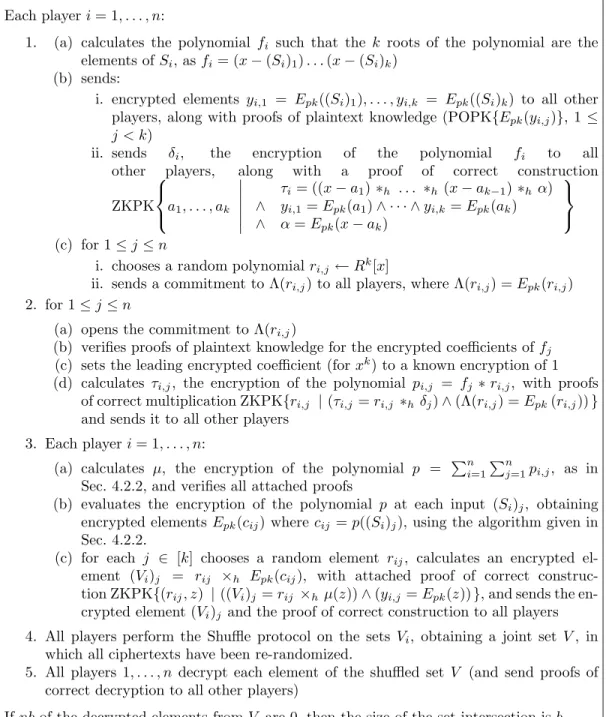
Our protocol for malicious parties performing Set-Intersection, given in Fig. 7, proceeds largely as the protocol secure against honest-but-curious parties, which was given in Fig. 1. The com-mitments to the data items Λ(ci,j) are purely for the purposes of a simulation proof. We add zero-knowledge proofs to prevent three forms of misbehavior: choosing ciphertexts for the en-crypted coefficients of fi without knowledge of their plaintext, not performing the polynomial multiplication offj∗ri,j correctly, and not performing decryption correctly. We also constrain the leading coefficient of fi to be 1 for all players, to prevent any player from setting their polynomial to 0; if fi = 0, every element is a root, and thus it can represent an unlimited number of elements. We can thus detect or prevent misbehavior from malicious players, forcing this protocol to operate like the honest-but-curious protocol in Fig. 1. The protocol can gain efficiency by taking advantage of the maximum coalition sizec.
Our set-intersection protocol secure against malicious parties utilizes an expensive (O(k2) size) zero-knowledge proof to prevent malicious parties from cheating when multiplying the polynomial ri,j by the encryption of the polynomialfj. Each player i must commit to each polynomial ri,j (1 ≤i, j ≤n), for purposes of constructing a zero-knowledge proof. We may easily replace this proof with use of the cut-and-choose technique, which requires only O(k) communication.
Security Analysis.
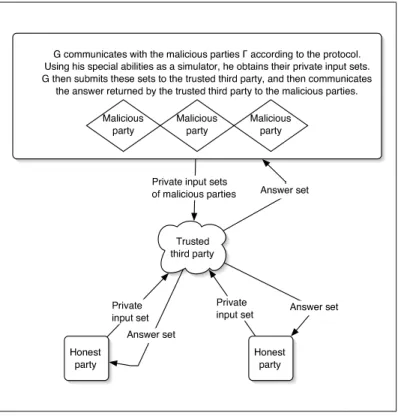
We provide a simulation proof of this protocol’s security; an interme-diaryGtranslates between the real wold with malicious, colluding PPT players Γ and the ideal world, where a trusted third party computes the answer set. Our proof shows that no Γ can distinguish between the ideal world and the real world, thus no information other than that in the answer set can be gained by malicious players. A formal statement of our security property is as follows:Theorem 16. Assuming that the additively homomorphic, threshold cryptosystem Epk(·) is
semantically secure, and the specified zero-knowledge proofs and proofs of correct decryption cannot be forged, then in the Set-Intersection protocol for the malicious case in Fig. 7, for any coalitionΓof colluding players (at mostn−1such colluding parties), there is a player (or group of players)Goperating in the ideal model, such that the views of the players in the ideal model is computationally indistinguishable from the views of the honest players andΓin the real model.
Proof of this theorem is given in Appendix C.1.
7.3
Cardinality Set-Intersection Protocol for Malicious Adversaries
We give a protocol, secure against malicious parties, to perform Cardinality Set-Intersection in Fig. 8. It proceeds largely as the protocol secure against honest-but-curious parties, which was given in Fig. 2. The commitments to the data items Λ(ri,j) are purely for the purposes of a simulation proof. We add zero-knowledge proofs of knowledge to prevent five forms of misbehavior: choosing fi without knowledge of its roots, choosing fi such that it is not the product of linear factors, not performing the polynomial multiplication of fj ∗ri,j correctly, not calculating encrypted elements (Vi)j correctly (either not from the data items (Si)j or not evaluating the encrypted polynomialp), and not performing decryption correctly. We can thus detect or prevent misbehavior from malicious players, forcing this protocol to operate like the honest-but-curious protocol in Fig. 2.
Security Analysis.
We provide a simulation proof of this protocol’s security; an interme-diaryGtranslates between the real wold with malicious, colluding PPT players Γ and the ideal world, where a trusted third party computes the answer set. Our proof shows that no Γ can distinguish between the ideal world and the real world, thus no information other than that in the answer set can be gained by malicious players. A formal statement of our security property is as follows:Theorem 17. Assuming that the additively homomorphic, threshold cryptosystem Epk(·) is
semantically secure, the Shuffle protocol is secure, and the specified zero-knowledge proofs and proofs of correct decryption cannot be forged, then in the Cardinality Set-Intersection protocol for the malicious case in Fig. 8, for any coalition Γ of colluding players (at most n−1 such colluding parties), there is a player (or group of players) G operating in the ideal model, such that the views of the players in the ideal model is computationally indistinguishable from the views of the honest players andΓ in the real model.
Proof of this theorem is given in Appendix C.2.
7.4
Over-Threshold Set-Union Protocol for Malicious Adversaries
We give a protocol, secure against malicious parties, to perform Over-Threshold Set-Union in Fig. 9. It proceeds largely as the protocol secure against honest-but-curious parties, which was given in Fig. 3. The commitments to the data items Λ(ri,j) are purely for the purposes of a simulation proof. We add zero-knowledge proofs of knowledge to prevent six forms of misbehavior: choosing fi without knowledge of its roots, choosing fi such that it is not the product of linear factors, not performing the polynomial multiplication offj∗λj−1 correctly, not calculating αi,ℓ =p(ℓ)∗ri,ℓ (0 ≤ℓ ≤ t−1) correctly, not calculating encrypted elements (Vi)j correctly (either not from the data items (Si)jor not evaluating the encrypted polynomial Φ), and not performing decryption correctly. We can thus detect or prevent misbehavior from malicious players, forcing this protocol to operate like the honest-but-curious protocol in Fig. 3.
Security Analysis.
We provide a simulation proof of this protocol’s security; an interme-diaryGtranslates between the real wold with malicious, colluding PPT players Γ and the ideal world, where a trusted third party computes the answer set. Our proof shows that no Γ can distinguish between the ideal world and the real world, thus no information other than that in the answer set can be gained by malicious players. A formal statement of our security property is as follows:Theorem 18. Assuming that the additively homomorphic, threshold cryptosystem Epk(·) is
semantically secure, the Shuffle protocol is secure, and the specified zero-knowledge proofs and proofs of correct decryption cannot be forged, then in the Over-Threshold Set-Union protocol for the malicious case in Fig. 8, for any coalitionΓof colluding players (at mostn−1such colluding parties), there is a player (or group of players) G operating in the ideal model, such that the views of the players in the ideal model is computationally indistinguishable from the views of the honest players andΓ in the real model.
Proof of this theorem is given in Appendix D.1.
8
Other Applications
Our techniques for privacy-preserving computation of multiset operations have wide applicability beyond the protocols discussed earlier in Sections 5 and 6. We first discuss the composition of our techniques to compute arbitrary functions based on the intersection, union, and reduction operators. We also propose an efficient method for the Subset problem, determining whether
A⊆ B. As an example of the application of our techniques to problems outside the realm of set computation, we describe their use in evaluation of boolean formulas.
8.1
General Set Computation
Our techniques for privacy-preserving set operations can be arbitrarily composed to enable a wide range of privacy-preserving set computations. In particular, we give a grammar describing functions on multisets that can be efficiently computed using our privacy-preserving operations:
Υ ::=s|Rdd(Υ)|Υ∩Υ|s∪Υ|Υ∪s,
where s represents any multiset held by some player, and d ≥ 1. Note that any monotone function on multisets can be expressed using the grammar above, and thus our techniques for privacy-preserving set operations are truly general.
It is worth noting that the above grammar only allows computation of the union oper-ator when at least one of the two operands is a set known to some player. Although any monotone function on sets can be described by our grammar, in some cases it is desirable (or more efficient) to enable the calculation of the union operator on two sets calculated from other set operations, such that neither operand is known to any player. In this case, we could calculate the union operation in the following way. Let λand Epk(f) be the encrypted poly-nomial representations of the two multisets. The players use standard techniques to privately obtain additive shares f1, . . . , fν of f, given Epk(f). Using these shares, they then calculate (f1∗hλ) +h . . . +h(fν ∗hλ) =f ∗hλ, the encryption of the polynomial representation of the union multiset.
8.2
Private Subset Relation
Problem Statement
Let the set A be held by Alice. The set B may be the result of an arbitrary function over multiple players’ input sets (for example as calculated using the grammarabove). TheSubset problem is to determine whetherA⊆B without revealing any additional information.
Letλbe the encryption of the polynomialprepresentingB. Note thatA⊆B⇔ ∀a∈Ap(a) = 0. Alice thus evaluates the encrypted polynomialλ at each elementa ∈A, homomorphically multiplies a random element by each encrypted evaluation, and adds these blinded ciphertexts to obtainβ′. Ifβ′ is an encryption of 0, thenA⊆B. More formally:
1. For each elementa=Aj (1≤j≤ |A|), the player holdingA: (a) calculates βj =λ(a)
(b) chooses a random elementbj←R, and calculatesβj′ =bj ×h βj 2. The player holdingAcalculates β′=β1′ +h . . . +h β′|A|
3. All players together decryptβ′ to obtainy. Ify= 0, thenA⊆B.
This protocol can be easily extended to allow the setAto be held by multiple players, such that
A=A1∪ · · · ∪Aν, where each set Ai is held by a single player.
8.3
Computation of CNF Formulas
Finally, we show that our techniques on private set operations have applications outside of the realm of set computations. As a concrete example, we show that we can apply our techniques to efficient privacy-preserving evaluation of boolean formulas, in particular, the conjunctive normal form (CNF). A formula in CNF is a conjunction of a number of disjunctive clauses, each of which is formed of several variables (or their negations).
Problem Statement
Letφbe a public CNF boolean formula on variablesV1, . . . , Vκ. Each player knows the truth assignment to some subset of{V1, . . . , Vκ}, where each variable is known to at least one player. The players cooperatively calculate the truth value of φ under this assignment, without revealing any other information about the variable assignment.We address this problem by introducing set representations of boolean formulas. Let True, False be distinct elements of R (e.g., 0 and 1). For each variable in the formula, let the set representation of the variable be{True} if its value is true, and{ False} if its value is false.
Then, replace each∨operator inφwith a∪operator, and each∧operator with a∩operator. If True is a member of the resulting set, then φ is true. The polynomial set representation
of the CNF formula can now be evaluated by the players through use of our privacy-preserving multiset operations, as the function is described in the grammar given in Section 8.1.
We can also solve many variations of boolean formula evaluation using our techniques. For example, we might require, instead of using the boolean operations, that at least t of the variables in a clause be satisfied. Note that using our techniques can be more efficient than standard multiparty techniques, as they require an expensive multiplication operation, involving all players, to compute the∧operator [3, 17].
Acknowledgments:
We extend our thanks to Dan Boneh, Benny Pinkas, David Molnar, and Alexandre Ev-fimievski for their invaluable help and comments on the content and presentation of this paper. We also extend our thanks to Luis von Ahn, Lujo Bauer, David Brumley, Bryan Parno, Alina Oprea , Mike Reiter, and anonymous reviewers for their comments.
References
[1] Rakesh Agrawal, Alexandre Evfimievski, and Ramakrishnan Srikant. Information sharing across private databases. In SIGMOD ’03: Proceedings of the 2003 ACM SIGMOD