Board of Governors
GOV
/2013/38Date: 12 August 2013
Restricted Distribution
Original: English
For official use only
Item 6(b) of the provisional agenda (GOV/2013/37)
The Conceptualization and Development of
Safeguards Implementation at the State Level
Report by the Director General
Summary
The General Conference, in resolution GC(56)/RES/13, requested the Director General to report to the Board of Governors on “the conceptualization and development of the State-level concept for safeguards”. This report is in response to that request.
Recommended Action
The Conceptualization and Development of
Safeguards Implementation at the State Level
Report by the Director General
A.
Introduction
1. The General Conference, in resolution GC(56)/RES/13, requested the Director General to report to the Board of Governors on “the conceptualization and development of the State-level concept for safeguards”. This report is in response to that request.1
B.
Principles of Safeguards Implementation
2. In order to maintain effective and efficient safeguards over time, the Agency needs to be able to address new challenges, take into account experience gained from previous safeguards implementation and take advantage of new techniques and technologies, and to do so within the constraints of finite resources. This requires that the implementation of safeguards continues to evolve, while remaining consistent with the following principles:
safeguards implementation is governed by the safeguards agreement and, where applicable, the additional protocol (AP), between the Agency and the State or States concerned;
safeguards implementation is non-discriminatory;
safeguards implementation is technically based;
safeguards implementation is effective;
safeguards are implemented as efficiently as possible;
nuclear material accountancy is the primary basis for deriving a conclusion on the non-diversion of declared nuclear material;
information acquired by the Agency in the implementation of safeguards is stringently protected;
safeguards conclusions are independent, objective and based upon the Secretariat’s own findings; and
findings and conclusions arising from safeguards implementation are reported by the Director General to the Board of Governors.
__________________________________________________________________________________ 1 This report focuses on safeguards implementation in States with comprehensive safeguards agreements in force. It does not address implementation of safeguards in connection with other obligations.
C.
Background
3. Under comprehensive safeguards agreements (CSAs), the Agency has both the right and the obligation to verify the correctness and completeness of States’ declarations so that there is credible assurance of the non-diversion of nuclear material from declared activities and of the absence of undeclared nuclear activities.2 Specifically, the Agency has the “right and obligation to ensure that safeguards will be applied, in accordance with the terms of the Agreement, on all source or special fissionable material in all peaceful nuclear activities within the territory of the State, under its jurisdiction or carried out under its control anywhere, for the exclusive purpose of verifying that such material is not diverted to nuclear weapons or other nuclear explosive devices” (emphasis added).3 4. Notwithstanding the above, for many years after the Agency first started implementing safeguards pursuant to CSAs, its safeguards activities were focused primarily on nuclear material and facilities declared by the State concerned. The shortcomings of doing so were underlined in the early 1990s by the Agency’s inability to detect Iraq’s clandestine nuclear weapons programme.4 The Agency recognised the need to give greater consideration to a State as a whole, rather than focusing primarily on nuclear material and facilities declared by the State. These developments triggered efforts to strengthen the Agency’s ability to exercise its right and fulfil its obligation to ensure that safeguards are applied on all nuclear material in States with CSAs in force.
5. Between 1991 and 1993, the Board of Governors took decisions in which it, inter alia, requested the Director General to verify the correctness and completeness of States’ declarations under CSAs,5 and reaffirmed the Agency’s right under CSAs to ensure that all nuclear material in peaceful nuclear activities was under safeguards.6 It also approved the implementation of a number of strengthening measures, including the early provision of design information7 and the voluntary provision of other information.8 At the end of 1993, the Agency embarked on a broad development programme (Programme 93+2) to further strengthen safeguards implementation under CSAs by enhancing the Agency’s ability to consider a State as a whole.
6. As part of Programme 93+2, the Secretariat presented to the Board of Governors a list of measures designed to improve the Agency’s ability to detect undeclared nuclear material and activities in States with CSAs. Some of these measures were identified for implementation under existing legal authority provided for in CSAs, while for others the Secretariat considered that complementary legal authority might be required for their implementation.9 In March 1995, the Board of Governors reiterated that “the safeguards system for implementing CSAs should be designed to provide for verification by the Agency of the correctness and completeness of States’ declarations so that there is credible assurance of the non-diversion of nuclear material from declared activities and of the absence __________________________________________________________________________________ 2 GOV/DECISIONS 1991-92, 91-92/21; GOV/OR.776, paras 48, 83 and 84; GOV/DECISIONS 1994-95, 94-95/28; GOV/OR.864, para. 49; GOV/OR.865, paras 53–54.
3 INFCIRC/153 (Corr.), para. 2.
4 GOV/DECISIONS 1990-91, 90-91/65; GOV/2532 (18 July 1991).
5 GOV/DECISIONS 1990-91, 90-91/71; GOV/2547/Rev.1 (11 September 1991); GOV/DECISIONS 1992-93, 92-93/19; GOV/2636 (26 February 1993).
6 GOV/DECISIONS 1991-92, 91-92/21; GOV/OR.776, paras 48, 83 and 84. 7 GOV/DECISIONS 1991-92, 91-92/22; GOV/OR.777, paras 71–76.
8 GOV/DECISIONS 1992-93, 92-93/21; GOV/OR.803, paras 5, 6, 13, 14 and 19–33. 9 GOV/2784 (21 February 1995), para. 22; GOV/2807 (12 May 1995).
of undeclared nuclear activities”.10 The Board of Governors also endorsed the general direction of Programme 93+2. In June 1995, the Board of Governors took note of the Director General’s plan to implement those measures which fell within the Agency’s existing legal authority provided for in CSAs.11
7. Between June 1995 and June 1996, the Secretariat held informal consultations with Member States on the measures to be implemented under complementary legal authority, as well as on a draft model protocol for such complementary legal authority. In June 1996, the Board of Governors acknowledged that such measures would strengthen the Agency’s ability to detect undeclared nuclear material and activities, and decided to establish an open ended committee of the Board of Governors to negotiate a draft model protocol based on the Secretariat’s draft.12 In May 1997, the Board of Governors approved the Model Additional Protocol and instructed the Director General to use it as the standard for additional protocols (APs) concluded by States with CSAs.13
8. APs concluded with CSA States equip the Agency with important additional measures that provide for broader access to information about the State’s nuclear programme, increased physical access by the Agency and improved administrative arrangements.14 The implementation of an AP significantly increases the Agency’s ability to detect undeclared nuclear material and activities in States with CSAs. Indeed, it is only for those States with both CSAs and APs in force that the Agency draws the broader conclusion that all nuclear material remains in peaceful activities in the State.15 For those States with CSAs but without APs, the Agency draws the conclusion that declared nuclear material remains in peaceful activities, as the Agency does not have the measures available under an AP to enable it to provide credible assurance of the absence of undeclared nuclear material and activities.
9. For all CSA States, safeguards implementation that was focused primarily on nuclear material and facilities declared by the State (see paragraph 4 above) was based on safeguards approaches for specific facility types. These approaches, in turn, were based on the safeguards criteria16 which, inter
alia, set out the frequency, scope and intensity of safeguards activities to be undertaken at declared
__________________________________________________________________________________ 10 GOV/DECISIONS 1994-95/, 94-95/28; GOV/OR.864, paras 49–75; GOV/OR.865, paras 1–57.
11 GOV/DECISIONS 1994-95, 94-95/44; GOV/OR.872, paras 7–10. Such measures include the early provision of design information, environmental sampling and the use of satellite imagery.
12 GOV/2863 (6 May 1996), Annex III; GOV/DECISIONS 1995-96, 95-96/35; GOV/OR.898, paras 84–100.
13 INFCIRC/540 (Corr.), Model Protocol Additional to the Agreement(s) between State(s) and the International Atomic Energy Agency for the Application of Safeguards.
14 Such measures include: (i) State provision of information about, and Agency access to, all parts of a State’s nuclear fuel cycle, from uranium mines to nuclear waste and other locations where nuclear material intended for non-nuclear uses is present; (ii) State provision of information on, and Agency short-notice access to, all buildings on a site; (iii) State provision of information about, and Agency access to, a State’s nuclear fuel cycle research and development activities not involving nuclear material; (iv) State provision of information on the manufacture and export of sensitive nuclear-related equipment and material, and Agency access to manufacturing and import locations in the State; (v) Agency collection of environmental samples beyond declared locations, when deemed necessary by the Agency; and (vi) a simplified procedure for designation of Agency inspectors, the issuance of multiple entry/exit visas and Agency use of internationally established systems of communications.
15 A safeguards conclusion that all nuclear material has remained in peaceful activities in a State is based on the Secretariat’s finding that there are no indications of diversion of declared nuclear material and no indications of undeclared nuclear material or activities in the State as a whole. The Agency only draws such a conclusion where States have both CSAs and APs in force and the necessary evaluations have been completed.
16 The safeguards criteria, developed in the late 1980s, concentrate on the quantity and type of nuclear material, and the type of nuclear facilities, placed under Agency safeguards in a State and are based on the assumption that a State might have all the necessary capabilities to produce a nuclear explosive device.
facilities within the State. In the determination of such effort, little consideration was given to the State as a whole.
10. The implementation of the strengthened safeguards measures (see paragraphs 5–8 above) provided the Agency with increased information about a State and added to the Agency’s ability to consider the State as a whole. This was particularly true for those States with an AP in force. The Agency began to consider how this information could be used in the determination of safeguards activities, both in the field and at Headquarters. The best opportunity for the Agency to maximise the effectiveness and efficiency of safeguards implementation was for those States for which the broader conclusion had been drawn. Through an optimized combination of safeguards measures provided for under a State’s CSA with those provided for under its AP, by taking into account State-specific factors17 and through the evaluation of all safeguards relevant information, the Agency sought to enhance the efficiency of safeguards implementation for such States, without compromising effectiveness. The implementation of safeguards in this manner was called ‘integrated safeguards’. The framework for this effort was described in reports by the Director General to the Board of Governors.18
11. In 2001, in the context of integrated safeguards, the Agency began implementing individual safeguards approaches for States (‘State-level approaches’) for which the broader conclusion had been drawn.19 Although some considerations relating to the State as a whole were reflected in these approaches, the primary basis for determining safeguards activities at declared facilities in these States remained the safeguards criteria, albeit their application adjusted to take into account the broader conclusion for such States.20
12. The term ‘State-level concept’ was first introduced to the Board of Governors in the Safeguards Implementation Report (SIR) for 2004 to describe safeguards implementation that is based on State-level approaches developed using safeguards objectives common to all States with CSAs and taking State-specific factors into account.21 As the SIR for 2004 noted, the State-level concept was being implemented for States with integrated safeguards and would be extended to all other States with CSAs.22
13. In line with paragraph 2 above, the Agency’s need to further evolve the implementation of safeguards has continued. The growing verification demand on the Agency arising from an increasing number of facilities and quantities of nuclear material under Agency safeguards, coupled with budgetary constraints, has placed greater importance on the need to improve efficiency while maintaining effectiveness. The Agency has also needed to continue to strengthen the effectiveness of safeguards implementation by better utilizing the experience that has been gained in the implementation of State-level approaches (e.g. the greater use of unannounced and randomised inspections and streamlined verification activities in the field) and in the detection of indications of undeclared nuclear material and activities.
__________________________________________________________________________________ 17 At that time, State-specific factors were referred to as ‘State-specific features and characteristics’.
18 GOV/INF/2000/4 (9 March 2000); GOV/INF/2000/26 (17 November 2000); GOV/2002/8 (8 February 2002). 19 The Agency is currently implementing State-level approaches for 53 States.
20 GOV/2002/8 (8 February 2002). 21 GOV/2005/32 (13 May 2005), para. 68.
22 In practice, for the reason stated in paragraph 10, the Agency continued to focus on those States with the broader conclusion, of which there was a growing number.
D.
Current Safeguards Implementation in CSA States
14. The Agency continues to further enhance the effectiveness and efficiency of safeguards implementation for CSA States, in particular for those States with the broader conclusion, by making greater use of its ability to consider the State as a whole. In doing so, the emphasis continues to be on the attainment of safeguards objectives (see Section D.1), but with better use of all safeguards relevant information and of State-specific factors (see Section D.2). This allows the Agency to concentrate its efforts on areas of greater safeguards significance and to implement safeguards in a manner that is more responsive to changing circumstances, which results in the better use of Agency resources. The impact of the State-level concept on the implementation of safeguards is described below (see Section E).
D.1.
Generic and Technical Safeguards Objectives
15. The implementation of safeguards for a State is governed by the safeguards agreement and, where applicable, the AP, concluded between the Agency and the State or States concerned. In order to exercise its right and fulfil its obligation under a CSA to verify the correctness and completeness of States’ declarations (see paragraph 3 above), the Agency identifies and conducts safeguards activities to address the following generic State-level safeguards objectives common to all States with CSAs:
to detect any undeclared nuclear material or activities in the State as a whole;
to detect any undeclared production or processing of nuclear material in declared facilities or locations outside facilities where nuclear material is customarily used (LOFs); and
to detect any diversion of declared nuclear material in declared facilities or LOFs.23 16. In determining how these generic safeguards objectives are to be addressed for a particular State, the Agency first conducts an analysis of all technically plausible paths by which that State could pursue the acquisition of nuclear material for the development of a nuclear weapon or other nuclear explosive device. This process is referred to as ‘acquisition path analysis’. In the course of that analysis, a technical assessment is made of the specific steps a State could potentially undertake (e.g. carrying out undeclared nuclear activities) along each plausible path, taking into consideration the State’s nuclear fuel cycle and related capabilities.24 These paths are prioritised according to an assessment of their safeguards significance. The Agency then establishes technical objectives for each path and prioritises them according to their relative importance in covering that path. Safeguards measures for addressing the technical objectives are then identified.
17. By way of example, for a State with only a nuclear reactor, a plausible acquisition path would involve the diversion of spent fuel from the reactor and its subsequent processing at an undeclared reprocessing installation to recover plutonium from the spent fuel. One technical objective for this path would be to detect undeclared activities related to reprocessing. Safeguards measures to address this technical objective could include complementary access, the collection of environmental samples at research institutions in the State, and evaluation of information available to the Agency related to the State’s research activities.
__________________________________________________________________________________ 23 GOV/2007/21, paras 98–103 and Figure 3; GOV/2008/14, paras 108–111 and Figure 3; GOV/2009/24, paras 70–73 and Figure 2; GOV/2010/25, paras 67–70 and Figure 2; GOV/2011/24, paras 60–63 and Figure 2; GOV/2012/18, paras 65–68 and Figure 2; GOV/2013/20, paras 64–67 and Figure 2.
18. While State-level safeguards objectives are the same for all States with CSAs in force, technical objectives can differ from one State to another depending upon State-specific factors.
D.2.
State-Specific Factors
19. The term ‘State-specific factors’ refers to those factors about a State that may influence the development of the State-level approach, and the planning, conduct and evaluation of safeguards activities, for that State. The State-specific factors used by the Agency are: (i) the type of safeguards agreement in force for the State and the nature of the safeguards conclusion drawn by the Agency;25 (ii) the nuclear fuel cycle and related capabilities of the State; (iii) the technical capabilities of the State or regional system of accounting for and control of nuclear material (SSAC/RSAC); (iv) the ability of the Agency to implement certain safeguards measures in the State (e.g. remote monitoring, unannounced/short notice inspections); (v) the nature and scope of the cooperation between the State and the Agency in the implementation of safeguards; and (vi) the Agency’s experience in implementing safeguards in the State. State-specific factors are assessed objectively, are not used to rate or grade States and do not include political or other extraneous considerations.
20. By way of example, certain State-specific factors, such as the State’s nuclear fuel cycle and related capabilities, are taken into account in the acquisition path analysis and in the determination of the technical objectives – key elements in developing a State-level approach. Other factors, such as the nature and scope of the cooperation between the State and the Agency in the implementation of safeguards (e.g. the timeliness, correctness and completeness of declarations and reports provided by the State; the facilitation of the resolution of anomalies) are taken into account in the planning, conduct and evaluation of safeguards activities for the State.
D.3.
The Processes Supporting Safeguards Implementation
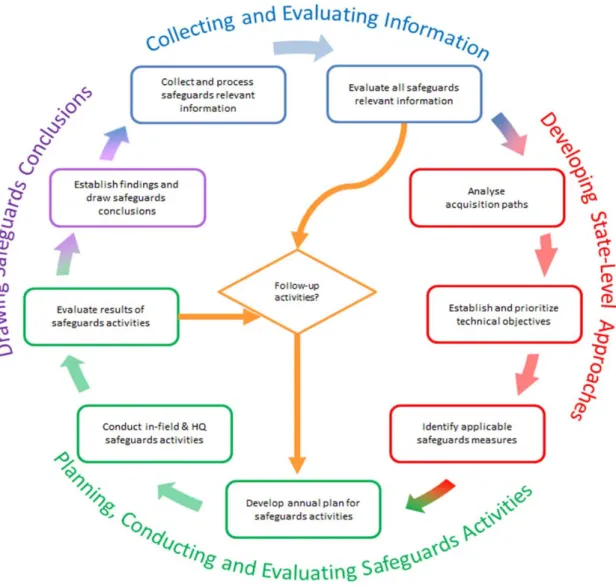
21. To ensure consistency and non-discrimination in the implementation of safeguards, the Agency has improved internal work practices, including through: the better integration of the results of safeguards activities conducted in the field with the results of those carried out at Headquarters in the determination of safeguards effort; advances in the handling of safeguards relevant information to facilitate evaluation; further development of internal procedures and guidance, and their documentation; and adjustments to the safeguards training programme. Of particular importance is the improvement of the key processes supporting safeguards implementation and the departmental oversight mechanisms relevant to the implementation of these processes. These processes are briefly described below and are depicted in Figure 1.
__________________________________________________________________________________ 25 The nature of the safeguards conclusion refers to the safeguards conclusions reported by the Director General to the Board of Governors in the SIR.
Figure 1: Processes supporting safeguards implementation
D.3.1.
Collecting and Evaluating Information
22. The Agency collects and processes safeguards relevant information about a State from a wide range of sources: information provided by the State itself (e.g. declarations and reports); safeguards activities conducted by the Agency in the field and at Headquarters (e.g. inspections, design information verification, material balance evaluations); and other relevant information (e.g. from open sources and third parties).26 The Agency conducts ongoing reviews of such information and evaluates its consistency with the State’s declarations about its nuclear programme.27 Any anomalies, questions or inconsistencies are identified and addressed in a timely manner through follow-up action. The evaluation of all safeguards relevant information also contributes to the Agency’s understanding of the State’s nuclear fuel cycle activities and plans, the assessment and use of relevant State-specific factors and the development of State-level approaches.
__________________________________________________________________________________ 26 Since the mid-1990s the Agency has been developing and implementing ways of collecting, processing and evaluating such information. The Agency protects all of that information in accordance with the confidentiality regime approved by the Board of Governors in December 1997 (GOV/DECISIONS 1997-98, 97-98/16; GOV/OR.934, paras 24–26).
D.3.2.
Developing State-Level Approaches
23. As indicated above (see paragraph 16), a State-level approach for each State is developed on the basis of an acquisition path analysis through which the technical objectives (and their relative priority) are established. This, in turn, leads to the identification of safeguards measures that could be implemented to address the technical objectives. Where possible, a State-level approach identifies more than one measure that could be used to address each technical objective. In developing and implementing a State-level approach, the Agency conducts appropriate consultations with the State concerned.28
D.3.3.
Planning, Conducting and Evaluating Safeguards Activities
24. Based on the State-level approach, the Agency develops an annual implementation plan which specifies the safeguards activities, both in the field and at Headquarters, which the Agency plans to conduct in a given year for the State concerned.29 Once an activity has been conducted, the Agency evaluates the extent to which that activity has attained the technical objective(s) and identifies any anomalies, questions or inconsistencies necessitating further follow-up activities, which may then be incorporated into an updated plan. The evaluation includes assessments to ensure that all activities were conducted in a manner consistent with the Agency’s established procedures and guidelines and that the rationale for any changes to the plan was appropriate and properly documented.
D.3.4.
Drawing Safeguards Conclusions
25. The Agency evaluates the results of its activities in the context of its understanding of the State’s nuclear fuel cycle activities and plans. On the basis of this evaluation, the Agency establishes its independent findings from which an annual safeguards conclusion is drawn for each State with a safeguards agreement in force. The process for drawing safeguards conclusions for CSA States is outlined in the annual SIR.30
E.
Impact on Safeguards Implementation
E.1.
Elements Common to all States with CSAs
26. As indicated below, the impact of the State-level concept on the implementation of safeguards in CSA States differs according to whether a State has an AP in force and, for those States that have an AP in force, whether the broader conclusion has been drawn by the Agency. However, the following elements are common to all States with CSAs:
the underlying objective of safeguards implementation continues to be the attainment of the generic State-level safeguards objectives described above (see paragraph 15) - in short, the detection of the diversion of declared nuclear material and the detection of undeclared nuclear material and activities. In this regard, the timely detection of the diversion of nuclear material and the deterrence of such diversion by the risk of early detection remain fundamental. The __________________________________________________________________________________ 28 And, where applicable, with the RSAC.
29 A safeguards activity is the implementation of a specific measure (e.g. a physical inventory verification conducted at a facility in the State).
Agency’s ability to detect undeclared nuclear material and activities significantly increases if a State has an AP in force;
the Agency conducts acquisition path analysis, establishes and prioritises technical objectives, identifies safeguards measures for addressing the technical objectives, and develops a State-level approach;
State-specific factors are taken into account in developing a State-level approach and in the planning, conduct and evaluation of safeguards activities (see Section D.2 above);
any anomalies, questions or inconsistencies identified in the evaluation of all safeguards relevant information are followed up in a timely manner, which may include the Agency seeking clarification from the State itself and, if necessary, an increase in safeguards activities (within the limits provided for in the CSA) in order to address a particular technical objective; and
the Agency evaluates all safeguards relevant information available to it about each State (see paragraph 22 above). In assessing indications of undeclared nuclear material and activities, the Agency seeks, as necessary, clarification from the State. A State’s cooperation in this regard is important. The Director General reports to the Board of Governors, as appropriate, on the Secretariat’s findings.
E.2.
States with CSAs, but without APs
27. In addition to the elements itemised in Section E.1, the following apply to States with a CSA but without an AP in force. The annual implementation plan identifies activities to pursue all technical objectives for all plausible acquisition paths in each State. For those technical objectives relating to the detection of the diversion of declared nuclear material and the detection of undeclared production or processing of nuclear material in declared facilities and LOFs, the safeguards criteria continue to provide the primary basis for the determination of in-field verification effort at those facilities and LOFs. For any given State this effort is not expected to change from one year to the next. To pursue the technical objectives relating to the detection of undeclared nuclear material or activities in the State as a whole, the Agency utilizes the measures provided for in the CSA, evaluates all safeguards relevant information about the State and, as necessary, seeks clarifications from the State.
E.3.
States with CSAs and APs, but without the Broader Conclusion
28. In addition to the elements itemised in Section E.1, the following apply to States with a CSA and an AP in force but without the broader conclusion. The annual implementation plan identifies activities to pursue all technical objectives for all plausible acquisition paths in that State. For those technical objectives relating to the detection of the diversion of declared nuclear material and the detection of undeclared production or processing of nuclear material in declared facilities and LOFs, the safeguards criteria continue to provide the primary basis for the determination of in-field verification effort at those facilities and LOFs. To pursue the technical objectives relating to the detection of undeclared nuclear material or activities in the State as a whole, the Agency utilizes the measures provided for in the CSA and AP, evaluates all safeguards relevant information about the State and, as necessary, seeks clarifications from the State.31
__________________________________________________________________________________ 31 For these States, significant effort is directed towards the implementation of the AP and the evaluation of all safeguards relevant information in order to support the drawing of the broader conclusion for the first time.
E.4.
States with CSAs, APs and the Broader Conclusion
29. The greatest opportunity for further optimizing safeguards implementation continues to be for States with CSAs and APs in force and for which the Agency has drawn the broader conclusion. In addition to the elements itemised in Section E.1, the following apply to such States. Given the broader conclusion for these States, not all technical objectives for all plausible acquisition paths need to be addressed each year: rather, the annual implementation plan identifies activities to pursue selected technical objectives for the selected acquisition paths. For those technical objectives relating to the detection of the diversion of declared nuclear material and the detection of undeclared production or processing of nuclear material in declared facilities and LOFs, the determination of in-field verification effort is based on the attainment of technical objectives in accordance with their assessed priority.32 Emphasis is placed on those technical objectives and associated measures that address areas of greatest safeguards significance for the State as a whole (e.g. technical objectives associated with nuclear material in the State that can be directly used for a nuclear explosive device) while maintaining appropriate coverage of other technical objectives relevant to the State. To pursue those technical objectives relating to the detection of undeclared nuclear material or activities in the State as a whole, the Agency utilizes the measures provided for in the CSA and AP, evaluates all safeguards relevant information about the State and, as necessary, seeks clarifications from the State. Generally, for these States, in-field verification effort is lower than that under the original State-level approaches for implementing integrated safeguards.
F.
Overview and Next Steps
30. Safeguards implementation by the Agency continues to evolve to strengthen its effectiveness and to improve its efficiency. In light of the continuing growth in verification demand on the Agency and budgetary constraints, improving efficiency without compromising effectiveness is a priority. Central to these efforts is the further evolution of safeguards implementation in CSA States focusing on considerations relating to the State as a whole, particularly in those States with the broader conclusion. This evolution is continuing to take place in a structured, objective and coordinated manner, consistent with well-established principles.
31. The Agency is currently implementing individual State-level approaches for 53 States for which the broader conclusion has been drawn and is continuing to improve them to further optimize the implementation of safeguards. The Agency is also developing individual State-level approaches for States for which the broader conclusion has been drawn for the first time. In developing and implementing State-level approaches, the Agency will continue to conduct appropriate consultations with the States concerned.33 The Agency will also consult with the other States33 with CSAs in force in the development of their respective individual State-level approaches.
32. Given the importance of an AP in significantly increasing the Agency’s ability to verify the peaceful use of all nuclear material in States with CSAs in force, the Director General will continue to encourage States that have yet to do so to bring an AP into force.
__________________________________________________________________________________ 32 Although the safeguards criteria are no longer used to determine verification effort at declared facilities and LOFs, elements of the criteria continue to serve as guidance for conducting certain safeguards activities (e.g. a physical inventory verification at a light water reactor, nuclear material balance evaluations).
33. The Director General will continue to report, as appropriate, to the Board of Governors and to the General Conference on the Agency’s efforts to enhance the effectiveness and efficiency of safeguards implementation.