Apple Fruits Classification Using Deep Learning
Al-Shawwa Mohammed O.
Department of Information Technology,
Faculty of Engineering and Information Technology,
Al-Azhar University - Gaza, Palestine
Abstract:
Apple is a plant species that follows the apple genus, which is a fruit because it contains seeds of the pink family. It is
one of the most fruit trees in terms of agriculture. The apple tree is small in length from 3 to 12 meters. Several recent studies have
shown many health benefits of apples. It helps with the strengthening of the brain, heart, and stomach. It is used in the treatment of
joint pain and limberness. It is opposite. It stops vomiting. It goes to dyspnea. It corrects the liver, purifies the blood of toxins,
strengthens the heart muscle, and kills the abdominal dentures. Which are richer in cell nutrition and development, bone
strengthening and neuronal regeneration is an important source of detoxification, viruses, bacteria, and microbes in the body. In
this paper, machine learning based approach is presented for identifying type of Apple with a dataset that contains 8,554 images.
We used 4,488 images for training, 1,928 images for validation and 2,138 images for testing. A deep learning technique that
extensively applied to image recognition was used. 70% from images were used for training and 30% from image for validation.
Our trained model achieved an accuracy of 100% on a held-out test set, demonstrating the feasibility of this approach.
Keywords:
Type of Apple, Deep Learning, Classification, Detection.
INTRODUCTION
Apples are rich in vitamins A, B, C, and sugary substances, protein, fatty substances, organic acids and mineral salts such as
potassium, calcium, sodium and others [1].
Apple benefits are:
Good for Weight Loss
Apples are high in fiber and water — two qualities that make them filling.
In one study, people who ate apple slices before a meal felt fuller than those who consumed applesauce, apple juice, or no
apple products.
In the same study, those who started their meal with apple slices also ate an average of 200 fewer calories than those who
didn't [2].
Good for Your Heart
Apples have been linked to a lower risk of heart disease.
One reason may be that apples contain soluble fiber - the kind that can help lower your blood cholesterol levels.
They also contain polyphenols, which have antioxidant effects. Many of these are concentrated in the peel [1].
One
of
these
polyphenols
is
the
flavonoid
epicatechin,
which
may
lower
blood
pressure.
An analysis of studies found that high intakes of flavonoids were linked to a 20% lower risk of stroke [1].
Promote Good Gut Bacteria
Apples contain pectin, a type of fiber that acts as a prebiotic. This means it feeds the good bacteria in your gut.
Your small intestine doesn't absorb fiber during digestion. Instead, it goes to your colon, where it can promote the growth
of good bacteria. It also turns into other helpful compounds that circulate back through your body.
New research suggests that this may be the reason behind some of the protective effects of apples against obesity, type 2
diabetes, and heart disease [1].
Help Prevent Cancer
Test-tube studies have shown a link between plant compounds in apples and a lower risk of cancer.
Additionally, one study in women reported that eating apples was linked to lower rates of death from cancer.
Scientists believe that their antioxidant and anti-inflammatory effects may be responsible for their potential
cancer-preventive effects [1].
Help Fight Asthma
Antioxidant-rich apples may help protect your lungs from oxidative damage.
A large study in more than 68,000 women found that those who ate the most apples had the lowest risk of asthma. Eating
about 15% of a large apple per day was linked to a 10% lower risk of this condition.
Apple skin contains the flavonoid quercetin, which can help regulate the immune system and reduce inflammation. These
are two ways in which it may affect asthma and allergic reactions [1].
Good for Bone Health
Eating fruit is linked to higher bone density, which is a marker of bone health.
Researchers believe that the antioxidant and anti-inflammatory compounds in fruit may help promote bone density and
strength.
Some studies show that apples, specifically, may positively affect bone health.
In one study, women ate a meal that either included fresh apples, peeled apples, applesauce, or no apple products. Those
who ate apples lost less calcium from their bodies than the control group [1].
Deep Learning is an Artificial Intelligence (AI) subfield that imitates the works of a human brain in processing data and producing
patterns for use in decision making. Deep learning is a subset of machine learning in artificial intelligence that has networks the
skills of learning from data that is unlabeled or unstructured.
In this work, we show that a Deep Convolutional Neural Network (CNN) does well in classifying apple type. In computer vision,
CNNs have been known to be powerful visual models that yield hierarchies of features enabling accurate segmentation. They are
also known to perform predictions relatively faster than other algorithms while maintaining competitive performance at the same
time [5].
DEEP LEARNING
Deep learning (also known as deep structured learning or hierarchical learning) is part of a broader family of machine learning
methods based on learning data representations, as opposed to task-specific algorithms. Learning can be supervised,
semi-supervised or unsemi-supervised [2]-[3]. In deep learning, each level learns to transform its input data into a slightly more abstract and
composite representation. In an image recognition application, the raw input may be a matrix of pixels; the first representational
layer may abstract the pixels and encode edges; the second layer may compose and encode arrangements of edges; the third layer
may encode a nose and eyes; and the fourth layer may recognize that the image contains a face. Importantly, a deep learning
process can learn which features to optimally place in which level on its own. (Of course, this does not completely obviate the
need for hand-tuning; for example, varying numbers of layers and layer sizes can provide different degrees of abstraction) [2],[4].
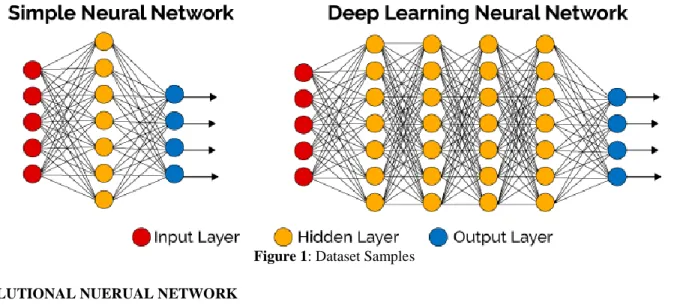
Figure 1
: Dataset Samples
In deep learning, a convolutional neural network (CNN, or ConvNet) is a class of deep neural networks, most commonly applied
to analyzing visual imagery. CNNs use a variation of multilayer perceptron’s designed to require minimal preprocessing. They are
also known as shift invariant or Space Invariant Artificial Neural Networks (SIANN), based on their shared-weights architecture
and translation invariance characteristics [6].
TYPES OF MACHINE LEARNING ALGORITHMS
There some variations of how to define the types of Machine Learning Algorithms but commonly they can be divided into
categories according to their purpose and the main categories are the following [7]:
Supervised learning
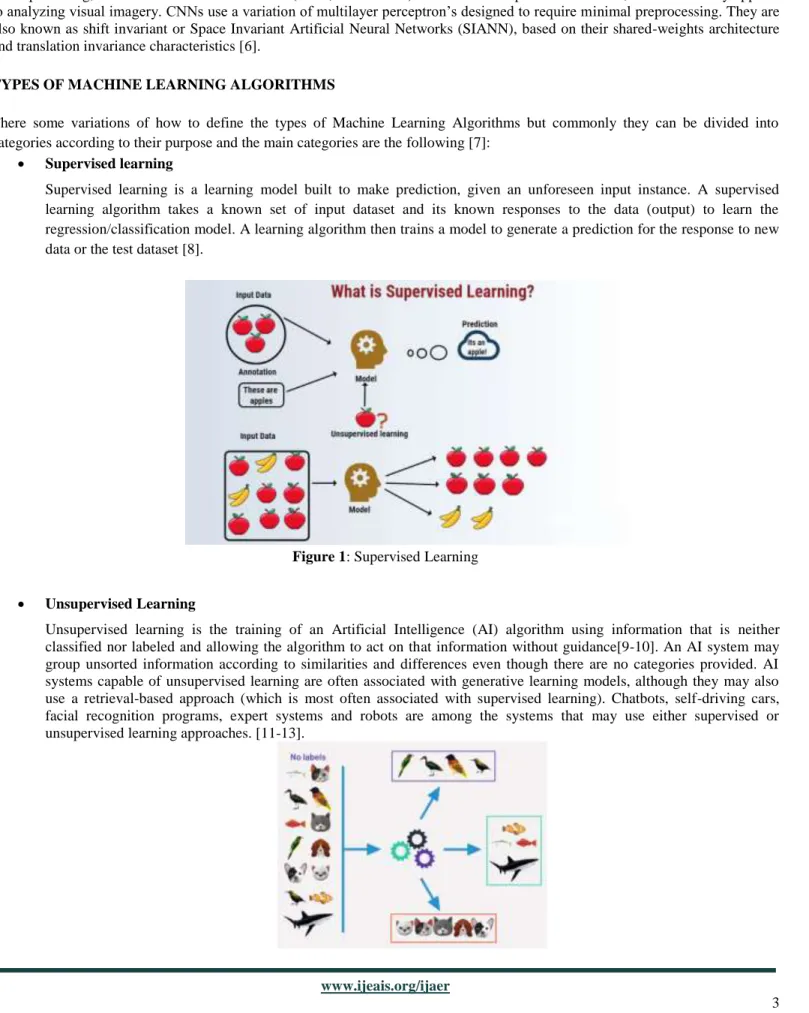
Supervised learning is a learning model built to make prediction, given an unforeseen input instance. A supervised
learning algorithm takes a known set of input dataset and its known responses to the data (output) to learn the
regression/classification model. A learning algorithm then trains a model to generate a prediction for the response to new
data or the test dataset [8].
Figure 1
: Supervised Learning
Unsupervised Learning
Unsupervised learning is the training of an Artificial Intelligence (AI) algorithm using information that is neither
classified nor labeled and allowing the algorithm to act on that information without guidance[9-10]. An AI system may
group unsorted information according to similarities and differences even though there are no categories provided. AI
systems capable of unsupervised learning are often associated with generative learning models, although they may also
use a retrieval-based approach (which is most often associated with supervised learning). Chatbots, self-driving cars,
facial recognition programs, expert systems and robots are among the systems that may use either supervised or
unsupervised learning approaches. [11-13].
Figure 2
: Unsupervised Learning
STUDY OBJECTIVES
1-
Demonstrating the feasibility of using deep convolutional neural networks to classify Type Apple.
2-
Developing a model that can be used by developer to create smartphones application or web site to detect Type Apple.
DATASET
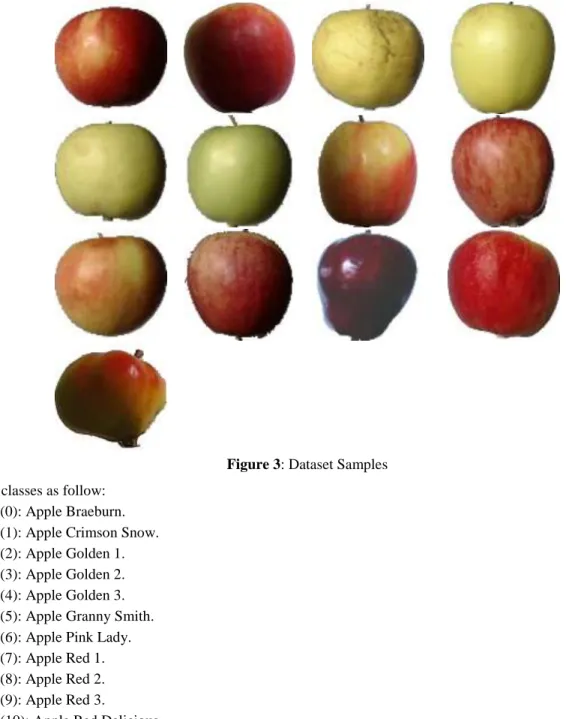
The dataset used, provided by Kaggle, contains a set of 8,554 images use 4,488 images for training, 1,928 images for validation
and 2,138 images for testing belonging to 13 species from apple. See Fig. 3 for types apple.
Figure 3
: Dataset Samples
The output 13 classes as follow:
class (0): Apple Braeburn.
class (1): Apple Crimson Snow.
class (2): Apple Golden 1.
class (3): Apple Golden 2.
class (4): Apple Golden 3.
class (5): Apple Granny Smith.
class (6): Apple Pink Lady.
class (7): Apple Red 1.
class (8): Apple Red 2.
class (9): Apple Red 3.
class (12): Apple Red Yellow 2.
The images were resized into 150×150 for faster computations but without compromising the quality of the data.
METHODOLOGY
In this section we describe the proposed solution as selected convolutional network (ConvNet) architecture and discuss associated
design choices and implementation aspects.
MODEL
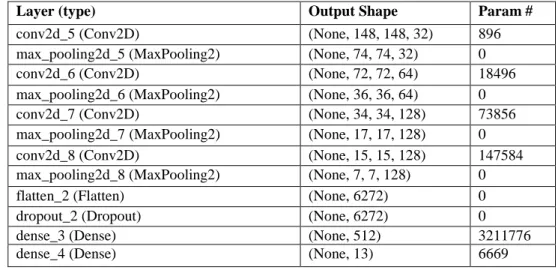
Our model takes raw images as an input, so we used Convolutional Neural Networks (CNNs) to extract features, in result the model
would consist from (features extraction), which was the same for full-color approach and gray-scale approach, it consist of 4
Convolutional layers with Relu activation function, each followed by Max Pooling layer.
Layer (type)
Output Shape
Param #
conv2d_5 (Conv2D)
(None, 148, 148, 32)
896
max_pooling2d_5 (MaxPooling2)
(None, 74, 74, 32)
0
conv2d_6 (Conv2D)
(None, 72, 72, 64)
18496
max_pooling2d_6 (MaxPooling2)
(None, 36, 36, 64)
0
conv2d_7 (Conv2D)
(None, 34, 34, 128)
73856
max_pooling2d_7 (MaxPooling2)
(None, 17, 17, 128)
0
conv2d_8 (Conv2D)
(None, 15, 15, 128)
147584
max_pooling2d_8 (MaxPooling2)
(None, 7, 7, 128)
0
flatten_2 (Flatten)
(None, 6272)
0
dropout_2 (Dropout)
(None, 6272)
0
dense_3 (Dense)
(None, 512)
3211776
dense_4 (Dense)
(None, 13)
6669
SYSTEM EVALUATION
We used the original apples dataset that consists of 6,416 images after resizing the images to 150x150 pixels. We divided the data
into training (70%), validation (30%). The training accuracy was 99.99% and the validation accuracy was 100%.
Figure 4
: Training and validation accuracy and loss
CONCLUSION
We proposed a solution to help people determine the type of apples more accurately. We got 100% accuracy for our best model.
We built a model using deep learning convolutional neural networks and uses this model to predict the type of (previously unseen)
images of apple with a network from 4 layers and a dropout of 0.2, that takes apple images with 13 different species an input.
References
1. Abu-Naser, S. S. (2012). "Predicting learners performance using artificial neural networks in linear programming intelligent tutoring system." International Journal of Artificial Intelligence & Applications 3(2): 65.
2. Abu-Nasser, B. S. and S. S. Abu Naser (2018). "Rule-Based System for Watermelon Diseases and Treatment." International Journal of Academic Information Systems Research (IJAISR) 2(7): 1-7. 3. Abu-Nasser, B. S. and S. S. Abu-Naser (2018). "Cognitive System for Helping Farmers in Diagnosing Watermelon Diseases." International Journal of Academic Information Systems Research (IJAISR) 2(7):
1-7.
4. Abu-Saqer, M. M. and S. S. Abu-Naser (2019). "Developing an Expert System for Papaya Plant Disease Diagnosis." International Journal of Academic Engineering Research (IJAER) 3(4): 14-21. 5. Afana, M., et al. (2018). "Artificial Neural Network for Forecasting Car Mileage per Gallon in the City." International Journal of Advanced Science and Technology 124: 51-59.
6. Alajrami, E., et al. (2019). "Blood Donation Prediction using Artificial Neural Network." International Journal of Academic Engineering Research (IJAER) 3(10): 1-7. 7. Alajrami, E., et al. (2020). "Handwritten Signature Verification using Deep Learning." International Journal of Academic Mult idisciplinary Research (IJAMR) 3(12): 39-44. 8. Alajrami, M. A. and S. S. Abu-Naser (2020). "Type of Tomato Classification Using Deep Learning." International Journal of Academic Pedagogical Research (IJAPR) 3(12): 21-25. 9. Al-Daour, A. F., et al. (2020). "Banana Classification Using Deep Learning." International Journal of Academic Information Systems Research (IJAISR) 3(12): 6-11.
10. Alghoul, A., et al. (2018). "Email Classification Using Artificial Neural Network." International Journal of Academic Engineering Research (IJAER) 2(11): 8-14.
11. Alkronz, E. S., et al. (2019). "Prediction of Whether Mushroom is Edible or Poisonous Using Back-propagation Neural Network." International Journal of Academic and Applied Research (IJAAR) 3(2): 1-8. 12. Al-Massri, R., et al. (2018). "Classification Prediction of SBRCTs Cancers Using Artificial Neural Network." International Journal of Academic Engineering Research (IJAER) 2(11): 1-7.
13. Al-Mubayyed, O. M., et al. (2019). "Predicting Overall Car Performance Using Artificial Neural Network." International Journal of Academic and Applied Research (IJAAR) 3(1): 1-5. 14. Alqumboz, M. N. A. and S. S. Abu-Naser (2020). "Avocado Classification Using Deep Learning." International Journal of Academic Engineering Research (IJAER) 3(12): 30-34.
15. Al-Shawwa, M. and S. S. Abu-Naser (2019). "Predicting Birth Weight Using Artificial Neural Network." International Journal of Academic Health and Medical Research (IJAHMR) 3(1): 9-14.
16. Al-Shawwa, M. and S. S. Abu-Naser (2019). "Predicting Effect of Oxygen Consumption of Thylakoid Membranes (Chloroplasts) from Spinach after Inhibition Using Artificial Neural Network." International Journal of Academic Engineering Research (IJAER) 3(2): 15-20.
17. Al-Shawwa, M. O. and S. S. Abu-Naser (2020). "Classification of Apple Fruits by Deep Learning." International Journal of Academic Engineering Research (IJAER) 3(12): 1-7. 18. Alshawwa, I. A., et al. (2020). "Analyzing Types of Cherry Using Deep Learning. " International Journal of Academic Engineering Research (IJAER) 4 (1): 1-5.
19. Abu-Saqer, M. M., et al. (2020). "Type of Grapefruit Classification Using Deep Learning. " International Journal of Academic Information Systems Research (IJAISR) 4 (1): 1-5.
20. Al-Shawwa, M., et al. (2018). "Predicting Temperature and Humidity in the Surrounding Environment Using Artificial Neural Network." International Journal of Academic Pedagogical Research (IJAPR) 2(9): 1-6.
21. AlZamily, J. Y. and S. S. A. Naser (2020). "Lemon Classification Using Deep Learning." International Journal of Academic Pedagogical Research (IJAPR) 3(12): 16-20.
22. Ashqar, B. A. M. and S. S. Abu-Naser (2019). "Identifying Images of Invasive Hydrangea Using Pre-Trained Deep Convolutional Neural Networks." International Journal of Academic Engineering Research (IJAER) 3(3): 28-36.
23. Ashqar, B. A. M. and S. S. Abu-Naser (2019). "Image-Based Tomato Leaves Diseases Detection Using Deep Learning." International Journal of Academic Engineering Research (IJAER) 2(12): 10-16. 24. Ashqar, B. A., et al. (2019). "Plant Seedlings Classification Using Deep Learning." International Journal of Academic Information Systems Research (IJAISR) 3(1): 7-14.
25. Barhoom, A. M., et al. (2019). "Predicting Titanic Survivors using Artificial Neural Network." International Journal of Academic Engineering Research (IJAER) 3(9): 8-12. 26. Dalffa, M. A., et al. (2019). "Tic-Tac-Toe Learning Using Artificial Neural Networks." International Journal of Engineering and Information Systems (IJEAIS) 3(2): 9-19. 27. Dheir, I. M., et al. (2020). "Classifying Nuts Types Using Convolutional Neural Network." International Journal of Academic Information Systems Research (IJAISR) 3(12): 12-18. 28. El_Jerjawi, N. S. and S. S. Abu-Naser (2018). "Diabetes Prediction Using Artificial Neural Network." International Journal of Advanced Science and Technology 121: 55-64. 29. El-Kahlout, M. I. and S. S. Abu-Naser (2020). "Peach Type Classification Using Deep Learning." International Journal of Academic Engineering Research (IJAER) 3(12): 35-40. 30. El-Khatib, M. J., et al. (2019). "Glass Classification Using Artificial Neural Network." International Journal of Academic Pedagogical Research (IJAPR) 3(2): 25-31. 31. El-Mashharawi, H. Q., et al. (2020). "Grape Type Classification Using Deep Learning." International Journal of Academic Engineering Research (IJAER) 3(12): 41-45. 32. Elsharif, A. A., et al. (2020). "Potato Classification Using Deep Learning." International Journal of Academic Pedagogical Research (IJAPR) 3(12): 1-8.
33. Elzamly, A., et al. (2017). "Predicting Critical Cloud Computing Security Issues using Artificial Neural Network (ANNs) Algor ithms in Banking Organizations." International Journal of Information Technology and Electrical Engineering 6(2): 40-45.
34. Heriz, H. H., et al. (2018). "English Alphabet Prediction Using Artificial Neural Networks." International Journal of Academic Pedagogical Research (IJAPR) 2(11): 8-14.
35. Jamala, M. N. and S. S. Abu-Naser (2018). "Predicting MPG for Automobile Using Artificial Neural Network Analysis." International Journal of Academic Information Systems Research (IJAISR) 2(10): 5-21. 36. Kashf, D. W. A., et al. (2018). "Predicting DNA Lung Cancer using Artificial Neural Network." International Journal of Academic Pedagogical Research (IJAPR) 2(10): 6-13.
37. Khalil, A. J., et al. (2019). "Energy Efficiency Predicting using Artificial Neural Network." International Journal of Academic Pedagogical Research (IJAPR) 3(9): 1-8.
38. Marouf, A. and S. S. Abu-Naser (2018). "Predicting Antibiotic Susceptibility Using Artificial Neural Network." International Journal of Academic Pedagogical Research (IJAPR) 2(10): 1-5. 39. Mettleq, A. S. A., et al. (2020). "Mango Classification Using Deep Learning." International Journal of Academic Engineering Research (IJAER) 3(12): 22-29.
40. Metwally, N. F., et al. (2018). "Diagnosis of Hepatitis Virus Using Artificial Neural Network." International Journal of Academic Pedagogical Research (IJAPR) 2(11): 1-7. 41. Musleh, M. M., et al. (2019). "Predicting Liver Patients using Artificial Neural Network." International Journal of Academic Information Systems Research (IJAISR) 3(10): 1-11. 42. Nabahin, A., et al. (2017). "Expert System for Hair Loss Diagnosis and Treatment." International Journal of Engineering and Information Systems (IJEAIS) 1(4): 160-169. 43. Nasser, I. M. and S. S. Abu-Naser (2019). "Artificial Neural Network for Predicting Animals Category." International Journal of Academic and Applied Research (IJAAR) 3(2): 18-24. 44. Nasser, I. M. and S. S. Abu-Naser (2019). "Lung Cancer Detection Using Artificial Neural Network." International Journal of Engineering and Information Systems (IJEAIS) 3(3): 17-23. 45. Nasser, I. M. and S. S. Abu-Naser (2019). "Predicting Books’ Overall Rating Using Artificial Neural Network." International Journal of Academic Engineering Research (IJAER) 3(8): 11-17. 46. Nasser, I. M. and S. S. Abu-Naser (2019). "Predicting Tumor Category Using Artificial Neural Networks." International Journal of Academic Health and Medical Research (IJAHMR) 3(2): 1-7. 47. Nasser, I. M., et al. (2019). "A Proposed Artificial Neural Network for Predicting Movies Rates Category." International Journal of Academic Engineering Research (IJAER) 3(2): 21-25. 48. Nasser, I. M., et al. (2019). "Artificial Neural Network for Diagnose Autism Spectrum Disorder." International Journal of Academic Information Systems Research (IJAISR) 3(2): 27-32. 49. Nasser, I. M., et al. (2019). "Developing Artificial Neural Network for Predicting Mobile Phone Price Range." International Journal of Academic Information Systems Research (IJAISR) 3(2): 1-6. 50. Sadek, R. M., et al. (2019). "Parkinson’s Disease Prediction Using Artificial Neural Network." International Journal of Academic Health and Medical Research (IJAHMR) 3(1): 1-8.
51. Salah, M., et al. (2018). "Predicting Medical Expenses Using Artificial Neural Network." International Journal of Engineering and Information Systems (IJEAIS) 2(20): 11-17.
52. Zaqout, I., et al. (2015). "Predicting Student Performance Using Artificial Neural Network: in the Faculty of Engineering and Information Technology." International Journal of Hybrid Information Technology 8(2): 221-228.
53. Abu Naser, S. S. (2018). "TOP 10 NEURAL NETWORK PAPERS: RECOMMENDED READING–ARTIFICIAL INTELLIGENCE RESEARCH." word press 1(1).
54. Almadhoun, H. R. and S. S. Abu Naser (2018). "Banana Knowledge Based System Diagnosis and Treatment." International Journal o f Academic Pedagogical Research (IJAPR) 2(7): 1-11. 55. Salman, F. and S. S. Abu-Naser (2019). "Rule based System for Safflower Disease Diagnosis and Treatment." International Journal of Academic Engineering Research (IJAER) 3(8): 1-10. 56. Salman, F. M. and S. S. Abu-Naser (2019). "Expert System for Castor Diseases and Diagnosis." International Journal of Engineering and Information Systems (IJEAIS) 3(3): 1-10. 57. Nassr, M. S. and S. S. Abu Naser (2018). "Knowledge Based System for Diagnosing Pineapple Diseases." International Journal of Academic Pedagogical Research (IJAPR) 2(7): 12-19. 58. Mettleq, A. S. A. and S. S. Abu-Naser (2019). "A Rule Based System for the Diagnosis of Coffee Diseases." International Journal of Academic Information Systems Research (IJAISR) 3(3): 1-8. 59. Musleh, M. M. and S. S. Abu-Naser (2018). "Rule Based System for Diagnosing and Treating Potatoes Problems." International Journal of Academic Engineering Research (IJAER) 2(8): 1-9. 60. Khalil, A. J., et al. (2019). "Apple Trees Knowledge Based System." International Journal of Academic Engineering Research (IJAER) 3(9): 1-7.
61. Elzamly, A., et al. (2015). "Classification of Software Risks with Discriminant Analysis Techniques in Software planning Development Process." International Journal of Advanced Science and Technology 81: 35-48.
62. Elzamly, A., et al. (2015). "Predicting Software Analysis Process Risks Using Linear Stepwise Discriminant Analysis: Statistical Methods." Int. J. Adv. Inf. Sci. Technol 38(38): 108-115. 63. Elqassas, R. and S. S. Abu-Naser (2018). "Expert System for the Diagnosis of Mango Diseases." International Journal of Academic Engineering Research (IJAER) 2(8): 10-18. 64. Elsharif, A. A. and S. S. Abu-Naser (2019). "An Expert System for Diagnosing Sugarcane Diseases." International Journal of Academic Engineering Research (IJAER) 3(3): 19-27.
65. El-Mashharawi, H. Q. and S. S. Abu-Naser (2019). "An Expert System for Sesame Diseases Diagnosis Using CLIPS." International Journal of Academic Engineering Research (IJAER) 3(4): 22-29. 66. Dheir, I. and S. S. Abu-Naser (2019). "Knowledge Based System for Diagnosing Guava Problems." International Journal of Academic Information Systems Research (IJAISR) 3(3): 9-15. 67. El Kahlout, M. I. and S. S. Abu-Naser (2019). "An Expert System for Citrus Diseases Diagnosis." International Journal of Academic Engineering Research (IJAER) 3(4): 1-7. 68. Alshawwa, I. A., et al. (2019). "An Expert System for Coconut Diseases Diagnosis." International Journal of Academic Engineering Research (IJAER) 3(4): 8-13.
69. Al-Shawwa, M. and S. S. Abu-Naser (2019). "Knowledge Based System for Apple Problems Using CLIPS." International Journal of Academic Engineering Research (IJAER) 3(3): 1-11. 70. Ahmed, A., et al. (2019). "Knowledge-Based Systems Survey." International Journal of Academic Engineering Research (IJAER) 3(7): 1-22.
71. Akkila, A. N., et al. (2019). "Survey of Intelligent Tutoring Systems up to the end of 2017." International Journal of Academic Information Systems Research (IJAISR) 3(4): 36-49. 72. Almasri, A., et al. (2019). "Intelligent Tutoring Systems Survey for the Period 2000-2018." International Journal of Academic Engineering Research (IJAER) 3(5): 21-37. 73. Masri, N., et al. (2019). "Survey of Rule-Based Systems." International Journal of Academic Information Systems Research (IJAISR) 3(7): 1-23.
74. Ng, S., et al. (2010). "Ad hoc networks based on rough set distance learning method." Information Technology Journal 10(9): 239-251.
75. Owaied, H. H., et al. (2009). "Using rules to support case-based reasoning for harmonizing melodies." Journal of Applied Sciences 11(14): pp: 31-41. 76. Sulisel, O., et al. (2005). "Growth and Maturity of Intelligent Tutoring Systems." Information Technology Journal 7(7): 9-37.
77. Al-Qumboz, M. N. A. and S. S. Abu-Naser (2019). "Spinach Expert System: Diseases and Symptoms." International Journal of Academic Information Systems Research (IJAISR) 3(3): 16-22. 78. Baker, J., et al. "& Heller, R.(1996)." Information Visualization. Information Technology Journal 7(2).
79. Baker, J., et al. (1996). "Information Visualization." Information Technology Journal 7(2): pp: 403-404.