Lehigh University
Lehigh Preserve
Theses and Dissertations2014
Mining and Analyzing the Academic Network
Zaihan Yang
Lehigh University
Follow this and additional works at:http://preserve.lehigh.edu/etd Part of theComputer Sciences Commons
This Dissertation is brought to you for free and open access by Lehigh Preserve. It has been accepted for inclusion in Theses and Dissertations by an authorized administrator of Lehigh Preserve. For more information, please [email protected].
Recommended Citation
Mining and Analyzing the Academic Network
by
Zaihan Yang
A Dissertation
Presented to the Graduate Committee of Lehigh University
in Candidacy for the Degree of Doctor of Philosophy
in
Computer Science
Lehigh University May 2014
Copyright c 2014 by Zaihan Yang All Rights Reserved
Approved and recommended for acceptance as a dissertation in partial fulfill-ment of the requirefulfill-ments for the degree of Doctor of Philosophy.
Zaihan Yang
Mining and Analyzing the Academic Network
Date
Prof. Brian D. Davison, Dissertation Director, Chair
(Must Sign with Blue Ink)
Accepted Date
Committee Members
Prof. Mooi Choo Chuah
Prof. Jeff Heflin
Prof. Roger Nagel
Acknowledgments
First of all, I owe my sincerest thanks to my advisor, Prof. Brian D. Davison, for his encouragement, patience, guidance and insightful advice throughout my PhD study. Prof. Davison provides me a stable and enjoyable studying environment, where he gives me much freedom to explore various kinds of research topics and encourages me to work independently. As a research advisor, his passion towards research, hard-working spirits, good sense of finding problems, and special insistence on details, not only in developing ideas, but also in conducting and analyzing experiments as well as organizing and writing papers, have greatly inspired me and influenced my perspectives towards academic research. He has shaped me from many aspects from figuring out working directions to writing papers. I am grateful to him for the fruitful discussions, stimulating feedbacks and practical helps I got from him, and will never forget the many late-nights and early-mornings that he spent with us revising papers and preparing for submissions. Beyond just a research advisor, Prof. Davison is a kind and generous friend, who is always considerate and willing to provide help. I will always remember the great patience and support he offers when I had some difficulties in obtaining visa back to school. Without his advice and support, the completion of this dissertation would be impossible.
I would also like to thank my committee members: Prof. Mooi Choo Chuah, Prof. Jeff Heflin, Prof. Roger Nagel, and Prof. Catherine Ridings, for the help, feedback and advice they have provided during the writing of this dissertation and in my general examination. Sincere gratitude also goes to Prof. Charles Smith, who provides me the opportunity to work as the teaching assistant for several semesters. Many thanks to my WUME lab mates: Liangjie Hong, Dawei Yin, Na Dai, Xiaoguang Qi, Zhenzhen Xue, Ovidiu Dan, Jian Wang, Nie Lan and Will West, and friends from other labs: Dezhao Song, Xingjian Zhang, Jin Chen, Yingjie Li and Yang Yu, for their valuable discussions and participation in my experiments. I would especially thank Liangjie, Dawei, Na and Xiaoguang, for their help, comfort and encouragement when I had difficulties in research. I appreciate those happy days spent together with these fellow students. It was full of laughters and fun. No
matter how far away we would be in the future, such a long-time experience studying together and the friendship among us will be precious and long-lasting memory in my mind.
Last but not the least, I am deeply indebted to my family. My deepest thanks go to my dearest father Binwen Yang and mother Dianzi Chen. Their endless love and unconditional support is the most powerful source of strength leading me move forward and going through all the difficult times in my life. Special gratitude also goes to my husband, Feng Zhu, who has always been my best friend and mental support. Without his love and companionship, I could not have overcome such difficulties and completed this work. I would also thank Feng’s parents, who are always kind and supportive to me.
Much of the work presented in this dissertation was supported in part by a grant from the National Science Foundation under award IIS-0545875, as well as an equipment grant from Sun Microsystems. Any opinions, findings, and conclusions or recommendations expressed in this material are those of the author(s) and do not necessarily reflect the views of the National Science Foundation.
Dedication
Lovingly dedicated to my parents, Binwen Yang & Dianzi Chen
and Feng
Contents
Certificate of Approval iii
Acknowledgements iv
Dedication vi
Table of Contents vii
List of Tables xii
List of Figures xiv
Abstract 1
1 Introduction 3
1.1 Overview . . . 3
1.1.1 Modeling Expertise Retrieval . . . 6
1.1.2 Research Action Recommendation and Prediction . . . 8
1.2 Contributions . . . 10
1.3 Dissertation Organization . . . 15
2 Background 18 2.1 Expertise Retrieval: Introduction . . . 18
2.2 Expertise Retrieval Systems . . . 23
2.2.2 Expert Search Engine . . . 24
2.3 Main Challenges in Expert Search . . . 25
2.4 Experimental Data Collections . . . 27
2.5 Evaluation Metrics . . . 32
2.6 Existing Approaches . . . 34
2.6.1 Generative Probabilistic Models . . . 35
2.6.2 Voting Models . . . 36
2.6.3 Discriminative Probabilistic Models . . . 37
2.6.4 Topic-Modeling-based Models . . . 38
2.6.5 Graph-based Models . . . 38
2.7 Recommender Systems: Introduction . . . 40
2.8 Collaborative Filtering . . . 42
2.8.1 Neighborhood Memory based CF . . . 42
2.8.2 Latent Factor Model-based CF: Matrix Factorization . . . 43
2.8.3 Solving Matrix Factorization Model . . . 46
2.9 Evaluation metrics . . . 48
3 Expert Ranking: Topic-Driven Multi-Type Citation Network Analysis 51 3.1 Introduction . . . 52
3.2 Multi-type Citation Network Framework . . . 54
3.2.1 Notation and Preliminaries . . . 54
3.2.2 Framework Version-1 . . . 54
3.2.3 Framework Version-2 . . . 56
3.2.4 Heterogeneous PageRank . . . 57
3.3 Topical Link Analysis in citation networks . . . 59
3.3.1 Topical PageRank . . . 59
3.3.2 Topical Citation Analysis . . . 60
3.4 Experimental Work . . . 61
3.4.1 Data Collection . . . 61
3.4.2 Evaluation . . . 61
3.5 Bibiliographic Notes . . . 71
3.6 Summary . . . 73
4 Expert Ranking: Integrating Learning-to-Rank with Topic Modeling 74 4.1 Introduction . . . 75
4.2 Model Design . . . 77
4.2.1 Model Description and Generative Process . . . 78
4.2.2 Incorporating Features . . . 81
4.3 Model Estimation and Ranking Scheme . . . 87
4.3.1 Inference and Estimation . . . 88
4.3.2 Ranking Scheme . . . 93
4.4 Experimental Evaluation . . . 94
4.4.1 Experiments Setup . . . 94
4.4.2 Application . . . 95
4.4.3 Qualitative Topic Modeling Results . . . 102
4.5 Bibliographic Notes . . . 104
4.6 Summary . . . 106
5 Writing with style: venue classification and recommendation 107 5.1 Introduction . . . 107 5.2 Venue Classification . . . 111 5.2.1 Problem Identification . . . 111 5.2.2 Features . . . 111 5.2.3 Experimental Evaluation . . . 113 5.3 Venue Recommendation . . . 121 5.3.1 Problem Identification . . . 122 5.3.2 Approach . . . 123 5.3.3 Evaluation . . . 126 5.4 Bibliographic Notes . . . 135 5.5 Summary . . . 136
6 Academic Network Analysis: a Joint Topical Modeling Approach 147
6.1 Introduction . . . 147
6.2 Model . . . 150
6.2.1 Model Description / Generative Process . . . 152
6.2.2 Parameter Inference and Estimation . . . 154
6.3 Application . . . 156
6.3.1 Expert Ranking . . . 156
6.3.2 Cited Author Prediction . . . 159
6.3.3 Venue Prediction . . . 161
6.4 Experimental Evaluation . . . 161
6.4.1 Experimental Setup . . . 161
6.4.2 Experimental Methodology and Results . . . 162
6.4.3 Cited Author Prediction . . . 169
6.4.4 Venue Prediction . . . 171
6.5 Bibiliographic Notes . . . 172
6.5.1 Author Topic Modeling . . . 172
6.5.2 Applications . . . 174
6.6 Summary . . . 174
7 Recommendation in Academia: a Joint Multi-Relational Model 176 7.1 Introduction . . . 176
7.2 Preliminary Experiments . . . 179
7.2.1 Data Sets . . . 180
7.2.2 Coupled Relations . . . 180
7.2.3 Cold Start Problem . . . 180
7.2.4 Interests Evolution . . . 182
7.3 Joint Multi-Relational Model (JMRM): Model Design and Generation 183 7.4 Joint Multi-Relational Model: Algorithm . . . 191
7.4.1 Preliminary Notations . . . 191
7.4.2 Model Factorization Maximizing MAP . . . 192
7.5 Experimental Evaluation . . . 196
7.5.1 Data Preprocessing . . . 196
7.5.2 Co-effects Analysis of Multiple Relations . . . 197
7.5.3 Comparison with Existing Methods . . . 199
7.6 Bibiliographic Notes . . . 201
7.7 Summary . . . 203
8 Conclusions and Future Work 204 8.1 Recapitulation . . . 204
8.2 Impact . . . 207
8.3 Caveats . . . 213
8.4 Future Work . . . 214
8.4.1 Expertise Retrieval . . . 214
8.4.2 Research Action Prediction and Recommendation . . . 216
Bibliography 218
List of Tables
1.1 Models developed within this work . . . 11
2.1 Data Collections Summary (1) . . . 29
2.2 Data Collections Summary (2) . . . 32
3.1 Queries . . . 61
3.2 NDCG Results from human judgements (λ=0.5) . . . 66
3.3 Top-level topics from the ACM Digital Library. . . 67
3.4 TopicalV2 vs CoRank (on PC members) . . . 69
3.5 NDCG@20 for Heterogenous PageRank . . . 70
4.1 Notation . . . 79
4.2 Community, Query and Award Winners ground truth . . . 95
4.3 Community, Conference, and PC member ground truth . . . 97
4.4 Award winner prediction: ACM avgRank . . . 100
4.5 Award winner prediction: ArnetMiner avgRank . . . 100
4.6 PC member prediction: ACM MAP . . . 100
4.7 PC member prediction: ArnetMiner MAP . . . 101
4.8 Topic Modeling Results . . . 103
5.1 Features . . . 138
5.2 Statistics over Chosen Venues . . . 139
5.3 Multi-Class Venue Classification for ACM Data Set . . . 139
5.4 Multi-Class Venue Classification for CiteSeer Data Set . . . 140
5.6 F1 Score for Different Feature Sets and Techniques . . . 141
5.7 P-values of pairwise t tests on Accuracy for different types . . . 141
5.8 CiteSeer Data Set: Contribution of individual features . . . 142
5.9 Content vs. Writing Style: ACM data set . . . 143
5.10 Writing Styles vs. Genres . . . 143
5.11 Content vs. Writing Style: CiteSeer Data Set . . . 144
5.12 Writing Styles vs. Topics . . . 144
5.13 Venue Recommendation Results on ACM and CiteSeer data . . . 145
5.14 ACM and CiteSeer: Comparison with baseline algorithms . . . 146
5.15 Venue Recommendation Results: Examples . . . 146
6.1 Notation . . . 151
6.2 Statistics over ACM and ArnetMiner data set . . . 162
6.3 Topic Modeling Results on ArnetMiner data set . . . 163
6.4 Evaluation Benchmark . . . 165
6.5 Comparison of Topic Modeling Results: MAP . . . 166
6.6 Expert Ranking Results Comparison (on ArnetMiner data set) . . . . 167
6.7 Comparison of Topic Modeling Results: MAP . . . 169
6.8 Comparison of Cited Author Prediction: MAP . . . 170
6.9 Comparison of Venue Prediction: MAP . . . 171
7.1 Statistics on Papers’ Citations . . . 182
7.2 Statistics on Changes of Publishing Venues . . . 183
7.3 Author Features . . . 187
7.4 Notations . . . 191
7.5 Data Set Statistic (1) . . . 197
7.6 Data Set Statistics (2) . . . 197
7.7 Performance comparison over different combinations of relations (1) . 198 7.8 Performance comparison over different combinations of relations (2) . 198 7.9 Performance Comparison: ACM data set . . . 200
List of Figures
1.1 Academic Network and its properties . . . 6
2.1 One Sample for Expertise Retrieval . . . 19
2.2 Expert Finding System Architecture . . . 23
2.3 Microsoft Academic Search Engine search example: Coauthor-graph . 25 2.4 Matrix Factorization example . . . 44
3.1 Multi-type (4-T) Citation Network version-1 . . . 55
3.2 Multi-type (4-TV2) Citation Network version-2 . . . 57
3.3 Heterogeneous PageRank . . . 58
3.4 Comparison among different levels of citation network (1) . . . 64
3.5 Comparison among different levels of citation network (2) . . . 64
3.6 Comparison among different levels of citation network (3) . . . 65
3.7 Comparison among different levels of citation network (4) . . . 65
3.8 Topical PageRank Performance for ACM members . . . 68
3.9 Topical PageRank Performance for PC members . . . 68
4.1 Graphical Model for original LDA . . . 78
4.2 Graphical Model for LtoRTM . . . 82
4.3 Graphical Model for LtoRTMF . . . 83
4.4 Feature Analysis (award winner) . . . 102
4.5 Feature Analysis (PC member) . . . 102
4.6 Perplexity . . . 104
5.2 JCDL and WWW paper distribution over Number of Sentences . . . 110
5.3 Comparison of Classifiers (ACM) . . . 115
5.4 Comparison of Classifiers (CiteSeer) . . . 116
5.5 Bagging and Boosting Results (ACM) . . . 120
5.6 Bagging and Boosting Results (CiteSeer) . . . 120
5.7 ACM data set: Individual contribution of types of neighbors . . . 130
5.8 CiteSeer data set: Individual contribution of types of neighbors . . . 130
5.9 ACM data set: Weight of Neighbors . . . 131
5.10 CiteSeer data set: Weight of Neighbors . . . 131
5.11 ACM data set: Parameter Optimization . . . 132
5.12 CiteSeer data set: Parameter Optimization . . . 132
6.1 Graphical Model for the original Author-Topic Model . . . 150
6.2 Graphical Model for the Author-Citation-Venue-Topic Model . . . 152
6.3 Heterogeneous Academic Network . . . 160
6.4 Combine ranking methods (ACM data set) . . . 168
6.5 Combine ranking methods (ArnetMiner data set) . . . 168
6.6 Cited Autor Prediction: Precision@K . . . 170
6.7 Venue Prediction: Precision@K . . . 171
7.1 Correlation between Number of Publications and Coauthors . . . 181
7.2 Correlation between Number of Publications and Citations . . . 181
7.3 Average number of citations change over time . . . 182
7.4 Coupled Matrices and Tensor . . . 184
Abstract
Social Network research has attracted the interests of many researchers, not only in analyzing the online social networking applications, such as Facebook and Twitter, but also in providing comprehensive services in scientific research domain. We define an Academic Network as a social network which integrates scientific fac-tors, such as authors, papers, affiliations, publishing venues, and their relationships, such as co-authorship among authors and citations among papers. By mining and analyzing the academic network, we can provide users comprehensive services as searching for research experts, published papers, conferences, as well as detecting research communities or the evolution of hot research topics. We can also provide recommendations to users on with whom to collaborate, whom to cite and where to submit.
In this dissertation, we investigate two main tasks that have fundamental ap-plications in the academic network research. In the first, we address the problem of expertise retrieval, also known as expert finding or ranking, in which we iden-tify and return a ranked list of researchers, based upon their estimated expertise or reputation, to user-specified queries. In the second, we address the problem of research action recommendation (prediction), specifically, the tasks of publishing venue recommendation, citation recommendation and coauthor recommendation. For both tasks, to effectively mine and integrate heterogeneous information and therefore develop well-functioning ranking or recommender systems is our principal goal. For the task of expertise retrieval, we first proposed or applied three modified versions of the PageRank-like algorithms into citation network analysis; we then proposed an enhanced author-topic model by simultaneously modeling citation and publishing venue information; we finally incorporated the pair-wise learning-to-rank algorithm into traditional topic modeling process, and further improved the model by integrating groups of author-specific features. For the task of research action recommendation, we first proposed an improved neighborhood-based collaborative filtering approach for publishing venue recommendation; we then applied our pro-posed enhanced author-topic model and demonstrated its effectiveness in both cited
author prediction and publishing venue prediction; finally we proposed an extended latent factor model that can jointly model several relations in an academic environ-ment in a unified way and verified its performance in four recommendation tasks: the recommendation on author-co-authorship, author-paper citation, paper-paper citation and paper-venue submission. Extensive experiments conducted on large-scale real-world data sets demonstrated the superiority of our proposed models over other existing state-of-the-art methods.
Chapter 1
Introduction
1.1
Overview
A social network [182] is a social structure consisting of individual entities (repre-sented as nodes), which are connected via relationships (repre(repre-sented as links). With the rapid growth of social media, especially online networking applications such as sharing sites (e.g., YouTube [198], Flickr [53]), instant message applications (e.g., MSN, Skype), microblogs (e.g., Twitter [175], Weibo [160]), social communication networks (e.g., Facebook [48], Myspace, RenRen [142]) and professional networks (Linkedin [103]), people are more closely linked with each other, and are more likely to exchange information, share messages, opinions, and (or) personal experience or status over online social networking. Social network has greatly reshaped the pattern of people’s lives.
The academic network, according to our definition, is a social network, par-ticularly constructed for the academic research environment to model academic en-tities as well as their mutual relationships. In an academic network, nodes are often associated with academic (scientific) factors, such as authors (researchers), pa-pers, publishing venues, and affiliations, and links are representing the relationships among academic factors, such as the co-authorships among authors and citation-ships among papers.
The research in mining and analyzing the academic network has attracted much attention these years due to many applications arising in the academic environment. For example, one of the information needs of many academic/research committees or organizations is to evaluate the expertise of a researcher in a specific domain, as it plays an important role in determining people’s job promotion, funding support application, scientific awards assignments as well as paper reviewing assignments. This information need can be satisfied by the research task known as expert search or expertise ranking, where given a query representing a research domain, we can identify and generate a ranked list of researchers based on their estimated expertise. For another example, researchers are often in need of finding the most relevant or the most recent publications related to their own research, even though people can fulfill this task manually by themselves, a well-developed automatic recommender system can largely relieve the burden of users and provide more accurate and complete list of papers for the researchers to refer. This kind of application and information need has stimulated the research task as citation recommendation and prediction. Other important applications in academic research domain include recommending or predicting future co-authors to collaborate, recommending publishing venues for a paper to consider to submit, detecting research communities, predicting future research hot topics, and etc. All these applications have motivated the research in mining and analyzing the academic network.
On the other hand, with the rapid development of online digital libraries, the proliferation of large quantities of scientific literature provides us abundant oppor-tunities to extract the textual content of scientific factors (i.e., publishing papers) as well as their mutual relationships (citation, co-authorship), and therefore makes the research in mining and analyzing academic network workable and applicable. Several widely-deployed search engines, such as Microsoft Academic Search1, ArnetMiner2,
have been particularly developed for academic search purpose, and demonstrated their success.
There are several properties that are associated with the academic network.
1
http://academic.research.microsoft.com/
2
Figure 1.1 shows an example of a subset of a typical academic network with it properties.
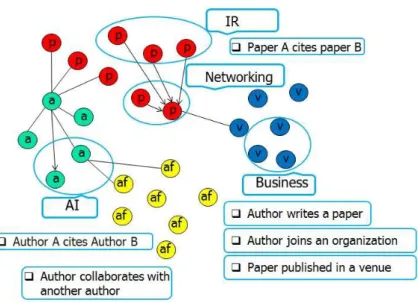
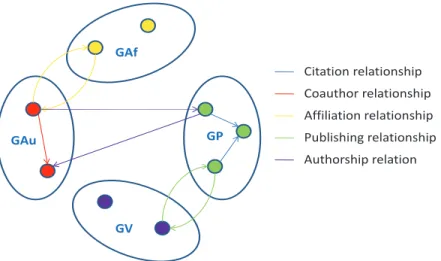
• Heterogeneous First of all, it is often a heterogeneous network, composed of multiple types of academic entities (authors, papers, venues) and academic relationships, for example, the bidirectional co-author relationships, and direc-tional citation relationships. To better model and integrate this heterogeneous information, and to evaluate their individual importance remains one of the challenges in academic network research.
• Community-based Secondly, within the network, we can discover commu-nities, and these communities (clusters) are often related with specific topics. For example, as shown in the illustrated figure, researchers can form different communities: IR-based community, Networking-based, AI-based or Business-based, determined by the main research domains the researchers focus on. Papers can construct such communities in a similar way. Entities with one community (either researchers or papers) would have more and closer inter-actions among themselves and thus form a community than other researchers from outside of this community.
• Temporal dynamic Thirdly, the academic network remains dynamically changing over time. For example, researchers transfer to different institutions, papers keep on attracting new citations, and researchers gradually accumulate their research experience by publishing new papers and attracting new cita-tions and therefore gaining reputation and growing to researchers with higher expertise, all of which emphasize the importance of temporal information in academic network analysis.
To provide effective models that can represent all these properties remains chal-lenging.
In this dissertation, we pay particular attention and focus on two main tasks that have fundamental applications in academic network research: the task of mod-eling expertise retrieval, also known as expert search, expertise ranking, and the
Figure 1.1: Academic Network and its properties
task of research action prediction and recommendation. To be more specific, we focus on prediction and recommendation over three research actions: publishing venue prediction/recommendation, coauthorship prediction/recommendation, and citation prediction and recommendation. For both tasks, properly mining and effectively integrating heterogeneous information and therefore develop-ing well-functiondevelop-ing rankdevelop-ing or recommendation systems is the principal and targeted goal.
1.1.1
Modeling Expertise Retrieval
Modeling expertise retrieval, also known as expert (people) search or expertise rank-ing, has been a promising research topic due to the ever-growing trend of users’ information needs to identify and interact with other people with relevant expertise (knowledge).
Resorting back to the development history of information retrieval (IR) tech-nology, much of the research has been focused on traditional document (textual)
retrieval in the 1970s and 1980s, whose main task is to efficiently identify docu-ments that are relevant to some information need. With the advent of Web, which has generated a large and ever-increasing volume of online documents (web pages), identifying relevant documents becomes difficult by manual browsing. Various web search engines have therefore been developed to facilitate users browsing and search-ing over the Internet. With a web search engine, people often represent their infor-mation need as a query, and the search engine would then return a ranked list of documents with regards to their estimated relevance to that query. More recently, the rapid increase in the amount of information available online has led to people’s information needs going beyond the traditional plain document retrieval. Instead, they begin to search for other kinds of entities, such as books, movies, music, and restaurants. ‘People’, is one particular kind of such entity.
Searching for people with relevant expertise is of great importance not only to employees in an organization, but also to online social media users, as well as to researchers in the academic domain. In the enterprise organization settings, it is believed that finding the right person with an appropriate skill or knowledge is often crucial to the success of a project being undertaken [125]. In an online social media environment, users are often interested in finding other users who share similar interests (e.g., Flickr, Twitter), or identifying users who can provide the most valuable answers to a proposed question (e.g., Yahoo! Answers). In the academic environment, it is also of great importance to evaluate the expertise of a researcher in a specific domain, as it can offer help in determining the job promotion and funding assignment.
Initial research in evaluating people’s expertise is mainly focused on unifying dis-parate databases of the organization [192] or simply counting bibliographic records of researchers [58]. With the advent of TREC enterprise track initiated in 2005 [34], which provides an open platform with two standard data sets and evaluation bench-mark, much more research efforts in the computer science and information retrieval community have been devoted into expertise ranking research. Several groups of new models have been proposed and developed ever since. The TREC data sets, however, are more enterprise oriented. Later on, with the rapid development of
online digital library, one group of research focus has been paid on identifying ex-perts within a pure academic environment. Generally speaking, there exists two main methodologies for expertise ranking: the content-based approach, where the expertise of a researcher is often characterized by examining the documents associ-ated with them, and the graph-based based approach [39, 170, 206, 30, 57], where researchers’ expertise are more widely investigated via exploring their interactions with other academic entities. The content-based approach can be further divided into language model based approaches [8, 108, 50, 40] and topic model based ap-proaches [147, 173, 168].
In this dissertation, one of the principle challenges (objectives) of our work is to develop an effective and efficient expert search system, to further extend and enhance previous works. We first focus on a random-walk based approach, for which we propose several new models, including a heterogeneous PageRank algorithm and a modified PageRank algorithm incorporated with temporal information. We further effectively integrate topic-based link analysis, which has demonstrated its success in web search domain, into citation network analysis. We construct our academic network as a multi-type heterogeneous network which integrates several academic factors, by which we can evaluate an author’s expertise in a more complete and thus more accurate way. We then focus on a topic modeling based approach for which, we propose a joint topic modeling approach, which extends the original topic models by integrating more supportive factors; we then propose a supervised topic modeling approach by incorporating the pair-wise learning-to-rank mechanism into the generative process. Extensive experiments have been carried out on real world data sets, which demonstrate the superiority of each of our endeavors over several state-of-the-art algorithms.
1.1.2
Research Action Recommendation and Prediction
In an academic environment, we can take many ‘research actions’, such as writing papers, citing other papers, or collaborating with other researchers. When modeled as an academic network, these actions will be represented as ‘links’ between scientific
factors. Therefore, the problem of research action prediction and recommendation is equivalent to the problem of link prediction and recommendation. In this disser-tation, we are particularly interested in three kinds of research action prediction: (1) publishing venue prediction/recommendation, where we aim to predict the real publishing venue of a given paper or provide recommendations as to where to sub-mit for given a paper; (2) citation prediction/recommendation, in which we would provide a ranked list of papers (authors) for a given paper (author) to cite; (3) and coauthorship prediction/recommendation, which aims to generate a ranked list of authors for a given author to consider to collaborate with in the future.
We made contributions in the following three directions. In recommending pub-lishing venues, we adopt the memory-based collaborative-filtering framework and provide two extensions to the original model by incorporating stylometric features into computing the similarity between pairs of papers, and differentiating the im-portance of different types of neighboring papers by tuning and optimizing their associated weights.
We further demonstrate the joint topic model, as mentioned in the work on modeling expertise retrieval, to be an effective method not only in evaluating re-searchers’ expertise, but also in predicting both publishing venues and cited authors for a given author. Experiments based on real world data sets indicate that we can make improved predictions on these two tasks as compared to previous topic model based approaches which integrate fewer informative factors.
Finally, we extend the tensor factorization model maximizing MAP to model coupled higher order data in an academic environment, and demonstrated its capa-bility in multiple types of research actions prediction and recommendation, includ-ing predictinclud-ing co-authorship among authors, citation-ships among papers, citations between authors and papers, as well as publishing venue prediction.
1.2
Contributions
This dissertation aims to develop effective models for two main applications in aca-demic network mining and analysis: modeling expertise retrieval and research ac-tions prediction and recommendation. Although there are many differences between these two applications, a key common point is that there exist heterogeneous and mutually influenced meta data in both applications that will play an important role in determining the application’s performance. For the task of ranking experts, researchers’ expertise is often represented in many aspects which when integrated together can provide a more comprehensive and accurate evaluation of researchers’ expertise. For example, a prestigious researcher is believed to have more publi-cations and more citations, to publish in high-ranked conference/journal, to work often with other excellent researchers, and/or to work in good institutions; For the task of research action prediction, it is believed that people’s decision is often made under the consideration of multiple aspects. For example, when deciding where to submit a finished paper, a researcher will not only consider the topic match with the potential venue, but also his/her own historical publication experience, and/or other related papers’ choices. Therefore, to effectively mine and extract useful heteroge-neous information and develop efficient algorithms to integrate these heterogeheteroge-neous information will be of great importance. Motivated by this observation and intu-ition, this dissertation proposes a general framework to take into account multiple heterogeneous information, and combines information retrieval models, link anal-ysis algorithms and machine learning techniques in a unified way to improve the performance of these applications.
Based on this framework, challenges for each application are addressed and in-dividual specific models are proposed to solve them respectively. We summarize in Table 1.1 the models we developed, which illustrates the relationships between the models, the used data, and the utilized techniques.
Basically, for modeling expertise retrieval, we follow the main stream of how to effectively model topics into ranking process. We first integrate topical information
Table 1.1: Models developed within this work
Model Heterogeneous Data Techniques
Topic-drive multi-type authors, papers, venues, affiliations Link Analysis citation network analysis multiple relations, temporal factor
Joint topic models authors, papers, citation, venues Topic Models Learning-to-rank with authors, papers Learning-to-Rank; topic models author-specific features Topic Models Venue classification venues, papers, stylometric features Classification;
and recommendation Collaborative Filtering
Joint multi-relational model authors, papers, venues, words Matrix factorization; author-specific features, citation Tensor factorization coauthor-ship, publication
temporal factor
into link analysis by applying the Topical PageRank algorithm into citation net-work analysis; we then directly model authors’ interests by an extended author-topic model, based upon which authors are ranked by their learned topic distributions; we finally integrate pair-wise learning-to-rank into topic modeling process, which makes it easy to incorporate other supporting features related to authors’ expertise. For the task of research action recommendation, we focus on adapting and modi-fying the collaborative filtering approach, which is the state-of-the-art approach for recommender systems.
We then discuss the main contribution of each of our proposed models.
1. An enhanced topic-driven multi-type citation network analysis ap-proach for expertise ranking
In this work, we develop enhanced random-walk based algorithms for evalu-ating researchers’ expertise. Particularly, we construct a multi-type hetero-geneous academic network by incorporating more instructive scientific factors as compared to previous work which limit themselves to a subset of all the available informative knowledge. Particularly, we integrate author, papers,
venues, affiliations and their mutual relationships to form a multi-type aca-demic network. To our best knowledge, we are the first to explicitly incorpo-rate the affiliation factor. Based on this network, several investigations have been made. Firstly, we investigate the performance on different academic network structure design. We propose two versions of the academic network construction, and test via experiments the importance of introducing addi-tional scientific factors as well as addiaddi-tional relationships (links); Secondly, we introduce a topic-based link analysis approach into academic network anal-ysis to distinguish the different endorsement of academic links on different topics, and therefore, we can better model the different reputations of a re-searcher on different topics; Thirdly, we propose a heterogeneous PageRank algorithm to differentiate the importance and contribution of scientific factors in providing supportive evidence to the reputation of a researcher; Fourthly, we incorporate temporal information into consideration, not only by consider-ing some temporal characteristics related with individual researchers, but also considering the influence between researchers that would be affected by time. We incorporate such temporal information into the PageRank algorithm, to better model researchers’ expertise that changes over time. The importance of temporal information is evaluated for the task on predicting future award winners in the SIG community, one specific application of expertise ranking. Extensive experiments have been carried out on real world data sets on each different settings and demonstrate the superiority of our proposed approaches over several state-of-the-art algorithms.
2. A novel learning-to-rank topic modeling approach for expertise rank-ing
In this work, we propose a supervised machine learning mechanism by distin-guishing the importance with regards to their estimated expertise over pairs of authors into the topic modeling process, which to our best knowledge, re-sults in the first work integrating pair-wise learning-to-rank into topic models.
We choose to make use of topic modeling as the basic methodology for exper-tise ranking in this work since it can effectively overcome the data sparsity problem as compared to other bag-of-words approaches, and well discover the underlying semantic meanings of word tokens. We incorporate the pair-wise learning-to-rank scheme into topic modeling under the hypothesis that with the guidance and support of prior knowledge, we can unearth latent topics within author profiles more accurately, and thus can better model and esti-mate an author’s expertise. Moreover, we extend the original proposed model by incorporating additional features, each of which measures the expertise of an author from a different aspect. We apply these two models into two expert search related applications: predicting future award winners and PC members. Experiments have been conducted over real world data sets to demonstrate its effectiveness as compared with several other state-of-the-art algorithms.
3. An enhanced collaborative-filtering model for publishing venue pre-diction and recommendation
In this work, we focus on the prediction and recommendation for one particular kind of research action: choosing a proper publishing venue to submit given a target paper.
Before developing models, we first carry out empirical studies on determining whether writing styles can play an important role in correctly classifying pub-lishing venues. This study is initiated by the observations that today we have many different kinds of publications covering different topics and requiring dif-ferent writing formats. Even though the research on authorship identification has been well developed, no prior work has been carried out on investigating the different writing styles of publishing venues. Our work takes this first step. By approaching the task using the traditional classification method, we extract three types of writing style-based features, and conduct detailed experiments in examining the different impacts among features, classification techniques, as well as the influence of venue content, topics and genres. Experiments on
real data from real-world digital libraries demonstrate that publishing venues are indeed distinguishable by their writing styles.
We then approach the task of publishing venue prediction and recommenda-tion by a memory-based collaborative-filtering (CF) methods, in which other neighboring papers with known venues will be utilized to predict or recom-mend venues for the target paper. Moreover, we propose two extensions to the original CF model: one is to incorporate stylometric features to better mea-sure the similarity between papers. We introduce this extension based on the observations from venue classification results. For the second extension, we divide all the neighboring papers of the target paper into four categories, and differentiate the importance of each category of neighboring papers via tun-ing and optimiztun-ing their associated weights. Experiments based on real world data set demonstrate that our approach provide effective recommendations, and that both of the extensions can bring improved performance.
4. An extended joint topic modeling approach for academic network analysis
In this work, we propose a novel probabilistic topic model that jointly models authors, documents, cited authors, and venues simultaneously in one inte-grated framework, as compared to previous work which embeds fewer com-ponents. We show the wide applicability of this model, as it can be adopted for three typical applications in academic network analysis: expertise ranking, cited author prediction and venue prediction. For fulfilling expertise ranking, we introduce the method on how to integrate the topic distributions computed from topic modeling results to represent the expertise of an author for a spe-cific query. We further combine the topic modeling results with the traditional language model based approach and random-walk based approach to further improve the ranking performance. Experiments based on two real world data sets demonstrate the model to be effective, and it outperforms several state-of-the-art algorithms in all three applications.
5. A joint multi-relational model for several recommendation tasks in academic environment
In this work, we target four specific recommendation tasks in the academic environment: the recommendation for author coauthorships, paper citation recommendation for authors, paper citation recommendation for papers, and publishing venue recommendation for author-paper pairs. Different from pre-vious work which tackles each of these tasks separately while neglecting their mutual effect and connection, we propose a joint multi-relational model that can exploit the latent correlation between relations and solve several tasks in a unified way. Moreover, for better ranking purpose, we extend the work maximizing MAP (mean average precision) over one single tensor, and make it applicable to maximize MAP over multiple matrices and tensors. Experi-ments conducted over two real world data sets demonstrate the effectiveness of our model: 1) improved performance can be achieved with joint modeling over multiple relations; 2) our model can outperform three state-of-the art algorithms for several tasks.
1.3
Dissertation Organization
In this dissertation, we focus on research in mining and analyzing the academic network. Particularly, we address new problems and propose several novel models for two main applications in academic network analysis: modeling expertise retrieval and research actions prediction and recommendation. The remainder of the thesis is organized as follows.
Chapter 2: We review the background knowledge on expertise retrieval and recommender systems in this chapter. For the task of expertise retrieval, we first introduce its problem statement, the research development history and discuss the main research challenges in modeling expertise retrieval. Special focus has been paid on introducing the current state-of-the-art methodologies for expertise retrieval.
Evaluation methods, metrics and experimental data sets used in these related mod-els are also discussed. For recommender systems, we concentrate on introducing the state-of-the-art approach for recommender systems design: the Collaborative Filtering (CF) approach. Both the neighborhood memory-based CF methods, and one representative model-based CF method: the Matrix Factorization method are addressed.
Chapter 3: We present our topic-driven multi-type citation network analysis approach for expert search. Network structure design is introduced first, followed by the introduction on how to integrate the topic-based link analysis into citation network analysis. We then present the heterogeneous PageRank algorithm and a modified PageRank algorithm with temporal information incorporated. Extensive experiments based on the ACM data set are presented and discussed.
Chapter 4: We present a novel learning-to-rank topic modeling approach for expert search. Model design is introduced, followed by theoretical derivations to solve the model using variational inference. We further present an extended version of this model by incorporating additional supportive features with regards to au-thors’ expertise. We apply the model into two expert search related applications, and conduct empirical studies in evaluating models’ performance as compared to other state-of-the-art algorithms.
Chapter 5: We introduce and discuss our empirical study on venue classification in which three groups of stylometric features of publishing venues are identified, with their contribution to venue classification results being examined and reported. We then apply a memory-based collaborative filtering method for venue prediction and recommendation, and propose two extensions to the original model. We report on experiments conducted on two real world data sets to demonstrate the effectiveness of our model.
Chapter 6: We present an extended joint topic model for academic network analysis in this chapter by simultaneously modeling cited author and publishing venue information, and show its applications in expert search, publishing venue prediction and cited author prediction. We report and discuss the experiments results over two real world data sets.
Chapter 7: We propose a joint multi-relational model that can exploit the latent correlation between relations and solve several tasks in a unified way. This model is especially designed for four recommendation tasks: the author-author coauthorship recommendation, author-paper citation recommendation, paper-paper citation rec-ommendation and paper-publishing venue recrec-ommendation. Moreover, for better ranking purpose, we extend the work maximizing MAP over one single tensor, and make it applicable to maximize MAP over multiple matrices and tensors. Experi-ments conducted over two real world data sets demonstrate the effectiveness of our model.
Chapter 8: We summarize the dissertation in this chapter and provide some directions to be explored in future work.
Chapter 2
Background
2.1
Expertise Retrieval: Introduction
As ‘people’ have become one important source of information, there has been in-creasing demand and interest for people to find each other as a source of inquiring questions, seeking help, making friends, or building social communities. Finding and ranking people with regard to their estimated expertise over a topic has a wide range of applications in people’s lives, as it can help to facilitate finding experts in research or industry organizations, facilitate making decisions on job recruitment or promotions and more.
In this chapter, we give an overall summary of the task and current state-of-the-art approaches for expertise retrieval.
Problem Identification: What is Expertise Retrieval?
Expertise retrieval addresses the task of identifying and ranking a list of people with their estimated relevant expertise for a given query. In a typical expert finding process, given a query, the participating system will return in response a ranked list of candidate persons with respect to their predicted expertise. Figure 2.1 illustrates
Figure 2.1: One Sample for Expertise Retrieval (results from ArnetMiner expert search engine)
one such example: the returned ranking results as we issue the query ‘information retrieval’ to a typical expert search engine (ArnetMiner1) indicating that we are
looking for the experts on ‘information retrieval’. As shown in the figure, several well-known researchers have been identified with their photos and basic information provided.
Why to retrieve people’s expertise?
Expertise retrieval emerges as an important research topic as the result of the vast development of world wide web and information retrieval technology. People are currently regarded as one important source of information. Identifying experts is beneficial for multiple reasons.
On one hand, expertise retrieval is an effective supplement to traditional document-centric retrieval. Since not all the information can be possibly documented, much important information can only be transferred through experience and informal con-versations, and therefore many information-gathering tasks would be better handled
1
by finding a referral to a human expert rather than by simply interacting with online documentary information sources. Besides, as compared to spending lots of time and effort in accumulating experience and finding a piece of information from the very beginning, individual users will sometimes find it more convenient and effective to directly find an expert and leverage on their expertise to tackle problems. These advantages make finding experts a better way to solve problems than searching documents in some occasions.
On the other hand, the wide range of real-world applications of expertise retrieval stimulate research work in this area. Here we illustrate several such examples.
• Finding experts in organizations
Knowledge in an organization is contained in the skill, experience and exper-tise of its people [25]. These organizations can either be industry enterprises or academic institutes. Finding the right person in the organization with appro-priate skills and knowledge is often crucial to the success of problem solving or projects being undertaken [8]. In a research organization, for example, peo-ple often need to find specialists or professors to answer questions with whom to collaborate; in an enterprise, the organizers usually hope to assign tasks to those who have obtained enough skills and experience to fulfill that task. Identifying the appropriate person is of great importance to these organiza-tions. Much of the recent work in expert finding has been to address this need in such organizations.
• Finding experts in online social media communities
Web-based communities have become important places for people to seek and share expertise [203]. Typical communities include the help-seeking question-answering systems [105], online discussion forums [204], Blogs [8] and Twitter [175]. Identifying the most influential experts in such communities can help us choose the best one to answer our questions, or to follow those learned people for updated information over certain topics.
Peer-review is an important practice for quality control in scholarly publica-tions [15]. It is the duty of journal editors, funding program managers (e.g., at NSF), conference program chairs and research councils to assign submitted papers to reviewers with appropriate knowledge and experience. Traditionally, this complicated job is manually handled by a few people, which turns out to be labor-intensive. An expert finding system which can automatically extract and identify the expertise of each reviewer can largely relieve the burden of journal/conference editors.
• Facilitating job recruitment, promotion and award assignment
In modern society, the most common practice for people finding a job is via submitting personal resumes and other supporting documents. Employers need to find out proper candidates with related skills and work experience by reviewing hundreds of thousands of such documents. Developing automated job recruitment system which can evaluate applicants’ expertise and identify proper candidates can greatly relieve the work of employers and improve both efficiency and accuracy. The same process can benefit people who are respon-sible for making decisions on who needs a promotion. Expert finding can also help in facilitating the identification of nominees and award winners for scientific awards.
Research Development Outline
People have had such information needs for experts even before the invention of computers. With the development of computer and information technology, people started to concentrate on developing automatic computer-supported expert finding systems. Ever since then, the development history of the research on expertise retrieval can be divided into three periods: 1) historical work; 2) focused attention because of the TREC Enterprise track, and 3) modern work.
approach for expertise retrieval relies on creating, organizing and controlling ex-pertise information in a database [134], which is often constructed by individual users manually inputting their personal information and using keywords to describe their own expertise. This method is labor-intensive, and is inconvenient for in-time update. With the development on information knowledge, more efforts have been taken into developing automatic expert finding systems which utilize modern infor-mation retrieval technology. However, during this period of time, different systems focus on different specific document types, for example, organizational technical reports, software source codes, emails, and more. Without standard working data collections and queries, the proposed algorithms and approaches are hard to be eval-uated and compared. Besides, no unified models have been provided that can tackle heterogeneous data collections.
The TREC Enterprise Track: from 2005 to 2008, the task on expertise re-trieval was launched as part of the Enterprise Track in Text REre-trieval Conference (TREC) which provided two standard data collections with queries and labeled ground truth and therefore generated a common platform for researchers to em-pirically evaluate their proposed methods and techniques for expert finding. Ever since then, expertise retrieval has received a substantial boost in attention from information retrieval, data mining and machine learning communities.
After the TREC Enterprise Track: after the advent of TREC Enterprise Track, much more work has been developed and evaluated based upon other data test beds rather than those provided by TREC Track. These test beds more focused on scientific literature within academic environments. Typical such data sets include the UvT data collections, DBLP, CiteSeer, ACM and ArnetMiner data sets, for which we will introduce in more detail in the following sections. Compared to the models proposed for expertise retrieval task in TREC Track, which emphasize their research on mining candidate-document pairs associations and extracting the expertise mainly from related documents, more research efforts have been made on mining other supporting expertise, i.e., the social interactions among expert candidates. Our work developed in this dissertation falls into this group of research.
Users Informationneeds Expert Candidate Set Document Set ExtractExpertise Candidates’ relationship Query/Query Optimization Set Expertise Modelingand Presentation Comparison
RankedListofExpertCandidates
Figure 2.2: Expert Finding System Architecture
2.2
Expertise Retrieval Systems
2.2.1
A Typical System Framework
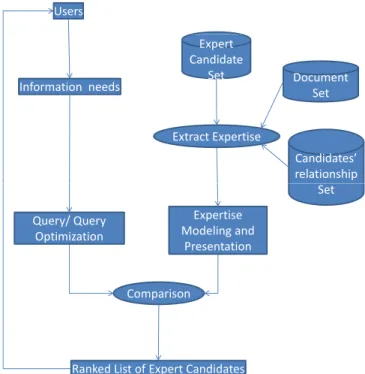
In an automated expert finding system, users can input as queries the particular kind of expert they are seeking, and the system will return a list of experts in the order of their relevancy to the query (topic). Figure 2.2 shows the typical framework of an expert finding system.
Two components are of special importance to an expert finding system: the pro-cess of how to collect and well represent the expertise of a candidate; and the propro-cess of how to evaluate the relevancy of candidates’ expertise to the query. Generally speaking, two types of expertise evidence have been explored in previous research work: the supporting documents associated with expert candidates and the social interactions among expert candidates. Several models and algorithms have been
proposed with the goal to accurately and efficiently estimate the relevance of the identified evidence of expertise to the query, which we will discuss in the following sections.
2.2.2
Expert Search Engine
With the rapid development of world wide web and information retrieval technology, document-centric search engines have shown great success and re-shaped people’s daily life. Under this background, the ever increasing information needs for people search stimulates the emergence and development of search engines particularly designed for expertise retrieval. ArnetMiner and Microsoft Academic Search are two representatives of them, both of which focus on the academic domain, and their main functionality is to provide ranking for academic related entities, i.e. authors, papers, conferences and organization, as well as mine and analyze their mutual interactions.
ArnetMiner system2 is developed by Tsinghua University of China, which aims
to ‘provide comprehensive search and mining services for researcher social networks’, particularly in the computer science domain. The main search and analysis functions in ArnetMiner include profile search, expert finding, conference analysis, course search, sub-graph search, topic browser, academic ranks, and user management. They provide visualization tools to represent their ranking or analysis results for better users’ experience. Figure 2.1 shows one example for their expert finding results for query ‘information retrieval’. Microsoft Academic Search3 developed
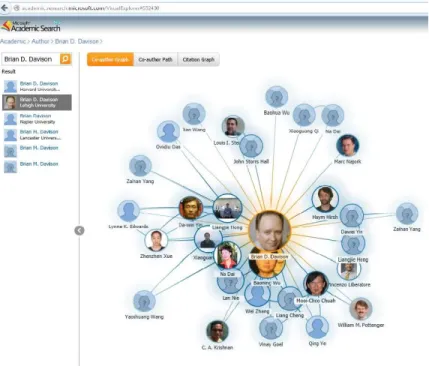
by Microsoft Research Asia is another well-known public expert finding system. Compared to ArnetMiner which focuses on computer science domain, Microsoft Academic Search supports expertise retrieval for 15 different research disciplines, and further divides each discipline into finer-grained sub-disciplines. In computer science domain, for example, they identify 23 sub-categories which cover the main research topics for computer science. Similar to ArnetMiner, Microsoft Academic
2
http://arnetminer.org/
3
Figure 2.3: Microsoft Academic Search Engine search example: Coauthor-graph
Search also visualizes the results. One prominent instance is that they provide graph visualization over several types of relationships for each researcher, for example, his/her co-authors or citations. Figure 2.3 shows such an example for Prof. Brian D. Davison.
2.3
Main Challenges in Expert Search
Finding an expert is a non-trivial task and it brings new challenges to those associ-ated with traditional document retrieval. We list here several key challenges.
Identify and extract proper sources of evidence to represent the expertise of experts
most challenging components for expert finding is to identify proper sources to rep-resent the ‘expertise’ of expert candidates. Generally speaking, two main categories of expertise have been identified: 1) the documents associated with the expert can-didates, which include their published papers, project reports, emails, posts, blogs, tweets, product reviews or any other content. The principal intuition behind making use of such source of expertise is that if an expert can generate more documents that are highly relevant to a query, then this expert would also have a higher prob-ability to be an expert for that query. 2) the interaction or relationships with other candidates or other types of entities. For example, there is a greater probability for a researcher to have high expertise for a query topic if he can collaborate with many other experts on this topic or be cited more often by other experts. These two types of expertise evidence can be combined.
Estimate the relevancy of an expert candidate to the query
Given the identified expertise evidence, the key component of expert finding is to develop proper approaches to mine information from such evidences and estimate the relevancy of the expert candidate to the query. This is the part that most research endeavors emphasize. Multiple approaches have been provided to solve this task, which we will introduce in more detail in the following sections.
Name Disambiguation
People’s names are often ambiguous: they can be written in various formats, for example, some people put their given name first while others put the family name first. There are many abbreviations, multilingual issues, and that some identical names belong to different people. These will have a large effect on the process of accurately extracting the associated documents with a specific expert or build his connections with others. Name disambiguation is a separate research topic in IR community, however, is not the research focus in this dissertation.
As pointed out, there are many kinds of evidence to represent an expert’s exper-tise, and these evidences often come from heterogeneous sources, whose importance in determining the expertise of an expert may vary. To find approaches to effectively integrate these heterogeneous sources is a challenging and interesting research task.
Expertise evolution
People’s expertise will change over time. A new researcher in a specific research domain will gradually accumulate his reputation and become a respected scientist in this area in the future. Examining the pattern of growth is interesting and may offer help in predicting some events, such as scientific award assignments.
Evaluation Problem
In order to evaluate the performance of proposed algorithms, we need to have standard data collections, queries and labeled ground truth. Before the advent of TREC Enterprise Track, we lacked such information for quite a long time. The data collections provided by TREC Enterprise Track, however, are very limited to the data sources within the W3C or CISRO organizations, and have much noise. With the rapid development of online digital libraries, scientific literatures provide us plenty of excellent data sources for evaluating people’s expertise, especially the research scientists. However, we still lack proper queries, and the ground truths often need to be manually labeled.
In the following sections, we will first introduce some standard or widely used data collections, as well as the data collections we used in this dissertation, and then focus on introducing the main existing approaches for expertise retrieval.
2.4
Experimental Data Collections
To evaluate the performance over different expertise retrieval algorithms, standard test data collections as well as queries and their associated ground truths are of great importance. In this section, we briefly review several such data collections developed in previous research, two of which are provided by the Enterprise Track of TREC,
focusing on the enterprise domain, and three of which focus on the academic domain.
The W3C Collection4: the W3C data collection is the first standard data
col-lection provided by the Enterprise Track in TREC, whose appearance has initiated the rapid development in expert finding research in the IR community. It was used as the working data set for the Enterprise Track in 2005 and 2006. The collection is composed of the internal documentation of the World Wide Web Consortium (W3C) crawled in June 2004. It contains 331,037 documents from the following six sub-collections: email discussion forum (lists), source code documentation (dev), web pages (www), wiki (esw), miscellaneous (other), and personal homepages (people). In total, 1,092 expert candidates represented by their full names and email addresses have been identified, In 2005, 50 queries have been provided using the titles of the working groups in W3C, and that all members of each group are considered as the relevant experts for that query. In 2006, 49 queries have been provided by the TREC participants, and their associated ground truths also manually generated by those participants based on assessing the supporting documents of each candidate.
The CERC Collection5: the CSIRO Enterprise Research Collection (abbreviated
as the CERC data collection) was used at the Enterprise Track of TREC in 2007 and 2008. It is the result of crawling the publicly available pages on the official web set of CSIRO, which contains 370,715 documents. There is no explicit expert candidates list provided but a list of email addresses used by CSIRO employees. In total, 127 queries and their associated relevant experts list were developed by several science communicators invited by the TREC organizers.
The UvT Expert Collection6: the UvT collection concentrates on the academic
domain. It was developed by using the public data about employees of Tilburg University in Netherlands. The collection contains for each expert candidate a page in both English and Dutch which includes the expert’s contact information, research
4 http://research.microsoft.com/en-us/um/people/nickcr/w3c-summary.html 5 http://es.csiro.au/cerc 6 http://ilk.uvt.nl/uvt-expert-collection
Table 2.1: Data Collections Summary (1)
Data Collection CandidatesNo. DocumentsNo QueriesNo Total Relevant Judgments W3C 1092 331037 99 9860 CERC 3500 370715 127 2862 UvT 1168 36699 1491 4318 DBLP + 574369 953774 17 244 Google Scholar INDURE 12535 NA 100 6482
and course description and publication records. There are 1,880 expert candidates in total. 981 queries have been provided, and their associated ground truths are generated by the university’s employees themselves.
The DBLP Collection [40]: the DBLP data collection is a subset of the DBLP database which contains records of 953,774 papers. It is often used in combination with data from other digital libraries to retrieve detailed information of each pa-per. For example, in the research work carried out by H. Deng [40], they further incorporate for each paper in the DBLP records its abstract by downloading from Google Scholar. Assessments for expert candidates were conducted manually, and a four-grade score is assigned to each candidate indicating his/her different levels of expertise. A. Hogan et al. used in their work [74] DBLP data records combined with CiteSeer data set to retrieve papers’ abstracts.
The INDURE Expert Collection [50]: the Indiana Database of University Research Expertise (INDURE for short) is a collection mainly containing data for faculty in PURDUE university. The data information comes from four sources: (1) a profile filled by each faculty member indicating his or her main research areas; (2) faculty homepages; (3) faculty’s NSF funded projects descriptions; and (4) faculty’s own publications and their PhD students’ dissertations.
Even though these data collections have been used in previous research, they have some limitations. The two data collections provided by TREC Enterprise Track: the W3C and CERC data collection are very limited to the data sources within the W3C or CISRO organizations, and have much noise. The UvT and INDURE data collection are created from one single data source within one organization, and therefore are not easy to be generalized. DBLP data collection contains no citation information, and has to be integrated with other data sets, such as Google Scholar or CiteSeer. Such an integration process is prone to introduce additional data noise. To avoid such limitations, we adopt the following three data collections throughout the work we present in this dissertation, including (1) the ACM data set; (2) the CiteSeer data set; and (3) the ArnetMiner data set. We choose to use these three data sets as our working data sets because of the following three reasons. First of all, they are academic-centric data sets, and are therefore appropriate for our research in mining academic networks. Secondly, they are more general, consisting of authors and papers from different organizations. Thirdly, they are in plain text or XML format and are self-contained. We can not only retrieve from these data sets the content-based information of papers, such as their titles, abstracts, authors and publishing venues, but also the social interactions among those academic factors, such as the co-authorship among authors, and citations among papers. We do not need to further integrate them with other supporting data collections.
We introduce the three data sets as follows:
• ACM data set: The ACM data set is composed of papers crawled from the ACM digital library7. For each paper, we crawled one descriptive web page for
it; we extracted and recorded the information of each paper’s title, abstract, publishing venue, authors, affiliation of each author, and citation references. Simple statistics shows that there are 172,890 distinct web pages within the crawled data set that appear to have both title and abstract information. These papers are published between 1951 to 2009.
7
Name ambiguity is a common problem in representing author names and venue names. While not eliminating the problem, to minimize ambiguity in the use of author names, we concatenate the authors’ first and last name, and remove the middle name (if present). We then use exact match to merge candidate author names. Finally, we obtain 170,897 distinct authors. Due to possible venue name ambiguity, we first convert all upper-case characters into lower-case, and remove all non-alphabetical symbols. We further removed all digits as well as the ordinal numbers, such as the 1st, the 2nd, and applied Jaccard similarity match to merge duplicate venue names. We finally obtained 2,197 distinct venues.
In extracting citation references, the title is the representative of each pa-per, and we only consider those cited papers for which we also crawled the corresponding web page for it.
• CiteSeer data set: The CiteSeer data set is distributed by the 2011 HCIR challenge workshop8. The whole data corpus is divided into two parts: the
meta-data about a paper, such as its title, publishing venue, publishing year, abstract, and information about citation references are kept in XML format; and the full content of that paper is in plain text format. From the distributed data corpus, we collected 510,231 distinct scientific papers published between 1934 and 2010. After applying the same working process as we did for ACM data set to merge ambiguous author names and venue names, we finally ob-tained 479,805 authors and 65,441 venues.
• ArnetMiner data set: The ArnetMiner data set we utilized in this dis-sertation is the data set ‘DBLP-Citation-network V5’ provided by Tsinghua University for their ArnetMiner academic search engine [170]. This data set is the crawling result from the ArnetMiner search engine on Feb 21st, 2011 and further combined with the citation information from ACM. The original
8
Table 2.2: Data Collections Summary (2)
ACM ArnetMiner CiteSeer authorNo. 170,897 798,385 479,805 paperNo. 172,890 1,558,415 510,230 venueNo. 2,197 6,010 65,441 year range [1951, 2009 ] [1936, 2011 ] [1934, 2010 ]
data set is reported to have 1,572,277 papers and to include 2,084,019 citation-relationships. After carrying out the same data processing method as we did for the ACM data set, we find 1,558,415 papers, 795,385 authors and 6,010 venues. Papers in this data set are published between 1936 to 2011.
Table 2.2 shows a summary on the ACM, CiteSeer and ArnetMiner data sets. Experiments reported in this dissertation are conducted on one or two of these three data sets. For better evaluation purpose, further data preprocessing may be carried out over these original data sets for which we will introduce in more detail in the following chapters respectively.
2.5
Evaluation Metrics
To evaluate the performance of different approaches, several metrics have been adopted. The most representative ones include: 1) P@k; 2) MAP; 3) MRR; and 4) NDCG@k.
MRR, MAP, and P@k are suitable metrics for binary relevance ranking per-formance evaluation, where entities (documents, people or other entities) are ei-ther relevant (relevance=1) to a query or non-relevant to a query (relevance=0). MRR works for the situation when there is only one relevant entity in the data corpus. NDCG@K works for multiple levels of relevance, both the relevance scores for retrieved entities and their ranking positions are important to the final ranking performance.