Comparison of Selection Methods in On-line Distributed Evolutionary Robotics
I˜naki Fern´andez P´erez, Amine Boumaza and Franc¸ois Charpillet
Universit´e de Lorraine, INRIA, Campus scientifique BP 239 Vandoeuvre-l`es-Nancy Cedex, F-54506, [email protected]
Abstract
In this paper, we study the impact of selection methods in the context of on-line on-board distributed evolutionary al-gorithms. We propose a variant of the mEDEA algorithm in which we add a selection operator, and we apply it in a task-driven scenario. We evaluate four selection methods that in-duce different intensity of selection pressure in a multi-robot navigation with obstacle avoidance task and a collective for-aging task. Experiments show that a small intensity of se-lection pressure is sufficient to rapidly obtain good perfor-mances on the tasks at hand. We introduce different measures to compare the selection methods, and show that the higher the selection pressure, the better the performances obtained, especially for the more challenging food foraging task.
Introduction
Evolutionary robotics (ER) (Nolfi and Floreano (2000)) aims to design robotic agents’ behaviors using evolutionary algorithms (EA) (Eiben and Smith (2003)). In this context, EA’s are traditionally seen as a tool to optimize agents’ con-trollers w.r.t to an explicit objective function (fitness). This process is carried out in an off-line fashion; once the behav-ior is learned and the controller optimized, the agents are deployed and their controllers’ parameters remain fixed.
On the other hand, on-line evolution (Watson et al. (2002)) takes a different approach in which behavior learn-ing is performed durlearn-ing the actual execution of a task. In these algorithms, learning or optimization is a continuous process,i.e.robotic agents are constantly exploring new be-haviors and adapting their controllers to new conditions in their environment. Usually, this is referred to as adaptation.
These two visions of ER can be related to on-line and off-line approaches in Machine Learning (ML). Off-off-line ML al-gorithms learn a specific task and solutions should general-ize to unseen situations after the learning process, whereas on-line ML algorithms progressively adapt solutions to new presented situations while solving the task. In this sense, both on-line ML algorithms and on-line EA’s perform life-long adaptation or learning, to possibly changing environ-ments or objectives.
In this paper, we focus on on-line distributed evolution of swarm robotic agents. We are interested in learning indi-vidual agents behaviors in a distributed context where the agents adapt their controllers to environmental conditions independently while deployed. These agents may locally communicate with each other and do not have a global view of the swarm. In this sense, this approach finds many ties with Artificial Life, where the objective is to design au-tonomous organisms that adapt to their environment.
On-line distributed evolution may be viewed as distribut-ing an EA on the swarm of agents. Traditional evolutionary operators (mutation, crossover etc.) are performed on the agents and local communication ensures the spread of ge-netic material in the population of agents.
In EA’s, selection operators drive evolution toward fit in-dividuals by controlling the intensity of selection pressure to solve the given task. These operators and their impact on evolutionary dynamics have been extensively studied in off-line contexts (Eiben and Smith (2003)). In this paper, we study their impact in on-line distributed ER, where evolu-tionary dynamics are different to the off-line case: selection is performed locally on partial populations and fitness val-ues on which selection is performed are not reliable. Our experiments show that, in this context, a strong selection pressure leads to the best performances, contrary to classical approaches in which lower selection pressure is preferred, to maintain diversity in the population. This result suggests that, in distributed ER algorithms, diversity is already main-tained by the disjoint sub-populations.
Several authors have addressed on-line evolution of robotic agent controllers in different contexts: adapta-tion to dynamically changing environments (Dinu et al. (2013)), parameter tuning (Eiben et al. (2010)), evolution of self-assembly (Bianco and Nolfi (2004)), communication (Pineda et al. (2012)), phototaxis and navigation (Karafotias et al. (2011), Silva et al. (2012)). Some of this work is de-tailed in the next section. The authors use different selection mechanisms inducing different intensities of selection pres-sure to drive evolution. In this paper, we compare different selection operators and measure the impact they have on the
performances of learning two swarm robotics tasks: naviga-tion with obstacle avoidance and collective food foraging.
We begin by reviewing different selection schemes pro-posed in the context of on-line distributed ER and then we present the algorithm that will serve as a test bed, along with the selection methods we compare. In the fourth section, we detail our experimental setting and discuss the results. Finally, we close with some concluding remarks and future directions of research.
Related Work
In the following, we review several on-line distributed ER algorithms and discuss the selection mechanisms that were applied to ensure the desired intensity of selection pressure in order to drive evolution.
A common characteristic of on-line distributed ER algo-rithms is that each agent has one controller at a time, that it executes (the active controller), and locally spreads altered copies of this controller to other agents. In this sense, agents have only a partial view of the population in the swarm (a lo-cal repository). Fitness assignment or evaluation of individ-ual chromosomes is performed by the agents themselves and is thus noisy, as different agents evaluate their active con-trollers in different conditions. Selection takes place when the active controller is to be replaced by a new one from the repository.
PGTA (Probabilistic Gene Transfer Algorithm) intro-duced by Watson et al. (2002), is commonly cited as the first implementation of a distributed on-line ER algorithm. This algorithm evolves the weights of fixed-topology neural con-trollers and agents exchange parts (genes) of their respective chromosomes using local broadcasts. The algorithm consid-ers a virtual energy level that reflects the performance of the agent’s controller. This energy level increases every time the agents reach an energy source and decreases whenever communication takes place. Furthermore, the rate at which the agents broadcast their genes is proportional to their en-ergy level and conversely, the rate at which they accept a received gene is inversely proportional to their energy level. This way, selection pressure is introduced in that fit agents transmit their genes to unfit ones.
Silva et al. (2012) introduced odNEAT, an on-line dis-tributed version of NEAT (Neuro-Evolution of Augment-ing Topologies) (Stanley and Miikkulainen (2002)), where each agent has one active chromosome that is transmitted to nearby agents. Collected chromosomes from other agents are stored in a local repository within niches of species ac-cording to their topological similarities, as in NEAT. Each agent has a virtual energy level that increases when the task is performed correctly and decreases otherwise. This energy level is sampled periodically to measure fitness values and, whenever this level reaches zero, the active chromosome is replaced by one in the repository. At this point, a species is selected based on its average fitness value, then a
chro-mosome is selected within this species using binary tourna-ment. Each agent broadcasts its active chromosome at a rate proportional to the average fitness of the species it belongs to. This, added to the fact that the active chromosome is se-lected from fit niches, maintains a certain selection pressure toward fit individuals.
EDEA (Embodied Distributed Evolutionary Algorithm) (Karafotias et al. (2011)), was applied to different swarm robotics tasks: phototaxis, navigation with obstacle avoid-ance and collective patrolling. In this algorithm, each agent possesses one chromosome, whose controller is executed and evaluated on a given task. At each iteration, agents broadcast their chromosomes alongside with their fitness to other nearby agents with a given probability (fixed parame-ter). Upon reception, an agent selects a chromosome from those collected using binary tournament. This last chromo-some is then mutated and recombined (using crossover) with the current active chromosome with probability scf×(xf′()x),
wheref(x′)
is the fitness of the selected chromosome,f(x)
is the fitness of the agent’s current chromosome and sc is a scalar controlling the intensity of selection pressure. To ensure an accurate measure of fitness values, agents evalu-ate their controllers for at least a minimum period of time (maturation age), during which agents neither transmit nor receive other chromosomes.
With mEDEA (minimal Environment-driven Distributed Evolutionary Algorithm), Bredeche and Montanier (2010) address evolutionary adaptation with implicit fitness, i.e. without a task-driven fitness function. The algorithm takes a gene perspective in which successful chromosomes are those that spread over the population of agents and which requires: 1) to maximize mating opportunities and 2) to min-imize the risk for agents (their vehicles).
At every time step, agents execute their respective active controllers and locally broadcast mutated copies of the cor-responding chromosomes. Received chromosomes (trans-mitted by other agents) are stored in a local list. At the end of the execution period (lifetime), the active chromosome is replaced with a randomly selected one from the agent’s list and the list is emptied. An agent dies if there are no chro-mosomes in its list (if it did not meet other agents) and it remains dead until it receives a chromosome from another agent passing by.
The authors show that the number of living agents rises with time and remains at a sustained level. Furthermore, agents develop navigation and obstacle avoidance capabil-ities that allow them to better spread their chromosomes. This work shows that environment-driven selection pressure alone can maintain a certain level of adaptation in a swarm of robotic agents. A slightly modified version of this algo-rithm is used in this work and is detailed in the next section. Noskov et al. (2013) proposed MONEE (Multi-Objective aNd open-Ended Evolution), an extension to mEDEA adding a task-driven pressure as well as a mechanism (called
market) for balancing the distribution of tasks among the population of agents, if several tasks are to be tackled. Their experiments show that MONEE is capable of improving mEDEA’s performances in a collective concurrent foraging task, in which agents have to collect items of several kinds.
The authors show that the swarm is able to adapt to the environment (as mEDEA ensures), while foraging different kinds of items (optimizing the task-solving behavior). In this context, each type of item is considered a different task. The algorithm uses an explicit fitness function in order to guide the search toward better performing solutions. The market mechanism, which takes into account the scarcity of items, ensures that agents do not focus on the most frequent kind of items (the easiest task), thus neglecting less frequent ones. In their paper, the agent’s controller is selected using rank-based selection from the agent’s list of chromosomes. The authors argue that when a specific task is to be addressed, a task-driven selection pressure is necessary. This idea is discussed in the remainder of this paper.
In the aforementioned works, authors used different clas-sical selection operators from evolutionary computation in on-line distributed ER algorithms. It is however not clear if these operators perform in the same fashion as when they are used in an off-line non-distributed manner. In an on-line and distributed context, evolutionary dynamics are different, since selection is performed locally at the agent level and over the individuals whose vehicles had the opportunity to meet. In addition, and this is not inherent to on-line dis-tributed evolution but to many ER contexts, fitness evalua-tion is intrinsically noisy as the agents evaluate their con-trollers in different conditions, which may have a great im-pact on their performance. A legitimate question one could ask is: does it still make sense to use selection?
In this paper, we compare different selection methods cor-responding to different intensities of selection pressure in a task-driven context. We apply these methods in a modified version of mEDEA and measure their impact on two differ-ent swarm robotics tasks.
Algorithms
In this section, we describe the variant of mEDEA we used in our experiments (Algorithm 1). It is run by all the agents of the swarm independently in a distributed manner. At any time, each agent possesses a single controller which is ran-domly initialized at the beginning of evolution.
The main difference w.r.t. mEDEA is that the algorithm alternates between two phases, namely an evaluation phase, in which the agent runs, evaluates and transmits its controller to nearby listening agents, and a listening phase, in which the agent does not move and listens to incoming chromo-somes, sent by nearby agents. The evaluation and the lis-tening phases lastTeandTl respectively, and, for different
robots, they take place at different moments. Since the dif-ferent robots are desynchronized, robots in the evaluation
phase are able to spread their genomes to other robots that are in the listening phase.
If only one common phase takes place, an agent that turns on the spot transmits its controller to any fitter agent cross-ing it, as broadcast and reception are simultaneous. This separation in two phases is inspired from MONEE where it is argued that it lessens the spread of poorly achieving controllers. Also, task-driven selection was introduced in MONEE to simultaneously tackle several tasks.
The agent’s controller is executed and evaluated during the evaluation phase. For each agent, this phase lasts Te
time-steps at most1. During this phase, at each time-step the agent executes its current controller by reading the sen-sors’ inputs and computing the motors’ outputs. The agent also updates the fitness value of the controller, based on the outcome of the its actions, and locally broadcasts both the chromosome corresponding to its controller and its current fitness value.
Once the Te evaluation steps are elapsed, the agent
be-gins its listening phase, which lastsTl time-steps. During
this phase, the agent stops and listens for incoming chro-mosomes from nearby passing agents (agents that are in their evaluation phase). These chromosomes are transmit-ted along with their respective fitness values. Consequently, at the end of this phase, an agent has a local list of chromo-somes and fitnesses, or local population. Another difference w.r.t mEDEA is that the local population also contains the agent’s current chromosome. This is done to ensure that all agents always have at least one chromosome in their respec-tive populations, which happens particularly when an agent is isolated during its listening phase and does not receive any other chromosome. In mEDEA, isolated agents stay inactive until they receive a chromosome from another agent passing by.
After the listening period, the agent needs to load a new controller for its next evaluation phase. To do so, it selects a chromosome from its list using one of the selection methods discussed further. The selected chromosome is then mutated and becomes the agent’s active controller. In this case, muta-tion consists in adding a normal random variable with mean
0and varianceσ2to each gene (each synaptic weight of the neuro-controller).
Once the next controller is chosen, the list is emptied. This means selection is performed on a list of chromosomes that have been collected by the agent during the previous listening phase. At this time, the new controller’s evaluation phase begins. We consider one iteration of the algorithm (evaluation plus listening phase) as one generation.
The selection method selects the new chromosome among the collected ones based on their fitness. This can be done in different manners, depending on the desired intensity of selection pressure. In this paper we compare four different
1
A little random number is substracted fromTeso as the evalu-ation phases of the agents are not synchronized.
Algorithm 1mEDEA 1: ga:=random() 2: whiletruedo 3: l:=∅ 4: // Evaluation phase 5: fort= 1toTedo 6: exec(ga) 7: broadcast(ga) 8: end for 9: // Listening phase 10: fort= 1toTldo 11: l:=lSlisten() 12: end for 13: l:=lS{ga} 14: selected:=select(l) 15: ga:=mutate(selected) 16: end while
selection methods, each one defining a different intensity of task-driven selection pressure. The choice of these selec-tion methods aims at giving a large span of intensities of selection pressure, from the strongest (Best), to the lowest (Random):
Best Selection: This method deterministically selects the controller with the highest fitness. This is the selection method with the strongest selection pressure, as the agent will never be allowed to select a controller with a lower fit-ness than the previous one.Bestselection can be compared to an elitist selection scheme where the best fit controllers are always kept.
Algorithm 2Best selection
1: orderxiand index asxi:nsuch that:
f(x1:n)≥f(x2:n)≥. . .≥f(xn:n)
2: returnx1:n
Rank-Based Selection: In this case, selection probabili-ties are assigned to each controller according to their rank, i.e.the position of the controller in the list, once sorted w.r.t. fitness values. The best controller has the highest probabil-ity of being selected; however, less fit controllers still have a positive probability of being selected. Traditionally, this method is preferred to Roulette Wheel selection that assigns individuals probabilities proportional to their fitness values, which highly biases evolution toward best individuals. Binary Tournament: This method uniformly samples a number of controllers equal to the size of the tournament (two in our case) and selects the one with the highest fitness. Here, the selection pressure is adjusted through the size of
Algorithm 3Rank-based selection 1: orderxiand index asxi:nsuch that:
f(x1:n)≥f(x2:n)≥. . .≥f(xn:n)
2: selectxi:nwith probabilityP r(xi:n) =1+2+n+1...−+in
3: returnxi:n
the tournament: the higher the size, the higher the selection pressure, the extreme case being when the tournament size is equal to the size of the population. In this case, the best controller is chosen2. Conversely, when the size of the tour-nament is two, the induced selection pressure is the lowest. Algorithm 4k-Tournament selection
1: uniformly samplek xi, noted{x1:k, . . . , xk:k}
2: orderxi:ksuch that:
f(x1:k)≥f(x2:k)≥. . .≥f(xk:k)
3: returnx1:k
Random Selection: This method selects a controller in the local population at random, disregarding its fitness value and therefore inducing no task-driven selection pressure at all. Randon selection is considered as a baseline for compar-isons with the other methods that effectively induce a certain task-driven selection pressure. As discussed in the previous section, this is the selection operator used by mEDEA for evolving survival capabilities of the swarm without any task-driven explicit goal. By consideringRandomin our exper-iments, we aim to compare the original mEDEA selection scheme with more selective operators.
Each one of these four selection methods induces a dif-ferent intensity of selection pressure on the evolution of the swarm. In the next section, we describe our experiments comparing the impact of each one of these intensities.
Experiments
We compare these selection methods on a set of experiments in simulation for two different tasks, fast-forward navigation and collective foraging, which are two well-studied bench-marks in swarm robotics. All our experiments were per-formed on the RoboRobo simulator (Bredeche et al. (2013)).
Description
In all experiments, a swarm of robotic agents is deployed in a bounded environment containing static obstacles (black lines in Figure 1). Agents also perceive other agents as ob-stacles.
All the agents in the swarm are morphologically homo-geneous,i.e.they have the same physical properties, sensors and motors, and only differ in the parameters of their respec-tive controllers. Each agent has8obstacle proximity sensors
2
evenly distributed around the agent, and8food item sensors are added in the case of the foraging task. An item sensor measures the distance to the closest item in the direction of the sensor. These simulated agents are similar to Khepera or e-puck robots.
We use a recurrent neural network as the architecture of the neuro-controllers of the agents (Figure 1). The inputs of the network are the activation values of all sensors and the 2 outputs correspond to the translational and rotational veloc-ities of the agent. The activation function of the output neu-rons is a hyperbolic tangent, taking values in[−1,+1]. Two bias connections (one for each output neuron), as well as4
recurrent connections (previous speed and previous rotation for both outputs) are added. This setup yields22connection weights for the navigation task and38for the foraging task in the neuro-controller. The chromosome of the controller is the vector of these weights. Table 1 summarizes the different parameters used in our experiments.
b ia s o b st ac le se n so rs fo o d se n so rs vr vt
Figure 1: Left: the simulation environment containing agents (red dots with thin hairlines representing sensors), obstacles (dark lines) and food items (blue dots). Right: the architecture of the neuro-controller.
In the navigation task, agents must learn to move as fast and straight as possible in the environment while avoiding obstacles, whereas in the foraging task, agents must collect food items present in the environment (Figure 1). An item is collected when an agent passes over it, at which time it is replaced by another item at a random location.
We define the fitness function for the navigation task af-ter the one introduced in (Nolfi and Floreano (2000)). Each agentrcomputes its fitness at generationgas:
frg= Te
X
t=1
vt(t)·(1− |vr(t)|)·min(as(t)) (1) where vt(t), vr(t) and as(t) are respectively the transla-tional velocity, the rotatransla-tional velocity and the activations of the obstacle sensors of the agent at each time-stept of its evaluation phase.
In the foraging task, a controller’s fitness is computed as the number of items collected during its evaluation phase.
Table 1: Experimental settings. Experiments
Number of food items 150
Swarm size 50 agents
Exp. length 5×10⁵sim. steps
Number of runs 30
Evolution
Evolution length ∼250 generations
Te 2000−rand(0,500)sim. steps
Tl 200 sim. steps
Chromosome size Nav.: 22, Forag.: 38 Mutation step-size σ= 0.5
Furthermore, since we are interested in the performance of the entire swarm, we define the swarm fitness as the sum of the individual fitness of all agents at each generation:
Fs(g) =
X
r∈swarm
frg (2)
Measures
A characteristic of on-line ER is that agents learn as they are performing the actual task in an open-ended way. In this context, the best fitness ever reached by the swarm is not a reliable measure, since it only reflects a ”good” performance at one point of the evolution. Furthermore, fitness evaluation is inherently noisy, due to different evaluation conditions en-countered by the agents. Therefore, we introduce four mea-sures that will be used to compare the impact of the differ-ent selection methods. These measures summarize informa-tion on the swarm spanning over several generainforma-tions. They are used only for evaluation and comparison of the selection methods and are computed once the evolution has ended. A pictorial description of these four measures is shown in Fig-ure 2.
• Average accumulated swarm fitness (fc): is the average swarm fitness in the last generations. This metric reflects the performance of the swarm at the end of the evolution. In our experiments, we compute the average over the last
8%generations.
• Fixed budget swarm fitness (fb): is the swarm fitness reached at a certain generation (computational budget). This measure helps to compare different methods on the same grounds. In our experiments, we measure this value at 92%of the evolution, which corresponds to the first generation considered in the computation offc.
• Time to reach target (gf): is the first generation at which a predefined target fitness is reached. If this level is never reached,gf corresponds to the last generation. We fixed the target at 80%of the maximum fitness reached over
f t gb fc f t fb gb f t gf ft t f ft fa
Figure 2: A pictorial description of the four comparison measures. From top to bottom and left to right: the average accumulated swarm fitness, the fixed budget swarm fitness, the time to reach target and the accumulated fitness above target.
all runs and all selection methods. This metric reflects a certain convergence rate of the algorithms,i.e. how fast the swarm hits the target fitness on the task at hand. • Accumulated fitness above target (fa): is the sum of all
swarm fitness values above a predefined target fitness. It reflects to which extent the target level is exceeded and if this performance is maintained over the long run. We used the same target fitness as withgf.
These comparison measures are not to be taken individu-ally. For instancefcandfbcomplement each other and give an indication of the level and stability of the performance reached by the swarm at the end of evolution. Iffbandfcare close then performance of the swarm is stable. Also,gfand
facombined reflect how fast a given fitness level is reached and to which extent that level is exceeded. Adding the two latter measures tofcshows if that trend is maintained.
Results and discussion
For both navigation and foraging tasks, we run30 indepen-dent runs for each selection method, and we measuredFsat each generation in all runs. Figures 3 and 4 show the median
Fsper generation over the30runs for each task. We com-puted the four performance metrics in the case of navigation (Figure 5) and of foraging (Figure 6). For both tasks, we per-formed pairwise3Mann-Whitney tests at99%confidence on these measures, between the four selection methods.
On the one hand, upon analysis of Figure 3 and Figure 4, we observe that the swarm rapidly reaches a high fitness level in both tasks whenever there is a task-driven selection pressure,i.e.withBest,Rank-basedorBinary tournament selection. On the other hand, without any selection pressure
3
Pairwise in this context means all combinations of pairs of se-lection methods, six combinations in our case.
0 50 100 150 200 250 10000 20000 30000 40000 50000 60000 Generations Fitness Best Rank−based Bin. Tourn. Random
Figure 3: Median swarm fitness per generation over the30
runs for the navigation task.
(Random), learning is much slower. Furthermore, for the three former selection methods the algorithm reaches com-parable levels of performance in terms of median values of the swarm fitness. An exception can be noted for Best se-lection in the foraging task, which outperformsRank-based andBinary tournament.
0 50 100 150 200 250 0 500 1000 1500 2000 2500 Generations Fitness Best Rank−based Bin. Tourn. Random
Figure 4: Median swarm fitness per generation over the30
runs for the foraging task.
Despite the lower performances achieved byRandom, the swarm still manages to learn behaviors for both tasks. This can be seen in the increasing trend of the median swarm fit-ness in Figure 3 and Figure 4. This result is expected on the navigation task. As it is the case in (Bredeche and Montanier (2010)), environmental pressure drives evolution toward be-haviors that maximize mating opportunities and thus behav-iors that explore the environment, increasing the swarm fit-ness.
The same trend is also observed on the foraging task. The improvement is slower but still present withRandom selec-tion. This could be explained by the fact that collecting
items is a byproduct of maximizing mating opportunities. Agents collect items by chance while they navigate trying to mate. When inspecting the swarm in the simulator, we ob-served that, when selection pressure is present, the evolved behaviors drive the agents toward food items which means that the food sensors are in fact exploited. In other words, evolution drove the controllers to use these sensors. How-ever, without any selection pressure (Random), there can not be a similar drive. We also observed this in the simulator: agents were not attracted by food items forRandom selec-tion.
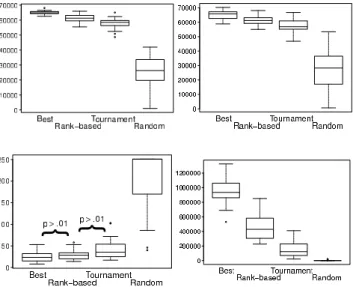
When we analyze the comparison measures we intro-duced earlier, similar trends are observed. Figure 5 (respec-tively Figure 6) shows the box and whiskers plots of the four measures for each selection method over the30runs for the navigation task (respectively the foraging task).
Figure 5: Box and whisker plots (30independent runs) of the comparison measures for the four selection methods on the navigation task. From top to bottom and left to right:fc,
fb,gf andfa. The labelp > 0.01indicates no statistical difference for the corresponding two selection methods.
On the navigation task, the pairwise comparisons of the four measures, using Mann-Whitney tests at99%confidence level, yield significant statistical difference between all se-lection methods except between Best andRank-based (p-value=0.0795) and betweenRank-basedandBinary tourna-ment(p-value0.0116) in the case of the time to reach target (gf).
We also observe thatBestreaches a higher swarm fitness for the fixed budget than the rest of selection methods, and this level is maintained at the end of evolution, as is shown infcandfb(upper left and right in the figure). The target fitness level is rapidly reached for the three methods induc-ing selection pressure, and there is not significant difference betweenBestandRank-based, nor betweenRank-basedand
Binary Tournamentw.r.tgf(lower left). Furthermore, in the case ofBest, the required level is not only reached but sur-passed during the entire evolution, leading to a value offa much higher than the ones of the rest of selection methods (lower right). However, this is not the case forRandom se-lection that has much lowerfb(upper right) andfc (upper left), and does not reach the target fitness level on more than half the runs that were launched (lower left and right).
Figure 6: Box and whisker plots (30independent runs) of the comparison measures for the four selection methods on the foraging task. From top to bottom and left to right: fc,
fb, gf andfa. The labelp > 0.01indicates no statistical difference for the corresponding two selection methods.
On the foraging task, there is a significant difference for all pairwise comparisons, except between Binary Tourna-ment and Random in the case of the time to reach tar-get, gf, and the accumulated fitness above target, fa, (p-value=0.0419in both cases). This is explained by the fact that very few runs attained the target fitness4in which case
gf is the last generation andfa is almost zero. There is also no statistical difference between Rank-based and Bi-nary Tournamenton the fixed budget swarm fitness,fb, (p-value=0.0105). This means thatBinary Tournamentreaches a fitness at the given budget that is comparable to the one ofRank-based, but it does not maintain this level, since for these two methods the difference is significant onfc.
Bestalso gives better results on the foraging task: a high swarm fitness is reached and maintained at the end of evolu-tion (fbandfc, upper left and right). It surpasses the target fitness level in almost all runs much faster and to a larger extent thanRank-based, that also manages to reach the re-quired level for most runs (gf, lower left), although by a
4
For both tasks, the target fitness is80%of the highest fitness reached by all methods during all runs.
lower level (fa, lower right). This is not the case for
Tour-nament andRandomthat do not achieve the target fitness level for most runs (lower left and right).
We can observe that all task-driven selection pressures yield much better performances on both tasks compared to Random selection. Consequently, we may conclude that selection pressure has a positive impact on performances, when solving a given task, and when the objective is not only to achieve adaptation of the swarm as it was the orig-inal motivation of mEDEA. Further, statistical tests show a direct correlation between the selection pressure and the performances achieved by the swarm on the two considered tasks. In other words, the stronger the selection pressure, the better the performances reached by the swarm.
In general, it has been argued that elitist strategies are not desirable in traditional EA’s, and the same argument holds for traditional ER. This is due to the fact that elitist strategies may lead to a premature convergence at local op-tima. There exists an extensive body of work, especially in non-convex optimization, where it is preferable to explic-itly maintain a certain level of diversity in the population to escape local optima and to deal with the exploration vs. exploitation dilemma. This requirement is perhaps not as strong in the context of distributed ER as our experiments show. Selection is performed among a portion of the pop-ulation at the agent level, therefore, one might argue that these algorithms already maintain a certain level of diversity inherent to the fact that sub-populations are distributed on the different agents. Comparisons with other approaches in which separated sub-populations are evolved, such as spa-tially structured EA’s (Tomassini (2005)) and island models (Alba and Tomassini (2002)), could give further insights on the dynamics of this kind of evolution.
Conclusions
In this paper, we studied the impact of task-driven selec-tion pressures in on-line distributed ER for swarm behav-ior learning. This kind of algorithms raises several ques-tions concerning the usefulness of selection pressure (partial views of population, noisy fitness values, etc.). We com-pared four selection methods inducing different intensities of selection pressure on two tasks: navigation with obstacle avoidance and collective foraging. Our experiments show that selection pressure largely improves performances, and that the intensity of the selection operator positively corre-lates with the performances of the swarm.
Foraging and navigation can be considered as relatively simple tasks and we believe that more complex and chal-lenging ones, involving deceptive fitness functions, could give further insights on selection and evolution dynamics in the distributed case.
Acknowledgements
The authors would like to thank Evert Haasdijk for provid-ing the version of RoboRobo simulator we used in the ex-periments, and for his insightful comments.
References
Alba, E. and Tomassini, M. (2002). Parallelism and evolutionary algorithms. Evolutionary Computation, IEEE Transactions on, 6(5):443–462.
Bianco, R. and Nolfi, S. (2004). Toward open-ended evolu-tionary robotics: evolving elementary robotic units able to self-assemble and self-reproduce. Connection Science, 16(4):227–248.
Bredeche, N. and Montanier, J.-M. (2010). Environment-driven Embodied Evolution in a Population of Autonomous Agents. InPPSN 2010, pages 290–299, Krakow, Poland.
Bredeche, N., Montanier, J.-M., Weel, B., and Haasdijk, E. (2013). Roborobo! a fast robot simulator for swarm and collective robotics.CoRR, abs/1304.2888.
Dinu, C. M., Dimitrov, P., Weel, B., and Eiben, A. (2013). Self-adapting fitness evaluation times for on-line evolution of sim-ulated robots. InProc. of GECCO’13, pages 191–198. ACM. Eiben, A., Karafotias, G., and Haasdijk, E. (2010). Self-adaptive mutation in on-line, on-board evolutionary robotics. In Fourth IEEE Int. Conf. on Self-Adaptive and Self-Organizing Systems Workshop (SASOW), 2010, pages 147–152. IEEE. Eiben, A. E. and Smith, J. E. (2003). Introduction to Evolutionary
Computing. Springer.
Karafotias, G., Haasdijk, E., and Eiben, A. E. (2011). An algorithm for distributed on-line, on-board evolutionary robotics. In Proc. of GECCO ’11, pages 171–178, New York, NY. ACM. Nolfi, S. and Floreano, D. (2000). Evolutionary Robotics: The Bi-ology, Intelligence, and Technology. MIT Press, Cambridge, MA, USA.
Noskov, N., Haasdijk, E., Weel, B., and Eiben, A. (2013). Monee: Using parental investment to combine open-ended and task-driven evolution. In Esparcia-Alc´azar, editor,App. of Evol. Comput., volume 7835 ofLNCS. Springer Berlin.
Pineda, L., Eiben, A., and Steen, M. (2012). Evolving communi-cation in robotic swarms using on-line, on-board, distributed evolutionary algorithms. In Chio, C.et al., editor, Applica-tions of Evolutionary Computation, volume 7248 of LNCS, pages 529–538. Springer Berlin Heidelberg.
Silva, F., Urbano, P., Oliveira, S., and Christensen, A. L. (2012). odneat: an algorithm for distributed online, onboard evolu-tion of robot behaviours. InArtificial Life, volume 13, pages 251–258. MIT Press.
Stanley, K. O. and Miikkulainen, R. (2002). Evolving neural networks through augmenting topologies. Evol. Comput., 10(2):99–127.
Tomassini, M. (2005). Spatially structured evolutionary algo-rithms. Springer Berlin.
Watson, R. A., Ficici, S. G., and Pollack, J. B. (2002). Embodied evolution: Distributing an evolutionary algorithm in a popu-lation of robots.Robotics and Autonomous Systems, 39:1–18.