DOI: 10.5897/AJBM12.1333
ISSN 1993-8233 © 2013 Academic Journals http://www.academicjournals.org/AJBM
African Journal of Business Management
Full Length Research Paper
Adoption analysis of cloud computing services
Leonardo Rocha de Oliveira*, Adriano JulioMurlick, Gabriela Viale Pereira and Rafael
Vicentin
Pontifical University of Rio Grande do Sul, Brazil.
Accepted 10April, 2013
Making decisions for IT outsourcing is always a challenge for companies worldwide, and cloud computing has been growing as an alternative. This article analyzes the viewpoint of IT managers about the adoption of cloud computing services. It confronts the literature review on the main features of cloud computing with the opinion of sixteen managers responsible for IT departments in their companies. The interviews were conducted using a semi-structured questionnaire for collecting qualitative data. The results were divided into five main dimensions of analysis, which are: usability, scalability, service quality, security and cost. The results obtained in this study showed cloud computing as a subject present in the daily lives of IT managers. The main advantage pointed to cloud computing adoption was related to the scalability, especially due the ease and dynamism for adapting to variations of companies’ IT needs. The results also show that security is a major concern among IT managers and crucial for CC adoption decisions. The possibility of paying only for the IT resources that are actually used makes cost attractive for cloud computing adopting decisions.
Key words: IT acceptance, cloud computing, IT management, IT outsourcing.
INTRODUCTION
The current dynamic and competitive economic market leads firms to face continuous challenges in their internal activities and external competitors. The ability to concentrate on their business core and quickly adapt to market changes are requirements for companies willing to survive and maintain their competitiveness (Babcock, 2010; Mansur, 2007). The growing role of Information Technology (IT) in a range of business aspects and the constant change in the way of using IT resources have required frequent and complex decisions from managers and executives (Weill and Ross, 2005). Cloud Computing (CC) is an example of IT resource, whose adoption in its various forms has challenged professionals from various levels of corporate hierarchies.
The success of companies is now increasingly depen-dent on the use of IT resources (Mansur, 2007). The agility to alter their ways of work and operate in dynamic business environments has been considered as a major
factor for them to succeed (Fernandes and Abreu, 2009; IBM, 2010). Business agility in this work is related to the ability to quickly and successfully alter working and managerial processes to face external and internal challenges (Mansur, 2007). IT services that are tradi-tionally managed by companies internally have been growing outsource to specialized firms, and they include systems backup, data warehousing, application develop-ment, technical support and information sharing. It is currently quite common to find companies deciding to outsource for IT resources operations in order to achieve better results in their core business activities (Fernandes and Abreu, 2009).
IT is a resource that requires strategic planning and management, as it may be decisive for the success or failure of a company. IT has currently a role that strongly impacts business activities, and one of the major management challenges for companies today is to align *Corresponding author. E-mail: [email protected]. Tel:+55 51 3320-3524. Fax: +55 51 3320-3624.
IT resources with strategic business objectives (Weill and Ross, 2005). This alignment must occur in operational and strategic levels, leading to the establishment of mechanisms for managing IT services and resources (Armbrust et al., 2009; Weill and Ross, 2005). IT mana-gers play an important role in this business scenario and are usually under constant pressure to ensure the provision of IT services and to work with limited budgets (Mansur, 2007).
CC offers an alternative to the provision of IT services by specialized companies with the capacity to cope with changes in business demands of its customers (Chorafas, 2011). IT services provided in the cloud have the potential to change the way that IT infrastructure and systems are used for supporting business objectives of organizations (Rittinghouse and Ransome, 2010). CC allows paying based on need and with an unlimited growing provision; thus allowing companies to innovate, even to start small and grow with time (Armbrust et al, 2009). CC seeks to provide easy access to IT services with low cost and offers features such as usability, scalability and security, thus challenging managers’ decisions for adopting it in their companies. It also considers needs that are unique to each organization (Marks and Lozano, 2010; Sarna, 2011).
Like any other technology, the use of CC should be aligned with strategic business objectives and meet the needs of IT management contractors (Slabeva and Wozniak, 2010). Therefore, companies willing to adopt CC should conduct a detailed assessment of costs, benefits, cultural aspects, risks, corporate atmosphere, policies and compliance with legislation (Chorafas, 2011). Issues related to companies’ existing IT resources and possible disposal must also be considered in this assessment.
CC contracts allow a range of service options and resources for contract, seeking to fulfill every customer’s need (Marks and Lozano, 2010). Contractors may choose based on the offer of flexibility to scale up the IT service provision, as to meeting demand variations. Others may focus on business goals of IT outsourcing to specialized companies able to provide technical support, systems maintenance and infrastructure management. There is also the option of allowing contractors to focus on their key business objectives and outsourcing IT re-sources for specialized companies, such as CC suppliers (Marks and Lozano, 2010).
Among the reasons that can lead to adoption of CC, it should always be considered that results must meet objectives and guidelines portrayed by the contractors’ strategic business plan (Armbrust et al., 2009; Rosenberg and Mateos, 2011). Hiring services of CC, it should be considered the specific needs for process operation and business strategic management, in compliance with corporate and industry policies and regulations. Contracts for hiring CC services may also pursue a hybrid ap-proach, combining IT services provided inside the
Oliveira et al. 2363
company with others provided by the cloud (Marks and Lozano, 2010).
CC has been seen as an option that will strongly impact the IT services providers market, as well as contractors’ practices of IT management (Slabeva and Wozniak, 2010). CC providers have an opportunity for enlarging services deployment and optimizing IT resources and energy consumption (Armbrust et al., 2009). CC con-tractors foresee a possibility for hiring unlimited IT resources, though paying only for what has been actually consumed. Contractors may use a variety of devices for accessing IT services, such as desktop computers, laptops, smartphone and tablets as there are variety of options for contracting systems applications, data storage, platforms and operating systems for accessing CC services (Chorafas, 2011). Therefore, the market of IT devices manufacturers for accessing information and systems in the cloud will also be impacted (Chee and Franklin, 2010).
Making the right business decision for hiring CC services is a challenge faced by IT managers and business executives, which is the focus of this work, as it aims to analyze IT managers’ acceptance for adopting CC services. Interviews were conducted with IT mana-gers of companies in Porto Alegre (Brazil) and metro-politan area. Interview results show the viewpoint of professionals regarding various aspects of CC service, highlighting features such as usability, scalability, security, quality and cost.
Cloud computing (CC)
The term CC has historically been associated with World Wide Web (Web) systems and IT services that can be accessed from a remote location (Rittinghouse and Ransome, 2010). Web applications have always been linked to accessing virtual IT resources that sometimes are not even identifying the information source or destination. The concept of CC has been following the growth of web access (Slabeva and Wozniak, 2010). As far as in 1961 it was already suggested the possibility of sharing computer applications worldwide, though the term used to describe this kind of work was Utilitarian Computing (or Utility Computing) (Slabeva and Wozniak, 2010). That approach did not consider the growth of personal computers, but companies sharing IT resources from mainframes, with users accessing it remotely from a computer monitor and keyboard. Utilitarian computing practices were limited in their origin, due to technical aspects (limitations of bandwidth, disk space, cost of terminals for access and processing speed) and human (professional expertise and difficulty in realizing business usefulness). Although the IT infrastructure for this type of technology is almost obsolete, the use of leased mainframe processing has proven to be profitable for some time, both for contract and suppliers (Antonopoulos
and Gillam, 2010).
Since 1990, there has been a growth in using personal computers, which are available everyday at lower cost and with higher processing power and data storage; they have reflected on the increasing amount of Web access, information sharing and CC services being offered (Babcock, 2010). The current status of CC services almost eliminates the needs of local information systems and database resources for running business appli-cations, apart from the hardware devices required for accessing IT services in the cloud. Business objectives of CC service providers include allowing access to data, information and applications from anywhere in the world and at any time, regardless of the IT device (Slabeva and Wozniak, 2010).
CC involves a set of hardware, networking, storage, services and interfaces that enable the delivery of IT resources as a service. CC services include software delivery, infrastructure and data storage through the Web, in accordance to users’ demand (Chee and Franklin, 2010). Accessing CC services requires only computers (or IT devices) with Internet access. All processing and computational resources are available on the Web and the client computer or device works just as hardware with Internet access (Buyya et al, 2011).
CC models
Companies’ decisions for outsourcing IT resources in their business activities have been growing considering CC as an option, and there are four main different models as options for adoption: (i) Public, (ii) Private, (iii) Hybrid or (iv) Community (Chorafas, 2011; Antonopoulos and Gillam, 2010; Rittinghouse and Ransome, 2010):
1. Private Cloud - occurs when services are provided only for a unique client, who prefers to keep his data and systems in a specific IT infrastructure that is operated exclusively for the contractor. This option is usually taken by large companies or government institutions that require a high level of security, control and privacy for IT operations;
2. Public Cloud - is the most common model and it allows companies to share infrastructure resources and systems, while keeping data and information as a unique asset of each client. This model allows companies to outsource IT resources to specialized companies, and paying only for the services that are being used;
3. Community Cloud - the IT infrastructure is shared by a group of companies, usually with common charac-teristics, such as being part of the same production network, supply chain, government institution or com-panies’ consortium. This model represents an attractive option for companies with similar needs for IT resources, such as website hosting, booking systems and financial controls for hotels of a similar tourist destination. In this
example, each client’s data and information have privacy, but sharing costs of web hosting and systems development.
4. Hybrid Cloud – comprises using two or more models together (private, public and community), thus allowing that different business objectives could be aligned to the different characteristics of CC models, or even to have its own IT resources expanded in a public cloud. According to Goscinski and Brock (2010), this model is the most commonly adopted by companies that are just beginning to adopt CC services.
Although all four CC models are available for contracting, this work has the objective of analyzing the adoption of CC in any particular model. However, the results of the interviews have highlighted some characteristics of the different models that were considered by the respondents for adopting CC services in their companies.
CC services
There are different categories of IT services being offered by CC suppliers, which can be hired individually or com-bined. The main categories of CC services available are known as: (i) Infrastructure as a Service (IaaS), (ii) Platform as a Service (PaaS) and (iii) Software as a Service (SaaS). These services are provided and consumed in real time and are usually charged according to the amount of use (Buyya et al., 2011).
The category of (i) Infrastructure as a Service (IaaS) provides IT resources for processing, storage and group working, eliminating the need for acquisition and configuration of servers and network equipment (Buyya et al., 2011). Users are not supposed to manage the contracted IT resources, but should control such aspects as amount of data transactions, used storage space, applications and network access rates (Winkler, 2011).
The category (ii) Platform as a Service (PaaS) allows users to develop systems that are specific for the com-panies they work with, or even for their own interest (Buyya et al., 2011). PaaS offers to developers a pro-gramming environment to facilitate interaction and supporting the required scalability to run applications (Antonopoulos and Gillam, 2010). Developers have the benefits of developing applications in a cloud programming base that includes automatic sizing and load balancing, as well as integration with services as authentication, e-mail, users’ interface and reports creation shared by all contractors (Winkler, 2011). Thus, much of the burden of developing applications is minimized and managed by the PaaS provider (Winkler, 2011).
The category (iii) Software as a Service (SaaS) is perhaps the most popular CC service (Sarna, 2011) and allows users to run their systems from a Web browser, paying only for the bandwidth consumed and data stored
space. The category explores the use of systems from remote sessions in data centers, in which systems are deployed. SaaS is capable of adapting to demand variations of processing power and systems’ memory, making contractors to avoid the need of investing on attending to IT using peak times (Rosenberg and Mateos, 2010). SaaS also allows reducing needs for hardware configuration requirements from client devices and it may be useful for easing the burden of software licensing and technical support (Sarna, 2011).
This work is not considering specific aspects of these three categories of CC services. The analysis in this work considers CC services as a whole, as the IT managers interview work in companies from different sectors and with different business goals and processes. However, results taken from the analysis are highlight some specific aspects from the different models and categories of CC services pointing out some barriers or justifying decisions for adopting CC.
CC characteristics
The aptitude for outsourcing IT resources by adopting CC services has been a growing interest for companies of all sectors (Rosenberg and Mateos, 2011). CC includes a number of features that may represent benefits for companies willing to improve the use of IT resources. These characteristics define the set of services and technologies involved in CC and it implies changes at working process of contracting companies. Therefore, companies willing to adopt CC services must consider impacts regarding human aspects, internal operations and strategic business activities (Rittinghouse and Ransome, 2010).
The literature review shows that the main charac-teristics to be considered by companies willing to adopt CC services are:
1. Scalability - this feature allows the contracted services to be customized and charged accordingly to contractors’ business needs, and it includes aspects such as changes in bandwidth consumption, periodic (or seasonal) influence on data transactions amount, data storage space and even gradual upgrade for applications that become obsolete.
2. Usability- it impacts on how CC systems and resources will be integrated inside the contractors’ companies and employees, whether they are business users or IT managers. CC services can be accessed by different types of computers and mobile devices with different operating systems. This feature has influence on users’ policies and systems management, as it alters the way of working as well as eliminates geographic frontiers. 3. Quality of Service - it involves management aspects of CC service performance and the definition of roles, rights and responsibilities of all persons and companies
Oliveira et al. 2365
involved with the contracting relationship. CC providers are responsible for service availability and should allow contractors to access from wherever and whenever they want, according to the quality levels established in the contract. Companies that carry out intensive amounts of data transactions need to assure that the CC service can sustain the expected performance, without excessive latency, even considering the existence of users who work outside the company or at locations with limited bandwidth.
4.Cost - contractors only pay for the services contracted for and consider the quality level agreed on as well as technical support; but it does not include infrastructure maintenance for running applications. Although con-tractors can save on hardware and software, there may be an increased cost due to network bandwidth demand, which may not be significant in cases of low data transactions rate. However, the bandwidth demand is expected to grow as more applications are hired and transferred to the cloud.
5. Security - this feature is a major concern for adopting CC services and involves various aspects of contractors and suppliers against attacks and vulnerabilities. Con-tractors’ data and information are kept outside the realm and responsibility of internal staff, but users’ policies and responsibilities must apply for both contractors and suppliers personnel.
Each one of these characteristics involves aspects that may influence decisions for adopting CC services. Although CC adoption may offer gains for contractors, especially for allowing business and IT personnel to work more on strategic activities, it is still a decision that involves many factors (Rittinghouse and Ransome, 2010). The following section shows the framework pro-posed in this work to help in understanding the factors involved in making decisions for CC adoption.
Adopting CC
For the analysis about the adoption of CC services proposed in this work, a literature review was carried out searching for previously developed models for evaluating results of IT adoption decisions, as well as for factors specifically related to adopting CC services. The aim at this stage is to identify a set of general factors to be considered for adopting CC, covering characteristics of workplaces and practices that may be unique for each company, users and business need (Klaus and Blanton, 2010; Petter et al., 2008).
One of the models mostly referred to in the literature for evaluating technology adoption is the TAM (Technology Acceptance Model) proposed by Davis (1989), which considers two principles relating to the perception of decision makers, which are (i) perceived usefulness and (ii) perceived ease of use. The TRI (Technology
Readiness Index) proposed by Parasuraman (2000) was also reviewed in this work and it considers two principles for IT adoption, which are (i) drivers (represented by optimism and innovation) and (ii) inhibitors (represented by discomfort and insecurity). It was also reviewed the EAOSS (Enterprise Adoption of Open Source Software) model proposed by Kwan and West (2005), which considers aspects of alignment between the system role to be adopted regarding companies’ business strategies, covering such aspects as (i) strategy (competitive advan-tage and differentiation), (ii) critical mission (integration, reliability and risk), (iii) support (efficiency and cost), and (iv) laboratory (evolution and future benefits). Considering aspects of this work and its impact as a reference, the decision in this work was for taking the model UTAUT (Unified Theory of Acceptance and Use of Technology), which has been proposed by Venkatesh et al. (2003) and its applications are largely referenced in the literature. The UTAUT model indicates individual beliefs towards the four main determinants for analyzing the intent for IT adoption, which are:
1. Expected Performance – considers aspects regarding gains of performance in the workplace;
2. Effort Expectancy – involves issues related to the effort required for adopting the IT resource;
3. Social Influence – considers aspects from the users group regarding the IT adoption;
4. Facilitating Conditions – involve aspects of IT infrastructure and technical support present in the company for adopting the new technology.
The literature review on factors that may influence decisions for CC adoption shows a range of options, which may even be different when related to the model to be contracted (public, private, hybrid or community), as well as for the type of service (IaaS, PaaS, SaaS and their derivatives) (IBM, 2010; Rittinghouse and Ransome, 2010; Marks and Lozano, 2010; Babcock, 2010). Consi-dering the factors listed in the literature review, this work considered the 5 characteristics of CC as dimensions for analyzing the intent for adopting CC services, which are (i) Scalability, (ii) Usability, (iii) Quality, (iv) Cost and (v) Security (see section 2.3).
Security related aspects were the most present in the literature review, which is not a surprise considering that CC is not different from any other emerging technology (Winkler, 2011). The cloud security must be part of the overall enterprise security strategy (Marks and Lozano, 2010). Most companies prioritize testing and monitoring threats on datacenter, buildings, people and information (Winkler, 2011). Security risks, threats and violations can come in many forms and from many places so that com-panies must adopt a comprehensive approach to managing IT security (Krutz and Vines, 2010).
Although the literature indicates that companies providing CC services offer good quality conditions of
security (physical, networking, operating system and application infrastructure), it is also the responsibility of the contractor to protect his applications, data and infor-mation (Krutz and Vines, 2010). Given the importance of security, CC suppliers offer a comprehensive set of terms in their contracts. However, most of these terms aim at protecting CC suppliers, thus requiring a careful understanding of contractors’ responsibilities and rights (Krutz and Vines, 2010). From a technology standpoint, contractors should consider application rules for data security services of CC on the following instances (Winkler, 2011):
1. Stored data privacy, avoiding data that can be accessed or modified by unauthorized third parties (including the CC operator);
2. Runtime data privacy, preventing data from being seen and/or altered while in the clients’ computer memory or in the service supplier machines;
3. Data transfer privacy, preventing access while in transfer to the CC provider, as well as in the contractors’ intranet and suppliers’ network;
4. Access data authentication, it considers rules and responsibilities of contractors to alter users’ rights and include new ones.
In addition to technology solutions, business policies and legal guidelines can be used to ensure data security, providing terms and conditions for assuring the rights of all involved with the hiring and use of CC services, including penalties of financial compensation for cases of security breaches (Winkler, 2011). It is essential for companies willing to hire CC services to perform a detailed analysis of the impacts and risks regarding its adoption, especially if it involves a critical business activity. There are still plenty of room for the current state of the art of CC contracts to evolve, especially for considering specific contractors business needs, as the current reality is more related to protecting suppliers (Krutz and Vines, 2010).
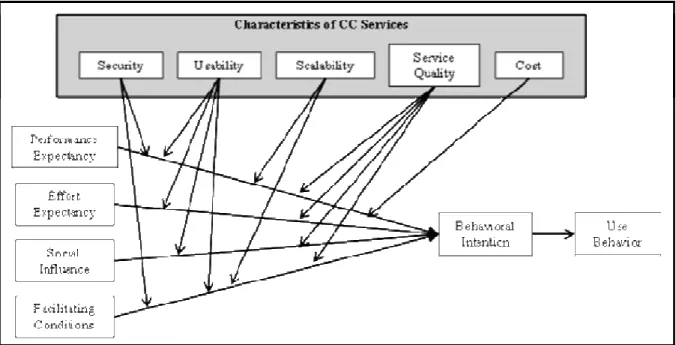
The framework for analyzing the adoption of CC servi-ces has considered two viewpoints taken from the litera-ture review, which are (i) the five main characteristics for adopting CC services, and (ii) the four factors present in the UTAUT model for IT adoption. The priority in this work was for identifying the most influencing characteristics for adopting CC services, thus offering a broad understanding on this issue. The framework was also used for understanding the relationship between the CC services characteristics with the IT adoption factors present in the UTAUT model. Therefore, the framework shown in Figure 1 was firstly drawn without the links between the analysis factors. However, the current version of the framework in Figure 1 shown in this work is already presenting the links taken as a result of the interviewing process.
Oliveira et al. 2367
Figure 1. Influencing factors for CC adoption decisions.
subjected to the analysis of IT managers for under-standing their viewpoints about the characteristics that mostlt influence decisions for adopting CC services. The framework was also used for identifying the interviewers’ opinion in regard to the UTAUT determinants for analyzing the intent for IT adoption. Details regarding the research methodology and the interviewing process with the IT managers are presented as follows.
RESEARCH METHOD
This work presents an exploratory research that seeks for an understanding about the factors that influence IT managers’ decisions for adopting CC services in their companies. This type of research is especially suited for cases in which there is neither a literature review specific to the area nor the researchers have an extensive knowledge on the matters in relation to the research problem (Cooper and Schindler, 2004). Although there are several literatures exploiting issues of CC services, this work focuses on the perception of IT managers about the main factors affecting the adoption of CC in the companies they work.
To deepen the understanding about the research objectives, qualitative interviews were carried out with IT managers experien-ced with CC adoption projects. The interviewing process was conducted based on a semi-structured instrument, which was firstly developed from the literature review, and represents the conceptual framework shown in Figure 1. The research instrument was design-ned with three sections. The first was for mapping respondents’ profile and the companies they work for. The second aims at investigating respondents’ opinions considering the relationships between the five characteristics for adopting CC services (Usability, Scalability, Service Quality, Security and Costs), each one in regard of the four determinants for IT adoption present in the UTAUT model (Expected Performance, Effort Expectancy, Social Influence and Facilitating Conditions). The last section of the instrument contains open questions for identifying general aspects of the
issues under study, such as standards that can be revealed or reasons for the respondents’ positioning on certain research aspects (Cooper and Schindler, 2004).
The questions in the research instrument followed a guideline for identifying interviewers’ opinions about all CC services charac-teristics. It means that there was neither time limit nor an expected standard for the contents of the answers. The interviewees’ selection was based on convenience and considering the proximity to the researcher, though respecting the criteria of more than five years working experience as IT manager. A total of 16 IT managers of Brazilian and international companies from different sectors (retailing, manufacturing, services and IT) were interviewed, and all working at the southernmost state of Brazil.
The interviews were conducted face to face; focused and informal, allowing the interviewees to feel free to openly discuss the topics in the research instrument. This type of interview is often used for exploratory research, especially in cases where the researcher is dealing with unstructured knowledge (Cooper and Schindler, 2004). The interviews were conducted during May-July 2011 and confronting the IT managers’ comments with the literature reviewed. The main advantage of a face to face interview is the opportunity to freely explore topics in depth, allowing the interviewer to feel comfortable for redirecting opinions and openly comment and justify their answers (Cooper and Schindler, 2004). However, the task of encouraging respondents to freely talk about the research topics belongs to the interviewer (Cooper and Schindler, 2004).
The interviews’ content analysis was carried out for classifying, explaining and quantifying the respondents’ understanding about the research context and CC aspects in the instrument. The content analysis applied thematic and categorical techniques, which are based on grouping the research issues into categories and explaining the context and application of the aspects present in the research instrument (Bardin, 2004; Cooper and Schindler, 2004). Though the interviews respected companies’ policies and professionals’ privacy, they were recorded for further analysis when allowed. The analysis proposed in this study can be repeated at a later date for comparing with the results obtained in this work, and thus evaluating changes in the IT managers’ opinions.
Table 1. IT managers and companies’ profile.
1 2 3 4 5 6 7 8 9
M1 7 2 Software Medium IT None 3 b ii
M2 10 3 Financial Big Finance MBA 1 a, b, d i, ii, iii
M3 5 7 Services Medium IT MBA 2 b iii
M4 6 4 Services Medium Business MBA 2 b ii
M5 5 3 Software Medium IT MBA 3 b i, ii
M6 5 12 Financial Big Business MBA 1 a i, ii, iii M7 9 6 Manufacturing Big Business None 1 a, b i, ii M8 15 8 Bookstore Big IT MBA 1 b, d i, ii, iii M9 9 3 Services Big Marketing MBA 2 a, b i, ii M10 17 8 Manufacturing Big Business MBA 2 a, b i, ii, iii M11 15 4 Retailing Big Business MBA 2 b, d i, iii M12 20 9 Retailing Big Business MBA 1 a, b i, ii, iii M13 15 6 Manufacturing Medium Engineer MBA 2 b i, iii M14 16 7 Services Big Engineer MBA 2 b, d i, iii M15 17 7 IT Hardware Big IT Master 4 a i, ii, iii M16 19 9 IT Hardware Big Engineer MBA 4 a, b i, ii, iii
RESULT ANALYSES
The interviews carried out in this work took an average of 35 min conversation with each IT manager individually, and the result analysis present in this work starts by describing respondents’ profile, and followed by showing aspects related to the five dimensions considered for CC services adoption decisions.
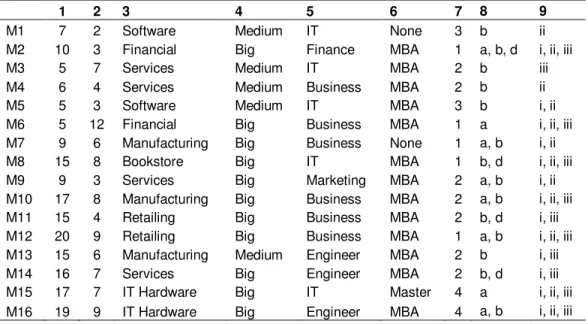
The research sought to capture the general perception of IT managers, regardless of market sector, business objectives and size of the company they work for. Table 1 shows the respondents’ profile, considering aspects such as: (1) years of IT management experience, (2) years in the company, (3) company’s business sector, (4) company’s size, (5) academic undergraduate formation, (6) higher academic degree, (7) years of CC adopting experience, and (8) CC services adopted (a- Private Cloud; b- Public Cloud; c- Community Cloud; d- Hybrid Cloud), and (9) type of CC model adopted (i- Infra-structure as a Service; ii- Platform as a Service; iii Software as a Service). As solicited by some managers, their names and companies were preserved and only identified by a letter "M" followed by a number, according to the interviewing order (M1 to M16).
All respondents have academic degrees in areas related to the working activities they perform in their com-panies. In this work, it was not examined the relationship between the interviewees’ profile and their point of view about the research objective of analyzing the acceptance for adopting CC services. Despite the differences of working time experience (5 to 20 years), all professionals built their formation in IT related areas, which is essential for this work, along with the time experience with CC services adoption (1 to 4 years). Although the there are differences in interviewees’ profile, it does not seem to
have affected their opinions about CC services adoption, since most answers were justified based on technical aspects. Moreover, there was a consensus for answering the majority of the questions present in this work. Details of the answers provided for each of the five characteristics of CC services are described as follows.
Usability
Usability of CC in this work seeks to analyze whether the services being offered are aligned with business needs. The analysis considers users’ experience with the companies’ situation prior to adopting CC and the ability for adapting to the new technology, preferably with no great efforts for training, and perceiving advantages over the previous scenario (Antonopoulos and Gillam, 2010).
Managers’ opinion highlighted that the mobility offered by CC is a strong motive for adopting (Performance Ex-pectations). It was also indicated that Effort Expectancy for CC contracting firms must be analyzed from two perspectives: (i) from the point of view of IT profess-sionals, who are responsible for managing CC services; as well as from (ii) the viewpoint of end users and managers of other business areas.
When asked to comment about (i) CC usability for IT managers, 10 of the 16 respondents agreed that this is not a problem since the interfaces for managing services are very similar to those they are used to. For instance, infrastructure management results provided by CC vendors are very similar to those currently used in their organizations. Moreover, they are transparent for con-tractors as well as for CC vendors. One respondent quoted that "I believe that the changes for IT managers are small compared to what they are accustomed to
using, especially for web applications". The only barrier pointed by the respondents regarding the IT managers was Usability, quoted by M12, who said that "Some managers are very conservative and prefer to have privacy and full control over their information; they do not trust third party companies for providing IT services results; though I believe that it is something very personal and that has been losing ground".
Usability for (ii) end users was indicated by all respondents as a difficulty, and that cultural issues and changes on systems interfaces are obstacles for CC adoption. The Social Influence is a common barrier for most changes on current working situations, and IT projects are not an exception. M10 cited that "For some IT applications, end users may not even notice whether they using a local or a CC service". M11 reinforces it by saying that "Some applications require training, especially those that are 100% web based, but mostly those applications that will no longer have the same users".
The interviewees were also asked to point out the most important issues of Usability that they believe should merit attention for adopting CC services. M1, M3, M4 and M7 (4 of 16) referred to customizing CC services and applications for meeting specific business needs of contracting companies. M2, M6 and M9 (3 of 16) elected end users’ training requirements as a major issue. M5, M8, M10, M11, M12, M13, M14, M15 and M16 (9 of 16) considered the adaptation of CC vendors for meeting specific business needs of contractors as the major Usability barrier. All agrees that training and a period for adapting to the CC supplier should be part of any CC migration project.
The Usability analysis carried out in this work shows that this characteristic should be considered, but it was not highlighted as a relevant barrier for adopting CC services. The interfaces provided by CC suppliers are similar to those used by IT managers as controlling con-soles of IT resources. Though the respondents were insti-gated to talk openly about CC, there was no indication of concern regarding changes on working activities related to green IT and more efficiency on using energy. The major concern relies on selecting CC suppliers capable of offering a service that suits contractors’ business needs. The analysis also shows that the Usability characteristic of CC influences aspects of Expected Performance, Effort Expectancy, Social Influence and Facilitating Con-ditions. Thus, Usability is a characteristic that influences all aspects of adopting new technologies of the UTAUT model.
Scalability
CC provides access to a wide range of IT services that are charged according to use in attending to contractors’ demand variations (Rittinghouse and Ransome, 2010). CC has automated provisioning mechanisms to ensure
Oliveira et al. 2369
that applications and services are continuously available and keeping the performance levels established in contracts (Antonopoulos and Gillam, 2010).
The respondents pointed out that Scalability is crucial as a Facilitating Condition for adopting CC services. They also consider its ability to adapt to contractors’ demand variations as an important advantage of Performance Expectations. M5 cited that "the fact that there is a possibility to quickly add processing power for specific periods favors the current business agility demand". When asked specifically, all respondents mentioned that Scalability is an important factor for adopting CC services, but not the major. For instance, M8 said that "Scalability can be considered as the main advantage to certain companies, depending on the business area and technical expertise. In my particular case, I do not need to grow IT resources often”. Actually, 10 of the 16 respondents quoted that they do not have large demand variations in their companies, though all mentioned to believe that CC vendors would meet their needs in case it is necessary. Respondents were asked to comment whether they had experienced with cases of increasing IT demands generated by business activities, in which CC Scalability was decisive. M1 cited that “Switching the company’s e-mail to the cloud was one of the best decisions in terms of our infrastructure management, since we had a significant growth in our workforce and it was easily handled by the CC provider”. M10 said that "since we began using CC we had a considerable growth on storage and processing power for meeting our project needs and we did not have any scalability problem". M12 also cited that "there are seasonal sales campaigns in my company that require IT services to grow significantly and CC has always supported our demand".
The Facilitating Condition of Scalability is a determinant factor for CC adoption. The ability to quickly acquire more computing resources, and in some cases automatically, and paying only for what is actually used was considered by 5 respondents as the main advantage of adopting CC. IT resources in CC can be purchased with varying amount and at any time, and all respondents had suc-cessful experiences with this ability to scale for meeting business needs.
The Scalability analysis carried out in this work shows that this characteristic influences aspects of Expected Performance and Facilitating Conditions for adopting new technologies present in the UTAUT model.
Service quality
Service Quality in CC aims to ensure that applications are being offered by attending to contractors’ business demands and expectations, as agreed in the contract (Slabeva and Wozniak, 2010). Quality and utilization measurements of CC services must be available and transparent to contractors, as it also helps managers to
rely on migrating their companies’ IT applications (Rittinghouse and Ransome, 2010). As CC adoption involves becoming dependent on the supplier, it is necessary to ensure and manage service quality.
Respondents indicated that CC service quality should be managed based on the contract terms offered by suppliers. They also pointed that service quality is a CC characteristic that has influence over the four deter-minants for assessing Benefits Perception present in the UTAUT model (Performance Expectancy, Effort Expec-tancy, Social Influence and Facilitating Conditions). None of the respondents commented on having experienced difficulties related to contracted CC services quality. On the contrary, they indicated that CC vendors strive to ensure contractors’ confidence by offering high service level agreements (SLA) and penalties for violations in the hiring contracts. Respondents M2, M3, M4, M7, M10, M12, M15 and M16 commented that they had excellent experiences adopting CC and achieved quality gains in comparison to the previous proprietary scenario in their companies. M4 cited that "my CC provider has been offering good quality on processing power, bandwidth, applications and technical support." M7 shares the same opinion and quoted that “we have been using our financial system and e-mail in the cloud for three years and yet no problems related to the CC supplier service quality. We had some problems, but mostly caused by our local network”.
M1, M5, M6, M8 and M9 agreed in considering CC services quality as good, but with caveats. They heard of instabilities experienced by other companies and colleagues and quoted that this issue is closely tied to CC suppliers, and some still cannot assure the quality agreed in contract. The main restriction regarding CC quality was pointed by M11, who cited that some suppliers still need to evolve on providing better contracts and should go beyond the passive approach of just attending to contractors’ demand and expectations.
When asked to comment on their experiences with CC service quality, the respondents said that, so far, there were no major disappointments. Concerns were most associated to bandwidth and technical support, which were indicated as crucial for evaluating CC services quality. M10 said that "There is no point on providing services with high processing power, storage space and technical support if the bandwidth is insufficient”. M14 cited that “CC vendors sometimes are not providing technical support with the agility and quality I expected". M12 stated that "As applications are stored in the CC providers’ infrastructure, it turns out that we became 100% dependent on their technical support for solving any problem that may happen". M11 was the only one to point out that they once had a quite serious problem, as the financial system was unavailable for 6 hours. M11 cited that “Although the financial system was not a business critical application, we did not take measures to end the contract with the CC supplier; but there was a lot
of inconvenience to our company”.
Apart from some punctual restrictions, the respondents did not consider service quality as an obstacle for adopting CC. Although there were some caveats related specifically to some suppliers, bandwidth and technical support were pointed out as the most relevant aspects for evaluating CC service quality. Bandwidth can com-promise the IT service continuity and technical support could somehow be the only option for returning the CC services. The analysis also shows that CC service quality has influences on all four determinants of adopting new technologies present in the UTAUT model, which are Expected Performance, Effort Expectancy, Social Influence and Facilitating Conditions.
Security
The literature review shows that security is considered as the major barrier for adopting CC (Minnear, 2011) and that was confirmed by the respondents in this work. Com-panies’ expectation is to have protection, confidentiality, integrity, availability and access control over the IT resources and services, no matter if it is in the company or in a private or public cloud (Winkler, 2011). Safety measures and monitoring of IT resources should be kept consistent, based on CC (Krutz and Vines, 2010). Under-standing the aspects that involve information security specifically related to adopting CC services is the issue focused on in this work.
The respondents indicated that Effort Expectancy and Social Influence do not apply as determinants for assessing the Benefits Perception for adopting CC services, as there are nothing specifically applied that is different from adopting any other IT resource. However, they pointed out that Performance Expectancy and Facilitating Conditions are determinants for adopting CC strongly related to CC security. Performance Expectancy was indicated as harshly related to the security terms present in the contract offered by CC suppliers. Moreover, the Facilitating Condition was directed as mostly dependent on the internal workplace and security matters from the contracting company. Part of the res-ponsibility for protecting CC services goes to contracting firms, which also need to adapt for adopting CC. M1 says that "I consider CC safe because there are security mechanisms for assuring access and privacy of com-pany’s data and information."
The literature review shows that CC services can be provided with different models and contracts for adopting Public Cloud are the most common, allowing companies to share infrastructure and systems, but keeping data and information as a unique asset of each contractor. The respondents have not shown much concern for consi-dering security as a barrier for adopting CC, even for Public Cloud contracts. They indicated that some security aspects can even be better provided by CC vendors, as
they have the expertise for setting up, managing and updating IT infrastructure and applications. Only M6 and M15 quoted that they did not feel comfortable with hiring public CC services for security reasons and this specific reason leads them to hire a private CC service.
When asked about the security of information confi-dentiality, the respondents did not believe that it should be a barrier for CC adoption, as service providers have been dealing well with this issue. M8 said, "There are encryption techniques used by CC vendors that reduce this risk, and hence the restriction for adopting CC". M12 was the only one who showed some concern about information confidentiality and said, "No company would like to share information with another, especially with competitors, and it is difficult to assure that it is not happening with CC". M12 went further in this issue and stressed that confidentiality is a critical issue for adopting CC, and said, "This issue is even more critical when it comes to highly sensitive business information, such as financial results or product development projects, as leaks can cause losses that are hard to measure".
When questioned about the availability aspect of CC security, the respondents said that it is mostly related to bandwidth and CC suppliers have currently been capable of providing high level services. They recommended a prior detailed evaluation of suppliers and contract items, including issues of damage compensation that can be caused by service unavailability. Respondents also indicated that they are aware that Web accessing service does not need to be provided by CC suppliers, as it can be purchased from Internet Services Providers (ISP). M7 said, “bandwidth is my biggest concern and that may end up impacting directly on my company’s business results”. M7 also stressed that "Bandwidth is currently the most important constraint for information availability and it also requires attention in regard to the option of hiring from other than the CC supplier, as it may become difficult to know who is failing."
The accessibility aspect of security was pointed out by all respondents as a strong point for motivating the adoption of CC, as it deals with a wide variety of mobile and hardware devices for accessing services. The advantage due to the facility for accessing CC services from anywhere and anytime was well recognized by all respondents. M2 said that "The need and amount of integrated information for running business activities is increasingly every day and it must be readily available for everyone involved". M6 and M15 have shown concern on sharing IT resources with public clouds. M6 said that "I am worried about accessibility in Public Cloud contracts, as my company became dependent on security policies and management expertise of CC vendors". All other respondents pointed out that were comfortable with the current safety standards given by CC providers.
Security was considered as an important factor, but it was not considered as a major barrier for adopting CC services. Only two respondents showed some concern,
Oliveira et al. 2371
but it was specifically related to the adoption of Public Cloud services. The analysis also shows that CC security has influences only on two determinants for adopting new technologies from the UTAUT model, which are Expected Performance and Facilitating Conditions.
Cost
It is difficult for companies to precisely assess the real costs of IT resources or even for a particular application that runs internally using conventional datacenters. Thus, it is also difficult to compare costs for taking decisions to adopting CC services. CC can impact businesses of all types and companies, regardless of size and activity sector. CC also offers to micro, small, medium and big companies the opportunity to play as equals for accessing IT resources and making it as a competitive advantage (Antonopoulos and Gillam, 2010; Rittinghouse and Ransome, 2010; Rosenberg and Mateos, 2011). The fact is that CC services are available for hiring by any kind of company that could benefit from its adoption.
The respondents shared that although the expectation of reducing costs is real with CC adoption, it is very difficult for evaluating it precisely. There was also a consensus that the cost characteristic of CC is only related to the Expected Performance determinant of the UTAUT model. The opportunity for reducing fixed costs by paying only for the amount of the IT resources used was also pointed as a positive aspect for CC adoption. Beyond the cost of IT infrastructure, the adoption of CC also impacts aspects of systems licensing and personnel from technical areas that require expertize. Respondents agreed in considering that the cost for tech support is considered in CC suppliers’ contracts. M10, M12 and M13 cited that although this cost may not be much smaller than by keeping personal into the company, professionals from CC suppliers are better trained and with higher expertise.
When asked about the prices charged by CC suppliers, the respondents commented that this issue is closely related to the type and amount of services hired. For instance, prices are very attractive for services that are considered simple, such as email, files exchanging and backup. However, services that are more complex and/or specifically customized for some companies’ businesses have to be negotiated. M11 quoted that "Pricing for complex CC services are also dependent on the hiring context. The basic idea is that the more you hire from a vendor, the more you get as a whole”. The general opinion is that prices are still high and the main reason indicated is that most CC vendors are outside of Brazil. M10 pointed that "As long as CC providers remain in Europe and US, the pricing for Brazilian companies would still be considered high".
Babcock (2010) cited that CC provides transferring IT resources cost from fixed to variable. It means that is
Table 2. CC characteristics vs. determinants for IT adoption. Variable Security (i) / (ii) Usability (i) / (ii) Scalability (i) / (ii) Quality (i) / (ii) Cost (i) / (ii) Expected Performance 16 / 10 12 / 12 16 / 16 16 / 12 16 / 9 Effort Expectancy 2 / 2 15 / 13 1 / 2 14 / 2 2 / 5 Social Influence 3 / 1 16 / 10 2 / 2 13 / 4 1 / 2 Facilitating Conditions 16 / 11 12 / 12 15 / 15 13 / 10 2 / 2
possible to eliminate fixed cost of IT resources that are depreciated over time, such as servers, networking equipment and items related to datacenters. All res-pondents agreed that eliminating some IT infrastructure cost and having services charged according to the use are positive influences for adopting CC.
All respondents pointed out that cost is an essential characteristic for CC adoption, and it has to be evaluated from a short, medium and long term perspective. M6 commented that "The fact of no longer having to maintain a staff for this purpose and the rapid and frequent changes on operating systems, equipment and security measures should be considered for evaluating cost, though it is difficult for measuring".
The respondents did not consider cost as the main deciding factor for CC adoption. It was considered highly relevant and that should be carefully analyzed. Most respondents (14 of 16) indicated that decisions for adopting CC are already capable of providing cost reductions, though there are services that still could be cheaper when provided by IT legacy resources. They all believe that soon there should be a number of CC suppliers in Brazil, and it must lower the cost for adopting CC services. M16 cited that “Brazil is a country that shall soon be seen as an attractive option for CC suppliers, as electric energy is cheap and mostly provided by clean sustainable sources (hydroelectric dams)”.
All respondents indicated that turning IT cost from fixed to variable is a positive influence for adopting CC. The analysis also shows that the cost characteristic influences only on the determinant of Expected Performance for adopting new technologies in the UTAUT model.
Consolidated results analysis
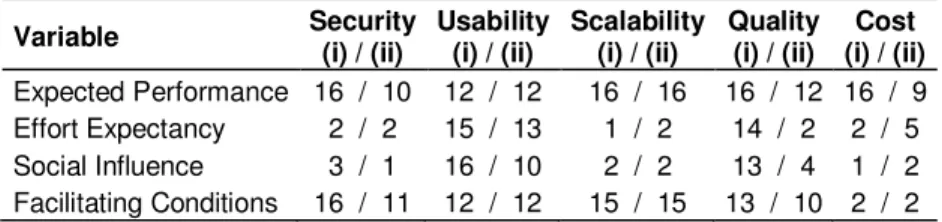
A quantitative summary of the results taken from the interviews is presented in Table 2 and it considers each one of the five main CC characteristics, in regard to (i) the influence and (ii) the perceived advantage over the four determinants for IT adoption in the UTAUT model. The first value in each cell (i) represents the amount of respondents that indicated a relationship between the CC characteristic with the UTAUT determinants for IT adop-tion. The second value (ii) in the cells shows the amount of respondents that indicated a perception of advantage in adopting CC services considering the CC characteristic
in regard to the UTAUT determinants for IT adoption. The results in Table 2 were taken to build the relation-ships indicated by the connectors (arrows) in Figure 1. As shown in Table 2, Security was indicated by all 16 respondents as strongly associated with determinants such as Expected Performance (Winkler, 2011) and Facilitating Conditions (Winkler, 2011). However, only 10 respondents indicated that Security is perceived as an advantage that can be obtained by adopting CC in regard to Expected Performance (Kandukuri et al., 2009). Still, only 11 respondents indicated Security as an advantage related to the Facilitating Conditions that can be taken by adopting CC services (Gellman, 2009). However, Security was not an issue of concern regarding the adop-tion determinants of Effort Expectancy and Social Influence neither; it was not an influencing factor or per-ceived as having advantage over conventional computing services.
The CC characteristic of Usability was the one pointed out as the most capable of (i) influencing and (ii) providing advantages over the four determinants for IT adoption. Usability deals with the companies’ ability to adapt to the new technology and involves training as well as advantages over the previous scenario of conventional computing (Antonopoulos and Gillam, 2010). Although the respondents were instigated to talk openly about all CC services issues, the reasons most related to Usability as capable of influencing all four determinants for IT adoption were users’ interface, contract management and companies’ policies.
The results for the CC characteristic of Scalability were very similar to Security. Though it was strongly consi-dered as an advantage that can be taken from adopting CC services, it impacts only two determinants of IT adoption. For the determinant of Expected Performance, all 16 respondents pointed that Scalability represents an (i) influence (ii) and a perceived advantage over con-ventional computing. A similar result was shown for the Facilitating Conditions determinant for IT adoption, but only with 15 answers, as one of the respondents considered scalability as intrinsic for CC services and that it should not be considered as Facilitating, but only for Performance.
The results for Quality were highly evaluated as (i) in-fluencing over all the four determinants for IT adoption. However, the (ii) perception of providing advantage over conventional computing was just related to the
determinants of Expected Performance and Facilitating Conditions. Considering the interviews’ contents as well as the respondents’ position over the Quality charac-teristic of CC services, there has not been a concern for determinants of IT adoption as Effort Expectancy nor for Social Influence. Though Quality for CC services has been pointed as a concern in the literature review, mostly by the latency on accessing IT services from the cloud (Minnear, 2011), it is a major concern on aspects of how to be settled in contract and managed by contractors (Rittinghouse and Ransome, 2010)
Results in Table 2 also show that all 16 respondents pointed out that the cost of adopting CC is only and strongly (i) influencing the Expected Performance determinant. However, only 9 respondents indicated a perception of (ii) advantage in regard to the conventional IT services. Though it is not difficult to realize that Cost is not related to the other three determinants of IT adoption, it was expected in more than nine indications of a (ii) perception of providing advantages over conventional computing. The literature review shows that most end users are not satisfied with the current cost vs. IT services performance of conventional computing and that CC should help bridge this gap (Armbrust et al., 2009; Rittinghouse and Ransome, 2010; Chorafas, 2011).
Conclusion
CC is a growing business and represents an attractive opportunity for companies that operate with business objectives that are supported by IT resources and strive for keeping internal experts for support and maintenance. This work shows that CC is already present in the daily life of IT managers and it is considered as an option for most IT decisions in their companies. Constant needs for improving companies’ business and IT resources as well as the continuous growth of CC services offered by suppliers are reasons that challenge IT managers for keeping up to date with this technology.
Scalability was pointed out in this work as the most positive characteristic that supports decisions for adopting CC services. The ability to scale an IT service and always cope with the demand, and paying according to what is actually used, represents an advantaged for CC adoption that was recognized by all interviewed. Although most managers believe that CC is safe, some expressed concern about this characteristic. Respon-dents indicated that they are aware that the CC architecture is designed to provide the highest possible level of security (considering reliability, availability, inte-grity and authenticity). However, there are different contracting options for hiring Private CC services that offer a higher security level.
The Cost for adopting CC services was only related to the Expected Performance determinant from the UTAUT model. The possibility of paying only for the amount of
Oliveira et al. 2373
the CC services actually used was considered as a positive aspect for CC adoption. Cost also involves other aspects indicated as positive and related to depreciation and upgrade of IT infrastructure and systems update. Though these costs are in some ways considered by the hiring contracts, CC vendors have more expertise to ma-king decisions for acquiring and updating IT resources, which can be shared between contractors, making the access cheaper as a whole.
Conclusions taken from the interviews showed that IT managers are satisfied with the service quality currently provided by CC suppliers. There is a growing number of IT services being offered as well as companies hiring CC resources. The most attractive CC services for hiring are currently those considered simple, such as email, web hosting and backup. It was also pointed out that most CC suppliers are outside Brazil and, though it may affect costs, it does not affect service quality. There was some concern with bandwidth, as well as with the terms for detailing the service level agreement in contracts, as they are more related to protecting CC vendors than assuring contractors’ rights and penalties for failures.
Due to general difficulties with conventional IT re-sources, the interviewers quoted that hiring CC services shall soon to turn out to be a market standard for most companies. As some companies and business assets will keep running locally their IT resources, sharing IT services with CC is a close reality for such reasons as technical, strategic or personal.
As suggestion for future developments, the research carried out in this work should be applied to a larger number of IT managers for a quantitative evaluation of the relationships between the CC characteristics and the UTAUT determinants for IT adoption. It is also suggested to perform a specific research related to the costs of CC in comparison to conventional IT structures for com-panies with different sizes and business areas.
REFERENCES
Antonopoulos N, Gillam L (2010). Cloud Computing: Principles, Systems and Applications. Springer, London.
Armbrust M, Fox A, Griffith R, Joseph, AD, Katz RH, Konwinski A, Lee G, Patterson DA, Rabkin A, Stoica I, Zaharia, M (2009). Above the clouds: a Berkeley view of cloud computing, Technical Report UCB/EECS-2009. Department, University of California, Berkeley, Feb.
Babcock C (2010). Management Strategies for the Cloud Revolution.McGraw-Hill, New York.
Bardin L (2004). Análise de Conteúdo. Edições 70, Lisboa.
Buyya R, Broberg J, Goscinski A (2011). Cloud Computing: Principles and Paradigms. John Wiley & Sons, New Jersey.
Chee BJS, Franklin C (2010). Cloud Computing: Technologies and Strategies of the Ubiquitous Data Center. CRC Press, Boca Raton. Chorafas DN (2011). Cloud Computing Strategies. CRC Press, Boca
Raton.
Cooper DR, Schindler PS (2004). Business Research Methods. McGraw-Hill, New York.
Davis FD (1989). Perceived usefulness, perceived ease of use, and user acceptance of information technology. MIS Q. 13(3):319-341. Fernandes AA, Abreu VF (2009). Implantando a Governança de TI da
Estratégia à Gestão de Processos e Serviços. Brasport, Rio de Janeiro.
Gellman R (2009). Privacy in the clouds: Risks to privacy and confidentiality from cloud computing, The World Privacy Forum, http://www.worldprivacyforum.org/pdf/WPF_Cloud_Privacy_Report.p df.
Goscinski A, Brock M (2010). Toward dynamic and attribute based publication, discovery and selection for cloud computing. Future Gener. Comput. Syst. 26:947-70.
IBM (2010). Defining a Framework for Cloud Adoption.IBM Global Technology Services.Thought Leadership White Paper. USA, NY. Available at ftp://public.dhe.ibm.com/common/ssi/ecm/en/ ciw03067usen/CIW03067USEN.PDF.Last accessed in 10/2011. Kandukuri BR, Paturi RV, Rakshit A (2009). Cloud Security Issues.
IEEE International Conference on Services Computing, Bangalore, India, September 21-25, 2009. In Proceedings of IEEE SCC'2009. pp.517-520, ISBN: 978-0-7695-3811-2.
Klaus T, Blanton JE (2010). User resistance determinants and the psychological contract in enterprise system implementations. Eur. J. Inform. Syst. 19:625-636.
Krutz RL, Vines RD (2010). Cloud Security: A Comprehensive Guide to Secure Cloud Computing. Wiley Publishing, Indianapolis.
Kwan S, West J (2005). A Conceptual Model for Enterprise Adoption of Open Source Software. In: BOLIN, S. (ed.), The Standards Edge: Open Season, Sheridan Books, pp.274-301, Ann Arbor.
Mansur R (2007). Governança de TI: Metodologias, frameworks e melhores práticas. Brasport, Rio de Janeiro.
Marks EA, Lozano B (2010). Executive´s Guide to Cloud Computing. John Wiley & Sons Inc., Hoboken.
Minnear R (2011). Latency: The Achilles Heel of Cloud Computing. Cloud Expo: Article, Cloud Computing Journal, March, http:// cloudcomputing.sys- con.com/node/1745523.
Parasuraman A (2000). Technology Readiness Index (TRI): a multiple-item scale to measure readiness to embrace new technologies. J. Serv. Res. 2(4):307-320.
Petter S, DeLone, W, McLean E (2008). Measuring information system success: models dimensions, measures, and interrelationships. Eur. J. Inform. Syst. 17:236-263.
Rittinghouse JW, Ransome JF (2010). Cloud Computing: Implementation, Management and Security. Boca Raton, CRC Press. Rosenberg J, Mateos A (2011). The Cloud at Your Service: The when, how, and why of enterprise cloud computing. Manning Publications, Greenwich.
Sarna DEY (2011). Implementing and Developing Cloud Computing Applications. CRC Press, New York.
Slabeva KS, Wozniak T (2010). Grid and Cloud Computing: A Business Perspective on Technology and Applications. Springer, New York. Venkatesh V, Morris M, Davis G, Davis F (2003) User acceptance of
information technology: toward a unified view.MIS Q. 27(3):425-478. Weill P, Ross JW (2005). It Governance: How Top Performers Manage
IT Decision Rights for Superior Results, Harvard Business School Press, Boston.
Winkler VJR (2011). Securing the Cloud Computer Security Techniques and Tactics. Elsevier, Waltham.