Running virtualized native drivers in User Mode Linux
∗V. Guffens G. Bastin
Centre for Systems Engineering and Applied Mechanics (CESAME)
Universit´
e Catholique de Louvain, Belgium
{guffens,bastin}@auto.ucl.ac.be
Abstract
A simulation infrastructure for wireless network em-ulation based on User Mode Linux and on the vir-tualisation of the hostap driver is proposed. The in-terconnection of these components is first described and the architecture of the resulting network emula-tor is explained. Two practical applications are then detailed : the testing of an implementation of the AODV routing protocol in a highly realistic environ-ment and the study of the interactions between the hostap driver and the card it drives.
1
Introduction
User Mode Linux(UML [1]) has proven to be very useful for kernel debugging ([9], chap. 4), for the implementation of new functionalities in the kernel and as a testing and teaching tools. The Openswan developers, for instance, report in [7] the use of UML as a testing and development tools for their project. It is also used in [2] for network protocol testing with the VNUML project. UML is also used to implement web hosting solutions, honeypots and redundant ser-vices.
Some customs drivers exist in UML that provide, as an example, network connectivity. One of the ex-isting Ethernet driver, for instance, works by open-ing a tapinterface on the host side and by present-ing this interface at the UML kernel side as the usual net device structure with the suitable inter-facing functions. From the point of view of the user land tools such as ifconfig or ip, this interface can therefore be manipulated as any other real Ethernet interface would.
∗This paper presents research results of the Belgian Pro-gramme on Interuniversity Attraction Poles, initiated by the Belgian Federal Science Policy Office. The scientific respon-sibility rests with its author(s).
However, these custom UML drivers are differ-ent from the native Linux drivers and the benefits mentioned above are therefore lost. Those benefits could nevertheless be recovered if the virtualisation process was carried on at a lower level. In this pa-per, we describe how this process can be successfully achieved by implementing a new bus, that we call netbus, which implements the functionalities found at the PCI level. This new bus allows for inserting native PCI Linux driver inside UML providing that some piece of code exists to emulate the hardware device that the driver is manipulating. To this end, the implementation of a software 802.11 card that can be operated by thehostap[6] driver is presented. These software cards are then connected to each other trough a network server that we have de-veloped (sources available at [3]) in QT/C++ and which provides a physical layer emulation as well as a graphical tool to represent the virtual machines in a 2-dimensional world (See figures later in the text). The advantages of such a system are as follows :
• It provides a complete wireless network emula-tor which is highly realistic and which can be used to test and develop new wireless related protocols. We report the implementation of the name resolution manet draft using this system in [4]. In this paper, we focus on the testing of the AODV multihop adhoc routing protocol. The implementation under investigation is the NIST kernel AODV module [5]. This implemen-tation has been chosen because users from a wifi community [8] have reported random failures in the routing after many hours of operation. Di-agnosing the cause of the failure on site might be a real nightmare and the solution is usually to reboot the device immediately. Reproducing the failure in the emulator might therefore be very valuable and help in development of such
citizen networks.
• It can be used as a teaching tool to understand how a driver works.
In Section 2, the architecture of the emulator is first described and in Section 3 and 4 it is shown how it can be used to efficiently debug the AODV routing protocol and to help in understanding the interactions between a driver and the hardware it drives. Some related works are mentioned in Section 5 and the conclusion is given in Section 6
2
Emulator architecture
As described in the introduction, the main compo-nents used in the emulator are the User Mode Linux kernel code and a wireless driver. For this work, we chose the hostapdriver [6] because it supports different kind of hardware and its hardware depen-dent code is therefore neatly separated. Further-more, thehostapdriver may be setup as an access point and supports software-based encryption. The advantages of the Linux kernel are, among others, availability of the source code, availability of ad-vanced networking features, increasing use in embed-ded network devices and huge amount of networking related softwares. In the context of this paper, the availability of a stable User Mode port is of course essential.
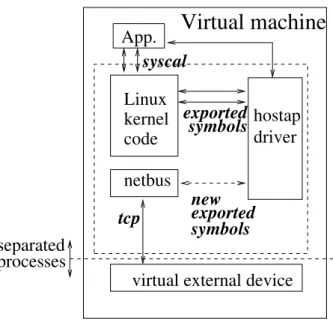
Linking the hostap driver with the User Mode kernel requires the resolution of all symbols from the kernel’s exported symbol table which is not possible as User Mode Linux does not contain any bus implementation. Unresolved symbols, whose names are self-explanatory are for instance : pci enable device,writewandreadw.
The first component that had to be implemented was therefore a simple bus suitable to export the re-quired symbols for thehostapdriver to be inserted in the kernel. The modification of thehostapdriver is minimal and consists in replacing unresolved sym-bols with the new ones, along with some minor mod-ifications due to the simpler implementation of our bus compared to a standardPCI bus. We refer to this bus as “netbus” as its primary use is to con-nect a network device to UML. The functionalities of this bus, sending and receiving data as well as transmitting interrupt signals are implemented with TCP connections. Once the hostap driver is suc-cessfully linked into the kernel, it must of course act on a device which also has to be emulated.
Linux
kernel
code
netbus
App.
hostap
driver
new
virtual external device
tcp
exported
symbols
Virtual machine
exported
symbols
syscal
separated
processes
Figure 1: Interconnection of the driver with the UML kernel
2.1
Interconnection of the
compo-nents
As any other device, our emulated wireless card has to be connected or “virtually plugged” into the UML via netbus. This situation is depicted in Fig. 1 show-ing the different interconnections existshow-ing between the components introduced above. The emulated wireless card runs as a different process, which is the emulator itself. This core program is written in QT/C++ and also implements the physical layer emulation as well as a visualisation system.
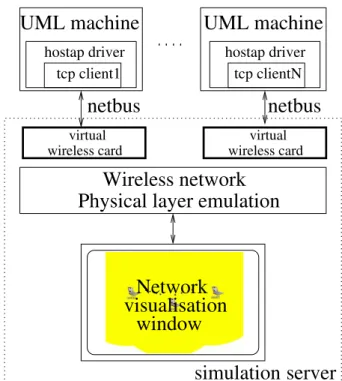
As mentioned above, netbus is built with TCP connections and the core emulator is therefore writ-ten as a TCP server.
The architecture of the emulator is depicted in Fig. 2 where it can be seen that the hostap driver is represented as a TCP client which is implemented on top of netbus. When the driver tries to register itself, it calls a function netbus register device
which tries to bind to the emulator server socket. If the operation is successful, a new object imple-menting the virtual wireless card is instantiated in the emulator. The visualisation system displays an icon representing the mobile node with a surround-ing circle which represents the reachability zone of the card (See more details later in the text).
window
Network
visualisation
virtual wireless card virtual wireless cardPhysical layer emulation
Wireless network
UML machine
UML machine
simulation server
netbus
netbus
hostap driver hostap driver
tcp client1 tcp clientN
Figure 2: Architecture of our wireless emulator
2.2
Netbus implementation
As mentioned previously, the connection between the emulated card and the driver is realised with a TCP connection. Using TCP makes it possible to run multiple UML machines on different hosts. The simulation can therefore be distributed among mul-tiple CPU’s. The TCP protocol has been chosen for its reliability. Indeed, it is not desirable to introduce uncertainty in the delivery of interrupt and data as one would like to control in a deterministic fashion if packet drops occur or not.
In our prototype, two different TCP connections are used : one connection is used for data trans-mission while the other is only used for interrupt emission.
The client socket corresponding to the interrupt line at the UML side is configured in ASYNC mode and the associated SIGIO signal is registered in UML as an interrupt signal associated with the wireless card. The data line operates in blocking mode. This is necessary as, from the UML point of view, the read/write operation has to be “atomic” and must be completed entirely before the UML may continue to execute. Every command sent on the data line is therefore followed by a blockingrecv call which waits for an acknowledgement from the card and synchronises the kernel with the card.
As packets are transmitted by the hostapdriver
Fixed nodes
Mobile nodes Visualisation toolbar
Figure 3: The setup used for testing the AODV pro-tocol
by a series of writew command (programmed IO), the synchronisation mode described above induces a high latency in packet transmission. Therefore, an extra feature has been implemented in netbus which permits to send a block of “len” bytes of data in a single blocking operation. In some sense, this feature is analogous to a DMA in a real hardware.
3
A testbed environment
With the spreading of roof-top wifi networks, ded-icated devices such as the meshbox and dedicated distributions such asOpenAPstarted to appear. Ba-sically, these devices should be configured as AODV routers, installed at the right position and forgot-ten. Unfortunately, stability issues, interoperability problems or unexpected circumstances often prevent such an ideal situation to occur. In this Section, we report our attempt to reproduce a typical breakdown in a multihop ad-hoc network.
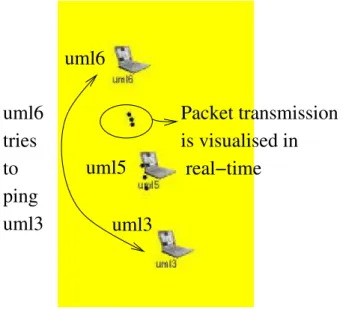
The setup is shown in Fig. 3 and a zoom on the fixed nodes is depicted in Fig. 4. A video captured during the experiment can be downloaded at [3]. The machine namedU M Lxreceived and IP adresse of 192.168.0.x.
Obviously, this setup puts the system at loads and AODV messages are printed on the nodes console as soon as other nodes are coming in their reachability zone (as depicted by the yellow circles in Fig. 3). After letting the system run for a while, it was then found that a ping fromU M L6 toU M L3 would only receive a single reply while a ping from U M L3 to U M L6 would receive no reply at all.
real−time
is visualised in
uml6
tries
to
ping
uml3
uml5
uml6
uml3
Packet transmission
Figure 4: A zoom on the fixed nodes
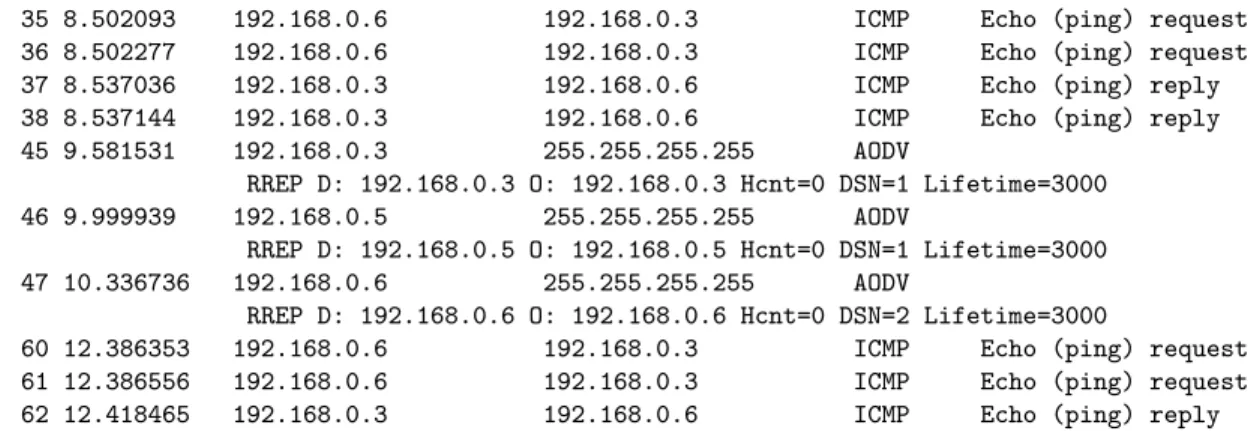
A first tool at our disposal to understand what is happening is the use of the tcpdump packet cap-ture program and the ethereal analyser. The trace acquired at U M L5 is shown in Fig. 5. It can be seen in lines 35-38 that the ping request is arriving at U M L5 and forwarded toward U M L3 as is the first ping reply in the reversed direction. Lines 45-47 show the AODV hello messages with a lifetime of 3 seconds. The next trace, acquired atU M L03 is shown in Fig. 6 with the Ethernet addresses where one can see the same sequence of two ping requests with one ping reply. However, the destination Eth-ernet address of the ping reply now comes as a sur-prise as it corresponds to the hardware address of
U M L6 showing thatU M L3 tries to bypassU M L5. A look at Fig. 7 showing the AODV routing table of
U M L6 andU M L3 reveals thatU M L6 is present in the routing table ofU M L3 while the reverse is not true. Indeed, it can be seen on the last line of Fig. 6 that U M L3 can receive the hello messages from
U M L6.
A quick check revealed that the transmission power ofU M L3 had been modified at the beginning of the simulation and that its transmission range was therefore smaller than the transmission range of
U M L6. The first ping request was creating a reverse route on its way towardU M L3 and the first reply was therefore reachingU M L6. After the first hello message from U M L6, the routing table in U M L3 was modified and the ping replies were sent directly to U M L6 which could not receive them because of the limited transmission power ofU M L3.
This practical example that actually occurred in the simulator is in fact widespread in practice and had been reported many times (for instance in [8]). It occurs notably when an AODV router is setup with a high power transmission while people try-ing to connect to it use a regular laptop card with smaller power transmission. The realistic physical transmission model used in the simulator allowed for recovering a typical situation often encountered in practice while the use of UML allowed for using conventional tools such as tcpdump for the debug-ging. This latter point might be of great practical interest for evaluating wireless oriented distribution before deploying them in the field.
4
A teaching tool
Although the results presented in the previous sec-tion did require an ergonomic simulasec-tion environ-ment and a realistic enough physical layer emulation, the same results could have been obtained without the hassle of emulating in software the behaviour of a real hardware card. It would have been sufficient to code a UML specific driver just like the already existing tun/tap Ethernet driver. This would re-quire, however, the complete rewriting of the user-land interface, including the wireless extension. In this section, we present some results that specifically exploit the virtualisation of the wireless driver.
Indeed, with the help of the emulated hardware card, it is very easy to obtain detailed informa-tion about the internal mechanisms involved in the operation of the card. For many program-mers, the interactions between the driver and the device remain a terra incognita that we may easily explore with our emulator. Fig. 8 and Fig. 9 show two different traces that can easily be obtained from the emulator software log file. The trace of the Fig. 8 can be read as follows : 1-3 The driver sets the parameter for a
fu-ture command to 0x93c and send the com-mand CMDCODE ALLOC which interprets the given parameter as the size of the segment to allocate
4-5 Internally, the driver sets the event register bit corresponding to the memory allocation event and writes the ID of the allocated frame at the expected memory location
7-9 The events are acknowledged by the driver This initialisation phase allocates memory regions referred to by their frame ID to be used later for packet transmission and reception. This is shown in Fig. 9 which display a trace corresponding to the transmission of a data frame. Thenetbus send
com-35 8.502093 192.168.0.6 192.168.0.3 ICMP Echo (ping) request 36 8.502277 192.168.0.6 192.168.0.3 ICMP Echo (ping) request 37 8.537036 192.168.0.3 192.168.0.6 ICMP Echo (ping) reply 38 8.537144 192.168.0.3 192.168.0.6 ICMP Echo (ping) reply 45 9.581531 192.168.0.3 255.255.255.255 AODV RREP D: 192.168.0.3 O: 192.168.0.3 Hcnt=0 DSN=1 Lifetime=3000 46 9.999939 192.168.0.5 255.255.255.255 AODV RREP D: 192.168.0.5 O: 192.168.0.5 Hcnt=0 DSN=1 Lifetime=3000 47 10.336736 192.168.0.6 255.255.255.255 AODV RREP D: 192.168.0.6 O: 192.168.0.6 Hcnt=0 DSN=2 Lifetime=3000
60 12.386353 192.168.0.6 192.168.0.3 ICMP Echo (ping) request 61 12.386556 192.168.0.6 192.168.0.3 ICMP Echo (ping) request 62 12.418465 192.168.0.3 192.168.0.6 ICMP Echo (ping) reply
Figure 5: packet capture onU M L5 (from ethereal)
11:44:01.294387 0:c0:9f:16:27:4 0:c0:9f:16:10:3 0800
98: 192.168.0.6 > 192.168.0.3: icmp: echo request (DF) 11:44:01.314788 0:c0:9f:16:10:3 0:c0:9f:16:6d:2 0800
98: 192.168.0.6 > 192.168.0.3: icmp: echo request (DF) 11:44:01.314936 0:c0:9f:16:6d:2 0:c0:9f:16:27:4 0800
98: 192.168.0.3 > 192.168.0.6: icmp: echo reply 11:44:01.326203 0:c0:9f:16:6d:2 0:c0:9f:16:27:4 0806 42:
arp who-has 192.168.0.6 tell 192.168.0.3 11:44:01.676545 0:c0:9f:16:27:4 ff:ff:ff:ff:ff:ff 0800
62: 192.168.0.6.654 > 255.255.255.255.654: udp 20 (DF) [ttl 1]
Figure 6: packet capture onU M L3 with the Ethernet addresses (from tcpdump)
Route Table at uml6
---IP | Seq | Hop Count | Next Hop
---192.168.0.2 1 1 192.168.0.2 Valid s ec/msec: 2/827 0 192.168.0.5 1 1 192.168.0.5 Valid s ec/msec: 2/591 0 192.168.0.6 1 0 192.168.0.6 Valid s ec/msec: 172874790/837 1 ---Route Table at uml3
---IP | Seq | Hop Count | Next Hop
---192.168.0.7 1 1 192.168.0.7 Valid E xpired! 192.168.0.6 1 1 192.168.0.6 Valid s ec/msec: 2/227 0 192.168.0.5 1 1 192.168.0.5 Valid s ec/msec: 2/904 0 192.168.0.3 1 0 192.168.0.3 Valid s ec/msec: 172874821/157 1
(1) writew(0x93c,HFA384X_PARAM0_OFF) (2) writew(0xa,HFA384X_CMD_OFF) (3) HFA384X_CMDCODE_ALLOC(0x93c,0x0) (4) writew(HFA384X_EV_ALLOC,HFA384X_EV_STAT_OFF) (5) writew(0x10,ALLOCFID_OFF) (6) evStat=0x18 (7) writew(0x10,HFA384X_EVACK_OFF) (8) writew(0x8,HFA384X_EV_STAT_OFF) (9) writew(0x8,HFA384X_EVACK_OFF)
Figure 8: Exchange between the hostap driver and the card during the card initialisation phase
(1) writew(0x50,HFA384X_SELECT0_OFF) (2) writew(0x0,HFA384X_OFFSET0_OFF) (3) netbus_send a=HFA384X_DATA0_OFF len=60 (4) writew(0x3c,HFA384X_OFFSET0_OFF) (5) netbus_send a=HFA384X_DATA0_OFF len=6 (6) netbus_send a=HFA384X_DATA0_OFF len=1054 (7) readw(0x30) (8) readw(0x38) (9) writew(0x460,HFA384X_OFFSET0_OFF) (10) writew(0x50,HFA384X_PARAM0_OFF) (11) writew(0x0,HFA384X_PARAM1_OFF) (12) writew(0x10b,HFA384X_CMD_OFF) (13) HFA384X_CMDCODE_TRANSMIT(0x50,0x0) (14) readw(0x38) (15) Tx packet at 0x5000, len=1120 (16) readw(0x60) (17) writew(0x8,0x60) (18) writew(0x50,0x44) (19) Interrupt evStat=0x8,inten=0xe09f (20) writew(0x50,0x14) (21) evStat=0x18 (22) writew(0x10,HFA384X_EVACK_OFF) (23) writew(0x8,0x60)
Figure 9: Exchange between the hostap driver and the card during the transmission of a data frame
mand corresponds to the extra feature mentioned previously that is used to transmit an entire buffer in one operation. Line (3) corresponds to the trans-mission of a frame descriptor and line (6) to the packet in itself. Once all the data have been trans-mitted, the transmit command itself is finally issued by the driver (line (10) to (13)) with the frame ID as parameter. Then, the card actually transmit the packet in the air (15) and the event status register bits are cleared. To our point of view, this kind of traces might be interesting to understand not only the static behaviour of a chipset as described in the datasheet but also the dynamics of the interactions between the driver and the card.
5
Related work
Several types of emulators have been proposed in the literature. In [10], Keshav et al. virtualised the net-working stack of a FreeBSD kernel and allowed to run routing protocols and other networking applica-tions in an emulated environment. Another similar approach is IMUNES proposed in [11]. IMUNES al-lows a FreeBSD kernel to maintain several network-ing stacks that are used to support different applica-tions. However, those two solutions do not support wireless interfaces. As mentioned in the introduc-tion, VNUML can be used to simulate wireless ad-hoc networks. However, this approach is less flexible as it requires an explicit description of the topology. Furthermore, communication links are bidirectional and symmetrical. In contrast, our physical model allows for a more realistic description of the trans-mission medium and the topology can be modified in real time by a simple “click-and-drag” operation. Some debugging techniques related to Section 4 are described in [9], chap. 4 and include the use of a kernel debugger or of the Linux Trace Toolkit. Their also exists some I/O analysers that could be used to obtain some traces similar to those shown in Section 4. All these techniques could off course be used in conjunction with the tool presented in this paper. In particular, GDB can be used directly with UML and with the inserted modules. As the software card is “virtually plugged” into the kernel by inserting a module, the UML side of the card may easily be debugged and its interactions with the kernel may be studied with conventional tools.
Other emulation based solutions exist such as for instancevmware,qemuorbochs. Whilevmwaredoes not allow for the addition of new emulated hard-ware components, qemu and bochs, which are free software could be used to accomplish the tasks de-scribed in this paper. For instance bochs supports an NE2000 compatible network card and a wireless interface could be added just as well. However, as stated in the bochs FAQ, bochs emulates every x86 instructions and all the devices in a PC system, it does not reach high emulation speeds.
6
Conclusion and future work
A virtual bus was proposed for User Mode Linux and used to insert the Linux hostapdriver with nearly no modifications. By connecting multiple UML ma-chines through a physical layer emulator and by pro-viding a GUI for network visualisation, it was shown that this system could represent an interesting ap-proach for wireless network emulation. The utility
of such a method has been illustrated with two prac-tical examples : the testing of an implementation of the AODV routing protocol in a highly realistic en-vironment and the study of the interactions between the driver and the card it drives. Future work will now be focused on
• a complete implementation of the UML PCI in-terface to allow native drivers to run completely unmodified in UML.
• an implementation of the software card as a Linux kernel thread instead of a separate pro-cess. This would greatly improve the perfor-mance as it would no longer require any block-ing operations for the synchronisation of the card and the kernel.
• improving the readability of the debugging facil-ities of the emulator. In particular, the writew
operations initiated by the driver and the sub-sequentwritewcommands executed by the em-ulator itself should be reported separately. A GUI could be used to monitor the different sta-tus registers in real time.
References
[1] J. Dike. User mode linux. In5th Annual Linux Showcase & conf., Oakland CA, 2001.
[2] D. Fernandez, Tomas de Miguel, and F. Galan. Study and emulation of ipv6 internet-exchange-based addressing models. IEEE Communica-tion Magazine, pages 105–112, January 2004. [3] V. Guffens. A wifi layer for user mode linux.
http://www.auto.ucl.ac.be/uml-wifi/.
[4] V. Guffens, G. Bastin, and O. Bonaventure. An emulation infrastructure for multi-hop wireless communication networks.Internal report, 2004. [5] Luke Klein-Berndt. Kernel aodv,national institue of standards and technology , http://w3.antd.nist.gov/wctg/aodv kernel/. [6] Jouni Malinen. Host ap driver for intersil
prism2/2.5/3,http://hostap.epitest.fi/.
[7] User-mode-linux testing guide - openswan wiki. http://wiki.openswan.org/index.php/UMLTesting. [8] R´eseau citoyen. http://www.reseaucitoyen.be/. [9] A. Rubini and J. Corbet.Linux Device Drivers,
2nd Ed. O’Reilly, 2001.
[10] X.W.Huang, R. Sharma, and S. Keshav. The entrapid protocol development environment. In
Proc. of Infocom, March 1999.
[11] Marko Zec. Implementing a clonable network stack in the freebsd kernel,. InProceedings of the 2003. USENIX Annual Technical Confer-ence, San Antonio, Texas, June 2003.