Development Education Research Centre
Frances Hunt and Olga Cara
Research Paper No.15
for the Global Learning Programme
Global Learning in
England: Baseline analysis
of the Global Learning
Programme Whole School
Audit 2013–14
the Global Learning Programme Whole School
Audit 2013–14
Frances Hunt and Olga Cara
2015
Published by the Development Education Research Centre Development Education Research Centre
UCL Institute of Education 36 Gordon Square London WC1H 0PD Tel: 020 3073 8309 Website: www.ioe.ac.uk/derc First published 2015 © Crown copyright ISBN: 978-0-9574546-8-2 Disclaimer
This paper has been written by Frances Hunt and Olga Cara, and the content and opinions are theirs alone. The authors do not speak on behalf of the GLP-E and its consortium partners. Cover image: © Woodlands Primary School, Birkenhead
Contents
Acknowledgements 3 Executive Summary 4
1 Introduction 7
2 Background to the Global Learning Programme England (GLP-E) 9
3 Previous research and evidence 11
4 Methods and data collection 12
5 Which schools are signing up for the GLP-E? 17
6 Why are schools signing up for the GLP-E? 24
7 What global learning activities are schools signing up to the GLP-E already involved in? 28
8 What are levels of global learning in schools signing up to the GLP-E? 32
9 Further discussion and conclusions 43
10 References 50
11 Appendix 1: GLP Whole School Framework 52
12 Appendix 2: GLP-E Whole School Audit Questions 54
Figures
Figure 1: Percentage of schools in geographical region registering for the GLP-E (GLP schools, N = 953) 18
Figure 2: % Ofsted data on GLP-E registered schools versus national data (GLP schools, N = 927) 21
Figure 3: KS2 performance – % of GLP-E registered schools with pupils achieving Level 4 or above in reading, writing and maths (GLP schools, N = 619 (registered), 374 (WSA)) 22
Figure 4: KS4 performance of GLP-E registered schools – % achieving 5+ A*–C GCSEs (or equivalent) including English and maths GCSEs (GLP schools, N = 227 (registered), 138 (WSA) 22
Figure 5: % reasons why schools engage with or want to engage with global learning
(GLP schools, N = 563) 25
Figure 6: % Global learning programmes and awards GLP schools are already taking part in (GLP schools, N = 563) 30
Figure 7: Pupils and global learning (GLP schools) 33
Figure 8: Teachers and global learning (GLP schools) 35
Figure 9: Data on behaviour and relationships (GLP schools) 37
Figure 10: Data on leadership and community (GLP schools) 38
Figure 11: How the school curriculum supports global learning
(GLP schools, N = 543) 40
Figure 12: % of schools where global learning is included in curriculum subject areas
(GLP schools, N = 419 41
Figure 13: % Breakdown of global learning coverage in subject areas by school phase
(GLP schools, N = 419) 42
Figure 14: Summary of Whole School Audit responses (GLP schools, N=563) 46
Tables
Table 1: Regional breakdown of schools signed up for the GLP 17
Table 2: Phase of schools registered for GLP-E compared to national 19
Table 3: Type of establishments registered for GLP-E 19
Table 4: Background indicators for schools registering on the GLP compared to national averages 20
Acknowledgements
Firstly, we would like to thank the schools registered on the GLP who have provided data for this study by registering and completing the Whole School Audit. We also greatly appreciate the feedback from Doug Bourn and Harriet Marshall, who read drafts of the paper. Finally, we would like to thank the
individuals and organisations who helped us develop the GLP Whole School Audit and Whole School Framework, in particular Richard P. King from Oxfam GB, John Hopkin from the Geographical Association, Sam Colley at Pearson and the team at Think Global.
Executive Summary
The GLP-E is an initiative aimed at supporting the teaching and learning of global learning in schools in England at Key Stage 2 and Key Stage 3. It is a five-year national programme of support to schools to enhance their provision of global learning. Specifically, the GLP-E works with teachers to enhance their confidence and ability to provide whole school support to global learning across their institutions. The GLP-E has a strong emphasis on research and evaluation, in particular using research evidence to support the development of better practice in the programme.
The Whole School Audit (WSA) is an online data-gathering tool that respondents in participating schools complete after registering onto the GLP-E. This paper presents findings from the baseline analysis of WSA submissions for schools joining the GLP-E between June 2013 and February 2014. Specifically, the paper responds to four key questions:
1. Which schools are signing up for the GLP-E? 2. Why are schools signing up for the GLP-E?
3. What global learning activities are schools signing up to the GLP-E already involved in?
4. What are levels of global learning in schools signing up to the GLP-E?
The WSA asks a range of questions that directly link to the GLP Whole School Framework criteria, where respondents indicate which response best relates to their school. Their responses identify the school as ‘beginner’, ‘early’, ‘developing’ or ‘embedded’ 1 in global learning in the various Whole School Framework criteria.
Overall, the WSA asks respondents questions about:
l Why their school engages and/or wants to engage with global learning l Other global learning activities the school is involved in and links with other
organisations that support global learning
l Pupils’ knowledge and skills in relation to global learning
l Teachers’ knowledge and confidence in relation to global learning
1 For example, a beginner response generally relates to a school doing very little or no global learning against that criterion; early indicates a little global learning; a developing response shows evidence of global learning practices and an embedded response shows evidence of widespread global learning against that criterion. The Whole School Framework and Hunt and King (2015) provide more detail.
l How teachers incorporate global learning into teaching and learning and specific curriculum areas
l Values and relationships within the school
l Global learning CPD support staff have undertaken l Leadership and school vision in relation to global learning l The school’s links with external organisations.
Registration onto the GLP involves schools providing basic contact details and choosing a co-ordinator in order to register for the programme. Once registered schools are encouraged to complete the Whole School Audit (which is mandatory for Expert Centres). In this research 953 schools had initially registered onto the programme by February 2014, which allowed us to analyse school information against national datasets. The Whole School Audit was subsequently completed by 563 schools, which gives us insight into global learning practices within the schools. The data was analysed using SPSS.
The data gives a picture of global learning across whole schools and provides important evidence for the GLP and researchers more generally. The data shows:
A range of schools sign up for the GLP-E: Schools are signing up across England, with higher proportions of schools in the South West, the North West and West Midlands. 4% of English primary schools are registered and 5% of secondary schools.
Schools registered onto the GLP have fewer children on free school meals compared to national averages, fewer children with English as an Additional Language, and slightly fewer children with special educational needs statements compared to national averages.
Schools registered onto the GLP-E have slightly better Ofsted ratings than national averages and higher attainment data than national averages in KS2 SATs and GCSEs.
Schools want to engage in global learning for a number of reasons: The most prominent reasons respondents give for wanting to participate in global learning are to: develop pupils’ active citizenship, responsibility and voice; develop pupils’ interest in other countries and cultures; and develop pupils’ values.
Many schools signing up for the GLP-E are already engaged in global learning activities: Many have worked on global learning previously, but almost
40% of respondents identify their school as not explicitly working on global learning.
Many schools have received some training on a global issue, and some have previously worked with Development Education Centres or NGOs.
Schools have different levels of engagement with global learning: Expert Centres engage in more global learning across the whole school than Partner Schools, and secondary schools more than primary schools.
The most prominent response in most Whole School Framework (WSF) categories is for respondents to identify the school at ‘early’ level. Over 50% of respondents place schools at early level for:
l Pupils developing their understanding of global knowledge themes through a range of subjects and topic areas;
l Pupils developing high-quality learning skills through global learning, supporting their literacy, numeracy and communication;
l Global learning supports better engagement with parents, community groups and other organisations locally, nationally and globally.
l The school curriculum supporting global learning
There are certain categories where global learning is more evident in schools. These include: teachers’ knowledge of global themes; their use of pedagogic approaches that support global learning; their use of cross-curricular approaches to support global learning; and the extent to which schools support positive attitudes to diversity and cultural difference.
There are some categories where global learning is less evident in schools. These areas include: pupils planning and running global learning activities; schools using global learning to enhance transitions from primary to secondary school; staff support and development across the school; and using global learning to enhance relations with parents, local community and external organisations.
Geography is the main curriculum area where global learning is present in
schools, with History, RE and PSHE also having strong representations. There is less evidence of global learning integrating into English, Maths and Science.
The data presented is an initial baseline analysis of the WSA for the GLP. Analysis in coming months will produce further evidence of global learning in our schools as initial registration onto the programme increases and impact data becomes available.
1
Introduction
Global learning is an approach to learning that is adopted within schools to support pupils’ learning about and engaging with global perspectives. Global learning encourages the development of knowledge of global issues, skills related to active, critical citizenship and values supporting co-operation and justice. Within a global learning environment, pupils might learn about the causes and effects of global poverty, be encouraged to challenge media portrayals of underdevelopment, and identify ways their lives may be interlinked with others overseas. There is a range of approaches and ways schools get involved in global learning, but all schools address it in some way. Some schools may include teaching and learning about global issues in one or two curriculum areas, others actively integrate global elements across the whole school, often engaging with an external organisation or programme that supports their global learning journey. This paper is a product of one of those external programmes, the Global Learning Programme in England (GLP-E).
The GLP-E is an initiative aimed at supporting the teaching and learning of global learning in schools in England at Key Stage 2 (pupils aged 7–11) and Key Stage 3 (pupils aged 11–14). It is a five-year programme funded through the UK Government and run by a consortium of organisations with a history of involvement in education and global learning2. A fundamental part of the GLP-E
is encouraging schools to take a whole school approach to global learning, which means global activities across multiple areas of the school, involving a range of stakeholders. Data gathered on the GLP-E reflects this whole school approach. The GLP-E has a strong emphasis on research and evaluation, in particular using research evidence to support better practice in the GLP-E in England and elsewhere. The Whole School Audit (WSA) is an online data-gathering tool that respondents in participating schools complete as part of their registration onto the GLP-E. The aim of this paper is to present findings from the analysis of WSA submissions for schools joining the GLP-E between June 2013 and February 2014. Specifically, the paper responds to four key questions:
1. Which schools are signing up for the GLP-E? 2. Why are schools signing up for the GLP-E?
3. What global learning activities are schools signing up to the GLP-E already involved in?
4. What are levels of global learning in schools signing up to the GLP-E?
The paper presents baseline data from which schools are looking to progress as they engage with global learning through the GLP-E. While specific to the GLP-E, the findings provide wider snapshot evidence of the state and nature of global learning in England. It is the first of a series of studies via the GLP-E that attempts to map global learning across schools and highlights a range of issues that will be explored in more detail through the GLP-E.
The focus of this paper is on the presentation of data collected through the WSA, with literature referenced where relevant3. The paper begins with a short piece of
contextual information about the GLP-E and what is currently known about global learning practices in schools. An overview of data collection tools and analysis is provided in the methods section. The data analysis sections address
the four research questions, and the paper finishes with a discussion and conclusion section.
3 The paper is co-authored by Fran Hunt and Olga Cara. Fran was responsible for designing the research tools, writing the text and presenting the data within the text. All references to ‘I’ in the text come from Fran. Olga Cara carried out the data analysis in SPSS, including analysing the data against other datasets.
2
Background to the Global Learning Programme
England (GLP-E)
The Global Learning Programme is a national programme of support to schools to enhance their provision of global learning. Specifically, the GLP-E works with teachers to enhance their confidence and ability to provide whole school support to global learning across their institutions. The ambition of the GLP is to work with 10,700 schools across England at KS2 and KS3. The core aims of the GLP are to: l help young people to understand their role in a globally interdependent world and
to explore strategies by which they can make it more just and sustainable l familiarise them with the concepts of interdependence, development,
globalisation and sustainability
l move them from a charity mentality to a social justice mentality
l stimulate critical thinking about global issues both at whole school and at pupil level
l promote greater awareness of poverty and sustainability
l enable schools to explore alternative models of development and sustainability in the classroom.
The GLP-E promotes the embedding of global learning through a national network of registered schools. The idea behind this model is that schools with experience and expertise in global learning (Expert Centres) are best placed to support the development of other schools in their local area (GLP Partner Schools). Expert Centres lead networks of up to 23 Partner Schools and run a series of training events, twilight sessions and meetings for their network groups. Expert Centre networks are supported by GLP Local Advisors and National Leaders. The GLP-E also provides a range of resources, such as curriculum frameworks, subject guidance, CPD support and a personalised action plan for each school. The GLP-E works alongside other programmes and providers and is designed to complement existing global learning provision.
Each school that signs up for the GLP allocates a lead practitioner/co-ordinator to lead the programme in their school. The main emphasis of the GLP-E is on supporting teachers to develop knowledge and confidence in global learning, so they in turn make changes to teaching and learning across their schools (Global Learning Programme, 2015).
To this end, the GLP-E advocates a whole school approach to global learning. Hunt and King (2015) outline the reasons why a whole school approach is appropriate for global learning and how this relates to the GLP-E. Specifically, they suggest a whole school approach to global learning is suitable because global learning does not fit into one specific curricular area, rather it works best when it is practiced in multiple areas of a school, involving a range of stakeholders.
The GLP-E has various mechanisms to support and evidence a whole school approach to global learning. The GLP Whole School Framework (Global Learning Programme, 2013) provides the criteria on which the GLP-E’s whole school approach to global learning is based (see Appendix 1: GLP Whole School Framework). The GLP Whole School Audit is an online audit tool that schools complete after registering onto the programme. The questions directly reflect the GLP Whole School Framework criteria and a school’s responses to the audit tells them how well embedded global learning is against the criteria of the Whole School Framework. For further information about the development of these tools and their context see Hunt and King (2015).
After schools are involved in the GLP-E for four school terms (approx. 18 months) they are asked to resubmit their Whole School Audit to see whether there have been any changes in responses against the criteria. This second audit submission should identify impact from the programme. The paper here presents baseline data from which the impact data will be measured.
3
Previous research and evidence
This paper adds to the growing evidence on the extent and nature of global learning in schools in England. It draws on the largest available evidence base on global learning to date and as such provides a unique insight into the status of global learning in England, which will be enhanced as more quantitative data and qualitative studies are developed through the GLP-E.
Existing research has often focused on schools or teachers that have experience and expertise in global learning (Bourn, 2014; Bourn and Hunt, 2011; Edge et al., 2009) and we know less about schools that are at earlier stages of engagement. The focus on engaging schools has to some extent been driven by the availability of and access to the sample (Hunt, 2012) and the research questions, which centre on learning from the experiences of these schools (Edge et al., 2009; Bourn, 2014; Bourn and Hunt, 2011). Often related studies have focused on the evaluation of a particular programme or intervention (Coe, 2007; Sizmur et al., 2011; Barker, 2013; Sebba and Robinson, 2010; Trickey and Topping, 2014) or how global learning is developed within particular curriculum areas (Bourn, 2012; Lambert and Morgan, 2011). Many studies are qualitative and small in scale (Blackmore, 2014; Marshall, 2007), offering detailed contextual insight into the school and its engagements with global learning, although others use qualitative approaches to look at global learning across a number of schools (Nicholas et al., 2010). Overall we know less about global learning across a larger range of schools, with Hunt (2012) and Sizmur et al. (2011) being exceptions in England.
These studies offer insight into global learning in schools in relation to the research questions for this study, which will be highlighted where possible and appropriate in analysis sections.
The data presented in this paper is able to fill in some previous gaps in research or extend empirical evidence in the field. Specifically, it provides:
l evidence of global learning across whole schools
l an increased sample to include schools that have not worked extensively in global learning previously (see: Table 5)
l quantitative analysis of global learning across a large number of schools.
What this study lacks is the qualitative insight that gives contextual meaning in to the numbers presented. This lack of qualitative analysis will be addressed in future studies for the GLP-E.
4
Methods and data collection
4.1 Quantitative methods
In developing the WSA, I focused on quantitative data collection methods. The emphasis on quantitative methods is appropriate given the number of schools involved in the programme. It is also potentially easier (and quicker) for respondents to respond to numerically based questionnaires as opposed to qualitative accounts of their experiences with global learning. Additionally, a large-scale quantitative account of global learning in English schools has not yet been done. Using quantitative methods allows us to see patterns in global learning across a range of schools and allows for comparisons between school types or regions.
While adopting a quantitative approach, I acknowledge my role in developing the WSA4 data collection tool and my influence on the how the analysis is presented.
The questionnaire text (and analysis) is influenced by the researcher’s theoretical and social position, substantive interests and biography, even though these elements of researcher identity may be hidden behind the apparent objectivity of the text (Dunne et al., 2005: 46).
It is with this awareness that I present the data.
Finally, while most of the data collected is quantitative, within the WSA there are also spaces for schools to provide more qualitative insights. Where possible and relevant these have been included within this analysis and provide slightly more contextual insight, albeit on a small scale.
4.2 Whole School Audit (WSA)
Data for this study is generated by schools as they complete the online registration process onto the GLP-E. Schools provide basic details, such as name / location of school and key contact details, in order to register on the programme. This then gives schools access to then complete a Whole School Audit. Schools can complete their WSA at any stage in their engagement with the GLP-E, but are encouraged to do before or just after attending their first twilight session5 with
the Expert Centre network, and again after they have been on the programme for
4 I developed the WSA text with Richard P. King from Oxfam GB. Richard, myself and John Hopkin from the Geographical Association developed the criteria for the Whole School Framework.
5 Expert Centre Lead Practitioners run eight twilight CPD sessions (or equivalent) with their local network of Partner Schools. These sessions cover the knowledge required to support global learning in the school, access to resources and information about creating change within a school setting.
a period of time. There are various incentives in place for schools to complete their WSA, including access to e-credit funds for continuing professional development and the generation of an individualised action plan for their school.
The WSA asks a range of questions that directly link to the GLP Whole School Framework criteria (see Appendix 1) – where respondents indicate which response best relates to their school. Their responses identify the school as ‘beginner’, ‘early’, ‘developing’ or ‘embedded’6 in global learning in the various criteria. The
questions asked that directly relate to the Whole School Framework criteria can be found in Appendix 2, with an explanation of how responses map onto the early, beginner, developing and embedded levels. For further information, Hunt and King (2015) go into more detail about the content, mechanisms and processes of the Whole School Audit and how it works in practice alongside the Whole School Framework.
Overall, the WSA asks respondents questions about:
l Why their school engages and/or wants to engage with global learning l Other global learning activities the school is involved in and links with other
organisations that support global learning
l Pupils’ knowledge and skills in relation to global learning
l Teachers’ knowledge and confidence in relation to global learning
l How teachers incorporate global learning into teaching and learning and specific curriculum areas
l Values and relationships within the school
l Global learning CPD support staff have undertaken l Leadership and school vision in relation to global learning l The school’s links with external organisations.
I have previously highlighted some of the caveats of the WSA as a data collection tool, but there are others. Firstly there are no opportunities for respondents to clarify the meaning of the questions included. Indeed:
6 For example, a beginner response generally relates to a school doing very little or no global learning against that criteria; early indicates a little global learning; a developing response shows evidence of global learning practices and an embedded response shows evidence of widespread global learning against that criteria. The Whole School Framework and Hunt and King (2015) provide more detail.
The single point of contact with respondents through the questionnaire text places important emphasis on issues of communication especially in terms of clarity, transparency and the avoidance of ambiguity (Dunne et al., 2005: 44).
Partly in order to counter this, the WSA was piloted before ‘going live’, and language and assumed meanings of words were reviewed. The WSA as a tool is being reviewed on an ongoing basis.
The WSA tool doesn’t allow for in-depth understanding of the quality of global learning interventions at school level. Questions refer to how many pupils or teachers are involved in activities and what pupils and teachers are able to do as a result of the learning. There is less scope for understanding how well they understand, teach or engage with global issues.
There is also some feedback from WSA respondents about completing the WSA. The first quote highlights issues with the GLP Lead Co-ordinator gaining an overview of global learning across the whole school – this might be particularly the case where schools are larger and departments more disparate (more likely at secondary school):
It is quite difficult to get a whole school picture at this stage. I have asked heads of departments to reflect on their own areas, and they have responded. I have tried to integrate their responses into the WSA but as the bulk of global learning in our school seems to go on in my own subject area I feel that it is not necessarily a completely balanced audit (Expert Centre, Secondary School).
The second response highlights issues with how the school has chosen to respond to questions and therefore ‘rate’ its status in terms of global learning.
We have possibly graded ourselves a bit harshly here. As we better understand the term ‘global learning’ and engage in it we would expect to see
improvements (Expert Centre, Special School).
It is evident from this response that there are some difficulties in schools trying to ‘grade’ themselves. It is likely some respondents will identify their global learning at different levels from others doing similar work in other schools, and there has to be some acknowledgement of this. Each response is a perception and the study builds up evidence from these multiple perceptions. That said, the pilot WSA review allowed us to trial and moderate responses from a group of schools across each WSF category. Similarly, the evidence that follows indicates a differentiation between how Expert Centres and Partner Schools identify global learning within their schools, which is to be expected, and assumes appropriate differentiation.
4.3 Ethical issues
Ethical issues were considered in this study, particularly in relation to
confidentiality, anonymity and informed consent. Participants registering onto the GLP-E are informed that the data gathered via the WSA will be used for research and evaluation purposes, and are given the option to opt-out of the research if they so wish. All names of individuals and schools are guaranteed to be confidential and anonymised. Data is held safely and transferred between project partners in a secure way. The research and evaluation programme has undergone an ethical review within the UCL Institute of Education and the ethics comply with BERA research ethics guidelines (British Educational Research Association, 2011).
4.4 Data analysis
Registration and WSA data from all GLP-E registered schools was captured from the GLP-E website and transferred into Excel by the GLP lead partner, Pearson. Researchers at the UCL Institute of Education are responsible for analysing that data. In the IOE, we cleaned the data in Excel, sorted anomalies where possible, and mapped individual school responses against publicly available national school databases, i.e. the National Pupil Database (Department for Education, 2013) and Ofsted Inspections and Outcomes Database (Ofsted, 2013).
The National Pupil Database (Department for Education, 2013) hosts a comprehensive set of data, which all maintained schools in England have to submit to. It provides school-level evidence on school type, location, school intake, number of pupils on free school meals, ethnicity and special educational needs of pupils. In some cases not all data has been captured, particularly on FSM, ethnicity and SEN status, which has led to gaps to data in Table 2 and Table 4. This might be because not all data is available or due to changes in school type, e.g. a move to academy status.
Ofsted (Ofsted, 2013) provides data on the most recent Ofsted inspection results, but not all GLP-E registered schools are included. There are gaps (see Figure 2) both where schools have recently moved to academy status and have not yet had an inspection, and from independent schools, which do not undergo Ofsted inspections.
The data was then coded and transferred into SPSS. SPSS is a statistical analysis software package which allowed us to carry out a descriptive analysis of data, including cross-tabulations of it against different variables. We then used SPSS to explore the research questions, as highlighted in the analysis section to follow.
4.5 Sample of schools
The GLP-E has a two-part registration process as highlighted above. In part one basic data from the schools allows us to map onto national datasets for schools. In this report 953 schools completed the first part of the registration process evidence from these schools forms the basis of Section 5.
For various reasons, not all schools complete their WSA. By February 2014, 563 schools had completed their audits. The WSA data analysis of these 563 schools forms the basis of analysis for Sections 6, 7 and 8.
In certain instances, reference is made to GLP-E ‘targets’. The GLP-E aims to engage with 50% of maintained schools in England, which I calculate to be just over 10,700 schools. This reference to targets is an internal measure for GLP-E partners, so there is less emphasis on it in this paper. Rather the background analysis focuses on analysis against national data where the data is available. In the next data analysis sections I look at which schools are signing up for the GLP-E (Section 5), why they are signing up (Section 6), what activities schools are already involved in (Section 7) and what the current levels of global learning are in the schools (Section 8). These correspond to the research questions.
5
Which schools are signing up for the GLP-E?
In this section I look at which schools are signing up for the GLP-E in terms of where schools are located and the type of schools registering. I also look at background data on schools, such as Ofsted inspection and SATs results, as well as data on free school meals, pupils with English as an additional language and special educational needs.
5.1 Regional breakdowns of schools registering on the GLP-E
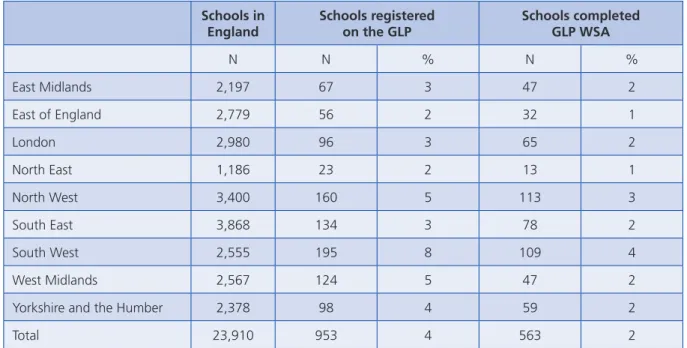
Schools have signed up to the GLP-E throughout England. Table 1 provides a geographical breakdown of where schools registering for the GLP between September 2013 and 17 February 2014 are located and compares this to overall regional numbers of schools. It shows over 100 schools registered in each of the following: North West, South East, South West and West Midlands.
Table 1: Regional breakdown of schools signed up for the GLP
Schools in
England Schools registered on the GLP Schools completed GLP WSA
N N % N % East Midlands 2,197 67 3 47 2 East of England 2,779 56 2 32 1 London 2,980 96 3 65 2 North East 1,186 23 2 13 1 North West 3,400 160 5 113 3 South East 3,868 134 3 78 2 South West 2,555 195 8 109 4 West Midlands 2,567 124 5 47 2
Yorkshire and the Humber 2,378 98 4 59 2
Total 23,910 953 4 563 2
Figure 1 shows that 8% of schools in the South West are registered with the GLP, while only 2% of schools in the North East and the East of England are.
Figure 1: Percentage of schools in geographical region registering for the GLP-E (GLP
schools, N = 953)
At a local authority level, the local authorities with the highest number of schools registered are Worcestershire (65), Dorset (48), Cornwall (38) and Cumbria (38), and local authorities with the highest % of schools signed up are Torbay (39%), Dorset (24%) and Worcester (24%). In February 2014, 39 out of 152 local authorities had no schools signed up to the GLP.
In terms of reaching GLP targets7, figures shift slightly when I remove independent
and non-maintained special schools from the total breakdown (Hunt and Cara, 2015). This shift is particularly evident at local authority level in certain areas of London and the home-counties, where there are larger numbers of independent schools. In eight local authorities the GLP has registered over 20% of targeted schools (Hunt and Cara, 2015).
There are many reasons why some geographical areas have proportionally more schools registering onto the GLP-E. These might include, for example, the regional location of the GLP-E local advisors, and the pre-existence of global learning and other local networks.
5.2 Types of schools registering on the GLP
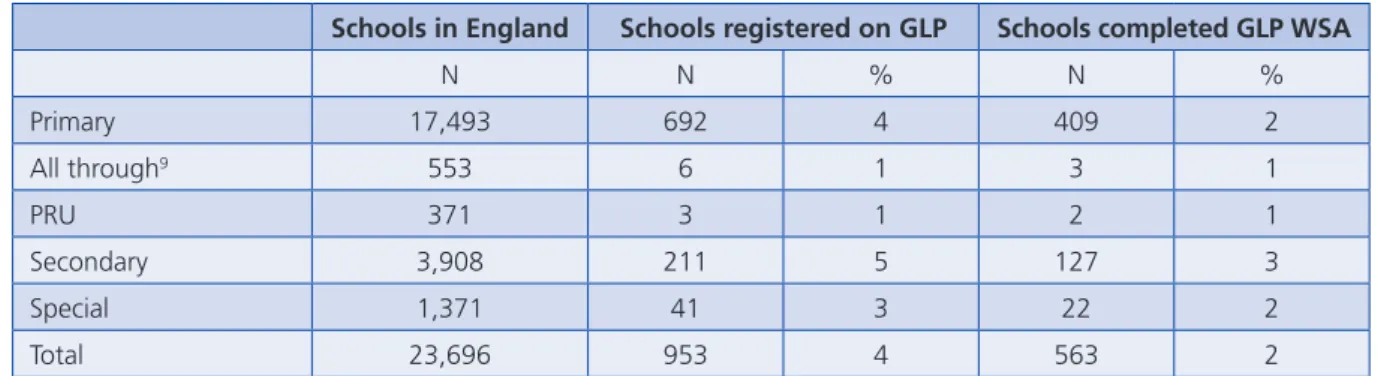
Table 28 provides information on the school phase of GLP-E registered schools
compared to national averages. It shows that 4% of primary schools in England are
7 GLP target schools do not include independent and non-maintained schools.
registered on the GLP-E, 5% of secondary schools are and 3% of special schools.
Table 2: Phase of schools registered for GLP-E compared to national
Schools in England Schools registered on GLP Schools completed GLP WSA
N N % N % Primary 17,493 692 4 409 2 All through9 553 6 1 3 1 PRU 371 3 1 2 1 Secondary 3,908 211 5 127 3 Special 1,371 41 3 22 2 Total 23,696 953 4 563 2
Different types of schools10 are registered on the GLP-E and Table 3 shows the
type of establishments registered for the GLP-E compared to national averages. It shows that while overall 4% of schools in England were registered on the GLP-E by February 2014 – 7% of academies are registered, 3% of special schools are and less than 1% of independent schools are registered. The low number of independent schools is not surprising, as this isn’t a target group of the GLP-E, also independent schools do not get funding, e.g. through e-credits or Expert Centre grants, if they do register.
Table 3: Type of establishments registered for GLP-E
Schools in
England Schools registered on the GLP-E Schools completed GLP WSA
N N % N % Academy 2,573 181 7 102 4 Community School 10,143 404 4 259 3 Foundation School 910 46 5 27 3 Free School 71 1 1 0 0 Independent School 2,413 7 0 3 0 Other 3 0 0 0 0
Pupil Referral Unit 400 3 1 2 1
Special schools 1,032 41 4 22 2
Voluntary-Aided Schools 3,901 149 4 87 2
Voluntary-Controlled Schools 2,464 121 5 61 2
Total 23,910 953 4 563 2
School type and who the pupils are can be important in terms of how schools register onto the GLP-E and how they integrate global learning. One respondent writes.
9 Includes both primary and secondary phases – these are often special schools
As a hospital school we have to focus on continuity of education … whilst the global dimension often makes certain lessons very fun and engaging, it is not something which I think can become a whole-school focus due to each student having a very personalised curriculum (GLP Partner School).
5.3 Background statistical data for schools registering on GLP
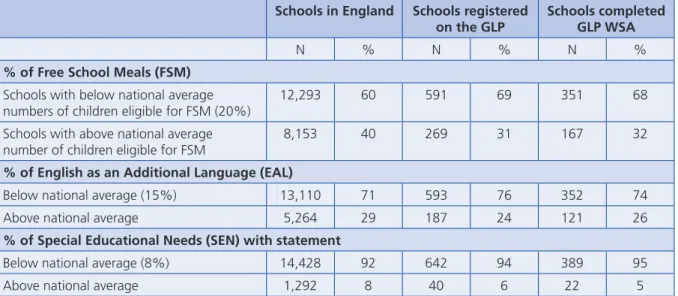
Table 4 provides background statistical data on schools registered onto the GLP compared to national averages. It shows that 69% of schools registered onto the GLP-E have fewer than average children eligible for free school meals compared to the national average of 60%; 76% of GLP-E schools have fewer than average children with English as an Additional Language (EAL) compared to national averages (71%) and 94% of GLP-E schools have fewer than average children with special educational needs statements compared to national averages (92%). These indicators are relevant because they provide some social and contextual information to the sample. Free school meals data, for example, is often used as a proxy for social disadvantage and EAL data provides some insight into the location of schools (EAL pupils can be more heavily concentrated in certain urban areas).
Table 4: Background indicators for schools registering on the GLP compared to national averages11
Schools in England Schools registered
on the GLP Schools completed GLP WSA
N % N % N %
% of Free School Meals (FSM)
Schools with below national average numbers of children eligible for FSM (20%)
12,293 60 591 69 351 68
Schools with above national average number of children eligible for FSM
8,153 40 269 31 167 32
% of English as an Additional Language (EAL)
Below national average (15%) 13,110 71 593 76 352 74
Above national average 5,264 29 187 24 121 26
% of Special Educational Needs (SEN) with statement
Below national average (8%) 14,428 92 642 94 389 95
Above national average 1,292 8 40 6 22 5
5.4 Ofsted and attainment data for schools registering for the GLP-E
Figure 2 shows schools registered on the GLP-E (927 schools12) compared to
national averages. It shows that schools registered onto the GLP-E have slightly
11 The data was lacking information for some schools – which means not all schools were included.
12 This doesn’t include the full number of 953 registered schools as independent schools don’t have Ofsted inspections and some academies haven’t yet have Ofsted inspection results.
better Ofsted ratings than national averages, especially in terms of schools identified by Ofsted as ‘good’ (64% of GLP-E schools, compared to 59% national average). There are comparatively fewer schools identified as requiring improvement or inadequate. This is interesting. It might be the case that schools with better Ofsted ratings have found the time to dedicate to approaches such as global learning and those where Ofsted ratings are not so good are required to spend more time concentrating on the necessary improvements. However, it may be too that adopting global learning can help support the development of the school. There is limited research on how this might be done (Coe, 2007), but Holland13 and Covell et al. (2011) both explore how global learning might counter
the effects of social disadvantage.
Figure 2: % Ofsted data on GLP-E registered schools versus national data (GLP schools,
N = 927)
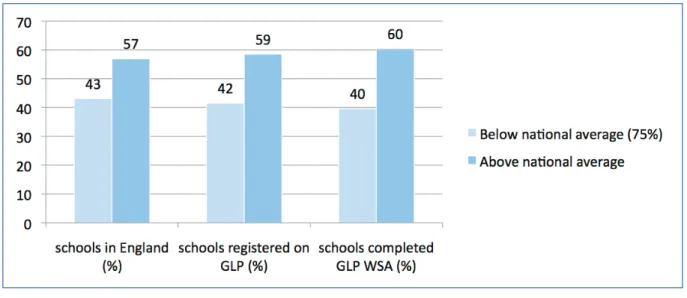
In terms of attainment data, schools registered onto the GLP-E have slightly higher achievement data than the national average. Figure 3 shows performance in KS2 SATs14, with 59% of GLP-E registered schools achieving above national average
scores compared to a 57% national average score.
13 Heidi Holland – ongoing PhD research based at UCL Institute of Education.
Figure 3: KS2 performance – % of GLP-E registered schools with pupils achieving Level 4 or above in reading, writing and maths (GLP schools, N = 619 (registered), 374 (WSA))
The difference in attainment is more pronounced for KS4 performance at
secondary level, with 73% out of 227 schools registered onto the GLP-E achieving above average KS4 results at GCSE, compared to the national average of 60% (see: Figure 4). Results are comparatively better for secondary schools that have been involved in global learning for longer than 5 years, with 48 out of 53 of these schools achieving above average K2S results at GCSE. It will be interesting to explore this again as further data emerges.
Figure 4: KS4 performance of GLP-E registered schools – % achieving 5+ A*–C GCSEs (or equivalent) including English and maths GCSEs (GLP schools, N = 227 (registered),
5.5 Background data for Expert Centres and Partner Schools
There are 96 Expert Centres15 registered on the GLP-E by February 2014 compared
to 857 Partner Schools. A breakdown of background data for GLP-E registered Expert Centres and Partner Schools can be found in Hunt and Cara (2015). It provides contextual data to the analysis which follow, where Expert Centre and Partner School comparisons are made. Some interesting points emerge:
l Comparatively, there are more secondary schools as GLP-E Expert Centres than primary schools. 20% of the 211 secondary schools registered are Expert Centres, whereas 7% of the 692 primary schools are.
l 15% of academies registered on the GLP are expert centres, as are 11% of community schools, but only 3% of the voluntary controlled schools registered on the GLP are.
l No Expert Centres received an inadequate Ofsted inspection (in their most recent inspection), whereas 12 Partner Schools did.
l 60% of the 50 Expert Centres at primary level have above average KS2 results, whereas 58% of the 569 of Partner Schools do.
l 86% of the 42 Expert Centres at secondary level have above average KS4 results, whereas 70% of 185 of Partner Schools do.
It indicates that the initial GLP-E Expert Centres tend to have above average educational indicators.
5.6 Background data for primary and secondary schools
A breakdown of background data for GLP-E registered schools by phase of schooling (i.e. primary/secondary/special) can be found in Hunt and Cara (2015). It compares numbers and percentages to those nationally. It provides a context for the analysis to follow, where phase of school comparison is made. Some interesting points emerge: l 71% of academies on the GLP-E are at secondary level and 60% of all secondary
schools registered are academies.
l At primary level, 89% of the 403 community schools are at primary level and 52% of the 692 registered primary schools are community schools.
l 93% of registered voluntary-aided and voluntary-controlled schools (often faith schools) are at primary level.
15 Expert Centres are recruited in waves onto the GLP-E. Most of these schools were recruited into wave 1A and 1B which ran between September 2013 and early 2015. However, some are recruited onto wave 2 which would run slightly later.
6
Why are schools signing up for the GLP-E?
Respondents give a range of reasons for wanting to engage with global learning (either via the GLP-E or other activities). The 563 respondents to the Whole School Audit (rather than the 953 schools registered on programme) were asked to identify against a set of predetermined categories16 why they engage or would like
to engage in global learning in their school. Figure 5 shows the most prominent of the reasons given is developing pupils’ active citizenship, responsibility and voice (72% of respondents), followed by developing pupils’ interest in other countries and cultures (65%) and developing pupils’ values (62%). There is less evidence of schools engaging with global learning in order to raise attainment levels or to encourage general school improvements.
The analysis provides some interesting insights in relation to the GLP-E’s goals. Firstly, while one of GLP-E goals is to move schools from a charity to a social justice mentality, only 9% of respondents have ‘helping others’ as one of their goals, which suggests schools can identify a difference between charitable giving and global learning. Overall developing pupils’ values and skills come out as a high priority, whereas developing pupils’ knowledge seems less prominent, even though this is a key goal of the GLP-E. One of the target areas for knowledge development on the GLP-E is raising pupils’ understandings of poverty and what can be done about it – yet this is not necessarily what most schools want from global learning (only 27% of respondents prioritised this). It is therefore a challenge for the GLP-E team to pursue this focus, where many schools appear to have other initial priorities.
16 They were also given space for qualitative responses, even so it’s likely these responses are partial reasons – with future qualitative research providing further insight.
Figure 5: % reasons why schools engage with or want to engage with global learning
(GLP schools, N = 563)
If I compare the responses from the 408 primary schools and 126 secondary schools to this question, the reasons for engaging in global learning are broadly similar.
l Secondary schools put a greater emphasis on raising attainment levels (27% secondary, compared to 13% primary) and working towards social justice (31% secondary, compared to 21% primary).
l Primary schools are more interested in developing active citizenship (73% compared to 68% secondary) and curriculum enhancement (59% of primary, compared to 52% secondary).
Overall there is greater emphasis on building knowledge at secondary level than primary school, i.e. through developing understandings of poverty and knowledge of developing countries; and a greater emphasis on developing pupils’ skills (but not values) at primary level, i.e. through developing skills such as critical thinking and active citizenship.
If I compare the responses from the 85 Expert Centres that completed the WSA to the 476 Partner Schools, many of the reasons for engaging with/wanting to engage with global learning are similar. However:
l 40% of respondents from Expert Centres are interested in working towards social justice, compared to 20% of Partner Schools. 74% of responses from Expert Centres highlight being interested in developing skills such as critical thinking, compared to 51% of Partner Schools.
l Partner Schools indicate more interest in using global learning to support curriculum enhancement than Expert Centres (61% compared to 41%) and developing pupils’ interest in other countries and cultures (67% compared to 53%).
The analysis of why schools get involved in global learning isn’t dissimilar to other studies. For example, in Hunt (2012) respondents in primary schools put an emphasis on developing respect, responsibility and values (77%) and developing an interest in other cultures and countries (60%). Hunt (2012) refers to Andreotti (2006) suggesting the responses from these primary schools prioritise global learning to foster ‘soft’ global citizenship education, with less importance placed on nurturing ‘critical’ global citizenship education (Andreotti, 2006). The responses are similar here – with responses from Expert Centres and secondary schools emphasising a more critical global citizenship education, with more focus on social justice and critical thinking.
Qualitative responses provide some insight into what schools are interested in. These responses include an emphasis on pupils:
We strive to give our students a full access to global issues and use this to broaden their horizons, make them think for themselves and to combat the negative attitudes that many come with (Expert Centre, Special School).
The desire for curriculum enhancement:
We would like to be able to embrace a culture of global learning across the curriculum (Partner School, Primary).
As a school we have identified that we want to develop a global theme, and through some teachers’ involvement in P4C and Eco Schools we are looking for ways to increase it within the curriculum (Partner School, Primary).
We currently feel that the school doesn’t cover enough global issues in its curriculum and would like to address this… (Partner School, Primary).
Some respondents put an emphasis on the whole school approach adopted by the GLP-E:
… one of the more difficult aspects is embedding it across the whole school. I am looking forward to learning more about how to encourage this (Partner School, secondary)
The GLP offers an opportunity to strengthen… values further by exploring the cross curricular nature of Global Learning and devising a range of strategies and opportunities that can be used to…. empower students to take a more active role in thinking critically and responding to issues such as development, poverty, social justice, and sustainability. This will be evident at a deeper level in more areas of the whole school curriculum … and enhanced by extra curricular systems such as the PSHE and Chaplaincy team (Expert Centre, Secondary).
7
What global learning activities are schools signing
up to the GLP-E already involved in?
7.1 How long have schools registered on the GLP-E been working on global learning
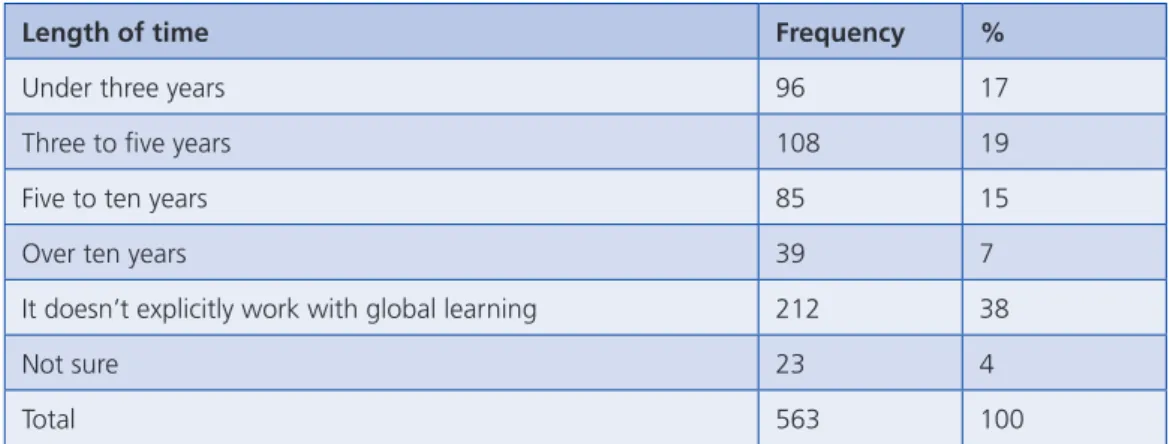
GLP-E schools have a range of experiences with global learning before they register onto the programme. Table 5 asks respondents how long their schools have been working on global learning. 7% of the 563 schools have been working on global learning for over 10 years, and around 50% have been working on global learning for up to ten years. 212 of 563 schools identify themselves as not explicitly working on global learning (38%).
Table 5: How long the schools have been working on global learning
Length of time Frequency %
Under three years 96 17
Three to five years 108 19
Five to ten years 85 15
Over ten years 39 7
It doesn’t explicitly work with global learning 212 38
Not sure 23 4
Total 563 100
If the numbers are unpacked there are some interesting differences:
l 41% of primary schools don’t explicitly work on global learning compared to 28% of secondary schools.
l 4% of primary schools have more than 10 years’ global learning experience, while 16% of secondary schools do.
l 25% of Expert Centres have more than 10 years’ experience and 4% of Partner Schools do.
l 44% of Partner Schools don’t explicitly work on global learning.
A goal of the GLP-E is to work with schools that have not previously engaged with global learning, and the data in Table 5 suggests this is happening. However, it is unlikely the numbers are as clear-cut as this indicates. Many of the schools identifying as ‘not explicitly doing global learning’ are involved in activities that
suggest a global learning focus. For example, 25% of these schools are involved in the International Schools Award and 34% of schools have an international school link. There may be explanations for this. Firstly, the terminology of ‘global learning’ might not be understood by all respondents and this might be something the programme needs to address, for example, one respondent describes the ‘lack of clarity around what global learning actually is’ (Partner School, secondary). Secondly, schools might be taking part in a school link without actively pursuing global learning; Bourn (2014) differentiates between the two. Another explanation could be present in qualitative responses from respondents, which suggest the vulnerability of global learning in schools, particularly where it isn’t embedded across a whole school (Hunt and King, 2015):
There was a lot of training and a focus on Global Learning in our school a few years ago. We were supported by a DEC17 and were involved in a project about
measuring attitudinal change. However due to a number of new staff, other pressures and no global learning co-ordinator it seems to have lost as much presence as it once had in our school (Partner School, Primary).
In previous years we have had active links with (various) schools. Due to various reasons (staff leaving, political instability), these links have petered out (Partner School, Primary).
7.2 What activities are GLP-E schools already doing?
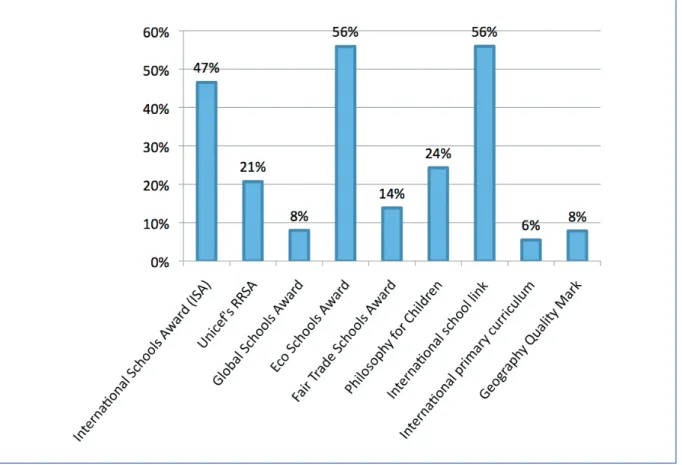
Figure 6 shows current activities and awards schools signing up for the GLP-E are already involved in. It shows that 56% of the 563 registered schools already have an international school link, 56% take part in the Eco Schools Award and 47% of schools are involved in the International Schools Award. There is obvious cross-over with many of these activities and the GLP-E is designed to link to quality marks and awards, either as stepping stones into the GLP, or as a development from it (Global Learning Programme, n.d.).
Figure 6: % Global learning programmes and awards GLP schools are already taking part in (GLP schools, N = 563)
These numbers vary for different groups.
l GLP-E secondary schools are already involved in some activities more than primary schools. This includes an international school link (73% of secondary schools), the Geography Quality Mark (19%), the Fair Trade Award (22%) and the International Schools Award (65%). And GLP-E primary schools are involved in some activities more than secondary schools, for example, P4C (27% of primary schools), Eco Schools Award (60%) and Unicef’s Rights Respecting Schools Award (25%). l Expert Centres are already involved in more global learning activities than Partner
Schools (on average one more). This is particularly the case for the International Schools Award, where 71% of Expert Centres are taking part compared to 42% of Partner Schools; P4C (44% of Expert Centres compared to 21% of Partner Schools) and an international school link (75% of Expert Centres compared to 53% of Partner Schools).
Schools are often involved in multiple activities and awards (usually between two and five). The exception seems to be the Eco Schools Award where 19% of participating schools are not involved in another global learning project or awards.
72% of schools on the GLP-E are engaged in some form of fundraising, with 63% of schools fundraising on a local issue and 61% on an international issue. Comparatively Expert Centres carry out more fundraising than Partner Schools, especially on international issues (74% of Expert Centres). There is little difference between primary and secondary schools in terms of fundraising, but special schools did comparatively less fundraising (45% of special schools fundraise on international issues). Faith schools and academies have comparatively higher rates of fundraising than other school types. This data suggests schools are able to support both charitable giving and a global learning ethos. GLP-E’s focus on moving from a charitable to a social justice mentality advocates schools move beyond seeing the Global South as ‘just about poor people’ in need of charity and aid, and rather, supporting critical engagement with the reasons behind poverty and inequality. Previous research has looked at the relationship between global learning and fundraising (see: Bryan and Bracken, 2011; Andreotti, 2006; Hunt, 2012 for further information).
7.3 What support are GLP-E schools currently getting?
Respondents to the WSA identify the global learning support their school has received in the previous three years.
l 111 schools (27% of responding schools) have been supported by a Development Education Centre (DEC18).
l 52 schools (12% of responding schools) have been supported by an international development organisation (NGO).
l 208 schools (45% of responding schools) have received training on a global theme.
In terms of training, Expert Centres have proportionally had more training on a globally related theme than Partner Schools (80% compared to 30%). Similarly 44% of Expert Centres have been supported by Development Education Centres, whereas only 16% of Partner Schools have. This suggests the GLP-E is identifying schools as Expert Centres that have been actively supporting their own global learning development.
8
What are levels of global learning in schools
signing up to the GLP-E?
The next set of data looks at the Whole School Audit analysis where responses are mapped against the GLP Whole School Framework (see Appendix 1). This area of the WSA uses the Ofsted framework19 as a guide to shaping the
analysis and breaks responses into four categories: pupils; teachers; behaviour and relationships; and leadership and community. The WSA asks a range of questions that link directly to the GLP Whole School Framework criteria, and in each question respondents are asked to choose a statement they think is most appropriate for their school. Their responses identify the school as ‘early’, ‘beginner’, ‘developing’ or ‘embedded’ in global learning in the various whole school criteria. The questions asked can be found in Appendix 2, with an
explanation of how the responses map onto the Whole School Framework levels. For further information, Hunt and King (2015) go into detail about the content, mechanisms and processes of the Whole School Audit and it works alongside the Whole School Framework criteria.
8.1 Pupils and global learning
Figure 7 provides data analysis on pupils and global learning. The actual questions and possible responses can be found in Appendix 2 (questions 1–5) and they explore the following areas:
l Pupils develop their understanding of global knowledge themes through a range of subjects and topic areas.
l Pupils develop high-quality learning skills through global learning, supporting their literacy, numeracy and communication.
l Pupils are better prepared for transition and work through global learning activities.
Figure 7: Pupils and global learning20 (GLP schools)
Figure 7 shows that for more than half of responding schools (58%) pupils’ knowledge of global themes is identified at an ‘early’ level21. Similarly, over half
the respondents indicate their school is at an early level in terms of using global learning to support pupils’ learning skills, literacy, numeracy and communication skills. 82% of schools identify at ‘beginner’ level for using global learning to support transitions to secondary school and 52% of secondary schools think that some pupils have learnt about and understand career options related to global development (early level).
Further breakdown of this data by Expert Centre and Partner School, as well as school phase (Hunt and Cara, 2015) provide the following detail:
l Respondents in 52% of Expert Centres indicate pupils’ knowledge of global themes to be at ‘developing’ level, compared to 24% of Partner Schools. This pattern is similar for secondary schools, where 49% of respondents rate pupils’ knowledge of global themes at developing, compared to 22% of primary schools. Conversely, 64% of respondents in partner and primary schools indicate pupil’s global knowledge to be at early levels.
l 52% of respondents in Expert Centres indicate global learning is used to support many pupils’ learning skills (developing level), compared to 22% of
20 In all categories in this section: beginner corresponds to no/few pupils (0–10%); early to some pupils (10–50%); developing to many pupils (50–75%) and embedded to most/all pupils (75–100%).
Partner Schools. Most respondents in Partner Schools indicate they support pupils’ learning skills through global learning at an early level. At secondary level respondents indicate support to pupils’ learning skills at early (40%) and developing (38%); at primary, these results are early (55%) and developing (22%). l More than half of the respondents from Expert Centres indicate their school
uses global learning to support numeracy, literacy and communication skills at developing or embedded levels, compared to 20% of Partner Schools. 32% of respondents in secondary schools do likewise, compared to 19% of Primary Schools.
l Overall respondents from special schools often place pupils in early categories in relation to global learning: pupil knowledge (77%), developing pupils’ learning skills though global learning (64%), and developing numeracy, literacy and communication skills through global activities (55%).
l Global learning activities do not currently tend to be used to support transitions to secondary school (either by primary or secondary schools), with most respondents in sub-categories defining their school at an early level.
Evidence suggests overall Expert Centres and secondary schools use global learning to support pupils’ development at more embedded levels than Partner and primary schools.
8.2 Teachers and global learning
Figure 8 provides data analysis on teachers and global learning. The questions and possible responses can be found in Appendix 2 (questions 6–9). The analysis is in response to questions in the audit that respond to the following GLP Whole School Framework criteria:
l Teachers are confident in their global knowledge, and use teaching approaches supporting pupils’ skills and values development.
l Teachers are equipped to support active global citizenship by pupils in lessons and extra-curricular activities.
l Teachers use effective cross-curricular planning skills to provide coherent global learning experiences.
Figure 8: Teachers and global learning22 (GLP schools)
Respondents mostly locate teachers in their schools in ‘early’ or ‘developing’ categories for their knowledge of global issues, their use of pedagogic approaches to support global learning, how they support active global citizenship for pupils, and the extent to which they deliver global learning activities in a cross-curricular way. Almost 20% of respondents think no teachers use pedagogical approaches supporting (beginner level) and over 20% more than half of their teachers have delivered at least one global learning activity across subjects in a cross-curricular way (embedded level) – this might be particularly possible in primary schools. Further breakdown of this data by Expert Centre and Partner School, as well as school phase, can be found in Hunt and Cara (2015). Some summary points emerge from this breakdown:
l Respondents in 91% of Expert Centres think teachers are at ‘developing’ or ‘embedded’ levels in terms of teachers’ confidence in their global knowledge and understanding how it supports pupils’ learning. In Partner Schools this number is at 50%, with 41% of schools identifying as ‘early’. Similarly, respondents in 84% of Secondary Schools think their teachers are at ‘developing’ or ‘embedded’ levels in terms of teachers’ confidence in their global knowledge compared to 47% in primary schools. 43% of primary schools identify as ‘early’, with one or two teachers being confident in their knowledge of global learning and 10% of primary schools indicate no teachers have confidence in their global knowledge. l Respondents in 86% of Expert Centres think their teachers are at ‘developing’ or
‘embedded’ levels in terms of teachers’ using pedagogic approaches to support
22 In all categories in this section: beginner corresponds to no teachers; early to one or two teachers; developing to some teachers (10-50%); and embedded to many/most/all teachers (50-100%).
global learning. In Partner Schools this number is at 33%, with 48% of Partner Schools identifying as ‘early’. Patterns for Primary Schools are similar to those of Partner Schools, whereas 64% of respondents from secondary schools think their teachers are at developing or embedded levels in terms of using pedagogic approaches to support global learning.
l Respondents in 57% of special schools think their teachers are at developing or embedded levels in terms of confidence in teacher knowledge and 52% are at developing or embedded levels in relation to pedagogic approaches supporting global learning.
l Respondents in almost half of Expert Centres indicate some teachers understand the principles of active global citizenship and they plan opportunities for pupils to participate in in the school. For Partner Schools this number is 29%, secondary schools 56% and primary schools 24%.
l Respondents were asked the extent to which teachers are involved in delivering global learning activities across subjects in a cross-curricular way. In Expert Centres, 76% of respondents identify as developing or embedded, whereas in Partner Schools this number is 46%. The difference between Secondary and Primary Schools is not evident, with 50% of Secondary Schools, 51% of Primary schools and 48% of special schools categorising teachers at developing or embedded levels for using global learning across subjects.
8.3 Behaviour and relationships
Figure 9 provides data analysis on behaviour and relationships in schools in relation to global learning. The questions and possible responses can be found in Appendix 2 (questions 10–12). The analysis is in response to questions in the WSA that respond to the following Whole School Framework criteria:
l Global learning assists values development across the school community, supporting positive relationships.
l Global learning supports positive attitudes towards diversity and difference. l Pupil voice is developed across the school through global learning activities.
Figure 9: Data on behaviour and relationship23 (GLP schools)
Figure 9 shows respondents are most likely to identify their school as at an ‘early’ level for pupils’ values, diversity and cultural difference, and pupil voice. Almost 50% of respondents put their school at either developing or embedded levels for the extent to which the school develops positive attitudes to diversity and cultural difference. There are fewer schools that use global learning to develop pupil voice, with only 6% of schools identifying at embedded level.
Further breakdown of this data by Expert Centre and Partner School, as well as school phase, can be found in (Hunt and Cara, 2015). Some summary points emerge from this breakdown:
l Respondents in 77% of Expert Centres indicate their school is at developing or embedded levels for developing pupils’ values through global learning activities, compared to 27% of Partner Schools. In Primary Schools 51% of respondents identify the school at ‘early’ level, compared to 43% of secondary schools and 43% of special schools.
l Respondents in over 80% of Expert Centres rated the school at developing or embedded levels in terms of the extent to which the school supports positive attitudes towards diversity and cultural difference. For Partner Schools this
number is 43%, secondary schools 68% and primary schools 43%. Just over half respondents from Partner and primary schools identify their schools at an early level. There are low numbers in all sub-categories for schools at beginner level
23 In the values and diversity categories in this section beginner corresponds to no/few pupils (0–10%); early to some pupils (10–50%); developing corresponds to many pupils (50-75%) and embedded to most/all pupils (75–100%). In the pupil voice category beginner corresponds to no pupils (0%); early corresponds to few pupils (0–10%); developing to some pupils (10–50%) and embedded to many/ most/all pupils (50–100%).
suggesting the vast majority of schools do some work on developing positive attitudes to diversity, with or without global learning.
l Overall pupil voice in relation to pupils planning and running global activities in the school appears less well developed. Around half of Expert Centre and secondary school respondents think that ‘some’ pupils are involved in planning and running global activities (embedded level), while around 40% of Partner Schools and primary schools think a few pupils are. Around a third of respondents in Partner and primary schools indicate no pupils are involved in the planning and running of global activities.
8.4 Leadership and community
Figure 10 provides data analysis on leadership and community in relation to global learning. The questions and possible responses can be found in Appendix 2 (questions 13, 15 and 16). The analysis is in response to questions in the audit that respond to the following Whole School Framework criteria:
l School leaders use effective planning to embed a school vision preparing pupils for a globally interdependent world.
l Global learning helps to create a rich and rewarding professional development programme.
l Global learning supports better engagement with parents, community groups and other organisations locally, nationally and globally.