296
Journal of Advanced Research in Fluid
Mechanics and Thermal Sciences
Journal homepage: www.akademiabaru.com/arfmts.htmlISSN: 2289-7879
Optimization Techniques in PID Controller on a Nonlinear
Electro-Hydraulic Actuator System
Chai Mau Shern1, Rozaimi Ghazali1,*, Chong Shin Horng1, Chong Chee Soon1, Hazriq Izzuan Jaafar1,2
1 Centre for Robotics and Industrial Automation, Faculty of Electrical Engineering, Universiti Teknikal Malaysia Melaka, Hang Tuah Jaya, 76100 Durian Tunggal, Melaka, Malaysia
2 Department of Control and Mechatronics Engineering, School of Electrical Engineering, Universiti Teknologi Malaysia, 81310 Sk udai, Johor, Malaysia
ARTICLE INFO ABSTRACT
Article history:
Received 19 October 2018
Received in revised form 29 November 2018 Accepted 10 April 2019
Available online 20 April 2019
The controller is an important component in the nonlinear control system, especially for the s ys tem that needs a ccuracy i n position tra cking. El ectro-Hydraulic Actuator (EHA) s ys tem i s a popular nonlinear s ystem that is used by researchers. Proportional-Integral-Derivative (PID) controller is the most popular controller that is normally used i n the i ndustry. This i s mainly because of i ts simplicity i n the design process. However, there are three constants that need to be assigned in the PID controller, often we called thi s as the parameters s election process or the PID tuning process. In this paper, a compa rison s tudy for the s election process of the PID pa ra meters process will be conducted a mong Zi egler-Nichols tuni ng method, conventional Pa rti cle Swarm Opti mization (PSO) technique and Pri ority-based Fitness Pa rticle Swarm Optimization (PFPSO) technique. PFPSO is one of the i mproved versions of the conventional PSO technique. The s imulation study wi ll be conducted on a nonlinear Electro -Hydraulic Actua tor (EHA) system. A simple robustness test on the PID controller will be evaluated i n terms of actuator i nternal leakage. Results s howed that the PID performed better when its controller’s parameters are selected using PFPSO technique rather than the Zi egler-Nichols method and conventional PSO technique.
Keywords:
El ectro-Hydraulic Actuator Sys tem, Zi egler-Nichols Tuning Method, Pa rticle
Swa rm Optimization Copyright © 2019 PENERBIT AKADEMIA BARU - All rights reserved
1. Introduction
Controllers are designed and used in a feedback control system to improve system response or to achieve desired and prescribed response. The first application feedback controller used in the industrial process is agreed to be James Watt’s Flyball governor. It was developed in 1769 to control the speed of a steam engine [1]. Until 1922, a Russian-American engineer Nicholas Minorsky developed a controller, which is now called Proportional-Integral-Derivative (PID) controller. He had developed PID controller based on his observation on the helmsmen steering ships and found out that they acted not only on the current error itself, but also on the past error and the current rate of
*Corresponding author.
E-mail address: [email protected] (Rozaimi Ghazali)
Open Access
297
change of the error [2,3]. There are three constants which are called controller parameters that need to be selected or assigned in PID controller: Kp is the proportional gain; KI is the integral gain and KD
is the derivative gain. All these three gains are responsible for three different actions which occur simultaneously in PID controller: proportional action, integral action, and derivative action.
However, the parameters selection process for these three values is often a topic of interest among researchers. There are a lot of methods which had been developed or invented by researchers across the years. The best known and widely used is Ziegler-Nichols (ZN) tuning method. It was developed by Ziegler and Nichols in 1942 [4].
In recent years, the parameters selection techniques have shifted to optimization techniques. Many optimization techniques had been developed and proposed by researchers in different system over the last decades, such as neural network optimization [5-7], Evolutionary Algorithm [8], Particle Swarm Optimization (PSO) [8,9], Genetic Algorithm (GA) [10-12], Differential Evolution (DE) Algorithm [13]. A suitable optimization technique will yield the optimal parameters in each scheme for it to render the maximum output or the desired output based on the input fed to the respective system.
In this paper, the Ziegler-Nichols (ZN) tuning method, Particle Swarm Optimization (PSO) and improved version of Particle Swarm Optimization (PSO) in [14] will be employed to optimize PID controller parameters. An output performance comparison study will be done on these three techniques and then a simple robustness test will be evaluated.
The paper will continue by following sections: section 2 will describe the methodology, including the non-linear EHA system and PID controller design. The parameters selection process using different optimization techniques will be discussed in section 3 and section 4 will discuss the output performance of the controller after optimized by three different techniques. Finally, conclusions are drawn in section 5.
2. Methodology
2.1 PID Controller Design
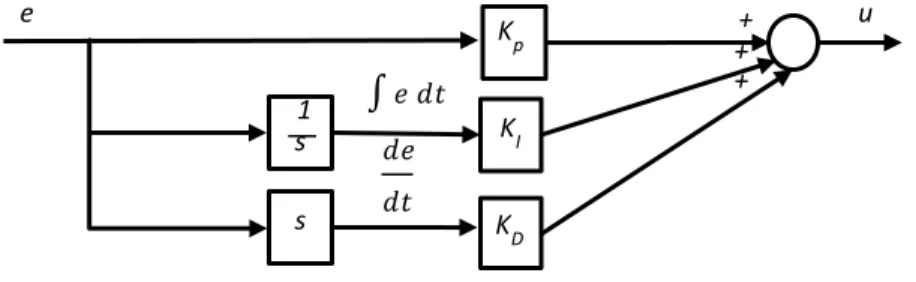
PID controller is the most popular controller used in industry and often used as a benchmark by researchers. Figure 1 illustrates the PID controller structure. The top path is called the proportional path, the output of the proportional path is the multiplication of the error (e) and the proportional gain, KP. The second path is the integral path. The output of this path is the multiplication of the
integral of the error (e) and the integral gain, KI. Note that the integral of the error is the area under
the curve of the graph of error (e) versus time. Finally, the third path is the derivative path. The error (e) is first differentiated to get the rate of change of the error and then multiply it with derivative gain, KD. All the output of these three paths is then added together using a summing block to become
a total PID controller action and produce a control s ignal (u) to a plant or system.
Fig. 1. PID controller structure
+ 𝑑𝑒 𝑑𝑡 𝑒𝑑𝑡 e Kp KI KD u + + s s 1
298
The overall PID control function can be expressed mathematically as in Eq. (1).
0
t
P I D
d e(t ) u(t ) K * e(t ) K * e(t )dt K *
dt (1)
2.2 Electro-Hydraulic Actuator (EHA) System
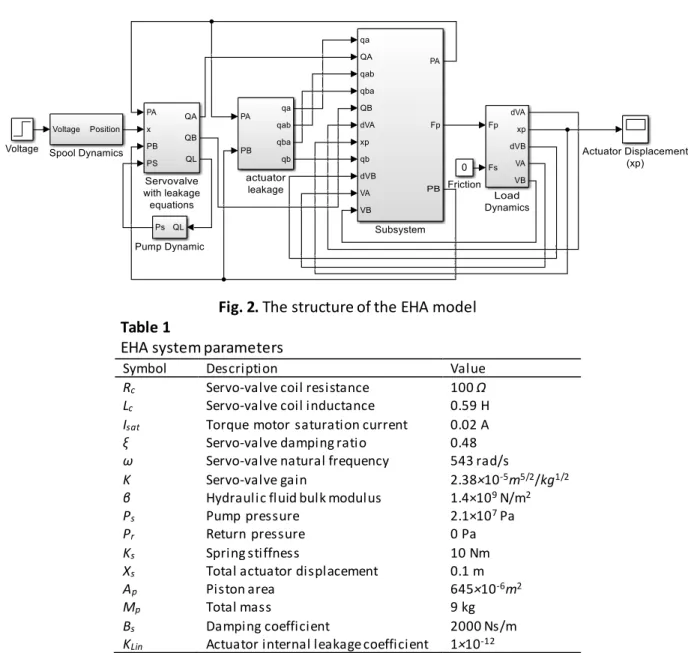
Electro-hydraulic actuator (EHA) system is a type of non-linear system due to its disturbance and uncertainties. The established nonlinear EHA model in [15] be utilized in this paper as it has includes some of the disturbances and uncertainties characteristics like leakage, pump, and load dynamics equations. Figure 2 shows the structure EHA model used in this paper. The EHA system dynamic parameters are listed in Table 1.
Fig. 2. The structure of the EHA model Table 1
EHA system parameters
Symbol Description Value
Rc Servo-valve coil resistance 100 Ω
Lc Servo-valve coil inductance 0.59 H
Isat Torque motor saturation current 0.02 A
ξ Servo-valve damping ratio 0.48
ω Servo-valve natural frequency 543 rad/s
K Servo-valve gain 2.38×10⁻⁵m5/2/kg1/2
β Hydraulic fluid bulk modulus 1.4×10⁹ N/m2
Ps Pump pressure 2.1×10⁷ Pa
Pr Return pressure 0 Pa
Ks Spring stiffness 10 Nm
Xs Total actuator displacement 0.1 m
Ap Piston area 645×10-6m2
Mp Total mass 9 kg
Bs Damping coefficient 2000 Ns/m
KLin Actuator internal leakage coefficient 1×10-12
Figure 3 illustrates the block diagram of the EHA system with PID controller optimized by using different parameters selection techniques as discussed earlier.
299 Fig. 3. The block diagram of EHA system with PID controller
3. Parameters Selection Processes 3.1 Ziegler-Nichols (ZN) Tuning Method
Ziegler-Nichols tuning method is probably the best known and most widely used methods. It was developed by John G. Ziegler and Nathaniel B. Nichols in the 1940s [4]. The Ziegler-Nichols method will first get the ultimate gain, Ku and ultimate period, Pu with the P-only controller by the trial-and-error method and then use these two values to get KP, KI, and KD values. First, set the KI and KD values
in Figure 3 to zero and left only KP value. Increase KP value until the EHA system oscillation
continuously (marginally stable). Ku is referring to the value of KP when the EHA system is marginally
stable and Pu is the period of the non-decaying oscillations at this point of marginal stability. The
value of KP, KI, and KD values can be calculated using the formula in Table 2.
Table 2
Ziegler-Nichols method to get PID controller parameters
Controller KP KI KD
PID 0.6*Ku 2*Ku/Pu Ku*Pu/8
3.2 Conventional Particle Swarm Optimization (PSO) Technique
Particle Swarm Optimization (PSO) is introduced by James Kennedy and Russell Eberhart in 1995. It was developed from the swarm intelligence and based on fish and bird flock movement behavior to find the food.
A number of particles that are moving around the searching space are used on the basic principle of the PSO algorithm to look for the best solution. Each particle will keep track of its coordinate in the fitness equation that has achieved by that particular particle. This value is known as personal best, PBEST. Another value called global best, GBEST is tracked by the PSO. Each particle can be shown
by its current position and velocity as shown in Eq. (2) and Eq. (3).
1 1 i i i x x v (2) 1 1 1 2 2 i i i i BEST BEST v v c r (P x ) c r (G x ) (3) where
𝑥𝑖+1 = position of particle at iteration k
𝑣𝑖+1 = velocity of particle at iteration k
𝜔 = inertia weight factor
𝑟1, 𝑟2 = random numbers between 0 and 1
𝑐1, 𝑐2 = acceleration coefficients
Reference
300
3.3 Priority-based Fitness Particle Swarm Optimization (PFPSO) Technique
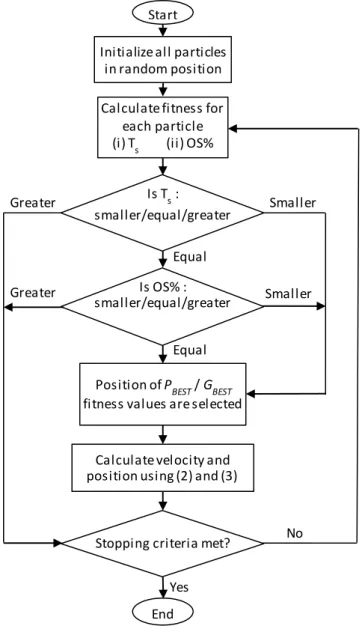
PFPSO technique is a combination of Priority-based Fitness Scheme and conventional Particle Swarm Optimization (PSO) technique. It was developed by Jaafar in 2012 and apply it to a nonlinear double-pendulum crane system [5]. The PBEST and GBEST values in this PFPSO technique are updated
according to the priority: settling time (TS) and overshoot percentage (OS%). Figure 4 shows the
flowchart of the Priority-based Fitness Particle Swarm Optimization (PFPSO) technique in optimizing the PID parameters.
Fig. 4. The flowchart of PFPSO technique in optimizing PID parameters
4. Results and Discussion
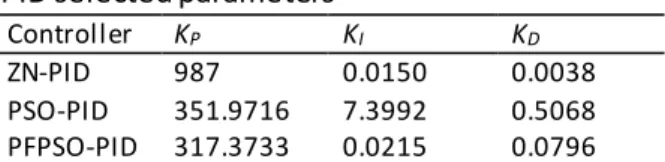
The performance of the proposed PID controller parameters selection method was investigated via simulations in Simulink. Simulation results are compared among Ziegler-Nichols selected parameters (ZN-PID), conventional PSO technique selected parameters (PSO-PID) and PFPSO technique selected parameters (PFPSO-PID). Table 3 shows the PID selected parameters.
Is OS% : smaller/equal/greater
End
Initialize all particles in random position Calculate fitness for
each particle (i) Ts (ii) OS%
Calculate velocity and position using (2) and (3)
Start
Position of PBEST / GBEST
fitness values are selected Equal Equal Smaller Smaller Greater No Yes Greater Is Ts : smaller/equal/greater
301 Table 3
PID selected parameters
Controller KP KI KD
ZN-PID 987 0.0150 0.0038
PSO-PID 351.9716 7.3992 0.5068 PFPSO-PID 317.3733 0.0215 0.0796
In order to evaluate the performance of the PID controller apply to a nonlinear EHA system, step reference input signal is fed into the system. Using the PID controller’s parameters in Table 3, the simulation is executed and the output performance is shown in Figure 5.
Fig. 5. The transient performance of step reference input
The output performance analysis is recorded in Table 4. As observed, the ZN-PID yields extremely high overshoot with 19.03% of overshoot percentage. PSO-PID have the least overshoot which is only 1.23% of overshoot percentage and PFPSO-PID showed a 1.7622% of overshoot percentage. As discussed earlier, PFPSO-PID is done by considering the priority and this paper will focus on the priority in terms of settling time followed by the overshoot percentage. That is why the overshoot percentage of the PFPSO-PID is slightly higher than the PSO-PID. ZN-PID have a long settling time, which is 0.078s as compared to PSO-PID and PFPSO-PID which have almost the same settling time 0.04s and 0.041s respectively. ZN-PID shows great performance on the steady-state error with only 0.2534×10⁻⁶m. The steady-state error for PSO-PID and PFPSO-PID are acceptable which have a value
of 0.0378m and 0.0001m respectively.
Table 4
The output performance analysis for each parameter selection methods
Controller Overshoot Percentage (%) Peak Time (s) Settling Time (s) Steady-state Error (m)
ZN-PID 19.03 0.537 0.078 0.2534×10⁻⁶
PSO-PID 1.2360 0.555 0.040 0.0378
302
Another similar simulation that includes the actuator internal leakage is done on the nonlinear EHA system to observe and record the robustness of the PID controller. Figure 6 shows the position tracking performance of the PID controller on the nonlinear EHA system where the same controller parameters in Table 3 is used and the actuator internal leakage is included.
Fig. 6. The output performance of the EHA system with actuator internal leakage
The output performance analysis is recorded in Table 5. From Figure 6, again the ZN-PID shows the obvious overshoot and 11.9765% of overshoot percentage is recorded. Both PSO-PID and PFPSO-PID shows only a small overshoot with 0.0974% and 0.0574% of overshoot percentage. The settling time for these three parameters selection techniques is below than 0.1s which is an acceptable value for this system. The steady-state error for the ZN-PID is recorded as 1.3259×10⁻⁵m which is the least
as compared to the other two techniques. The PSO-PID and the PFPSO-PID have the steady-state error of 0.0492m and 0.0040m respectively.
Table 5
The robustness test for PID controller for each parameter selection method
Controller Overshoot Percentage (%) Peak Time (s) Settling Time (s) Steady-state Error (m)
ZN-PID 11.9765 0.551 0.084 1.3259×10⁻⁵
PSO-PID 0.0974 0.605 0.065 0.0492
PFPSO-PID 0.0574 0.607 0.068 0.0040
5. Conclusions
Optimum parameters are needed for a PID controller to function more effectively in a system. In this paper, three parameters selection processes had been identified to select the PID controller’s parameters which are ZN tuning method, conventional PSO technique, and PFPSO technique. These three processes are being investigated through MATLAB Simulink simulation and a comparison study had been made based on the output performance among these three selection processes. Results
303
showed that the PID controller is performed better when its controller parameters are selected by using PFPSO technique rather than ZN tuning method and conventional PSO technique. A robust test in terms of actuator internal leakage is done on these three selection processes. The test results showed that the PFPSO technique gives an outstanding performance among three selection processes.
Acknowledgment
The support of Universiti Teknikal Malaysia Melaka (UTeM), Centre for Robotics and Industrial Automation (CeRIA), and Ministry of Education (MOE) are greatly acknowledged. The research was funded by the Fundamental Research Grant Scheme (FRGS) Grant No. (FRGS/1/2017/TK04/FKE -CeRIA/F00333) and Short-Term Grant No. (PJP/2017/FKE/HI11/S01534).
References
[1] Bennett, Stuart. "A brief history of automatic control." IEEE Control Systems Magazine 16, no. 3 (1996): 17-25. [2] Minorsky, Nicolas. "Directional stability of automatically steered bodies." Journal of the American Society for Naval
Engineers 34, no. 2 (1922): 280-309.
[3] Bennett, Stuart. "Nicholas Minorsky and the automatic steering of ships." IEEE Control Systems Magazine 4, no. 4 (1984): 10-15.
[4] Ziegler, John G., and Nathaniel B. Nichols. "Optimum settings for automatic controllers." trans. ASME 64, no. 11 (1942).
[5] Attaran, Seyed Mohammad, Rubiyah Yusof, and Hazlina Selamat. "A novel optimization algorithm based on epsilon constraint-RBF neural network for tuning PID controller in decoupled HVAC sys tem." Applied Thermal Engineering 99 (2016): 613-624.
[6] Wang, Yaonan, Yuanli Chenxie, Jianhao Tan, Chu Wang, Yuanyuan Wang, and Yiwei Zhang. "Fuzzy radial basis function neural network PID control system for a quadrotor UAV based on particle swarm optimi zation." In 2015 IEEE International Conference on Information and Automation, pp. 2580-2585. IEEE, 2015.
[7] I. Muhaini, M. Noor, M. Kamal, and M. Amin, “Optimized parameters of wastewater treatment system using fuzzy control,” J. Adv. Res. Appl. Sci. Eng. Technol. 5, no. 2, (2016): 27–35.
[8] Saad, Mohd Sazli, Hishamuddin Jamaluddin, and Intan Zaurah Mat Darus. "Active vibration control of a flexible beam using system identification and controller tuning by evolutionary algorithm." Journal of Vibration and Control 21, no. 10 (2015): 2027-2042.
[9] Haji, V. Haji, and Concepción A. Monje. "Fractional order fuzzy-PID control of a combined cycle power plant using Particle Swarm Optimization algorithm with an improved dynamic parameters selection." Applied soft computing 58 (2017): 256-264.
[10] Ye, Yi, Chen-Bo Yin, Yue Gong, and Jun-jing Zhou. "Position control of nonlinear hydraulic system using an improved PSO based PID controller." Mechanical Systems and Signal Processing 83 (2017): 241-259.
[11] Khan, Muhammad Waqas, Mohammad Ahmad Choudhry, Muhammad Zeeshan, and Ahsan Ali. "Adaptive fuzzy multivariable controller design based on genetic algorithm for an air handling unit." Energy 81 (2015): 477-488. [12] Harrag, Abdelghani, and Sabir Messalti. "Variable step size modified P&O MPPT algorithm using GA-based hybrid
offline/online PID controller." Renewable and Sustainable Energy Reviews 49 (2015): 1247-1260.
[13] Rout, Umesh Kumar, Rabindra Kumar Sahu, and Sidhartha Panda. "Design and analysis of differential ev olution algorithm based automatic generation control for interconnected power system." Ain Shams Engineering Journal 4, no. 3 (2013): 409-421..
[14] Jaafar, Hazriq Izzuan, and Zaharuddin Mohamed. "PSO-tuned PID controller for a nonlinear double-pendulum crane system." In Asian Simulation Conference, pp. 203-215. Springer, Singapore, 2017.
[15] Kalyoncu, Mete, and Mustafa Haydim. "Mathematical modelling and fuzzy logic based position control of an electrohydraulic servosystem with internal leakage." Mechatronics 19, no. 6 (2009): 847-858.