Procedia Computer Science 34 ( 2014 ) 344 – 351
1877-0509 © 2014 Elsevier B.V. This is an open access article under the CC BY-NC-ND license (http://creativecommons.org/licenses/by-nc-nd/3.0/).
Selection and peer-review under responsibility of Conference Program Chairs doi: 10.1016/j.procs.2014.07.035
ScienceDirect
The 11th International Conference on Mobile Systems and Pervasive Computing
(MobiSPC-2014)
MVCC: An Architectural Pattern for Developing Context-aware
Frameworks
Hossein Shams
a*, Kamran Zamanifar
a aUniversity of Isfahan, Hezar Jerib Ave, Isfahan, IranAbstract
Presenting a personalized service and information is a key aspect of pervasive computing, but development of such context-aware systems is quite complicated. Context-context-aware applications should be able to acquire raw data from sensors, make high-level
context information, recognize the user’s situation, and adapt behavior of the system. Developers need an infrastructure layer to mitigate such complexities. Also, programmers have tended to use software frameworks for getting away from low-level communication challenges of the infrastructure layer. Software frameworks should develop an architecture and implement
facilities to support programmers’ requirements. In this paper, we identify an existing obstacles that each programmer faced with in the application layer development. Following, we will introduce MVCC (Model-View-Controller-Context) as an architectural pattern solution for software frameworks to overcome the mentioned obstacles. This architectural pattern can be implemented in a variety of frameworks and will brings easy and rapid development, reusability of the code, and flexibility for developers. © 2014 The Authors. Published by Elsevier B.V.
Selection and peer-review under responsibility of Elhadi M. Shakshuki.
Keywords: Context-aware Computing; Context-awareness; Context-aware Application; Context-aware Framework; Context-aware Architecture; Context-aware Architectural Pattern
1.Introduction
In the pervasive computing era, computers should be able to realize the users’ demand without receiving an
explicit input. So personalized information and services should be available for users when they need or even before users think that they need for them. In other words, the application should prognosticate users’ demands. To this
* Corresponding author. Tel.: +98-311-7394011; fax: +98-311-7394011.
E-mail address: [email protected]
© 2014 Elsevier B.V. This is an open access article under the CC BY-NC-ND license
(http://creativecommons.org/licenses/by-nc-nd/3.0/).
end, applications have to be aware of user and environment’s context, or be context-aware. Context-aware systems will bring new opportunity for developers to determine the users’ situation, and to adapt the functionality of their applications to that situation. Adding the context-aware capability to applications is not convenient task and impose many complexities on the developers. Context-aware systems organized from several parts to make a proper response based on the user’s situation. Firstly, it should acquire raw data from available physical and logical sensors.
Moreover, it needs to perform preprocessing operations on the raw data, producing high-level contextual information, and storing information in a certain context model. Finally, the application should recognize significant situations from contextual information, and trigger the appropriate response on the specific situation.
Recently, researchers have introduced many programming frameworks and middleware infrastructures in order to simplify the development of context-aware systems1. Although Context Management Systems (CMS) have a proper
support for providing high-level context information, there is lack of programming support to guide developers on how utilizing context information in the application development process. Programming support means there should be a framework that puts some principles and restrictions on how to write code, but these restrictions come with facilities to do more comfortable programming and rapid development. Furthermore, they do not have ability to write the same code for different types of CMS. Writing the same code in future projects, is a base principal of code reusability and causing simplicity of learning and velocity of programming for developers.
The aim of this paper is to introduce a new architectural pattern for software frameworks. Proposed pattern is going to separate context-awareness section apart from business logic, and programmer’s code will become
independent of underlying CMS. Separating situation definition and recognition will reduce complex conditional statements from business logic. This separation, causing to simplex development, increasing code readability, ability to use domain experts in situation definition part, and simple maintenance of applications. Also in this architectural pattern we bring up a Context Data Provider (CDP) that is a context-access abstraction layer for providing a uniform method of access to multiple CMS. The CDP layer suggests that regardless of which CMS is used by developers, they must be able to use the same functions to communicate with CMS.
The rest of this paper is organized as follows. In the next section we will introduce some of related work in this area, and explain their deficiency in the application layer. In section 3 we will express the programmer problems in the application layer, then go on by describing our proposed architectural pattern that overcomes these problems in section 4. Finally, finishing the paper with a conclusion and future works in section 5.
2.Related Works
There is a large volume of published studies with attempting to help developers add context-awareness property to their application. A large amount of literature has attention to context middleware layer, where raw data are acquired from sensors and transforms to high-level context information. With the help of these systems, programmers can concentrate on developing their application functionality and do not have any concern about context acquisition. To this goal, various architectures and frameworks had been introduced which Context Toolkit2
is one of the first attempts and famous project for rapid prototyping of context-aware applications. This framework creates a separation between context consumption and context acquisition, by providing Context Widgets for access high-level context information from the application layer. This toolkit provides contextual information in key-value pair model. JCAF3 is another framework for Java programmers and has two main modules: a runtime infrastructure
which consists a range of contextual services, and programming API which empowers programmers to access context information. Infrastructure runtime will present context information in an object-oriented model. SOCAM4
is a three-layered middleware that contains: context sensing layer, context middleware layer, and context application layer. Main context processing tasks take place in the middleware layer, and the application layer receives high-level context information in Web Ontology Language (OWL) model. Semantic Spaces5 also use OWL for context
modeling, and employs RDF Data Query Language (RDQL)6 for querying over context knowledge base to extract
desired context information. Together, These studies alongside other systems like CAMPH7, Hydra8, and J2CS9 had
put their consideration on the middleware layer. Although all of the previously mentioned systems are able to perform general tasks of providing context, they suffer from lack of enough support in the development process and programming techniques in the application layer. Some of their deficiencies are separation of concerns, reusability of codes, flexibility of choosing or switching the CMS, and ability to use domain experts for the situation definition.
There are several studies that paid more attention to the application layer. OPEN10 framework introduced three
programming modes named incremental, composition, and parameterization for three kinds of technical user in the application layer. This framework use OWL context modeling for presenting context information and can participate domain experts in the development process. Martin et al.11 introduced a situation-driven methodology and platform
to ease development of context-aware applications. This platform can participate peoples without need to have any technical programming skills in the development life-cycle, so this platform support for collaboration of domain experts with programmers. While last two mentioned researches have a support for code reusability and using domain experts, but they did not present any method to use different context models in the same way from the application layer, so developers cannot use diverse CMS easily and uniformly in a variety of projects. Zhang introduced12 rule-based architecture for separating business logic from context-aware part. This architecture based
on three layers of HCI, Rule, and Context. HCI layer is a GUI interface for users to define, inspect, and debug personal rules. Rule layer is a repository of user-defined rules for control the context layer. Context layer is responsible for acquiring, delivering, and managing the context data which uses Context Toolkit. Rules in this architecture defined in an Event-Condition-Action (ECA) format which a situation can define by a set of rules and conditions. Although this architecture did the separation of situation definition and business logic, but did not suggest any solution for using diverse CMS and handling different context models.
In this research, unlike former studies that the main attention of them was on the middleware layer and just providing contextual data for the application layer, we are going to concentrate on the application layer. In this paper, we will introduce an architectural pattern for context-aware software frameworks with the goal of: separating context-aware part from application business logic, code reusability for situation definition and recognition, capability of participating situation domain experts in the development process, and offering a method for uniformly access to different CMS. Implementation of these goals by context-aware frameworks not only brings simplicity and rapid development for programmers, but it can also make more accurate and efficient application for end-users.
3.Problems of Developers in Application Layer
Determining required situations and associate proper reactions to occurrence of them, is the first step in developing context-aware applications. For example, suppose a healthcare application that intents to control the
user’s daily dietary habits. Hence, activitieslike eating or drinking are important user’s situations to this application,
and relevant functions should call on their occurrence. For detection of a situation occurrence, an application must determine which contextual properties are necessary for this detection and what value they should have. Contextual information is clues for the programmer to define and recognize the occurrence of a situation. Finding the appropriate combination of these clues to define a situation is a challenging task. In the former example, for determining the occurrence of eating activity, simplest state space is when the user located in a dining room, nearest embedded weight sensor of a chair recognizes that somebody is sitting in a chair, and nearest motion sensor of spoon indicates regular vertical movements. Certainly, there are other compositions of contextual property that the collection of them can determine an eating activity. The prior context collection will recognize an eating situation when the user is in the dining room of the house and eating with a spoon while sitting in a chair. There are other possibilities like when the user placed in a kitchen or restaurant, eating in standing state or while moving, and eating with the help of other utensils like forks, chopsticks, or even with bare hands. This recognition comes harder if there is a lack of enough sensors in the environment and this decision should make with limited contextual information. If the duty of situation definition devolves to programmers, undoubtedly each programmer can have a unique collection of contextual property. These unique collections could cover all state space of a situation or just partly support it, because they define these situations based on previous knowledge. So a collection of context properties for defining a situation has a different value of precisely based on the comprehensive decision of programmers. To overcome this problem, domain experts can take part in the development process and define requirement situations13. However, this domain experts are people who do not usually have enough programming skills and
cannot employ in other parts of the development like business logic or data access layer. Context-aware frameworks should propose a solution to use domain experts for situation recognition without employing them in other programming parts.
Spreading conditional statements in whole of source code is another problem in the development of context-aware applications. Using conditional statements for recognizing a situation is an unavoidable part of context-context-aware programming. These If-Then statements generally have long condition and contain several clauses and logical operator. In the healthcare application example, we explained that recognition of eating activity can be done with different context property compositions. This numerous variety of collections for detection of eating activity will force programmers to use several, complex, and long conditional statements that are unavoidable. The presence of these conditional statements causing to hard-to-read programming style and brings several problems in the development process, code readability, and software maintenance. Context-aware frameworks should provide facilities to reduce the number of these conditional statements in business logic.
Created situations in context-aware application should be able to apply in future projects. Code reusability is a programming technique for reducing implementation time by using tested codes with slight or no modification. In our healthcare application example, if recognition of eating situation was accomplished, programmers should be able to use this code in other projects with slight or without any change. Context-aware frameworks should provide this ability that if developers write some situation definition code at one time, they should be able to use them in other projects with fewest changes.
There is a possibility that developers need to use a different CMS in diverse projects or even employ several CMS in parallel. In the future, a lot of CMS with different functionality for diverse infrastructures and specific-purpose projects will introduce. In addition to CMSs that we introduced in section 2, there are other accessible frameworks like AWARE, Qualcomm Gimbal, Hubiquitous, Ambient Dynamix, and we will see more of them in future. These CMSs provide different methods for accessing and using their context information. For example, in presenting contextual information to the application layer, these CMSs define, store, and provide their contextual information in special context models. Until now, several methods for modeling context information are proposed, e.g. key-value pair model, XML-based models, Object Oriented models, Ontology-based models (OWL), etc14.
Context-aware frameworks should provide a method that regardless of what CMS type is utilized in the application, developers write uniform and integrated context-aware code.
The next section will describe our solution for helping developers to avoid these problems and will introduce our MVCC architectural pattern. The MVCC will put a context-awareness component besides other main components of software development and this component will cause to separating context codes from business logic, ability to use domain experts in the field of situation definition and recognition, situation reusability, and integrated using of CMSs. As a result, MVCC proposes an architectural pattern for context-aware frameworks that can utilize by a variety of frameworks.
4.Proposed Architecture Pattern
Architectural pattern is one of the important concepts in the field of software engineering. In general, an architectural pattern is a general and reusable solution for a commonly occurring problem in the software development15. Sometimes architectural patterns documented as a software design pattern or even conceptual
framework. Architectural pattern is a concept that describes a solution for existence problems in a specific field and does not a final implementation that can be used by developers in their programming code. Many frameworks can develop based on the same pattern and apply solutions of it in their architecture.
The first step for supporting developers in the application layer is separation of concerns or detaching the situation definition codes from business logic. Concerns are a set of related information that has a major effect on the software. In context-aware applications, recognition of a situation and associate it to a proper response, are a significant part of the source code. So, we should consider context-awareness as an application concern and define a separate part for it like business logic, data access layer, and presentation layer.
Context-aware framework should help developers to instead of waste their time for low-level communication with the CMS, put their concentration on the software functionality and requirements. Thus, software frameworks should take responsibility of low-level communications and help developers to decrease total development time. This aim could reach with implementation of general and most commonly used tasks. For example, if developer using Object Oriented Programming (OOP) and CMS presents its context information in the OWL context model,
the framework should support developer for manipulating OWL data in OOP manner and vice versa. This manipulation should perform with minimum writing of code and using predefined methods.
In the next section, we will describe our proposed architectural pattern and show how it can solve the mentioned problems.
4.1. MVCC Architecture Pattern
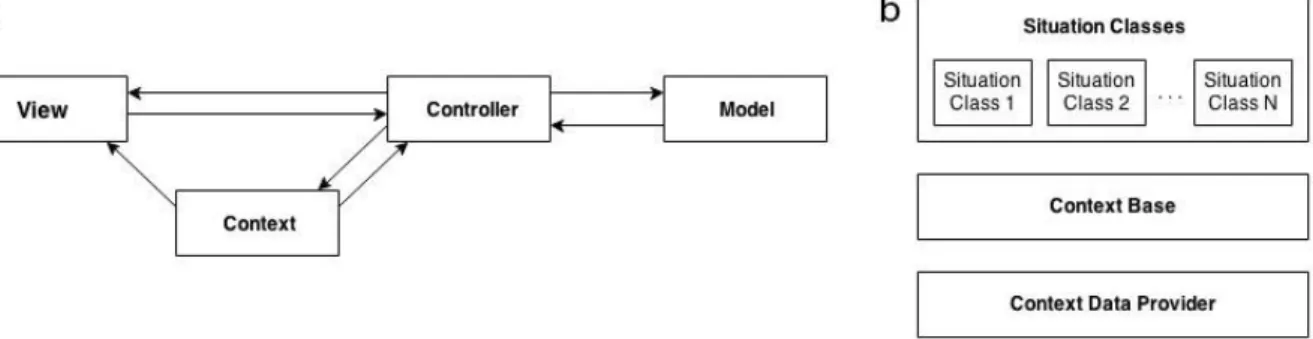
MVCC is a derivation of the Model-View-Controller (MVC) software pattern with the addition of Context component. MVC is an architectural pattern that mostly used in applications that has a user interface16. MVC
divides application development concerns into three interconnected parts: Model, View, and Controller. The main idea of this architectural pattern for this separation is that each component should be independent of other components as much as possible, and changes which made to one component do not compel programmer to make changes in other components. For instance, Graphical User Interface (GUI) of a program can update to the new style without having to change in the model or controller components. The goal of our proposal pattern is to assign context-aware duty to separate component and provide an easy way to employ contextual part from other components. Fig. 1.a illustrates this architecture. In this figure, Model, View, and Controller are responsible for doing predefined tasks in MVC architecture and Context component is responsible for separating context-awareness property from other components.
The model is part of the application that each request for a change or receive data should send to this component. The model is responsible for storage and management of application data and often getting help from DBMS for doing this aim. This component delivers appropriate response based on interactions from the end-user. The response will generate based on the information on the Model and application logics that implemented in the Controller. Also, Context component can apply filters to respond based on an existing situation. The Controller is responsible for hosting application logic codes and handling the relation of other components. This component receives a user request from the View and prepare an appropriate response by aiding the Model and Context components. Since the response was ready, Controller displays the result by manipulating the associated View file. Every command to apply changes or retrieve data from Model should pass from this component.
Context component is responsible for communication to CMS, modeling context data to a unified format, defining situations from high-level contexts, and presenting these situations to other components. Connection of Context to Controller means that Context should present the current situation to the Controller, and it can use this situation to make logical decisions in functionality of the program. Also, maybe application could be able to produce context information from entering data or interaction to end-users. This context information can help Context component to make more precise situations. Further, Controller should be able to send this information to Context component, and Context component can directly use this data or even send it to the CMS. In context-aware applications that have the User Interface (UI), there is a possibility that a developer decides to hide some of the elements or show them with minor changes. Context component should help View in such a situation, and connection from Context to View display this capability requirement.
4.2. Context’s Internal Architecture
In the previous section, we demonstrate position, tasks, and connection of Context with other components of the architecture. In this section, we decided to see the internal architecture of Context component and describe how each part of it works and which tasks are assigned to them. Fig. 1.b illustrates the internal architecture of this component. The Context organized from three layers which we describe each layer in further sections.
4.2.1. Context Data Provider
Context Data Provider is a layer for fetching high-level context information from CMS uniformly. As we described before, in the future a lot of CMS will introduce for different platforms. Developers will choose each of these CMSs based on their requirements and the platform that their application should run on. This CMSs may manage their communications in varied ways. For example, diverse communication protocols, different way for authentication and authorization, several context models, etc. Despite such diversity in protocols and communication styles, this layer should be able to interact with most CMSs. For instance, consider a context-aware application that is under developing and using an OOP language. Application developers do not care about which context modeling is used by CMS, they want to use context information in their object oriented language and this transformation is the main task of CDP. Ease of access to the CMS, switching CMS even after development, quick learning and easy utilization of CMSs, simultaneously using several CMSs, and increasing reusability of code are some advantages of this layer. The goal of this layer is a context-access abstraction layer for providing a uniform method of access to multiple CMS, and use the same functions for interaction to CMS.
4.2.2. Context Base
This layer is responsible for implementing common actions for the upper layer. These actions are methods that run the consecutive operations for reaching a specific goal. These consecutive operations usually contain several low-level API executions for connecting and sending requests to the specified CMS and subsequently receive and interpret the response. Implementing of these general actions will cause to acceleration and convenience of programming. Some of these actions could be reading and writing the context information, check for availability of a certain context property, refreshing cached context data, setting notifier for call to a callback function when a specific context data gets changed, etc. Table 1 is illustrating a sample code snippet that shows how using these predefined base functions, can reduce the size of the code. In this code snippet, we have set a notifier on property of the city name, and it will check if the user left his/her home town, the UserTravellingCallback function will call. Calling Update method causing to refresh all properties of the GpsSensor class to latest values that sensed by CMS. This task could be a collection of operations like connecting to the CMS, request for updating GPS data, receiving data from CMS, doing necessary transformation on data, and assigning these values to GpsSensor properties. These base methods will use extremely by situation classes that defined in the upper layer.
Table 1. Using predefined functions in context base. GpsSensor Location = new GpsSensor(); Location.Update();
if (Location.City == CurrentUser.HomeTown)
Location.City.OnChange(UserTravellingCallback);
4.2.3. Situation Classes
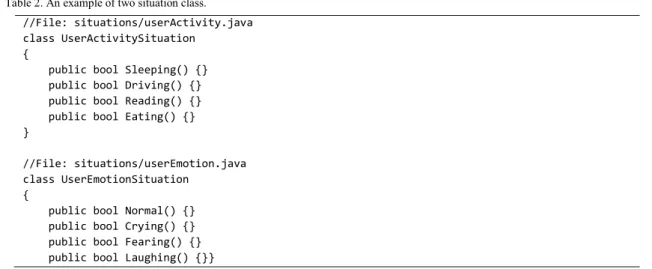
Programmer code for definition and recognition of situations will put in this layer. Developers should create a class within a file for each collection of related activities, or important entities of the application. Then each situation should be defined by a boolean method. For instance, human’s physical activities can consider as a
situation class, because it can contain situations like sleeping, eating, driving, watching TV, playing football, etc. Situations like crying, laughing, fearing, thinking, etc. are a set of human’s mental situations and can define as an
emotional situation class. Table 2 illustrates the code snippet of these classes. Creating each situation class in distinct file will permit developers to reuse these classes in future projects just by copying the file to situations’
folder of the new project. The collection of classes that defined in this layer should contain all of the required situations by application.
Table 2. An example of two situation class. //File: situations/userActivity.java class UserActivitySituation
{
public bool Sleeping() {} public bool Driving() {} public bool Reading() {} public bool Eating() {} }
//File: situations/userEmotion.java class UserEmotionSituation
{
public bool Normal() {} public bool Crying() {} public bool Fearing() {} public bool Laughing() {}}
Methods of situation classes have to use entire available context to reach more precision in their situation recognition. The body of the methods contain several conditional statements that are a composition of context information for detecting if a situation is stable or not. Recognizing of all states that causing to the establishment of a situation, should be based on available sensors and contextual information. Disability to recognize some of the states or false recognition of them will cause to a wrong situation detection. For this reason, it is better to have domain experts in the development team for writing these methods or just detecting state spaces.
After producing required situations, developers should be able to use them easily. These situations can be used by the Controller and View components in two major ways; synchronous and asynchronous. In synchronous mode programmers should check for establishment of the situation when writing code, and change the behavior of the application based on the situation. This job can be done by a simple If-Then statement. For example, table 3 is a
snippet code that shows how programmers can use the synchronous method to adjust a phone’s ringtone volume
based on the environmental noise. But in the asynchronous way, an occurrence of a situation causing to call a callback function. For instance, an energy management system of a smart home can program to decrease power consumption of the house to minimum value when habitants are asleep. Table 4 is illustrating how the programmer can call a method when the situation has just occurred.
Table 3. Calling situation methods synchronously. //File: controller/callManagement.java
EnvironmentSituation Env = new EnvironmentSituation(); if (Env.Noisy())
//Set ring volume to %100 else if(Env.Calm())
//Set ring volume to %50 else
//Set to %75 or default user selected
5.Conclusion
This paper has explained several developers’ problems in the application layer for context-aware application development. Then we have described several approaches to solve these problems, and propose several ways that
accelerate the development. These findings enhanced our understanding of the programmer’s requirements. Thus,
Context component to MVC architecture. Minimizing of writing codes, acceleration and convenience of the development process, reusability of situation recognition codes, and high flexibility in utilizing CMSs are the results of this separation. Developers of software frameworks can implement the results of this architectural pattern in their frameworks, or even they can write a context-aware framework from scratch based on this architectural pattern.
Table 4. Calling situation methods asynchronously. //File: situations/callbackRepository.java
HomeHabitantSituation ppl = new HomeHabitantSituation();
ppl.UpdateEachMinute(ppl.AllSleeping, 10).OnChange(PowerManagementCallback); //File: controller/energyController.java
public void PowerManagementCallback(bool sleeping) {
if (sleeping)
//Turn off lights, standby appliances, etc. else
//Rollback }
References
1. Baldauf M, Dustdar S, Rosenberg F. A survey on context-aware systems. International Journal of Ad Hoc and Ubiquitous Computing. 2007;2(4):263-77.
2. Dey AK, Abowd GD, Salber D. A conceptual framework and a toolkit for supporting the rapid prototyping of context-aware applications. Human-computer interaction. 2001;16(2):97-166.
3. Bardram JE. The Java Context Awareness Framework (JCAF)–a service infrastructure and programming framework for context-aware applications. Pervasive Computing: Springer; 2005. p. 98-115.
4. Gu T, Pung HK, Zhang DQ. A serviceϋoriented middleware for building contextϋaware services. Journal of Network and computer applications. 2005;28(1):1-18.
5. Wang X, Dong JS, Chin C, Hettiarachchi SR, Zhang D. Semantic space: An infrastructure for smart spaces. Computing. 2002;1(2):67-74. 6. Miller L, Seaborne A, Reggiori A. Three implementations of SquishQL, a simple RDF query language. The Semantic Web—ISWC 2002:
Springer; 2002. p. 423-35.
7. Pung HK, Gu T, Xue W, Palmes PP, Zhu J, Ng WL, et al. Context-aware middleware for pervasive elderly homecare. Selected Areas in Communications, IEEE Journal on. 2009;27(4):510-24.
8. Caus T, Christmann S, Hagenhoff S, editors. Hydra–An application framework for the development of context-aware mobile services. Business Information Systems; 2008: Springer.
9. De Miranda DC, Valente MTO, editors. A Flexible and Extensible Component-Oriented Middleware for Creating Context-Aware Applications. Pervasive Services, 2006 ACS/IEEE International Conference on; 2006: IEEE.
10. Guo B, Zhang D, Imai M. Toward a cooperative programming framework for context-aware applications. Personal and Ubiquitous Computing. 2011;15(3):221-33.
11. Martín D, López-de-Ipiña D, Alzua-Sorzabal A, Lamsfus C, Torres-Manzanera E. A Methodology and a web platform for the collaborative development of context-aware systems. Sensors. 2013;13(5):6032-53.
12. Zhang T, editor An architecture for building customizable context-aware applications by end-users. Pervasive 2004 Doctoral colloquium; 2004.
13. Martín D, de Ipiña DL, Lamsfus C, Alzua A. Situation-Driven development: a methodology for the development of context-aware systems. Ubiquitous Computing and Ambient Intelligence: Springer; 2012. p. 241-8.
14. Bettini C, Brdiczka O, Henricksen K, Indulska J, Nicklas D, Ranganathan A, et al. A survey of context modelling and reasoning techniques. Pervasive and Mobile Computing. 2010;6(2):161-80.
15. Medvidovic N, Taylor RN, editors. Software architecture: foundations, theory, and practice. Proceedings of the 32nd ACM/IEEE International Conference on Software Engineering-Volume 2; 2010: ACM.
16. Krasner GE, Pope ST. A description of the model-view-controller user interface paradigm in the smalltalk-80 system. Journal of object oriented programming. 1988;1(3):26-49.