Similarity Measures for Scientific Workflows
D I S S E R T A T I O N
zur Erlangung des akademischen Grades
Dr. Ing.
im Fach Informatik
eingereicht an der
Mathematisch-Naturwissenschaftlichen Fakultät
Humboldt-Universität zu Berlin
von
Dr.med. Dipl.-Inf. Johannes Starlinger
Präsident der Humboldt-Universität zu Berlin:
Prof. Dr. Jan-Hendrik Olbertz
Dekan der Mathematisch-Naturwissenschaftlichen Fakultät:
Prof. Dr. Elmar Kulke
Gutachter:
1. Prof. Dr. Ulf Leser
2. Prof. Dr. Mathias Weske
3. Prof. Dr. Carole Goble
eingereicht am:
16.12.2014
Acknowledgements
This thesis would not have made it to submission without the continuous support and encouragement by a number of people.
First of all, I thank my supervisor, Prof. Ulf Leser, for the opportunity to pursue research in his group. He balanced analytical stimulus, scientific guidance, and a reasonable amount of laissez-faire patience with my endeavors just right to provide a fruitful research environment over the past years. I greatly enjoyed working with him and have learnt many a lesson well beyond this thesis. On the same lines, the ongoing exchange of ideas and critical assessment of my work, and the motivation provided by Prof. Sarah Cohen-Boulakia have been invaluable. Thank you so much! I thank Prof. Susan B. Davidson for providing me with guidance and support, and Prof. Sanjeev Khanna for our inspiring discussions during my time as a visiting scholar at Penn, that brought forward some important aspects of this thesis.
I was lucky to conduct this thesis’ research under regular review by the board of supervisors in the SOAMED graduate school, especially Prof. Weske, and my fellow graduate students at SOAMED and WBI in Berlin, and Bryan Brancotte at Université Paris-Sud, who listened and engaged in sometimes eager discussions, and created a very welcoming working environment.
My wife Katrin greatly supported my work not only by tolerating the sometimes quite askew work times, but also by listening to the challenges I faced and providing a different and often very helpful perspective to them. Last but not least, my parents always supported me in persuing my academic career. I can not thank them enough. The DFG RTG SOAMED and DAAD grants D1240894 and 55988515 provided funding for the research presented in the following. Thank you very much!
Abstract
Over the last decade, scientific workflows have been gaining an increasing amount of attention as a valuable tool for scientists to create reproducible in-silico experiments. For design and execution of such workflows, scientific workflow management systems have been developed, such as Taverna, Kepler, Galaxy, and several others. These enable the user to (often visually) create pipelines of tasks to be carried out on the data, including local scripts and applications and web-service calls. Yet, creating scientific workflows is still a laborious task and complex enough to prevent many non computer-savvy re-searchers from using these tools. As a consequence, there has recently been growing interest in sharing, reusing and repurposing existing workflows. This is reflected by the emergence of online repositories for scientific workflows, which allow workflows to be uploaded, searched, and downloaded by the scientific community. With increasing size of such repositories, methods to compare the scientific workflows stored in them regarding their functional similarity become a necessity. For instance, to allow duplicate detection, similarity search, or grouping of workflows into functional clusters, similarity measures for scientific workflows are an essential prerequisite.
This thesis investigates similarity measures for scientific workflows. We carry out four consecutive research tasks: First, we closely investigate the relevant properties of scientific workflows and their components regarding their simi-larity and identify characteristics of their re-use. Second, we review and dis-sect existing approaches to scientific workflow comparison into a defined set of subtasks necessary in the process of workflow comparison, and re-implement previous approaches to each subtask. We create a large gold-standard corpus of expert-ratings on workflow similarity, with more than 2400 ratings provided
for 485 pairs of workflows by 15 workflow experts from 6 institutions. For
the first time, this allows comprehensive, comparative evaluation of different scientific workflow similarity measures, confirming some previous findings, but rejecting others. Third, we propose and evaluate a novel method for scientific workflow comparison. We show that this novel method provides results of both higher quality and higher consistency than previous approaches, and can easily be stacked and ensembled with other approaches for still better performance and higher speed. Fourth, we show how our findings from the previous steps can be leveraged to implement a search engine using off-the-shelf tools. This search engine performs fast, high quality similarity search for scientific work-flows at repository-scale, addressing a premier area of application for similarity measures for scientific workflows.
Zusammenfassung
In Laufe der letzten zehn Jahre haben Scientific Workflows als nützliches Werkzeug für Wissenschaftler zur Erstellung von reproduzierbaren in-silico Ex-perimenten in zunehmendem Maße an Aufmerksamkeit gewonnen. Für die Er-stellung, Ausführung und Verwaltung solcher Workflows wurden spezielle Sys-teme entwickelt wie etwa Taverna, Kepler, Galaxy und einige andere. Diese ermöglichen es dem Nutzer, (oft visuell) Piplines von datenverarbeitenden Ak-tivitäten zu erstellen, die sowohl lokale Skripte und Anwendungen, als auch Aufrufe von Web-Services beinhalten können. Trotzdem ist das Erstellen eines Scientific Workflows aufwendig und hinreichend komplex, um
computeruner-fahrene Nutzer am Gebrauch dieser Systeme zu hindern. In jüngerer Zeit
wächst daher das Interesse daran, bereits existierende Workflows weiterzugeben, wiederzuverwenden und zu modifizieren. Dies drückt sich im Entstehen von Online-Bibliotheken, sogenannten Repositories, aus, die speziell dafür entwick-elt wurden, Workflows zu veröffentlichen, zu suchen, und herunterzuladen. Mit zunehmender Größe dieser Repositories werden Methoden zur Notwendigkeit, die einen Verleich von Scientific Workflows hinsichtlich ihrer funtionalen Ähn-lichkeit erlauben. Um etwa die Erkennung von Duplikaten, ÄhnÄhn-lichkeitssuche oder die Gruppierung von Workflows in funktionale Cluster zu ermöglichen, sind Ähnlichkeitsmaße für Scientific Workflows eine unabdingbare Voraussetzung.
Die vorliegende Arbeit untersucht Ähnlichkeitsmaße für Scientific Workflows. Wir leisten dabei vier aufeinanderfolgende Forschungsbeiträge: Als erstes unter-suchen wir eingehend ähnlichkeitsrelevante Eigenschaften von Scientific Work-flows und ihrer Komponenten und identifizieren Charakteristika für die Wieder-verwendung dieser Komponenten über mehrere Workflows hinweg. Als zweites analysieren wir existierende Lösungen für das Vergleichen von Scientific Work-flows, zerlegen diese in eine definierte Anzahl von Unterschritten, die für das Vergleichen von Workflows notwendig sind, und reimplementieren existierende Anzätze für jeden dieser Unterschritte. Wir erstellen einen großen Gold-Stan-dard Corpus mit von Experten bewerteten Workflowähnlichkeiten, der über 2400 Bewertungen für 485 Workflowpaare enthält, die von 15 Workflowexperten aus 6 Institutionen beigetragen wurden. Zum ersten Mal erlauben diese Vorar-beiten eine umfassende, vergleichende Evaluation verschiedener Ähnlichkeits-maße für Scientific Workflows, in der wir einige vorige Ergebnisse bestätigen, andere aber revidieren. Als drittes stellen wir ein neue Methode für das Ver-gleichen von Scientific Workflows vor. Unsere Evaluation zeigt, dass diese neue Methode sowohl bessere als auch konsistentere Ergebnisse liefert und darüber hinaus leicht mit anderen Ansätzen kombiniert werden kann, um eine weitere Qualitätssteigerung bei gleichzeitiger Beschleunigung zu erreichen. Als viertes zweigen wir, wie die Resultate aus den vorangegangenen Schritten genutzt wer-den können, um mit Hilfe von Standardkomponenten eine Suchmaschine zu implementieren. Diese Suchmaschine erlaubt schnelle, qualitativ hochwertige Ähnlichkeitssuche im Repositorymaßstab und adressiert damit ein vorrangiges Anwendungsfeld von Ähnlichkeitsmaßen für Scientific Workflows.
Contents
1 Introduction 1
1.1 Motivation . . . 1
1.2 Contribution . . . 4
1.3 Outline of this Thesis . . . 6
1.4 Own Prior Work . . . 7
2 Scientific Workflows and Workflow Similarity 9 2.1 Scientific Workflows . . . 9
2.1.1 Modules, Datalinks and Dataflows . . . 11
2.1.2 Other Workflow Concepts . . . 17
2.2 Infrastructure for Scientific Workflows . . . 20
2.2.1 Scientific Workflow Management Systems . . . 20
2.2.2 Scientific Workflow Repositories . . . 22
2.3 Similarity of (Scientific) Workflows . . . 25
2.3.1 Functional Similarity of Scientific Workflows . . . 25
2.3.2 Approaches to Workflow Similarity . . . 25
3 Component (Re)Use in Public Scientific Workflow Repositories 31 3.1 Materials and Methods . . . 32
3.1.1 Data Sets . . . 32
3.1.2 Identifying Shared Workflow Elements . . . 35
3.2 Results . . . 37
3.2.1 Modules . . . 37
3.2.2 Dataflows . . . 41
3.2.3 Workflows (Top-Level Dataflows) . . . 43
3.3 Discussion . . . 43
3.4 Summary . . . 46
4 A Benchmark for Scientific Workflow Similarity Search 49 4.1 A Framework for Scientific Workflow Similarity . . . 51
4.1.1 Structure-based Measures . . . 53 4.1.2 Annotation-based Measures . . . 59 4.2 Previous Findings . . . 60 4.3 Experimental Setup . . . 61 4.3.1 Workflow Dataset . . . 61 4.3.2 Expert Ratings . . . 62 4.3.3 Evaluation Metrics . . . 63
Contents
4.4 Results . . . 64
4.4.1 Workflow Ranking . . . 64
4.4.2 Workflow Retrieval . . . 70
4.4.3 Evaluation on Second Data Set . . . 73
4.5 Conclusion . . . 74
5 Layer Decomposition Similarity of Scientific Workflows 77 5.1 Related Work . . . 78 5.2 Preliminaries . . . 78 5.2.1 Module Comparison . . . 79 5.2.2 Module Mapping . . . 80 5.2.3 Normalization . . . 80 5.2.4 External Knowledge . . . 80
5.3 Layer Decomposition Workflow Similarity . . . 81
5.3.1 Topological Decomposition . . . 82 5.3.2 Topological Comparison . . . 83 5.3.3 Normalization . . . 84 5.4 Evaluation . . . 84 5.4.1 Workflow Ranking . . . 85 5.4.2 Workflow Retrieval . . . 87 5.4.3 Runtime . . . 88
5.4.4 Reranked Retrieval Results . . . 91
5.4.5 Applicability to Other Datasets . . . 93
5.5 Conclusion . . . 94
6 Accelerating Similarity Search in Scientific Workflow Repositories 95 6.1 Two-phase Retrieval Architecture . . . 96
6.1.1 Workflow Indexing and Retrieval . . . 96
6.1.2 Structure-based Result Reranking . . . 100
6.2 Related Work . . . 102
6.3 Evaluation . . . 102
6.3.1 Retrieval Quality . . . 103
6.3.2 Runtime . . . 108
6.4 Conclusion . . . 112
7 Summary and Outlook 115 7.1 Summary . . . 115
7.2 Future Directions . . . 116
1 Introduction
1.1 Motivation
Over the last decades, the role of computers in natural sciences’ research has steadily grown, and has shifted from a merely supporting to a fundamentally necessary one.
This is reflected by the notion of in-silico experiments: computer-aided methods
of data processing have become a major part of the experimental setup in many sciences [48]. Traditionally, these methods have been implemented in the form of custom scripts and applications, created by computer-savvy scientists to cope with their specific data processing needs. Such scripts are usually hard to maintain and reuse, which hinders both reproducibility and sharing of methods. Also, the hur-dle of learning - and mastering - a programming language to conduct research, is counterproductive to scientific advances in many fields.
To overcome these obstacles, scientific workflows have been introduced [7]. The
term scientific workflow refers to the intended target audience of such workflows, the scientists, rather than these workflows being an interesting research object in their own right, or even a possible requirement of being a scientist to create such workflows. Scientific workflows strive to replace the legacy of scripting and com-mand line based approaches to data extraction, processing, and analysis currently still prevalent in many fields of data-intensive scientific research by enabling the user to declaratively, and often visually create pipelines of tasks to be carried out on the data, including both local scripts and applications, and web-service calls. As such, scientific workflows have gained an increasing amount of attention as a valuable tool for scientists to create reproducible in-silico experiments [41] and, today, are used in a variety of domains, including biology, chemistry, geosciences, medicine, or physics [41]. Recently, interest in scientific workflows has further been fueled by the incent of new scientific paradigms: Both processing of very large scientific datasets, i.e., ’Big Data’, and sharing of computational methods to ease scientific collaboration in the age of e-Science, are forthcoming necessities scientific workflows lend themselves to [91].
For design and execution of scientific workflows, specialized applications, termed scientific workflow management systems (SWFM), are available. Examples of these SWFMs include Taverna [68], Kepler [14], VisTrails [38], or Galaxy [45]. Yet, while easier than traditional programming, creating scientific workflows using an SWFM is still a laborious task and complex enough to prevent many non computer-savvy researchers from using these tools [90]. Especially for the primary target audience of scientific workflows, the scientists, this hurdle is often still too high. As a
con-1 Introduction
sequence, the increasing use of scientific workflows themselves has come with great interest in sharing, reusing and repurposing such workflows: Once designed, a scien-tific workflow is a valuable piece of knowledge, encoding a (usually proven) method
for analyzing a given data set (much like an executable Methods part of a paper).
Sharing such workflows between different authors and research groups is a natural next step towards increasing collaboration in research which may have a large im-pact on research, in the same manner as the increased sharing of data sets across the Internet was important for advancing science [10]. This is reflected by the emer-gence of online repositories for scientific workflows, such as CrowdLabs [64], SHIWA [3], the repositories offered with Kepler [14] and Galaxy [45], or myExperiment [74], currently containing more than 2500 workflows from various disciplines. Such repositories, together with the increasing number of workflows uploaded to them, raise several new research questions to address the challenges of managing large collections of scientific workflows and for using them as a source of expert-supplied knowledge [21, 44].
One such question is how to best enable both manual and automatic discovery of the workflows in a repository to support the user in finding the appropriate workflow for a given task or dataset. Here, challenges include the detection of func-tionally equivalent workflows, grouping of workflows into functional clusters, the use of existing workflows in the design of novel workflows, or similarity-based work-flow retrieval [82, 78, 76, 8, 43]. For instance, arranging workwork-flows into (possibly hierarchical) clusters of equivalent or highly similar functionality, would enable the user to browse the repository along functional categories to discover workflows of interest. Similarly, applying such clustering to the - sometimes extensive - lists of results retrieved from large repositories in response to an initial, keyword driven search for suitable workflows, could greatly benefit the user in selecting the best workflow from amongst those results. Or, given a workflow they have used before, similar (or complementary) workflows could be suggested which would be instantly executable on the data at hand. The ultimate goal is to allow scientists to use scientific workflows without detailed knowledge of the process of their creation, by providing them with optimal methods of searching - and finding - relevant workflows. The core operation necessary for meeting any of these challenges of workflow dis-covery and enabling their use cases is the algorithmic comparison of two workflows regarding their functional similarity, i.e., similarity measures for scientific work-flows [21]. Only when algorithms of sufficient quality are available to automatically assess whether two workflows do the same, similar or even related things, can these workflows be clustered or recommended. Such assessment is inherently difficult: On the one hand, scientific workflows in public repositories can be richly annotated, and such annotations may be used to assess their function and similarity. Yet, quality and availability of annotations vary greatly between repositories and, more generi-cally, may not be available on a sample workflow a user is searching with. Scientific workflows themselves, on the other hand, represent graphs, and an enormous body
1.1 Motivation
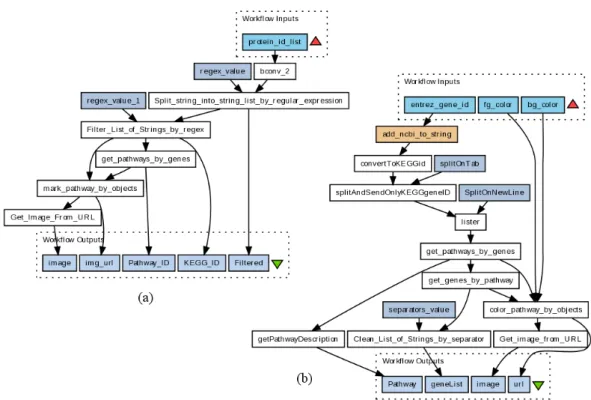
Figure 1.1: Two scientific workflows from myExperiment: (a) ID: 1189, Title: KEGG
pathway analysis, (b) ID: 2805, Title: Get Pathway-Genes by Entrez gene id.
of research exists on graph comparison. Yet, it is not clear to what extent func-tional similarity of workflows is linked to them being structurally similar. The two workflows shown in Figure 1.1, for instance, arguably offer similar functionality (pro-viding information on relevant metabolic pathways for an input gene or protein), but their structures exhibit a number of differences. Furthermore, each node of such a workflow graph is a distinct data processing task and thus represents a distinct functional element in its own right. From the workflow perspective, each such ele-ment is a blackbox, only exposing a limited set of information for assessele-ment of its functionality. How to best identify and compare elements between workflows given this information is still an open question.
This thesis investigates similarity measures for scientific workflows and develops algorithms that deliver high quality results in functional comparison of scientific workflows. In the following sections, we give an overview of our specific contributions and achievements, followed by an outline of the thesis’ structure, and an account of own prior work in preparation of this thesis.
1 Introduction
1.2 Contribution
The central goal of this thesis is to study methods for the automatic assessment of similarity between scientific workflows, especially in the context of large scientific workflow repositories. In summary, we start at a detailed analysis of workflows and their components in the to-date largest such repository, and continue with an evalua-tion of existing approaches to scientific workflow comparison. Based on our findings, we propose a novel approach to structure-based comparison of scientific workflows which outperforms previous approaches, and show how it can be effectively stacked and ensembled with other approaches and state-of-the-art information retrieval tech-nology to achieve fast, high quality results.
We make the following main contributions:
Re-use characteristics of workflows and their elements
To compare scientific workflows, the first step is to investigate which elements are shared between workflows, and how these elements can be identified and charac-terized. Looking closely at almost 900 workflows contained in the largest public scientific workflow repository to-date, we make a number of contributions:
• We explore different methods to identify workflows and their components and
determine the most suitable method for detecting re-use.
• We characterize workflow elements not only by the quantity, but especially by
the quality of their re-use. Following a functional categorization of workflow elements, we are able to distinguish trivial elements from functionally specific ones. We show that the appearance of single workflow elements in multiple workflows is not per se an indication of functional similarity, and that not all elements are equally well suited for deriving information about functional workflow similarity.
• For the first time, we consider not only sharing of elements across workflows,
but also between authors. This allows us to observe that while overall 36% of workflow elements are re-used, only 11% are used by more than one author. This finding greatly supports our motivation of improving workflow discovery through respective similarity measures.
A Framework and Gold-Standard Corpus for Benchmarking Scientific Workflow Similarity Measures
The process of (especially structure-based) comparison of scientific workflows en-tails several steps. These range from comparison of single workflow elements, to the assessment of the overall similarity value for two entire workflows. Approaches to scientific workflow comparison proposed in previous work have addressed these steps rather heterogeneously and sometimes only implicitly, focusing on the most
1.2 Contribution
prominent aspect of workflow topology. This heterogeneity greatly hinders compar-ative evaluation of different methods. Additionally, previous evaluations have been carried out either by manual inspection of an algorithm’s output, on small corpora which are not publicly available, or by mere comparison to a baseline derived from another computational approach – without consideration of human judgment. A major goal of this thesis is to allow full systematic comparison of different methods for which we make the following specific contributions:
• We carefully analyze previous approaches to measuring scientific workflow
sim-ilarity and identify a set of necessary steps in the process of workflow compari-son. Dissecting previous work along this process, we comprehensively enumer-ate different approaches taken at each step.
• We set up a framework implementing the workflow comparison process and
various methods for each step as adopted from previous work. This framework allows to separate and combine each such method at each step for thorough evaluation. In the framework, we further extend the process of workflow com-parison to (optionally) include external knowledge derived from a scientific workflow repository to investigate how such knowledge may benefit workflow comparison quality. Altogether, 288 different setups for the process as a whole are available.
• We collect the to date largest corpus of human workflow similarity ratings,
contributed by 15 workflow experts from 6 institutions in 4 countries, which contains more than 2400 similarity ratings for 485 pairs of scientific workflows over a repository of almost 1500 workflows from the Taverna scientific work-flow management system. The corpus consists of two sets of ratings: The first set of 1900 similarity ratings over 24 query workflows and ranked lists of 10 workflows compared to each query workflow is independent of any concrete algorithm. It is thus suitable for evaluation both of large sets of algorithms, and of new algorithms to be developed in the future. The second set of ratings was specifically collected for pairs of workflows from the result lists returned by selected, promising algorithms for similarity search over a given repository to determine retrieval quality. For cross-repository evaluation, the corpus ad-ditionally contains 181 ratings over a dataset of 139 workflows from the Galaxy system. We make the whole corpus publicly available.
• For the first time, framework and corpus together allow for a comprehensive
and systematic, comparative evaluation of different settings and approaches used for each step of the workflow comparison process. We pinpoint different options at each such step, investigate how they influence the quality of the resulting similarity measures as a whole, and combine different measures into ensembles to further improve result quality. Finally, we trace our findings back to the properties of scientific workflows in a number of online repositories.
1 Introduction
Layer Decomposition: a Novel Structure-Based Approach for Scientific Workflow Similarity and its Application to Fast Similarity Search at Repository-Scale
Our observations from the differentiated evaluation of existing approaches to mea-suring scientific workflow similarity indicate potential for improvement with respect to how the workflows’ topology is compared: On the one end, approaches that only consider the data processing tasks contained in the compared workflows, and disre-gard the way they are connected with each other, deliver results of satisfying quality only when other steps of the comparison process are tuned to match the specific properties of a given repository - which limits their applicability to off-the-shelf deployment. On the other end, comparing workflow topologies by substructures greatly reduces the amount of tuning necessary, but is too slow for application at repository-scale. Targeting this apparent trade-off between speed and stability, we make the following contributions:
• We propose a novel approach to the assessment of scientific workflow
similar-ity. This approach is based on a concise representation of the partial order of a
workflow’s modules, which we term Layer Decomposition. This approach not
only provides best results in comparison to previous measures, but requires as little tuning as previously found for substructure-based comparison. At the same time, while naturally still being outrun by fully structure-agnostic algo-rithms, our approach is much faster than other structure-aware approaches.
• Specifically targeting the use case of similarity search over a large scientific
workflow repository, we investigate how multiple different comparison methods can be stacked and ensembled to maximize both speed and quality. We imple-ment a system that uses state-of-the-art docuimple-ment indexing for fast
structure-agnostic retrieval of candidate workflows, which are reranked by our Layer
Decomposition approach. Evaluation shows that this system not only deliv-ers high quality results, but is faster than the fastest standalone approach to structure-based workflow comparison by several orders of magnitude.
1.3 Outline of this Thesis
Chapter 2 introduces the necessary concepts and applications, including scientific workflows and online repositories for publishing and reusing them, and gives an overview of related work in the field of workflow comparison.
Chapter 3 presents our analysis of the workflows contained in the to-date largest publicly accessible scientific workflow repository, myExperiment [74], investigating how workflows and their elements are used and re-used across workflows and their authors, and identifying characteristics of most commonly used elements.
1.4 Own Prior Work Chapter 4 closely inspects the process of scientific workflow comparison and gives a detailed review of previous work, describing how each aspects of the comparison process has been treated. The collection of a human-annotated corpus of similarity ratings is described, on which a rich set of previous approaches is comprehensively evaluated.
Chapter 5 proposes a novel approach to structure-based assessment of scientific workflow similarity, designed to balance the amount of structural information taken into account against runtime considerations. We observe how this approach follows from our findings in the previous chapters and provide a comparative evaluation of its quality in similarity search, and of its runtime properties. We also explore options for further speedup of repository-scale retrieval.
Chapter 6 makes direct use of these findings, presenting a proof-of-concept imple-mentation of structure-aware similarity search for scientific workflows at repository-scale which we show to provide high quality results at high speed.
Chapter 7 concludes the thesis with a summary of its findings, and an outlook on future work.
1.4 Own Prior Work
Chapter 3 presents an analysis of (re)use of workflows and their elements in a large public repository, which has been published by Starlinger et al [81] with multiple authors. The authors’ roles can be assigned as follows: Leser supervised the work. All analysis work was done by Starlinger. Starlinger wrote the the manuscript which was critically revised by Leser and Cohen-Boulakia.
Chapter 4 presents a framework for and evaluation of similarity measures for sci-entific workflows, which has been published by Starlinger et al [79] with multiple authors. The authors’ roles can be assigned as follows: The work was conceived by Leser and Starlinger. Leser and Cohen-Boulakia supervised the work. Bran-cotte provided methods for consensus ranking of expert ratings. All implementation (apart from consensus ranking) and evaluation was done by Starlinger. Starlinger wrote the manuscript, which was critically revised by Leser and Cohen-Boulakia. Chapter 5 presents a novel approach to scientific workflow comparison which has been published by Starlinger et al [80] with multiple authors. The authors’ roles can be assigned as follows: Davidson, Khanna, and Starlinger conceived the Layer Decomposition idea. The work was supervised by Leser and Davidson. Implemen-tation and evaluation was done by Starlinger. Starlinger wrote to the manuscript, which was critically revised by Leser, Davidson, Khanna, and Cohen-Boulakia.
2 Scientific Workflows and Workflow
Similarity
In this chapter, we introduce the core concepts of scientific workflows and review how they compare to other types of workflows, including the well studied area of business workflows and processes. In Section 2.2 we provide an overview of existing systems for the creation, management, and storage of scientific workflows, and target the properties of current scientific workflow repositories. In Section 2.3 we then give a comprehensive account of previous work on workflow comparison both for scientific workflows and for other types of workflows.
2.1 Scientific Workflows
Scientific workflows have been introduced as a means to ease the creation of data processing and analysis pipelines for in-silico experiments [7]. These workflows not only lend themselves to the automated processing of large volumes of data, but also facilitate sharing, reuse, and re-purposing of computational methods. Therefore, it is not surprising that both deployment of, and research in scientific workflows have lately gained additional momentum in the context of the e-Science and Big Data movements. Nowadays, scientific workflows are used in a variety of domains, including physics, chemistry, geosciences and the life sciences, in particular, biology and biomedicine [41]. Prominent examples of scientific workflows thus exist in several
of these domains: TheMontage [11] astrophysics workflow generates mosaic images
from telescope surveillance photographs of the sky;CyberShake[47] is a workflow to
compute a specific geographical site’s earthquake hazard estimate from a variety of sources of information; and in biology, workflows for the processing and analysis of
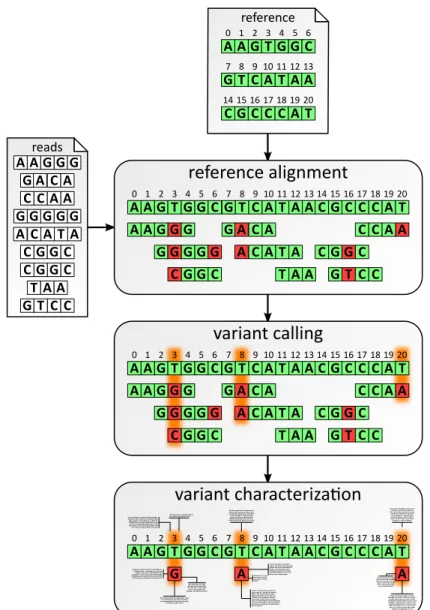
Next Generation Sequencing (NGS)data are establishing themselves as an invaluable tool for processing the large quantities of input data these experiments produce [86]. An abstract example of such an NGS-workflow is shown in Figure 2.1 where the short nucleotide sequences read by the sequencing machine are automatically aligned and mapped to a given reference genome, to assess information on genetic variations discovered in consecutively executed analysis steps. Note that we contrast the abstract workflow shown in Figure 2.1 to concrete workflows in Section 2.1.1 (page 15).
The overall tasks these three workflows carry out, while being rather different in the intended area of application, share the same anatomy: Scientific workflows follow
a modular design, where a variety of tools, or modules, are composed to create the
2 Scientific Workflows and Workflow Similarity G AAG G GA C A A C C A GGGGG C A T A A C GGC C G G C T A A G T C C reads
reference alignment
AAG TGGC 0 1 2 3 4 5 6 G T C A T A A 7 8 9 10 11 12 13 C 14 G 15 C 16 C 17 C 18 A T 19 20 G AAG G C C AA T A A GGGGG C G G C C A T A A GA C A GT C C C GGCvariant calling
AAG TGGC 0 1 2 3 4 5 6 G T C A T A A 7 8 9 10 11 12 13 C 14 G 15 C 16 C 17 C 18 A T 19 20 G AAG G C C AA T A A GGGGG C G G C C A T A A GA C A GT C C C GGCvariant characteriza
�
on
Alice took up the fan and gloves, and, as the hall was very hot, she kept fanning herself all the time she wenton talking: 'Dear, dear!
Her first idea was that she had somehow fallen into the sea, 'and in that case I can go back by railway,' she said to herself. 'Perhaps it doesn't understand English,'
thought Alice; 'I daresay it's a Frenchmouse, come over with William the Conqueror.' (For, with all her knowledge of history, Alice had no very clear notionhow long ago anything had happened.) 'I'm sure those are not the right words,' said poor Alice, and her eyes tears again as she went on, 'I must befilled with Mabel after all, and I shall have to go and live in that poky little house, and have next to no toys to play with, and oh! ever so many lessons to learn!
'Not like cats!' cried the Mouse, in a shrill, passionate voice.
AAG TGGC 0 1 2 3 4 5 6 G C 14 G 15 C 16 C 17 C 18 A T 19 20 A 'It was much pleasanter at home,' thought poor Alice, 'when one wasn't always growing larger and smaller, and being ordered about by mice and rabbits. I almost wish I hadn't gone down that rabbit-hole—and yet—and yet—it's rather curious, you know, this sort of life! I do wonder what CAN have happened to me! Presently the Rabbit came up to the door, and tried to open it; but, as the door opened inwards,and Alice's elbow was pressed hard against it, that attempt proved a failure. Alice heard it say to itself 'Then I'll go round and get in at the window.'
Alice noticed with some surprise that the pebbles were all turning into littlecakes as they lay on the
floor, and a bright idea came into her head. The first question of course was,
how to get dry again: they had a consultation about this, and after a few minutes it seemed quite natural to Alice to find herself talking familiarly with them, as if she had known them all her life.
'Ahem!' said the Mouse with an important air, 'are you all ready? This is the driest thing I know. Silence all round, if you please! "William the Conqueror, whose cause was favoured by the pope, was soon submitted to by the English, who wanted leaders, and had been of late much accustomed to usurpation and conquest.
'But who is to give the prizes?' quite a chorus of voices asked.
It did so indeed, and much sooner than she had expected: before she had drunk half the bottle, she found her head pressing against the ceiling, and had to stoop to save her neck from being broken. G T C A T A A 7 8 9 10 11 12 13 A reference AAG TGG C 0 1 2 3 4 5 6 G T C A T A A 7 8 9 10 11 12 13 C 14 G 15 C 16 C 17 C 18 A T 19 20
Figure 2.1: Abstract sample workflow for the processing and analysis of experimental data from next generation sequencing. Courtesy of Marc Bux, [17]
by datalinks, where each module automatically passes its output to the successive one. While this conceptual anatomy of scientific workflows is rather generic, a vast number of different implementations of this concept exist. These implementations
come in the form of so called Scientific Workflow Management Systems (SWFM),
each of which has its own set of features, and typically uses its own syntactic format for storing the workflows created in it.
Before we turn to a review of the features of popular SWFM in Section 2.2.1, we here give a more detailed description of the core concepts of scientific workflows common to most of these systems - especially those relevant in the light of this thesis.
2.1 Scientific Workflows
We also formally define the notion of scientific workflows considered, and introduce the nomenclature used throughout this thesis. Again, in the broad landscape of scientific workflow systems, not all systems strictly adhere to the concepts described here but provide extensions or adaptions. For instance, it is not uncommon for scientific workflows systems to provide means to the user to explicitly manipulate the underlying flow of execution control within the workflow. We make note of these variations, and provide real world examples from existing SWFM were necessary.
2.1.1 Modules, Datalinks and Dataflows Data Processing Modules in Scientific Workflows
A scientific workflow consists of a number of distinct subtasks, and each of these sub-tasks usually represents a full data processing step in its own right. For instance, the
subtask ofreference alignment in the NGS workflow example of Figure 2.1 compares
each of the plenitude of short read sequences output by the sequencing machine to a given genome, chromosome, or other nucleotide sequence to act as a reference, and maps it to the most appropriate genetic location. Often, more than one im-plementation of such a (sub)task exists, e.g., Bowtie [55], BWA [57], or Perm [18]
for reference alignment. Such implementations are used asmoduleswithin a given
workflow, and are treated as blackbox components, i.e., no information about their internal working is available.
Technically, each task is usually wrapped into a container to provide a uniform interface within the workflow, regardless of how the task is invoked. Thus, strictly
speaking, when we saymodule, we refer to such a container – which is parameterized
by the type of operation to carry out (e.g.,web-service call orlocal executable), and
the operation’s concrete configuration (e.g., the web-service’s url or the executable’s path in the filesystem). Which types of operations are available and which config-uration parameters these expose, depends on the concrete SWFM, just as much as schema and syntax of their storage in an SWFM-specific workflow file format do.
Listings 2.1 and 2.2 contrast the module representation in theScuflworkflow format
supported by Taverna [68], to the format used by Galaxy [45].
While type and configuration parameters are carefully encoded in the XML schema of the Scufl workflow, containing only the necessary information, the module’s def-inition in the Galaxy workflow contains an extensive set of attributes, including positional information for where the module was laid out in the graphical repre-sentation in the SWFM, whereas the specific configuration of the wrapped tool is
stringified in thetool_state parameter. Despite the apparent heterogeneity, for any
given module independent of its type, the configuration most typically includes a
descriptive label or name reflecting the module’s functionality (which is often
pro-vided by the workflow author), but it does not include any semantic annotations. To formally capture this diversity, we represent the configuration of a module as a
setA of pairs of attributesaand valuesv:
2 Scientific Workflows and Workflow Similarity
Listing 2.1: Module definition in Taverna’s Scufl XML format
< s : p r o c e s s o r name=" g e t P 5 3 M u t a t i o n s B y I d s "> < s : d e s c r i p t i o n>
Get t p 5 3 g e n e m u t a t i o n s by i d s from TP53 IARC d a t a b a s e ( s e e h t t p : // s r s . o 2 i . i t / s r s 7 1 / ) </ s : d e s c r i p t i o n> <s : s o a p l a b w s d l> h t t p : // b i o i n f o r m a t i c s . i s t g e . i t : 8 0 8 0 / a x i s / s e r v i c e s / o 2 i . g e t P 5 3 M u t a t i o n s B y I d s </ s : s o a p l a b w s d l> </ s : p r o c e s s o r>
Listing 2.2: Module definition in Galaxy’s workflow format
" 5 " : { " a n n o t a t i o n " : " " , " i d " : 5 , " i n p u t _ c o n n e c t i o n s " : { " i n p u t " : { " i d " : 4 , " output_name " : " o u t _ f i l e 1 " } } , " i n p u t s " : [ ] , " name " : " Cut " , " o u t p u t s " : [ { " name " : " o u t _ f i l e 1 " , " t y p e " : " t a b u l a r " } ] , " p o s i t i o n " : { " l e f t " : 2 8 2 . 3 8 3 3 3 1 2 9 8 8 2 8 1 2 , " t o p " : 381 } , " p o s t _ j o b _ a c t i o n s " : { } , " t o o l _ e r r o r s " : n u l l , " t o o l _ i d " : " Cut1 " , " t o o l _ s t a t e " : " { \ " c o l u m n L i s t \ " : \ " \ \ \ " c1 , c5 , c 5 \ \ \ " \ " , \ " i n p u t \ " : \ " n u l l \ " , \ " d e l i m i t e r \ " : \ " \ \ \ "T\ \ \ " \ " , \ " __page__ \ " : 0 } " , " t o o l _ v e r s i o n " : " 1 . 0 . 1 " , " t y p e " : " t o o l " , " u s e r _ o u t p u t s " : [ ] } 12
2.1 Scientific Workflows
Each attribute thus refers to an SWFM- and type-specific parameter, including aforementioned label (where available), and the type of operation itself.
Each module has input and output ports which interface the tool it wraps to the other modules of the workflow. The attentive reader will have noticed that in the sample Galaxy module from Listing 2.2, these ports are included in the module’s definition. For Scufl, on the other hand, a module’s ports are only referenced by the datalinks that connect it to other modules (see Listing 2.3). These ports commonly have both a name to identify them, and a syntactic type describing the expected
structure of the input, such as string, or tabular. Semantic typing, or even more
fine grained syntactic typing of inputs and outputs, on the other hand, is far less
common than would be desirable. The typestring, for instance, is usually used even
for inputs requiring data in specific formats like fasta (used for DNA-Sequences) or XML, or data of a very specific type such as a protein id. We define
I ={(ni1, ti1), . . . ,(ni|I|, ti|I|)} and O={(no1, to1), . . . ,(no|O|, to|O|)}
as sets of a module’s input portsI and output ports O, where nil and nok are the
ports’ names, andtil and tok are their type.
Altogether, from a syntactic point of view, a module can thus be defined by its
setA of configuration attributes and their values, and its setsI and 0 of input and
output ports:
m= (I, O, A)
We refer to specific attributes or ports of a modules as m:ai, m:nil, and m:nok,
respectively. Note that this definition explicitly does not require a module to carry a distinctive name or label, as not all SWFM provide these. Where available, such names are included in the modules’ attributes.
The set of modules used in a workflow is thus M ={m1, ..., m|M|}.
Datalinks linking Modules by Data
How different modules are combined and connected in a given workflow is defined by the data they produce or consume: When the output of one subtask serves as input
for the successive one, they are connected by adatalink. In Figure 2.1, the genetic
mapping information fromreference alignment serves as input for variant callingto
find differences in the read and the reference sequences - the datalink between these two modules is represented by an arrow connecting them.
Datalinks are typically defined on specific output and input ports of the modules they connect. Listing 2.3, for instance, shows an excerpt of a Scufl workflow linking
the input port namedid of thegetP53MutationsByIdsmodule from Listing 2.1 to the
filteredlist output port of its preceding module. Each such port may have multiple datalinks connected to it.
2 Scientific Workflows and Workflow Similarity
Listing 2.3: Datalink definition in Taverna’s Scufl XML format
< s : l i n k s o u r c e=" F i l t e r L i s t O f S t r i n g s E x t r a c t i n g M a t c h T o A R e g e x : f i l t e r e d l i s t " s i n k=" g e t P 5 3 M u t a t i o n s B y I d s : i d " /> D⊂ {(m:nok, m ′ :nil) |(m, m ′ )∈M×M}
is the set of (directed) datalinks of a workflow, where each datalink connects a pair of modules from one module’s output to the next module’s input port. Note that where a single port has multiple datalinks connected to it, the underlying semantics are always AND: All datalinks sourcing a given output port receive the same data, and module’s receiving data on a single input port through multiple datalinks will be executed on each of the inputs in turn. As such, datalinks do not provide branching, and do not carry a state for the data they transport.
Scientific Workflows as Dataflows
The overall functionality of a workflow is thus defined by the entirety of the sub-tasks it is comprised of (its modules), and how these are orchestrated within the workflow (by datalinks). That is, scientific workflows typically don’t explicitly con-tain elements to control execution of the data processing modules they concon-tain, but
represent dataflows. Visually speaking, the datalinks define how the data flows
from one module to the next through the entire workflow. Once constructed, such workflows are invoked with a set of (user provided) input data and parameters on which they operate in a fully automated manner to produce one or more final
out-puts which are then returned to the user. The intermediatereference alignmentdata
is passed to the step of variant calling without user intervention, and execution of
modules is triggered by the availability of their respective input data. Note that
the term dataflow is also frequently used to specifically refer to declarative data
processing languages such as Pig [69] or Dryad [50] which follow the same model of computation. Here, we use the term to reflect that this model of computation is used by most SWFM for the scientific workflows created in them [7].
Formally, dataflows represent directed acyclic graphs (DAG), with modules and
datalinks as nodes and edges, respectively. A scientific workflow W can thus be
defined as
W = (M, D)
where M and D are the sets of modules and datalinks as defined above. Note
that this dataflow-oriented definition explicitly does not distinguish between differ-ent classes of modules, such as modules for controlling and manipulating workflow execution, or modules for data processing. Nor does it distinguish between different
types of modules within its module setM. As stated above, which types of modules
are available depends on a given SWFM. While the respective SWFM, of course,
2.1 Scientific Workflows
Figure 2.2: Instantiation of a Montage workflow, [52].
distinguishes these types very well, for the sake of generality we, formally, treat each module as a blackbox component. The only exception we make here are mod-ules which contain complete workflows themselves: some SWFM allow to include nested dataflows, or subworkflows, by wrapping these in modules of an appropriate type. For the most part of this thesis, we extract such such nested dataflows from their containing modules and inline their elements with the surrounding top-level dataflow. We make note of exceptions, where this is not the case.
Workflow Definition vs Workflow Instance vs Abstract Workflow
In the scientific literature and discourse, the term scientific workflow is frequently
used to refer to different representations of these workflows. Reflecting the dataflow paradigm and the absence of explicit control-flow modeling, the workflow defined by the user in an SWFM represents the intent of the computational experiment. The example workflows shown so far depict this user-view on the workflow, i.e., the
workflow definition. This workflow definition typically specifies which tasks are to
be carried out on all independent instances of the data passed to the workflow or
its modules, without the need for the user to explicitly allocate a dedicated module to each data instance. Such allocation is usually handled by the underlying SWFM,
2 Scientific Workflows and Workflow Similarity
Figure 2.3: Sample concrete workflow definition from the Taverna SWFM to retrieve information about a genetic sequence using several
dif-ferent types of modules (blue: input or string constant; pink:
local string operation; beige: web-service call). See also
http://www.myexperiment.org/workflows/1013.
before or while the workflow is executed, and inflates the workflow into a concrete
workflow instance. The amount of inflation typically depends on the number of independent data items present, and the physical resources available for execution. Contrasting our previous examples, Figure 2.2 shows the workflow instance in a specific execution of a Montage workflow for processing telescope images of the sky. Here, each (colored) row holds thousands of instances of a specific module defined for one processing step in the workflow, which is instantiated multiple times for par-allel processing of data. Each module instance operates on a separate instance of (intermediate) data. In the corresponding workflow definition, on the other hand, each row will be represented by only a single module.
On the other end of the scale of representation, the intent specified by the user
may not even go as far as theconcreteworkflow definition ready for execution, where
each module contains information about the concrete task to be carried out and its
execution parameters, but is only specified by a description of what is to be done
(as opposed to the how). Such abstract workflows again range from rather informal
illustrations (such as the one shown in Figure 2.1) to formal plans of which tasks are to be executed, yet without assigning concrete executables to them. It is the responsibility of either the users themselves, or of the SWFM to assign concrete executables or services to each task before workflow execution. For example, in the
abstract workflow shown in Figure 2.1, the task of reference alignment would thus
need to be mapped to a concrete tool, such as Bowtie, BWA, or Shrimp. Making
2.1 Scientific Workflows
such assignments automatically, is a line of research in its own right [29, 59], and – depending on the degree of formal planning expressed in a given abstract workflow – may, for instance, require modification of the workflow to include additional steps of data transformation [71]
Throughout the remainder of this thesis, when we use the termscientific workflow,
we refer to aconcrete workflow definition, where a workflow’s modules are assigned
concrete tools to operate on the data. Not only is this the user’s view on the work-flow most frequently supported by current SWFM, but it is also the representation typically found in scientific workflow repositories. Figure 2.3 shows the concrete workflow from the Taverna SWFM, from which the excerpts from Listings 2.1 and 2.3 were taken.
2.1.2 Other Workflow Concepts
The concept of using distinct interconnected components to form a workflow or process with a composite, overall functionality is, of course, not new or limited to scientific workflows. Here we compare the conceptual and technical aspects of scientific workflows to related technologies. Often enough, there is no clear cut distinction, but only specific aspects of the underlying concepts differ.
Scripted Data Analysis
Scripting languages, such as Perl, Python, or Bash, are often used to glue differ-ent external tools together and to implemdiffer-ent the necessary data-transformation between one tool’s output and the next tool’s input. These scripts represent the conceptual predecessor of scientific workflows as they are used in a similar way to pipeline data through a number of consecutive processing tasks. Yet, such scripts are usually rather tedious to create, require the knowledge of (at least one) program-ming language to write or even understand, and often require substantial effort to be amended when new tools for particular subtasks are to be used, or even slight changes to the overall functionality are required. Additionally, more technical as-pects such as parallelized execution of single tasks on multiple independent sets of data, or the inclusion of dedicated code for logging and debugging have to be taken care of explicitly by the script’s author - distracting focus from the original experi-mental intent. Scientific workflows have been introduced to target these issues and simplify the creation of data processing applications, and, in doing so, promise a number of inherent benefits:
• Creation of workflows is (often) visual, and thus more accessible to
non-programmers than traditional scripting.
• The dataflow paradigm of scientific workflows abstracts the technical details
of execution, allowing the user to focus on the core aspects of the computa-tional experiment. Of course, this abstraction comes at the price of being less
2 Scientific Workflows and Workflow Similarity
expressive than traditional programming: Turing-complete languages can not be fully resembled by scientific workflows without conditionals or loops.
• Currently SWFM typically provide additional features, such as provenance
tracking and execution monitoring - removing the need for the user to include such functionality themselves (see below).
Business Workflows and Processes
Business workflows are a well established concept and research area [85]. In these workflows, compound processes are modeled as a series of relevant activities which are connected in a similar way as the modules in scientific workflows. Even though scientific workflows and business workflows differ already by their intended areas of application – as implied by their names – the actual differences in functionality are not as sharp as one might expect [90, 61]. In the light of the research target of this thesis, the most important distinctions are:
• Scientific workflows are typically dataflow-oriented DAGs whereas business
workflows include rich control-flow structures, such as conditionals, branches, and loops. This results in a clear definition of the behavior of a better part of the elements contained in a business workflow, in contrast to the uniform, blackbox view on modules used in scientific workflows.
• The focus of scientific workflows lies in automated data processing. As such,
most of their modules represent computational activities. The activities in business workflows, on the other hand, may be either computational or oper-ated by a human. Here, the workflow models how the work is to be distributed to the respective human actors by the system enacting the workflow.
• In contrast to in-company repositories of business workflows, scientific
work-flow repositories are oftenopen, leading to plenty of authors creating workflows,
with the result of cross-author differences in workflow design and naming of workflow components.
• The variety of languages scientific workflows are described in is greater than
with business workflows, not only, but also due to the absence of a widely accepted standard, such as BPMN or BPEL for business workflows.
Mashups
Mashups were introduced as a means of ad hoc integration of structured data on the web [5]. A typical use case is the cross-source interlinking of (possibly filtered) articles from a news feed with pictures from public libraries of tagged photographs, and their geographical display in an online maps application. Yahoo Pipes [70], for instance, is a system that allows graphical composition of such mashups in a very similar way to how SWFM allow the visual creation of scientific workflows.
2.1 Scientific Workflows
While thus very similar to scientific workflows at first sight, a number of important differences exist:
• Mashups almost exclusively work on structured data in the form of RSS, JSON,
or related types of web-feeds.
• The intended area of application is specifically that of online data integration
- as implied by the term mashup. Scientific workflows can be used for data
integration, too, but are not limited to this type of usage.
• As opposed to scientific workflows, mashups explicitly allow the modeling of
control-flow elements such as loops or conditionals.
Declarative Data Processing Languages
Declarative data processing languages such as Pig [69] or Dryad [50] can be seen as a close relative of scientific workflows. These languages provide high level operators to support analysis processes over distributed infrastructures, abstracting from the underlying computational paradigms (such as Map-Reduce[28]). The differences to scientific workflows are sparse and include:
• The application area of data processing languages is set on data analytics
with a focus on relational operations. While scientific workflows can be used for such tasks as well, they don’t explicitly support them.
• Declarative data processing languages typically focus on providing predefined
operators, e.g., for selecting or joining data. User-defined functions, on the other hand are a corner case. In scientific workflows, every module corresponds to a user-defined function (even when it is provided by the SWFM itself).
• Usually no visual composition is provided with such languages.
Service-oriented Architectures
The concept of service-oriented architectures (SOA) describes the provision of self-contained applications as programmatic services which can be combined in a manual, semi-automated, or automated manner to deliver a composite functionality [37]. Which services a required functionality is provided by is registered with a service broker, that can - in theory - be used to select the best service for a given task [36]. SOA is more of a paradigm than a concrete technology and is orthogonal to the concept of scientific workflows: Scientific workflows can be used as a modeling and execution layer on top of an underlying service-oriented architecture to orchestrate
available services. And indeed, many scientific workflows access services (either
locally or on the web) to include their specific functionality in the in-silico experiment executed by the workflow. The role of a service broker is typically taken by the workflow’s author, who manually chooses the services to include in the workflow.
2 Scientific Workflows and Workflow Similarity
2.2 Infrastructure for Scientific Workflows
For scientists to make best use of scientific workflows, infrastructure has been devel-oped. This infrastructure targets scientific workflow creation, execution, and stor-age, and is responsible for providing many of the benefits of scientific workflows to
the scientist: For authoring of scientific workflows,Scientific Workflow Management
Systems (SWFM) are available, which typically also manage workflow execution.
For sharing and re-using workflows,Scientific Workflow Repositorieshave emerged.
In the following, we introduce this infrastructure and give an overview of the benefits scientific workflows provide through it.
2.2.1 Scientific Workflow Management Systems
For the design and execution of scientific workflows, specialized systems are available,
calledScientific Workflow Management Systems (SWFM). Today, numerous SWFM
exist, including Taverna, Kepler, VisTrails, Galaxy, Pegasus, Knime, BioFlow, e-Science Central, or Askalon (e.g., [68, 14, 38, 45, 31]). These systems act as a central access point for the user to create, run, and monitor the execution of scientific work-flows, and sometimes even directly interface with public or local scientific workflow repositories. A comprehensive review of existing systems and their respective capa-bilities is out of the scope of this thesis. Surveys can be found in [91], [7] or [30]. Here, we give an overview of some of the most prominent features of SWFM.
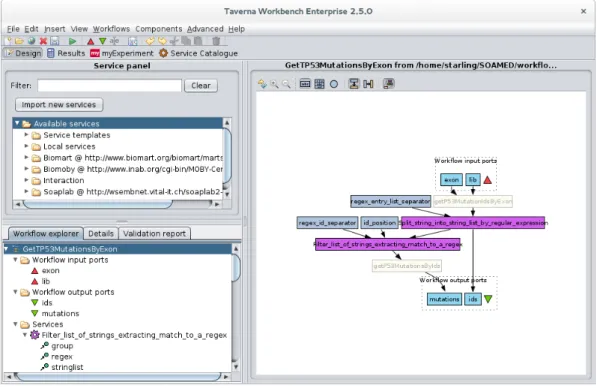
Graphical Workflow Editing. Most typically, SWFM provide a graphical user in-terface for accessing their functionality, including the ability to visually assemble and modify workflows. As an example, Figure 2.4 shows the user interface of the Taverna SWFM, where the workflow from Figure 2.3 is opened for editing. Next to the workflow canvas on the right, the lower left pane lists details about the modules used in the workflow. The upper left pane holds the library of available modules.
Libraries of Modules. Most SWFM provide libraries of predefined modules ready to be used in workflows. As many SWFM have defined domains of application, the modules offered often include domain-specific applications, next to generic opera-tions on string, tabular, or XML data. For defining modules not included in the library, wrappers are provided. Depending on the underlying SWFM, various kinds of modules are supported, which may run either locally or on the web. These include command line tools, web-services, or user-provided scripts defined directly within the SWFM. For example, the workflow shown in Figure 2.4 includes web-service calls (beige, grayed out), locally executed string modifiers from the built-in library (pink), and string constants (blue). This great flexibility in including components from a variety of technical pedigrees caters to the frequent need in scientific applica-tions to use both state-of-the-art web-service tools and data, and at the same time include pre-existing local data and scripts, carefully tailored to a specific aspect of the intended analysis, or tools not available as a web-service or inconvenient to use
2.2 Infrastructure for Scientific Workflows
Figure 2.4: SWFM user interface example: Taverna workbench with workflow
opened for editing.
as such due to, for instance, the high volume of data to be processed (e.g., when mapping the DNA sequences from a NGS experiment to a reference genome). How unlike the representation of modules is in different SWFM has been reviewed in Section 2.1.1.
Workflow Verification. Comparing Figures 2.3 and 2.4, the modules invoking web-services are grayed out in the workbench view of the workflow, indicating that the services are currently not reachable and the workflow can not be executed properly. Such verification is not only done on complete workflows, but may also be used during authoring of the workflow already.
Workflow Execution, Monitoring, and Recovery. Once a workflow is created, it can usually be executed directly in or from within the SWFM itself. Where actual execution takes place - locally or on a cluster - depends on the SWFM. Some SWFM provide monitoring capabilities, showing the user which modules of a workflow are running at a given point in time, how many parallel instances of each module exist, and where errors occur. In cases of errors, SWFM often allow recovery of workflow exection on the data collected prior to the error, without the need of recomputing intermediate results. This is especially useful for workflows executed on large data sets.
2 Scientific Workflows and Workflow Similarity
Provenance Tracking. As the data input by the user passes through each module, it is modified, enriched, or transformed. The record of how the data was subse-quently changed by the workflow’s modules is referred to as provenance, which some SWFM allow to record. Using provenance, the user is able to trace each piece of output data back to the input data it originates from, observing exactly how the output was derived.
To what extent each of these features is supported, depends on the concrete SWFM. And, despite the comfort these features offer to workflow authors, cre-ating a scientific workflow is still a laborious task, that requires deep knowledge of the data processing steps and tools involved in the computational experiment to be run. The data one tool produces often has to be transformed for consumption by the successive one - a task for which sometimes predefined modules from the library provided by the SWFM may be available (as in the example workflow of Fig. 2.4), other times scripts still have to be written for. As such, while much more accessible to domain scientists not trained in programming than traditional, pure scripting approaches, mastering scientific workflow creation is still challenging. For such users it is much more straightforward to re-use existing workflows found in scientific workflow repositories.
2.2.2 Scientific Workflow Repositories
Scientific workflow repositories allow upload of workflows created in an SWFM to store and share them with others. Once published in a repository, these workflows can then be searched, downloaded and executed by other scientists. This not only facilitates reproducibility of the underlying in-silico experiment, but also allows easy re-use of (usually) proven computational methods, or repurposing of a workflow for a different, but similar experiment by applying slight modifications.
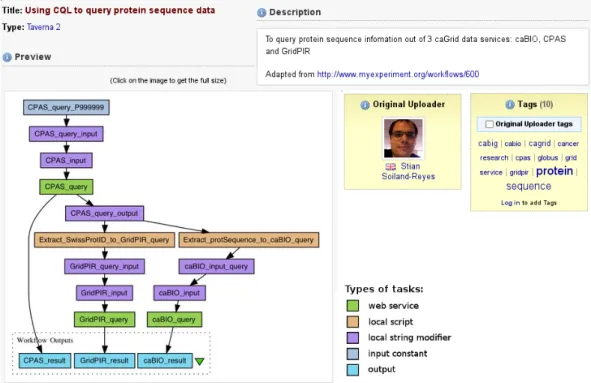
Next to the uploaded workflow definition itself, scientific workflows in online repos-itories may have several types of user-provided annotations associated with them. Which types of annotations are supported greatly varies by repository: While, for instance, myExperiment [74] provides user ratings, download statistics, attributions to workflow co-authors, and features of a social (scientific) network, many other repositories provide far less options for workflow annotation. The most common types of annotations are exemplified in Figure 2.5:
• A title ideally summarizes the workflow’s function.
• A description gives a more or less detailed explanation of the workflow’s
func-tionality as free-form text.
• Keyword tags assign categories of specific functionality or areas of application
to the workflow.
To what extent these annotations are available strongly depends on the concrete repository. Table 2.1 gives an overview of some popular public scientific workflow
2.2 Infrastructure for Scientific Workflows
Figure 2.5: Example of a scientific workflow and its annotations from an online repos-itory. Adapted from http://www.myexperiment.org/workflows/752.
repositories and repositories associated with popular SWFM, listing their size in terms of the number of workflows they contain and their respective workflow for-mats - and (roughly) indicating for how many workflows each type of annotation is available. For some repositories annotations are well available. Other repositories, while offering the functionality to add annotations, hardly contain any. Currently, this greatly impedes their potential for supporting users in discovery of the workflows they contain.
Scientific Workflow Discovery
Scientific workflow discovery is the process of finding that or those workflows in an online repository that match a user’s data processing needs. Providing adequate means for such discovery to a repository’s users is of vital importance for scientific workflows to reach their target audience, the scientist [21]. Comprehensive support for the discovery of scientific workflows has also been identified as a bottleneck for their re-use in [44].
The observations on the availability of annotations in existing online repositories presented in Table 2.1 are all the more interesting as the prevalent means currently offered by repositories for discovering the workflows they store - apart from browsing lists of hundreds of workflows - critically depends on such annotations: keyword
2 Scientific Workflows and Workflow Similarity
Repository App. no. of Workflow Annotations
Workflows Format title description tags
CrowdLabs [64] 200 VisTrails + -
-Galaxy [45] 225 Galaxy + ~
-public repository
Kepler [14] 25 Kepler + ~ n.a.
component library
myExperiment [74] 2600 any, + + +
mostly Taverna
SHIWA [3] 250 any, mostly + + ~
WS-PGRADE & Taverna
Table 2.1: Overview of sizes and workflow formats of public scientific workflow repos-itories, together with annotation frequency (+: always/often available , ~: balanced availability, -: seldom available, n.a: option not provided; data as of Nov 2014).
search. The definition, modules, and graph structure of the scientific workflows themselves are typically not exploited to further facilitate access to a repository’s contents, or to manage the workflows they contain, even while scientists themselves have identified the structure of a scientific workflow to play an important role in discovering and selecting appropriate workflows [43].
This greatly limits discoverability of scientific workflows. In keyword search, a user enters a number of keywords which are then matched against the annotations stored with the workflows to retrieve suitable ones. Of course, this only works if workflows have annotations, and if the user’s keywords match the keywords used by the workflow author to describe the workflow’s functionality. Often enough, only few workflows are returned, possibly missing the most suitable workflows due to a mismatch of the keywords used. Or, when the used keywords are too generic and the repository is large enough, long lists of workflows are presented to the user - again leaving him or her to manual inspection of each workflow returned by browsing through the list.
Clearly, this current state of scientific workflow discovery needs to be improved for users to make best use of scientific workflows, their repositories, and the promises they convey for the exchange of scientific knowledge. For instance, the status of keyword search could greatly be improved, if, for the case of using wrong keywords, those workflows matching the query would be used to automatically find other work-flows in the repository, which provide similar functionality, but don’t contain the respective keywords. In the case of long lists of workflows resulting from a search, workflows in the list providing equivalent or closely related functionality could be grouped to reduce the number of workflows (or groups thereof) the user would need to inspect, or even to suggest refinements of the initial query.