Intermediation by aid agencies
1
Colin Rowat
2Paul Seabright
3November 3, 2004
1The authors thank Ralph Bailey, Mayling Birney, Jayasri Dutta, Guido Friebel, Chirantan Ganguly, Martin Jensen, Alejandro Manelli, Herakles Pole-marchakis, Indra Ray, Stuart Taylor, Jennifer Tobin, Thierry Verdier and seminar participants at the Center for International Development at Harvard and the Uni-versity of Birmingham. Rowat thanks l’Institut d’Economie Industrielle for its hospitality.
2Department of Economics, University of Birmingham
Abstract
This paper models aid agencies as financial intermediaries that do not make a financial return to depositors, since the depositors’ concern is to trans-fer resources to investor-beneficiaries. This leads to a significant problem of verification of the agencies’ activities. One solution to this problem is for an agency to employ altruistic workers at below-market wages: workers can monitor the agency’s activity more closely than donors, and altruistic workers would not work at below-market rates unless the agency were gen-uinely transferring resources to beneficiaries. We consider conditions for this solution to be incentive compatible.
Key words: signalling, non-profit, wage differential, donations, altruism, two-sided market
The aid agencies themselves in this difficult environment do not have much incentive to achieve results, since the results are mostly unobservable. . . . Virtually all observers of aid agencies agree that they allocate too little effort either to insuring that loan conditions were actually observed or to later evaluation of loan effectiveness. . . . Aid agencies face a peculiar incentive problem: they spend one group of people’s money on a different group of people. The intended beneficiaries have almost no voice in how the money is spent. (Easterly (2003))
1
Introduction
Aid agencies, like banks, connect finance with projects. We can therefore think of aid agencies as a kind of financial intermediary, albeit of a rather special kind. Two things in particular make them special. First, unlike in the case of banks, it is not typically expected that any share of a project’s returns be returned to its financiers. This makes it difficult for donors to assess the efficiency of their intermediary: while the interest rate a bank of-fers to depositors can be compared to those of other banks, donors to an aid agency have no immediately observable signal of the results of the agency’s intermediation activity. Secondly, even if alternative signals of project re-turns are available (such as audited accounting data), one characteristic of an aid project is that its true social returns may not be fully or even partially captured in flows of finance, either because the project generates externalities that are not easily appropriable or because the value of such financial flows as are generated consists chiefly in their accruing to poor individuals whose weight in a social welfare function is high.
Not all intermediary organisations need to worry about providing signals between the individuals on the two sides of their market. Some intermedi-aries, such as dating agencies, exist to put individuals in contact with each other; once this has been done the contact itself provides the signal. Other organisations also act as intermediaries between a donor and a distant recip-ient without necessarily providing feedback to the donor. Postal services and florists generally do not, except at a higher price, inform donors when their orders have been delivered. In these cases, however, the donor and recipient may already know each other, and have their own channels for providing feedback.
Aid agencies, however, face the same predicament of distance and anonymity as financial institutions like banks, but without the feedback signal available to banks. This paper addresses the question of how aid agencies manage to
signal quality to potential donors. In doing so, it attempts to exploit the styl-ised facts that such agencies are typically incorporated as non-profits (NPs), and their professional staff may be paid at below market wages. The role of the former observation has already been explored in the literature: Glaeser and Shleifer (2001) and related papers assume that it is more expensive for those in charge of a NP to appropriate its resources (as they are required to do so through perks) than it is for those in charge of a for-profit (FP), since the latter may use dividends or other cash payouts. Thus, NP status imposes an inefficiency that weakens the incentives to appropriate the organisation’s resources for private gain.1
This paper’s contribution lies in its development of the second observa-tion. Before explaining how we do so, we review the empirical literature. In brief, early findings of wage discounts for employees of US domestic NPs (e.g. hospitals, universities, etc.) seem to disappear when self-selection, hours of work, etc. are controlled for. As a whole, however, this literature has not studied the fully two-sided markets of interest to us, in which the possibili-ties for feedback between donor and recipient are negligible. There is some empirical, and much anecdotal, evidence that a NP wage discount exists in this sector.
Handy and Katz (1998) report results suggesting that “nonprofits tend to pay their managers a lower wage than [do] for-profits”. The results on which they report are drawn from US NP organisations.2 Their explanations for
lower wages for professionals appeal to two factors: trust is more important in the environments in which they work, which are marked by asymmetric information; and managers may self-select on the basis of personality traits. Mocan and Tekin (2003) argue, instead, that “the empirical evidence on the nonprofit wage differential is ambiguous. Most of this ambiguity seems to stem from inadequate data sets”. In contrast, they control for self-selection into the child care sector in four US states as well as for unobserved worker heterogeneity. Doing so, they find wage premia associated with NPs: “non-profit compensation differential is 8% for full-time workers and 10% for part-time workers.” They note theoretical arguments for premia and for discounts: NP managers may ‘capture’ the organisation, and reward themselves more highly; NP managers may derive more job satisfaction from ‘doing good’, and require less pay.
An addition theoretical argument for NP wage premia is provided by 1FPs can, of course, write constitutions prohibiting such disbursals.
2Preston (1989) include “hospitals; health services; [schools and universities]; libraries; museums, art galleries, and zoos; religious organizations; welfare services; residential wel-fare facilities; and nonprofit membership organizations” - but not aid agencies. Frank (1996) does not indicate how it classified employers a FP, NP or government.
Fran¸cois (2003). He considers workers who receive utility from the level of provision of a public good: they do not care how that good is provided, thus their utility is not of what is sometimes called the ‘warm glow’ kind, namely dependent on the character of their own involvement in the desired outcome. Effort can be induced in one of two ways: a supervision technology which solves the moral hazard problem at a fixed cost; or a contract paying a wage premium if the contracted effort is supplied, firing the worker otherwise. Under the latter, the managers of FPs are induced to supply more remedial effort if the worker shirks: they care not just about the effect of shirking on the level of public good provision, but also on their profits. Inverting the usual story, the costs of shirking in a NP are greater: not just loss of an efficiency wage, but a greater reduction in the public good. The efficiency wage paid by NPs is therefore less than that required of FPs, causing the FPs to be competed out of the sectors that do not use the supervision technology. Therefore NPs will predominate in the sectors that pay a wage premium. Note, however, that controlling for the production technology and for effort levels, workers in NPs are still being paid less than those in FPs would be paid for doing strictly identical work, even if actual empirical data might not make it possible to control accurately for these differences.
Ruhm and Borkoski (2002) study the US Current Population Survey Out-going Rotation Groups and survey the literature. They find no strong evi-dence of ‘labour donation’.
In the developmental context, Reinikka and Svensson (2004) estimate the relative behaviour of health care providers in Uganda. They find that religious NPs pay their medical staff at below market rates, but are more likely to provide pro-poor and public health care, charging lower rates for similar levels of (observable) quality.
Somewhat further afield, Buraschi and Cornelli (2003) study donations to the English National Opera. Donations seem to be motivated by a perception that the donor is pivotal to providing a production funded by the donations. Our own model supposes that donors to an aid agency cannot observe directly the quality of the agency’s work. However, they can observe, at least partially, the remuneration enjoyed by the agency’s employees. This need not be interpreted literally as an observation of the wage itself. We can think of monasteries that stress that their monks live the simple life; charities that consciously forgo luxury, and so on. Donors observing that employees live simply conclude something about the nature of the work those employees are doing. The question is whether such a signal is reliable in equilibrium.
We consider a one period world in which there are three, potentially similar agents: workers, who may be selfish or altruistic, founders, who may also be selfish or altruistic, and donors, or are always altruistic. By altruistic
we simply mean that they care about the results of the agency’s actions (this is not the same as a ‘mission’ in the sense of Besley and Ghatak (2003), since the utility is a function of equilibrium outcomes rather than the type of the organization). The objective functions of altruistic agents are additively separable in consumption and the altruistic component; this second term is omitted from those of selfish agents.
The founder (principal) hires a worker (agent) to manage projects on her behalf. The worker then performs two types of project for the principal: actual development work in a poor locale, and fund-raising and management in a wealthy one. His ability determines the efficiency with which he carries these tasks out.
The organisation receives income only from donations. Its founder splits that income between development aid, wages to the worker, and perks (or profits, in the case of a FP) to herself. As altruistic workers receive utility from their involvement in development work, they may be paid a lower wage than selfish workers for a given level of such work.
Donors imperfectly observe the organisation’s records. Thus, they may not observe the types of either the founder (i.e. altruistic or selfish) or the worker (again, altruistic or selfish, but now also competent or incompetent). Neither, as they are not ‘in the field’, may they observe the actual level of development work done. Finally, as they do not observe the founder’s personal behaviour, they cannot observe the perks that she takes from the organisation.
Thus, donors may only observe the worker’s wages. If they also observe the worker’s type, they can infer from the wages of an altruistic worker what level of development work the organisation undertakes. However, if types are not observable, donors must distinguish between two scenarios. In the former, a founder holds a competent, altruistic worker to below the market wage by involving him in development work. In the latter, a fraudulent founder pays rents to an incompetent worker in an attempt to disguise him as one of the former. The founder thus intends to split the donations induced between these rents and perks to herself.
In Section 2 we present the basic model. Section 3 analyses the founder’s problem in a world in which types are observable, though actions may not be; we thus consider the employment of altruistic workers purely as a com-mitment device against moral hazard. Section 4 introduces adverse selection, in which neither founders’ nor worker’s types are observable in equilibrium - we consider the incentive constraints that must be satisfied in a separat-ing to occur in equilibrium. In Section 5 we present a modified model that treats the different types of agents more symmetrically. Finally, Section 6 concludes.
2
The model
The model considers three agents, a founder, a donor and a worker. The founder hires a worker from a competitive labour market to carry out the work of an ostensibly charitable organisation. This work involves both im-plementing development projects and raising and managing funds for the organisation. Donations, the sole source of the organisation’s revenue, are solicited from an altruistic donor endowed with a single unit of wealth. Hav-ing raised the donation, d, the founder devotes a fraction, t, to development projects, allocating the rest to perks or profits (for herself),k, wages (for the worker), w, and management costs, c(·)3. Agent types and choice variables
are not necessarily observed by all agents: we defer a discussion of this until all the relevant variables have been introduced.
While performing different roles, all three agents share basic motivations. Their objective functions have the form:
u=g(·) +αh(·) ;
where the argument ofg(·) is some measure of wealth or income; that ofh(·) some measure of development activity and α ∈ {0,1} denotes whether the agent is selfish or altruistic. Donors are necessarily altruistic; the founder may or may not be; the worker’s altruism is chosen by the founder.
In Section 5 we consider the situation in which the argument of h(·) is
d·tfor founders, workers and donors: they all care about the total amount of resources directed to development. For now, we consider a version of worker’s motivation that simplifies exposition without changing the qualitative results:
uW =g(w) +αWh(t). (1)
These workers care about the ‘purity’ of the organisation in which they work - the total proportion of its donations directed towards development - rather than about the total results of their activity. The reason this simplifies the calculations is that it does not require us to solve the donor’s problem simultaneously with the worker’s.
3Strictly speaking these are “wastage costs” - that is, costs over and above the efficient minimum costs necessary to manage a portfolio of a given size. This is because we normalise the cost function to zero for an efficient worker.
We make the following assumptions about the objective functions: g, h ∈ C3; g0(0) =h0(0) = ∞; g0(x) =h0(x) > 0∀x∈[0,1] ; g00(x) = h00(x) < 0∀x∈[0,1] ; g(0) =h(0) = 0.
In addition to being altruistic or selfish, a worker may be competent or incompetent, denoted by θ ∈ {0,1}. Competent workers reduce the organ-isation’s operating costs as they implement projects and raise and manage funds more efficiently. Both types of worker have positive outside options, 1>w > w >¯ 0: the upper bound ensures that it is feasible to hire a selfish, competent worker under the most permissive conditions (i.e. when d= 1).
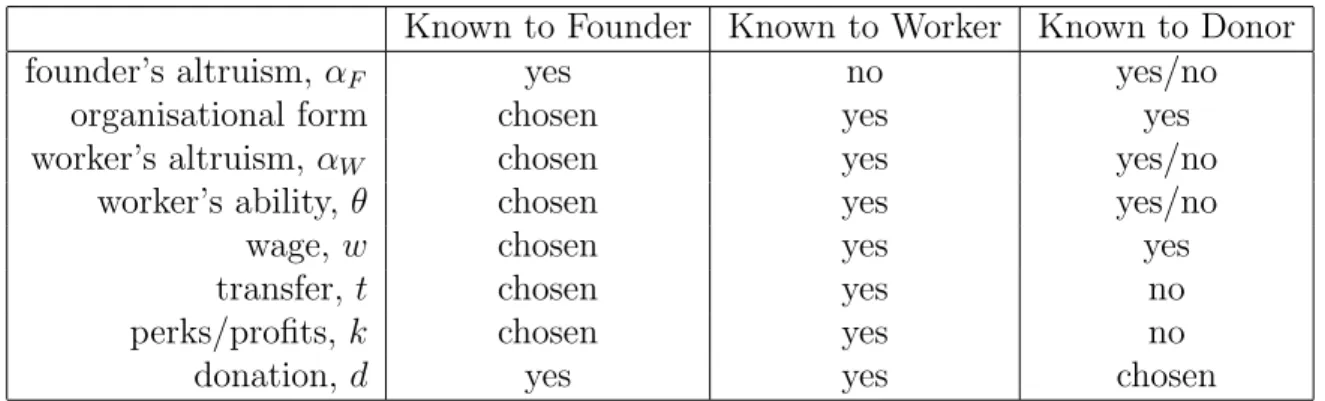
Agents’ behaviour hinges on issues of informational asymmetry. Table 1 outlines these with respect to the different type and action variables: its contents are common knowledge. Where the table indicates yes/no in reponse to the knowledge of the donor, this indicates that the donor observes the variable in the moral hazard model of this Section and section 3, but not in the mixed adverse selection and moral hazard model of Section 4.
Known to Founder Known to Worker Known to Donor
founder’s altruism, αF yes no yes/no
organisational form chosen yes yes
worker’s altruism, αW chosen yes yes/no
worker’s ability, θ chosen yes yes/no
wage, w chosen yes yes
transfer, t chosen yes no
perks/profits,k chosen yes no
donation, d yes yes chosen
Table 1: Agents’ information structure
Thus, the founder is better informed than the worker, knowing her own level of altruism, while the donor is the least well informed. Of particular importance, while the worker can observe t, the donor cannot. The donor seeks to infer this from the worker’s wage. If that is below the market rate, the donor infers that the worker is receiving altruism rents to compensate for foregone wages. This inference task may be complicated by the possibility that the worker is receiving low wages due to low competence.
Technically, then, the game in its full moral hazard and adverse selection version is an infinite signalling game. It is a signalling game as the founders
are of unknown type, and may undertake costly signalling (through wages) to donors. It is an infinite one as founders may set wages in a continuum. As there are only two types of founder, the set of Perfect Bayesian Equilibria and Sequential Equilibria coincide (Fudenberg and Tirole, 1991, Theorem 8.2). A large equilibrium set is often found in these games.
2.1
Competitive wages
In an equilibrium in which founders do not leave workers any rents, workers are paid:
wIS = w;
wCS = ¯w;
wIA(t) = g−1(g(w)−h(t)) ; and
wCA(t) = g−1(g( ¯w)−h(t)) ; (2)
where the subscriptsI indicate incompetence (θ = 1);Cindicate competence (θ = 0); S indicate selfishness (αW = 0) and A indicate altruism (αW = 1).
From the assumptions on the utility function it follows straightforwardly that for all t∈[0,1],
wCS ≥wCA(t)> wIA(t). (3)
Thus, competitive wages display both competence premia and altruism dis-counts.
2.2
Donations
Donors are altruistic, results-oriented and endowed with a single unit of wealth. Thus, their objective functions are
uD =g(1−d) +h(d·t).
We seek to establish equilibria in which donors can infer t even though they cannot observe it directly. When donors observe workers’ types this is straightforward since the functions 2 yielding a wage for each type are invertible. Here, therefore, we derive d(t) assuming that t can be inferred.
The following lemmas establish conditions for d(t) to be wellbehaved -that is, an increasing concave function of t.
Lemma 1. In an equilibrium of the pure moral hazard model,
d(0) = 0;
d(t) > 0∀t >0; and d0(0) = ∞.
Proof. Differentiating the objective function implicitly defines a unique max-imum for all t∈[0,1]:
g0(1−d)−h0(d·t)t= 0. (4)
When t = 0, the unique solution is d(0) = 0: the monotonicity of g(·) prevents an interior d from solving g0(1−d) = 0.
Whent >0, this has a unique solution ind∈(0,1): the utility function is continuously differentiable, yielding infinite marginal utility in consumption atd= 1 and in altruism atd= 0. Uniqueness follows from the monotonicity of g(·) and h(·) and their opposing arguments.
Finally, implicit differentiation of equation 4 yields
d0(t) = −h00(d·t)d·t+h0(d·t)
h00(d·t)t2+g00(1−d). (5)
At t= 0, this reduces to−gh000(0)(1) =∞.
Finally, implicitly defined(1) ≡d¯byg0¡1−d¯¢=h0¡d¯¢.
Lemma 2. A necessary and sufficient condition for donations to increase
over t ∈ [0,1] is that the coefficient of relative risk aversion in money be bounded below unity:
−xh
00(x)
h0(x) <1∀x∈[0,1]. (6)
Proof. As the denominator of equation 5 is negative, a positive sign overall depends on a negative numerator. The condition is equivalent to this.
Lemma 3. When d(t) is an increasing function,g000 >0 and h000 <0 ensure
that it is concave.
Proof. Differentiating the implicitly defined donation function a second time produces
d00(t) = g000(h00dt+h0)
2−h000(h0t−g00d)2+ 2h00£(h00)2t4d+ 2h0g00t+ 2h00h0t3−(g00)2d¤
(g00)3+ 3(g00)2h00t2+ 3g00(h00)2t4+ (h00)3t6 .
As the denominator is always negative, a positive numerator suffices for con-cavity. Setting g000 > 0 and h000 < 0 is sufficient to make its first two terms
positive. To ensure that the final term is as well, it suffices that the sole positive term of its bracketed component, (h00)2t4d, is offset by 2h00h0t3. This
condition reduces to
2h
0(x)
h00(x) <−x.
In what follows we assume that these third derivative conditions and the condition in inequality 6 hold. As theory does not suggest signs for these third derivatives, this is probably innocuous, and the monotonicity and concavity conditions seem empirically plausible.
3
The founder’s problem
Now consider the founder’s problem: max
t∈[0,1],k≥0,w≥0uF = g(ρk) +αFh(d·t) s.t. (7)
d = k+w(t) +d·t+c((θ) (1 +t)d). (8) The coefficient ρ measures how easily the founder can transform perks into income. The founder of a FP firm can set ρ = 1 (subject to taxation con-straints), but a NP founder is constrained to some ρ ∈ (0,1), depending on the rigor of the regulation of the NP sector.
The constraint is a budget constraint. It divides donations into perks, k; wages, w; development aid, d·t; and management costs, c(·). The manage-ment cost function itself satisfies:
c ∈ C2; c(0) = 0; c0(0) = 0; c0(x) > 0∀x∈(0,1] ; c0(1) < 1; c00(x) > 0∀x∈[0,1].
Thus, management costs are increasing convex in the volume of money han-dled, symmetrically in donations and aid, but decreasing in the worker’s ability. However, management costs never increase in donations by more than the value of the donation itself.
As already noted, we normalize the costs incurred by an efficient worker to zero.
Finally, we assume that incompetent workers cost enough to matter to founders but not so much that they would not be employed even by an organization undertaking no development work. That is, for high enough donation and development levels an incompetent worker will cost the founder more in wastage than he saves her in wage costs, but for a firm receiving only donations and undertaking no development, incompetent workers are better value.
Were this not the case, IA workers would be cheaper than CA workers, or vice versa, for all levels of t∈[0,1].
Altruistic founders, for whom αF = 1, correspond to the default case in
Glaeser and Shleifer (2001), whose founders care not only about profits and perks but also about the (expensive) quality of their products.
Substitute budget constraint 8 and wage function 2 into objective function 7 for uF =g ¡ ρ£(1−t)d−c(θ(1 +t)d)−g−1(g(w)−h(t))¤¢+α Fh(d·t) ; (10) where d is defined implicitly by donation function 4 and w ∈ {w,w¯}, de-pending on the worker’s competence.
We first consider under what conditions the founder’s problem is concave. This is by no means a simple matter. The primitives, g(·), h(·) and −c(·), are all concave, but their combination in the objective function does not preserve concavity. Intuitively, the founder’s choice of tnot only has a direct effect on her utility but also has two or three indirect effects, mediated by the responses of the donor and the altruistic worker. Under the direct effect, higher t leaves the founder a smaller share of the donated pie to enjoy as perks - a negative effect. The first indirect effect is in donations: higher t
induces more donations - a positive effect. The second is a wage effect: higher
t allows altruistic workers to be retained at a lower wage, also a positive effect. The combination of these two positive effects may violate concavity. The third indirect effect is only experienced by employers of incompetent workers: increased t, and its consequent d(t), induces more management costs, a negative effect.
The way we proceed therefore is to examine separately the founder’s problem for each of the four possible combinations of selfish and unselfish founders, and selfish and unselfish workers, on the assumption that these types are observable by both founder and donor. This is the task for the remainder of this section. We then consider in 4 incentive compatibility conditions required for a separating equilibrium to obtain when the donor does not observe these types.
3.1
Selfish founders
Founders must take three types of decision: what type of organizational form to establish, what kind of worker to employ, and what level of t to set. The first derivative of 10 when αF = 0 andθ = 0 is:
∂u0 F,CA ∂t =g 0(·)ρ ½ −d+ (1−t)d0(t) + h 0(t) g0(g( ¯w)−h(t)) ¾ ; (11)
while that when θ = 1 is ∂u0 F,IA ∂t =g 0(·)ρ ½ −d+ (1−t)d0(t)−c0(·) [d+ (1 +t)d0(t)] + h0(t) g0(g(w)−h(t)) ¾ . (12) Note therefore that the terms within the curled parentheses, which equate to zero at a maximum, are independent of ρ. This means that the level of t
set by a selfish founder is independent of the organizational form (for-profit or not-for-profit) of the agency. So a selfish founder has no interest in choosing not-for-profit status. NP status is redundant as a signalling device: t is already fully revealed by workers’ wages. Thus, when types are observable, a founder would prefer to run a FP, thereby enjoying ρ= 1, instead of an NP. Now consider the choice of type of worker. Any selfish founder who em-ployed a selfish worker would set t= 0, since t >0 would have no signalling value. A selfish founder employing a selfish worker would consequently re-ceive no donations. The more interesting questions therefore concern a selfish founder employing an altruistic worker. First, is it better to employ a compe-tent or an incompecompe-tent worker? Against the benefits of a compecompe-tent worker must be set that worker’s higher wages. Not surprisingly (since the benefits of competent workers are increasing in the level of donations received), founders who expect in equilibrium to be able to set higher levels of t are more likely to employ competent workers. In fact we can show that a single-crossing property obtains:
Lemma 4. Objective functionsuF,CA(t)anduF,IA(t)cross once int ∈[0,1].
Proof. Proving the lemma reduces to proving that
δ(t)≡c((1 +t)d)−(wCA(t)−wIA(t)) ;
has a single root in t ∈ [0,1]. By equation 3 and c(0) = 0, δ(0)w−w <¯ 0. By assumption 9, δ(1)>0. Therefore, monotonicity suffices for the result.
Differentiation yields δ0(t) = c0(·) [d+ (1 +t)d0(t)]+h0(t) · 1 g0(g( ¯w)−h(t)) − 1 g0(g(w)−h(t)) ¸ .
When the bracketed term containing the fractions is positive, the result follows. This is now established:
¯
w > w ⇒0< g0(g( ¯w)−h(t))< g0(g(w)−h(t)).
Letτ be implicitly defined byuF,CA(τ) = uF,IA(τ) for a founder of either
type, selfish or altruistic. Then all agencies above a certain size (as measured by the level of development work undertaken) will prefer to employ compe-tent workers. Agencies below that size will not be able to afford compecompe-tent workers.
We now show conditions for the founder’s problem to be concave in t.
Lemma 5. In the pure moral hazard model, a sufficient condition for the
objective function of a selfish founder employing a CA worker to be concave is that donations be concave functions of t. A sufficient condition for the objective function of a selfish founder employing an IA worker to be concave is that
0> d00(t)>− 2
1 +td
0(t). (13)
Proof. The second derivative of any selfish founder’s objective function is:
∂2u0 F ∂t2 = g 00(·)ρ2 ½ −d+ (1−t)d0(t)−c0(·) [d+ (1 +t)d0(t)] + h 0(t) g0(·) ¾2 + g0(·)ρn−2d0(t) + (1−t)d00(t)−c00(·) [d+ (1 +t)d0(t)]2 −c0(·) [2d0(t) + (1 +t)d00(t)] + h00(t) g0(·) + · h0(t) g0(·) ¸2 g00(·) ) ; (14) where the argument ofg(·) and its derivatives is eitherg( ¯w)−h(t) org(w)−
h(t), as appropriate.
When a CA worker is employed, the terms inc(·) are eliminated, reducing this to ∂2u0 F,CA ∂t2 = g 00(·)ρ2 ½ −d+ (1−t)d0(t) + h 0(t) g0(·) ¾2 + g0(·)ρ ( −2d0(t) + (1−t)d00(t) + h00(t) g0(·) + · h0(t) g0(·) ¸2 g00(·) ) .
The first line of this is negative and the coefficient of the braced term in the second line positive. Thus, concavity follows from that braced term being negative. As all but the second term are guaranteed to be negative,
d00(t) <0 ensures the result. When a IA worker is employed the conditions
in the statement collectively set the ambiguous terms in the second braced expression to negative values.
Lemma 6. In the pure moral hazard model, a selfish founder sets t ∈(0,1)
Proof. We first demonstrate thatt∈(0,1). Consider the lower bound,t= 0, which induces d(0) = 0 in a separating equilibrium. Theh0(0) term in both
first order conditions is infinite and the others either zero or finite. Thus, positive deviations from t = 0 produce infinite marginal returns.
The upper bound,t = 1 producesd= ¯d. Budget constraint 8 thus forces
w=k =c(·) = 0. The argument ofg(ρk) in the founder’s objective function is therefore zero, giving the founder infinite marginal utility of perks. Now the marginal utility of a downward deviation from t = 1 is infinite.
The same argument applies to k and w. When k = 0, the marginal utility of an upward deviation is infinite. When it is at its upper bound,
t is constrained to be zero, again inducing an infinite marginal utility of deviating. When w = 0, no donation is given in a separating equilibrium; when it is maximised, the founder receives no perks. In both cases, the marginal returns to deviation are infinite.
Finally, concavity ensures that the founder will set a higher value of t if she employs a competent worker than if she employs an incompetent worker, since at the value of t that solves her problem for an incompetent altruistic worker, ∂u0F,CA
∂t >0.
3.2
Altruistic founders
When founders are altruistic, there is now a fourth utility effect of changes in t: a direct, positive altruism effect. They experience a direct utility gain from increases in the proportion of their budget spent on development.
The first derivative now adds
h0(d·t) [d0(t) +d] ; (15)
to the expression in equation 12.
Lett0 solve the selfish founder’s problem and t∗ the altruistic founder’s.
Then:
Lemma 7. 0< t0 < t∗ <1.
Proof. First consider situations in which condition 13 holds. As expression 15 is always positive, adding this term to the selfish founder’s first order condition makes marginal utility positive at ˜t. Under condition 13, this can only be reduced to zero by increasing to somet∗ >t˜. Finally, ast∗ = 1 leaves
no perks, marginal disutility of t at that point is infinite. Thus, t∗ <1.
Now consider situations in which condition 13 is violated. If there remains a unique local maximum, the argument above goes through. If there are multiple local maxima, index these by their arguments, so thatt1 < . . . < tn.
The number of local maxima is unchanged relative to the case of the selfish founder: the addition of the increasing, concave function increases the value oftat each stationary point; none of them are forced beyondt= 1 due to the infinite disutility experienced by the founder there.
If the addition of the altruism function does not change which local maxi-mum is the global maximaxi-mum, then the result is established. If the addition of the altruism function does change which local maximum is the global, then the new maximum cannot correspond to a stationary point with a lower in-dex number: the altruistic objective function adds an increasing function to its selfish counterpart. This establishes the result.
In this environment, as in Glaeser and Shleifer (2001), the founder’s choice of FP or NP status does matter after all: ρno longer cancels out of the first order conditions. More specifically:
Theorem 1. When the coefficient of relative risk aversion in altruism is
bounded below unity, so that
−xg00(x)
g0(x) <1∀x∈[0,1] ; (16)
altruistic founders decrease t∗ as ρ increases.
Proof. Ash(·) is not a function ofρ, the envelope theorem only requires that we consider ∂2g(·) ∂t∂ρ = ½ −d+ (1−t)d0(t)−c0(·) [d+ (1 +t)d0(t)] + h0(t) g0(·) ¾ × [g0(ρk) +g00(ρk)ρk]. (17)
In equilibrium, the first bracketed term is negative: this must offset the positive derivative in the h function. The terms in the second bracket are positive and negative, respectively. The stated condition ensures increasing differences so that t∗(ρ) decreases inρ.
This result seems intuitive: more stringent requirements on NPs induce their founders to spend a higher share of donations on development aid. This is because such requirements raise the cost of using donations for perks relative to using them for development.
However, this does not mean that founders prefer NP status.
Theorem 2. If founders’ altruism is observable, an altruistic founder never
Proof. Denote by v(ρ) the solution to the altruistic founder’s maximisation problem, uF(t∗(ρ), ρ). By the envelope theorem, and the independence of
h(d·t) from ρ, we have ∂v(ρ) ∂ρ = ∂g(·) ∂ρ =g 0(ρk∗)k∗ ≥0;
where k∗ is the value of k att∗.
This generality of this result is noteworthy: when Theorem 1 holds, an altruistic founder sets a lower t, thereby inducing a lower d, when she founds a FP than when she founds an NP. Nevertheless, she prefers to optimise with
ρ = 1 than with ρ < 1. This result is in some ways unsurprising given that her altruism is observable: as the worker’s wage is doing all the signalling required, further signalling with organisational form choice is unnecessary. However, as we shall see below, the choice of organizational form may indeed matter for signalling given that her altruism is not observable, since NP status relaxes one of the key incentive constraints for a separating equilibrium to obtain.
4
Incentive compatibility
Until now, we have performed our analysis on the assumption that founder and worker types are observable and that the solution to the founder’s prob-lem can ignore incentive constraints. This has presented a paradox: in such a model, neither selfish nor altruistic founders would wish to run a NP. In this section, we present a sufficient condition for the space over which separating equilibria may occur to be strictly larger for NPs than it is for FPs. Thus, founders may be faced with a choice between founding an NP and enjoying a separating equilibrium, or founding a FP and pooling.
Analysis here centres around incentive compatibility constraints. When types are not directly observable by donors, a selfish founder may be tempted to pose as an altruistic founder (since for any level of the worker’s wage the altruistic founder sets a higher level of t). Additionally, a founder of either type may be tempted to employ an incompetent worker but pay him the wage of a competent altruistic worker in order to pretend to be setting a higher level of t.
A few simple arguments can help us to eliminate uninteresting cases and concentrate on the essential ones. First of all, notice that founders of ei-ther type prefer, at least weakly, altruistic workers to selfish workers. Selfish workers are (weakly) more expensive than their altruistic counterparts with-out offering any reductions in management costs. In addition, if their type
can be observed or inferred, they send the disadvantageous signal that the founder has no commitment to good works. So we can confine our attention in what follows to incentive constraints involving the employment of altruistic workers only.
Secondly, since the founder’s objective function is increasing in dwhile d
in turn is increasing in the inferred level oft, and sincec0(1)<1, both selfish
and altruistic founders prefer to receive more donations, however incompetent their workers. Therefore in all incentive constraints we need consider only the possibility that employers ofincompetent altruist workers would wish to lie about their workers’ type. While a founder employing an incompetent worker would be (weakly) better off pretending that the worker was in fact competent (because this would signal a higher level of t than the founder had in fact chosen), a founder employing a competent worker would never be better off pretending that the worker was in fact incompetent, as this would signal a lower level of t than the actual level. Therefore we can be sure that a founder signalling that she is employing an incompetent worker will always be doing just that. She will only signal this when the low scale of her operations makes it implausible that she should be doing anything else.
Thirdly, and for the same reasons as those just adduced, appearing to be a selfish founder is always dominated by appearing to be an altruistic one, since by Lemma 7, altruistic founders set higher levels oft. Thus we can write two incentive constraints, one for selfish and one for altruistic founders. The first requires that a selfish founder should prefer to employ whatever worker typeθ0 is optimal for her and to set the appropriate level oft (defined ast0),
rather than to appear to be an altruistic founder employing the appropriate worker type θ1 and setting the appropriate t1 , while actually employing an
incompetent worker (as implied by assumption 9) and setting t = 0. The second constraint requires that an altruistic founder should prefer to employ worker type θ1 and set t1while actually employing an incompetent worker
and setting a much lower level of t (defined as ˆt). Note that the altruistic founder will not set t = 0 even when cheating, as she derives some intrinsic utility from development work.
Note also that the value oft1set by the altruistic founder under separation
is not necessarily the same as the value t∗ chosen under pure moral hazard;
it may need to be higher, precisely to make it unattractive for the selfish founder to emulate her.
Thus, the incentive constraint for a selfish founder is
ρ0£¡1−t0¢d¡t0¢−c¡θ0¡1 +t0¢d¡t0¢¢−w0¡t0¢¤≥ρ1£d¡t1¢−c¡d¡t1¢¢−w1¡t1¢¤; (18)
while that for an altruistic founder is
g¡ρ1£¡1−t1¢d¡t1¢−c¡θ1¡1 +t1¢d¡t1¢¢−w1¡t1¢¤¢+h¡d¡t1¢t1¢
≥ g¡ρ1£¡1−ˆt¢d¡t1¢−c¡¡1 + ˆt¢d¡t1¢¢−w1¡t1¢¤¢+h¡d¡t1¢tˆ¢ (19)
where the ρ0 (resp. ρ1) is the optimal choice of ρ made by selfish (resp.
altruistic) founders under separation.
Looking at the two constraints, we can see that, for any given value ofρ0,
lowering the level ofρ1 relaxes both constraints (it relaxes the selfish founder’s
constraint trivially since it appears only on the right of the inequality, while it relaxes the altruistic foudner’s constraint since h(d(t1)t1) > h¡d(t1) ˆt¢.
This means that the tighter the constraints on not-for-profits that an al-truistic founder is prepared to accept, the more likely it is there will be a separating equilibrium. This does not mean that a separating equilibrium can be guaranteed to exist simply by some (a regulator, say) setting ρ at a suitably low level; for low enough ρ even an altruistic founder may pre-fer to establish a for-profit firm. However it does enable us to establish the following two simple results:
Lemma 8. If any separating equilibrium exists, there exists a separating
equilibrium in which selfish founders establish FPs and altruistic founders establish NPs.
Proof. Suppose that, for some combination of ρ0 and ρ1, the incentive
com-patibility constraints are satisfied. Then they will be satisfied by ρ0 = 1 and
ρ1 =ρ <1.
Lemma 9. There are no separating equilibria in which selfish founders
es-tablish NPs and altruistic founders eses-tablish FPs.
Proof. Suppose that such an equilibrium exists. It therefore satisfies in-equality 18. Thus, the inin-equality is also satisfied by ρ0 = 1, which is strictly
preferred by a selfish founder. As a change inρ0 does not alter inequality 19,
(ρ0, ρ1) = (1,1) also satisfies the IC constraints; as the selfish founder prefers
it, she will never incorporate as an NP. In addition it follows that:
Lemma 10. In any separating equilibrium, an altruistic founder hires a
com-petent worker.
Proof. Since t1 > ˆt, h(d(t1)t1) > h¡d(t1) ˆt¢, so incentive constraint 19 will
be satisfied if
¡
1−t1¢d¡t1¢−c¡θ1¡1 +t1¢d¡t1¢¢≥¡1−ˆt¢d¡t1¢−c¡¡+ˆt¢d¡t1¢¢ (20)
The natural interpretation of this is that hiring a competent worker (and thus setting a high enough level of t to justify this) is necessary for the altruistic founder to be able to distinguish herself from a selfish founder. When this necessary condition is satisfied, the altruist’s IC constraint reduces
to ¡
t1−tˆ¢d¡t1¢≤c¡¡1 + ˆt¢d¡t1¢¢.
Intuitively, honesty prevails when the costs of committing fraud with an IA worker exceed the perks gained.
Finally, we show how the size of the set of separating equilibria is related to the value of ρ.
Theorem 3. A sufficient condition for the set of separating equilibria to
weakly expand as NP regulation becomes stricter is that the coefficient of relative risk aversion in money be bounded below unity:
−xg00(x)
g0(x) <1∀x∈[0,1].
The result is proved in Appendix A.
5
Results-oriented workers
The analysis above considered altruistic workers’ motives differently from those of altruistic founders and donors. While the latter were allowed to care about the results that they helped to bring about, d·t, the former cared only about the ‘purity’ of the work, t. This assumption about workers’ motives simplified exposition slightly, creating a single channel by which the worker responded to changes in t - the simple wage effect. Now, changes in t affect workers’ wages both directly and indirectly, through d - a compound wage effect.
This extension does not alter the qualitative results derived above. Replace the previous objective function, 1, with
uW =g(w) +h(d·t) ;
so that
wCA =g−1(g( ¯w)−h(d·t)).
When these substitutions are performed on the altruistic founder’s objective function, the unconstrained version becomes
uF =g
¡
When the worker is competent (θ = 0), this has first derivative ∂uF ∂t =g 0(·)ρ ½ −d+ (1−t)d0(t) + h0(d·t) g0(·) [d+td 0(t)] ¾ +h0(d·t) [d+td0(t)].
Its second derivative is:
∂2u F ∂t2 = g 00(·)ρ2{·}2 + g0(·)ρ{−2d0(t) + (1−t)d00(t) + 1 g0(·) · h00(d·t) +h0(d·t)2 g00(·) g0(·) ¸ [d+td0(t)]2 +h0(d·t) g0(·) [2d 0(t) +d00(t)t] ¾ + h00(d·t) [d+td0(t)]2+h0(d·t) [2d0(t) +d00(t)t].
Ensuring concavity can therefore seen to be more difficult than previously. This is still not problematic: its failure simply means that multiple local maxima may exist, as before. In particular, the Arrow-Pratt bound on g(·) continues to ensure that t∗ decreases in ρ, as in Theorem 1:
∂2g
∂t∂ρ = [g
00(ρk)ρk+g0(ρk)]
× {−d+ (1−t)d0(t)−c0(·) [d+ (1 +t)d0(t)] +h0(d·t) [d+td0(t)]}.
6
Conclusions
In this paper we explore the idea that charitable organisations can use the salary paid to employees as a signal to donors of the quality of the work that employees undertake, where quality is understood in terms of the overall proportion of the organisation’s portfolio that is directed to development projects. A competent employee would accept a job at a low wage only if the job afforded genuine altruistic compensation. The donor can then infer that the organisation is doing genuinely good work. Furthermore, when founders are altruistic, the quality of the work done will be higher in a NP firm than in a FP.
However, it may be necessary for the donor to be sure that he is not being fooled by an organisation that is hiring low-quality workers, who are the only ones that would accept such a salary in the absence of altruistic compensation. He also needs to be sure, in order to infer the quality of the work done from the salary, that he has correctly inferred the founder’s type (where this is not directly observable). We have shown that for these inferences to be incentive-compatible requires that the costs to the founder
of hiring low-quality workers are sufficiently high relative to the funds that could thereby be misappropriated, and that the costs to a selfish founder of emulating the behaviour of an altruistic founder are high. This incentive constraint is less likely to bind in NP firms, providing an additional signalling advantage to NP status.
This approach to the signalling problem assumes that donors have no other ways to discover whether founders have misled them. In reality, of course, other instruments are available, including audits, press and media coverage, and direct involvement on the part of donors. Unless such mon-itoring instruments work perfectly there may still be a role for the kind of signalling mechanism we have described, but the interaction of monitoring and signalling will be subtle. Including such monitoring instruments into a more complete model of agency behaviour is an interesting challenge for future work.
A
Appendix
To prove Theorem 3 we first establish three lemmata. The first of these proves that fraud that retains more perks necessarily does so at the expense of transfers. The remaining two show that fraudulent, altruistic founders will set transfers below those of their honest counterparts.
Lemma 11. When fraud retains more perks than signalled,ˆk > k∗, the share
of resources transferred decreases relative to what is signalled, ˆt < t∗.
Proof. As argued above, only fraud involving IA workers need be consid-ered: fraudulent employers of CA workers receive fewer donations if they are presented as IA workers.
First consider the use of IA workers when a CA worker is less expensive. Formally, consider cases in which t0 or t1, as applicable, exceeds τ. The
founder’s budget constraint when honestly employing a CA worker is
k∗ = (1−t∗)d∗−w
CA(t∗).
When fraudulently employing an IA worker, it is ˆ k=¡1−ˆt¢d∗−wCA(t∗)−c ¡¡ 1 + ˆt¢d∗¢. Therefore, ˆ k > k∗ ⇒t∗ >tˆ+c ¡¡ 1 + ˆt¢d∗¢ d∗ ;
Now consider the complementary cases, those in which the relevantt0 or
t1 is less than τ. The founder’s budget constraint when honestly employing
an IA worker is
k∗ = (1−t∗)d∗−c((1 +t∗)d∗)−wIA(t∗).
When employing an IA worker while engaging in fraud it is ˆ k =¡1−ˆt¢d∗ −c¡¡1 + ˆt¢d∗¢−w IA(t∗). Therefore, ˆ k > k∗ ⇒t∗+c((1 +t∗)d∗) d∗ >tˆ+ c¡¡1 + ˆt¢d∗¢ d∗ ;
from which the result follows.
We now consider whether fraudulent founders increase or decrease the share of resources transferred relative to what they signal. As selfish founders derive no utility from altruism, their optimal fraud is always ˆt = 0. Thus, we consider altruistic founders:
Lemma 12. A fraudulent, altruistic founder who employs an IA worker at
w1(t1) for t1 > τ sets t < tˆ 1.
Proof. The first order necessary condition associated with honest employ of a CA worker is g0¡ρ1k1¢ρ1 · −d1+¡1−t1¢d0¡t1¢+ h 0(·) g0(·) ¸ +h0¡d1t1¢ £d0¡t1¢t1+d1¤= 0; while that associated with fraudulent presentation of an IA worker as a CA worker is
g0³ρ1ˆk´ρ1£−d1−c0¡¡1 + ˆt¢d1¢d1¤+h0¡d1ˆt¢d1 = 0.
The Inada conditions ong(·) andh(·) ensure that the maxima are stationary points.
Suppose that ˆt≥t1. By concavity of h(·), this implies that
h0¡d1ˆt¢≤h0¡d1t1¢;
so that rearrangement of the first order conditions yields
g0³ρ1ˆk´ρ1£d1+c0¡¡1 + ˆt¢d1¢d1¤ ≤ g0¡ρ1k1¢ρ1 · d1−¡1−t1¢d0¡t1¢− h 0(·) g0(·) ¸ −h0¡d1t1¢d0¡t1¢t1.
Compare the corresponding terms in each side of the inequality. The ρ1’s are
identical; the square bracketed term on the left larger than that on the right; further, a positive quantity is subtracted from the right.
Thus, for the inequality to hold, it must be that
g0
³
ρ1ˆk
´
< g0¡ρ1k1¢ ⇒ˆk < k1.
By Lemma 11, this implies that t1 >ˆt, a contradiction.
Now consider the complementary case:
Lemma 13. A fraudulent, altruistic founder who employs an IA worker at
w1(t1) for t1 < τ sets t < tˆ 1.
Proof. The first order condition associated with honest presentation of an IA worker is g0¡ρ1k1¢ρ1 ½ −d1+¡1−t1¢d0¡t1¢−c0¡¡1 +t1¢d1¢ £d1+¡1 +t1¢d0¡t1¢¤+h0(·) g0(·) ¾ +h0¡d1t1¢ £d0¡t1¢t1+d1¤ = 0;
while that associated with fraudulent use of an IA worker is
g0
³
ρ1ˆk
´
ρ1£−d1−c0¡¡1 + ˆt¢d1¢d1¤+h0¡d1ˆt¢d1 = 0.
Again suppose that ˆt ≥t1. As before, this assumption allows
rearrange-ment of the first order conditions for
g0³ρ1kˆ´ρ1£d1 +c0¡¡1 + ˆt¢d1¢d1¤ ≤ g0¡ρ1k1¢ρ1 · d1−¡1−t1¢d0¡t1¢+c0¡¡1 +t1¢d1¢ £d1+¡1 +t1¢d0¡t1¢¤− h 0(·) g0(·) ¸ −h0¡d1t1¢d0¡t1¢t1.
The right hand side of the inequality again subtracts a positive term and contains a smaller square bracketed expression. As above, this, by Lemma 11, yields a contradiction.
Proof of Theorem 3. For selfish founders, the only case to consider in detail is (ρ0, ρ1) = (1, ρ): the opposite was ruled out in Lemma 9; when ρ0 = ρ1
the IC constraints are insensitive to changes in ρ. In the remaining case, inequality 18 reveals the constraint to relax as ρ decreases.
Now consider altruistic founders’ constraints. Consider a game for which the IC constraints just bind for the altruistic founder of a FP. There are two
possibilities, each corresponding to an element of the max operator. Define
b(ρ1) so that, for either combination,
b¡ρ1¢≡g¡ρ1k1¢+h¡d¡t1¢t1¢−g³ρ1kˆ´−h¡d¡t1¢ˆt¢= 0; (21)
where k1 are the perks or profits accruing to ‘honest’ play, and ˆk are those
accruing to the optimal deception. (Management costs are subsumed in the perks.)
By Lemmata 12 and 13 all fraud with altruistic founders set ˆt < t1.
Thus, all forms of fraud yield reduced altruism utility relative to honest play. For the constraint to just bind, they must yield greater consumption utility, ˆ
k > k1.
As k1 is optimal given an honesty constraint, and ˆk optimal within a
particular class of fraud, the envelope theorem allows
b0¡ρ1¢=g0¡ρ1k1¢k1−g0 ³ ρ1kˆ ´ ˆ k.
The sign of this is the same as that of g0(ρ1k1)ρ1k1 −g0³ρ1kˆ´ρ1ˆk. These
are negative wheng0(x)x is decreasing inx. This is equivalent to the stated
condition.
Thus an IC constraint that bound for an FP ceases to do so for an NP. By identical reasoning, an IC constraint that was non-binding for an FP remains so.
References
Timothy Besley and Maitreesh Ghatak. Competition and incentives with motivated agents. May 2003.
Andrea Buraschi and Francesca Cornelli. Donations. mimeo, 16 August 2003. William Easterly. Can foreign aid buy growth? Journal of Economic
Per-spectives, 17(3):23 – 48, Summer 2003.
Patrick Fran¸cois. Not-for-profit provision of public services. The Economic Journal, 113(486):C53 – C61, March 2003.
Robert H. Frank. What price the moral high ground? Southern Economic Journal, 63(1):1 – 17, July 1996.
Edward L. Glaeser and Andrei Shleifer. Not-for-profit entrepreneurs. Journal of Public Economics, 81:99 – 115, 2001.
Femida Handy and Eliakim Katz. The wage differential between nonprofit institutions and corporations: Getting more by paying less? Journal of Comparative Economics, 26:246 – 261, 1998.
H. Naci Mocan and Erdal Tekin. Nonprofit sector and part-time work: an analysis of employer-employee matched data on child care workers. Review of Economics and Statistics, 85(1):38 – 50, February 2003.
Anne E. Preston. The nonprofit worker in a for-profit world. Journal of Labor Economics, 7(4):438 – 463, October 1989.
Ritva Reinikka and Jakob Svensson. Working for God? Discussion Paper 4214, CEPR, London, January 2004.
Christopher J. Ruhm and Carey Borkoski. Compensation in the nonprofit sector. mimeo, June 2002.