Citation:
Mahdi, S and Mahmoodi, N and Siddiqi, N (2018) Using a taxonomy of behaviour change techniques to define key components of Stop Delirium! a complex intervention to prevent delirium in care homes. Journal of Psychology, 1 (2). ISSN 2515-138X DOI: https://doi.org/10.5281/zenodo.1287299
Link to Leeds Beckett Repository record: http://eprints.leedsbeckett.ac.uk/4586/
Document Version: Article
Creative Commons: Attribution 4.0
The aim of the Leeds Beckett Repository is to provide open access to our research, as required by funder policies and permitted by publishers and copyright law.
The Leeds Beckett repository holds a wide range of publications, each of which has been checked for copyright and the relevant embargo period has been applied by the Research Services team.
We operate on a standard take-down policy. If you are the author or publisher of an output and you would like it removed from the repository, please contact us and we will investigate on a case-by-case basis.
1
Using a taxonomy of behaviour change techniques to define key
components of Stop Delirium! a complex intervention to prevent delirium
in care homes
Mahdi¹, Mahmoodi² & Siddiqi³
¹ School of Health and Related Research, University of Sheffield, UK
² School of Social Sciences, Leeds Beckett University, UK
³ Department of Health Sciences, University of York, UK
Corresponding Author:
Neda Mahmoodi, School of Social Sciences, Department of Psychology, City Campus, CL815 Calverley Building, Leeds Beckett University, Leeds, LS1 3HE, UK
Email: [email protected]
2 Abstract
Objective: This paper aims to describe Behaviour Change Techniques (BCTs) used within a
multi-component intervention to prevent delirium in older people living in care homes, called
Stop Delirium!
Methods: The Behaviour Change Technique Taxonomy version 1 (BCTTv1) was used to
code and characterise the ‘key ingredients’ within Stop Delirium!. Four sources of
information were examined to identify BCTs used: intervention manual and toolkit; the
delirium resource box; and contemporaneous written logs recorded by staff delivering the
intervention in two feasibility studies.Details of BCTs used in each part of the intervention
and whom they were targeting were recorded, as well as the frequency of each identified
BCT.
Results: 31.2% of all BCTs described in the BCTTv1 were used in the Stop Delirium!
intervention. The majority of BCTs focused on changing care home staff behaviour through
enhanced education, training and empowerment. ‘Social support (practical)’ was the most
frequently occurring BCT.
Conclusion: The large number of different BCTs identified within the Stop Delirium!
intervention reflects the complexities of multicomponent interventions. The prominence of
social support and empowerment further emphasises the group and organisational effort
required to improve delirium care. By explicitly identifying and describing the BCTs used in
Stop Delirium!, can enhance standardisation and replicability, and promote intervention
fidelity for future trial evaluation and implementation of a multicomponent intervention to
3 Introduction
Delirium is defined as a state of impaired attention and cognitive function that develops
quickly and fluctuates in severity (National Institute for Health and Clinical Excellence
(NICE), 2010). Delirium commonly affects older people and is associated with considerable
distress (Breitbart, Gibson, & Tremblay, 2002) and poor outcomes (Siddiqi, House, &
Holmes, 2006). The care home population is changing rapidly, with the average age of
residents, prevalence of dementia, and levels of co-morbid illness all rising (Bowman,
Whistler, & Ellerby, 2004; Lindesay, Rockwood, & Rolfson, 2002; Stewart et al., 2014). This
means that residents of care homes are likely to be at increased risk of delirium compared
with the general population (Clegg, Heaven, Young, & Holt, 2014; McCusker et al., 2011;
Siddiqi et al., 2016). However, delirium can be prevented. Multi-component interventions
that target delirium risk factors have been shown to prevent around one-third of delirium
episodes in hospitals (Inouye et al., 1999; Lundstrom et al., 2005; Marcantonio, Flacker,
Wright, & Resnick, 2001), and have been recommended for both hospital and care home
settings by national clinical guidelines (British Geriatrics Society and Royal College of
Physicians, 2006; NICE, 2010). However, such multicomponent interventions, by their very
nature, are ‘complex’ (Craig et al., 2008) making implementation and replication challenging
(Victora, Habicht, & Bryce, 2004). Moreover, the evidence base on which to base
recommendations for implementation of delirium prevention interventions in care homes is
still under development (Clegg et al., 2014).
Randomised controlled trials (RCTs) are the ‘gold standard’ to establish the effectiveness of
interventions, be they single component, relatively ‘simple’ interventions or more
multifaceted interventions targeting complex changes in healthcare practice; and
4 clinical practice (Wells, Williams, Treweek, Coyle, & Taylor, 2012). Replication,
accumulation and application of evidence depend on the ability to reliably specify the details
of the intervention being tested, both for primary research and for secondary evidence
syntheses (Chan et al., 2013; Craig et al., 2008; Neumann et al., 2002; Schulz, Altman, &
Moher, 2010).
Complex interventions have posed considerable challenges to researchers attempting to
identify the mechanisms underpinning their effects and to replicate them. It is only through
the systematic specification of the intervention to isolate its separate techniques, and the
subsequent testing of specific techniques in factorial designs that we can fully evaluate
which techniques are effective in changing health behaviour. For a complex intervention,
what is required then is a detailed description and specification of all the components of
which it is comprised, including the key ‘active ingredients’ implicated in changing
whichever behaviours are being targeted. Recent advances in behavioural science permit such
detailed identification and description of intervention components, using a comprehensive
classification system with agreed definitions (Davidson et al., 2003; Hoffman et al., 2014;
Michie, Fixsen, Grimshaw, & Eccles, 2009b; Proctor, Powell, & McMillen, 2013).
There has been considerable progress in the scientific literature on identification and isolation
of the single components or techniques adopted in interventions to change behaviour. This
has resulted in the development of taxonomies of the individual techniques that are effective
in changing the antecedents of behaviour in health-related behavioural interventions. For
example, 'MINDSPACE' an influential report from the UK's Institute of Government, is
intended as a checklist for policymakers of the most important influences on behaviour
(Institute for Government, 2010). The report recognises two systems by which human
5 and does not attempt to link influences on behaviour with the reflective. An analysis by
Michie, Stralen, and West (2011a) also suggests that it lacks coherence. A second example
comes from the Cochrane Effective Practice and Organisation of Care Review Group (EPOC,
2010) taxonomy. This broader taxonomy contains a list of strategies, which has been used to
categorise intervention content in systematic reviews (Tricco et al., 2012). The taxonomy
includes methods aimed at system level change, and designed to improve health service
delivery and practice. While the EPOC taxonomy helps to provide a common language, the
terms used are not mutually exclusive, and it is limited by broad categories which include
diverse types of interventions at different conceptual levels.Leeman, Baernholdt, and
Sandelowski (2007) linked existing taxonomies with relevant theories (contingency, diffusion
of innovation, and behavioural change theories) to develop a theory-based taxonomy of
methods for implementing change in healthcare practice, with particular attention to nursing.
By linking theory to methods, the taxonomy can be used for matching behaviour change
strategies to differences in the nature and context of the practice change. However, the
taxonomy can arguably be critiqued as ‘impoverished’ by a lack of process information and
limited description of methods used.
Changing behaviour is challenging, but can be more effective if interventions are based on
evidence-based principles of behaviour change (Abraham, Kelly, West, & Michie, 2009). It
has been argued that behaviour change interventions based on theory are more effective
(Albarracin et al., 2005; Gourlan, Bernard, & Bortholon, 2014; Ivers et al., 2012; Noar &
Zimmerman, 2005) and where theory use is scant, identifying the intervention functions and
behaviour change techniques (BCTs) used can reveal the implicit theoretical assumptions
underpinning interventions (Gardner, Whittington, McAteer, Eccles, & Michie, 2010). A
6 components’ of a complex intervention and to identify the theory informed BCTs on which
they are based. A BCT is defined as an “observable, replicable, and irreducible component of
an intervention designed to alter or redirect causal processes that regulate behaviour, that is, a
technique that is proposed to be an ‘active ingredient’ (p.82)” (Michie et al., 2013). Coding
for BCTs in interventions can provide a useful summary of the broad strategies and specific
techniques that have been employed (Gardner et al., 2010).
The last decade has seen the emergence of several comprehensive taxonomies of BCTs that
can be used to classify active ingredients of interventions using agreed definitions. These
taxonomies have been used to improve our understanding of the contents of interventions in a
range of health behaviour contexts, and provide opportunities to synthesise evidence at a
BCT level (Abraham and Michie, 2008; Avery, Flynn, van Wersch, Sniehotta, & Trenell,
2012; Dombrowski et al. 2012; Rodrigues, Sniehotta, & Araujo-Soares, 2013). Many have
been developed and applied to particular behavioural areas focusing on patient and public
physical activity and healthy eating (Michie et al., 2011b), alcohol consumption (Michie et
al., 2012), smoking cessation (Michie, Hyder, Walia, & West, 2011c), prevention of sexually
transmitted infections (Abraham, Good, Warren, Huedo-Medina, & Johnson, 2011;
Albarracin et al., 2005) and changing professional behaviour (Ivers et al., 2012).
Abraham and Michie (2008) developed the first cross-behaviour BCT taxonomy, building on
previous intervention content analyses (Hardeman, Griffin, Johnston, Kinmonth, &
Wareham, 2000). Reliability was demonstrated by identifying 22 BCTs and 4 BCT packages
across 221 intervention descriptions in papers and manuals. This method has been widely
used internationally to report interventions, synthesize evidence (Araujo-Soares, MacIntyre,
MacLennan, & Sniehotta, 2009; Gardner et al., 2010; Quinn, 2010; Michie, Jochelson,
7 Michie, Johnston, Francis, Hardeman, & Eccles 2008). It has also enabled the specification of
professional competences for delivering BCTs (Dixon & Johnston, 2012; Michie, Churchill,
& West 2011d), and guidance has also been developed for incorporating BCTs in text-based
interventions (Abraham, 2011).
More recently, a comprehensive version of the BCT taxonomy has been developed
(Behaviour Change Techniques Taxonomy version 1- BCTTv1), which has wider
applicability and includes 93 BCTs, organised into 16 domains (Michie et al., 2013). The
BCTTv1 has recently been used to characterise the active ingredients in trials of
implementation interventions for diabetes care (Presseau et al., 2015) and falls in old age
(Vestjens, Kempen, Crutzen, Kok, & Zijlstra, 2015). It has been suggested that the
prospective use of this taxonomy for developing and reporting intervention content would aid
in building a cumulative science of implementation for complex health interventions
(Presseau et al., 2015).
Few delirium interventions have been developed specifically for the care home setting, and to
date, there have been no definitive trials of delirium prevention in long-term care. We
recently completed a feasibility cluster randomised trial of Stop Delirium! in 14 care homes
in the UK (Siddiqi et al., 2016). Stop Delirium! is a multi-component intervention designed
to prevent delirium in older people living in care homes. The intervention is based on the
evidence-base for delirium prevention and for changing professional practice (Inouye et al.,
1999; Lundstrom et al., 2005; Marcantonio et al., 2001; Tabet et al., 2015). It is essentially an
enhanced educational package which provides clinical staff with the relevant skills to identify
and target risk factors associated with delirium. Our previous research showed that Stop
Delirium! increases awareness of delirium and self-reported confidence in delirium care in
8 key components and BCTs used in the Stop Delirium! intervention and relate them to the
BCTTv1 taxonomy for the purpose of increasing intervention fidelity and standardisation to
support future trial implementation (Michie & Abraham, 2004). Such an endeavour is
essential if the effectiveness of complex interventions that adopt BCTs is to be adequately
evaluated.
Methods
The Stop Delirium! intervention has been described in an earlier paper by Siddiqi, Young,
Cheater, and Harding (2008). The intervention was delivered to six care homes over a
10-month period. It aimed to place measures to identify and modify preventable risk factors in
care home residents, make changes to the physical environment, modify organisational
structures that may have a negative effect on delirium, and promote screening and early
identification of delirium. Five key components make up the intervention: i) a specialist
delirium practitioner, who trains support care staff to deliver the intervention and liaises with
key professionals working in care homes to embed the intervention in the wider context of
residents' care; ii) interactive educational sessions, which provide basic information about
delirium; iii) facilitated working groups of care home staff, which enable staff to implement
their education session learning into the care home; iv) a delirium champion, who oversees
the continuous implementation of the intervention in the care home and continues to train
staff in the absence of the specialist delirium practitioner; and v) a delirium box, which
provides written education materials aimed at reinforcing learning and the NICE guidelines.
The intervention is primarily designed to change care home staff behaviour, although it also
includes written educational materials aimed at residents and relatives or friends. Figure 1
9 An earlier feasibility study reports on the effectiveness of The Stop Delirium! intervention in
reducing the rates of delirium presentation within care homes (Siddiqi et al., 2011).
Qualitative and quantitative data was collected which provided clear insight into the potential
impact of the trial and potential findings. Staff self-reported outcome measures showed a
decrease in the number of drugs prescribed from baseline to post-intervention. Additional
self-reported data suggested a decrease in residents with hospital admission, residents
attending A&E, residents with urgent GP consultations, number of falls, and number of
antibiotic prescriptions. Results also suggested an increase in recorded delirium episodes
post-intervention in comparison to baseline. In addition, there was positive improvement
post-intervention (N=68), in comparison to baseline (N=195), in staff confidence regarding
their ability to recognise (75% vs. 47.7%), prevent (75% vs. 25.1%) and manage (69.1% vs.
34.4%) delirium, respectively.
Our main objective was to identify the key behaviour change techniques, according to the
Behaviour Change Taxonomy, utilised within the Stop Delirium! intervention.
[INSERT] Figure 1: Principles of the Stop Delirium! intervention
We examined four data sources for the Stop Delirium! intervention:
i) The Stop Delirium! intervention manual, which was developed following the initial
development and feasibility study (Siddiqi et al., 2011), and which provides a ‘step by
step’ guide to delivery of the intervention. The manual describes in detail each component
that forms the interventions, as described above, and the competencies of the staff required
to deliver the intervention.
ii)The Stop Delirium! toolkit. This includes guidance on how to use the manual, and master
10 iii) The delirium box, a resource for care homes, containing a range of educational materials
and reminders. All material within the delirium box formed part of the intervention and
was used for teaching and learning purposes. This included, care pathway cards (catheter
care, constipation, dehydration, medication, dying of thirst, environment, good
communication and pain), information for resident’s leaflet, delirium poster, NICE
guidance, delirium checklist, vignette book (this included case examples of delirium), how
would you feel cards, bookmarks, how can I prevent…? cards and a quiz.
iv) Contemporaneous written logs recorded by delirium practitioners (specialist practitioners
who delivered the Stop Delirium! intervention). Logs were kept in both the earlier
intervention development study (Siddiqi et al., 2011) and the recent feasibility trial
(Siddiqi et al., 2016), and recorded the process and challenges faced by the delirium
practitioners in implementation and delivery of the intervention. The written logs
themselves did not form part of the intervention. They did, however, act as a data source in
the form of a diary, as they provided insight into how the intervention was actually
delivered by the delirium practitioner, as opposed to how it should have been delivered as
advised in the manual.
Information was extracted and described in sufficient detail from these four data sources of
the intervention, using the Template for Intervention Description and Replication (TIDieR)
checklist (Hoffman et al., 2014), to allow replication.
Behaviour change technique coding
A researcher (SM), with no prior knowledge of the Stop Delirium! intervention,
systematically examined the components (delirium practitioner role, working groups,
11 identify BCTs used, using the definitions and examples provided in the BCTTv1 coding
manual.
A pre-piloted data extraction table was created which detailed: a) BCTs used in each
components of the intervention; b) the target for the BCT (care home staff or relatives and
friends); c) the data source; and d) extracts of the evidence on which judgments were made.
All 93 BCTs were considered for each of the components of the Stop Delirium! intervention.
Following coding, Excel software was used to generate a report of all BCTs coding and their
frequency.
Where several examples of evidence for the same BCT were identified, these were grouped
to avoid repetition. Coding of BCTs and themes were checked by a second researcher (NM),
who also had no prior involvement in developing the Stop Delirium! intervention, and
independently reviewed the data sources. Any differences in coding BCTs were noted and
discussed with the first researcher to reach consensus; where consensus could not be reached,
a third researcher, who had led the development of the intervention (NS) was consulted for
clarification. NM also assisted with contextualisation of the themes and BCTs, as reflected in
the findings. All researchers involved in this process had previously completed the
recommended online coder training (Wood et al., 2015), and were experienced in using BCT
taxonomies and in intervention development in health psychology.
Results
In line with the NICE (2010) Delirium guidelines, Stop Delirium! targets seven key risk
factors for delirium: confusion, infection, poor mobility, pain, prescribed medication,
difficulty hearing or seeing, and sleep problems. The majority of BCTs (n= 29, 31.2%)
12 risk factors, through enhanced education and training. Two (2.2%) BCTs (‘shaping
knowledge’ and ‘information about health consequences’), also targeted relatives or friends through materials provided in the delirium box.
Behaviour change techniques identified
In total, 14 of the 16 domains (87.5%) and 29 out of the 93 (31.2%) BCTs listed in the
BCTTv1 taxonomy were identified in the Stop Delirium! intervention. Supplementary File 1
illustrates a comprehensive overview of the BCTs, target audience, data source, intervention
component, and example evidence.
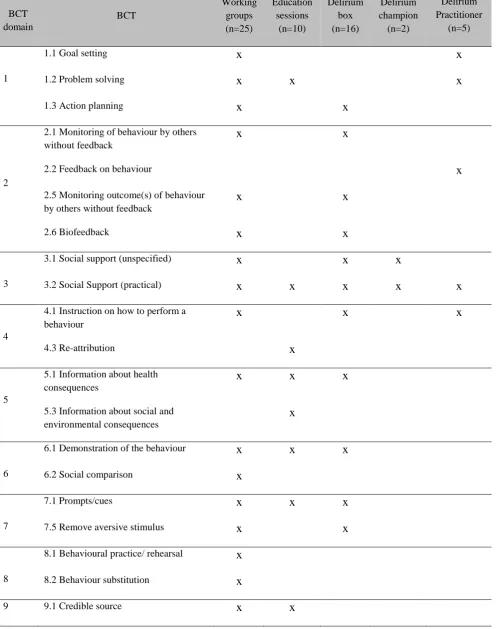
Twenty-five (26.9%) BCTs were identified within the working groups component of the
intervention; 16 (17.2%) BCTs were identified within the delirium box; 10 (10.8%) BCTs
were identified within education sessions; two BCTs (2.2%) were identified within the
delirium champion component; and five (5.4%) were identified with the delirium practitioner.
Table 1 lists the BCTS identified in each component of the Stop Delirium! intervention. The
delirium practitioner was responsible for delivering the various other components of the
intervention to staff. As such, all of the BCTs identified in the delirium practitioner part of
the intervention, were also present in one or more of the other components. BCTs for this
component were therefore not recorded separately. The BCTs identified within and form the
intervention is a reflection of how the intervention was used to prevent delirium.
[INSERT] Table 1: BCTs identified in each component of the intervention
The most frequently used BCT, common to all components of the intervention, was ‘social support (practical)’. Examples of practical social support were demonstrated within
education sessions, where staff were advised to “buddy up” in between teaching sessions to
13 working groups component of the intervention. Working groups provided practical social
support through peer support to put learning into practice. Care home staff were advised to
aid residents’ sleep by providing warm drinks at bedtime, increase residents’ nutrition by
providing them with the necessary aids they needed to eat, and prevent residents’ pain by
using alternative pain relief methods. The delirium box also included guidance on how to
provide practical social support to care home residents. For example, staff were advised to
attenuate disorientation in residents by checking their aids were clean and functional, whilst
clearing ear wax regularly. Staff were also advised to provide clear signs to help navigation,
provide safe footwear and walking aids to prevent environment falls, and to keep jugs and
cups of water within reach to promote hydration. As well as staff, the delirium practitioner
also demonstrated the BCT ‘social support (practical)’, by acting as a mentor, and training and supervising the delirium champions to deliver the Stop Delirium! intervention. As can be
seen within complex interventions, the recipient of the behaviour change technique can vary.
In this case, social support was demonstrated at one time by the delirium practitioner towards
the care home staff, and at other times care home staff provided social support to residents in
order to try and reduce their risk of delirium.
There were also four other BCTs commonly used in the intervention:
1) ‘Social support (unspecified)’ frequently targeted staff within working groups, the delirium box, and the delirium champion. Learning was encouraged and reinforced through sharing of
knowledge and experiences between staff, whereas delirium champions were designed to
help staff channel their knowledge on residents’ needs in order to address specific risk factors
for delirium.
2) ‘Information about health consequence’ was demonstrated throughout education sessions,
14 factors, including personal accounts. In addition, during working groups, care pathway cards
were produced which discussed the risk factors of delirium covering aspects of disorientation,
falls, immobility, sleep deprivation, dehydration, infections, medication, poor nutrition, and
pain. The delirium box also provided information about dehydration for family and friends
(amongst other risk factors) and discussed why older people are more at risk of delirium,
including causes, consequences and signs of dehydration.
3)‘Demonstration of behaviour’ was demonstrated during education sessions where staff
were provided with a “personal account of delirium” hand-out which provided an example of
the symptoms of delirium. During working groups staff were also asked to engage in
practical tasks that promote learning, such as observing their own fluid input/output. Vignette
booklets were provided within the delirium box which described personal experiences of
people with delirium.
4) Use of ‘prompts/cues’ was also a common BCT used throughout the intervention. Delirium recognition cards, “How can I prevent…” cards and “How would you feel”
bookmarks were used to help staff recognise delirium. During working groups, items of
“homework” were also given to prompt groups into thinking about delirium risk factors in
their own time. A delirium checklist was also produced which acted as a prompt to help staff
screen residents, record observations and hand over information between shifts.
One of the core aspects emphasised within the intervention was the concept of
‘empowerment’; staff were encouraged to take ownership of the day-to-day practices within
care homes. As this was not well represented in the taxonomy, this concept was coded to the
15 The Delirium Practitioner empowered staff by highlighting the unique position, knowledge
and expertise of staff that can contribute to preventing delirium. The Delirium Practitioner
also ensured staff took ownership of their proposed ideas for changes to be made in care
homes. Table 2 provides additional, but non-exhaustive, examples of how the behaviour
change techniques identified throughout the Stop Delirium! intervention were demonstrated.
The supplementary document provides a complete and detailed version of table 2.
[INSERT] Table 2: Illustrations of BCTs within Stop Delirium! intervention
Discussion
The aim of this paper was to identify the behaviour change techniques that formed a complex
multi-faceted intervention that targeted delirium prevention. We identified just over one-third
of all BCTs described in the BCTTv1 in the Stop Delirium! intervention. Our findings are
similar to other studies (Presseau et al., 2015; Vestjens et al., 2015), which also identified a
large number of BCTs within implementation and complex behaviour change interventions.
This reflects the necessary level of complexity in interventions to change staff behaviour and
organisational systems, which require diverse ‘active ingredients’ to generate positive
changes in behaviour and improve outcomes. Future delirium prevention interventions,
involving a component of staff and patient behaviour change, could be well-served to
consider incorporating these BCTs given the positive outcomes of the Stop Delirium!
intervention (Siddiqi et al., 2016).
The BCTs relating to the domain ‘social support’ featured significantly in the intervention, as has also been the case with other multicomponent interventions described in the literature
(Presseau et al., 2015; Vestjens et al., 2015). This is perhaps not surprising; the work required
16 support at staff group and organisation level. It could also be relevant that the majority of
staff in care home settings do not have professional qualifications, and have limited influence
on decisions about the organisation of care. Social support is vital for care home staff to be
able to make use of any knowledge-giving or training intervention (Zimmerman et al., 2005).
Information about health consequences is considered an effective behaviour change technique
and is prominent within the behaviour change literature. The Health Belief Model
(Hochbaum, 1958; Rosenstock 1966), for instance, has specified perceived susceptibility and
perceived seriousness of a health consequence as key variables that can shape an individual’s
perceived threat of a behaviour, which in turn can contribute towards actual behaviour
change. In the case of the Stop Delirium! intervention, care home staffs’ perceived risk of
delirium was facilitated by providing them with information about the health consequences of
delirium.
Bandura’s Social Learning Theory (Bandura, 1977) provides a strong basis for how the
demonstration of a target behaviour can inspire an individual to imitate such behaviour. Many
behaviour change interventions have been designed around the notion of imitation, or
modelling, and have primarily targeted behaviour change amongst children (Home, Tapper,
Lower, Hardman, Jackson, & Woolner, 2004). In the Stop Delirium! intervention, care home
staff were given the opportunity to learn about real-life instances in which delirium had
occurred and the main symptoms to look out for. The inclusion of practical tasks allowed care
home staff to learn about precautionary measures and checks that they ought to take and to
get them in that habit of routine.
Many instances concerning behaviour change may fail to materialise not because an
individual is averse to adopting a pro-health behaviour, but simply due to forgetfulness.
17 behaviours (Blackman, 1974). Habits are formed when a certain context or cue automatically
triggers a particular behaviour (Neal, Wood, Labrecque, & Lally, 2012). Care home staff
behaviour may be enacted in a habitual manner where routine, rather than reasoning, may be
the driving force behind decisions and actions (Bonetti et al. 2010). Therefore, the use of
prompts and cues as a social stimulus, to constantly remind staff of their learning and
delirium risk factors, can help break old habits where such behaviours did not take place and
shape the basis of new habit formation.
The ‘empowerment’ aspect of the intervention was highly valued by these staff (Siddiqi et al.,
2011) and again speaks of the need to promote and provide care staff additional support,
confidence and skills to effect change in their environment and practice. Although
‘empowerment’ was a core aspect of the Stop Delirium! intervention, this was not listed as a
BCT in the BCTTv1 (Michie et al., 2013). The research reports important findings showing
that there are additional techniques that should be specified in addition to the BCTs outlined
in the BCTTv1, if we are to fully describe interventions. The researchers mapped
empowerment to the closest BCTs which resembled it: ‘valued self-identity’ and ‘verbal
persuasion about capability’. The BCTTv1 has, to date, provided a common language and
definitions for understanding and classifying behaviour change techniques, as well as
informing the design and aiding accurate replication of future and present complex
interventions, respectively. However, the taxonomy may not capture all pertinent behaviour
change techniques. Indeed, the authors suggest that the taxonomy will continue to be added
to, as it is applied to more interventions (Lorencatto, West, & Seymour, 2011; Michie et al.,
2013). Research investigating multicomponent interventions to prevent delirium remains
relatively limited. Although we are not proposing that a separate taxonomy be formulated for
18 agree that that taxonomy will need to be expanded to address the range of settings in which
interventions may be implemented, and audiences that BCTs may target. The taxonomy may
also benefit from more comprehensive definitions and guidance for coding BCTs, with
particular attention on items that may have a degree of overlap. This will help promote
standardisation of the mapping process, and narrow the possibility of subjective interpretation
of BCTs and their respective definition within delirium practice.
Systematically identifying and describing in detail the components and BCTs in Stop
Delirium! using BCTTv1, can enhance its replicability in future research and promote
accurate implementation in delirium care. Future trial evaluations should include
measurement of intervention fidelity in order not only to establish effectiveness, but also to
identify the key techniques that influence outcomes. This will help establish whether a study
reliably and validly implements a clinical intervention. Should an intervention be found to be
effective (or ineffective) in a trial, if fidelity has not been monitored, it will remain unclear
whether the findings are actually due to the intervention or have been influenced by
unintentional inclusion of external factors or omission of intervention components (Cook &
Campbell, 1979). Categorising a complex intervention into BCTs helps facilitate
understanding of this process as it makes clear the behaviours targeted, and the techniques
used to promote behaviour change. As a next step, it would be appropriate to develop an
intervention fidelity tool to help assess the extent in which the Stop Delirium!intervention is
being carried out as is prescribed and in accordance to the BCTs identified.
Recommendations of factors to consider in developing measures of fidelity have been
outlined in Bellg et al. (2004). The authors have provided a breakdown of fidelity strategies
for monitoring and improving provider training, delivery of treatment, receipt of treatment,
19 In addition, these pre-defined behaviour change techniques can also be used as a source of
intervention evaluation within service delivery, where individuals whom the intervention is
targeting can rate how effective they felt each BCT was in helping them change their
behaviour and reach the desired outcome. This would not only be used as a source of
feedback for the individual delivering the intervention, but also feedback about which part of
the intervention seemed most effective. Future studies should test which BCTs are most
effective in promoting behaviour change and bringing about desirable behaviours, which
could then, in effect, be used to simplify multicomponent, complex interventions. This would
have a positive impact on the time required to deliver an intervention, and could potentially
reduce the time demanded from care home staff for intervention implementation.
Our research focused on the identification of BCTs rather than mechanisms ofchange.
Future research should further explore the mechanisms of changein complex health
interventions, and identify the likely candidate mediators. In doing this it will enable the
formation of more cost-effective and time-efficient revisions to the intervention, as well as
help reduce its complexity so that it is easier to adopt and implement, which in turn may
generate a greater interest in uptake. This would be highly desirable within care-home
practice and delirium care; working within a fast-paced demanding environment, with
irregular hours, reduces care home staff availability to participate in time-consuming
interventions. Considering that delirium is an avoidable and preventable by-product of poor
care for older people, it is essential to raise awareness among care home managers of the
most frequently used BCTs that have emerged within this intervention so that they can
consider adopting this through staff mentoring and training opportunities. Further
implementing interventions should aim to categorise and make explicitly clear all of the
20 classification system which will enable future replicability of healthcare and delirium
interventions. It will also allow comparisons to be made between different interventions with
respect to the BCTs implemented; this will be considerably useful when conducting
systematic reviews and meta-analyses investigating effectiveness of interventions for
delirium care, especially considering the scarcity of trial evaluations. Through the use of the
BCTTv1, randomised controlled trials and various interventions can all speak a common
language when relating back to their methods and the techniques used to modify behaviour.
This will reduce the potential for misclassification, misinterpretation and misrepresentation of
similar, but distinctly different, behaviour change approaches.
Our approach to describing the components and BCTs in Stop Delirium! has some
limitations. First, although two researchers independently examined and coded materials from
previous studies of the intervention, no contemporaneous observations of BCTs during
intervention delivery were made. Such post-hoc BCT coding is subjective to the coders’
understanding of the intervention protocol, manual and resources used to deliver the
intervention, and reports about its delivery, which may not reliably reflect practice. More
explicit consideration of the target behaviours and mapping of the BCTs that can influence
these prospectively during intervention development, along with contemporaneous
documentation of the BCTs used during delivery would be desirable in future design of
delirium interventions. Second, inter-rater reliability was not assessed between coders before
consensus discussions took place. Third, although both researchers coding for BCTs were
independent of the development of the intervention, a third researcher, who had led the work
to design Stop Delirium! was used to address any discrepancies that could not be resolved
through consensus. This may have influenced objectivity of the process. However, this was in
21 This research did not seek to investigate which BCTs are the most effective, or active
ingredients within the Stop Delirium! intervention, that significantly prevented delirium. This
is an endeavour for future research. On the other hand, this study did seek to identify the
BCTs, or active ingredients, that formed this complex intervention. We expect our research to
advance knowledge by enhancing the conceptualisation and operationalisation of delirium
interventions, by assessing the uniqueness of the Stop Delirium! techniques against the
behaviour change techniques identified in the most recent BCTTv1 taxonomy. The
identification of the specific techniques that make up the Stop Delirium! intervention will
enable researchers to develop studies that may establish which of the techniques, or
combination of techniques, is most effective in changing health behaviour in delirium care. In
addition, the identification of techniques may assist in developing more efficient and
parsimonious interventions by reducing redundancy and focusing on the techniques that are
most effective. This will not only assist in identifying the key techniques, but will also assist
delirium researchers and practitioners increase the efficiency of their interventions
(Hardcastle et al., 2015).
Conclusion
To our knowledge, this was the first attempt to explore the utility and capacity of using the
BCTTv1 to code an intervention for delirium care. The findings from this study show that it
is possible to use a taxonomy that focuses on behaviour change in this clinical context. This
study contributes to the ongoing emerging evidence demonstrating the reliability and
applicability of taxonomy coding methods in understanding the contents of behaviour change
interventions (Michie, Abraham, Whittington, McAteer, & Gupta 2009a; Michie et al., 2012;
Siddiqi et al., 2011; West, Walia, Hyder, Shahab, & Michie, 2010). The BCTTv1 is a useful
22 way forward in identifying and analysing the active ingredients, which are necessarily
complex. A challenge common to studies investigating effectiveness of complex
interventions is the difficulty in identifying which of the many BCTs involved most influence
behavioural outcomes. Identification of these BCTs could lead to simplification of
interventions, improving implementation and reducing costs within delirium care. For
research to improve service delivery for the treatment of delirium, there is a need to improve
understanding of the BCTs being used, and to study fidelity to intervention components in
process evaluations alongside effectiveness trials in order to develop streamlined
evidence-based interventions. Future delirium intervention research should routinely include the use of
behaviour change taxonomies in development, testing and implementation of interventions to
improve delirium care.
Disclosure statement
The authors declare that they have no competing interests.
References
Abraham, C. (2011). Mapping change mechanisms and behaviour change techniques: A systematic
approach to promoting behaviour change through text. In C. Abraham & M. Kools (eds.), Writing
Health Communication: An Evidence-Based Guide for Professionals. London: SAGE Publications.
Abraham, C., Good, A., Warren, M.R., Huedo-Medina, T.B., & Johnson, B.T. (2011). Developing
and testing a SHARP taxonomy of behaviour change techniques included in condom promotion
interventions. Psychology & Health, 26(Suppl. 2), 299.
Abraham, C., Kelly, M.P., West, R., & Michie, S. (2009). The UK national institute for health and
clinical excellence public health guidance on behavior change: a brief introduction. Psychology
23 Abraham, C.,& Michie, S. (2008) A taxonomy of behavior change techniques used in interventions.
Health Psychology, 27, 379-387
Albarracin, D., Gillette, J.C., Earl, A.N., Glasman, L.R., Durantini, M.R., & Ho, M.H. (2005). A test
of major assumptions about behavior change: a comprehensive look at the effects of passive and
active HIV-prevention interventions since the beginning of the epidemic. Psychological Bulletin, 131,
856-897
Araujo-Soares, V., MacIntyre, T., MacLennan G., & Sniehotta, F.F. (2009). Development and
exploratory cluster-randomized opportunistic trial of a theory-based intervention to enhance physical
activity among adolescents. Psychology & Health, 24, 805-822
Avery, L., Flynn, D., van Wersch, A., Sniehotta, F.F., & Trenell, M.I. (2012). Changing physical
activity behavior in type 2 diabetes: a systematic review and meta-analysis of behavioral
interventions. Diabetes Care, 35, 2681–9
Bandura, A. (1977). Social Learning Theory. Englewood Cliffs, NJ, Prentice Hall.
Bellg, A., Borrelli, B., Resnick, B., Hecht, J., Minicucci, D.S., Ory, M., Ogedegbe, G., Orwig, D.,
Ernst, D., & Czajkowski, S (2004) Enhancing treatment fidelity in health behaviour change studies:
best practices and recommendations from the NIH behaviour change consortium. Health Psychology,
22(5), 443-451
Blackman, D. E. (1974). Operant conditioning: an experimental analysis of behaviour. Cambridge:
Mathuen.
Bonetti, D., Johnston, M., Clarkson, J. E., Grimshaw, J., Pitts, N. B., Eccles, M.,… Walker, A. (2010).
Applying psychological theories to evidence-based clinical practice: identifying factors predictive of
placing preventive fissure sealants. Implementation Science, 5, 25
Bowman, C., Whistler, J., & Ellerby, M. (2004). A national census of care home residents. Age
Ageing, 33, 561-6
Breitbart, W., Gibson, C., & Tremblay, A. (2002). The delirium experience: delirium recall and
delirium-related distress in hospitalized patients with cancer, their spouses/caregivers, and their
nurses. Psychosomatics, 43, 183-94
British Geriatrics Society and Royal College of Physicians. (2006). Guidelines for the prevention,
diagnosis and management of delirium in older people. Report No. 6. [Accessed 21 March 2015]
Retrieved from:
24 Cahill, K., Moher, M., & Lancaster, T. (2008) Workplace interventions for smoking cessation.
Cochrane Database Systematic Reviews, CD003440
Chan, A.W., Tetzlaff, J.M., Gøtzsche, P.C., Altman, D.G., Mann, H., Berlin, J.A.,... Moher,
D. (2013). SPIRIT 2013 statement: defining standard protocol items for clinical trials. Annals of
Internal Medicine, 158(3), 200-207
Clegg, A., Siddiqi, N., Heaven, A., Young, J., & Holt, R. (2014). Interventions for preventing
delirium in older people in institutional long-term care. Cochrane Database Systematic Review, 31(1), CD009537
Cochrane Effective Practice and Organisation of Care Group. (2010). EPOC resources for review
authors. [Accessed 19 September 2016] Retrieved from:
http://epoc.cochrane.org/epoc-resources-review-authors
Cook, T.D., & Campbell, D.T. (1979). Quasi-experimentation: Design and analysis issues for field
settings. Chicago: Rand McNally.
Craig, P., Dieppe, P., Macintyre, S., Michie, S., Nazareth, I., & Petticrew, M. (2008).Developing and
evaluating complex interventions: the new Medical Research Council guidance. British Medical
Journal, 337, a1655
Davidson, K., Goldstein, M., Kaplan, R.M., Kaufmann, P.G., Knatterud, G.L., Orleans, C.T.,...
Whitlock, E.P. (2003). Evidence-based behavioral medicine: what is it and how do we achieve it?
Annals of Behavioural Medicine, 23(3), 161–71
Dixon, D., & Johnston, M. (2012). Health Behavior Change Competency Framework: competences to
deliver interventions to change lifestyle behaviors that affect health. Edinburgh: Scottish Government
Dombrowski, S.U., Sniehotta, F.F., Avenell, A., Johnston, M., Maclennan, G., & Araujo-Soares, V.
(2012). Identifying active ingredients in complex behavioural interventions for obese adults with
obesity-related co-morbidities or additional risk factors for co-morbidities: a systematic review.
Health Psychology Review, 6, 7–32
Gardner B, Whittington C, McAteer J, Eccles, M.P., & Michie, S. (2010). Using theory to synthesise
evidence from behaviour change interventions: The example of audit and feedback. Social Science &
25 Gourlan, M., Bernard, P., & Bortholon, C. (2014). Efficacy of theory-based interventions to promote
physical activity. A meta-analysis of randomised controlled trials. Health Psychology Review,
doi:10.1080/17437199.2014.981777
Hardcastle, S.J., Hancox, J., Hattar, A., Maxwell-Smith, C., Thorgersen-Ntoumani, C.,
& Hagger, M.S. (2015). Motivating the unmotivated: How do we change health behaviour in
those less willing to change? Frontiers in Psychology, 6,835.
Hardeman, W., Griffin, S., Johnston, M., Kinmonth, A.L., & Wareham, N.J. (2000). Interventions to
prevent weight gain: a systematic review of psychological models and behavior change methods.
Internation Journal of Obesity, 24, 131-143
Hochbaum, G. (1958). Public Participation in Medical Screening Programs: a sociopsychological
study. (Public Health Service Publication No. 572). Washington, D.C. Government Printing Office.
Hoffman, T., Glasziou, P.P., Boutron, I., Milne, R., Perera, R., Moher, D.,...Michie, S. (2014). Better
reporting of interventions: template for intervention description and replication (TIDieR) checklist
and guide. British Medical Journal, 348, g1687
Horne, P. J., Tapper, K., Lowe, C. F., Hardman, C. A., Jackson, M. C., & Woolner, J. (2004).
Increasing children's fruit and vegetable consumption: a peer-modelling and rewards-based
intervention. European journal of clinical nutrition, 58(12), 1649-1660.
Inouye, S.K., Bogardus, S.T., Charpentier, P.A., Leo-Summers, L., Acampora, D., Holford, T.R.,...
Cooney, L.M Jr. (1999). A multicomponent intervention to prevent delirium in hospitalized older
patients. New England Journal of Medicine, 340(9), 669-676
Institute for Government.(2010). MINDSPACE: Influencing behaviour through public policy. Institute
for Government, the Cabinet Office
Ivers, N., Jamtvedt, G., Flottorp, S., Young, J.M., Odgaard-Jensen, J., French, S.D., ... Oxman, A.D.
(2012). Audit and feedback: Effects on professional practice and healthcare outcomes. Cochrane
Database of Systematic Reviews, CD000259
Leeman, J., Baernholdt, M., & Sandelowski, M. (2007). Developing a theory-based taxonomy of
methods for implementing change in practice. Journal of Advance Nursing, 58(2), 191-200
Lindesay, J., Rockwood, K., & Rolfson, D. (2002). The epidemiology of delirium. In: J. Lindesay., K.
Rockwood., & A. Macdonald (Eds.), Delirium in Old Age. New York: Oxford University Press (pp.
26 Lorencatto, F., West, R., & Seymour, N. (2013). Developing a method for specifying the components
of behavior change interventions in practice: the example of smoking cessation. Journal of Consulting
and Clinical Psychology, 81(3), 528-544
Lundström, M., Edlund, A., Karlsson, S., Brännström , B., Bucht, G., & Gustafson, Y. (2005). A
multifactorial intervention program reduces the duration of delirium, length of hospitalization, and
mortality in delirious patients. Journal of the American Geriatrics Society, 53(4), 622-628
Marcantonio, E.R., Flacker, J.M., Wright, R.J., & Resnick, N.M. (2001). Reducing delirium after hip
fracture: a randomized trial. Journal of the American Geriatrics Society, 49(5), 516-522
McCusker, J., Cole, M.G., Voyer, P., Monette, J., Champoux, N., Ciampi, A.,... Belzile, E. (2011).
Prevalence and incidence of delirium in long-term care. International Journal of Geriatric Psychiatry,
26(11), 1152-61
Michie, S., & Abraham, C. (2004). Interventions to change health behaviours: evidence-based or
evidence-inspired? Psychology and Health, 19(1), 29-49
Michie, S., Ashford, S., Sniehotta, F.F., Dombrowski, S.U., Bishop, A., & French, D.P. (2011b). A
refined taxonomy of behaviour change techniques to help people change their physical activity and
healthy eating behaviours: the CALO-RE taxonomy. Psychology and Health, 26, 1479-1498
Michie, S., Abraham, C., Whittington, C., McAteer, J., & Gupta, S. (2009a).Effective techniques in
healthy eating and physical activity interventions: a meta-regression. Health Psychology, 28(6), 690
Michie, S., Churchill, S., & West, R. (2011d). Identifying Evidence-Based Competences Required to
Deliver Behavioral Support for Smoking Cessation. Annals of Behavioral Medicine, 41, 59-70
Michie, S., Hyder, N., Walia, A., & West, R. (2011c) Development of a taxonomy of behaviour
change techniques used in individual behavioural support for smoking cessation. Addictive Behaviors,
36, 315-319
Michie, S., Fixsen, D., Grimshaw, J.M., & Eccles, M.P. (2009b). Specifying and reporting complex
behaviour change interventions: the need for a scientific method. Implementation Science, 4, 40
Michie, S., Jochelson, K., Markham, W.A., & Bridle, C. (2009c). Low-income groups and behavior
change interventions: a review of intervention content, effectiveness and theoretical frameworks.
27 Michie, S., Johnston, M., Francis, J., Hardeman, W., & Eccles, M. (2008). From theory to
intervention: Mapping theoretically derived behavioral determinants to behavior change techniques.
Applied Psychology, 57, 660-680
Michie, S., Richardson, M., Johnston, M., Abraham, C., Francis, J., Hardeman, W.,...Wood, C.E.
(2013). The behavior change technique taxonomy (v1) of 93 hierarchically clustered techniques:
Building an international consensus for the reporting of behavior change interventions. Annals of
Behavioural Medicine, 46, 81-95
Michie, S., Stralen, M., & West, R. (2011a). The behaviour change wheel: A new method for
characterising and designing behaviour change interventions. Implementation Science, 6, 42
Michie, S., Whittington, C., Hamoudi, Z., Zarnani, F., Tober, G., & West, R. (2012). Identification of
behaviour change techniques to reduce excessive alcohol consumption. Addiction, 107, 1431-1440
National Institute for Health and Clinical Excellence (NICE, 2010). Delirium: diagnostic prevention
and management. NICE Clinical Guideline 103 [Accessed 15 May 2016] Retrieved from
https://www.nice.org.uk/guidance/cg103.
Neal, D. T., Wood, W., Labrecque, J. S., & Lally, P. (2012). How do habits guide behavior?
Perceived and actual triggers of habits in daily life. Journal of Experimental Social Psychology, 48(2),
492-498.
Neumann, M.S., Johnson, W.D., Semaan, S., Flores, S.A., Peersman, G., Hedges, L.V., & Sogolow,
E. (2002). Review and meta-analysis of HIV prevention intervention research for heterosexual adult
populations in the United States.Journal of Acquired Immune Deficiency Syndromes, 30(Suppl.1)
Noar, S.M., & Zimmerman, R.S. (2005). Health behavior theory and cumulative knowledge regarding
health behaviours: are we moving in the right direction?. Health Education Research: Theory &
Practice, 20, 275-290
Presseau, J., Ivers, N.M., Newham, J.J., Knittle, K., Danko, K.J.,& Grimshaw, J.M. (2015). Using a behaviour change techniques taxonomy to identify active ingredients within trials of implementation interventions for diabetes care. ImplementationScience, 10(1), 55
Proctor, E.K., Powell, B.J., & McMillen, J.C. (2013). Implementation strategies: recommendations for
specifying and reporting. Implementation Science, 8, 139
Quinn, F. (2010). On Integrating Biomedical and Behavioral Approaches to Activity Limitation with
28 Rodrigues, A., Sniehotta, F.F., & Araujo-Soares, V. (2013). Are interventions to promote
sun-protective behaviors in recreational and tourist settings effective? A systematic review with
meta-analysis and moderator meta-analysis. Annals of Behavioural Medicine, 45, 224–38
Rosenstock, I.M. (1966). Why people use health services. Milbank Memorial Fund Quarterly, 44,
94-124.
Schulz, K.F., Altman, D.G., & Moher, D. (2010). CONSORT 2010 statement: updated guidelines for
reporting parallel group randomised trials. BMC Medicine, 8(1), 1
Siddiqi, N., Cheater, F., Collinson, M., Farrin, A., Forster, A., George, D.,... Young, J. (2016). The
PiTSTOP study: A feasibility cluster randomized trial of delirium prevention in care homes for older
people. Age and Ageing, doi: 10.1093/ageing/afw091
Siddiqi, N., House, A.O., & Holmes, J.D. (2006). Occurrence and outcome of delirium in medical
in-patients: a systematic literature review. Age Ageing. 2006;35:350-64
Siddiqi, N., Young, J., Cheater, F.M., Harding, R.A. (2008). Educating staff working in long-term
care about delirium: The trojan horse for improving quality of care?. Journal of Psychosomatic
Research, 65(3), 261-266
Siddiqi, N., Young, J., House, A.O, Featherstone, I., Hopton, A., Martin, C.,... Holt, R. (2011). Stop
Delirium! A complex intervention to prevent delirium in care homes: a mixed-methods feasibility
study. Age and Ageing, 40(1), 90-98
Stewart, R., Hotopf, M., Dewey, M., Ballard, C., Bisla, J., Calem, M.,... Begum, A. (2014). Current
prevalence of dementia, depression and behavioural problems in the older adult care home sector: the
South East London Care Home Survey. Age and Ageing, 43(4), 562-567.
Tabet, N., Hudson, S., Sweeney, V., Sauer, J., Bryant. C., Macdonald, A., & Howard, R. (2005). An
educational intervention can prevent delirium on acute medical wards. Age and Ageing, 34(2),
152-156
Tricco, A.C., Ivers, N.M., Grimshaw, J.M., Moher, D., Turner, L., Galipeau, J.,... Shojania, K. (2012).
Effectiveness of quality improvement strategies on the management of diabetes: a systematic review
and meta-analysis. Lancet, 379, 2252–61
Vestjens, L., Kempen, G.I., Crutzen, R., Kok, G., & Zijlstra, G.A. (2015). Promising behavior change
techniques in a multicomponent intervention to reduce concerns about falls in old age: A Delphi
29 Victora, C.G., Habicht, J.P., & Bryce, J. (2004). Evidence-based public health: moving beyond
randomized trials. American Journal of Public Health, 94(3), 400-405
Wells, M., Williams, B., Treweek, S., Coyle, J., & Taylor, J. (2012). Intervention description is not
enough: evidence from an in-depth multiple case study on the untold role and impact of context in
randomised controlled trials of seven complex interventions. Trials, 13, 95
West, R., Walia, A., Hyder, N., Shahab, L., & Michie, S. (2010). Behavior change techniques used by
the English Stop Smoking Services and their associations with short-term quit outcomes. Nicotine and
Tobacco Research, 12(7), 742-747
Wood, C.E., Richardson, M., Johnston, M., Abraham, C., Francis, J., Hardeman, W., & Michie, S.
(2015). Applying the behaviour change technique (BCT) taxonomy v1: a study of coder training.
Translational Behavioral Medicine. 2015;5(2):134-148
Zimmerman, S., Williams, CS., Reed, PS., Boustan,i M., Preisser, J.S., Heck, E., & Sloane, P.D.
(2005). Attitudes, stress, and satisfaction of staff who care for residents with dementia. The
30 Table 1: BCTs identified in each component of the Stop Delirium! intervention
BCT domain BCT Working groups (n=25) Education sessions (n=10) Delirium box (n=16) Delirium champion (n=2) Delirium Practitioner (n=5) 1
1.1 Goal setting x x
1.2 Problem solving x x x
1.3 Action planning x x
2
2.1 Monitoring of behaviour by others without feedback
x x
2.2 Feedback on behaviour x
2.5 Monitoring outcome(s) of behaviour by others without feedback
x x
2.6 Biofeedback x x
3
3.1 Social support (unspecified) x x x
3.2 Social Support (practical) x x x x x
4
4.1 Instruction on how to perform a behaviour
x x x
4.3 Re-attribution x
5
5.1 Information about health consequences
x x x
5.3 Information about social and environmental consequences
x
6
6.1 Demonstration of the behaviour x x x
6.2 Social comparison x
7
7.1 Prompts/cues x x x
7.5 Remove aversive stimulus x x
8
8.1 Behavioural practice/ rehearsal x
8.2 Behaviour substitution x
31
10
10.1 Material incentive (behaviour) x
10.3 Non-specific reward x
11
11.1 Pharmacological support x x
11.3 Conserving mental resources x
12
12.1 Restructuring the physical environment
x x
12.2 Restructuring the social environment
x x
12.5 Adding objects to the environment x x
12.6 Body changes x x
13 13.4 Valued self-identity x
32 Table 2: Illustrations of BCTs within Stop Delirium! intervention
1. Goals and planning
Staff produce specific care pathways e.g. prevent dementia and cognitive impairment through encouraging stimulating activities for residents (1.1 Goal setting (behaviour)).
Staff identify solutions to identified problems – e.g. care home cook to discuss with residents how to improve diet (1.2 Problem solving).
Prevent constipation - The manager invited the cook to join the working group and agreed actions to provide a better diet to the residents (1.4 Action planning).
2. Feedback and monitoring
Staff to check for signs indicative of residents’ mood: relaxation, distress and confusion level (2.1
Monitoring of behaviours by others without feedback).
As part of the constipation care pathway staff should monitor residents’ mental and physical state for 48 hours, record fluid and bowel movement (2.5 Monitoring outcome(s) of behaviour by others without feedback).
Complete the delirium checklist, a checklist that is used to record feedback about the patient’s state (2.6 Biofeedback)
3. Social support
Learning is encouraged and reinforced through sharing of learning and experiences between staff (3.1 Social support (unspecified)).
Staff are advised to “buddy up” in between teaching sessions to look out for delirium so to facilitate learning (3.2 Social support (practical)).
4. Shaping knowledge
Control residents’ pain by administering prescribed medication/analgesia; Call GP; use checklist to describe symptoms (4.1 Instructions on how to perform a behaviour).
Staff taught to differentiate between delirium, dementia and depression (4.3 Re-attribution).
5. Natural consequences
Information provided on the negative outcomes of delirium, causes and risk factors, including personal accounts (5.1 Information about health consequences).
Information provided on the consequences of delirium, including why delirium is important and stressful for staff, residents and visitors (5.3 Information about social and environmental consequences).
6. Comparison of behaviour
Staff are asked to engage in practical tasks that promote learning, such as observing own fluid input/output (6.1 Demonstration of the behaviour).
Outputs of working groups and ideas are shared across homes (6.2 Social comparison).
33 Prevent resident disorientation by providing clear signs around the home to help residents find their way (7.1 Prompts/cues).
Prevent medication effects - ensure medications are kept securely to prevent them being taken by other residents who are confused (7.5 Remove aversive stimulus).
8. Repetition and substitution
Prevent resident from acquiring infections by encouraging regular hand-washing for staff, residents and visitors (8.1 Behavioural practice/rehearsal).
Replace sedentary behaviour with activities such as, dance, music and movement, singing, serving food, walks, and hobbies (8.2 Behaviour substitution).
9. Comparison of outcomes
Refer to NICE guidance regarding impact, risks and causes, prevention and management, and implementing changes (9.1 Credible source).
Receive certificate after completion of education sessions (10.1 Material incentive (behaviour)). Complete quiz and word search puzzle after completion of education sessions (10.3 Non-specific reward).
11. Regulation
Prevent resident pain by involving health professionals to manage pain; if pain medication is prescribed, remember to offer it regularly if indicated (11.1 Pharmacological support).
Prevent resident disorientation by providing them with cue cards which can help express basic needs and aid with communication difficulties (11.3 Conserving mental resources).
12. Antecedents
Improve residents’ sleep by providing a relaxing quiet environment, not too hot or cold (12.1 Restructuring the physical environment).
Prevent sleep disruption by providing most care during waking hours (12.2 Restructuring the social environment).
Prevent resident pain by providing walking aids within easy reach (12.5 Adding objects to the environment).
Prevent resident pain through physical activity to improve muscle strength and flexibility, TENS, warmth, massage (12.6 Body changes).
13. Identity
Delirium practitioner highlights unique position, knowledge and expertise of staff (specialists) on residents and their needs that can contribute to prevent delirium, specifically tailored to each care home. Ensure ownership of proposed changes to staff responsible (13.4 Valued self-identity).
15. Self-belief