Multiple-path interferometer
with a single quantum obstacle
H. Schomerus1, Y. Noat2, J. Dalibard3 and C. W. J. Beenakker4
1 Max-Planck-Institut f¨ur Physik komplexer Systeme N¨othnitzer Str. 38, 01187 Dresden, Germany
2 Kamerlingh Onnes Laboratory, Universiteit Leiden P.O. Box 9504, 2300 RA Leiden, The Netherlands
3 Laboratoire Kastler Brossel, D´epartement de Physique de l’Ecole Normale Sup´erieure 24 rue Lhomond, 75231 Paris, France
4 Instituut-Lorentz, Universiteit Leiden, P.O. Box 9506 2300 RA Leiden, The Netherlands
(received 22 August 2001; accepted in final form 14 December 2001) PACS.05.60.Gg – Quantum transport.
PACS.03.65.Nk – Scattering theory. PACS.42.25.Hz – Interference.
Abstract. – We consider the scattering of particles (kinetic energyε) by an obstacle which tunnels coherently between two positions (tunnel splitting ∆), for arbitrary values ofε/∆ and scattering strength U. The obstacle mimics two classical scatterers at fixed positions when
ε ∆. Interference disappears when ε ∆, but can be recovered if the elastic-scattering channel is detected only. At intermediate values of ε there is a systematic interplay of the coherent tunnel motion and the ballistic particle motion. We show that the transmission probability can remain finite even in the limit U → ∞ because the particle can evade the obstacle systematically. We discuss the realization of a quantum obstacle in mesoscopic systems.
In the familiar double-slit experiment a beam of particles is sent through two slits in a plate and the transmitted intensity is observed on a screen. One finds an interference pattern, thus demonstrating the coherent superposition of the two possible scattering paths. The same result is obtained for the reflection from obstacles,e.g., the bars of a reflection grating.
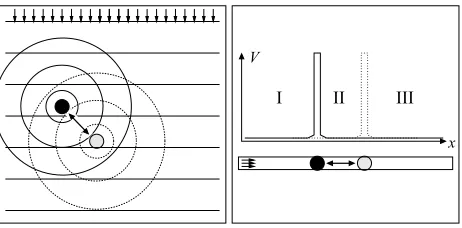
In these experiments the slits or bars only play a passive role. In this paper we consider scattering by a single obstacle, which, however, is by itself a quantum object with states that correspond to different locations (see fig. 1). Allowing for superpositions of these states, we have an obstacle that is delocalized in space. Which reflection or transmission pattern is then observed on the screen? It is straightforward to demonstrate that the quantum obstacle may act as a collection of classical scatterers, in that one observes the corresponding interference pattern on the screen. The condition for interference is that the tunnel splitting ∆ is larger than the kinetic energyεof the incident particles (fast-tunneling regime). For ∆ε ( slow-tunneling regime) the interference pattern from the obstacle disappears, but can be recovered if only the elastic-scattering channel is detected.
c
x
III II
V
[image:2.516.126.357.98.212.2]I
Fig. 1 – Scattering of a particle by a delocalized obstacle which tunnels between two positions (solid and shaded dot). Left panel: double slit, the obstacle provides two scattering paths in parallel. The lines indicate fronts of the wave function. Right panel: Fabry-Perot interferometer, the obstacle’s positions are arranged in series. The solid and dashed curves indicate the scattering potentials. The problem is solved by matching the waves in the regions I, II, and III.
In this paper we present a one-dimensional model with repulsive contact interaction (delta-function potential U δ(x)) which is exactly solvable for arbitrary values of ε/∆ and U and hence allows to study thecrossover regime ∆ ε between the two regimes discussed above (we mostly concentrate on the case of large interaction strengthU, in which the phenomena are most pronounced). The double slits or bars are two scattering elements put in parallel. Our model addresses the problem of two barriers arranged in series —a Fabry-Perot interfer-ometer. The quantum analogue is an obstacle which tunnels between two locations along the propagation direction of the incident particles.
In the context of our model, interference results in transmission resonances. We find that resonances are absent in the slow-tunneling regime, while in the fast-tunneling regime the transmission amplitude becomes identical to that of the Fabry-Perot interferometer if the separation of the tunnel positions is sufficiently large. In thecrossover regimeone finds a rich behavior of the transmission probability due to multiple inelastic scattering and the interplay of the coherent tunnel motion and the ballistic particle motion. In general, for parameters outside the slow-tunneling regime the particle may systematically evade the scatterer so that its scattering strength is greatly reduced, and the transmission probability remains finite even forU → ∞.
The quantum obstacle could be realized in double quantum dots [1, 2] or nanoconstric-tions [3, 4]. (A large interaction strength U can be achieved in one-dimensional electronic transport because the particles cannot circumvent the interaction region.) As we will discuss at the end of the paper, the quantum delocalization of scatterers in such mesoscopic system should be experimentally detectable from the temperature dependence of the conductance.
In order to set the stage for the one-dimensional model system discussed below, let us first consider the “parallel” quantum scatterer in three dimensions, which hops between two positions R1 = r0/2 (internal state |1), R2 =−r0/2 (internal state |2), with separation
the scatterer can then be written as
H = pˆ 2
2m+ ˆW − ∆
2
|12|+|21|,
ˆ
W = V1(r)|11|+V2(r)|22|. (1) Here ˆpis the momentum operator of the particle of massm. The plane-wave eigenstates|k are denoted by their wave vectork=p/.
We assume that the scatterer is initially prepared in its ground state|s (preparation in its excited state|a is equivalent to the case ∆ < 0; superpositions result in nonstationary behavior). In the limit of a weak interaction we can apply the Born approximation and obtain the probability of scattering from the initial state|ki into the final state|kf by summing the probabilities for each final state of the scatterer:
Pki→kf = 2π
kf;s|Wˆ|s;ki2δεi−εf+kf;a|Wˆ|s;ki2δεi−εf−∆ . (2)
For a short-ranged potential of the formV(r) =U δ(r), the probability reads
Pki→kf =2π U2
cos2∆k·r0/2δεi−εf+ sin2∆k·r0/2δεi−εf−∆, (3)
where ∆k =ki −kf. Interference with full contrast is observed when the energy εi of the incoming particle is smaller than ∆ (fast tunneling), because then the argument of the second delta-function is always negative (inelastic processes are forbidden). In this situation the quantum scatterer acts as two classical scatterers of fixed positionsR1andR2, sincePki→kf ∼ cos2∆k·r02). On the other hand, interference is lost if the kinetic energy of the incident particlesεi ∆ (slow tunneling) [5]. The interference pattern can be recovered if one only detects the elastic scattering channel (by means of energy-resolved detection at energyε).
Now we turn to the “serial” quantum barrier, which hops in the propagation direction of the scattered particle. In the case of one-dimensional scattering (plane-parallel barriers, or confined propagation) and for the delta-function potentialV1(x) =U δ(x−L/2),V2(x) = U δ(x+L/2), this scattering problem can be solved exactly. (The problem is defined by the Hamiltonian given in eq. (1) with these potentials and ˆp2 replaced by ˆp2x=−2∂2/∂x2.) In order to simplify the notation, we use units2/2m≡1, such that the kinetic energyε=k2.
Before we present the solution, let us briefly recall the results for the conventional case of immobile barriers. For a single immobile barrier of strengthU the transmission and reflection amplitudes at wave numberk are given by
t= 1
1 +iU/2k and r=
iU/2k
1 +iU/2k, (4)
respectively, such that the reflection probability approaches unity when U |k|. When two such immobile barriers are placed in series with separation L they form a Fabry-Perot interferometer, with transmission amplitude
t= k
2
The quantum scatterer is delocalized, giving rise to a number of additional resonance and interference effects. In order to explore these effects, we solve the stationary scattering problem for electrons with momentum k > 0 incident from the left, while the scatterer is prepared in the eigenstate|s, hence giving the total energyE=ε−∆/2. Under conservation of this energy, the electrons can be reflected or transmitted either elastically or inelastically, where in the latter case the outgoing electrons have momentum ±q, with q =√ε−∆, and the scatterer is excited into the state|a.
The scattering probabilities and phase shifts can be determined via wave matching of the wave functions
φα=aαeikx+bαe−ikx|s+cαeiqx+dαe−iqx|a (6) at the boundaries of the three regionsα= I forx <−L/2,α= II for −L/2< x < L/2, and α= III for x > L/2 (see fig. 1). The resulting linear system of equations is then solved for bI, dI, aIII, and cIII as a linear function of aI (which we set to unity), under the conditions cI=bIII=dIII= 0, because no electrons are coming in with momentumq, or from the right. (For the caseε <∆ we use the convention Imq >0, so that the wave functions with coefficient dI and cIII decay exponentially with the distance to the scatterer.) The coefficients (which are lengthy algebraic expressions and hence not written down here) determine the elastic and inelastic transmission and reflection probabilities by Tel=|aIII|2, Tinel= (Req/k)|cIII|2, Rel = |bI|2, and Rinel = (Req/k)|dI|2. (The inelastic scattering probability Tinel +Rinel vanishes forε <∆.) The coefficients also deliver the scattering phase shiftsφR,T;el,inel, with φT;el = argaIII, etc., and the delay times [6] τ = dφ/dε. Having solved the problem in principle, let us now discuss the different regimes introduced in the introduction.
Slow tunneling. – In the limit ∆→0 we find
R=Rel+Rinel= U 2
4k2+U2, Rel= cos
2(kL)R, T
el= 4k 2
4k2+U2, Tinel= 0. (7) The L-dependence of Rel corresponds to the result in Born approximation (3) with ki r0 whilekf points into the opposite direction, if we identify|r0|=Land |∆k|= 2k. Moreover, the total transmission and reflection probabilities are the same as for the conventional problem of a single delta-function of strength U (see eq. (4)), and for U → ∞ the transmittance vanishes. In striking contrast, we now will see that the transmission probability remains finite if ∆= 0.
Crossover regime. – For ∆< εwe find forU → ∞the coefficients aIII= 2ikg−1exp[iqL] Imf, cIII= exp[i(k−q)L/2]aIII, bI= 2qg−1[iImf −k(coskL+ cosqL)],
dI=kg−1exp−i(k+q)L/2kexp[2iqL]−1+qexp[2ikL]−1, (8) where f = qexp[ikL]−kexp[iqL], g = (k+q)2−f2. The proportionality between the transmission coefficientsaIIIandcIIIin eq. (8) entails for the elastic and inelastic transmission delay times the relationτT;inel=τT;el−mL(q−1−k−1)/2, where we momentarily reintroduced the units, m.
0 0.5 1
Probability
-100 0 100 200
0 5 10 15 20
Delay time/
τ0
[image:5.516.172.348.101.270.2]kL/π
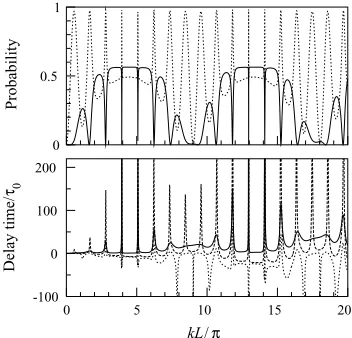
Fig. 2 – Upper panel: probabilities of transmissionTel+Tinel (solid curve) and inelastic scattering
Tinel+Rinel (dashed curve) for the one-dimensional model with U =∞ as a function ofkL/π, for ∆/ε= 0.4. Lower panel: delay timesτT;el (solid curve),τR;el(long dashes, peaks pointing upwards), andτR;inel (short dashes, peaks pointing downwards), in units ofτ0=/ε.
The transmission probability is modulated by a function F(kL/π) (related to f in eq. (8)) with periodp= 2/(1−1−∆/ε) and maxima atkL/π = (n+ 1/2)p. If we approach the slow-tunneling regime (p 4ε/∆), the maxima occur when the time of flight L/v of the particle between the two positions of the obstacle is an odd multiple of the tunneling time h/2∆ between these positions (the minima occur at even multiples). Close to the minima the peaks inτR,elandτR,inel alternate; close to the maxima they coincide.
At the border to the fast-tunneling regime (∆ = ε) the momentum q vanishes, and the inelastic-scattering rate (which is proportional to Req) drops to zero. The transmission prob-ability becomes
T =Tel= (kL−sinkL) 2
(1 + coskL)2+ (kL−sinkL)2. (9) In the limitkL 1 the transmission probabilityT = 1. This is a remarkable observation: The scatterer becomes totally transparent althoughU → ∞.
Fast tunneling. – Another remarkable case of total transmission is found for ∆ > ε, where all electrons are scattered elastically. The transmission probability is now
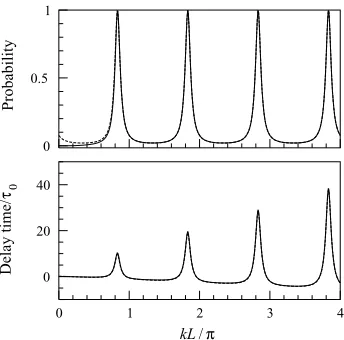
T = 4k2ksinh|q|L− |q|sinkL2e−2L|q|k+i|q|2−eikLke−L(|q|+ik)−i|q|2−2. (10) The delay times τT and τR are equal (this is a joint consequence of the unitarity of the scattering matrix and the reflection symmetry of the potential). At large length L 1/|q| the transmission amplitudet becomes exactly identical to the transmission amplitude of the Fabry-Perot interferometer, eq. (5), withU replaced by 2|q|. Hence, although we started out with an infinite scattering strengthU, the finesse of the quantum version of the Fabry-Perot interferometer is finite.
0 0.5 1
Probability
0 20 40
0 1 2 3 4
Delay time/
τ0
[image:6.516.156.328.99.269.2]kL/π
Fig. 3 – Transmission probability T (upper panel) and delay time τ in units of τ0 = /ε (lower panel), as a function ofkL/π. The solid curve is the result for the quantum obstacle with scattering strengthU =∞and ∆/ε= 4, the dashed curve (nearly indistinguishable from the solid curve) the result for the conventional Fabry-Perot interferometer (two fixed classical barriers) from eq. (5) with
U/k= 2√3.
tum obstacle behaves as two fixed classical scatterers when the tunnel splitting exceeds the kinetic energy.
It would be exciting to detect the quantum delocalization of scatterers in a mesoscopic system, e.g., by investigating the temperature dependence of the conductance. A possible manifestation of the delocalized scatterer in such systems is an interstitial defect, like a light atom, which hops between two energetically equivalent positions. When the thermal excitation energy is of the order of the energy barrier that the particle has to overcome, the defect jumps incoherently from one position to another. Since the potential in the system is changed after each jump, the conductance exhibits random temporal fluctuations (telegraphic noise) between two values G1 and G2 [7–9]. For a long measurement time one measures the time average G= (G1+G2)/2, which is small if the scattering strength is large. For lower temperatures, however, one enters the coherent-tunneling regime in which the defect acts as a quantum obstacle and its scattering strength can be greatly reduced, because it may be systematically avoided by the particles. Note that if electrons can be treated independently and scattering is elastic, our results for the transmission probability can be applied to obtain the conductance by the Landauer formulaG= (e2/h)T. Up to now, however, we have neglected many-body effects. The most straightforward modification is to account for the Pauli blocking of states below the Fermi energy EF: Inelastic scattering is forbidden when the excitation energy ε−EF < ∆. (The typical excitation energy is given by the potential drop eV or by the thermal excitation energy, whatever the larger.) More intricate many-body effects arise from sequential scattering of several particles by the same quantum scatterer.
effects to some extent, one might think of injecting “hot electrons” from one end of the wire, by shooting them over an additional potential barrier. In this way the excitation energies can be restricted to a small energy interval which is well separated from the Fermi energy.
To conclude, we have investigated scattering by a quantum obstacle which is delocalized in space. We found close analogies to the double slit and the Fabry-Perot interferometer for fast coherent tunneling of the obstacle, and that an infinitely high potential barrier can become transparent if it is delocalized. The dynamics of the delocalized scatterer is revealed in the efficiency with which the particle can evade the scatterer (the sensitive dependence of the effective scattering strength on kinetic energy and tunnel frequency).
Our results are relevant for recent experiments on mesoscopic structures that have probed the scattering by tunable [1, 2] or spontaneously formed [3, 4] two-level systems consisting of mobile entities. Moreover, experiments in molecular electronics revealed the interplay between electronic motion and kinetic degrees of freedom of the molecules [10]. The mobile entities and molecules are classical obstacles at high temperatures, but turn into quantum obstacles as the temperature is lowered. We have proposed a study of the temperature dependence of the conductance as a signature for having entered this new regime.
∗ ∗ ∗
We thankS. Bahn, H. Bouchiat, A. Georges, Y. Imry, M. Kociak, andB. Reulet
for discussions. This work was supported by the Dutch Science Foundation NWO/FOM and the European Commission.
REFERENCES
[1] Livermore C.et al.,Science,274(1996) 1332.
[2] Fujisawa T.et al.,Science,282(1998) 932.
[3] van den Brom H. E., Yanson A. I.andvan Ruitenbeek J. M.,Physica B,252(1998) 69.
[4] Keijsers R. J. P., Shklyarevskii O. I.andvan Kempen H.,Physica B,253(1998) 148.
[5] Cohen-Tannoudji C., Bardou F.andAspect A.,Laser Spectroscopy X, edited byDucloy
M., Giacobino E.andCamy G.(World Scientific, Singapore) 1992.
[6] Wigner E. P.,Phys. Rev.,98(1955) 145.
[7] Dutta P.andHorn P. M.,Rev. Mod. Phys.,53(1981) 497.
[8] Weissman M. B.,Rev. Mod. Phys.,60(1988) 537.
[9] Kogan Sh.,Electronic Noise and Fluctuations in Solids (Cambridge University Press,
Cam-bridge) 1996.