Department of Management Science,
Lancaster University Management School (LUMS),
Lancaster University
BRIDGING THE GAP:
Refining a Workload Control Concept
for Practical Implementation
By
Mark Stevenson
(BSc in Operations Management)
All rights reserved
INFORMATION TO ALL USERS
The qu ality of this repro d u ctio n is d e p e n d e n t upon the q u ality of the copy subm itted.
In the unlikely e v e n t that the a u th o r did not send a c o m p le te m anuscript and there are missing pages, these will be note d . Also, if m aterial had to be rem oved,
a n o te will in d ica te the deletion.
uest
ProQuest 11003688
Published by ProQuest LLC(2018). C op yrig ht of the Dissertation is held by the Author.
All rights reserved.
This work is protected against unauthorized copying under Title 17, United States C o d e M icroform Edition © ProQuest LLC.
ProQuest LLC.
789 East Eisenhower Parkway P.O. Box 1346
BRIDGING THE GAP:
Refining a Workload Control Concept for Practical Implementation
Mark Stevenson
BSc in Operations Management
Submitted for the Degree of Doctor of Philosophy
February 2006
ABSTRACT
Workload Control (WLC) is a Production Planning and Control (PPC) concept
designed for complex manufacturing environments such as the job shop, a
configuration commonly found in Make-To-Order (MTO) companies. The Lancaster
University Management School (LUMS) has been a major contributor to the
popularisation of WLC since the early nineteen eighties. This thesis contributes to the
further development of a WLC methodology developed at Lancaster, hereafter referred
to as the LUMS approach.
The majority of contemporary WLC research is simulation based; as a result,
there is a lack of understanding regarding practical elements of the concept. This has
created a void between theoretical aspects of WLC and the practice of MTO
production. This thesis is case study based and considers two research questions
important to improving the feasibility of applying WLC in practice and to the future
development of a body of empirical evidence. The first question focuses on bridging
the gap between the theory and practice of WLC by refining the LUMS approach. The
second centres on identifying the implementation issues surrounding WLC and
revisits the literature, identifying areas in which the LUMS approach can be
restructured. Stage Two focuses on developing a Decision Support System (DSS) based
on the LUMS approach, while considering the needs of present day MTO companies.
This resulted in changes to key assumptions underpinning the methodology. Through
the partial implementation of the DSS in a case study setting, Stage Three contributes
towards both research questions. This produced inductive refinements to the concept,
while issues involved in preparing the company for implementation were also explored,
PUBLICATIONS
Parts of this research have been published on the following occasions:
Stevenson, M., 2006, Refining a workload control (WLC) concept: A case
study, International Journal o f Production Research, 44, 4, 767 -
790.
Stevenson, M., and Hendry, L.C., 2006, Aggregate load oriented workload control: A review and a reclassification of a key approach,
International Journal o f Production Economics (Article in Press). Stevenson, M., Hendry, L.C., and Kingsman, B.G., 2005, A review of
production planning and control: The applicability of key concepts to
the make to order industry, International Journal o f Production
Research, 43, 5, 869 - 898.
Stevenson, M., (with Hendry, L.C., Land, M.L., and Gaalman, G.,), 2006, Investigating implementation issues for workload control: A
comparative case study analysis, 14th International Working Seminar
on Production Economics, Innsbruck, Conference Proceedings, 3, 1 2 9 - 142.
Stevenson, M., and Hendry, L.C., 2005, The development of a decision support
system (DSS) for workload control (WLC): A case study, Winds o f
Change: Production and Operations Management Society (POMS) Conference, Chicago, Conference Proceedings (Full Paper Available on Conference Compact Disc).
Stevenson, M., Hendry, L.C., and Kingsman, B.G., 2004, Aggregate load
oriented workload control, 13th International Working Seminar on
Production Economics, Igls, Innsbruck, Conference Proceedings, 1, 399 -41 1.
Stevenson, M., Hendry, L.C., and Kingsman, B.G., 2003, A review of new and established production planning and control (PPC) methods and their
applicability to make to order (MTO) companies, One World? One
View o f OM?: I st Joint EUROMA POMS Conference, Lake Como, Conference Proceedings, 2, 739 - 748.
Parts of this thesis are planned for publication:
Stevenson, M., and Hendry, L.C., Improving supply chain integration using a
workload control (WLC) concept and web functionality, Production
Planning and Control, (Submitted for Publication).
Stevenson, M., and Hendry, L.C., Achieving lean in customised b2B supply
First and foremost, I would like to pay tribute to my two supervisors, Professor Linda
Hendry and Professor Brian Kingsman. Professor Hendry has been a source of great
support and guidance throughout my research, has always encouraged me to pursue my
ideas, and has been of enormous benefit in my research training. Sadly Professor Brian
Kingsman died in August 2003, part way through this research project. Professor
Kingsman was the inspiration that motivated me to do this research from my days as an
undergraduate student in his very entertaining Supply Chain Management lectures. His
contribution has been greatly missed although his influence was never far away.
I would also like to thank fellow ‘Workload Controllers’ that I have had the
fortune to meet and share ideas with at conferences over the past three years. In
particular, I would like to thank Cristovao Silva from the University of Coimbra and
Gerard Gaalman, Martin Land and Peter Henrich from the University of Groningen.
A teaching studentship from the Department of Management of Science was
awarded to me for the duration of my studies, and is gratefully acknowledged. I would
also like to thank ‘Company X ’ for their collaboration during this research project.
Last but not least, I would like to thank my family: Anne, Arthur, Paul &
TABLE OF CONTENTS
PAGE
A b stract... i
P ublications... iii
A cknow ledgem ents... iv
Table of C o nten ts...v
List of F ig u res... xi
List of T a b le s... xiv
Glossary of A bbreviations... xvi
CHAPTER 1: INTRODUCTION 1.1 Overview of M anufacturing...1
1.2 The Make-To-Order (MTO) Industry... ... 3
1.2.1 The Make-To-Order Tendering S ta g e ...8
1.2.2 The Importance of Small and Medium Sized Enterprises (SM E’s ) .... 8
1.2.3 Job Shop Production... 9
1.2.4 Make-To-Order Planning and Control S ta g e s ...10
1.3 The Make-To-Order Planning P roblem ...11
1.4 Gaining C o n tro l...13
1.5 Research Objectives: Bridging the Gap Between Theory and P ractice 17 1.6 Organisation of the T h e sis...20
CHAPTER 2: A REVIEW OF PRODUCTION PLANNING AND CONTROL 2.1 Introduction... 22
2.2 The Requirements of the MTO S ecto r... 24
2.2.1 C ustom isation... 24
2.2.2 Shop Configuration... 25
2.2.3 Company S iz e ...26
2.2.4 Criteria for Determining A pplicability... 26
2.3.1 Assessing the Applicability of MRP and B ey o n d ... 33
2.4 Theory of Constraints (T O C )... 34
2.4.1 Assessing the Applicability of T O C ...36
2.5 Workload Control (W L C )...37
2.5.1 Overview of the LUMS A pproach... 40
2.5.2 Assessing the Applicability of W L C ...44
2.6 K an b an ... 44
2.6.1 Assessing the Applicability of K an b an ...46
2.7 Constant Work-In-Process (CO N W IP)...46
2.7.1 Assessing the Applicability of C O N W IP ... 48
2.8 Paired cell Overlapping Loops of Cards with Authorisation (PO L C A )... 49
2.8.1 Assessing the Applicability of P O L C A ... 50
2.9 Comparison of PPC Methods and Their A pplicability... 51
2.10 Gaps in the L iterature...56
CHAPTER 3: RESEARCH METHODOLOGY 3.1 Introduction... 63
3.2 Alternative WLC Methodological A pproaches...63
3.2.1 Empirical WLC Research H istory...65
3.3 Theory Versus Practice: Research Pitfalls and the WLC P arad o x ...68
3.4 Alternative Empirical Research M ethodologies... 70
3.4.1 Case Study R esearch... 71
3.4.2 Action R esearch...74
3.4.3 Differentiating Between Case and Action R esearch...76
3.4.4 Choosing the Type of Case Study R esearch... 78
3.4.5 Towards Effective Case Study R esearch...79
3.4.6 Summarising the A pproach... 86
3.5 Choosing the Case to S tu d y ... 88
3.5.1 Company X ... 92
3.5.2 Company Y ... 92
3.5.3 Company Z ...93
PAGE
3.7 Evaluating the Needs of the C om pany... 100
3.8 Determining Appropriate Performance M easu res...102
3.8.1 Delivery Date A dherence...104
3.8.2 Work In P rogress... 106
3.8.3 Manufacturing and Delivery Lead Times and Lead Time V ariability... 106
3.8.4 Backlogs and Work Centre U tilisation...107
3.8.5 Company Strike Rate Percentage...107
3.8.6 Feedback and O bservations... 108
3.9 C onclusion... 108
CHAPTER 4: AGGREGATE LOAD ORIENTED WORKLOAD CONTROL -A REVIEW -AND -A RE-CL-ASSIFIC-ATION OF -A KEY -APPRO-ACH 4.1 Introduction... I l l 4.2 Measure of Indirect Load: A R ev iew ... 113
4.3 Workload Bounding: A R eview ... 118
4.3.1 Variations on Traditional Approaches to Workload B ounding 121 4.4 The LUMS Approach U pdated... 123
4.4.1 LUMS Customer Enquiry M anagem ent... 127
4.4.2 LUMS Order Release M echanism ... 131
4.4.3 LUMS Measure of Indirect L o a d ... 134
4.4.4 LUMS Workload B ounding... 136
4.4.5 LUMS Priority D ispatching... 138
4.4.6 LUMS Backlog Length Parameter S ettin g ...139
4.5 C onclusion... 141
CHAPTER 5: A DECISION SUPPORT SYSTEM FOR WORKLOAD CONTROL 5.1 Overview of Decision Support System s... 143
5.1.1 Defining a Decision Support S ystem ... 144
5.2 Development of a D S S ...147
5.3 Features of the Proposed Decision Support S y stem ... 150
5.3.3 Determining Delivery D a te s... 157
5.3.4 The Job Entry S ta g e ... 162
5.3.5 Planned Backlog M anagem ent... 163
5.3.6 Backwards Scheduling Procedure...164
5.3.7 The Job Release S ta g e ... 175
5.3.8 Released Backlog M anagem ent... 175
5.3.9 Job Progress Reporting and Feedback Inform ation... 180
5.3.10 Capacity M anagem ent...184
5.3.11 Parameter S ettin g ...188
5.4 C onclusion...189
CHAPTER 6: THE CASE STUDY COMPANY 6.1 Introduction...194
6.2 Company O verview ... 195
6.3 Human R esources... 199
6.4 Machine R esources...202
6.5 Customer Enquiries and Setting Delivery D a te s ... 207
6.6 MAIS: An Internal Information S ystem ... 210
6.7 End-User D e ta ils...212
6.8: Organisational P o litics... 214
6.8.1 Political Agendas Within Company X ...216
6.9 Company Specific PPC Requirem ents...221
6.10 Capacity Management O ptions... 224
6.11 Pre-Implementation Data A nalysis...226
6.11.1 Delivery Date A dherence... 227
6.11.2 Delivery Lead Time and Lead Time V ariation...231
6.11.3 Inventory A nalysis... 233
6.11.4 Machine Utilisation and B acklogs... 234
6.11.5 Company Strike Rate Percentage and Customer Confirmation T im e ...234
6.11.6 Additional F acto rs...238
PAGE
6.13 C onclusion... 243
CHAPTER 7: DEVELOPING AN IMPLEMENTATION STRATEGY FOR WLC 7.1 Introduction... 247
7.2 Overview of Implementation Literature...248
7.2.1 General Implementation Issues and S trategies... 248
7.2.2 Workload Control Implementation Problem Issu e s... 254
7.2.3 Workload Control Implementation S trategies...255
7.2.4 Summary of Implementation F acto rs... 262
7.3 An Emerging Implementation Strategy for W L C ...264
7.4 Applying the Implementation Strategy to Company X ...267
7.4.1 Meeting System Data R equirem ents... 267
7.4.2 Grouping Machines into Work C en tres... 268
7.4.3 Determining C apacities...271
7.4.4 Determining Norms and Param eters... 280
7.5 C onclusion... 283
CHAPTER 8: OUTCOMES FROM THE CASE STUDY: REFINING THE WLC APPROACH AND THE IMPLEMENTATION STRATEGY 8.1 Introduction... 285
8.2 Reflections on the Case S tu d y ... 286
8.2.1 Towards the Gradual Implementation of Workload C o n tro l... 289
8.2.2 The Effects of Power and Politics on the Implementation of WLC ... 292
8.2.3 Reflections on the Political L andscape...302
8.3 Refining the LUMS Approach Using Case Study E vidence... 303
8.3.1 Data Input at the Customer Enquiry S ta g e ...304
8.3.2 Forwards Scheduling at the Job Entry S ta g e ... 308
8.3.3 Part Releasing Jobs at the Job Release S ta g e ...309
8.3.4 The Structure of the Backlog Control H ierarchy... 309
8.3.5 Job Reference Numbering S ystem ... 310
8.4 Refining the Emerging Implementation Strategy... 311
CHAPTER 9: CONCLUSIONS AND FUTURE RESEARCH POTENTIAL
9.1 Contribution: Building the Bridge from Theory to P ractice...317
9.1.1 Refining a WLC C oncept...317
9.1.2 Addressing Issues of Implementation... 320
9.2 Future Research S co p e... 325
REFERENCES... 327
APPENDIX 1: MEETING THE DATA REQUIREMENTS OF THE DSS 1.1 Importing Data from MAIS: Job D etails... 357
1.2 Importing Data from MAIS: Employee D etails... 362
1.3 Saving Data from the DSS: Job D etails... 365
1.4 Saving Data from the DSS: Work Centre Daily D etails... 366
1.5 Saving Data from the DSS: Work Centre Assigned W orkloads...367
LIST OF FIGURES
PAGE
CHAPTER 1
Figure 1.1: Classification Based on ‘Volume vs. Variety’ ...7
CHAPTER 2 Figure 2.1: Example of Job Routing in the General Flow S h o p ...26
Figure 2.2: Example of Job Routing in the General Job S h o p ... 26
Figure 2.3: A Variation on the Traditional Application of W L C ...39
Figure 2.4: Hierarchical Backlog Control Fram ew ork...42
Figure 2.5: Summary of WLC Planning and Control Procedure... 43
Figure 2.6: Dual POLCA System for a Job S h o p ...51
Figure 2.7: System Selection Matrix Presenting PPC Alternatives for the MTO S ecto r... 53
CHAPTER 3 Figure 3.1: Summary of the Case Study Approach Taken in This R esearch... 87
Figure 3.2: Three Stage Research Methodology and Conceptual Refinement Strategy... 96
Figure 3.3: Research T im eline...99
Figure 3.4: Research Methodology M ilestones... 110
CHAPTER 4 Figure 4.1: Measurement of Released Workload Spectrum ...118
Figure 4.2: Fluctuation of Backlogs Under an Upper and Lower Bound Release P o licy ... 120
Figure 4.3: Adaptation of the Traditional ‘Funnel’ and ‘Bathtub’ M o d els...131
Figure 4.4: Relationship Between Backlog Lengths and Lead T im e s...140
Figure 5.2: A Typical Workload Control Decision Making P ro cess... 152
Figure 5.3: Depreciation of the Backlog Length Over T im e ...154
Figure 5.4: Customer Enquiry Management M od ule...160
Figure 5.5: Example of Backwards Scheduling from the Delivery D a te ... 167
Figure 5.6: Job Entry Module with Planned Backlog T a b le ... 169
Figure 5.7: Job Entry Module and Job Workload D istribution...171
Figure 5.8: Job Entry Module and Job Gantt C h a rt...172
Figure 5.9: Job Entry Module and View of Planned Shop Floor Q u eu e... 173
Figure 5.10: Job Entry Module and Jobs Currently Beyond Planning H orizon... 174
Figure 5.11: Job Release Decision Support M odule... 179
Figure 5.12: Job Progress Reporting Module and Shop Floor WIP V ie w ... 181
Figure 5.13: Job Progress Reporting Module and Current Resource Q ueues...184
Figure 5.14: Capacity Management M odule... 186
Figure 5.15: Parameter Setting M odule... 189
CHAPTER 6 Figure 6.1: Distribution of Working Hours for Each Shift Type at a Shop Floor R esource... 201
Figure 6.2: Typical Daily Shift Pattern (Between Monday and T hursday)... 204
Figure 6.3: Machine-Level View of the Shop F lo o r... 206
Figure 6.4: Pie Chart Showing Sample Delivery Date Adherence of Company X .. 229
Figure 6.5: Summary of Contributory Factors to the Production Planning and Control Problem in Company X ... 246
CHAPTER 7 Figure 7.1: Factors Influencing the Outcome of an Implementation P ro ject... 263
Figure 7.2: Six Step Implementation and Continuous Improvement S trategy 266
Figure 7.3: Operator Distribution and Machine Allocation at a Work C en tre 272
PAGE
Figure 8.2: The Gradual Implementation of W L C ...291
PAGE
CHAPTER 1
Table 1.1: MTO Company Characteristics...13
CHAPTER 2
Table 2.1: Summary of Card Based Signalling S ystem s...52
Table 2.2: Summary of Justification of Preferred Methods in the System
Selection M atrix...55
Table 2.3: Summary of Production Planning and Control Literature R eview ed 60
CHAPTER 3
Table 3.1: Summary of Personnel Interviewed at Company X ... 101
Table 3.2: Summary of WLC Performance Measures from Previous Studies and
Those Chosen for This P roject... 105
CHAPTER 4
Table 4.1: Summary of ‘Measure of Indirect Load’ A lternatives... 117
Table 4.2: Summary of ‘Workload Bounding’ and its A lternatives... 123
Table 4.3: Summary of LUMS WLC Concept, Classified Using the Eight
Dimensions Presented by Bergamaschi et al. (1 9 9 7 )... 126
CHAPTER 5
Table 5.1 Total Backlog Length Exam ple...157
Table 5.2 Released Backlog Length Exam ple... 177
Table 5.3: Summary of Key Refinements from the Programming of the D S S 192
CHAPTER 6
Table 6.1: Overview of Company X ... 198
Table 6.2: Summary of Employee Skills and Working P atterns...203
PAGE
Table 6.4: Delivery Date Adherence Sum m ary...229
Table 6.5: Delivery Date Summary Statistics... 230
Table 6.6: Summary of Quoted Delivery Lead Time S tatistics...232
Table 6.7: Summary of Achieved Delivery Lead Time S tatistics... 232
Table 6.8: Monthly Financial Assessment of Inventory...234
Table 6.9: Summary of Customer Confirmation Time A nalysis... 236
Table 6.10: Distribution of Customer Confirmation T im e s...237
Table 6.11: Applicability of Company X for WLC (based on Henrich et al. 2 0 0 5 )... 242
CHAPTER 7 Table 7.1: Summarising the Performance of the Capacity Approximation M easure...277
Table 7.2: Summary of Machine Groupings and Reallocation Possibilities... 279
Table 7.3: Summary of WLC Parameters and Planning S tag e s... 282
CHAPTER 8 Table 8.1: Production Planning and Control Development and Implementation Fram ew ork... 314
CHAPTER 9 Table 9.1: Summarising the Contribution of the R esearch... 324
APPENDIX 1 Table I: Text Files Required by the Decision Support S ystem ...357
Table II: Job Details Flat File F orm at... 359
Table III: Machine ID Reference T ab le... 360
Table IV: Job Status Reference T ab le... 360
Table V: Example Operation D etails...361
Table VI: Employee Details Flat File F orm at... 364
Table VII: Confirmed Job Details File F orm at...366
Table VIII: Daily Work Centre H ou rs...367
Abbreviation Term
ATO Assemble To Order
B2B Business To Business
B2C Business To Consumer
CCT Customer Confirmation Time
CONWIP Constant Work In Process
DD Delivery Date
DLT Delivery Lead Time
DSS Decision Support System
ERD Earliest Release Date
ERP Enterprise Resource Planning
ETO Engineer To Order
FGI Finished Goods Inventory
GFS General Flow Shop
GJS General Job Shop
HCA Hierarchical Control Architecture
I/OC Input-Output Control
JIT Just In Time
LRD Latest Release Date
LUMS Lancaster University Management School
MLT Manufacturing Lead Time
MRP Material Requirements Planning
MRP II Manufacturing Resource Planning
MTO Make To Order
MTS Make To Stock
NOP Number of Operations
OCD Operation Completion Date
ORR Order Review and Release
PB Planned Backlog
PBL Planned Backlog Length
POLCA Paired cell Overlapping Loops of Cards with Authorisation
PPC Production Planning and Control
QRM Quick Response Manufacturing
RB Released Backlog
RBC Repeat Business Customiser
RBL Released Backlog Length
SCM Supply Chain Management
SFTT Shop Floor Throughput Time
TB Total Backlog
TBL Total Backlog Length
TOC Theory of Constraints
TWC Total Work Content
VMC Versatile Manufacturing Company
WIP Work In Process
Introduction
CHAPTER 1:
INTRODUCTION
1.1 OVERVIEW OF MANUFACTURING
In recent years, manufacturing companies, such as those in the United Kingdom (UK),
have been subjected to increasing competition and progressively more demanding
customers (see, for example, Braiden et al. 1993; Maffin & Braiden 2001). The
growth of the Internet within business (e-business / e-commerce), for example, has
contributed to the changing face of manufacturing, providing a globalised marketplace
in which firms must compete in order to survive. Such advancements as the Internet,
and its integration within Supply Chain Management (SCM), serve to break down
barriers to trade and increase competition by providing suppliers with access to new
markets and by providing customers with greater transparency and comparability, thus
creating a more ‘level playing field’ (see, for example, Kehoe & Boughton (2001a and
2001b) and Bruun & Mefford (2004)). This competitive environment has been further
intensified by the emergence of China within the global market place (see, for
example, Brown & Qi 2000) and a slowdown in the world economy. In addition, the
producers in Eastern Europe; with cheap and transferable labour skills, goods and
services, whilst also providing new opportunities for existing EU members (see, for
example, Nahuis 2004).
Globalisation has resulted in many manufacturers shifting their supply chain
sourcing overseas (CBI 2000). As a result, many manufacturing companies in the UK,
no longer able to compete on price alone, have struggled in the current, highly
competitive, manufacturing climate. While there have been a number of well
publicised takeovers, mergers and closures (such as in pharmaceuticals and ship
building), there is also a trend towards ‘off-shoring’, in other words, relocating
manufacturing facilities and jobs to low cost labour countries. Despite this, the
manufacturing industry remains an important contributor within the UK economy,
with a reputation for World Class Manufacturing (WCM) in areas such as aerospace,
engineering and the automotive industry. Three of Europe’s eight most productive car
plants can be found in the UK, while the UK aerospace industry is the second largest
in the world with a turnover exceeding £17.5bn and a workforce of over 150,000
people (CBI 2000). Over 374,000 people in the UK are employed in engineering
alone, with total sales in 2001 reaching £37,880m (see Ukplc 2002).
According to a survey by the Confederation of British Industry (CBI 2000),
manufactured products account for over 60% of the UK’s exports and a total of
approximately four million people are directly employed in manufacturing in the UK.
The report also finds that manufacturing contributes £150bn to the Gross Domestic
Product (GDP) of the UK each year, accounting for approximately 20% of the total
GDP of the UK. Although growth in the service sector means that it now contributes
more to employment than manufacturing, the report claims that approximately 2.4
Introduction
forecasts predict growth in manufacturing and engineering in forthcoming years (EEF
2004), even if this growth cannot keep pace with that in the service economy. Hence,
manufacturing remains the backbone of British industry, an argument likely to be
equally valid in other traditionally strong manufacturing countries in Europe, such as
in Germany and The Netherlands.
1.2 THE MAKE-TO-ORDER (MTO) INDUSTRY
With increased competition and shifts in buying trends, purchasers in Business to
Consumer (B2C) and Business to Business (B2B) relationships, have a great deal of
power in a buyers market, often demanding shorter lead times, greater customisation
and personalised products and services. This demand provides an opportunity for
companies to gain competitive advantage through manufacturing versatility or
flexibility, Delivery Date (DD) competitiveness and DD reliability. The capability of
offering a greater degree of customisation is an important strategic objective for many
companies (Spring & Dalrymple 2000; Hendry et al. 2003).
To highlight the importance of these companies, Brown & Bessant (2003)
refer to Ford (1990), explaining that the degree to which customisation is required
within industrial markets is now greater than before. As a result, there has been large
growth in the number of companies offering customers an element of customisation,
thus increasing competition. Even in the manufacture of a relatively standardised
product, issues such as diversification and shorter production cycle times encourage
manufacturers to shift their production from Make-To-Stock (MTS) to Make-To-
However, providing the flexibility to cater for specialised demand comes at a
cost. For example, due to unstable demand and the customised nature of production,
companies are unable to keep a Finished Goods Inventory (FGI) from which to satisfy
requirements. As a result, a product, and its requirements (such as raw materials),
must be directly attributed to a specific order from the moment the customer enquires
(the customer enquiry stage).
Such companies, aiming to capitalise on the individualised nature of customer
requirements, range from mass customisers (see, for example, Hendry et al. 2003) to
producers of bespoke one-off items; all of which can be considered as producers on a
MTO basis. As a result, there are a number of different definitions of MTO production
companies, making it important to specify what is meant by MTO in the context of
this thesis. It is insufficient to merely make a distinction between MTO and MTS
production as, for example, Assemble-To-Order (ATO), Engineer-To-Order (ETO),
Design-To-Order (DTO) and Make-To-Print (MTP) types must also be considered in
defining terminology.
Definitions range from grouping MTO, ETO and DTO producers together
under a broad definition, to distinguishing between a number of different types of
MTO Company with varying characteristics: M TO l, M T02, M T03 and so on (see
Amaro et al. 1999). Tobin et al. (1988) categorise MTO companies based on the type
of production and whether this is geared towards a product or a process, distinguishing
between the capital goods and subcontracting industries.
Companies that do not satisfy demand from a FGI have also been referred to
broadly as non-MTS companies (see Amaro et al. 1999; Muda 2001). Amaro et al.
(1999) present a new taxonomy for ‘non-MTS’ companies based on the level of work
Introduction
(2005) also categorises different types of MTO production by identifying the point at
which the customer order is received and the type of customisation offered at that
point, according to Mintzberg (1988), in other words pure, tailored or standardised
customisation. According to Amaro et al. (1999), in the case of a MTO company,
when an order is placed, the basic design is available and the remainder of the work is
in manufacturing and assembly. However, for the purposes of this thesis, the
definition of a MTO company incorporates the design stage, if required by the
customer. In other words, companies have the capability to offer pure customisation.
Perhaps the closest definition to the one used in this thesis is provided by Hill
(2000). The author states that:
“MTO businesses are usually involved in the provision o f special (that is, will not be repeated) products and services. In addition, some companies decide to meet demand fo r standard (that is, repeat) items only on a
MTO basis. Either way, a MTO response means that inventory will not be held either as part finished or finished items. What may be held in stock are the materials and components that form all or part o f an item”.
(Hill 2000, Page 379)
This thesis concentrates on the companies that are involved in the provision of
‘special products’ not manufactured on a regular basis. Thus, hereafter, the term MTO
is used in a broad sense, encapsulating companies that other researchers have referred
to as ETO and DTO. Here, the definition simply refers to products for which (1)
confirmation stage and (2) for which products are manufactured to the individual
requirements of each customer order. This is considered a sufficient distinction, as it is
these characteristics that make the topic of this thesis, the planning and control of
operations, so difficult. Such specialist companies represent a sector of manufacturing
companies concentrating on meeting the specific personalised requirements of
customers and are able to produce a wide variety of products, often in small volumes,
and varying in processing and material requirements, with few, if any, standard
products. Products manufactured by such MTO companies include specialised small
parts for aeroplanes, cars and construction equipment.
The thesis also classifies the MTO or ‘highly customised’ industry into two
types: Repeat Business Customisers (RBC) and Versatile Manufacturing Companies
(VMC), as discussed by Amaro et al. (1999), although it is acknowledged that
complexity within each category is not uniform. A RBC provides customised products
on a continuous basis over the length of a contract. Goods are customised but may be
made more than once permitting a small degree of predictability. The VMC market is
more complex requiring more sophisticated solutions where each order is competed
for individually and a high variety of products with variable demand are manufactured
in small batches with little repetition. Both types allow customisation, but the RBC is
able to establish more stability by enticing customers into a more predictable and
committed relationship.
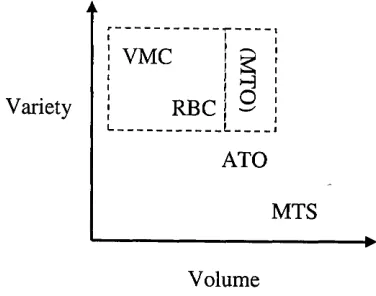
Figure 1.1 illustrates the position of the RBC and VMC categories on the
traditional volume/variety spectrum, in relation to the ATO and MTS categories. For
clarification, MTS companies are often able to purchase and produce in large batches,
operate continuous production methods, maintain low set up times and accumulate a
Introduction
employing an ATO strategy part-finish an item prior to a customer order, and then on
receipt of an order the item is completed (see Hill 2000). Under such ATO production,
components and subassemblies are made to stock (see Hill 1993).
Variety
VMC
ATO
MTS
[image:25.527.162.350.156.304.2]Volume
Figure 1.1: Classification Based on ‘Volume vs. Variety’
Although an ATO company could be considered a mass customiser in certain
settings, this research is focussed upon less standardised production problems. Brown
& Bessant (2003) refer to Davis (1987) in explaining that mass customisation
describes the ability to both produce and distribute what are perceived to be
customised goods and services within a high volume or mass market. Meanwhile,
Russell & Taylor (2003) define mass customisation as the mass production of
customised products. Brown & Bessant (2003) add that a large part of the volume is
achieved through the aggregate variety produced around a single product or similar
products. Krajewski & Ritzman (1998) explain that mass customisers attempt to
provide the variety inherent in an ATO strategy but often focus on relatively high
volume markets. Therefore, given this discussion, it seems reasonable to conclude that
producers of mass customisation do not typically provide the degree of production
MTO companies have an earlier Order Penetration Point (OPP) than ATO and
MTS producers: the stage at which a product is linked to a specific customer order
(see Olhager 2003). Therefore, delivery lead times are inevitably longer for MTO
companies than, for example, MTS companies (for a comparison, see Hill 1995), as
materials cannot be ordered or production started until after the customer has
confirmed the order (demand cannot be supplied or assembled from existing stocks).
1.2.1 The Make-To-Order Tendering Stage
Unless involved in partnerships with downstream elements of the supply chain, MTO
companies generally have to compete against a number of other companies for each
order that they receive and each job that they produce. This bidding or tendering stage
may consist of quoting a DD, or Delivery Lead Time (DLT), and a price to a
prospective customer, or even a series of prices and lead times for different order
quantities. Such a procedure requires (internal) vertical integration and a close link
between production and marketing decisions, although other factors can also play a
part in a successful bid (see, for example, Kingsman et a l 1993). The demands of
customers and the nature of production make lead times and delivery date
determinations a troublesome, but strategically important, issue for MTO companies.
The significance of the customer enquiry stage for MTO manufacturing is also further
explored by Hendry & Kingsman (1989), Easton & Moodie (1999), Calosso et a l
(2003) and Olhager (2003).
1.2.2 The Importance of Small and Medium Sized Enterprises (SME’s)
Small and Medium sized Enterprises (SME’s) represent a large and important sector
Introduction
defined based on the number of people employed and size of annual turnover, while,
for example, the European Commission also considers the actual monetary values
reported in the balance sheet and the independence of the company when determining
if a company warrants SME status (see Keynote 2002). A Small Enterprise may have
less than fifty employees or a turnover of less than or equal to ten million Euros, while
a medium sized company has less than 250 employees or a turnover of less than or
equal to fifty million Euros (see EUROPA 2003). Note that a company with less than
ten employees can also be considered a micro enterprise.
SM E’s are extremely important to supply chains and the economy as a whole;
such companies often act as suppliers to larger national or multinational companies
that have previously followed trends in outsourcing non-core competencies. However,
although large firms rely on SME’s for raw materials and subcontracting, large firms
dominate in terms of total turnover and employment and often have a major influence
on SM E’s. It is estimated that there are 3.7 million SM E’s in the UK alone and this
could rise to 4 million by 2006 (Keynote 2002). Based on figures produced by the
Department of Trade and Industry (DTI 1999), approximately 99% of all businesses in
the UK employ less than 250 people and of the small companies, 9% are based in the
manufacturing industry (Keynote 2002).
1.2.3 Job Shop Production
MTO companies often operate job shop production with flexible machines and
operators (see Muda & Hendry 2003). This configuration provides the company with
the agility and versatility required to produce pure customised products. However, the
random routing sequences prevalent in job shop production make it difficult to track
problems and approaches associated with job shop scheduling, see, for example,
Blazewicz et al. (1996) and Jain & Meeran (1999).
1.2.4 Make-To-Order Planning and Control Stages
To summarise, the cycle through which a manufactured MTO product must be
planned and controlled can be broken down into a number of steps:
(1) Customer Enquiry Stage: At the customer enquiry stage, a prospective customer
will invite a number of potential suppliers to provide a tender for a particular job
specification, perhaps including the design process.
(2) Job Entry Stage: If the customer accepts the tender the company can start to plan production, finalising processing requirements (including job routings) and
ordering the necessary materials. More detailed planning for the workload of the
job and the available capacity of the machines it will visit can also take place.
(3) Job Release Stage: At this stage the company must decide when a job is to be released onto the shop floor and the start of production is to be signalled. Once
released, the job can be considered as Work-In-Progress (WIP). Clearly every
company must release jobs onto the shop floor, whether this is as soon as materials
are available or based on more sophisticated criteria, thus making order release a
strategic decision.
(4) Priority Dispatching: This relates to the way jobs are sequenced at machines on the shop floor, such as according to a simple First-In-First-Out (FIFO) policy. The
job remains part of the WIP of the shop until it is completed, before finally being
Introduction
1.3 THE MAKE-TO-ORDER PLANNING PROBLEM
The description above highlights the supply chain uncertainty to consider when
quoting delivery dates and planning production. A company may have very few
regular customers, thus it is difficult to foresee when customers will make an enquiry
(forecast demand) or whether a particular tender will be successful. Hence, it is
difficult to know how many tenders to make at once, considering the capacity of the
shop, a wish to prevent resources from overloading and a natural tendency to avoid
rejecting jobs that are offered. With such prolonged tendering and negotiation stages it
can also be difficult to know when a customer will confirm or reject a tender
(customer confirmation time), or if they will formally notify the company of this
decision at all. On the other hand, accepting an infeasible mix of processing
requirements and delivery dates can result in a workload imbalance, late deliveries
and a loss of goodwill and reputation with valuable customers.
With such diverse customer needs, MTO companies are likely to have a wide
supplier base with materials only ordered when a job is confirmed; this is inevitable
given that the material and production requirements of a job may be vastly different to
those of other jobs in the factory. This increases the degree of uncertainty at the job
entry stage; as, for example, it may be difficult to be confident of material arrival
dates from a non-preferred supplier. It is also difficult to accurately estimate the Total
W ork Content (TWC) of a job that is significantly different to those that have been
previously processed. Furthermore, with such variable job routings and lead times
within job shops, it can be difficult to foresee how long a job will have to queue at
production (job release). Hence, a lack of parts commonality and variable job routings
add to the difficulties of planning and control.
Although it could be argued that starting production as early as possible, and
effectively forward scheduling, could produce the best delivery date adherence,
companies have a limited cash flow and do not want to have too much capital tied up
in WIP. In addition, changes to quantity and design specifications, common when
dealing with large, influential and demanding customers, can also be more easily
accommodated prior to the job release stage, while jobs can also be re-scheduled more
easily if production has not yet commenced. Beginning production as soon as possible
would also go directly against the philosophy of lean production, contributing towards
the lead time syndrome (see Mather & Plossl 1978). The lead time syndrome relates to
the detrimental impact of lead time variation throughout the supply chain caused by
overloaded resources, emphasising the importance of controlling lead times and
capacity requirements in order to meet delivery dates. As a result, striking a balance
between starting a job as late as possible and ensuring the job will be completed by the
delivery date, is considered a key planning problem.
Companies are under increasing pressure to quote short lead times, in order to
gain a competitive advantage and gain work for the shop resources. However, unless
delivery dates are realistic and reliable, based on current capacity and workload
constraints, this will not result in long-term success. If a company regularly fails to
meet delivery dates this will result in both internal and external repercussions.
Externally, a poor DD adherence record will affect the reputation and future sales of
the company, while internally it may indicate an unrealistic DD determination policy
and an unbalanced shop leaving some machines idle and others overloaded. However,
Introduction
companies. Determining delivery dates, and therefore planning aggregate machine
capacities and workloads, is very important. However, considering the individuality of
jobs and routing sophistication, accurate planning in the MTO industry is evidently a
complex process.
In summary, the (problematic) characteristics of a MTO company, as defined
for the purposes of this research, are presented in Table 1.1 below:
Company Characteristics
Unpredictable demand
Products are highly customised
High proportion of ‘first-off’ items produced In-house process may include a design stage Companies have to compete for every new order Variable material requirements
Large supplier base
High shop floor routing variability (job shop is typical) Variable processing times and delivery lead times Versatile machinery and workforce required Work often subcontracted from larger companies
Table 1.1: MTO Company Characteristics
1.4 GAINING CONTROL
Production Planning and Control (PPC) Systems are important tools for meeting
increasingly high customer demands and expectations in the present manufacturing
climate. An effective PPC approach is crucial if competitive and reliable delivery
dates are to be quoted to customers and achieved in practice. Typical functions of a
PPC System include planning material requirements, demand management, capacity
functions include reducing WIP, minimising Shop Floor Throughput Times (SFTT’s)
and lead times, lower stockholding costs, improving responsiveness to changes in
demand, and improving DD adherence (see Zapfel & Missbauer 1993). However, it is
also clear that the planning requirements for MTO companies are particularly
complex, and differ greatly from the needs of MTS companies (see Hendry &
Kingsman 1989).
Many manufacturers use ‘legacy PPC systems’, such as Material Requirements
Planning (MRP) systems (see Sower & Abshire 2003), or an ad-hoc and old-fashioned
paper based approach to planning production on the shop floor. SM E’s particularly lag
behind in the use of new technologies (see, for example, Quayle 2002); however,
through time and as a company grows, such ad-hoc or old-fashioned approaches are
likely to become unmanageable. The large number of SM E’s (with limited financial
resources), the importance of them within British industry (such as within the MTO
sector) and the growth in demand for customised products means that there is a great
need for cost effective PPC concepts designed for the MTO industry.
One PPC approach that can cater for the needs of MTO companies and job
shops is Workload Control (WLC). The approach originates from the concept of
Input-Output Control (I/OC), see Wight (1970), and uses a pre-shop pool to reduce
shop floor queues and congestion, maintaining a stable level of WIP through
emphasising the importance of the job release stage of production planning. The aim
is to stabilise lead times and provide a more predictable throughput time in an attempt
to ensure that delivery dates are more reliable (subsequent chapters provide a
complete description). WLC works particularly well in the job shop environment and
Introduction
a relatively simple and cost effective approach, making it a particularly appealing
alternative for SME’s with financial constraints and an aversion to risk.
Despite the apparent advantages of WLC, few empirical studies have been
presented in the literature and it has been noted that further practical research
regarding WLC is required (see, for example, Bertrand & Wortmann 1981; Bechte
1988; Kingsman & Hendry 2002; Bertrand & Van Ooijen 2002). Most of the limited
number of empirical WLC studies that have been conducted (see Bertrand &
Wortmann 1981; Fry & Smith 1987; Bechte 1988; Hendry et a l 1993; Bechte 1994;
Wiendahl 1995; Park et a l 1999) tend to focus on the results of implementation rather
than the actual process of implementation required by this concept in practice. The
majority of research in the field of WLC is focussed on simulation experiments;
however, in many respects these simulations tend to underestimate the complexities of
real life job shops (see Perona & Miragliotta 2000). It is therefore not surprising that a
number of attempts to implement WLC in practice have failed (see, for example,
Hendry et a l 1993). As a result, the process of implementation remains a ‘black box’,
surrounded by uncertainty, with a void existing between the extensive theoretical
aspects of WLC and the limited practical perspective.
Some previous empirical studies have also assumed accurate D D ’s have
already been quoted at the customer enquiry stage and that an appropriate mix of jobs
have been accepted at the job entry stage. Hence, such research has begun the
planning process with the job entry stage or the job release decision; thus simplifying
the requirements for implementation. Although the order pool and job release function
can help in an isolated (and decentralised) job shop scheduling problem, this fails to
cater for the customer enquiry / delivery date determination and job entry stages that
to control the customer enquiry stage, such approaches provoke comparisons with
alternative PPC concepts; such as Kanban, Constant Work-In-Process (CONWIP) and
Paired cell Overlapping Loops of Cards with Authorisation (POLCA) (see Chapter 2).
On the contrary, contemporary simulation research has demonstrated the benefits of
providing I/OC at the higher customer enquiry and job entry planning levels as a
complementary control mechanism to job release (see, Kingsman & Hendry 2002).
There appears to be some awareness regarding the use of both a pre-shop pool
and a simple order release mechanism in manufacturing practice. However, this often
relates to a partial and informal implementation of the WLC concept and has not been
explicitly documented. Bechte (1994), for example, states that Load Oriented
Manufacturing Control (LOMC), a particular branch of Workload Control
methodology, has been implemented in numerous factories, although this is not
reflected in the volume of detailed published accounts.
The uncertainty surrounding the process of implementing WLC in practice, the
time required to produce publishable results and a number of failed implementation
projects are likely to have been major contributing factors to this gap in knowledge.
Therefore, more empirical research is required for two reasons. Firstly, it is needed in
order to validate existing theory and advance the theoretical development of the WLC
concept. Secondly, it is required in order to improve the understanding of the WLC
Introduction
1.5 RESEARCH OBJECTIVES: Bridging the Gap Between Theory and Practice
The Lancaster University Management School (LUMS) has been a long-standing
contributor to the popularisation of WLC, and a particular branch of WLC known as
the Aggregate Load Approach. The methodology developed at LUMS is hereafter
referred to as the LUMS approach. The LUMS approach originates from the doctoral
work of Tatsiopoulos (1983) and Hendry (1989), and has also been documented in a
number of journal papers; see, for example, Hendry & Kingsman (1989 and 1991),
Kingsman (2000) and Kingsman & Hendry (2002). It is this approach to the concept
of WLC that is the topic of this thesis. Unlike many other WLC concepts, the LUMS
approach has been specifically designed for the particular needs of MTO companies.
However, despite a significant contribution to this field of research, the LUMS
approach has not been fully applied in practice and at the commencement of this
research project, did not exist in the form of a contemporary integrated Windows
based software package that would enable such research to take place. Hence, very
little is known about the exact requirements for implementing the approach in
practice. More contemporary research than is currently available from previous
projects is required when the fast moving and increasingly competitive environments
in which companies operate and for which WLC is designed are considered.
Since the conception of the LUMS approach, the amount of research in the
field of WLC and MTO production has increased greatly, perhaps the most notable
contemporary contributors are at the University of Groningen (see, for example, Land
& Gaalman 1996 and 1998; Henrich et a l 2002), the University of Eindhoven (see,
for example, Van Ooijen 1996; Bertrand & Van Ooijen 2002) and Hanover University
research was to consider whether the LUMS approach needs to be updated in the light
of such research.
Therefore, a process of re-evaluation and refinement of the LUMS approach
was required in order to facilitate future empirical results. For research rigour, this
process must begin with an in-depth exploration of both the MTO industry and of
applicable PPC approaches for this sector before further conceptual development of
the LUMS approach is considered. As described, researchers and practitioners would
also benefit from learning more about the implementation process and how this can be
eased.
While a great deal of past research has been invaluable to the development of
the concept, it is only by examining the application of the methodology in practice
that researchers will learn more about the needs and complexities of MTO companies
and what is required to allow WLC to be implemented in practice. Based on this
discussion, a second major element of this research project was to conduct a case
study analysis of the LUMS approach, refining the concept for practical use,
developing a contemporary Decision Support System (DSS) based on the approach
and advancing knowledge of the implementation process by applying the concept to
the company. It was anticipated that the process of implementation would present a
number of issues that have been overlooked in theoretical work and which warrant
further exploration. This aimed to bridge the gap between the theory of WLC and
practice of MTO companies, advancing the methodology of WLC with regards to both
theoretical / conceptual development and practical application.
Given the discussion presented here and the subsequent literature review in
Chapter 2 indicating a further need to research WLC, the remainder of this research is
Introduction
(1) How can theoretical aspects o f the LUMS approach be refined to facilitate practical implementation o f the Workload Control concept,
thus bridging the gap between theory and practice ?
(2) What Workload Control implementation issues can be identified, and how can they be addressed in practice ?
In order to contribute towards answering these research questions, this thesis
sets out to achieve the following accompanying objectives:
(a) Identify the most appropriate PPC approaches for the MTO industry.
(b) Re-evaluate and validate the applicability of the LUMS approach to WLC.
(c) Enhance the LUMS approach for MTO companies, refining the existing
methodology.
(d) Develop the methodology of the LUMS approach into a contemporary
Windows based Decision Support System (DSS) to assist PPC through the full
spectrum of planning and control stages applicable to MTO companies.
(e) Identify a suitable company for case study research and attempt to implement
the DSS.
(f) Learn from and reflect on experiences of the implementation process,
considering how the concept must be refined in the light of case study
1.6 ORGANISATION OF THE THESIS
The remainder of this thesis is organised as follows. Chapter 2 provides a literature
review, examining the existing PPC alternatives available to practitioners and
assessing the applicability of these techniques to MTO companies. This is achieved by
comparing the methodologies against a detailed criterion and analysing the insights
into the performance of the approaches presented in the literature. The motivation
behind this is to establish whether Workload Control remains a leading option for
MTO companies, in order to validate continuing with the intended research direction.
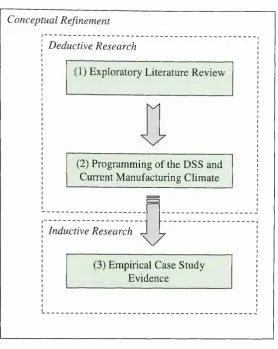
Chapter 3 outlines the research methodologies applied during this project,
covering a range of approaches, such as an exploratory literature review and case
study research (including semi-structured interviews and observational techniques).
The chapter also describes some of the different types of research methodologies
conducted in the field of WLC.
Chapter 4 then provides a detailed description of the concept of WLC and the
different branches of WLC research. This includes revisiting the existing LUMS
approach, evaluating its continued applicability and classifying it against an
established criterion (see Bergamaschi et a l 1997).
Chapter 5 describes the development of the DSS, programmed using Borland
Delphi (object oriented Pascal). Chapter 6 provides a description of the case study
company to be used as a test bed for the DSS and implementation process. The
applicability of the company to the concept of WLC is also evaluated using a
framework presented by Henrich et al. (2005).
Chapter 7 highlights a number of implementation issues presented in the
Introduction
how this was applied to the case study company. The outcomes of the implementation
process are described in Chapter 8. By applying the DSS to the company, the research
seeks to refine the concept and implementation strategy in line with the practical
requirements of MTO companies. Final conclusions and future research directions are
CHAPTER 2:
A REVIEW OF PRODUCTION
PLANNING AND CONTROL
-THE APPLICABILITY OF KEY
CONCEPTS TO THE MTO
INDUSTRY
2.1 INTRODUCTION
The importance of an appropriate PPC system has been highlighted in Chapter 1;
hence choosing the right PPC system for a particular company can be a crucial
strategic decision. However, determining the applicability of PPC approaches is a
complex process due to the increasing number of alternative concepts and the
inclination of many software producers to suggest that an approach is universally
appropriate. Often the latter is implied by a lack of indication of the type of company
that could hope to benefit from a particular PPC system and thus an intention to gain
wide applicability. However, through aiming for such wide applicability it is
inevitable that industry-specific planning and control needs are not adequately met
given that manufacturing environments are diverse in terms o f characteristics such as
shop floor configuration, levels of customisation offered and so on. Hence, the choice
A Review of Production Planning and Control
features rather than on the selection of features that are designed for a specific
industry.
The need to address the specific requirements of the MTO sector has been
increasingly acknowledged in recent research literature. Thus, contemporary literature
presents a number of concepts that claim to cater for complex production settings such
as the job shop. However, further guidance is required to determine when each
approach should be practically applied. As a result, a critical assessment of PPC
methodologies from a MTO viewpoint is necessary to aid this system selection
process for practitioners.
Zapfel & Missbauer (1993) present the most notable review of production
planning and control methodologies (see also Gelders & Van Wassenhove 1981).
However this does not focus primarily on MTO production. The authors review
Manufacturing Resource Planning (MRP II), Optimised Production Technology
(OPT), Workload Control (WLC), Kanban / Just In Time (JIT), briefly highlighting
both Constant Work In Process (CONWIP) and the Progressive Figures Approach.
Since this important review, further approaches have emerged, such as Paired cell
Overlapping Loop of Cards with Authorisation (POLCA), part of the Quick Response
Manufacturing (QRM) philosophy, and Enterprise Resource Planning (ERP). In
addition, there are also trends towards web or e-based Supply Chain Management (e-
SCM) tools, while further contemporary research has emerged for existing
approaches, such as CONWIP and WLC. The growth and importance of MTO
industries, coupled with this influx of new planning and control methodologies,
contribute to this need to undertake a critical assessment from a MTO perspective. In
the context of this thesis, reviewing and determining the applicability of the PPC
process of assessing whether this research project should continue in the field of
Workload Control or switch to an alternative concept.
The chapter continues by discussing the requirements of the MTO industry and
proposing criteria to be used to determine the applicability of each PPC system to the
MTO sector. The chapter reviews the approaches presented in the literature
contrasting ‘classic methods’ with a ‘new breed’ of approaches often hybrid in design.
In Section 2.9, the chapter evaluates and categorises the applicability of the
approaches reviewed in the previous sections in order to assist practitioners in the
choice of PPC approach and ensure the validity of the research direction pursued in
this thesis. Section 2.10 summarises the literature covered in the earlier sections in
tabular form and highlights some broad areas in need of further research.
2.2 THE REQUIREMENTS OF THE MTO SECTOR
When reviewing the PPC approaches presented in the literature, it is important to
consider the characteristics and particular planning requirements of MTO companies
in order to determine the applicability of the concepts. Three important features are
briefly discussed before the criteria for determining applicability are presented.
2.2.1 Customisation
The high degree of customisation offered by MTO companies invariably leads to non
standard product routings on the shop floor and longer lead times. As a result, the
ability to accommodate customisation is a key test of the applicability of the PPC
A Review of Production Planning and Control
2.2.2 Shop Configuration
Shop floor configuration is a major determining factor of PPC applicability. The
review considers the Pure Flow Shop (PFS), the General Flow Shop (GFS), the
General Job Shop (GJS) and the Pure Job Shop (PJS). However, shop configuration is
unlikely to lie at one of the extremes (Portioli 2002). The key difference between the
job shop and the flow shop is the direction of material flow. In a pure flow shop, work
travels in one direction through a sequence of work centres in a strict order, unlikely
in a MTO company. In a general flow shop work still travels in one direction but jobs
are allowed to visit a subset of work centres, permitting limited customisation,
relevant to a RBC. Pure job shop routing sequences are random; jobs can start and
finish at any work centre allowing complete freedom and customisation. The job shop
is still an appropriate configuration for many MTO Companies (Muda & Hendry
2003); as a result much of the literature has concentrated on this. However, there is
doubt whether the pure job shop can be found: in reality a dominant flow direction
usually exists (Oosterman et al. 2000). Enns (1995) meanwhile argues that the real life
job shop has more in common with the theoretical general flow shop. The general job
shop is defined as providing for multi-directional routing, but with a dominant flow
direction, relevant to both VMC and RBC groups. Hence, this discussion examines the
general flow shop but with particular focus on the general job shop.
The degree of customisation offered by a company is linked to shop
configuration and flexibility. However, it is possible for MTS companies to operate as
a job shop. To illustrate the distinction between GFS and GJS, Figures 2.1 and 2.2,
respectively, show the typical routing of a job in the general flow and general job
The General Flow Shop
Figure 2.1: Example of Job Routing in the G eneral Flow Shop
[image:44.517.74.474.133.438.2]The General Job Shop
Figure 2.2: Example of Job Routing in the G eneral Job Shop
2.2.3 Com pany Size
Where possible, the review also considers the impact of organisational size, with
particular interest in SME’s. The high proportion of SME’s in customised industries
means that accessibility to companies with more limited resources is an important
factor in the applicability of PPC approaches to many MTO companies.
2.2.4 C riteria for Determ ining Applicability
Soman et al. (2004) explain that the main operational issues for MTO companies are