IJPSR (2019), Volume 10, Issue 1 (Research Article)
Received on 08 May 2018; received in revised form, 19 June 2018; accepted, 13 July 2018; published 01 January 2019
METHOD DEVELOPMENT AND VALIDATION OF SIMULTANEOUS DETERMINATION OF HYDROCHLOROTHIAZIDE AND LOSARTAN IN TABLET DOSAGE FORM BY RP-HPLC
Nidhal M. Sher Mohammed * 1, Hasan R. Abdo 2 and Hassan M. Hassan 2
School of Chemistry 1, Faculty of Science, University of Zakho, Duhok, Kurdistan, Iraq. Duhok Environmental Directorate 2, Duhok, Kurdistan, Iraq.
ABSTRACT: Fixed-dose combinations have several advantages comparing with a single drug and separate agents. For simple dosing regimens and their synergistic antihypertensive action, a combination of hydrochlorothiazide and losartan potassium is widely prescribed. In this study, an HPLC-UV method was developed and validated for the simultaneous determination of hydrochlorothiazide and losartan in bulk and pharmaceutical formulation. The method was optimized selecting chromatographic conditions of 60: 40 acetonitrile: water, ACE3-C18 column (250 mm × 4.6 mm 5 µm), 20 µl injection volume, the flow rate of 1 ml/min at ambient temperature (25 °C), and 226 nm. The method was validated giving good precision (RSD% < 1), acceptable linearity (R2 ≥ 0.997), and low LOD and LOQ (0.5 and 1.5 µg/ml, respectively). Successful application on pharmaceutical dosage tablet form gave recovery percent within acceptance criteria (92% and above) indicating that the proposed method is simple and reliable for the determination of LOP and HCTZ and hence can be applied for routine analysis in quality control laboratories.
INTRODUCTION: Hypertension or high blood pressure is a chronic medical condition in which the blood pressure in the arteries is elevated. It is one of the most prevalent vascular diseases and
considered as the main risk factor for
cardiovascular, cerebrovascular, and peripheral vascular diseases that include coronary disease, stroke, peripheral artery disease, renal disease, and heart failure. Treatment with many medications known as anti-hypertensives is available to lower high blood pressure, and they include some different classes of drugs.
QUICK RESPONSE CODE
DOI:
10.13040/IJPSR.0975-8232.10(1).227-31
The article can be accessed online on
www.ijpsr.com
DOI link: http://dx.doi.org/10.13040/IJPSR.0975-8232.10(1).227-31
Fixed-dose combinations have many benefits comparing with a single drug and separate agents. Clinical practices proved that using combinations of antihypertensive drugs with complementary mechanisms of action is a marked increase regarding effects to reduce blood pressure levels more rapidly, convenience, improving treatment compliance, and low-cost treatment of hypertension
1
. Combination of hydrochlorothiazide and losartan potassium is widely prescribed by the physicians due to simple dosing regimens and their synergistic antihypertensive action, improved hypertension control and fewer dose-dependent side effects 2. So it is essential to develop a simple method for simultaneous estimation of HCT and LOP in a
combined formulation. Hydrochlorothiazide
chemical name is 2H-1, 2, 4-Benzothiadiazine-7-sulfonamide, 6-chloro-3, 4-dihydro-, 1, 1-dioxide Fig. 1.
Keywords:
Hydrochlorothiazide, Losartan, Hypertension, RP- HPLC, Method validation Correspondence to Author: Dr. Nidhal M. Sher Mohammed
Assistant Professor,
School of Chemistry, Faculty of Science, University of Zakho, Duhok, Kurdistan, Iraq.
It belongs to a class of drugs called as thiazide diuretics antihypertensive. Hydrochlorothiazide binds to and inhibits the carbonic enzyme anhydrase. It is frequently used alone or in combination with other medications for the treatment of hypertension, congestive heart failure, symptomatic edema, diabetes insipidus, renal tubular acidosis, hypoparathyroidism, edema, prevention of kidney stones and used in the treatment of osteoporosis 3. There are many published methods for determination HCTZ in
tablets and biological samples such as
spectrophotometric 4, TLC 5, voltammetry 6, GC 7, flow injection 8, polarography 9, and HPLC 10-13.
FIG. 1: CHEMICAL STRUCTURE OF HYDRO-CHLOROTHIAZIDE
Losartan potassium is (LOP) is chemically described as monopotassium salt of 4-butyl-4- chloro-1- [[2’-(1H-tetrazole-5-yl) [1, 1’-biphenyl]-4-yl] methyl]-1H-imidazole-5-methanol Fig. 2. LOP is an angiotensin II blocker and used mainly to treat high blood pressure (hypertension). It is official in United States Pharmacopeia, British Pharmacopoeia, and Japanese Pharmacopoeia.
FIG. 2: CHEMICAL STRUCTURE OF LOSARTAN POTASSIUM
In reviewing the literature, various analytical methods were found for the determination of LOP whether alone or in its combination with other drugs in pharmaceutical preparations including
spectrophotometry 14, potentiometry 15,
voltammetry 16, capillary electrophoresis 17 and HPLC 18, 19, 20.
A marketed tablet of brand name Angizaar-H which is an antihypertensive formulation contains 12.5 mg hydrochlorothiazide and 50 mg losartan. Meaning, the quantity of hydrochlorothiazide in this combination is four times smaller than losartan, which makes analysis more complicated and tedious. The present study aimed to develop a simple and fast HPLC method for routine analysis of both drugs without tedious extraction procedure. The analytical method was validated according to international conference on Harmonization (ICH) guidance for validation of analytical procedure by examining the precision, the linearity of the calibration curve and calculating the limit of detection (LOD) and the limit of quantification (LOQ) 21.
MATERIALS AND METHODS:
Instruments: HPLC system comprised an LC-20AT Shimadzu equipped with LC-LC-20AT pump and on-line degassing system DGU- 20A5 coupled with Flom manual sample injector (20 µl loop) and SPD-20A UV/visible detector and LC solution software. The analytical column was ACE3-C18 (250 mm × 4.6 mm, ultra pure silica). Quigg digital ultrasonic cleaner was used for the mobile phase. The spectrophotometric measurement was made on
a Cecil-7200 UV- visible double beam
spectrophotometer with 1 cm matched Quartz cells.
Chemicals: Pharmaceutically pure samples of hydrochlorothiazide and losartan potassium drugs were obtained from Awamedica Company (Erbil City - Kurdistan region of Iraq). Commercial tablet of Angizaar-H (losartan potassium USP 50 mg, HCTZ USP 12.5 mg, Micro labs limited) was brought from the local drug market. Acetonitrile was purchased from Romil SpS LTD (99.9%) for HPLC application. Double deionizer water filtrated with 0.2 µl cellulose filter paper was used to prepare standards solutions and mobile phase in this study.
Preparation the Mobile Phase: The mobile phase of HPLC analysis was prepared from the organic solvent of acetonitrile and water (v:v %) at different concentration of 30, 40 and 50% ACN.
[image:2.612.73.279.513.619.2]acetonitrile. The mixed standard solution was prepared by a dilute specific volume of each stock solution in a proper volumetric flask and make up the volume with mobile phase.
Sample Solution Preparation: 20 tablets were crushed to fine powder. An accurately weighed portion of the powder (equivalent to 37.16 µg/ml of HCTZ and 148.64 µg/ml of LOP) was taken and dissolved in 100 ml solvent of acetonitrile.
RESULTS AND DISCUSSION:
Development and Optimization of the HPLC Method: An isocratic programming was employed by analyzing a solution of 20 µg/ml at a different concentration of mobile phase (v/v) of ACN and water. The HPLC chromatogram in Fig. 3 shows the analysis of 20 µg/ml solution of a mixture of LOP and HCTZ under isocratic chromatographic conditions.
FIG. 3: CHROMATOGRAM OF MIXTURE OF 20 µg/ml LOP AND HCTZ
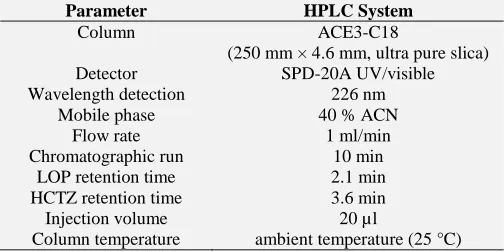
A good separation of two peaks was obtained at 40% strength of the mobile phase, although the chromatogram showed impurity peak that has little effect on the background of the baseline of the LOP peak, this impurity peak can be considered particularly at a very low concentration of LOP. The best chromatographic parameters for the proposed method were summarized in Table 1.
TABLE 1: CHROMATOGRAPHIC CONDITIONS OF PROPOSED METHOD
Parameter HPLC System
Column ACE3-C18
(250 mm × 4.6 mm, ultra pure slica) Detector SPD-20A UV/visible Wavelength detection 226 nm
Mobile phase 40 % ACN Flow rate 1 ml/min Chromatographic run 10 min
LOP retention time 2.1 min HCTZ retention time 3.6 min Injection volume 20 µl
Column temperature ambient temperature (25 °C)
Method Validation: Validation of the analytical method before determination of LOP and HCTZ in dosage sample was done by examining such parameters:
Precision: The precision of the method was estimated by repeated injections (n = 5) of 1 μg/ml of a mixture of LOP and HCTZ. The proposed method achieved good precision reporting RSD% values of the peak area of less than 1% as shown in Table 2.
TABLE 2: RSD% VALUES OF FIVE REPLICATE INJECTIONS OF 1 µg/ml OF MIXTURE OF LOP AND HCTZ
Injection no. LOP peak area HCTZ peak area
1 136553 202849
2 138453 202215
3 136053 203700
4 136475 203856
5 134998 205141
Mean 136506 203552
STDEV 1252 1109
% RSD 0.92 0.54
Linearity: Calibration curve was constructed for HCTZ and LOP standard by plotting the concentration of each drug versus peak area response at two ranges of 2-10 and 5-50 μg/ml. Using Excel® software, the coefficient of determination (R2) was obtained from the regression line to statistically assess the linearity of the method.
The results illustrate good linearity between the peak area and the concentrations of the standard solutions of two components giving the coefficient of determination (R2) ≥ 0.997 over the selected ranges of concentrations.
Limit of Detection and Limit of Quantification: The limit of detection (LOD) and limit of quantification (LOQ) of HCTZ and LOP in the present method were calculated statistically based on the data from the calibration curve at a low level of 2-10 µg/ml using the following equations:
LOD = 3.3 SD/S LOQ=10 SD/S
[image:3.612.50.299.333.473.2] [image:3.612.47.299.630.756.2]TABLE 3: LOD AND LOQ VALUES OBTAINED FROM THE CALIBRATION CURVE OF LOWER CONCENTRATIONS (2-10 µg/ml)
Parameter LOP HCTZ
Slope 124626.5 192826.6
Intercept 7738.6 15689.7
SD 18352.57314 27147.15385
LOD peak area 62796.31942 105275.3 LOQ peak area 191264.3 287161.2385
LOD 0.4 µg/ml 0.5 µg/ml
LOQ 1.5 µg/ml 1.4 µg/ml
System Suitability: System suitability was applying by testing such characteristics including capacity factor, tailing factor, theoretical plates and resolution. The results obtained are presented in Fig. 3 and Table 4 showing acceptance criteria set in method validation.
TABLE 4: SYSTEM SUITABILITY OF LOP AND HCTZ BY PROPOSED METHOD
Characteristic LOP HCTZ
Capacity factor 0.92 2.44
Tailing factor 0.74 1.03
Theoretical plates 1324 3844
Resolution 3.51
Recovery: The accuracy of the proposed method was determined by average recovery % of HCTZ and LOP in their pharmaceutical preparation as tablets (50 mg losartan potassium 12.5 mg and HCTZ) by triplicate injections under the same chromatographic conditions of the proposed method. As shown in Table 5, the results gave recovery percent within acceptance criteria (90% and above) indicating that the proposed method is suitable and reliable for the determination of LOP and HCTZ in pharmaceutical dosage forms.
TABLE 5: THE PERCENT RECOVERY (n = 3) OF DOSAGE SAMPLE
Peak area of recovered amount
Peak area of injected amount
Mean of Recovery
RSD %
LOP
Injection 1 951619
1032785 92 0.2 Injection 2 948405
Injection 3 950222 HCTZ
Injection 1 336508
349640 96 1.0 Injection 2 335909
Injection 3 330030
CONCLUSION: An isocratic HPLC-UV method for the determination of LOP and HCTZ was developed and validated. Optimizing the method using an ACE3-C18 (250 mm × 4.6 mm, ultra pure silica) column showed reliable chromatography conditions of 40% ACN of mobile phase strength, 226 nm wavelength detection, 20 µl injection
volume, 1 ml/min flow rate and retention time of 2.1 and 3.6 min of LOP and HCTZ respectively at a run time of 10 min. The proposed method was validated and offered acceptable precision (RSD % < 1), good linearity (R2 ≥ 0.997) and low values of LOD (~ 0.5 µg/ml) and LOQ (~ 1.5 µg/ml) of both components. The proposed method was applied to pharmaceutical formulation sample giving recovery of 92 and 96% of LOP and HCTZ respectively.
ACKNOWLEDGEMENT: This research was supported by Duhok environmental directorate, Duhok, Kurdistan, Iraq, particularly, Nidhal S. Mohammed would like to thank them for their help during this study.
CONFLICT OF INTEREST: The authors declare that there is no conflict of interests regarding the publication of this paper.
REFERENCES:
1. Wan X, Ma P and Zhang X: A promising choice in hypertension treatment: Fixed-dose combinations. Asian Journal of Pharmaceutical Sciences 2014; 9(1): 1-7. 2. Prisant LM: Fixed low-dose combination in first line
treatment of hypertension. J Hypertens 2002; 20(1): S11-S19.
3. Pickkers P, Garcha R, Schachter M, Smits P and Hughes A: Inhibition of carbonic anhydrase accounts for the direct vascular effects of hydrochlorothiazideitle. Hypertension 1999; 33(4): 1043-1048.
4. Mustafa A, El- Jindy A and Emara S: Simultaneous spectrophotometric estimation of bisoprolol fumarate and hydrochlorothiazide in tablet formulation using partial least-squares, principal component regression multivariate calibrations and RP-HPLC methods. Journal of Analytical and Pharmaceutical Research 2017; 4(6): 1-9
5. Bhoya PN and Patelia EM: Chromatography development and validation of TLC-densitometry method for simultaneous estimation of Bisoprolol fumarate and Hydrochlorothiazide in bulk and tablets. Journal of Chro-matography and Separation Techniques 2013; 4(1): 1-4. 6. Purushothama HT and Nayaka YA: Electrochemical study
of hydrochlorothiazide on electrochemically pre-treated pencil graphite electrode as a sensor. Sensing and Bio-Sensing Research 2017; 16: 12-18.
7. Morra PV and Davita PC: Fast gas chromatographic/mass spectrometric determination of diuretics and masking agents in human urine development and validation of a productive screening protocol for antidoping analysis. Journal of Chromatography A 2006; 1135(2): 219-229. 8. Idris AM and Elgorashe RE: Sequential injection
chromatography with a miniaturized multi-channel fiber optic detector for separation and quantification of Propranolol and Hydrochlorothiazide. Chemistry Central Journal 2011; 5(28): 1-8.
[image:4.612.48.298.89.184.2] [image:4.612.51.299.559.650.2]preparations. Analytica Chimica Acta 1999; 381(2-3): 247-256.
10. Mohammed NS and Mohammed AJ: Development and Validation of RP-HPLC Method for the Determination of Hydrochlorothiazide in Bulk Drug and Pharmaceutical Dosage Form. Chromatography Research International 2016; 1693024: 1-7.
11. Alghamdi AF: Quantitative analysis of hydro-chlorothiazide and its determination in a pharmaceutical preparation by HPLC. Pharmaceutical Chemistry Journal 2015; 48(12): 843-847.
12. Bhadresh SV, Raj HA, Rajanit S and Harshita S: Analytical techniques for determination of hydrochloro-thiazide and its combinations: a review. International Journal of Advances in Scientific Research 2015; 1(3): 114-128.
13. Hossen MA, Haque MA, Dewan I, Kabir ANMH and Hossain MK: Development and validation of RP-HPLC method for the simultaneous estimation of hydro-chlorothiazide and losartan potassium in tablet dosage form. Dhaka University Journal of Pharmaceutical Science 2011; 10(1): 35-42.
14. Demirkaya-Miloglu F, Polatdemir E, Senol O and Kadioglu Y: Design and optimization of a novel spectrophotometric method using response surface methodology for the determination of losartan potassium in pharmaceuticals. Current Pharmaceutical Analysis 2017; 13(6): 552-558.
15. Zareh MM, ElGendy K, Wassel AA, Fathy A and Abd Alkarem YM: Plastic sensor for losartan potassium
determination based on ferroin and ionic liquid. International Journal of Electrochem Science 2018; 13: 1260-1274.
16. Ali SA and Hasan A: Cyclic voltammetric study of losartan potassium. International Research Journal of Pure and Applied Chemistry 2014; 4(1): 128-136.
17. Williams RC and Alasandro MS: Comparison of liquid chromatography, capillary electrophoresis and super-critical fluid chromatography in the determination of losartan potassium drug substance in Cozaartablets. Journal of Pharmaceutical and Biomedical Analysis 1996; 14(11): 1539-1546.
18. Aneesh TP, Radhakrishnan R, Aravind PM, Sasidharan A and Choyal M: RP-HPLC method for simultaneous determination of losartan and chlorthalidone in the pharmaceutical dosage form. International Research Journal of Pharmacy 2015; 6(7): 453-457.
19. Mohammed ABWE and Rudwan EH: RP-HPLC method development and validation of stability indicating a method for estimation of losartan potassium under stress condition and tablet dosage form. International Journal of Pharmaceutical Sciences and Res 2016; 7(6): 2343-2351. 20. Li L, Lai C, Xuan X, Gao C and Li N: Simultaneous
determination of hydrochlorothiazide and losartan potassium in osmotic pump tablets by microemulsion liquid chromatography. Journal of Chromatographic Science 2016; 54(8): 1415-1420.
21. International Conference on Harmonization. Q1A9 (R2) Stability Testing of New Drug and Product. Step 5, version 2003.
All © 2013 are reserved by International Journal of Pharmaceutical Sciences and Research. This Journal licensed under a Creative Commons Attribution-NonCommercial-ShareAlike 3.0 Unported License.
This article can be downloaded to ANDROID OS based mobile. Scan QR Code using Code/Bar Scanner from your mobile. (Scanners are available on Google Playstore)
How to cite this article: