BIROn - Birkbeck Institutional Research Online
Li, B. and Xiong, W. and Wu, O. and Hu, W. and Maybank, Stephen J.
and Yan, S. (2015) Horror image recognition based on context-aware
multi-instance learning.
IEEE Transactions on Image Processing 24 (12), pp.
5193-5205. ISSN 1057-7149.
Downloaded from:
Usage Guidelines:
Please refer to usage guidelines at or alternatively
Horror Image Recognition Based on Context-Aware
Multi-Instance Learning
Bing Li1, Weihua Xiong1, Ou Wu1, Weiming Hu1*, Stephen Maybank2, Shuicheng Yan3
1
National Laboratory of Pattern Recognition, Institute of Automation, Chinese Academy of Sciences, China
2
School of Computer Science and Information Systems, Birkbeck College, UK
3
Department of ECE, National University of Singapore, Singapore (*Corresponding Author: [email protected])
Abstract Horror content sharing on the Web is a growing phenomenon that can interfere with our daily life and affect the mental health of those involved. As an important form of expression, horror
images have their own characteristics that can evoke extreme emotions. In this paper, we present a
novel context-aware multi-instance learning (CMIL) algorithm for horror image recognition. The
CMIL algorithm identifies horror images and picks out the regions that cause the sensation of horror
in these horror images. It obtains contextual cues among adjacent regions in an image using a random
walk on a contextual graph. Borrowing the strength of the Fuzzy Support Vector Machine (FSVM),
we define a heuristic optimization procedure based on the FSVM to search for the optimal classifier
for the CMIL. To improve the initialization of the CMIL, we propose a novel visual saliency model
based on tensor analysis. The average saliency value of each segmented region is set as its initial
fuzzy membership in the CMIL. The advantage of the tensor-based visual saliency model is that it not
only adaptively selects features, but also dynamically determines fusion weights for saliency value
combination from different feature subspaces. The effectiveness of the proposed CMIL model is
demonstrated by its use in horror image recognition on two large scale image sets collected from the
Internet.
Keywords: horror image recognition, context-aware multi-instance learning, visual saliency
1
Introduction
In the past decades, the explosive growth of Web technologies and resources has allowed us to
conveniently share texts, images, and videos via the Internet from geographically disparate locations.
regularizations allows the distribution of many harmful documents dealing with pornography,
violence, horror, racism, etc. To prevent people, especially children, from accessing the harmful
content on the Internet, many content-based Web filtering systems have been developed [1, 2, 36].
Automatic web filtering is most highly developed for documents with pornographic or violent
content; some filtering systems have matured to a point where they are usefully deployed [1, 2, 36].
In comparison, the automatic recognition and filtering of horror content is still being explored [9, 10,
11]. Many psychological and physiological researches have emphasized the severe effects of horror
images [3, 4, 5]. Field and Lawson [3] point out that exposure to horror increases behavioral
avoidance as well as fears. Ollendick and King [5] also describe an experiment in which 88.8%
children ascribe their fear to negative information acquisition. Many governments have taken
measures to prevent children from seeing horror films, or even passed laws to limit the public
showing of horror films. In the USA, the Motion Picture Association of America (MPAA) categorizes
most horror films as “NC-17” (No Children 17 and Under Admitted) [6, 27]. In 2008, the Chinese
government banned horror films with violent ghosts, monsters, demons, and other inhuman
portrayals [7]. In August 2009, the British Board of Film Censors banned the sale of a Japanese
horror DVD because of its psychological harm to audiences [8]. The severity of the effects of horror
films makes a horror content filtering system a necessity.
1.1 Related Work
Despite the importance of the horror content filtering, most existing work focuses on horror video
recognition. There is, to the best of our knowledge, no specific technique designed for horror image
recognition until now. An intuitive and direct solution is to view “horror” as a specific emotion, and
to apply general affective image classification methods to recognize it.
Normally, human affects can be represented by different emotional words, such as sadness,
excitement, contentment, etc [17, 18]. The basic idea of affective image classification methods is to
investigate the relationship between these high level emotional responses and low level image
features [12]. The affective image classification methods can be divided into two categories: domain
knowledge-based methods and machine learning-based methods [33]. Domain knowledge-based
methods build up hierarchical inference models or rules. Most early methods on image emotion
analysis belong to this category. Kuroda et al. [34] use the color/texture features of segmented image
image. Wang and Yu [13] analyze the emotional meaning embedded in an image through
accumulated knowledge and experience. Methods in the machine learning-based category involve the
training of mapping functions between low-level features and high-level emotional semantics in a
“black box” style. Wang et al. [30] extract image brightness, color temperature, saturation, and
contrast features; and then train an emotion classifier using Support Vector Machines (SVM) [19].
Chen et al. [32] propose to recognize the emotion in an image using a Bayesian classifier based on
color and texture features. Bianchi-Berthouze [14] extracts a set of features from homogeneous
regions in an image and inputs them into neural networks to obtain the emotion information. Fuzzy
neural networks are introduced by Guo and Gao [31] into image emotion recognition. Yanulevskaya
et al. [15] classify images into 8 emotional categories using an SVM classifier with holistic Weibull
and Gabor texture features. Solli and Lenz [16] propose a color-based bag-of-emotions model to
retrieve images associated with particular emotions. Liu et al. [33] present a novel
affective-probabilistic latent semantic analysis model based on feature’s tensor representation for
image emotion classification. Machajdik and Hanbury [17] feed an SVM classifier with a set of
effective features inspired by psychology and art theory for affective image classification. Li et al [18]
recently propose a novel bilayer sparse representation model for affective image classification by
[image:4.595.112.476.458.605.2]combining global and local features.
Figure 1. Images with different contextual cues evoke completely different emotions. The images are from the International Affective Picture System (IAPS) dataset [54].
Although these methods work well in general affective image classification, their performance
on horror image recognition is very limited. It is primarily because most existing affective image
classification methods try to extract and analyze global features while ignoring the interplay among
the regions in an image. However, our observations show that most horror images, in contrast to
essential parts: at least one horror region that stimulates a strong emotional response and a certain
supporting background. The importance of the context between the two parts is demonstrated by
Figure 1. Images including same man but with different objects in his hand create completely
different emotions due to different contextual cues; the left image is pleasing while the right one is
unsettling. Therefore, an effective classifier for horror image recognition should work on both local
regions and their contextual relationships.
1.2 Our Work
To circumvent the problems of general affective image classification, we apply multi-instance
learning (MIL) [22, 23] to the recognition of horror images. In MIL, an image is viewed as a bag and
the regions within it are instances of the bag. Traditional MIL methods treat the instances
independently and do not model the relations between different regions [22-24]. This paper proposes
a novel context-aware multi-instance learning (CMIL) model for horror image recognition. The
experimental results on two large image sets collected from the Internet show that our algorithm
outperforms the other competing methods. Our algorithm is original in the following ways:
We propose a novel context-aware multi-instance learning model (CMIL) that classifies a bag by taking into account both individual instances’ labels and their contextual interplay.
We extend the Fuzzy Support Vector Machine (FSVM) [26] into an effective classifier for the CMIL, referred to as “CMIL-FSVM”, that uses a random walk procedure [41] to model the
context among instances.
We present a novel tensor-based visual saliency model to integrate emotional cues adaptively. The resulting visual saliency maps of training images can be used to improve the initialization of the
CMIL-FSVM.
We present a specialized horror image recognition system based on the proposed CMIL model. The system can identify the horror images and the underlying horror regions simultaneously
with a set of discriminative visual and emotional features.
The remainder of this paper is organized as follows: Section 2 gives an overview of our work.
Section 3 introduces the details of horror image recognition based on CMIL. Section 4 presents an
improved initialization of the CMIL-FSVM based on the tensor-based visual saliency model. Section
2
System Overview
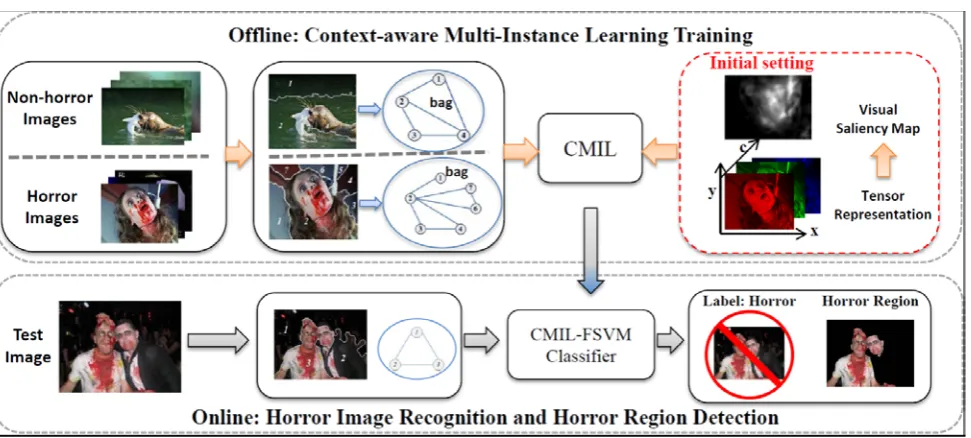
Horror image recognition based on CMIL proceeds in four main stages: bag construction, initial
setting, CMIL classifier training, and horror image recognition. Figure 2 gives an overview of our
[image:6.595.55.541.164.383.2]system.
Figure 2. Overview of the proposed framework for horror image recognition.
Step 1: Bag construction. We treat each image as a “bag” and all segmented regions in it as “instances”. In each bag, we use an undirected graph to define the contextual relationships between
pairs of regions. The vertices of the graph represent the regions. Two vertices are connected by an
edge if the corresponding regions are adjacent.
Step 2: Initial Setting. In the CMIL-FSVM algorithm, the fuzzy membership of each region in the FSVM for any image is initialized in the training procedure. For the non-horror samples, the
initial fuzzy membership of each region is always fixed to be 1. For the horror images, there are two
possible strategies for determining the initial fuzzy membership: (1) the fuzzy membership of each
region is simply fixed to be a lower value, such as 0.5; or (2) it is gained from the visual saliency map.
In the latter strategy, we compute the visual saliency map of each horror image using the proposed
tensor-based visual saliency model and set the average saliency value of each region as its initial
fuzzy membership.
Step 3: CMIL classifier training. We feed the bag and corresponding initial fuzzy membership values, as well as the label of each training image, into the CMIL and apply the proposed
Step 4: Horror image recognition. For any test image, we segment it into regions and construct its bag. Then, the CMIL classifier is used to predict whether it is a horror image. If it is predicted to
be a horror image, then the classifier further points out the most likely horror region.
3
Horror Image Recognition based on CMIL
In the following, we first describe the context-aware multi-instance learning (CMIL) in detail, and
then discuss its application to horror image recognition.
3.1
Context-Aware Multi-Instance Learning
3.1.1 Formulation of CMIL
Borrowing the formulation of the traditional MIL [22, 23], we add a new matrix term, Mi, into the CMIL definition. The formulation of CMIL is defined as follows: Let χ denote the instance space. Given a data set {(X1,M1, ),..., (Y1 Xi,Mi, ),...(Yi XN,MN,YN)} where { ,1,..., , ,..., , }
i
i i i j i n
X = x x x ⊆χ
is called a bag, xi j, ∈χ is an instance, and Mi is an adjacency matrix that specifies a contextual graph to model the relations among the instances in the bag Xi. The label of the bag Xi is
={ -1, 1}
i
Y ∈ψ + . The underlying label of any instance is not explicitly given. Different from the traditional MIL [22-24], the underlying label of an instance xi j, in the CMIL is a fuzzy label,
defined as (yi j, ,si j, )∈θi, where yi j, ∈ψ is the class label of xi j, , 0<si j, ≤1 is the fuzzy membership associated with instance xi j, , and θi is the label and fuzzy membership set of the bag
i
X . A hidden contextual score Ei j, is defined for each instance xi j, in the bag Xi given the graph
adjacency matrix Mi and fuzzy membership set θi. It can be regarded as the tendency of the instance xi j, towards the positive class considering contextual cues among instances in the bag Xi.
The labels of bags in the CMIL model are determined by the contextual scores and can be interpreted
as: If Yi = +1, then at least one instance xi j, ∈χ has yi j, = +1 and Ei j, ≥0.5. If Yi = −1, then
, 1
i j
(1) Contextual Graph
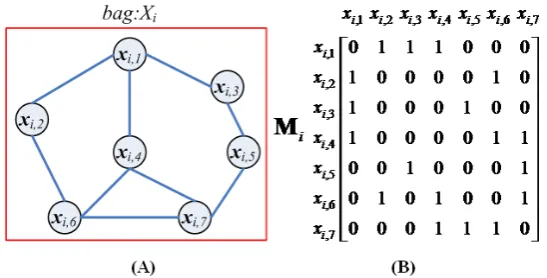
The contextual graph in the CMIL is designed to represent contextual relationship between any
two instances. An example of a contextual graph and its corresponding adjacency matrix Mi are shown in Figure 3. Each vertex of the graph corresponds to an instance in the bag Xi. If there is a
direct contextual link between two instances xi j, and xi k, , the entry in the adjacency matrix,
,
[Mi]j k is set as 1; otherwise it is set as 0. The details of the graph construction for horror images
[image:8.595.156.430.260.399.2]will be given in Section 3.2.1.
Figure 3. Contextual graph construction: (A) Contextual graph(B) Corresponding adjacency matrix Mi
(2) Contextual Score based on Random Walk
An important step in the CMIL is to compute the hidden contextual score Ei j, , for each instance
, i j
x , given the contextual graph. The contextual score Ei j, is determined by both the label of xi j,
and the labels of its neighbors. The larger the contextual score Ei j, is, the more possibly positive the
instance xi j, is. To model the contextual scores, we use a random walk on the contextual graph Mi. Random walks on graphs [41] are widely used to define the contextual relevance in many practical
applications, such as Web page ranking [37, 38], and multimedia retrieval [39, 40].
We first transform the fuzzy membership si j, into a corresponding probabilityvalue pi j, that
represents the conditional probability p y( i j, =1|xi j, ) as
, ,
,
, ,
1,
1 1.
i j i j
i j
i j i j
s if y
p
s if y
=
Since the probability pi j, includes no contextual information in the bag Xi, it can be viewed as
the independent score of an instance xi j, . We concatenate them together and get an independent
score vector for the bag Xi as [ ,1, ,2,...., , ]
i T i = pi pi pi n
p . The transition probability matrix
,
[ ]
i = i j k
Q Q in the random walk is defined as [37, 38]
, , , , , [ ] [ ] [ ]
i j k i k i j k
i j m i m m p p =
∑
M QM , (2)
where [Qi]j k, is the transition probability from vertex xi j, to vertex xi k, . It actually normalizes the
independent score value of xi k, according to all the adjacency vertices of xi j, .
Given the transition probability matrix Qi, the contextual score
( )
1 ,t i j
E + of the instance xi j, at
time t+1 is linearly fused by its neighboring vertices’ contextual scores at time t and its own
independent score pi j, [40, 41] :
( )
1( )
, [ ], , (1 ) ,
t t
i j k i k j i k i j
E + =α
∑
Q E + −α p , (3)where α is the combination weight, [ i k j],
( )
i k, tk E
∑
Q is the sum score that xi j, ’s neighborscontribute to xi j, . If we set [ ,1, ,2,..., , ]
i T i = Ei Ei Ei n
E , Eq. (3) can be rewritten in the matrix form as
1
(1 )
t t
i i i i
+ = + −
E αQ E α P. (4)
Eq. (4) defines a recursive updating of Eti. It can be shown that the limit i lim ti
t−>∞
=
E E exists [41]. On taking the limit t− > ∞ in (4), it follows that
1
(1 ) ,
(1 )( ) .
i i i i
i i i
which reduces to
α α
α α −
= + −
= − −
E Q E P
E I Q P (5)
Given the contextual score Ei j, of each instance xi j, , the label of each bag in the CMIL can be
described in the form of a constraint by
( )
(
,)
1maxi 0.5 0
i i j
j n
Y E
≤ ≤
× − ≥ . (6)
3.1.2 CMIL Classifier Optimization via Fuzzy SVM
labels of the instances are always binary. Lin et al. [26] propose the fuzzy SVM (FSVM) in which
each input training sample has a fuzzy class membership. In this paper, we propose an extended
FSVM, named as CMIL-FSVM, in which the contextual score is added as another constraint.
(1) Maximum Pattern Margin via FSVM
The basic idea of CMIL-FSVM is to learn a fuzzy classifier in instances space that can predict
the label and fuzzy membership of each instance in a bag and then determine the bag’s label from
these predictions. Let the classification hyperplane in the instance space be f x( i j, )=wTxi j, +b with the parameter ( , )w b [24]. The optimization objective function of the proposed CMIL-FSVM is
obtained by combining the contextual score constraint [26] and the objective function of the FSVM
as
( )
(
)
2 , , , 1 , , , , , 1 1 min 2subject to ( ) 1 , 0
max 0.5 0
i
i n
i j i j b
i j T
i j i j i j i j
i i j
j n
C s
y x b
Y E ξ ξ ξ = ≤ ≤ + + ≥ − ≥ × − ≥
∑∑
w w w , , , (7)where C is a constant and can be regarded as a regularization parameter. If si j, in Eq. (7) is small,
the effect of the parameter ξi j, and the corresponding instance xi j, is of less importance to the classification hyperplane.
(2) Optimization Heuristics
The big difficulty to solve Eq. (7) is that, different from the standard classification of the FSVM
in which the labels yi j, and fuzzy membership si j, are explicitly predefined in the training
procedure, these two terms are not explicitly given out in the CMIL. Inspired by the optimization
procedure of the mi-SVM [24], we present a heuristic procedure to minimize the objective function
defined in Eq. (7). The optimization procedure includes two major steps: fuzzy classification and
label update.
Step 1: Fuzzy Classification. Given the hidden label yi j, and fuzzy membership si j, of each
instance, the optimization of Eq. (7) is reduced to a quadratic programming problem that can be
Step 2: Label Update. Once the classification hyperplane has been learnt through FSVM, the
hidden label yi j, and fuzzy membership si j, of each instance will be updated based on the
hyperplane using Eq.(8).
,
, ,
, | ( )|
sgn( ( )),
1 , 1+ i j
i j i j
i j f x
y f x
s e− = = (8)
Algorithm 1. Pseudo-code for the CMIL-FSVM optimization heuristics.
Training Procedure
INPUT: All the training bags with corresponding labels as
1 1 1
{(X ,M, ),..., (Y Xi,Mi, ),...(Yi XN,MN,YN)}. Initialize
, , for ,
i j i i j i
y =Y x ∈X ;
, 1, for , and =-1; , 0.5, for , and =+1
i j i j i i i j i j i i
s = x ∈X Y s = x ∈X Y , ∆ =s 0.1.
REPEAT
Compute the classification hyperplane f x( i j, ) via the FSVM using all the instances.
Compute outputs
, ,
( ) T
i j i j
f x =w x +b for all xi j, in positive bags. Compute yi j, and si j, for all xi j, in positive bags using Eq. (8). Set k =0;
For (every positive bag Xi)
Compute
,
i j
E for each instance xi j, in Xi based on Eq. (5). Compute
( )
, 1
* arg max
i i j j n j E ≤ ≤ = If (
, * 0.5
i j
E < )
Set si j, *=min 1,
(
si j, *+ ∆s)
.Set k = +k 1. END
END
WHILE (k ==0 or maximal iteration number is arrived)
OUTPUT(w,b)
Test Procedure
INPUT: A test bag t
X and corresponding contextual graphMt.
Compute outputs
, ,
( ) T
t j t j
f x =w x +b for all instancesxt j, in t
X .
Compute yt j, and st j, for all instances xt j, in
t
X .
Compute
,
t j
E for each instance in
t
X based on Eq. (5). Compute
( )
, 1
* arg max t t j j n j E ≤ ≤ = IF (
, * 0.5 t j
E ≥ )
set 1
t
Y =
ELSE set 1
t
Y = −
END
OUTPUT(
t
where the sigmoid function is widely used to obtain an output from the SVM in the form of
probabilities.
After obtaining the classifier during the learning procedure, we can compute the label yt j, and
membership st j, of each instance xt j, in the test bag
t
X using ( , ) ,
T
t j t j
f x =w x +b and Eq. (8). And
the label of
t
X can be determined by the labels and memberships of all the instances in Xt. The
implementation details of the CMIL-FSVM are shown in Algorithm 1.
It is worth noting that, during the initialization stage, we pair positive labels of those instances in
positive bags with lower fuzzy memberships (si j, =0.5), and negative labels of those instances in
negative bags with higher fuzzy memberships (si j, =1) so as to make sure that all initial contextual
scores of negative bags are less than 0.5. Then, we iteratively adjust the hyperplane by improving the
fuzzy memberships of positive instances to ensure that the positive bags satisfy the constraints in Eq.
(7).
3.1.3 Differences from Other MIL Methods
Many MIL methods have been proposed in the literatures, in which mi-SVM and MI-SVM [24] are
widely used. Different from the CMIL that considers contextual cues among instances, these two
methods treat all instances from a bag as independently and identically distributed (i.i.d.). The
methods that are closer in spirit to our CMIL are miGraph and MIGraph proposed by Zhou et al. [25].
The main difference lies in the definition of the relationship between instances. The miGraph and
MIGraph algorithms [25] are essentially graph pattern classifiers. They only consider the global
graph structures of a bag and predefine any two instances’ relationship based on a -graph that uses
the Euclidean distance in a feature space; whereas our CMIL considers contextual cues among
instances using a random walk on a spatial adjacency graph. The relationship between any pairs of
instances can be dynamically learnt from the training data.
3.2
Horror Image Recognition based on CMIL
In this section, we apply the proposed CMIL model to horror image recognition using some effective
features.
The first step in the horror image recognition based on CMIL is to construct instances, bags and
contextual graphs. The intuitive idea is to treat an image Ii as a bag and segmented regions
,1 ,2 ,
{ , ,..., }
i
i i i n
I I I of the image Ii as instances. Among diverse image segmentation algorithms, the
JSEG algorithm [28] is adopted because of its flexibility. After segmentation, we discard the regions
whose areas are smaller than 1/40 of the image. Figure 4 gives an example of image segmentation by
the JSEG.
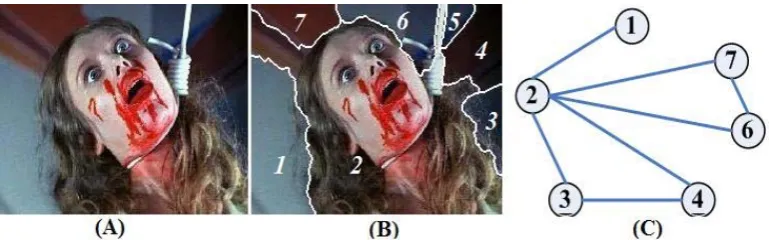
The next step is to construct the graph adjacency matrix M using the segmented regions in an image. The vertices of the graph represent the image regions and an edge with weight of 1 is defined
[image:13.595.102.487.308.428.2]between any two adjacent regions. An example of a bag and the corresponding graph is shown in
Figure 4.
Figure 4. Bag construction: (A) Original image. (B) Segmentation result. (C) Contextual graph. The 5th region is discarded because it is too small.
3.2.2 Feature Extraction
For each region, three types of features, namely color, color emotion, and texture, are extracted,
because they are validated by many affective image classification methods [15, 16, 17].
Color Feature. Colors are often used by artists to induce emotional effects. Here we consider image color information in the CIELAB space because it describes color perception more accurately
than RGB space [13]. Two feature sets are defined as [ ,1 2, 3] [ , , ] k k k
k k k
f f f = L a b and
4 5 6
[ ,fk fk,fk] [= Lk−L a, k−a b, k−b]. The former set is the average of all the pixels’ CIELAB values in the
th
k
region, and the latter set is defined as the difference between averaged pixel value in the th
k region
and that of the whole image.
emotion space with axes representing color activity (CA), color weight (CW), and color heat (CH).
The values of CA, CW and CH are calculated as follows:
1/ 2 2 *
* 2 * 2
* *
* 1.07 *
17
2.1 0.06 ( 50) ( 3) ,
1.4
1.8 0.04(100 ) 0.45 cos( 100 ),
0.5 0.02( ) cos( 50 ),
o
o
b
CA L a
CW L h
CH C h
− = − + − + − + = − + − + − = − + − (9)
where ( ,L a b* *, *)and ( ,L C h* *, *) are the corresponding color values in the CIELAB and CIELCH color spaces for a given RGB color. The average color emotion of the pixels in each region yields a
feature vector [f7k, f8k,f9k] [= CA CW CHk, k, k], and the difference between it and the whole image yields a second feature vector [f10k,f11k,f12k] [= CAk−CA CW, k−CW CH, k−CH].
Texture Feature. Geusebroek et al. [43] describe a stochastic texture perception. They show that the distribution of edge responses can be modeled by a Weibull distributionwb z( )as
1
( )
z
z
wb z e
γ γ β γ β β − − =
, (10)
where z is the edge responses in a single color channel to the Gaussian derivative filter, β >0 is the scale parameter of the distribution and γ >0 is the shape parameter. The parameters of the Weibull distribution completely characterize the spatial structure of the texture [43] and widely used
in for texture description [14]. The contrast in an image is represented by β, and the grain size is given by γ . Thus, the β and γ values for the x-edges and y-edges in the RGB color channels for each region yield a 12 dimensional feature vector, as [ 13, 14 15, 16] [ , , , ]
k k k k k k k k
xR xR yR yR
f f ,f f = γ β γ β ,
17 18 19 20
[ k, k k, k] [ k , k , k , k ]
xG xG yG yG
f f ,f f = γ β γ β , and [ 21k, 22k 23k, 24k] [ k , k , k , k ]
xB xB yB yB
f f ,f f = γ β γ β . In addition, the texture differences between the current region and the whole image are also used as texture features:
25 26 27 28
[ ,fk fk,fk,fk] [= γ γ β β γ γ β βxRk − xR, xRk − xR, yRk − yR, yRk − yR] , [ ,f29k f30k,f f31k, 32k] [= γxGk −γ βxG, xGk −β γxG, yGk −γ βyG, yGk −βyG] , and
33 34 35 36
[fk,fk,fk,fk] [= γkxB−γ βxB, xBk −β γxB, yBk −γ βyB, yBk −βyB].The concatenation of all these features yields a feature vector in R36 for each region.
Given the contextual graph of an image and feature vector of each region in it, we can construct a bag
for each image in the CMIL. Now the bag Xi represents the whole image Ii; the instance
36 , [ 1 , 2 ,..., 36]
j j j
i j
x = f f f ∈R is the feature vector of the jth region in the image Ii; Mi is the spatial contextual graph matrix of the image; and the label Yi for each image is set to 1 if it is a
horror image, and otherwise is set to -1. All the bags of the training images and their corresponding
labels are input to the CMIL to learn a classifier using the CMIL-FSVM algorithm. Given a test
image, the extracted feature vector of each region and the contextual graph of the image are obtained
in the form of a bag. Then, the bag is fed into the CMIL classifier to identify whether it is a horror
image. Furthermore, if the test image is judged as a horror image, we consider the region with the
highest contextual score to be a horror region in the image.
4
Improved CMIL-FSVM by Visual Saliency Map
In Algorithm 1, the memberships of all the instances in the positive bags are simply set to be 0.5
(si j, =0.5). This initialization may mislead the classifier, because there often exist instances with
negative labels or much lower positive memberships in positive bags, such as the background of a
horror image. If the CMIL-FSVM is initialized with weak labels and corresponding membership
values based on some prior knowledge, the convergence of the classification optimization algorithm
may be faster, and a more accurate classifier may be obtained.
Because a horror image always contains one or more popped-out region(s) that is (are) very
different from the background in their visual or emotional stimulus. The detection and separation of
these salient regions can provide very valuable initialization information to the CMIL-FSVM. In this
paper, we propose a simple and effective visual saliency model based on tensor reconstruction, and
then discuss how to initialize the CMIL-FSVM using visual saliency maps.
4.1
Emotional Attention Mechanism
Much recent psychological research indicates that emotion is of another fundamental importance in
the human vision system and produces specific contributions to selective attention [20]. Vuilleumier
[21] argues that the amygdala plays a crucial role in providing both direct and indirect signals on
effects implement specialized mechanisms of “emotional attention” that may supplement visual
attention.
In the past decades, many visual saliency computation models [46-52] have been proposed.
Most of them follow Koch’s bottom-up saliency map framework [44, 45] that extracts low level
visual features and combines the visual saliency values in different feature subspaces to produce the
final saliency map [46-52]. Therefore, they have to address two essential questions: (1) find those
features with good discriminating power; and (2) determine each feature’s weight in combination.
Although these elaborate methods achieve good performance, they have the following limitations:
(1) Most existing visual saliency methods predefine several low level features, such as gray intensity,
color channel and local shape orientation, and apply them to all pixels of any input image. These
widely-used features may be effective for general visual saliency models; but there is no evidence to
show that they are effective for modeling the emotional attention. (2) Most existing methods treat
color and texture features separately in visual saliency computation, but research has shown that
using color and texture in combination (i.e. color texture) results in better discrimination [55, 56]. (3)
Some existing methods fuse saliency maps obtained from different feature subspaces. They predefine
a combination weight for the saliency map from each feature subspace. The predefined weights may
yield good performance for some images or certain parts of an image; but they cannot always work
for all images or for all parts of an image containing different types of scene.
To avoid these limitations, we propose a novel visual saliency map model based on tensor
reconstruction that can combine several emotion cues dynamically. In the proposed model, we
represent an image in the color emotion space [42] and organize it as a color emotion tensor structure.
The first few basis elements in the tensor decompositions of neighboring blocks for each pixel are
chosen as features for saliency computation, since they can reveal the most significant information
inherent in the surrounding environment. The reconstruction residual error of the pixel’s feature
based on these basis elements, which shows whether the pixel includes the similar related features to
its neighbors, is used as the visual saliency value. The hypothesis behind the proposed tensor-based
saliency map model is that if a pixel is salient, its appearance (color, texture, etc.) and tensor structure
will be very different from its neighbors’, so the tensor reconstruction residual using its neighbors
will be large. Otherwise, the tensor structure of the pixel is similar to its neighbors’ and the tensor
reconstruction residual will be small.
the following advantages:
The tensor structure in color emotion space not only represents image’s color values into a unit, rather than 3 separate channels, but also takes into account the spatial interaction within each
channel as well as the interaction between different channels.
We need not explicitly extract features for each pixel. Features used for each pixel’s saliency computation are adaptively determined and selected by tensor decomposition.
The combinational coefficient for each selected feature are not predefined, instead they are dynamically gained from tensor reconstruction.
4.2
Visual Saliency Map Based on Tensor Reconstruction
4.2.1 Tensor Representation
Since the color emotion space is shown to contain more high-level emotional cues than other
color spaces [42], we first represent an image in the color emotion space as in Eq. (9). Then, we
divide the image into blocks with size of w w× pixels and use a 3-order tensor to represent color
values in color emotion channels of each block as w w c
R × ×
∈
B , where w is the row and column sizes of each block, and c=3 is the dimension of the color emotion space. For any pixel with its
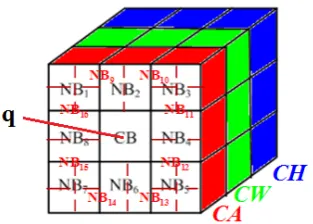
location q, the block centered on it is called the “Center Block” (CB). The adjacent blocks with
overlapped w/ 2 pixels yield 16 “Neighboring Blocks” (NB). The CB and NB are 3-order tensors.
All neighboring blocks are further assembled into a 4-order tensor, M∈Rb w w c× × × (b=16). An
[image:17.595.215.372.552.664.2]example is shown in Figure 5.
Figure 5. The center block (CB) of pixel q has 16 overlapped neighboring blocks with w/ 2 overlapping pixels: NB NB1, 2,...NB16. Each block is in size of w w× pixels.
4.2.2 Saliency Map from Tensor Reconstruction
1 block 2 row 3 column 4 color
= × U × U × U × U
M Z , (11)
where × × ×1, 2, 3 and ×4 are the n-mode product operations of the tensor Z and matrices ,
row column
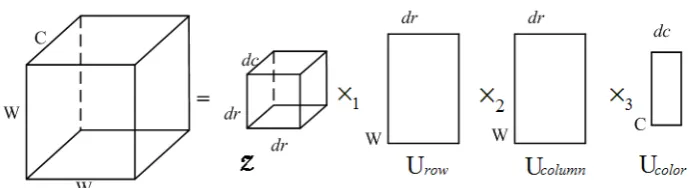
U U and Ucolor [53]. Here, the core tensor Z reflects the interactions among 4 subspaces: the matrix Ublock spans the subspace of block parameter; the matrix Urowspans the subspace of each
block row’s parameter, includes correlation between any two rows along all blocks, and represents
different texture basis along vertical direction. Similarly, the matrix Ucolumnspans the subspace of
each block column’s parameter, includes correlation between any two columns along all blocks, and
represents different texture basis along horizontal direction. The matrix Ucolor spans the subspace of color emotion parameter and each eigenvector represents one kind of linear transformation of color
[image:18.595.123.471.355.449.2]emotion values.
Figure 6. An example of a 4-order Tucker decomposition viewed from 1st Block.
Since Ublock only represents the correlation among all neighboring blocks, the decomposition output along this order is not considered in the following analysis. So we keep its dimension to be
16 16× . For the remaining three orders, we take first dr eigenvectors of Urow and Ucolumn to form the basis matrices Udrrow and Udrcolumn that contain the most important texture energy along
vertical and horizontal directions respectively. We also take the first dc most important linear
transformations of the Ucolor eigenvectors Udccolor to emphasize color emotion feature variations. An example of this tensor decomposition is given in Figure 6.
During projection and reconstruction, we represent the center block at location q as a 3-order
tensor T ∈Rw w c× × , then project it using Udrrow , dr column
U and Udccolor , the projected tensor is
dr dr dc
R × ×
∈
( )
(
) (
)
1 2 column 3 color
T T
T
dr dr dc
row
= × U × U × U
P T . (12)
Then, we get the reconstruction tensor T R of the center block tensor T by multiplying the
projected P with the basis matrices of dr row
U , dr column
U and dc color
U , as
( )
( ) ( )
( )
(
)
(
( )
)
(
( )
)
1 2 3
1 2 3 1 2 3
1 2 3
column color
column color column color
column column color color
R dr dr dc
row
T T
T
dr dr dc dr dr dc
row row
T T
T
dr dr dr dr dc dc
row row
= × × ×
= × × × × × ×
= × × ×
U U U
U U U U U U
U U U U U U
T P
T T
. (13)
After reconstruction, the residual error r q( ) at pixel q is computed as
(
)
2, , , , 1 1 1
( )
w w c
R i j k i j k i j k
r
= = =
=
∑∑∑
−q T T . (14)
The result r q( ) is used as the saliency value of the processed pixel. In this way, we approximate the
center block’s color emotion and texture pattern by the linear sum of the learned patterns of
neighbors through tensor reconstruction. Obviously, if the central block has similar features with its
neighbors in terms of color emotion and local textures, the principal tensor components gained from
neighboring blocks may be similar to those gained from the center block so that the reconstruction
error is small, otherwise the reconstruction error is higher and the pixel has a large saliency value.
4.2.3 Pyramid Saliency Map Calculation
The pyramid architecture, which is widely used in visual saliency methods, offers a framework
for image saliency map calculation with increased resolution quality [52]. We use a pyramid with L
different levels, denoted as 1 2
, ,..., L
I I I , for the saliency map calculation, where 1
I is the original
image and IL is the lowest resolution image. The value of L is determined to be sure that the
image’s width and height of IL are not less than 64 pixels. The normalized saliency map at each
level is then resized to match the size of the original image. The values of all the saliency maps at
different levels are averaged to gain the final saliency map:
1 1 ˆ ( ) ( ) L l l SM r L = =
∑
q q , (15)
where SM( ) [0,1]q ∈ is the final saliency value of pixel q, ˆ ( )r ql is the normalized saliency value
4.3
Initialize of the CMIL with Weak Labels Based on Visual Saliency Map
Using the proposed tensor-based visual saliency map model, we obtain a normalized visual saliency
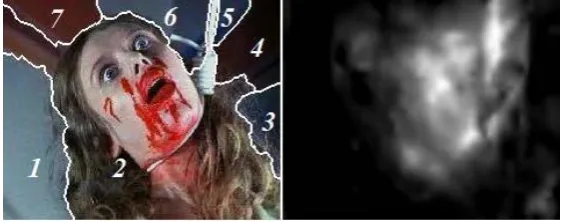
map of each horror image in the training set. As shown in Figure 7, the image regions with high
saliency values in a horror image indicate high emotional stimulus. For each positive training image
(bag) Xi, we compute its visual saliency map SMi. The average saliency values of all the
segmented region (instance) are also computed as ,1, ,2,..., ,
i
i i i n
SM SM SM . The initial fuzzy
membership si j, for the instance xi j, in the bag Xi is set as: si j, =SMi j, , rather than the value of
[image:20.595.153.436.283.394.2]0.5 used in Algorithm 1.
Figure 7. A horror image with the associated visual saliency map.
5
Experiments
To evaluate the performance of the proposed CMIL for horror image recognition, we compared it
with other prevailing affective image classification methods as well as some MIL methods on two
large scale image sets.
5.1
Data Set and Error Measurement
5.1.1 Data Set
Due to a lack of publicly available image sets for horror image recognition, we collected two horror
image sets from the Internet. One set includes 1000 horror and non-horror images (referred to as
1000 Horror Image Set). The other one includes 10,000 horror and non-horror images (referred to as
10000 Horror Image Set).
(1) 1000 Horror Image Set
This horror image set includes 500 horror images and 500 non-horror images. To collect the
search engines (google.com, bing.com, baidu.com) with related query words, such as “horror”, “fear”,
“bloody”, and corresponding Chinese words. We invited 7 students in our laboratory to label each
image as one of three categories: Non-horror, A little horror, and Horror. Then, we selected 500
images, each of which was labeled as “Horror” by at least 4 users. We also selected 500 non-horror
images with different scenes, objects or emotions. These non-horror images include 50 indoor images,
50 outdoor images, 50 human images, 50 animal images, 50 plant images, and 250 images with
emotional associations (adorable, amusing, boring, exciting, irritating, pleasing, and surprising). The
non-horror images were downloaded from the famous image retrieval system ALIPR, with website
(http://alipr.com/) using a range of different emotional query words.
In addition, in order to evaluate the performance of the proposed visual saliency map
computation model, these 7 students were also required to draw a bounding box around the most
salient horror region for each horror image in this set (according to their understanding). The
bounding boxes in each image were averaged to get the ground truth of the visual saliency map,
( )
EM q [48]:
( ) { | [0,1]}
EM q = mq mq∈ , where
1
1 U i
i
m a
U =
=
∑
q q (16)
where U =7 is the number of bounding boxes and i {0,1}
aq∈ is a binary label to indicate whether
or not the pixel q is inside the bounding box given by the ith student.
(2) 10000 Horror Image Set
The second image set includes 10,000 images, in which there are 5000 horror images and 5000
non-horror images. More than 8,000 candidate horror images were downloaded from a horror image
sharing group in a famous image sharing website (flickr.com). The sharing group advises that the
users who upload non-horror subject matter will be pulled out. As a result, all the images from this
group are horrible. Using the same selection procedure as that in creating 1000 image set, we
obtained 5000 horror images after removing duplicates. We also selected 5000 non-horror images
from the COREL database [35] which contains a large number of various scenes and is widely used
for image understanding research.
5.1.2 Error Measurement
For horror image recognition, given the ground truth of a horror image set, referred as HS, and the
measure defined in Eq. (17) were used to evaluate the recognition performance:
1
2
, , .
HS ES HS ES prec rec
pre rec F
ES HS prec rec
× ×
= = =
+
(17)
5.2
Horror Image Recognition Based on CMIL without Visual Saliency
In this section, we evaluated the performance of the CMIL in terms of horror image recognition
without the initialization using the visual saliency map, as shown in Algorithm 1.
We compared the CMIL with some general affective image classification methods: the
emotional valence categorization (EVC) algorithm [15], the color based bag-of-emotions (BoE)
model [16], the affective-pLSA based method (APLSA) [33] and the bilayer sparse
representation-based method (BSR) [18]. Although these methods are not specially designed for
horror image recognition, we still used them to classify images as: horror and non-horror. In addition,
the leading MIL algorithms, mi-SVM, MI-SVM [24], miGraph, and MIGraph [25], were also applied
to horror image recognition for comparison. To fairly compare all these MIL methods, the bag
construction and instances’ features in MIL methods are the same as those used in our CMIL.
Moreover, the Radial Basis Function (RBF) was adopted as kernel functions in the CMIL, mi-SVM,
MI-SVM, miGraph, and MIGrpah. The parameter α in Eq. (4) of the CMIL-FSVM was selected from {0.1, 0.3, 0.5, 0.7, 0.9}. The optimal parameters for each algorithm were determined through the
3-cross-validation on the training set in each experiment.
5.2.1 Results on 1000 Horror Image Set
The first experiment is on the 1000 horror image set. For each method, we repeated the 3-fold cross
validation 10 times and used the average performance of the 10 repeats as the final result.
(1) CMIL vs Affective Image Classification Methods
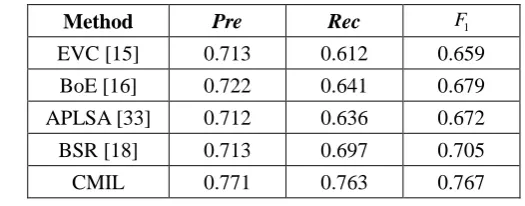
The performance comparisons between the CMIL and other affective image classification methods
are shown in Table 1. The experiment results demonstrate that the CMIL outperforms the completing
methods. The EVC, BoE and APLSA only use global features for affective image classification. The
BSR achieves slightly better performance than the other three affective classification methods due to
the fact that the BSR method combines local and global features for classification. However, the BSR
is essentially a global method in which it does not consider the contextual cues among regions. These
Table 1. Performance comparison with affective image classficiation methods on the 1000 horror image set.
Method Pre Rec F1
EVC [15] 0.713 0.612 0.659
BoE [16] 0.722 0.641 0.679
APLSA [33] 0.712 0.636 0.672
BSR [18] 0.713 0.697 0.705
CMIL 0.771 0.763 0.767
(2) CMIL vs MIL
We compared the proposed CMIL with 4 leading MIL methods, mi-SVM, MI-SVM [24], miGraph,
and MIGraph [25], in terms of horror image recognition on the 1000 horror image set. The mi-SVM
and MI-SVM can be viewed as local methods because they work on image regions. The miGraph,
MIGraph and CMIL are regarded as contextual methods because they take into account the
contextual cues among regions. The experimental results for these methods are listed in Table 2.
Table 2. Performance comparison with other MIL methods on the 1000 horror image set.
Method Pre Rec F1
mi-SVM [24] 0.712 0.726 0.719
MI-SVM [24] 0.693 0.707 0.700
miGraph [25] 0.725 0.732 0.728
MIGraph [25] 0.726 0.72 0.723
CMIL 0.771 0.763 0.767
According to Table 2, the proposed CMIL still outperforms other MIL methods. The local MIL
methods have slightly higher performance than the global methods [15, 16, 33], but lower
performance than the contextual methods. The miGraph and MIGraph algorithms achieve good
performance in the image set, but still lower than CMIL. The results show that horror image
recognition benefits from exploiting contextual information among the image regions. However, the
miGraph and MIGraph methods prefix instances’ relationship using a -graph in feature space and
emphasize the global structural of the -graph. This contextual strategy is not very suitable for
horror image recognition. In comparison, our CMIL method dynamically learns the contextual cues
among regions and focuses on those contextual regions that indicate a horror image.
5.2.2 Results on 10000 Horror Image Set
We then conducted experiments on the 10000 image set. Following the same setting in the previous
experiment, we obtained performance of each method.
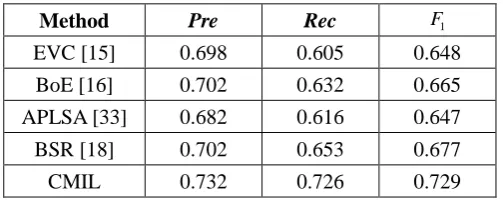
Method Pre Rec F1
EVC [15] 0.698 0.605 0.648
BoE [16] 0.702 0.632 0.665
APLSA [33] 0.682 0.616 0.647
BSR [18] 0.702 0.653 0.677
CMIL 0.732 0.726 0.729
(1) CMIL vs Affective Image Classification Methods
Experimental results for the CMIL and for other general affective image classification methods are
shown in Table 3. Similar conclusions to those in the previous experiment were obtained. The
proposed CMIL method still outperforms the competing affective image classification methods.
Interestingly, we found that the precision values of these global methods are slightly higher than their
recall values. It proves that some horror images are misclassified as a non-horror because of the
[image:24.595.169.421.48.148.2]background.
Table 4. Performance comparison with other MIL methods on the 10000 horror image set.
Method Pre Rec F1
mi-SVM [24] 0.657 0.695 0.675
MI-SVM [24] 0.649 0.687 0.667
miGraph [25] 0.682 0.691 0.686
MIGraph [25] 0.684 0.701 0.692
CMIL 0.732 0.726 0.729
(2) CMIL vs MIL
The experimental results of the CMIL and other MIL methods are listed in Table 4. The proposed
CMIL still outperforms the MIL methods on this larger set. The miGraph and MIGraph methods still
achieve slightly better performance than mi-SVM and MI-SVM. In addition, the precision values of
the local methods mi-SVM and MI-SVM are slightly lower than their recall values. It implies that
some non-horror images are misclassified as horror images because of their local similarity. The
precision and recall values of each contextual algorithm are comparable. It again indicates that
contextual cues are helpful for good horror image recognition scheme. When facing the larger scale
complex Internet image set, our proposed CMIL still has stable performance.
5.3
Horror Image Recognition Based on CMIL with Visual Saliency
We evaluated the proposed CMIL with improved initialization using the tensor-based visual saliency
map (denoted as CMIL+TVS). Before evaluating its performance on horror image recognition, we
including Itti’s method (Itti) [46], Hou’s method (Hou) [51], Graph-based visual saliency algorithm
(GBVS) [50], and Frequency-tuned salient region detection algorithm (FS) [52], in the context of
visual saliency map computation.
5.3.1 Comparison of Visual Saliency Maps
(1) Error Measurement for Visual Saliency Model
Given the ground truth annotation EM q( ) and the computed visual saliency SM q( ) of an
image, the precision (Spr), recall(Sre), and F0.5 measure, which are widely used for visual saliency
map evaluation [48], were used for performance comparison:
0.5
( ) ( ) ( ) ( ) (1 0.5)
, , .
( ) ( ) 0.5
SM EM SM EM Spr Sre
Spr Sre F
SM EM Spr Sre
+ × ×
= = =
× +
∑
∑
∑
∑
q q
q q
q q q q
q q (18)
(2) Comparison of Visual Saliency Models
There are 3 parameters in the tensor-based saliency map model. The block size, which has little
effect because of the pyramid architecture, was set as w=8. We set dr=3 and dc=1, meaning
[image:25.595.108.484.454.587.2]that matrices U3row, U3column, and U1color were used as basis for tensor reconstruction. The Precision (Spr), Recall (Sre) and F0.5 values of each method are listed in Table 5.
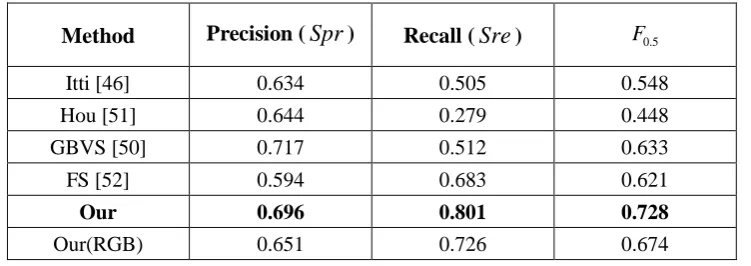
Table 5 Comparison with existing visual saliency algorithms on the 1000 horror image set
Method Precision (Spr) Recall (Sre) F0.5
Itti [46] 0.634 0.505 0.548
Hou [51] 0.644 0.279 0.448
GBVS [50] 0.717 0.512 0.633
FS [52] 0.594 0.683 0.621
Our 0.696 0.801 0.728
Our(RGB) 0.651 0.726 0.674
The performance of our tensor-based model is Spr=0.696, Sre=0.801 and F0.5 =0.728
respectively, showing that it outperforms the other visual saliency computation methods on this set.
Because the other visual saliency methods are designed only from the visual viewpoint, they do not
consider the higher emotional stimulus in horror images. In order to test the effectiveness of the color
emotion space, we also show the tensor-based model’s results in RGB color space in Table 5 (denoted
as Our(RGB)). The lower performance from RGB space indicates that the color emotion space does
indeed identify colors with a strong emotional impact and is helpful for emotion-related salient
in the proposed tensor-based saliency map model also improve the accuracy of the saliency map. For
the qualitative comparison, some saliency maps of the horror images generated by different
algorithms are also given in Figure 8. Our proposed method correctly detects the horror regions in
[image:26.595.50.540.151.320.2]almost all of these images.
Figure 8. Exemplar saliency maps on horror images produced by different algorithms.
5.3.2 Performance Comparison of Horror Image Recognition on 1000 Horror Image Set
In order to further evaluate the effect of the visual saliency map in the CMIL, we compared the CMIL
without the visual saliency map (denoted as CMIL) to the CMIL+TVS, as well as the CMIL with the
GBVS visual saliency map (denoted as CMIL+GBVS) in terms of horror image recognition. The
results are listed in Table 6. The fact that both CMIL+TVS and CMIL+GBVS outperform the CMIL
implies that the visual saliency maps do indeed give useful weak labels to the CMIL for improving its
performance on horror image recognition. In addition, the CMIL+TVS can achieve a slightly higher
1
F value than the CMIL+GBVS, it is because the GBVS has lower performance on visual salient
region detection than the proposed tensor-based model in Table 5.
Table 6. Performance comparison among different CMIL algorithms on the 1000 horror image set.
Method Pre Rec F1
CMIL 0.771 0.763 0.767
CMIL+GBVS 0.781 0.776 0.778
CMIL+TVS 0.809 0.801 0.805
5.3.3 Performance Comparison of Horror Image Recognition on 10000 Horror Image Set
We also compared the CMIL, CMIL+TVS and CMIL+GBVS methods on this larger image set.
[image:26.595.168.419.607.675.2]and the CMIL.
Table 7. Performance comparison among different CMIL algorithms on the 10,000 horror image set.
Method Pre Rec F1
CMIL 0.732 0.726 0.729
CMIL+GBVS 0.731 0.733 0.732
CMIL+TVS 0.786 0.773 0.779
We gave examples of the horror region extraction results of the proposed CMIL+TVS algorithm.
Because the instance with the largest contextual score in a bag in the CMIL is most likely to evoke
horror emotion, we considered it to be a horror region in the image. Figure 9 gives some horror
region extraction results from the CMIL+TVS method. It shows that the CMIL+TVS can correctly
identify the underlying horror region of each horror image. Furthermore, the isolated horror regions
shown in the second row of Figure 9 evoke almost no feeling of horror. This again indicates that the
horror emotion expressed by an image is not evoked by an isolated region but its context.
Figure 9. Examples of horror regions extraction from the CMIL+TVS. The first row contains original images; the images in the second row are segmentation results; the images in the third row are the horror regions extracted by our CMIL algorithm.
6
Conclusions and Future Work
Considering the challenges in horror image recognition from a contextual perspective, we have
proposed a novel context-aware multi-instance learning model (CMIL). The CMIL model is based on
the fact that the emotion of horror is not evoked by isolated image regions but by the interactions
[image:27.595.141.450.371.577.2]visual saliency values that are generated by the proposed tensor-based visual saliency method. The
effectiveness of our proposed CMIL framework has been validated on two large scale horror image
sets collected from the Internet. Experimental results have showed that the proposed CMIL algorithm
is superior to both general affective image classification methods and traditional MIL methods in
horror image recognition.
There is still much that has to be done in order to obtain more reliable and general horror image
filtering systems. Our future work will focus on the following directions: (1) Exploring more
effective emotion-related features for horror image recognition; (2) Integrating the image content
analysis with surrounding text tags to filter the horror content on the Web; (3) Investigating online
learning scheme so that we can dynamically adjust the classifier as more samples become available.
ACKNOWLEDGMENTS
This work was supported by the National Nature Science Foundation of China (No. 61370038,
61472421, and 61571045), the 973 Basic Research Program of China (No. 2014CB349303), the
Project Supported by CAS Center for Excellence in Brain Science and Intelligence Technology, and
Chinese National Programs for High Technology Research and Development (863 Program)
(No.2012AA012503 and No. 2012AA012504).
References
[1] W. Hu, O. Wu, and Z. Chen. Recognition of pornographic web pages by classifying texts and images. IEEE Transaction on Pattern Analysis and Machine Intelligence, 29(6): 1019-1034, 2007.
[2] M. Hammami,
Content-Based Analysis. IEEE Transaction on Knowledge and Data Engineering, pp. 272-284, 2006.
[3] A. Field, and J. Lawson. Fear information and the development of fears during childhood: effects on implicit fear responses and behavioural avoidance. Behaviour Research and Therapy, 41(11): 1277-1293, 2003.
[4] S. Rachman. The conditioning theory of fear acquisition. Behaviour Research and Therapy, 15(5):375-378, 1977.
[5] T. H. Ollendick and N. J. King. Origins of childhood fears: An evaluation of Rachman's theory of fear acquisition. Behaviour Research and Therapy, 29(2):117 -123,1991.
[6] http://en.wikipedia.org/wiki/Motion_Picture_Association_of_America_film_rating_system [7] http://slashdot.org/article.pl?sid=08/02/16/0654237
[8] http://seattletimes.nwsource.com/html/entertainment/2009687065_apeubritainhorrorfilm.html
[9] B. Wu, X. Jiang, T. Sun, S. Zhang, X. Chu, C. Shen, and J. Fan. A Novel Horror Scene Detection Scheme on Revised Multiple Instance Learning Model. Proc. International Conference on Multimedia Modeling, pp.359-370, 2011.
[10] J. Wang, B. Li, W. Hu, and O. Wu. Horror Movie Scene Recognition based on Emotional Perception. Proc. International Conference on Image Processing, pp.1489-1492, 2010.
[11] J. Wang, B. Li, W. Hu, and O. Wu. Horror Video Scene Recognition via Multiple-Instance Learning. Proc. International Conference on Acoustics, Speech, and Signal Processing, pp. 1325-1328, 2011.
[12] W. Wang, and Q. He. Survey on Emotional Semantic Image Retrieval. Proc. International Conference on Image Processing, pp. 117-120, 2008
[13] W. N. Wang and Y. L. Yu. Image emotional semantic query based on color semantic description. Proc. International Conference on Machine Learning and Cybernetics, pp. 4571-4576, 2005.
![Figure 1. Images with different contextual cues evoke completely different emotions. The images are from the International Affective Picture System (IAPS) dataset [54]](https://thumb-us.123doks.com/thumbv2/123dok_us/8869711.941475/4.595.112.476.458.605/different-contextual-completely-different-emotions-international-affective-picture.webp)