Smith, H.R. and Eryigit-Madzwamuse, S. and Barnes, Jacqueline (2013)
Paternal postnatal and subsequent mental health symptoms and child
socio-emotional and behavioural problems at school entry.
Infant and Child
Development 22 (4), pp. 335-348. ISSN 1522-7227.
Downloaded from:
Usage Guidelines:
Please refer to usage guidelines at or alternatively
Paternal postnatal and subsequent mental health symptoms and child
socio-emotional and behavioural problems at school entry
Smith, H., Eryigit-Madzwamuse, S. & Barnes, J.
Short title: Paternal mental health symptoms and child problems
Infant and Child Development (2013)
22, 335-348Abstract
Research on the effect of paternal mental health problems, particularly on young
children, is based predominantly on clinical levels of depression. Furthermore, potential
mediators such as marital discord have often been overlooked. This longitudinal
community study assessed the association between paternal mental health symptoms in
a community sample (N=705) assessed at 3 months postnatally (Edinburgh Postnatal
Depression Scale) and 36 months (General Health Questionnaire) and children's
socio-emotional and behavioural problems at 51 months (Strengths and Difficulties
Questionnaire) as reported by mother, father and teacher. Controlling for SES and
maternal mental health symptoms at 3 and 36 months, paternal postnatal depressive
symptoms predicted more father-reported child problems at 51 months but, in contrast
to previous findings, not mother-reported problems. Paternal mental health symptoms
at 36 months predicted both maternal and paternal reports of child problems at 51
months controlling for both paternal and maternal postnatal symptoms. Paternal mental
health symptoms at 3 and 36 months were not significant predictors of teacher reported
child problems. Postnatal marital discord and paternal mental health problems at 36
months both mediated the relationship between paternal postnatal symptoms and later
child emotional and behavioural problems. Child gender did not moderate the
relationship. Implications for interventions are discussed.
Maternal postnatal depression can have a detrimental effect on children’s emotional and
behavioural development (Beck, 1998; Bureau, Easterbrooks, & Lyons-Ruth, 2009; Murray
& Cooper, 1997). Fathers are also at risk for postnatal depression (estimates between 2.1%
and 25.5%; Goodman, 2004). While evidence has emerged on the importance of fathers to
child development (Lamb, 2010) the relationship between paternal postnatal mental health
and child development prior to school age has received little attention, with more focus on
children between school age and young adulthood (Beardslee, Versage & Gladstone, 1998;
Kane & Garber, 2004; Phares & Compas, 1992). With increased maternal employment there
has been an increase in fathers' caregiving of young children (Cabrera, Tamis-LeMonda,
Bradley, Hofferth, & Lamb, 2000). Therefore it is important to explore the likelihood that
paternal mental health problems early in children’s lives may have an impact on subsequent
child well-being. In particular, the postnatal period provides an opportunity for intervention,
when health professionals routinely contact families (Shribman & Billingham, 2009).
A small study (N=18) found that paternal postnatal depression (above the EPDS cut-off)
was associated with infant fussiness at six months as reported by mother, father or both
parents (Davé, Nazareth, Sherr & Senior, 2005). The relevance of child gender is not
clear-cut. Some researchers have found that maternal depression is more influential on boys
(Murray, 1992; Weinberg, Olson, Beeghly & Tronick, 2006) while others have shown girls to
be more vulnerable (Davies & Windle, 1997; Hops, 1992). A large study of fathers in the
UK (N=6,170) found that, controlling for maternal depression (but not education or social
class), marked paternal depression at six months (a relatively small group, 3%) was related to
difficult temperament of boys but not girls at 24 months, as reported by mothers (Hanington,
Ramchandani & Stein, 2010). However, in the same sample (ALSPAC), postnatal paternal
marked emotional and conduct problems (top 10%) and marked total behaviour problems
(top 10%) at 42 months as described by mothers, controlling for education and social class
(Ramchandani, Stein, Evans, & O’Connor, 2005). Controlling for subsequent paternal
depression at 21 months, paternal postnatal depression was only predictive of hyperactivity
and conduct problems; the impact on conduct problems was greater for boys than girls
(Ramchandani et al., 2005).
Different findings can be identified depending on whether depression is defined
according to total symptoms or a cut-off and whether child difficulties are defined using a
temperament scale or a behaviour problem measure with a cut-off or total problems. For
example, Davé, Sherr, Senior and Nazareth (2008) found a relationship between paternal
depression and child problems in a sample of parents of 4-6 year olds recruited though
General Practitioners. However this result was based on only 8 men with major depression
and 10 children with marked total problems out of a sample of 248 families. There was no
effect for men with minor depression. To understand what public health interventions might
be appropriate, in addition to clinical treatment for severely ill parents, it is important to look
at representative samples to understand whether less severe levels of paternal mental health
problems pose any risk for their children’s development.
It is important to consider other factors which may play a part in the relationship
between parental depression and child difficulties. Lower socioeconomic status (SES) is
positively associated with depression (Birtchnell, Masters, & Deahl, 1988) and child
difficulties (Meltzer, Gatward, Goodman, & Ford, 2000), and is therefore likely to be
involved in this relationship. Some studies, but not all, have controlled for parental education
and social class, but other family factors may also be involved. Marital discord has been
and with child difficulties (Reid & Crisafulli, 1990) and to mediate the relationship between
parental depression and child outcomes (Cummings, Keller, & Davies, 2005; Hanington,
Heron, Stein, & Ramchandani, 2012). Marital discord may influence child well-being
through a number of pathways. Marital discord may disrupt the child-parent relationship
(Erel & Burman, 1995; Krishnakumer & Beuhler, 2000) or the child’s emotional stability and
sense of security (Cummings & Davies, 1994; 1999). Furthermore, the child’s attribution of
the conflict witnessed between parents may shape their own interactions with their parents
and others (Harold & Conger, 1997). Despite these findings, few studies of the impact of
paternal depression have accounted for both marital discord and SES.
In summary, there is a wealth of evidence on the relationship between maternal
depression in the postnatal period and early years and young children’s development.
Research examining the effect of paternal mental health is not as yet so conclusive, with
several studies looking at the most severe paternal depression and the most marked child
behaviour difficulties. In addition, most previous studies have not explored mediating factors
and the majority rely on reports of child behaviour from a single-informant, usually the
mother.
The current study examines the relationship between paternal mental health and
children’s socio-emotional difficulties at the start of school, using a large sample and
multiple informants. The following hypotheses were addressed:
(1) Paternal postnatal depressive symptoms will have an adverse effect on child
socio-emotional outcomes at 51 months, independently of SES and maternal mental health
(2) Paternal mental health symptoms at 36 months will have an adverse effect on
children’s socio-emotional outcomes at 51 months, independently of SES, paternal
postnatal depressive symptoms, and maternal mental health symptoms.
(3) The effect of paternal postnatal depressive symptoms on child difficulties at 51 months
will be mediated by marital discord at 3 months and by later mental health symptoms
at 36 months.
Method
Sample
The sample was taken from the Families, Children and Child Care study (FCCC)
which recruited 1201 mothers and their babies from antenatal clinics in North London and
Oxfordshire. Eligibility included mother at least 16 years, infant full term singleton with no
congenital abnormalities, and no plans to put the child into care or adoption (Malmberg, et
al., 2005). The majority of parents were living together (99.0%), had a white ethnic
background (80.0%) and more than half the families had at least one parent with a
managerial/professional occupation (60.6%). Seven hundred and five partners agreed to
participate and were the sample of the present study. Of these, 97.6% were the child’s
biological father. Ethical approval for the study was given by the Royal Free and University
College Medical School and Oxford University and all participants gave written informed
consent.
Procedure
Data were collected at 3 months after the child’s birth, with follow-up at 10, 18, 30,
36 and 51 months. Data for this study involve contacts at 3, 36 and 51 months. Maternal
questionnaires were left at visits and returned by post. Teachers’ questionnaires (51 months)
were sent and returned by post.
Measures
Demographic characteristics
Information was collected on child gender, partnership/marital status and parents’
occupational status. Computer Assisted Standard Occupational Coding (CASOC) assigned
each participant to the 3-step CASOC (Working, Intermediate, Managerial/Professional).
Mothers’ and partners’ scores were averaged to create family SES.
Paternal and maternal mental health
At 3 months mothers and fathers completed the self-report 10-item Edinburgh
Postnatal Depression Scale (EPDS; Cox, Holden & Sagovsky, 1987) with possible scores
ranging from 0 to 30 and a cut-off of 12/13 indicating the likelihood of depression. While
initially developed for female respondents it has subsequently been validated for use with
males (Edmondson, Psychogiou, Vlachos, Netsi, & Ramchandani, 2010). Total EPDS scores
were used in all analyses (Cronbach alphas: mothers .84; fathers .80).
At 36 months mothers and fathers completed the self-report 12-item General Health
Questionnaire (GHQ-12; Goldberg & Williams, 1988), a measure of non-psychotic mental
health symptoms. Scores can range from 0 to 36 with a cut-off of 11/12 indicating likely
mental health problems. Total GHQ scores were used in all analyses (Cronbach alphas:
mothers .87; fathers .86).
Marital Discord
At 3 months mothers and fathers completed the self-report 32-item Dyadic
Adjustment Scale (DAS; Spanier, 1976) which measures dyadic consensus, dyadic
from 0 to 5 with two binary items. The four scales give a total satisfaction score (maximum
143). The scoring was reversed so that a higher total score represented more marital discord
(Cronbach alphas: mothers .88; fathers .89).
Child Behaviour
The 25-item Strengths and Difficulties Questionnaire (SDQ; Goodman, 1997), with
items scored from 0 to 2, has good internal consistency (mean Cronbach alpha .73), and retest
stability (mean .62) (Goodman, Lamping, & Ploubidis, 2010). It was completed by mothers,
fathers, and teachers at 51 months. There are five subscales each with five items (conduct
problems, hyperactivity, emotional symptoms, peer problems, and prosocial behaviour). The
first four combine to give a total difficulties score (range 0 to 40) which was used in this
study (Cronbach alphas: mother .74, father .74, teacher .81).
Statistical Analysis
Missing data for predictors were imputed using the Full Information Maximum
Likelihood (FIML) technique (Wothke, 1998). FIML calculates the maximum likelihood
estimates of the model's parameters which are then used to make the optimal regression
equations and predict missing values. As regression methods can underestimate standard
error, some error is added to the variances of these estimates. Bivariate correlations were
calculated between family characteristics, parents’ mental health and total child difficulties to
determine which variables to include in regression analyses. A series of hierarchical
regression analyses were then fitted in order to test the current hypotheses. In order to test for
mediation, bias-corrected (95 %) confidence intervals was examined using bootstrapping in
AMOS (MacKinnon, Lockwood, and Williams (2004). Finally, to test the moderation of
child gender on mediations, multi-group analysis in AMOS was run for boys and girls.
differences in goodness of fit statistics between unconstrained models and models where
paths were constrained to be equal across samples.
Results
Sample characteristics
Attrition was low between 3 and 36 months. Of the 705 men who completed the
EPDS at 3 months, 626 (88.8%) completed the GHQ at 36 months. Of the 705 fathers
completing the EPDS, 543 (77.0%) completed the SDQ at 51 months. The reasons for
attrition are not known, but some contact with mothers at 51 months was by telephone rather
than home visit, which may have reduced the likelihood of paternal response. Characteristics
of participants and non-participants at 51 months were compared (see Table 1). The groups
did not differ in terms of fathers' ethnicity, marital discord, paternal age, paternal postnatal
and 36 month mental health symptoms or child difficulties. Fathers participating at 51 months
were more likely to live with the mother at 3 months (χ2 (1) =4.66, p < .05) and be in a
managerial/professional SES family (χ2 (1) =14.21, p < .001). Participating fathers' partners
(child’s mother) were younger (t (243) =3.15, p < .01) and had fewer mental health
symptoms at 3 months (t (217) = -3.30, p < .001) and at 36 months (t (122) = -2.83, p < .01).
There were 502 teacher SDQ scores for these 543 families (92%).
Of the 543 fathers completing the SDQ, 43 (7.9 %) had scores above the male EPDS
cut-off score of 10 at 3 months, indicating that they were at risk of a depressive disorder
(Edmonson et al., 2010). A similar proportion (33, 6.1%) of their partners was at risk of a
depressive disorder at 3 months using a cut-off of 12 (Murray & Carothers, 1990). Of the
543 families with paternal SDQ scores, 30.0% of fathers and 32.9% of mothers had GHQ
scores at 36 months scored at or above the threshold of 12, indicating that they were at risk of
[Insert Table 1]
Bivariate correlations
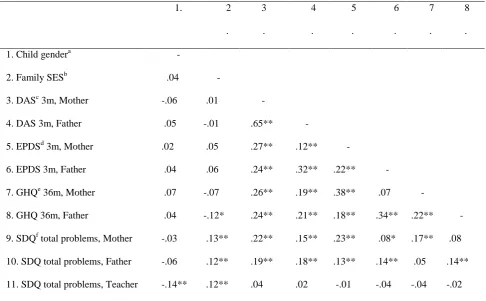
There were significant associations among mothers’, fathers’ and teachers’ reports of
child socio-emotional problems based on the SDQ, though these were lower for
parent-teacher than parent-parent correlations (mother-father r=.57, mother-parent-teacher r=.28,
father-teacher r=.21). The associations among family characteristics, parents’ mental health and
child difficulties were also examined (see Table 2). Child gender was only significantly
associated with teacher-reports of child difficulties (boys having more difficulties) and not
that of parents. Lower SES was significantly associated with child difficulties according to all
respondents. Postnatal depression symptoms of mothers and fathers were positively
associated with subsequent child difficulties as reported by each parent. However, fathers’
mental health symptoms at 36 months was only associated with father-reported child
difficulties at 51 months; and mother’s mental health symptoms at 36 months was only
associated with mother-reported child difficulties. Fathers’ and mothers’ postnatal depressive
symptoms were positively related to each other (r = .22), as were fathers’ and mothers’ 36
months mental health symptoms (r = .22). The extent of depressive symptoms at 3 months
was also positively associated with mental health symptoms at 36 months for both parents
(see Table 2).
Marital discord at 3 months was positively associated with child behaviour problems
at 51 months according to both maternal and paternal reports. Father and mother reports of
marital discord were closely associated to each other (r = .65).To avoid collinearity, only
fathers’ reports of marital discord were entered into the analyses. Teachers’ SDQ scores were
not significantly associated with parents’ postnatal depression, later mental health symptoms,
[Insert Table 2]
Direct effect of paternal postnatal depression and later mental health symptoms
It was predicted (hypothesis 1) that paternal postnatal depressive symptoms would
have an adverse effect on child socio-emotional outcomes at 51 months, independently of
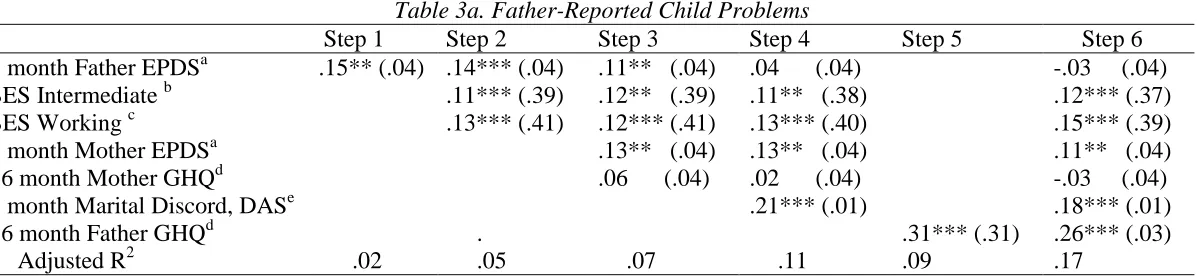
SES and maternal mental health symptoms. The step-wise regression analysis first
examined the influence of paternal depression at 3 months on child behaviour at 51
months, then controlled for family SES, maternal depression at both time points and
marital discord. Then the influence of paternal depression at 36 months was examined,
and finally the influence of paternal depression at 36 months taking all other factors into
account. These analyses were conducted first for father-reported behaviour problems then
for mother-reported problems. All the steps in both regression models were able to
account for a substantial amount of the variance in maternal and paternal reports of child
socio-emotional problems at 51 months (see Tables 3a and 3b).
Paternal postnatal depressive symptoms significantly predicted father-reported and
mother-reported child socio-emotional problems (see Tables 3a and 3b, step 1) and
remained so controlling for SES (Step 2). Controlling for maternal symptoms (step 3)
paternal postnatal depression was only a predictor for father-reports of child behaviour and
controlling for marital discord (step 4) it was not significant for mother or father reports.
Nor was postnatal paternal depression significant after controlling for paternal 36 month
mental health ( step 6). It was also predicted that paternal mental health symptoms at 36
months would have an adverse effect on children’s socio-emotional outcomes at 51
months, independently of SES, paternal postnatal depressive symptoms, and maternal
mental health symptoms (hypothesis 2) and this was confirmed. Paternal mental health
behaviour problems (Tables 3a and 3b, step5) and remained significant when all other
factors were controlled (step 6).
[Insert Tables 3a and 3b]
Mediation models
The third hypothesis was that the effect of paternal postnatal depressive symptoms on
child difficulties at 51 months would be mediated by marital discord at 3 months and by later
mental health symptoms at 36 months. The coefficients in Table 3 suggested two indirect
paths to be examined for mediation: the indirect link between paternal postnatal depressive
symptoms and both father- and mother-reported child difficulties through marital discord;
and the indirect link between marital discord and both father- and mother-reported child
difficulties through later paternal mental health. The bias-corrected confidence intervals for
the mediation of marital discord between paternal postnatal depression and child difficulties
showed a significant indirect path for father-reported child difficulties (Standard indirect
effect=.071, p<.01; 95% CI= .042; .107 ) and for mother-reported child difficulties (Standard indirect effect=.047, p<.01; 95% CI= .019; .080).
Paternal later mental health symptoms were found to be a significant mediator of the
association between marital discord and later child difficulties as reported by fathers
(Standard indirect effect=.032, p<.01; 95% CI= .010; .062) and mothers (Standard indirect
effect=.030, p<.01; 95% CI= .009; .064). To summarise, marital discord at 3 months mediated the relationship between early paternal mental health at 3 months and child
difficulties at 51 months. Later paternal mental health at 36 months was a mediator of the link
between marital discord at 3 months and child outcomes at 51 months.
Child gender did not moderate the associations among paternal mental health and
marital discord, controlling for maternal mental health and SES. The associations were
similar across boys and girls except for the link from paternal mental health at 36 months
to father-reported child difficulties (β = .19, s.e.= .06, p<.001 for females, β = .32, s.e.=
.05, p<.001 for males). This path was constrained to be equal in order to test whether the
difference was significant. However, the delta chi square test (comparing the models when
the path was and was not constrained) showed this path to be statistically equal across
boys and girls (Δχ2= 1.631 Δdf = 1, ns). To summarise, the direct and indirect links from
paternal mental health and child problems were not moderated by child gender.
Discussion
This study aimed to investigate the relationship between paternal mental health
symptoms and child socio-emotional problems. The parents in this relatively large study
were comparable in terms of the prevalence of depression in mothers and fathers to other
research (Gaynes et al., 2005; Goodman, 2004). The first and second hypotheses were that
paternal postnatal depressive symptoms and later paternal mental health symptoms would
both have an adverse effect on child socio-emotional outcomes, controlling for the expected
effects of SES and maternal mental health. Hypotheses 1 was confirmed for father-reported
child difficulties but not mother-reported child difficulties. Previous research has used the
small percentage of fathers with major depression to indicate a link between paternal
postnatal depression and child behaviour difficulties or difficult temperament (Hanington et
al., 2010; Ramchandani et al., 2005), but it appears that taking an approach based on a
continuous score of depression fails to find such a relationship unless the father is also the
informant of the child. This could indicate a tendency for fathers prone to depression to be
of their own negative mood (Briggs-Gowan, Carter, & Schwab-Stone, 1996), although the
time between measures here was four years.
However, hypothesis 2 was confirmed in that paternal mental health symptoms at 36
months was a significant predictor of child socio-emotional problems at 51 months as
reported by fathers and mothers. Thus any response bias related to fathers with mental health
problems being more likely to perceive their child as a problem is less likely. The greater
influence of later paternal mental health symptoms may be related to fathers’ increased
involvement with caregiving from 0 to 5 years (Bailey, 1994), i.e. later paternal mental health
symptoms may affect children more than symptoms in the postnatal year as there is increased
exposure to fathers’ symptoms at this later stage. These findings may also be related to the
fact that the GHQ includes questions covering additional symptoms to depression (e.g.
anxiety). This broader range of symptoms may be more relevant to parenting and influential
on children developing socio-emotional problems.
One important difference in this study was that marital discord was assessed in the
postnatal period and hypothesis 3 was confirmed in that paternal postnatal depression was no
longer a significant predictor of child difficulties once marital discord was taken into account.
The impact of paternal postnatal depressive symptoms on child difficulties at school entry
was fully mediated by early marital discord and paternal mental health beyond the postnatal
period. The importance of marital discord in the months following the birth of a child, when
couples are likely to be making many adjustments, should be of importance to health
professionals working with families. Many parents experience a range of depression
symptoms in the months following a birth and where the depression is extreme need strong
However, for other families, a more holistic approach may be more useful, focusing on the
marital relationship and family difficulties related to social disadvantage.
In addition, the exploratory examination to determine if the impact of marital discord
at 3 months would be mediated by paternal mental health symptoms at 36 months was
supported. Thus the relevance of early marital discord is most likely when there are ongoing
paternal problems. Ideally we would have asked about marital discord again at 36 months,
but this was not collected. However, as marital discord is more likely when one, or both,
parents has mental health problems (Beach & O’Leary, 1993), any intervention to reduce
depression postnatally for fathers or mothers is likely to minimise any ongoing impact of
paternal postnatal depression.
Contrary to some previous research, the possibility that child gender moderates the
relationship between paternal mental health and child difficulties was not confirmed. Other
studies have noted gender differences particularly for temperament (Hanington et al, 2010) or
for specific sub-types of problems such as conduct problems (Ramchandani et al., 2005).
Using the total difficulties score and a continuous measure of paternal mental health
problems rather than focussing on individuals with marked problems, may have masked
gender effects which previous research has identified using clinical cut-off points. However it
was decided that, given the low Cronbach alphas for the subscales in this sample, any
conclusions about subscales would not be warranted. A sample with more variability in child
behaviour problems may lead to additional results, linking parental mental health problems to
particular aspects of child behaviour.
Strengths and Limitations
A strength of this study was the availability of information about marital discord in
affecting child development with no mention of a specific focus on parental mental health.
The use of multiple informants of child difficulties was also important. The lack of any
relationship between paternal mental health and teacher reported problems highlights the
possibility that child problems may be situation specific (Achenbach, McConaughy &
Howell, 1987), with home behaviours exacerbated by marital discord. It was noteworthy that
mother and father reports of child behaviour were closely related but that neither was closely
related to teacher reports. There are limitations, nevertheless. The sample was
over-representative of high SES families which could be both a strength and a weakness. It
lessens the generalisability of the findings to more disadvantaged families, but the fact that in
this relatively advantaged group there was an important effect of both paternal and maternal
depression indicates that the topic is suitable for a public health approach rather than one
focussing on the most vulnerable parents. A similar study with families from a diverse SES
background, again taking marital discord into account and measuring discord at more than
one time point, would extend these findings. Another weakness was the attrition at the 51
month time point. It was shown that attrition was more likely if mothers reported more
mental health problems at 3 and 36 months. The absence of information from these families,
who are likely to have had children with more difficulties at 51 months, may have reduced
the likelihood of identifying significant influences. The response rate for teachers was high,
thus the reason for the lack of relationship between family characteristics and teacher
assessments of children’s behaviour is unlikely to be due to lack of information.
The present study had a measure of postnatal depression but a more general measure
of later mental health. The GHQ does not measure depression alone; therefore it could be
that other psychological symptoms (e.g. anxiety or somatic symptoms) are the most relevant
by post. A more direct route to fathers might have enabled some who were reluctant (possibly
those with more depression) to provide information.
Conclusions
The results suggest that fathers’ mental health symptoms in the pre-school years are
likely to adversely affect both boys’ and girls’ socio-emotional behaviours at school entry.
The relevance of paternal postnatal depression on subsequent child difficulties was mediated
by postnatal marital discord. The relevance of postnatal marital discord was further mediated
by subsequent paternal mental health symptoms at 36 months. These findings have important
implications for clinical interventions in terms of who to target and how best to help.
Although there is growing evidence to suggest the inclusion of fathers in intervention
programmes, the present findings suggest that in the postnatal period particular attention
should be paid to marital discord, especially when it is associated with depression in either
parent. Subsequently, at child health checks in the preschool period, it would be sensible to
enquire about paternal mental health. Ideally this would be directly with fathers, but if they
are not available then there should be a way to provide them with questionnaires so that they
can describe any symptoms. This will enable a better system for the prevention of young
children’s socio-emotional problems.
Acknowledgments
We would like to thank the families who took part in the Families, Children and Childcare
(FCCC) Study and the FCCC research team. The FCCC was funded by the Tedworth
Charitable Trust and the Glass-House Trust and led by Dr. Penelope Leach and Professor
Jacqueline Barnes in London and by Professor Alan Stein, Professor Kathy Sylva and Dr.
the data and takes responsibility for the integrity of the data and the accuracy of the data
analysis.
Correspondence to
Professor Jacqueline Barnes, Institute for the Study of Children, Families and Social Issues,
Birkbeck, University of London, Malet Street, London WC1E 7HX, UK; Telephone: 0207
Key points
Increasing attention is being paid to the potential implications for young
children of paternal mental health problems.
In this study paternal postnatal depressive symptoms were unrelated to child
symptoms four years later once postnatal marital discord had been taken into
account.
Paternal mental health problems when children were three years old was a strong predictor of children’s subsequent behavioural and emotional
symptoms at 51 months, as reported by both mothers and fathers.
The strong relationship between postnatal marital discord and child
behaviour and emotional problems four years later, if paternal postnatal
depression is also present, indicates that it may be important for health
visitors and other health professionals to work closely with both parents
when either has depression in the postnatal period and to talk about the
References
Achenbach, T. M., McConaughy, S. H., & Howell, C. T. (1987). Child/adolescent
behavioural and emotional problems: Implications of cross-informant correlations for
situational specificity. Psychological Bulletin, 101, 213-232.
Bailey, W. (1994). A longitudinal study of fathers’ involvement with young children:
Infancy to age 5 years. Journal of Genetic Psychology,155, 331–339.
Beach, S. R. H. & O’Leary, D.K. (1993). Marital discord and dysphoria: For whom does
the marital relationship predict depressive symptomatology? Journal of Social and
Personal Relationships, 10, 405-420.
Beardslee, W. R., Versage, E. M., & Gladstone, T. R. (1998). Children of affectively ill
parents: a review of the past 10 years. Journal of the American Academy of Child &
Adolescent Psychiatry, 37 (11), 1134-1141.
Beck, C. T. (1998). The effects of postpartum depression on child development: A
meta-analysis. Archives of Psychiatric Nursing, 12, 12-20.
Birtchnell, J., Masters, N., & Deahl, M. (1988). Depression and the physical environment.
A study of young married women on a London housing estate. British Journal of
Psychiatry, 153, 56-64.
Briggs-Gowan, M. J., Carter, A. S., & Schwab-Stone, M. (1996). Discrepancies among
mother, child, and teacher reports: Examining the contributions of maternal depression and
anxiety. Journal of Abnormal Child Psychology, 24, 749-765.
Bureau, J., Easterbrooks, M. A., & Lyons-Ruth, K. (2009). Maternal depressive symptoms
in infancy: Unique contribution to children’s depressive symptoms in childhood and
Cabrera, N. J., Tamis-LeMonda, C. S., Bradley, R. H., Hofferth, S. & Lamb, M. E. (2000).
Fatherhood in the twenty-first century. Child Development, 71, 127-136.
Cox, J. L., Holden, J. M. & Sagovsky, R. (1987). Detection of postnatal depression:
Development of the 10-item Edinburgh Postnatal Depression Scale. British Journal of
Psychiatry, 150, 782-786.
Cummings, E.M., & Davies, P. T. (1994). Children and marital conflict: The impact of
family dispute and resolution. New York: Guildford.
Cummings, E.M., & Davies, P.T. (1999). Depressed parents and family functioning:
Interpersonal effects and children’s functioning and development. In T. Joiner & J.C. Coyne
(Eds.), The interactional nature of depression: advances in interpersonal approaches (pp.
299–327). Washington, DC: American Psychological Association.
Cummings, E. M., Keller, P. S. & Davies, P. T. (2005). Towards a family process model
of maternal and paternal depressive symptoms: exploring multiple relations with child and
family functioning. Journal of Child Psychology and Psychiatry, 46, 479-489.
Davé, S., Nazareth, I., Sherr, L. & Senior, R. (2005). The association of paternal mood and
infant temperament: A pilot study. British Journal of Developmental Psychology, 23,
609-621.
Davé, S., Sherr, L., Senior, R. & Nazareth, I. (2008) Associations between paternal
depression and behaviour problems in children of 4-6 years. European Child and
Adolescent Psychiatry, 17(5), 306-315.
Davies, P. T. & Windle, M. (1997). Gender-specific pathways between maternal depressive
symptoms, family discord, and adolescent adjustment. Developmental Psychology, 33 (4),
Edmondson, O. J. H., Psychogiou, L., Vlachos, H., Netsi, E. & Ramchandani, P. G.
(2010). Depression in fathers in the postnatal period: Assessment of the Edinburgh
Postnatal Depression Scale as a screening measure. Journal of Affective Disorders, 125,
365-368.
Erel, O. & Burman, B. (1995). Interrelatedness of marital relations and parent-child relations:
a meta-analytic review. Psychological Bulletin, 118, 108–132.
Gaynes, B. N., Gavin, N., Meltzer-Brody, S., Lohr, K. N., Swinson, T., Gartlehner, G., et
al. (2005). Perinatal depression: Prevalence, screening, accuracy, and screening
outcomes. Retrieved August 13, 2011, from the Agency for Healthcare Research and Quality website: http://www.ahrq.gov/clinic/epcsums/ peridepsum.htm
Goldberg, D., & Williams, P. (1988). A user's guide to the General Health Questionnaire.
Windsor, UK: NFER-Nelson.
Goodman, J.H. (2004). Paternal postpartum depression, its relationship to maternal
postpartum depression, and implications for family health. Journal of Advanced Nursing,
45, 26–35.
Goodman, R. (1997). The Strengths and Difficulties Questionnaire: A Research Note.
Journal of Child Psychology and Psychiatry, 38, 581-586.
Goodman, A. Lamping, D. L., & Ploubidis, G. B. (2010). When to use broader
internalising and externalising subscales instead of the hypothesised five subscales on the
Strengths and Difficulties Questionnaire (SDQ): Data from British parents, teachers and
children. Journal of Abnormal Psychology, 38, 1179-1191.
Hanington, L., Heron, J., Stein, A. & Ramchandani, P. (2012). Parental depression and
child outcomes – is marital conflict the missing link? Child: Care, Health and
Hanington, L., Ramchandani, P. & Stein, A. (2010). Parental depression and child
temperament: assessing child to parent effects in a longitudinal population study. Infant
Behaviour and Development, 33, 88-95.
Harold, G. T. & Conger, R. D. (1997) Conflict and adolescent distress: the role of adolescent
awareness. Child Development, 68, 333–350.
Hops, H. (1992). Parental depression and child behavior problems: Implications for
behavioral family intervention. Behaviour Change, 9, 126-138.
Kane, P. & Garber, J. (2004). The relations among depression in fathers, children’s
psychopathology, and father-child conflict: A meta-analysis. Clinical Psychology Review, 24,
339-360.
Krishnakumar, A. & Buehler, C. (2000). Interparental conflict and parenting behaviours: a
meta-analytic review. Family Relations, 49, 25–44.
Lamb, M.E. (2010) The role of the father in child development. Fifth Edition. Hoboken
NJ: John Wiley & Sons, Ltd.
MacKinnon, D. P., Lockwood, C. M., & Williams, J. (2004). Confidence limits for the
indirect effect: Distribution of the product and resampling methods. Multivariate Behavioral
Research, 39, 99–128
Malmberg, L-E., Davies, B., Walker, J., Barnes, J., Sylva, K., Stein, A., & Leach, P. (2005).
The Families, Children and Child Care (FCCC) study in relation to area characteristics:
Recruitment and sample description. Retrieved 13 January 2012 from
http://www.familieschildrenchildcare.org/fccc_frames_home.html.
Meltzer, H., Gatward, R., Goodman, R. & Ford, T. (2000). The mental health of children
Murray, L. (1992). The impact of postnatal depression on infant development. Journal of
Child Psychology and Psychiatry, 33, 543-561.
Murray, L. & Cooper, P. J. (1997). Effects of postpartum depression on infant
development. Archives of Disease in Childhood,77, 99-101.
Phares, V. & Compass, B. E. (1992). The role of fathers in child and adolescent
psychopathology: Make room for Daddy. Psychological Bulletin, 111, 387-412.
Ramchandani, P., Stein, A, Evans, J., O’Connor, T. & the ALSPAC study team (2005).
Paternal depression in the postnatal period and child development: A prospective
population study. Lancet, 365, 2201-2205.
Reid, W. J. & Crisafulli, A. (1990). Marital discord and child behavior problems: A
meta-analysis. Journal of Abnormal Child Psychology, 18, 105-117.
Shribman, S. & Billingham, K. (2009). The Healthy Child Programme. Pregnancy and
the first five years of life. London: Department of Health.
Spanier, G. B. (1976). Measuring dyadic adjustment: New scales for assessing the quality
of marriage and similar dyads. Journal of Marriage and Family, 38(1), 15-28.
Weinberg, M. K., Olson, K. L., Beeghly, M., & Tronick, E. Z. (2006). Making up is hard
to do, especially in mothers with high levels of depressive symptoms and their infant sons.
Journal of Child Psychology and Psychiatry, 47, 670-683.
Wothke, W. (1998). Longitudinal and multi-group modeling with missing data. In T. D.
Little, K. U. Schnabel, and J. Baumert (Eds.). Modeling longitudinal and multiple group
Table 1. Characteristics of families with fathers who did and did not complete the Strengths
and Difficulties Questionnaire (SDQ) at 51 months. Percentages in brackets for categorical
indicators, standard deviations for continuous variables.
Completed
(N=543)
Not completed
(N=162)
Mother lives with partner (3 months) (%) 540 (99.4) 158 (97.5)*
Paternal Ethnicity - White (%) 482 (88.8) 137 (84.6)
Black (%) 22 (4.1) 10 (6.2)
Asian (%) 16 (2.9) 9 (5.6)
Mixed/other (%) 23 (4.2) 6 (3.7)
Family SES - Managerial/professional (%) 402 (74.0) 95 (58.6)**
Intermediate (%) 76 (14.0) 33 (20.4)*
Working (%) 65 (12.0) 34 (21.0)**
Mean maternal age at birth 32.1 (4.6) 34.5 (5.6)**
Mean paternal age at birth 34.5 (5.6) 33.5 (6.5)
Mean mother DASa total (3 months) 33.6 (12.4) 35.6 (13.9)
Mean father DAS total (3 months) 33.1 (12.4) 35.9 (15.5)
Mean mother EPDSb total (3 months) 5.9 (3.9) 7.3 (5.0)***
Mean father EPDS total (3 months) 5.2 (3.8) 5.8 (3.8)
Father EPDS above cut-off (3 months) (%) 43 (7.9) 14 (8.6)
Mother EPDS above cut-off (3 months) (%) 33 (6.1) 23 (14.2)
Mean mother GHQc total (36 months) 10.3 (5.3) 11.9 (5.7)**
Mean father GHQ total (36 months) 10.6 (5.1) 10.2 (4.1)
Father GHQ above cut-off (36 months) (%)
Mother GHQ above cut-off (36 months) (%)
Mean SDQ total problems (mothers’ report, 51 months)
135 (30.0) 159 (32.9) 7.1 (4.1) 16 (30.7) 45 (44.1) 6.8 (4.3) a
Dyadic Adjustment Scale, b Edinburgh Postnatal Depression Scale, c General Health Questionnaire
Table 2. Bivariate correlation coefficients between family characteristics, parents’ mental
health symptoms, and child socio-emotional and behavioural problems at 51 months based on
the Strengths and Difficulties Questionnaire, completed by mother, father and teacher
1. 2
.
3
.
4
.
5
.
6
.
7
.
8
.
1. Child gendera -
2. Family SESb .04 -
3. DASc 3m, Mother -.06 .01 -
4. DAS 3m, Father .05 -.01 .65** -
5. EPDSd 3m, Mother .02 .05 .27** .12** -
6. EPDS 3m, Father .04 .06 .24** .32** .22** -
7. GHQe 36m, Mother .07 -.07 .26** .19** .38** .07 -
8. GHQ 36m, Father .04 -.12* .24** .21** .18** .34** .22** -
9. SDQf total problems, Mother -.03 .13** .22** .15** .23** .08* .17** .08
10. SDQ total problems, Father -.06 .12** .19** .18** .13** .14** .05 .14**
11. SDQ total problems, Teacher -.14** .12** .04 .02 -.01 -.04 -.04 -.02
a Coded 0=Male, 1=Female b Socioeconomic status (3 months), coded 1=Managerial/Professional,
2=Intermediate, 3=Working, c Dyadic Adjustment Scale, d Edinburgh Postnatal Depression Scale, e General
Health Questionnaire f Strengths and Difficulties Questionnaire
Table 3. Standardized coefficients from regression analyses to predict father- and mother-reported child total socio-emotional and
[image:28.842.55.654.150.288.2]behavioural problems (Strengths and Difficulties Questionnaire) with standard errors in brackets (n=705)
Table 3a. Father-Reported Child Problems
Step 1 Step 2 Step 3 Step 4 Step 5 Step 6
3 month Father EPDSa .15** (.04) .14*** (.04) .11** (.04) .04 (.04) -.03 (.04) SES Intermediate b .11*** (.39) .12** (.39) .11** (.38) .12*** (.37)
SES Working c .13*** (.41) .12*** (.41) .13*** (.40) .15*** (.39)
3 month Mother EPDSa .13** (.04) .13** (.04) .11** (.04)
36 month Mother GHQd .06 (.04) .02 (.04) -.03 (.04)
3 month Marital Discord, DASe .21*** (.01) .18*** (.01)
36 month Father GHQd . .31*** (.31) .26*** (.03)
Adjusted R2 .02 .05 .07 .11 .09 .17
Table 3b. Mother-Reported Child Problems
Step 1 Step 2 Step 3 Step 4 Step 5 Step 6
3 month Father EPDSa .10** (.04) .09* (.04) .04 (.04) -.01 (.04) -.08 (.04) SES Intermediate b .12*** (.40) .13*** (.39) .13*** (.39) .13*** (.37)
SES Working c .14*** (.42) .13*** (.41) .13*** (.41) .15*** (.40)
3 month Mother EPDSa .20*** (.04) .20*** (.04) .19*** (.04)
36 month Mother GHQd .13*** (.04) .11** (.04) .06 (.04)
3 month Marital Discord, DASe .14*** (.01) .11** (.01)
36 month Father GHQd .29*** (.03) .25*** (.04)
Adjusted R2 .01 .09 .12 .13 .09 .18
a
Edinburgh Postnatal Depression Scale total score, b vs. Managerial, c vs. Managerial, d General Health Questionnaire total score, eDyadic Adjustment Scale total score.