International Journal of Emerging Technology and Advanced Engineering
Website: www.ijetae.com (ISSN 2250-2459, ISO 9001:2008 Certified Journal, Volume 7, Issue 7, July 2017)
320
Energy Efficient Clustering in WSN Using Sleep/Awake
Protocol
Sandhya Kulkarni
1, Suvarna Kanakaraddi
2, A K Chikraddi
31,2,3Department of Computer Science, KLE Technological University (Formally called BVBCET), Hubballi, India
Abstract - In wireless sensor networks a traditional layer network design is not efficient. Usually there is an underlying feature, e.g., energy consumption, which spans across several layers. If the goal is optimized a certain value directly related to such a feature then separate design for each layer leads to a sub-optimal performance. In order to have a near optimal performance the different layers should be able to coordinate their behavior. Here the design for the determination of energy consumption using the awake/sleep protocol in clustering for narrow band wireless sensor network is presented.
Keywords - Wireless Sensor Network, Energy Efficiency, Clustering, Sleep/Awake protocol, Leach protocol.
I. INTRODUCTION
Generally a Wireless sensor network (WSN) is a collection of sensor nodes interconnected by wireless communication channels. Where each sensor node is a small device that can collect data from its surrounding area, carry out simple computations, and communicate with other sensors or with the base station (BS). Because of this property the wireless sensor network has become a very important topic with the rapid development that is vulnerable to a wide range of attacks due to deployment in the hostile environment [1]. A WSN is a large network of resource-constrained sensor nodes with multiple preset functions, such as sensing and processing with number of low-cost, resource limited sensor nodes to sense important data related to environment and to transmit it to sink node that provides gateway functionality to another network, or an access point for human interface. These sensor networks are composed of energy constrained nodes embedding limited transmission, processing and sensing capabilities.
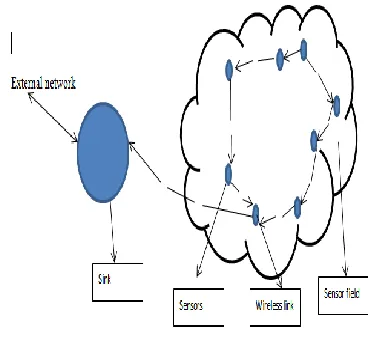
[image:1.612.350.534.231.402.2]Components of basic structure of wireless sensor networks are:
Figure 1.1 Basic Structure of WSN
i. Sensor: It is a converter which is used to measure physical conditions.
ii. Sensor work is sensing the data, processing and communicating.
iii. Sensor field: For sensing the data there will be particular area in that area sensor will sense the data which is called as sensor field.
iv. Sink node: Some time it is called as base station. It consists of more energy compare to sensor nodes.
1.1 Advantages of Scheduling
i. With the sleep/wake scheduling the sensors within the same cluster are densely deployed, the connectivity of the area covered by active sensors can be guaranteed. ii. If a source has no more traffic to send, the slot
International Journal of Emerging Technology and Advanced Engineering
Website: www.ijetae.com (ISSN 2250-2459, ISO 9001:2008 Certified Journal, Volume 7, Issue 7, July 2017)
321
iii. For continuous monitoring systems,synchronization-based sleep/wake scheduling schemes are often used because the traffic pattern is periodic.
iv. Energy consumption can be controlled when the sleep/wake scheduling is applied to the node of the network i.e. when a task has to be done only some of the nodes are assigned through a work message.
II. LITERATURE SURVEY
This chapter describes the work proposed by various authors, limitations of the existing system and proposed work of the system.
i. Guofang Nan et al., [3] have proposed a coverage-guaranteed distributed sleep/wake scheduling scheme. The main purpose of this approach is to prolonging the network lifetime while guaranteeing network coverage. Here in this approach the sensor nodes are divided into clusters based on sensing coverage metrics and allows more than one node in each cluster to keep active simultaneously via a dynamic node selection mechanism.
ii. Sha Liu et al., [4] have contributed in an energy efficient sleep scheduling protocol called BSMac for sensor networks while maintaining high throughput and low latency which is based on a new architecture called BoostNet in which the base station broadcasts critical scheduling coordination information using large transmission range to reach all sensor nodes in one hop. The main contribution of this paper in energy conserving scheduling approach that conserves energy during event occurrence and does not require any transmissions by the sensors during periods of inactivity and they have used in-band high transmission power from the base station for network parameters optimization without requiring the second transceiver on sensor nodes.
iii. Yan Wu et al., [5] have proposed an optimal sleep/wake scheduling algorithm, which satisfies a given message capture probability threshold with minimum energy consumption. In this approach is there is an inherent trade-off between energy consumption and message delivery performance. iv. Bo Jiang et al., [6] have proposed an energy-aware,
sleep scheduling algorithm called SSMTT to support multiple target tracking sensor networks. SSMTT leverages the awakening result of interfering targets to save the energy consumption on proactive wake-up communication.
2.1 Proposed Work
WSN is a kind of ad-hoc network which consists of scattered sensors to examine physical and logical situation which are of independent type. Low Energy Adaptive Clustering Hierarchy (LEACH) protocol and AODV are such protocols used to expand the life span of WSN by creating clusters in a major network. Sensor will sense the data and sensed data are aggregated. Then it will send the data through cluster heads. The problem is there is a possibility of selecting the less energy cluster node as a cluster head due to random selection of cluster head so a new method is introduced i.e. integrating Sleep/Awake Protocol. This protocol replace in the position of node which loses its power. Considering residual energy when sensor node energy is less than of threshold value, the lesser node is replaced with higher energy node, which increases the life span of whole network. In cluster there is a possibility of selecting low energy node as intermediate node for data transmission to send data to the sink so used replacement of low level energy node by higher energy node so, energy consumption can be minimized.
2.2 Objectives
The objective of this project is to create a random topology in which four clusters are formed and among the four clusters one cluster head is formed in each cluster. After creating cluster head, randomly energy is assigned to each node and to each node energy is assigned. Then Sleep/Awake protocol is integrated to improve the network performance.
Figure 2.1: Proposed work
III. REQUIREMENT SPECIFICATIONS
3.1 Functional requirements
i. System shall be able to design a topology with 100 nodes.
International Journal of Emerging Technology and Advanced Engineering
Website: www.ijetae.com (ISSN 2250-2459, ISO 9001:2008 Certified Journal, Volume 7, Issue 7, July 2017)
322
iii. System shall be able to form clusters.iv. System shall be able to identify the cluster heads. v. System shall be able to integrate Sleep/Awake
protocol.
Figure 3.1: Use case diagram for functional requirements
3.2 Non-Functional requirements
i. Performance is improved in terms of energy. ii. Performance is improved in terms of delay.
3.3 System requirement analysis
Software requirements
i. Tool-ns 2.35 ii. OS- Ubuntu
Hardware requirements
i. 2GB RAM
ii. Intel CORE processor
IV. METHODOLOGY
4.1 Low Energy Adaptive Clustering Hierarchy (LEACH)
One of the first and most popular clustering protocols proposed for WSNs was LEACH (Low Energy Adaptive Clustering Hierarchy). It is probably the first dynamic clustering protocol which addressed specifically the WSNs needs, using homogeneous stationary sensor nodes randomly deployed, and it still serves as the basis for other improved clustering protocols for WSNs. It’s an hierarchical, distributed, with main objectives (a) to improve the lifetime of WSNs by trying to evenly distribute the energy consumption among all the nodes of the network and (b) to reduce the energy consumption in the network nodes (by performing data aggregation and thus reducing the number of communication messages).
It forms clusters based on the received signal strength and also uses the CH nodes as routers to the Sink. LEACH forms clusters by using a distributed algorithm, where nodes make autonomous decisions without any centralized control. Initially a node decides to be a CH with a probability and broadcasts its decision. Specifically, after its election, each CH broadcasts an advertisement message to the other nodes and each one of the other (non-CH) nodes determines a cluster to belong to, by choosing the CH that can be reached using the least communication energy (based on the signal strength of each CH message).
Properties of LEACH include:
i. Cluster based
ii. Random cluster head selection each round with rotation. Or cluster head selection based on sensor having highest energy
iii. Cluster membership adaptive iv. Data aggregation at cluster head
v. Cluster head communicate directly with sink or user
4.2 Cluster Creation
The architecture of the sensor network in this protocol is based on a hierarchical grouping, where closer nodes form clusters and this is the second level process till the base station (sink) is accomplished. The below algorithm explains steps for creating clusters.
Algorithm: Creation of clusters
For every node n in network
for (i=1; i<n; i++)
if(x1(i)>=250 && $y1($i)<=250){
node(i) cluster1 }
if (($x1($i)>=250 && $y1($i)>=1) && ($x1($i)<=500
&&$y1($i)<=250)) {
node(i) cluster2 }
if { ($x1($i)>=1 && $y1($i)>=250) &&
($x1($i)<=250 && $y1($i)<=500)} {
node(i) cluster3 }
if { ($x1($i)>=250 && $y1($i)>=250) &&
($x1($i)<=500 && $y1($i)<=500)} {
International Journal of Emerging Technology and Advanced Engineering
Website: www.ijetae.com (ISSN 2250-2459, ISO 9001:2008 Certified Journal, Volume 7, Issue 7, July 2017)
323
4.3 Cluster-Head (CH) Selection
LEACH protocol includes the cluster head selection procedure. It makes residual energy of node as the main which decides whether these nodes turn into cluster head or not in the next round. In first round communication, every node has the same probability to turn into cluster head. Nodes are randomly selected as cluster heads, and then, the residual energy of each node is different after one round communication. We select four nodes with more residual energy as cluster heads in next round communication, and so on until all nodes are covered. LEACH protocol divides into many rounds, and each round contains cluster formation phase and cluster steady phase.
i. In cluster selection phase, each node decides whether to turn into cluster head or not by comparing with residual energy
ii. Some nodes with more residual energy turn into cluster heads and send cluster head information to inform other nodes. The other nodes with less residual energy turn into common nodes, and send information about joining cluster to a cluster head [9].
4.4 Sleep/Awake protocol
In sleep and wakeup approach, aims to increase the WSN lifetime by using reducing the energy consumption. The CH has selected based on energy efficiency and sink distance, subsequently the data packet transmission will takes place [10].
Algorithm, Sleep/Awake approach is explained below. Here the CH has been selected as a sensor node. The CH can create a path to Base-station (sink) then the Base station (sink) can send the message to CH. If the sensor nodes are in the path (path coverage >90%), then the particular sensor node becomes an active node. After that the data packet transmission will take place to base station. If the nodes are away from the path (path coverage<60%), then the particular sensor nodes becomes an inactive nodes (sleep nodes). Subsequently, the sleep node does not send the data packet to base station. After completing the data packet transmission, the sleep nodes preserve the sleep status message to CH, and then this process will repeated again, because of high-energy conservation.
Algorithm: The Sleep & Wakeup Technique
1. Node state cluster member
2. Distance & Energy for CH selection
3. if sensor node high energy & < Distance.
4. be static CH TRUE
5. else
6. static CH FALSE
7. end if
8. path creation CH to sink
9. if Ready to wake up sensor nodes path covered
> 90%
10. be wake up node = TRUE
12. Nodes in sleep mode sensor nodes path
covered < 60%
13. be sleep node = TRUE
14. if completed packet transmission
15. end if
16. end if
17. exit
V. RESULT ANALYSIS
5.1 Parameters selected for evaluation
For evaluation selected parameters are energy of the nodes and delay.
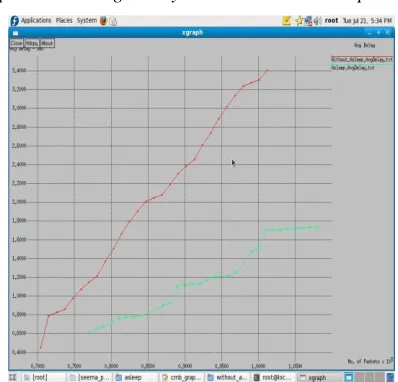
i. Energy: Energy is the most important parameter for node in WSN because of the small size of the nodes. This parameter affects the whole network so considered this parameter .In this discussion we analyzing how much energy it is consuming for transmission of packet and comparing the results of without integration of Sleep/Awake mechanism and after integration of Sleep/Awake mechanism.
International Journal of Emerging Technology and Advanced Engineering
Website: www.ijetae.com (ISSN 2250-2459, ISO 9001:2008 Certified Journal, Volume 7, Issue 7, July 2017)
324
[image:5.612.51.278.138.732.2]Data transmission
Figure 5.1: Data Transmission
[image:5.612.331.541.143.308.2]Coverage area in terms of hops
Figure 5.2: Coverage area in terms of hops
Status of nodes
Figure 5.3: Status of nodes
Comparison Energy consumption with and without Sleep/Awake
Figure 5.4: Energy consumption with and without Sleep/Awake
Comparison Average delay with and without Sleep/Awake
Figure 5.5: Average delay with and without Sleep/Awake
VI. CONCLUSION
[image:5.612.71.265.154.365.2] [image:5.612.343.542.336.527.2]International Journal of Emerging Technology and Advanced Engineering
Website: www.ijetae.com (ISSN 2250-2459, ISO 9001:2008 Certified Journal, Volume 7, Issue 7, July 2017)
325
REFERENCES[1] T. Shah, N. Javaid, T. N. Qureshi “ Energy Efficient Sleep Awake
Aware Intelligent Sensor Network Routing Protocol”
arXiv:1212.4106v1 [cs.NI] 17 Dec 2012.
[2] G. Smaragdakis, I. Matta, A. Bestavros, SEP: A Stable Election
Protocol for clustered heterogeneous wireless sensor networks, in: Second International Workshop on Sensor and Actor Network Protocols and Applications (SANPA 2004), 2004.
[3] Guofang Nan, Guanxiong Shi, Zhifei Mao and Minqiang Li
“CDSWS: coverage guaranteed distributed sleep/ wake scheduling for wireless sensor networks”, EURASIP
[4] Journal on Wireless Communications and Networking 2012
[5] Sha Liu, Kai-Wei Fan, Prasun Sinha “Dynamic Sleep Scheduling
using Online Experimentation for Wireless Sensor Networks”, 2005
[6] Yan Wu, Sonia Fahmy, Ness B. Shroff “Sleep/Wake Scheduling for
Multi-hop Sensor Networks: Non-convexity and Approximation Algorithm”, October 7, 2009
[7] Bo Jiang, Binoy Ravindran and Hyeonjoong Cho “Energy Efficient
Sleep Scheduling in Sensor Networks for Multiple Target Tracking”, 2009
[8] Muhammad Arshad, Mohamad Y. Aalsalem, Farhan A. Siddiqui
“ENERGY EFFICIENT CLUSTER HEAD SELECTION IN MOBILE WIRELESS SENSOR NETWORKS” Journal of Engineering Science and Technology Vol. 9, No. 6 (2014) 728 – 746
[9] Nikita Sehgal, Gurwinder Kaur “ Improved Cluster Head Selection
Using Enhanced LEACH Protocol” International Journal of Engineering and Innovative Technology (IJEIT) Volume 3, Issue 3, September 2013
[10] Sasikala V, C. Chandrasekar “ Cluster based Sleep/Wakeup
Scheduling Technique for WSN” International Journal of Computer Applications (0975 – 8887) Volume 72– No.8, May 2013
[11] Shunfu Jin, Wuyi Yue “Performance Analysis of Multi-Hop with
Sleep/Wakeup Protocol on Wireless Sensor Networks”
[12] Subhash Dhar Dwivedi, Praveen Kaushik “Energy Efficient Routing