International Journal of Emerging Technology and Advanced Engineering
Website: www.ijetae.com
(ISSN 2250-2459, ISO 9001:2008 Certified Journal
, Volume 6, Issue 3, March 2016)
282
Performance Analysis of Optical IDMA by using Different type
of Photodetectors
Jitendra Kumar
1, Devendra Kumar Tripathi
2, Kamal Prakash Pandey
3 1,2,3Department of Electronics and Communication Engineering, S.I.E.T. Allahabad, India.Abstract—This paper is concerned with comparative
performance analysis of the optical IDMA system with photo detectors. At this instant uncoded , coded optical IDMA systems bit error rate performance for PIN and APD photo detector, for the number of simultaneous users 40,50,60,70,80,90,100 and variation in data length have been explored . It showed good performance with Avalanche photo detector. It also inferred that performance relies upon number of simultaneous users, the spreading length. The IDMA system is an efficient solution of high data rate, less multiple access interference, cost is independent of number of user, high spectral efficiency and major contender for the upcoming communication technology.
Keywords— Optical CDMA [OCDMA]; Interleave
Division Multiple Access (IDMA); Multiple access interference (MAI); Band width (BW); Elementary signal estimator (ESEB) .
I. INTRODUCTION
Optical CDMA has been adopted in second and third generation cellular telephone networks. Optical CDMA possesses many attractive features such as dynamic channel sharing, mitigation of cross-cell interference, asynchronous transmission, ease of cell network planning, and robustness against fading. Optical CDMA system has the advantages as- the way it handles a finite band width (BW) among a large number of Users (more users can transmit the same data over the same bandwidth)[1-9]. The complexity and computational cost is the major problem of Optical CDMA [OCDMA] systems. Interleave Division Multiple Access (IDMA) scheme in which interleavers are employed as the only means of user separation. Interleave division multiple access (IDMA) essentially a low cost iterative soft cancellation technique. Recently, an newly evolved multiple access scheme known as interleave-division multiple-access (IDMA) scheme has demonstrated superior performance to Optical CDMA scheme. In IDMA scheme, the user-specific interleavers are referred as the only means of user separation. In addition to it, iterative chip by chip multiuser detection technique is also employed in the system for better performance.
In this paper, a novel optical multiple access technique has been introduced incorporating the merits of optical medium along with IDMA scheme named as optical interleave- division multiple-access technique (OIDMA). The biggest challenge with any multiple access system is to maintain the performance of the system and offer high bandwidth for higher number of users at minimum cost. Higher capacity optical networks are required to fulfill the growth of Internet services and new digitized schemes. In order to meet these requirements, Optical IDMA presents an attractive solution. Optical IDMA inherits the advantage of both optical system and IDMA technique, for instance flexibility of asynchronous and
decentralized networking, potentially secure and
uncongested high-rate data transmission, both high rate and low rate transmission achieved, reduces multiple access interference (MAI) and better BER[9-16].
In this view this paper proposes the performance evaluation of Optical IDMA system for its numerous key parameters. The paper has been bifurcated into four sections as: The Introduction section, theory of OIDMA
system, the tree based interleaver, results and discussion
subsequently the conclusion part.
II. THEORY OPTICAL IDMASYSTEM
International Journal of Emerging Technology and Advanced Engineering
Website: www.ijetae.com
(ISSN 2250-2459, ISO 9001:2008 Certified Journal
, Volume 6, Issue 3, March 2016)
283
Where, hk is the channel coefficient for user-k and {n
(j)} are samples of an AWGN
Process with zero mean and variance, σ 2 = N/2 .
Assuming, that the channel coefficient {hk} are known a
priori at the receiver.
The receiver consist of an elementary signal estimator (ESEB) and bank of k single user a posteriori probability (APP) signal decode SDECs, operating and iterative manner. The modulation technique is used for modulation is binary phase shift keying (BPSK) signaling.
The outputs of the PSE and DECs are extrinsic log-
likelihood ratios (LLRs) about { xk ( j )} defined below as;
e( (j)) = log For all k,
j………(2)
Those LLR s are further distinguished by subscripts, i.e.
( (j)) and ( (j)), depending on whether they
are generated by the PSE or DECs.
Due to the use of random interleaver {πk}, the PSE
operation can be carried out in a chip-by-chip manner, with only one sample r(j) used at a time.
So, rewriting to as –
r(j) = (j) +
(j),………..(3)
Where,
ξk ( j) = r( j) − hk xk ( j) = ∑ hk ' xk ' ( j) + n( j) ..…………
.
(4) k≠kξk (j) is the distortion including interference –plus-noise in r(j) with respect to user k.
A brief description of CBC algorithm [1] used in IDMA, has been presented in [3], the operation of ESEB and APP decoding are carry out user by user. The output of ESEB and extrinsic log likelihood ratios (LLRs) is given as
The LLR out of SDEC is given as:
Figure1. Optical IDMA Transmitter and Receiver Structure
2.1The Tree based Interlever
The Tree Based Interleaver (TBI) is basically aimed to optimize the problems of the computational complexity and memory requirement which occurs in MRI and RI respectively. In addition to it, TBI also targets on consumption of optimal bandwidth during communication process. In case of TBI generation mechanism, two randomly generated master interleavers Π1 and Π 2, are taken initially.
These interleavers are bound to have orthogonality between each other. The zero cross correlation between two randomly selected interleavers ensures the minimal cross
correlation between other generated user-specific
International Journal of Emerging Technology and Advanced Engineering
Website: www.ijetae.com
(ISSN 2250-2459, ISO 9001:2008 Certified Journal
, Volume 6, Issue 3, March 2016)
284
For obtaining the interleaving sequence of the 14th
user, the TBI mechanism needs only 2 cycles of clock, as compared to many more cycles needed in case of master random interleaver method.
( ( ))
As already stated, the mechanism of Tree Based user-specific interleaver generation is based on two master interleavers П1 and П2, which are randomly selected. User specific interleavers are designed using a combination of randomly selected master interleavers. The interleaver П1 is opted for upper branch while П2 is reserved for initiation for lower branch. Upper branch is selected for the case of odd user count while lower branch is selected with even user count. First user is allocated with interleaver П1 while the second user, is reserved with the interleaver П2. In case of third user, the user- specific interleaver is decided with П1 (П1) and for fourth user, the interleaving sequence will be П2 (П1).
Figure2. Tree Based Interleaving Scheme
III. RESULTS AND DISCUSSION
The performance evaluation for optical interleave-
division multiple-access technique with MATLAB
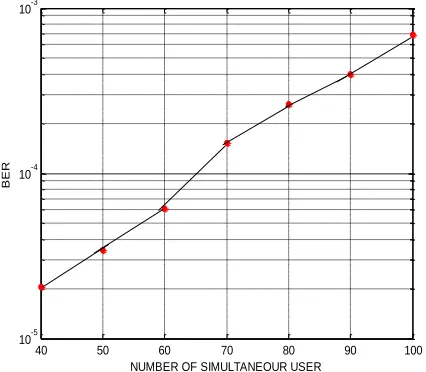
software is explored. Numerous results demonstrated in the figure3 to figure8 for the BER performance of optical IDMA scheme with different numbers of simultaneous users. During the simulation, the spreading length is chosen as 16, and the iterative number is set to be 10. The variation is user count has been opted as parameter of performance has been displayed in figures during performance comparison to uncoded IDMA system. For performance evaluation purpose, the input data for each user is assumed to be as 512, 1024, 2048 and 4096 bits. Optical fiber has been operated with 155nm wavelength with maximum bit rate of 1Gbps capability. The transmitted power is chosen to be 1mw. Whereas, the intensity dependent refractive index parameter is taken as
2.35*10-20. The responsively and efficiency is 0.65, 0.80
has been taken respectively. The input to optical fiber is a Gaussian pulse and ON-OFF keying (OOK) is used for pulse transmission. The simulations have been performed using various Interlevers.In demonstrated plot 3 to plot 6 BER performance of optical IDMA in optical channel with
different numbers of simultaneous users
(40,50,60,70,80,90,100) is shown. During the evaluation, the spreading length is choosen as 16,and the iterative number is set to be 10 and data length as 2048 .The
performance evaluation depicts the Avalanche
International Journal of Emerging Technology and Advanced Engineering
Website: www.ijetae.com
(ISSN 2250-2459, ISO 9001:2008 Certified Journal
, Volume 6, Issue 3, March 2016)
285
For Block Length = 512 And Various Number of Users
40 50 60 70 80 90 100
10-5 10-4 10-3
NUMBER OF SIMULTANEOUR USER
BER
Figure3: BER performance of uncoded Optical IDMA by using PIN Photodetector
40 50 60 70 80 90 100
10-6 10-5 10-4 10-3
NUMBER OF SIMULTANEOUR USER
[image:4.612.340.541.168.361.2]BER
Figure 4.BER performance of uncoded Optical IDMA by using Avalanche Photodetector
For Block Length = 1024 And Various Number Of Users
40 50 60 70 80 90 100
10-6 10-5 10-4 10-3
NUMBER OF SIMULTANEOUR USER
BER
Figure5. BER performance of uncoded Optical IDMA by using PIN photodetector
40 50 60 70 80 90 100
10-7 10-6 10-5 10-4 10-3
NUMBER OF SIMULTANEOUR USER
BER
[image:4.612.59.272.175.361.2]International Journal of Emerging Technology and Advanced Engineering
Website: www.ijetae.com
(ISSN 2250-2459, ISO 9001:2008 Certified Journal
, Volume 6, Issue 3, March 2016)
286
For Block Length = 2048 And Various Number Of Users
40 50 60 70 80 90 100
10-6 10-5 10-4 10-3
NUMBER OF SIMULTANEOUR USER
BER
Figure7.BER performance of uncoded Optical IDMA by using PIN Photodetector
40 50 60 70 80 90 100
10-8 10-7 10-6 10-5 10-4
NUMBER OF SIMULTANEOUR USER
BER
Figure8.BER performance of uncoded Optical IDMA by using AVALANCHE Photodetector
IV. CONCLUSION
The performance for optical IDMA uncoded and coded systems with different number of simultaneous users, different data length, PIN and APD has been evaluated successfully.
Results showed that Avalanche photodetector has better performance than PIN photo detector. It also inferred that OIDMA system provides less multiple access interference, cost effective and independent of number of users and efficient technology for the high data rate. It is one of strong contender for the future communication technology.
REFERENCES
[1] Govind P.Agrawal, ―Fiber-Optic Communications Systems‖, Third
Edition. John Wiley & Sons,INC.;New York,2002.
[2] D.K. Tripathi et.al, ―Design and performance analysis in multiuser
optical CDMA systems,‖OPTIK [ELSEIVER], vol.125 (17), Sept.2014, pp.4998-5001.
[3] G.Keiser,Optical Fiber Communications‖, (McGraw-Hill, 2000).
[4] T. S. Rappaport, ―Wireless Communications: Principles and
Practice,‖ 2nd. Englewood Cliffs, NJ: Prentice-Hall, 2002.
[5] Li Ping, Lihai Liu, Keying Wu, W. Leung,‖Interleave Division
Multiple Access‖IEEE Transactions On Wireless Communications, Vol. 5, No. 4, April 2006, pp. 938-947.
[6] J. G. Andrews, ―Interference cancellation for cellular systems: A
contemporary overview,‖ IEEE Trans. Wireless Commun., vol. 12, Apr. 2005, pp. 19–29.
[7] D. Tse and P. Viswanath, ―Fundamentals of Wireless
Communication,‖ Cambridge: Cambridge University Press, 2005.
[8] Pingzhi Fan, ―Multiple Access Technologies for Next Generation
Mobile Communications,‖ in Proc. 6th International Conference on ITS Telecommunications, 2006, pp. 10-11.
[9] D.K.Tripathi, Pallavi Singh, et.al. ―Study in F.O.C. Multiplexing
Techniques-A Review,‖ Journal of Electrical Engineering & Electronic Technology, vol. 3(1), 2014,pp1-23.
[10] Li Ping, Lihai Liu, Keying Wu, W. Leung, ―Interleave Division
Multiple Access,‖ IEEE Transactions on Wireless Communications, vol. 5, April 2006, pp. 938-947.
[11] I. Pupeza, A. Kavcic, and L. Ping, ―Efficient generation of
interleavers for IDMA,‖ in Proc. IEEE International Conference on Communications, ICC 2006, vol. 4, June 2006, pp. 1508-1513.
[12] H. Wu, L.Ping and A. Perotti, ―User-specific chip-level interleaver
design for IDMA System,‖ IEEE Electronics Letters, vol.42, Feb 2006.
[13] X. Wang and H. V. Poor, ―Iterative (turbo) soft interference
cancellation and decoding for coded CDMA,‖ IEEE Trans. Commun., vol. 47, July 1999, pp. 1046–1061.
[14] X. Wang, H. V. Poor, ―Iterative (turbo) soft interference
cancellation and decoding for coded CDMA,‖ IEEE Trans. Commun., vol. 47, July 1999, pp. 1046–1061.
[15] Basharat A., Khokhar, I.A., Murtaza, S., ―CDMA versus IDMA for
subscriber cell density,‖ in Proc. International Conference on Innovations in Information Technology, IIT 2008. 2008, pp. 520-524.
[16] Katsutoshi Kusume, Gerhard Bauch, Wolfgang Utschick, ―IDMA