International Journal of Emerging Technology and Advanced Engineering
Website: www.ijetae.com (ISSN 2250-2459, ISO 9001:2008 Certified Journal, Volume 5, Issue 2, February 2015)
357
Forecasting Cascading Failures in Power Grids Using
Cascading Method
Gulshan Bhatia
1, Rashmi Khemani
2, Neelima Nebhani
3, Prof. Gresha Bhatia
41,2,3B.E. Computers, Department of Computer Engineering, VESIT,Mumbai.
3
Deputy HOD, Computer Engineering Department, VESIT, Mumbai. Abstract— Power grid being a paramount system of all, has
increased the need for more reliable and resilient system. Power grid has resulted in many outages lately that brought the entire industrial and domestic functionality round the globe to a stand-still. We have proposed a system that will provide look-ahead analysis of existing system. Providing a web based user interface, our system enables multi-level abstraction. The input from various parameters within the network of nodes is given to prediction model which in turn draws indications of foreseeable cascading failures. Prediction model makes use of Hybrid ARIMA-ANN model which is proved to be efficient in predicting results as compared to other existing system that implements each algorithm alone. Real time input including current, voltage, frequencies, power grid topology etc. is subjected to Hybrid model which provide, using MATLAB, statistical graph and predicted values. Thus “to predict cascading failures we have used cascading method”. This system can be deployed in existing power grid to implement process like restoration, isolation of nodes to avoid outages.
Keywords — Prediction, cascading failures, power grid, ARIMA, ANN, classification.
I. INTRODUCTION
Power systems are inevitable. With the rapid development of national economy, the power system has gradually developed into a super-large-scale system. They provide electricity to billions of individuals around the globe. Because the social structures in most countries rely on power systems, massive disruption occurs when the power grids fail to deliver energy to the consumers – transportation systems come to a halt, heating and cooling systems stop, computer systems shut down, and vital services like water and communications quickly degrade [1].
A power grid is a complex system connecting a variety of electric power generators to customers through power transmission and distribution networks across a large geographical area.
Smart grids are next generation electricity grids in which the power network and the communication network work in symphony.
In smart power grid, power grid and communication network are connected and mutually dependent. A tiny failure in either of them could trigger cascade of failures within the entire system.
The flow of electricity in the power grid is governed by the laws of physics and there are no strict capacity bounds on the lines. Instead, there is a rating threshold associated with each line, such that when the low through a line exceeds the threshold, the line heats up and eventually faults. Such an outage in turn, causes another change in the power grid, which can eventually lead to a cascading failure [2].
Recently, people all over the world suffered many outages due to cascading failures. For example, on November 1, 2014, Bangladesh suffered nationwide power outage for almost 10 hours, on Friday 21 November, 2014, South Africa experienced rolling blackouts which were implemented nationwide, and continued for the duration of the weekend. [3]
Till now, researchers have put considerable efforts in deriving models for cascading failures in power grids, with the ultimate goal of designing a reliable power-outage management system and for converting the present power grids into robust smart grids. However, detailed models of cascading failure blackouts are intractable since power grids are among the largest and most complex artificial systems. Moreover, blackouts are particularly complex phenomena as they are consequence of large number of internal and external interacting factors.
On the basis of analyzing the occurrence of cascading failures and eventually, blackouts, we propose a method which can predict subsequent failures. We use Auto-regressive Integrated Moving Average (ARIMA), which is one of the popular linear models in time series forecasting during the past three decades, after which we use Artificial Neural Networks (ANN) as a classification tool for detecting cascading failures from the predicted values.
International Journal of Emerging Technology and Advanced Engineering
Website: www.ijetae.com (ISSN 2250-2459, ISO 9001:2008 Certified Journal, Volume 5, Issue 2, February 2015)
358 The main theoretical concepts of the ARIMA model and ANN are described in section IV and V respectively. Finally, the hybrid model is explained in section VI. In section VII, we propose a further scope of the cascading failure prediction system.
II. INDIAN POWER GRID SCENARIO
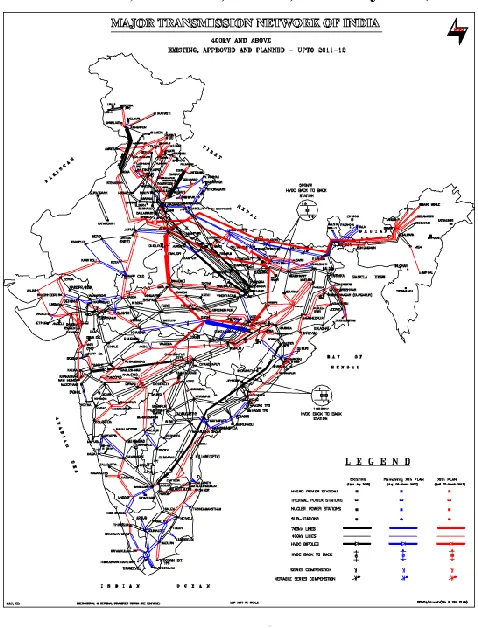
Indian power grids are maintained and looked after by the Power Grid Corporation of India. In India, the regional grids situated in northern, southern, eastern, western and south eastern parts were connected together to bring up a 'ONE NATION'-'ONE GRID'-'ONE FREQUENCY' policy. Power Grid Corporation of India Ltd., takes continuous action regarding operation and maintenance to ensure compliance with prescribed standards as well as to achieve high availability of the system for uninterrupted power supply to customers [4].
[image:2.612.329.568.128.442.2]A cascading failure is a failure in a system of interconnected nodes, in which the failure of one node can trigger the failure of subsequent dependent nodes, similar to a domino effect, causing a large-scale blackout. The characteristic feature of cascading failure is that a series of failures weakens the system and makes further failures increasingly more likely as the failures become widespread [5].
Figure 1: Indian power grid map
International Journal of Emerging Technology and Advanced Engineering
Website: www.ijetae.com (ISSN 2250-2459, ISO 9001:2008 Certified Journal, Volume 5, Issue 2, February 2015)
359 Some of the major outages occurred in India due to cascading failures are described: On January 2, 2012, a fault in the transmission system in the state of Uttar Pradesh led to cascading failure throughout northern India. On July 30, 2012, due to a massive breakdown in the northern grid, there was a major power failure which affected seven north Indian states, including Delhi, Punjab, Haryana, Himachal Pradesh, Uttar Pradesh, Jammu and Kashmir, and Rajasthan. On July 31, the July 2012 India blackout, which is being called the biggest ever power failure in the world, left half of India without electricity supply [3].
Monitoring the operation of a power system in real-time and disconnection of suspected parts can help prevent a cascade. Another technique is to have pre-hand information of the occurrence of a cascading failure which is proposed further in this paper. Moreover, various load shedding strategies are also used for preventing cascading failures [6].
III. PROPOSED SYSTEM
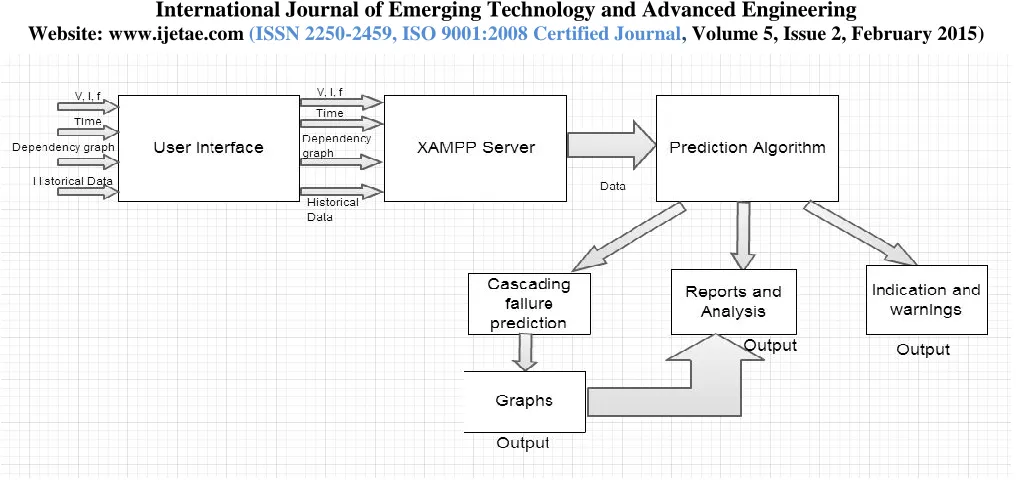
Power systems play a very important role in the society. Because of the demerits of the existing systems, there is a need to propose a model which is able to predict the occurrence of cascading failure in future and thereby preventing the blackouts. Cascading failure in a system of interconnected parts in which the failure of a part can trigger the failure of successive parts [7].Massive blackouts have occurred in the past since the existing system lacks real-time control ability, e.g., the very recent huge blackout happened in August, 2014, affected 2-3lakh people in southern parts of Mumbai in India [8]. Our proposed model is a system that addresses the real time data.
The weight of each node is stored and the weight distribution is based on the topology of the network. When a node is switched off, its weight gets distributed among the other nodes which subsequently may lead to cascading failures. In this model, system parameters such as voltage, current, network topology, date and time are taken into consideration. Some noticeable deviations that could potentially weaken the systems, such as high electricity demands, heavy power flows, depressed voltages, and frequency variations, etc, could be observed using the model. Based on the observations, an analysis whether a any fault on the power line that may cause the power stations to trip.
International Journal of Emerging Technology and Advanced Engineering
Website: www.ijetae.com (ISSN 2250-2459, ISO 9001:2008 Certified Journal, Volume 5, Issue 2, February 2015)
[image:4.612.53.561.107.347.2]360
Figure 2: Block diagram for the proposed system
IV. ARIMA
Time series forecasting is an important area of forecasting in which past observations of the same variable are collected and analyzed to develop model describing the underlying relationship. One of the most important and widely used time series models is the auto-regressive integrated moving average (ARIMA) model [9]. The ARIMA model is representative of linear models and has achieved great popularity since the publication of Box Jenkins’ classic book: Time-Series Analysis: Forecasting and Control (Box and Jenkins, 1976; Zhang, 2001). The data can be collected yearly, monthly, quarterly, weekly or even daily. Data can contain any one parameter like current, voltage or power is measured.
ARIMA prediction can be carried out using a three-step process explained as follows:
A.Identification stage
In this stage, we specify the response series and identify the ARIMA model for it. Input time series is read, differencing is performed if time series is not stationary. We also compute autocorrelations, inverse autocorrelations,
partial autocorrelations and cross correlations.
Identification stage usually suggests more than one ARIMA models that could be fit.
B.Estimation stage
In estimation stage, we specify the ARIMA model to fit to the time series read in identification stage and to estimate the parameters of that model.
These parameters are estimated for comparing suggested models for goodness-of-fit. This stage also produces diagnostic statistics to help us judge the adequacy of the model. If these diagnostic tests indicate problems with the model, we try another model and repeat the estimation stage.
C.Forecasting stage
In forecast stage, future values of time series are forecasted and confidence intervals are generated for the forecasts from the ARIMA model produced by estimate stage. [10]
The main advantage of ARIMA forecasting is that it only requires data of the time series in question. This avoids occurrence of any problem that arises due to any multivariate models. ARIMA models are quite flexible in that they represent several types of time series [9].
V. ANN
The basic building block of a (artificial) neural network (ANN) is the neuron. ANN resembles the brain network. A neuron is a processing unit which have some (usually more than one) inputs and only one output. Roughly speaking, a neuron in an ANN is:
1. A set of input values (xi) and associated weights (wi) 2. A function (g) that sums the weights and maps the
International Journal of Emerging Technology and Advanced Engineering
Website: www.ijetae.com (ISSN 2250-2459, ISO 9001:2008 Certified Journal, Volume 5, Issue 2, February 2015)
361 We use a classification model using ANN for detecting cascading failures in a given set of load data. Classification model classifies each set of data into a particular class having similar properties. ANN can learn patterns in data by mimicking the structure and learning process of neurons in the brain.
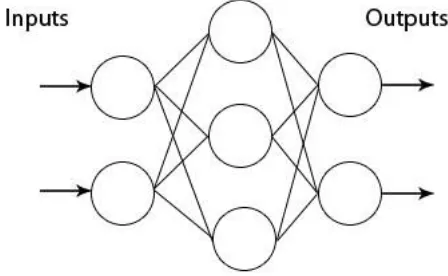
[image:5.612.56.280.256.394.2]The standard ANN architecture has three layers: an input layer where features are fed in, an output layer with one neuron per class, and a hidden layer of neurons.
Figure 3: The standard ANN architecture
The inputs to the neuron are summed to give a single value, x. This is then input to the function, and the output of the neuron is the output of the function, f(x). There are a certain weights assigned to the neuron inputs. A feature can have a large or small weight, varying the contribution it makes to the sum in any neuron. In fact, a feature can have a large weight feeding into one neuron and an almost zero weight feeding into another, meaning it has a strong influence on the first and practically none on the second.[12]
A training iteration, or epoch, is when the network has been shown every sample of training data one time. Training continues over multiple iterations, until the weights reach a steady state value, or a maximum number of iterations are reached. ANN models provide a high degree of accuracy as they are said to be universal approximators.
Initially, random weights are assigned to the neurons and output is generated. It is then compared with the actual output and error is determined. If the error is too large and undesirable, a feedback is provided and the weights are adjusted accordingly. This is known as back propagation and is a method used to train ANNs.
In our case, there is only one neuron in the output layer for detecting whether a cascading failure is possible or not.
Hidden layers are decided on the basis of trial and error till accuracy is reached.
VI. THE ARIMA-ANNHYBRID
ARIMA model is the most important and widely used model for forecasting. ANNs are well known for non linear modeling capability. Hence, by using the unique properties of each of them, we propose a hybrid ARIMA-ANN model for predicting cascading failures in near-future. This hybrid model will help in improving forecasting accuracy.
For developing a hybrid model, we consider a time series as input to ARIMA. These time series will contain load information on monthly, weekly or hourly basis. ARIMA will efficiently predict the future load for the time series using the 3-stage method i.e.,
1. Identification stage
2. Estimation stage
3. Forecasting stage
These predicted values will then be given as input to ANN classifier which will detect the occurrence of cascading failures using method explained in section V. Hence, the hybrid model will look something like:
ARIMA-ANN hybrid = ARIMA prediction + ANN classification
VII. FUTURE WORK
Proposed ARIMA Model successfully predicted load consumption that the Power grid in focus will experience which can enhance strategic planning and maintaining power grid functioning. Interconnected nodes that may in near future result in blackout rendering a great economic loss can be thus prevented. The graphs and indications thus generated will be very useful in Analysis of faults that can result into severe outages. Only predicting the occurrence of cascading is not sufficient to prevent an outage, the results thus generated must be conveyed to utility authorities that can take necessary preventive measures to stop could be occurring blackout. We have used email to inform relevant staff. Our system can further use variant ICT tools to spread the warning thus generated.
International Journal of Emerging Technology and Advanced Engineering
Website: www.ijetae.com (ISSN 2250-2459, ISO 9001:2008 Certified Journal, Volume 5, Issue 2, February 2015)
362 Our system provides report of such nodes that can be further analyzed and used to prevent an outage. Feedbacks can be recorded from experts and thus training can be improved using ANN to implement dynamic redistribution to the grid.
REFERENCES
[1] Paul Hines, Karthikeyan Balasubramaniam, and Eduardo Cotilla Sanchez, “Cascading failures in power grids”, 0278-6648/09/$26.00 © 2009 IEEE
[2] Andrey Bernstein, Daniel Beinstock, David Hay, Meric Uzungolu, and Gil Zussman, “Sensitivity Analysis of the Power Grid Vulnerability to Large Scale Cascading Failures”, Performance Evaluation Review, Vol. 40, No. 3, December 2012
[3] http://en.wikipedia.org/wiki/List_of_major_power_outages [4] Power Grid Corporation of India, www.powergridindia.com [5] Yajun RONG, Yuan GONG, “A Research on the Method of Power
System Cascading Failure Forecasting”, Journal of Computational Information Systems, 7: 7 (2011) 2259-2266
[6] S. Pahwa, C. Scoglio, S. Das, N. Schulz, “Load shedding strategies for preventing cascading failures in power grid”, Electrical and Computer Engineering Department, Kansas State University, Manhattan, KS 66506-5204, USA
[7] http://en.wikipedia.org/wiki/Cascading_failure
[8] “Going over the dark side.” Times Of India 2nd September. 2014.
[9] G. Peter Zhang, “Time series forecasting using a hybrid ARIMA and neural network model”, Department of Management, J. Mack Robinson College of Business, Georgia State University, University Plaza, Atlanta, GA 30303, USA.
[10] The ARIMA Procedure, Chapter 7, SAS OnlineDoc : Version 8. [11] Roman Dudko, Abhishek Sharma, Jon Tedesco, “Effective Failure
Prediction in Hadoop Clusters”, Department of Computer Science, University of Illinois at Urbana-Champaign, Urbana, IL 61801. [12]
http://cowlet.org/2014/01/12/understanding-data-science-classification-with-neural-networks-in-r.html
[13] Fadi Aloula, A. R. Al-Alia , Rami Al-Dalkya, Mamoun Al-Mardinia Wassim El-Hajjb,”Smart Grid Security: Threats, Vulnerabilities and Solutions”.
[14] Alexander Gutfraind, “Optimizing Network Topology for Cascade Resilience “, M.T. Thai and P.M. Pardalos (eds.), Handbook of Optimization in Complex Networks: Communication and Social Networks, Springer Optimization and Its Applications 58, DOI 10.1007/978-1-4614-0857-4 2, © Springer Science+Business Media, LLC 2012.
[15] Andrey Bernstein, Daniel Beinstock, David Hay, Meric Uzungolu, and Gil Zussman, “Sensitivity Analysis of the Power Grid Vulnerability to Large Scale Cascading Failures”, Performance Evaluation Review, Vol. 40, No. 3.
[16] Mahshid Rahnamay-Naeini, Zhuoyao Wang, Andrea Mammoli and Majeed M. Hayat, “A Probabilistic Model for the Dynamics of Cascading Failures and Blackouts in Power Grids”, 978-1-4673-2729-9/12/$31.00 ©2012 IEEE
[17] Chris Chatfield, ” Time-Series Forecasting”, © 2000 by Chapman & Hall/CRC
[18] A.S.Weigend, N.A. Gershenfeld, Time Series Prediction, Addison-Wesley, Reading, MA, 1994.
[19] Xuqing Huang, Irena Vodenska, Shlomo Havlin & H. Eugene Stanley, “Cascading Failures in Bi-partite Graphs: Model for Systemic Risk Propagation”, SCIENTIFIC REPORTS | 3 : 1219 | DOI: 10.1038/srep01219 .
[20] Wei Zhang, Wei Pei , Tiande Guo, “An efficient method of robustness analysis for power grid under cascading failure”, www.elsevier.com/locate/ssci, Safety Science 64 (2014) 121–126. [21] G. Peter Zhang, “Time series forecasting using a hybrid ARIMA and
neural network model”, Department of Management, J. Mack Robinson College of Business, Georgia State University, University Plaza, Atlanta, GA 30303, USA.
[22] Paul D. H. Hines, Ian Dobson, Eduardo Cotilla-Sanchez, Margaret Eppstein, “Dual Graph” and “Random Chemistry” methods for Cascading Failure Analysis.
[23] Ian Dobson, “ANALYSIS OF CASCADING INFRASTRUCTURE FAILURES”, University of Wisconsin-Madison, Madison, Wisconsin.
[24] Pablo A. Parrilo, Sanjay Lall, Fernando Paganiniy, George C. Verghesez, Bernard C. Lesieutrez , Jerrold E. Marsden, “Model reduction for analysis of cascading failures in power systems”. [25] “Vulnerability Assessment for Cascading Failures in Electric Power