approach for the analysis of metabolomics
and spectroscopic data: application to the
rapid detection of Bacillus spores and
identification of Bacillus species
Correa, E and Goodacre, R
http://dx.doi.org/10.1186/147121051233
Title
A genetic algorithmBayesian network approach for the analysis of
metabolomics and spectroscopic data: application to the rapid detection of
Bacillus spores and identification of Bacillus species
Authors
Correa, E and Goodacre, R
Type
Article
URL
This version is available at: http://usir.salford.ac.uk/41380/
Published Date
2011
USIR is a digital collection of the research output of the University of Salford. Where copyright
permits, full text material held in the repository is made freely available online and can be read,
downloaded and copied for noncommercial private study or research purposes. Please check the
manuscript for any further copyright restrictions.
For more information, including our policy and submission procedure, please
M E T H O D O L O G Y A R T I C L E
Open Access
A genetic algorithm-Bayesian network approach
for the analysis of metabolomics and
spectroscopic data: application to the rapid
identification of Bacillus spores and classification
of Bacillus species
Elon Correa
1, Royston Goodacre
1,2*Abstract
Background:The rapid identification ofBacillusspores and bacterial identification are paramount because of their implications in food poisoning, pathogenesis and their use as potential biowarfare agents. Many automated analytical techniques such as Curie-point pyrolysis mass spectrometry (Py-MS) have been used to identify bacterial spores giving use to large amounts of analytical data. This high number of features makes interpretation of the data extremely difficult We analysed Py-MS data from 36 different strains of aerobic endospore-forming bacteria encompassing seven different species. These bacteria were grown axenically on nutrient agar and vegetative biomass and spores were analyzed by Curie-point Py-MS.
Results:We develop a novel genetic algorithm-Bayesian network algorithm that accurately identifies sand selects a small subset of key relevant mass spectra (biomarkers) to be further analysed. Once identified, this subset of relevant biomarkers was then used to identifyBacillusspores successfully and to identifyBacillus species via a Bayesian network model specifically built for this reduced set of features.
Conclusions:This final compact Bayesian network classification model is parsimonious, computationally fast to run and its graphical visualization allows easy interpretation of the probabilistic relationships among selected
biomarkers. In addition, we compare the features selected by the genetic algorithm-Bayesian network approach with the features selected by partial least squares-discriminant analysis (PLS-DA). The classification accuracy results show that the set of features selected by the GA-BN is far superior to PLS-DA.
Background
Bacillus and Clostridiumspecies can adapt to rapidly
changing environments and starvation by developing spores. An endospore is a dormant non-reproductive structure produced by these Gram-positive bacteria and is a survival mechanism adapted to spending a long per-iod of time in hostile conditions. The sporulation
pro-cess in Bacillusspecies causes singular molecular and
cellular changes in the cell which are not seen in the vegetative state [1]. One of these changes is the
biosynthesis of calcium dipicolinate, which is found in sporulated cells but not in the vegetative ones.
Members of the genusBacillus are widely distributed
in the environment and because their spores are so resistant their control is of considerable importance in the food manufacture [2]. Some of these bacteria are
pathogenic including B. cereusand B. subtilis which
cause food poisoning. The most notorious member of
this genus is B. anthracis, which is the causal agent of
anthrax, and the rapid identification of spores and bac-terial identification are paramount because of its impor-tance as a potential biological warfare agent [3] and in bioterrorism [4]. Thus there is a need to have a generic
* Correspondence: [email protected] 1
School of Chemistry, The University of Manchester, 131 Princess Street, Manchester, M1 7ND, UK
Full list of author information is available at the end of the article
characterisation method that allows rapid identification of spores and typing of bacteria.
Many automated analytical techniques such as Raman spectroscopy [5], liquid and gas chromatography [6,7] and Curie-point pyrolysis mass spectrometry (Py-MS) [8-10] have been used to identify bacterial spores. All of these methods rely on chemometric analyses of the data and the question arises as to how robust these mathe-matical models are. However, the vast majority of
mod-elling approaches are considered“black boxes” as they
do not readily allow the specific association between input analytical data and output classification to be revealed.
These types of data analysis involve a large number of features to be analysed, such as several mass spectra. This high number of features makes interpretation of the data extremely difficult Therefore, we start our data analysis by reducing data dimensionality. This data reduction step selects a small subset of key relevant masses to be further analysed and discards the less important ones. This feature selection procedure uses Bayesian network learning methods coupled with genetic algorithms to identify bacterial spores and clas-sifyBacillusspecies.
A Bayesian network (BN) is basically a graphical model of a probability distribution over a set of variables of a given problem domain [11,12]. This graphical model provides a compact and intuitive representation of the relationships among variables of a given problem domain. Nodes on the graph represent variables from
the problem (e.g.,m/zintensities) and an arrow linking
two nodes indicates a statistical correlation between them. This statistical correlation falls broadly into one
of the two categories: (a) “positive correlation”indicates
that the values of both variables increase or decrease
together, and (b)“negative correlation” indicates that as
one variable increases, the other decreases, orvice versa.
The network structure of a BN encodes probabilistic dependencies among domain variables and a joint prob-ability distribution quantities the strength of these dependencies [13]. The resulting graphical model or network has two main uses. (1) Visualization of prob-abilistic relationships: the graphical model provides direct and accurate information about the underlying
interactions among variables of interest, m/zintensities
in our case, and (2) Inference: the Bayesian network is intrinsically an inference model and can be used to pre-dict outputs or to classify new samples.
We use statistical and data mining algorithms to iden-tify Bacillusspores automatically from their Curie-point pyrolysis mass spectrometry data. This process extends the data mining analysis to a two step hierarchical-based classification that further identifies the bacilli into one of their respective species. First, the data dimensionality
is reduced by a feature selection process using genetic algorithms (GA) and BNs in parallel. Subsequently, once that the relevant variables are identified, a classification model using only BN is built based on the reduced data set, and this process undergoes full validation. Next a statistical analysis of the interactions among variables and classes and variables and variables is performed using the built Bayesian network model. As this
com-bined process identifies probabilisticbiomarkers in the
data set it is possible to develop predictive, testable models that allow inference of biological properties of the bacilli. The computer code for the GA-BN algorithm developed on this work was written in R programming language [14] ver. 2.9.2 and is freely available, together
with theBacillusdata set, on request to the
correspond-ing author.
Methods
TheBacillusdata set
The work uses theBacillusPy-MS data set reported in
[8] and described as an additional file (see Additional file 1). Unlike most data sets which concentrate on a
single or only a handful of Bacillusspecies, this data set
investigates 36 different strains of aerobic endospore-forming bacteria encompassing seven different species:
Bacillus amyloliquefaciens, Bacillus cereus, Bacillus licheniformis, Bacillus megaterium, Bacillus subtilis (including Bacillus niger and Bacillus globigii), Bacillus sphaericus, and Brevibacillus laterosporus. These bac-teria were grown axenically on nutrient agar as detailed in [8,15] and vegetative biomass and spores were ana-lyzed in triplicates by Curie-point Py-MS. The data set
contains 216 Bacillus samples; 108 are vegetative and
108 are sporulated. For a more detailed explanation of this data set see [8]. A phylogenetic tree of the type
strains of theBacillusspecies studied in this paper can
be found in [16].
Data analysis
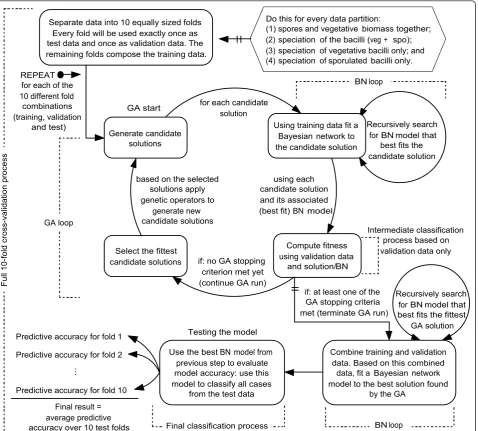
The overall work flow for the data analysis is shown in Figure 1 and involved a two stage process. The input data sets for the data analysis contained the full Py-MS
spectra, 150 m/zintensities. The data were normalised
as a percentage of the total ion count to remove the
influence of sample sizeper se.
Stage 1 employed a genetic algorithm for feature
selection with classification of (a) either spores versus
searches for an optimal feature subset tailored to a particular algorithm, such as a Bayesian network. For more information on wrapper and other feature selec-tion approaches see [17].
Stage 2involved the fitting of a new Bayesian network model to the best GA solution found on the previous stage. The built BN model is then used to determine
probabilistic relationships between the m/z intensities
selected by the GA and the classification (sporulation status or speciation). This two step process and model validation are detailed below.
Genetic algorithms (GAs)
A GA is an optimization procedure that evolves a popu-lation of candidate solutions to solve an objective func-tion [18]. A GA repeatedly applies operators based on natural selection and genetic recombination to the can-didate solutions. In a standard GA the initial solutions are randomly generated using a uniform distribution. The candidate solutions are called chromosomes. The chromosomes are usually represented by fixed-length strings over a finite alphabet. The term fitness is used to describe the quality of a candidate solution. The fitness
Testing the model
...
Predictive accuracy for fold 10
Intermediate classification process based on validation data only
Recursively search for BN model that best fits the fittest
GA solution
Final result = average predictive accuracy over 10 test folds
if: at least one of the GA stopping criteria met (terminate GA run) GA start
based on the selected solutions apply genetic operators to
generate new candidate solutions
if: no GA stopping criterion met yet (continue GA run)
using each candidate solution and its associated (best fit) BN model
Recursively search for BN model that
best fits the candidate solution for each candidate
solution
Compute fitness using validation data
and solution/BN Select the fittest
candidate solutions
Using training data fit a Bayesian network to the candidate solution
Combine training and validation data. Based on this combined data, fit a Bayesian network model to the best solution found
by the GA Use the best BN model from
previous step to evaluate model accuracy: use this model to classify all cases
from the test data
BN loop
Final classification process BN loop
GA loop
Full
10-fold cross-validation process
Separate data into 10 equally sized folds Every fold will be used exactly once as test data and once as validation data. The remaining folds compose the training data.
Predictive accuracy for fold 1
Generate candidate solutions
Predictive accuracy for fold 2
Do this for every data partition:
(1) spores and vegetative biomass together; (2) speciation of the bacilli (veg + spo); (3) speciation of vegetative bacilli only; and (4) speciation of sporulated bacilli only.
for each of the 10 different fold combinations (training, validation
[image:4.595.62.541.89.520.2]and test) REPEAT
is a measurement of how well the chromosome solves the objective function. The fitness associated with a chromosome is used to select probabilistically which chromosomes from the population will recombine and possibly generate new solutions. A genetic operator called crossover is applied to create two new chromo-somes (progeny) from a pair of selected chromochromo-somes called parents. The crossover consists of swapping ran-dom subsets of the genetic material from both parents. Because of the selective pressure applied on the popula-tion through a number of generapopula-tions, the overall trend is towards higher-fitness chromosomes. Mutations are used to help preserve diversity in the population by introducing random changes into the chromosomes. Both crossover and mutation are usually applied with user-defined probabilities, and in general, the probability of crossover is much larger than the probability of mutation. For more details on genetic algorithms see [19-21]. The design of our genetic algorithm is as fol-lows. We employed a binary chromosome with 150 bits,
one for eachm/z variable. A gene value of 1 indicates
that the corresponding m/z variable is selected and a value of 0 indicates that it is not selected. A population size of 200 candidate solutions was used, with a cross-over and mutation probabilities of 0.75 and 0.033, respectively. During the test phase of the GA these para-meters generated the best results; but we make no claim that they are optimal parameter values. Setting the para-meters of a GA is not a trivial task and GA parameter optimization is a topic for future investigation. The objective function that we employed was to maximize classification accuracy. The fitness of a candidate solu-tion was assessed as the classificasolu-tion accuracy, on a validation set, achieved by the BN model built for the candidate solution being assessed. As each candidate
solution represents a different subset of features (m/z
intensities), the BN model built for a particular solution is a classification model based solely on the features pre-sent on that solution, e.i., the features that correspond to the genes whose value is equal to 1 inside the chro-mosome, Figure 1. The stopping criteria used were: (1) maximum of 200 generations are performed on a single GA run, (2) a solution whose classification model (BN) produces 100% of predictive accuracy is found, or (3) when all the 200 solutions in the population converge to a single solution.
Bayesian networks (BNs)
A BN is a graphical map of the probabilistic relation-ships among variables of a given problem domain [22]. The graphical representation of a BN is a directed
acyc-lic graph. A directed acycacyc-lic graphGis an ordered pair
G=(V; E) where V is a set whose elements are called
vertices or nodes and E is a set whose elements are
called directed edges, arcs, or arrows. The graphG
con-tains no directed cycles; for any vertexυÎV, there is no
directed path that starts and ends on υ. An example of
a Bayesian network is as follows. This is a modified
ver-sion of the so-called “Asia”problem found in [23].
Sup-pose that a doctor is treating a patient who has been suffering from shortness of breath, called dyspnoea. The doctor knows that diseases such as tuberculosis, bron-chitis and lung cancer are possible causes of this. The doctor also knows that other relevant information includes whether the patient is a smoker, which increases the chances of lung cancer and bronchitis, and what sort of air pollution the patient has been exposed to. A positive X-ray would indicate either tuberculosis or lung cancer. The set of variables for this problem and their possible values are shown in an additional file (see Additional file 2) together with a Bayesian network representing this problem. The network structure, also known as network topology, shows how variables
corre-late to each other. More formally, let X= {X1,X2,..., Xn}
be a multivariate random variable whose componentsXi
are also random variables. A corresponding lower-case
letter xidenotes an assignment of state or value to the
random variable. Xi Parents (Xi) represents the set of
nodes that have a directed edge pointing toXi.
Consider a BN containing n nodes, X1 toXn, taken
in that order. A particular value of X = {X1,X2,..., Xn}
in the joint probability distribution is represented by
p(X) =p(X1 =x1, X2 =x2, ..., Xn =xn), or more
com-pactly,p(x1, x2, ...,xn). The chain rule of probability
the-ory allows the factorization of joint probabilities, therefore:
p p x p x x p x x x
p x x x
n n
i i
i
( ) ( ) ( | )... ( | ,..., ) ( | ,..., )
X
1 2 11 1 .. 1 1 (1)As the structure of a BN implies that the value of a particular node is conditional only on the values of its parent nodes, Equation 1 is reduced to:
p p Xi Parents Xi
i
( )X
( | ( )). (2)Learning the structure of a BN is an NP-hard problem [24,25]. Many algorithms developed to this end use a scoring metric and a search procedure. The scoring
metric evaluates the“goodness-of-fit” of a structure to
algorithm adds to the current network the edge that most increases the score of the new resulting network. The search stops when no other edge addition improves the score of the network. Additional file 3 shows the pseudocode of a generic greedy search algorithm for learning Bayesian network structures. In this paper, we use an unconventional scoring metric to evaluate the
goodness-of-fit” (score) of a network structure to the
data. The scoring metric adopted is specific to our clas-sification task and is computed as follows. The entire data set is divided into mutually exclusive training and
test sets, see “Model validation” for more details. The
training set is further divided into two mutually exclu-sive parts - training and validation sets. The first part (training set) is used to compute the probabilities for the Bayesian network. The second part is used as the validation set. During the search for the best possible network structure only the validation set is used to compute predictive accuracy and the measurement (quality) of the predictive accuracy achieved is used as the scoring metric for the Bayesian network model pro-posed. The higher the predictive accuracy value, the bet-ter the BN model fits the data. Once the best GA solution is found, at the end of the GA run, the valida-tion set and the training set are merged and this merged data (i.e., the entire original training set) is used to com-pute the probabilities for a new BN fitting to this data. Using this newly built BN model the predicted accuracy, for that combination of folds, is then computed on the previously untouched test set. The results reported in this paper are the average predictive accuracy over 10 entirely distinct test folds.
To summarize, the Bayesian network is used both in parallel to the GA and sequentially after each complete
GA run is performed as shown in Figure 1. First, the
parallel GA-BN usage. For each new GA solution the
following procedure is repeated. Solution Sk is
gener-ated. A Bayesian network modelBkis built based only
on the features (m/z variables) that are selected inSk
and using the training set to compute probabilities. The
model Bk is then used to predict the samples on the
validation set and the predictive accuracy produced by
Bk becomes the fitness value of solutionSk, i.e., fitness
value of Sk = predictive accuracy resulting from model
Bk. At the end of the GA run, the solution with the
highest fitness value Sbest is retained. Second, the
sequential BN usage after the complete GA-BN run.
A new Bayesian networkBbestis built based onSbestbut
this time using the combined data, training set + valida-tion set, for computavalida-tion of probabilities. The predictive
accuracy ofBbestis then evaluated on a third, previously
untouched fold, the test set. This result is then added to the computation of the average accuracy over the
10-fold cross-validation. The process is repeated for each of the 10 folds.
Feature selection
Many data mining applications involve the task of build-ing a model. The goal of such a model is to classify data records according to a set of common features. Feature selection, also known as variable or attribute selection, is the technique of selecting a subset of relevant vari-ables for building robust and accurate learning models. In the present work, feature selection using GA is used to reduce data dimensionality before a classification model is built. The reduction of the number of variables speeds up model building and improves model stability and interpretability. In addition, we independently applied a partial least squares-discriminant analysis [26,27] (DA) algorithm for feature selection. PLS-DA is a particular case of partial least squares regression where the dependent variable, or response, is a binary or a dummy variable. We use the PLS-DA implementation
form the R package “Classification and Regression
Training” (Caret) ver. 4.31 written by Max Kuhn [28].
The importance of every variable for the prediction model is measured by their variable importance for pro-jection (VIP) coefficient. Variables with large VIP, larger than 1, are the most relevant ones for the model and contribute more for class discrimination.
Model validation
examples in the validation set. When the run of the GA algorithm is completed, the training set (8 folds) and the validation set (1 fold) are merged into a full, bigger training set. This full merged training set is used to re-compute the probabilities for a new BN fitted to the best solution (subset of features) returned by the GA. The new Bayesian network is then used to classify examples in the test set (the 10th fold), which was never accessed before during the run of the genetic algorithm. The reasons for having separate validation and test sets are that in a classification model the goal is to measure predictive accuracy (generalization ability) on a test set unseen during training. Hence, the test set cannot be used by the GA, and is reserved just to compute the predictive accuracy associated with the Bayesian net-work built with the best set of variables selected at the end of the GA run.
Results and Discussion
Discriminating between different physiological states
First, a GA was used for the variable selection phase as detailed above. Thirty independent runs of the genetic algorithm were performed. Each individual run included a 10-fold cross-validation, therefore 300 randomly gen-erated folds were analyzed overall. All variables that appeared in 70% or more of the final GA solutions were selected, and this included 17, out of the 150 variables:
m/z 58,m/z 59, m/z 60,m/z 63, m/z 64,m/z 65, m/z
70,m/z76,m/z77, m/z79,m/z84,m/z90,m/z92,m/
z99,m/z105, m/z132 andm/z154. We chose a cutoff
percentage of 70% for two main reasons: (1) to simplify the interpretation of the Bayesian network model by limiting the number of variables used to build the model, and (2) to concentrate the analysis only on the most relevant features from the data. After this variable selection two classification models were built using Bayesian networks. The first BN model is built using all 150 variables available; the second BN model is built
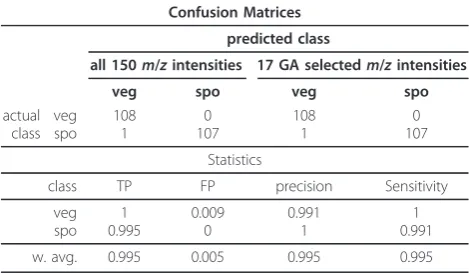
using only the 17 GA-selected variables. Table 1 shows the confusion matrices for both classification models and the statistics related to those matrices. TP and FP are the numbers of true positives and false positives respectively.
The results in Table 1 show an identical predictive accuracy for the classifications with either all 150 vari-ables or the reduced data (17 GA selected varivari-ables). In practice the classification model using only 17 variables should be favoured because it is less computationally expensive to run, more parsimonious [30], and also sim-pler to interpret. Whilst the variable selection and classi-fication model shows the most relevant variables for the
identification of Bacillus spores, it does not give any
information about how these variables correlate to the classes or indeed to each other. Therefore, we use
prin-cipal component analysis (PCA) to detect groups ofm/z
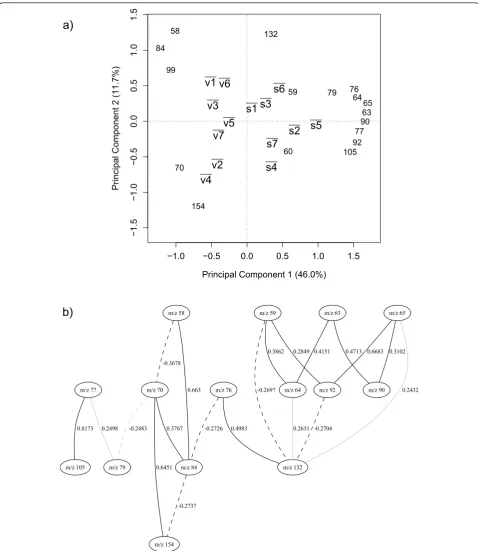
intensities that strongly correlate to each other and observe their relationships to the physiological state of the bacilli. Figure 2(a) shows the biplot for the average PC scores value of the 14 classes and overlaid on this
plot are them/z intensities from the PC loadings matrix.
The PC scores plot in Figure 2(a) shows a clear
separation between the vegetative ( )v and sporulated
(s) bacilli in the first PC which accounts for 46% of the
total explained variance. Them/zintensities that appear
to the right of the vertical dotted line that divides the graph have a strong correlation with the sporulated phy-siological state and the intensities to the left of that line are strongly correlated to the vegetative state. The
proximity of v1 and v6 on the graph indicates that in
their vegetative stateB. amyloliquefaciensandB. subtilis
are very closely related and this reflects the known tax-onomy of these two species [16]; these are also closely
related to the taxonomically similar B. licheniformis
(v3). This is also seen in the spores of these bacteria.
This suggests that despite choosingm/zthat can
discri-minate between spores and vegetative cells some infor-mation on the different species is still present. This is
also true for B. cereus (v2) and B. megaterium (v4)
that also co-cluster and are taxonomically similar [16].
To examine the interactions among the m/zintensities
further we have developed a powerful probabilistic model based on Bayesian networks. Contrary to intui-tion, the direction of the arrows in a Bayesian network does not necessarily imply a cause-effect relationship between the variables; that is to say a Bayesian network
is not a “causal network”. Thus to eliminate possible
confusion we have intentionally omitted the arrow heads from our BN graphs. Figure 2(b) shows the BN
describing the association of the 17 selectedm/z
[image:7.595.56.291.594.731.2]intensi-ties, and as detailed above this was fully validated using
Table 1 Vegetative and sporulated classes: confusion matrices and summary statistics, w. avg. = weighted average
Confusion Matrices
predicted class
all 150m/zintensities 17 GA selectedm/zintensities
veg spo veg spo
actual class
veg spo
108 1
0 107
108 1
0 107
Statistics
class TP FP precision Sensitivity
veg spo
1 0.995
0.009 0
0.991 1
1 0.991
−1.0 −0.5 0.0 0.5 1.0 1.5
−
1.5
−
1.0
−
0.5
0.0
0.5
1.0
1.
5
Principal Component 1 (46.0%)
Pr
incipal Component 2 (11.7%)
v1
v2
v3
v4
v5
v6
v7
s1
s2
s3
s4
s5
s6
s7
5859
60
63 64
65
70
76
77 79 84
90
92 99
105 132
154
m/z 77
m/z 105 0.8173
m/z 79 0.2498
m/z 65
m/z 92
0.6683
m/z 132
0.2432 m/z 90
0.3102
-0.2704 m/z 58
m/z 84 0.663 m/z 70
-0.3678
m/z 154 -0.2737 0.3767
0.6451 -0.2483
m/z 76
-0.2726 0.4983
m/z 63
0.4713
m/z 64 0.4151
0.2631 m/z 59
0.2849
-0.2697 0.3862
a)
[image:8.595.58.537.87.639.2]b)
10-fold cross-validation. Solid lines indicate a positive correlation between nodes, dashed lines indicate nega-tive correlation and the thickness of the line indicates the strength of the correlation. Therefore the thicker the line is the stronger the correlation. The number beside the line shows the partial correlation coefficient for that correlation. A partial correlation estimates the correla-tion between two nodes when the effect of all other nodes in the model is held constant, and this process
avoids finding variables (m/z) that are not directly
cor-related to each other [31].
The network Figure 2(b) shows the correlation among
the m/z intensities. The strongest correlation on the
network is a positive correlation betweenm/z 105 and
m/z 77. m/z 105 is a pyridine ketonium ion known to
arise from DPA [8] and Beverlyet al., Havey et al. and
Opitz have suggested thatm/z77 results from the
elec-tron ionization fragmentation pathway via loss of CO
fromm/z 105 [32-34]. As thesem/z are highly
corre-lated in the BN and appear closer to the sporucorre-lated classes on Figure 2(a), the results indicate that for
sporulated bacilli them/z 105 andm/z 77 intensities are
noticeably higher than for the vegetative case.
In order to generate a rule for differentiating spores from vegetative cells we also applied a classification and regression trees algorithm (CART) implemented accord-ing to the methods described in [35] and written in R programming language [14]. The classification tree pro-cedure creates a tree-based classification model which classifies cases into groups. The procedure provides vali-dation tools for exploratory and confirmatory classifica-tion analysis. The CART algorithm produced a
classification tree containing only four biomarkers,m/z
63,m/z77,m/z84 andm/z105, as sufficient to
discrimi-nate accurately between the physiological states of the bacilli. We then proceeded to use discriminant analysis to produce a classification equation using those four m/z intensities. To compute such equation we used the
discri-minant analysis option in the software“Statistical
Pack-age for the Social Sciences”SPSS Inc. [36] ver. 16. The
equation coefficients are canonical discriminant coeffi-cients. The resulting formula is shown in Equation 3.
f MZ( ) h
vegetative, if 0,
spore, otherwise. (3)
where h= 3.523 m/z 63+ 4.193m/z 77 - 1.007 m/z
84 -0.347m/z105 -0.961, and MZ= (m/z63, m/z 77,
m/z 84 ;m/z 105). This equation successfully classifies
100% of the cases from the Bacillusdata set correctly.
Thus we have understood some of the relationships between the variables, confirmed that DPA and its pro-duct ions in Electron Impact Mass Spectrometry (EI-MS) are excellent biomarkers for spores and have a
very parsimonious model where only 4 of the original 150 ions are used to describe the solution adequately.
Discriminating between species
For this analysis the species are considered as classes
(n= 7). In order to ascertain whether there was any
dif-ference in classifications based on physiology, we per-formed these experiments using three different partitions of the mass spectral data. The first partition uses all the 216 bacilli collectively, vegetative + sporu-lated. The second partition uses only vegetative cells and the third one uses only sporulated cells. Experi-ments on the second and third partitions expect that one has already differentiated between the two physiol-ogy states (as illustrated above) and would work like a hierarchical classification were the physiological state of the cases is known and only the species have to be predicted.
The variable selection GA-classifier was applied to each of the three partitions of the data and produced the subsets of variables shown in the Venn diagram Figure 3.
The diagram, Figure 3, shows that for the data set
containing the 216 bacilli, labelled BOTH, 22m/z
inten-sities have been selected as relevant to discriminate
between the differentBacillus species, whereas for the
data set containing only vegetative cells and the data set containing only sporulated cells, 25 and 39 variables were selected respectively It is also clear that some ions
(m/z57, 67, 74, 89, 104 and 136) were used by all
classi-fiers irrespective of data partitioning.
Species as classes: all bacilli
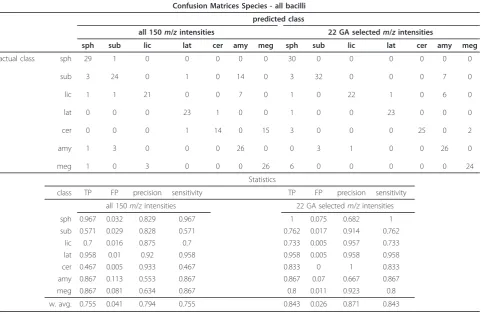
These experiments were aimed at classifying all the 216 Py-MS spectra from the bacilli into one of the seven possible species. Table 2 shows the confusion matrix for
this classification when all 150m/zions were employed
as well as the statistics related to these classifications. This table also details the results after GA variable selection down to the 22 ions highlighted in Figure 3. It is clear from the summary statistics (Table 2) that pre-diction was improved when only these 22 GA selected ions were used again highlighting the power of the fea-ture selection performed by the GA-Bayesian network algorithm (GA-BN).
Figure 4(a) shows the PC scores biplot for the average value of the classes and the associated PC loadings plot
which shows the influence of the m/z intensities
selected. This figure shows the classes and their
rela-tionship with them/z intensities. The intensitiesm/z 89,
m/z 136 andm/z65, for instance, are good
discrimina-tors for the speciesB. sphaericus ( )5s when theBacillus
is sporulated but not as good when this species is in
to ( )1s and of (3v) to ( )3s on the graph suggests that bacilli belonging to those respective species remain rela-tively similar regardless of their physiological state.
The Bayesian network model built on the 22 GA selected variables is shown in Figure 4(b). Interpretation of these relationships is difficult given the molecular nature of the ions in Py-MS (molecular ions are very rarely seen, rather complex pyrolysate and fragments thereof are detected but remain unidentified).
Despite this limitation of the data, rather than the BN, we see two separate sub-networks for species clas-sifying when both spores and vegetative cells are included in the BN analysis. These relationships are
not directly related to the differences between spores and vegetative cells, nor are these probabilistic rela-tionships among variables wholly mirrored in PC scores (Figure 4(a)), and we see a mixture of selected ions from the different areas of PCA. For example,
whilst m/z 89, 136, 65 are highly positively correlated
in both the BN and PCA the BN extends this network
via a negative correlation to m/z 108 and m/z 57
which are located diagonally opposite in the PC
load-ings plot, but not m/z 70 which is not used in the BN
at all. In addition, despite m/z 52 and 53 close
rela-tionship in PCA these are found to be separated in the BN. Thus this suggests that additional information
SPO VEG
BOTH
m/z 55, m/z 62
m/z 63, m/z 64
m/z 71, m/z 72
m/z 77, m/z 82
m/z 86, m/z 90
m/z 93, m/z 102
m/z 105, m/z 117
m/z 119, m/z 120
m/z 121
m/z 122
m/z 126
m/z 132
m/z 140
m/z 51
m/z 58
m/z 60
m/z 61
m/z 75
m/z 94
m/z 100
m/z 131
m/z 154
m/z 112
m/z 129
m/z 52
m/z 59
m/z 65
m/z 68
m/z 69, m/z 108
m/z 147, m/z 156
m/z 53
m/z 70
m/z 97
m/z 101
m/z 113
m/z 157
m/z 57
[image:10.595.60.537.90.514.2]m/z 67
m/z 74
m/z 89
m/z 104
m/z 136
m/z 73
m/z 83
m/z 91, m/z 92
could be generated from the BN when compared to PC loadings plots, and this will be an area of future work using ions of known origin.
Species as classes: vegetative cells only
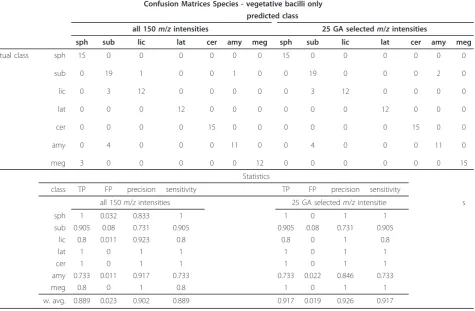
These experiments classified 108 mass spectra from the vegetative bacilli into one of the 7 possible species stu-died. Table 3 shows the confusion matrix for this classi-fication as well as the statistics related to this classification for both the full Py-MS spectrum and for the 25 ions selected using GA, and in this case the data reduction has not led to a significant improvement in classification.
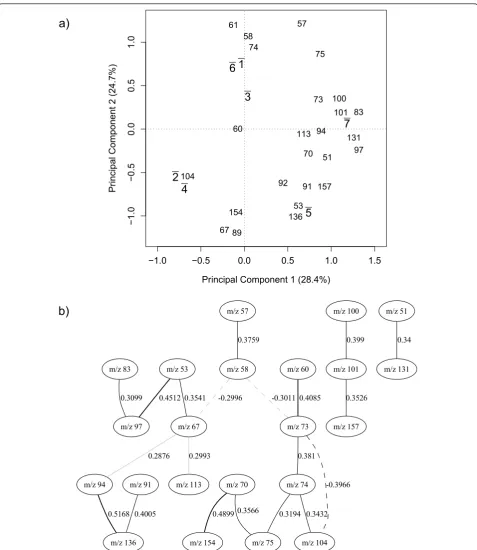
Figure 5(a) shows the PC scores biplot for the average
value of the classes and the associated m/z intensities
located in the PC loadings. This biplot was generated based on the 25 GA selected variables for this configura-tion of the data set and shows the locaconfigura-tions of the
spe-cies classes and their relationship with the m/z
intensities. These relationships mirror very well the expected taxonomy of these bacilli as 4 groups are seen: (1)B. subtilis, B. amyloliquefaciensandB. licheniformis, (2)B.cereusand B. megaterim, (3) B. sphaericusand (4)
B.laterosporus, and highlights that reduction of the data
has not comprised the known relationships between these bacteria.
The Bayesian network model built on the 25 GA selected variables is shown in Figure 5(b).
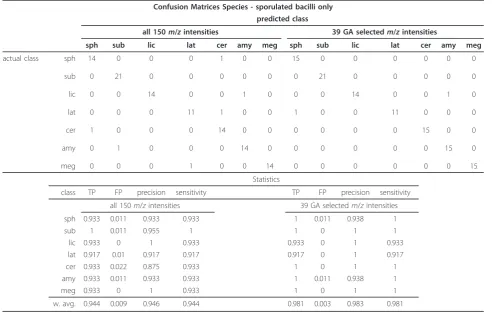
Species as classes: spores only
These experiments classified the Py-MS data from 108 sporulated bacilli into one of the 7 possible species stu-died. Table 4 shows the confusion matrix for these classifi-cations as well as the statistics related to this classification for both the full Py-MS spectra and the 39 GA selected ions. In contrast to the model made from the vegetative cells, the reduced ions for the spores shows an improve-ment in the predictive ability for this model, which is encouraging considering that previous studies have
sug-gested that the phenotype ofBacillusspecies on
sporula-tion, as measured using Py-MS, becomes more similar and hence one would expect the predictions for spores to be worse than for vegetative cells [37].
Figure 6(a) shows the PC score biplot based on the 39 GA selected variables for the average value of the classes
and the correspondingm/zintensities from the PC
[image:11.595.58.540.101.415.2]load-ings matrix are also shown. In contrast to the same ana-lysis from the vegetative cells, the taxonomic
Table 2 Species: classification results for all bacilli (including vegetative and sporulated cases)
Confusion Matrices Species - all bacilli
predicted class
all 150m/zintensities 22 GA selectedm/zintensities
sph sub lic lat cer amy meg sph sub lic lat cer amy meg
actual class sph
sub lic lat cer amy meg 29 3 1 0 0 1 1 1 24 1 0 0 3 0 0 0 21 0 0 0 3 0 1 0 23 1 0 0 0 0 0 1 14 0 0 0 14 7 0 0 26 0 0 0 0 0 15 0 26 30 3 1 1 3 0 6 0 32 0 0 0 3 0 0 0 22 0 0 1 0 0 0 1 23 0 0 0 0 0 0 0 25 0 0 0 7 6 0 0 26 0 0 0 0 0 2 0 24 Statistics
class TP FP precision sensitivity TP FP precision sensitivity
all 150m/zintensities 22 GA selectedm/zintensities
sph 0.967 0.032 0.829 0.967 1 0.075 0.682 1
sub 0.571 0.029 0.828 0.571 0.762 0.017 0.914 0.762
lic 0.7 0.016 0.875 0.7 0.733 0.005 0.957 0.733
lat 0.958 0.01 0.92 0.958 0.958 0.005 0.958 0.958
cer 0.467 0.005 0.933 0.467 0.833 0 1 0.833
amy 0.867 0.113 0.553 0.867 0.867 0.07 0.667 0.867
meg 0.867 0.081 0.634 0.867 0.8 0.011 0.923 0.8
w. avg. 0.755 0.041 0.794 0.755 0.843 0.026 0.871 0.843
−1.0 −0.5 0.0 0.5 1.0 1.5
−
1.5
−
1.0
−
0.5
0.0
0.5
1.0
Principal Component 1 (24.3%)
Pr
incipal Component 2 (23.3%)
1v
2v
3v
4v
5v
6v
7v
1s
2s
3s
4s
5s
6s
7s
52 53
57
59
65 67
68 69
70 74
89
97
101 104
108
112
113 129
136
147
156 157
m/z 156
m/z 157 0.711
m/z 53
m/z 97
0.6195
m/z 67 0.424
m/z 129 0.3157
m/z 68
m/z 69 0.4943
m/z 65
m/z 136
0.4751 m/z 89 0.2865
m/z 57
-0.2852
m/z 74 0.4425
m/z 112 -0.2931
m/z 113 0.4408 0.3159
m/z 101
0.3825
m/z 147 0.3486
0.3408
m/z 108
0.3713 0.3377 -0.3483
m/z 52
-0.2978
-0.338
a)
[image:12.595.58.539.87.640.2]b)
Figure 4Species all bacilli. (a) principal component analysis discriminating among species (all bacilli). v = vegetative, s = sporulated, 1
relationship between these bacilli whilst evident is more
diffuse; that is to say there is overlap betweenB.
lateros-porus ( )7 and theB. subtilislike cluster ( , , )1 3 6 . Fig-ure 6(a) raises some other interesting observations. First,
there is a suggestion that the cluster formed bym/z77,
m/z 105 andm/z122 could be related to the
fragmenta-tion pathway of benzoic acid as reported by [34,38].
Sec-ond,m/z77 and 105 are DPA related mass spectra [32]
and their proximity toB. cereuson the PCA plot could
indicate that B. cereushas a higher level of DPA than
the other 6 Bacillusspecies studied in this work. This
idea, however, seems to be contradictory. While some
studies such as [39] suggest that B. cereushas in fact a
high DPA level, higher than for B. megaterium, for
instance, other studies such as [40,41] indicate the con-trary. Although our PCA plot does seem to suggest that
B. cereus has a high DPA level (agreeing with [39]), clo-ser inspection of the data set tells a slightly different
story. It reveals that the average values form/z 77 and
m/z105 are higher forB. megateriumandB.sphaericus
than they are for B. cereus (agreeing with [40,41]).
Therefore, the reason why m/z77 and 105 are closer to
B. cereus on the PCA plot may be due to the fact that
B. cereus falls in-between B. megaterium and B.
sphaericus on the plot. The Bayesian network model
built on these 39 ions is shown in Figure 6(b) where the
strong correlation involving m/z 77,m/z 105 and m/z
122 is also highlighted.
GA-Bayesian network vs. PLS-DA
To assess the power of the proposed GA-BN method as a feature selection technique we compare it to PLS-DA. Using exactly the same partitions of the data set assessed by the GA-BN algorithm, we applied PLS-DA to identify the most relevant features in each of those partitions. We then computed the new classification results based on those features selected by PLS-DA. Table 5 reports the following classification results: (1) the weighted true positive rate, (2) the total number of variables selected, and (3) the percentage of variables selected by PLS-DA that have also been selected by
GA-BN, described as “overlap”. The true positive rates from
[image:13.595.64.540.103.414.2]Table 5 show that variables selected by GA-BN separate the classes more accurately than the variables selected by PLS-DA, in all cases. In particular, the results suggest that as the number of classes increases, from 2 for phy-siological state to 7 to the other cases, the classification accuracy obtained by PLS-DA decreases noticeably. For
Table 3 Species: classification results for vegetative bacilli only
Confusion Matrices Species - vegetative bacilli only predicted class
all 150m/zintensities 25 GA selectedm/zintensities
sph sub lic lat cer amy meg sph sub lic lat cer amy meg
actual class sph
sub lic lat cer amy meg 15 0 0 0 0 0 3 0 19 3 0 0 4 0 0 1 12 0 0 0 0 0 0 0 12 0 0 0 0 0 0 0 15 0 0 0 1 0 0 0 11 0 0 0 0 0 0 0 12 15 0 0 0 0 0 0 0 19 3 0 0 4 0 0 0 12 0 0 0 0 0 0 0 12 0 0 0 0 0 0 0 15 0 0 0 2 0 0 0 11 0 0 0 0 0 0 0 15 Statistics
class TP FP precision sensitivity TP FP precision sensitivity
all 150m/zintensities 25 GA selectedm/zintensitie s
sph 1 0.032 0.833 1 1 0 1 1
sub 0.905 0.08 0.731 0.905 0.905 0.08 0.731 0.905
lic 0.8 0.011 0.923 0.8 0.8 0 1 0.8
lat 1 0 1 1 1 0 1 1
cer 1 0 1 1 1 0 1 1
amy 0.733 0.011 0.917 0.733 0.733 0.022 0.846 0.733
meg 0.8 0 1 0.8 1 0 1 1
w. avg. 0.889 0.023 0.902 0.889 0.917 0.019 0.926 0.917
−1.0 −0.5 0.0 0.5 1.0 1.5
−
1.0
−
0.5
0.0
0.5
1.0
Principal Component 1 (28.4%)
Pr
incipal Component 2 (24.7%)
1
2
3
4
5
6
7
51
53 57 58
60 61
67
70 73 74
75
83
89
91 92
94
97 100
101
104
113 131
136 154
157
m/z 94
m/z 136 0.5168
m/z 70
m/z 154 0.4899
m/z 75 0.3566 m/z 53
m/z 97
0.4512
m/z 67 0.3541
m/z 60
m/z 73 0.4085
m/z 104 -0.3966 m/z 74
0.381
m/z 91
0.4005
m/z 100
m/z 101 0.399
m/z 157 0.3526
0.3432 0.3194 m/z 57
m/z 58 0.3759
-0.3011 -0.2996
0.2876
m/z 113 0.2993
m/z 51
m/z 131 0.34
m/z 83
0.3099
a)
[image:14.595.59.537.86.637.2]b)
the physiological state data partition there is a good agreement, 73.2%, between the features selected by GA-BN and PLS-DA. We expected PLS-DA to perform well on this partition of the data set because the PCA plot, Figure 2(a), suggests that this is a linearly separable sys-tem. By contrast, for the species vegetative only partition of the data set there is only a 1% agreement, and, although PLS-DA selected 41 variables more than GA-BN did, the PLS-DA model prediction accuracy was 13.0% lower.
Conclusions
In this study Py-MS data from a diverse group of
Bacillus species were analysed using a novel approach
of combining variable selection from GA with the probabilistic relationship inference from BN. This che-mometrics-fusion approach was first used for the
suc-cessful classification of spores versus vegetative
biomass and subsequently the same data were used to
identify the Bacillus species that was under analysis.
The results of the physiological classification confirm
thatm/z 105 which is a pyridine ketonium ion known
to arise from DPA [8] plays a significant part in discri-minating the spores from vegetative bacilli. Moreover,
m/z 77 was also selected which is known to be a
frag-ment ion that results from pyridine ketonium [32]. A very parsimonious rule was constructed that only used four ions and had a 100% classification rate on the validation data. Taken together this shows that the GA-BN was able to discover novel biomarkers for spores and that these were validated by the know phy-siological differences that occur during sporulation [1]. Variable selection is an important aspect of any multi-variate data analysis as it seeks to simplify a data set by reducing its dimensionality and identifying relevant underlying variables without sacrificing predictive accuracy. As a result for species classification the GA-BN significantly reduced the redundancy in the information provided by the variables actually used for
prediction from 150 m/z to between 22-39 depending
on the subset of the data analysed. As no single classi-fier works best on all given classification problems (see [42]), the present work designed a specific classifica-tion model for each particlassifica-tion of the data set analyzed.
The results show that using significantly less m/z
intensities, the classifiers obtained, on average, a better
performance than the classifiers using all 150 m/z
[image:15.595.54.547.100.413.2]intensities available.
Table 4 Species: classification results for sporulated bacilli only
Confusion Matrices Species - sporulated bacilli only predicted class
all 150m/zintensities 39 GA selectedm/zintensities
sph sub lic lat cer amy meg sph sub lic lat cer amy meg
actual class sph
sub lic lat cer amy meg 14 0 0 0 1 0 0 0 21 0 0 0 1 0 0 0 14 0 0 0 0 0 0 0 11 0 0 1 1 0 0 1 14 0 0 0 0 1 0 0 14 0 0 0 0 0 0 0 14 15 0 0 1 0 0 0 0 21 0 0 0 0 0 0 0 14 0 0 0 0 0 0 0 11 0 0 0 0 0 0 0 15 0 0 0 0 1 0 0 15 0 0 0 0 0 0 0 15 Statistics
class TP FP precision sensitivity TP FP precision sensitivity
all 150m/zintensities 39 GA selectedm/zintensities
sph 0.933 0.011 0.933 0.933 1 0.011 0.938 1
sub 1 0.011 0.955 1 1 0 1 1
lic 0.933 0 1 0.933 0.933 0 1 0.933
lat 0.917 0.01 0.917 0.917 0.917 0 1 0.917
cer 0.933 0.022 0.875 0.933 1 0 1 1
amy 0.933 0.011 0.933 0.933 1 0.011 0.938 1
meg 0.933 0 1 0.933 1 0 1 1
w. avg. 0.944 0.009 0.946 0.944 0.981 0.003 0.983 0.981
−1.5 −1.0 −0.5 0.0 0.5 1.0 1.5
−
1.5
−
1.0
−
0.5
0.0
0.5
1.0
Principal Component 1 (30.2%)
Pr
incipal Component 2 (19.4%)
1
2
3
4
5
6
7
5255
57
59 62
63 64
65 67
68 69 71 72
73 74
77 82 83
86
89 90
91 92 93
102 104
105
108 117
119 120 121
122 126
132
136
140 147
156
m/z 73
m/z 74 0.614
m/z 105
m/z 122 0.4579 m/z 67
0.2578
m/z 93 0.4515
m/z 119 0.4219
m/z 77
0.4245
0.3747 m/z 147
0.2943
m/z 132
m/z 156 0.3634
m/z 126
m/z 140 0.3593 m/z 72
m/z 102 -0.3492
0.3097
0.3279
m/z 89
m/z 117 0.3291
m/z 90
0.31 m/z 52
m/z 104 0.3052
m/z 121 -0.2833
m/z 120
-0.2987
m/z 55
m/z 83 0.2972
m/z 82
0.2966
0.269
0.2802
m/z 68
m/z 86 0.2761
m/z 57
0.2646
a)
[image:16.595.58.536.85.641.2]b)
Taking the true positive (TP) rate as an example for analysing both spores and vegetative cells together the
prediction from using 150 m/z to just 22 increased
from 0.755 to 0.843. When only vegetative cells were
analysed the TP rate was 0.889 for all 150 m/z and
0.917 for when the 22 GA selected variables were employed. By contrast, the TP rate increased from 0.944 to an impressive 0.981 when spores were ana-lysed by Py-MS using either all 150 m/z or 39 selected ions respectively. This result indicates that not only are individual classifiers better than combining both
spores and vegetative biomass, but thatBacillus
specia-tion is better when spores are analysed. This is in con-trast to what is expected from classical physiology studies and indicates that a lot more than just the pro-duction of DPA and specific proteins is occurring. This has implication for rapid analysis as one may be able to speciate the bacilli directly without the need for cultivation. Notwithstanding our results show that a hierarchical-like, or informed, classification of the bacilli into classes has shown a higher predictive accu-racy than the classification without previous knowledge of physiological state.
The GA-BN algorithm has also outperformed a tradi-tional classification method used in chemometrics, namely PLS-DA, in all cases tested. Although GA-BN did not always select the smallest subset of features, the classification accuracy indicated that it always selected the most relevant ones when compared to PLS-DA.
Bayesian networks explore two main characteristics of the target data set: associations among variables and the strength of these associations. The graphical model out-put from the GA-BN explicitly informs one about prob-abilistic associations. A conditional probability table stores the strength of the correlations given the associa-tions displayed on the graphical model. Expert knowl-edge and statistical information can easily be introduced in BNs, as demonstrated in this study. BNs model the probability distribution of the problem domain and, therefore, can compute the predictive distribution on the outcomes of possible outputs.
In conclusion, we have developed a novel genetic algorithm-Bayesian network and demonstrated its
implementation on a well described data set comprising pyrolysis mass spectra from a wide variety of different
Bacillusspecies analysed both as vegetative cells and spores. The physiological assessment of these data reconfirmed that dipicolinic acid is a valuable biomarker for spore identification; whilst our hierarchical-informed classification structure showed excellent identification of the different species in the sporulated state, a finding that to our knowledge has not been shown before for Py-MS data.
Additional material
Additional file 1: The distribution of samples on the Bacillus data set. This table shows the distribution of samples of theBacillusPy-MS data set reported in this article.
Additional file 2: Bayesian network representing the lung cancer problem. This figure shows a Bayesian network representing the lung cancer problem: L = low, H = high, T = true, F = false, Pos = positive and Neg = negative.
Additional file 3: Pseudocode for a generic greedy search algorithm. Shows the pseudocode of a generic greedy search algorithm for learning Bayesian network structures.
Acknowledgements
EC and RG would like to thank the“Systems Biology of Microorganisms” (SysMO) project and in particular BBSRC for financial support.
Author details
1School of Chemistry, The University of Manchester, 131 Princess Street, Manchester, M1 7ND, UK.2Manchester Centre for Integrative Systems Biology, Manchester Interdisciplinary Biocentre, University of Manchester, 131 Princess Street, Manchester, M1 7ND, UK.
Authors’contributions
EC designed and implemented the code for the GA-BN algorithm, performed the statistical analysis of the data and drafted the manuscript. RG designed and performed the Py-MS analysis of theBacillusdata set, collected the data and collaborated with the interpretation of the results from the statistical data analysis and manuscript preparation. Both authors read and approved the final manuscript.
Received: 10 June 2010 Accepted: 26 January 2011 Published: 26 January 2011
References
1. Atrih A, Foster SJ:The role of peptidoglycan structure and structural dynamics during endospore dormancy and germination.Antonie van Leeuwenhoek1999,75(4):299-307.
2. Doyle MP, Beuchat LR, Montville TJ, (Eds):Food Microbiology: Fundamentals and FrontiersWashington DC: Amercian Society of Microbiology; 1997. 3. Barnaby W:Plague Makers: The Secret World of Biolgoical WarfareVision;
1999.
4. Inglesby TV, Henderson DA, Bartlett JG, Ascher MS, Eitzen E, Friedlander AM, Hauer J, McDade J, Osterholm MT, O’Toole T, Parker G, Perl TM, Russell PK, Tonat K:Anthrax as a Biological Weapon - medical and Public Health Management.JAMA - Journal of the American Medical Association1999, 281(18):1735-1745.
5. Ghiamati E, Manoharan R, Nelson WH, Sperry JF:UV Resonance Raman Spectra ofBacillusSpores.Applied Spectroscopy1992,46(2):357-364. 6. Tabor MW, MacGee J, Holland JW:Rapid determination of dipicolinic acid
in the spores of Clostridium species by gas-liquid chromatography.
[image:17.595.59.291.112.188.2]Applied and Environmental Microbiology1976,31:25-28. Table 5 Classification results: comparison GA-Bayesian
network vs. PLS-DA
True positive rate # of variables selected
Class type GA PLS-DA GA PLS-DA Overlap
physiological state 99.5% 97.2% 17 15 73.2% species both 84.3% 73.6% 22 47 12.7% species veg. only 91.7% 78.7% 25 66 1.0% species spo. only 98.1% 75.9% 39 11 45.4%
7. Warth AD:Liquid Chromatographic Determination of Dipicolinic Acid from Bacterial Spores.Applied and Environmental Microbiology1979, 38(6):1029-1033.
8. Goodacre R, Shann B, Gilbert RJ, Timmins EM, McGovern AC, Alsberg BK, Kell DB, Logan NA:Detection of the Dipicolinic Acid Biomarker inBacillus Spores Using Curie-Point Pyrolysis Mass Spectrometry and Fourier Transform Infrared Spectroscopy.Analytical Chemistry2000,72:119-127. 9. DeLuca SJ, Sarver EW, Voorhees KJ:Direct analysis of bacterial glycerides
by Curie-point pyrolysis-mass spectrometry.Journal of Analytical and Applied Pyrolysis1992,23:1-14.
10. Snyder AP, Dworzanski JP, Tripathi A, Maswadeh WM, Wick CH:Correlation of mass spectrometry identified bacterial biomarkers from a fielded pyrolysis-gas chromatography-Ion mobility spectrometry biodetector with the microbiological gram stain classification scheme.Analytical Chemistry2004,76(21):6492-6499.
11. Jensen FV:Bayesian networks and decision graphsSpringer; 2001. 12. Neapolitan RE:Learning Bayesian networksPrentice Hall; 2003. 13. Heckerman D:A tutorial on learning with Bayesian networks.Tech rep,
Microsoft Research1995.
14. The R Project for Statistical Computing:R programming language. [http://www.r-project.org/].
15. Shute LA, Gutteridge CS, Norris JR, Berkeley RCW:Curie-point Pyrolysis Mass Spectrometry Applied to Characterization and Identification of SelectedBacillus Species.Journal of General Microbiology1984,130:343-355. 16. Lopez-Diez EC, Goodacre R:Characterization of Microorganisms Using UV Resonance Raman Spectroscopy and Chemometrics.Analytical Chemistry
2004,76(3):585-591.
17. Witten IH, Frank E:Data mining: practical machine learning tools and techniques.second edition. The Morgan Kaufmann Series in Data Management Systems, Morgan Kaufmann; 2005.
18. Holland JH:Adaptation in Natural and Artificial Systems: An Introductory Analysis with Applications to Biology, Control, and Artificial IntelligenceThe MIT Press; 1992.
19. Goldberg DE:Genetic algorithms in search, optimization and machine learningAddison-Wesley; 1989.
20. Mitchell M:An introduction to genetic algorithmsMIT Press; 1998. 21. Goldberg DE:The design of innovation: lessons from and for competent
genetic algorithmsKluwer Academic; 2002.
22. Pearl J:Probabilistic reasoning in intelligent systems: networks of plausible inference.The Morgan Kaufmann series in representation and reasoningSan Mateo, CA, USA: Morgan Kaufmann; 1988.
23. Lauritzen SL, Spiegelhalter DJ:Local computations with probabilities on graphical structures and their application to expert systems.Journal of the Royal Statistics Society1988,50:157-224.
24. Bouckaert RR:Properties of Bayesian belief network learning algorithms.
Conference on Uncertainty in Artificial Intelligence UAI 1994Seattle, WA, USA: Morgan Kaufmann; 1994, 102-109.
25. Chickering DM, Geiger D, Heckerman D:Learning Bayesian networks is NP-hard.Tech rep, Microsoft Research1994.
26. Barker M, Rayens W:Partial least squares for discriminantion.Journal of Chemometrics2003,17:166-173.
27. Karp NA, Griffin JL, Lilley KS:Application of partial least squares discriminant analysis to two-dimensional difference gel studies in expression proteomics.Proteomics2005,5:81-90.
28. Kuhn M:Classification and Regression Training (Caret).R programming language package[http://cran.r-project.org/web/packages/caret/index.html]. 29. Zeng X, Martinez TR:Distribution-balanced stratified cross-validation for
accuracy estimation.Journal of Experimental and Theoretical Artificial Intelligence2000,12:1-12.
30. Seasholtz M, Kowalski B:The parsimony principle applied to multivariate calibration.Analytica Chimica Acta1993,277(2):165-177.
31. Hair JF, Black B, Babin B, Anderson RE, Tatham RL:Multivariate Data Analysis.
6 edition. Pearson Education; 2007.
32. Beverly MB, Basile F, Voorhees KJ, Hadfield TL:A Rapid Approach for the Detection of Dipicolinic Acid in Bacterial Spores Using Pyrolysis/Mass Spectrometry.Rapid Communications in Mass Spectrometry1998, 10(4):455-458.
33. Havey CD, Basile F, Mowryb C, Voorhees KJ:Evaluation of a micro-fabricated pyrolyzer for the detection ofBacillusanthracis spores.Journal of Analytical and Applied Pyrolysis2004,72:55-61.
34. Opitz J:Electron-impact ionization of benzoic acid, nicotinic acid and their n-butyl esters: An approach to regioselective proton affinities derived from ionization and appearance energy data.International Journal of Mass Spectrometry2007,265:1-14.
35. Breiman L, Friedman J, Stone CJ, Olshen R:Classification and Regression Trees.1 edition. Chapman & Hall; 1984.
36. SPSS computer program used for statistical analysis. Website http://www.spss.com/.
37. Shute LA, Gutteridge CS, Norris JR, Berkeley RCW:Reproducibility of pyrolysis mass spectrometry: effect of growth medium and instrument stability on the differentiation of selectedBacillusspecies.Journal of Applied Microbiology1988,64:79-88.
38. Sproch N, Begin KJ, Moms RJ:The Modern Student Laboratory: Chromatography: An LC/Particle Beam/MS Experiment for Undergraduates.Journal of Chemical Education1996,73(2):A33iA39. 39. Huang Ss, Chen D, Pelczar PL, Vepachedu VR, Setlow P, Li Yq:Levels of Ca2
+dipicolinic acid in individualbacillusspores determined using
microfluidic Raman tweezers.The Journal of Bacteriology2007, 189(13):4681-4687.
40. Zhang P, Kong L, Setlow P, Li Yq:Characterization of wet heat inactivation of single spores of Bacillus species by dual-trap Raman spectroscopy and elastic light scattering.Applied and Environmental Microbiology2010,76(6):1796-1805.
41. Pendukar SH, Kulkarni PR:Chemical composition of bacillus spores.Food/ Nahrung1988,32(10):1003-1004.
42. Wolpert DH, Macready WG:No Free Lunch Theorems for Optimization.
IEEE Transactions on Evolutionary Computation1997,1:67-82.
doi:10.1186/1471-2105-12-33
Cite this article as:Correa and Goodacre:A genetic algorithm-Bayesian network approach for the analysis of metabolomics and spectroscopic data: application to the rapid identification of Bacillus spores and classification of Bacillus species.BMC Bioinformatics201112:33.
Submit your next manuscript to BioMed Central and take full advantage of:
• Convenient online submission
• Thorough peer review
• No space constraints or color figure charges
• Immediate publication on acceptance
• Inclusion in PubMed, CAS, Scopus and Google Scholar
• Research which is freely available for redistribution