
Introduction
Many have argued that the risks to health from climate change are overwhelmingly negative. At the conclusion of the United Nations Climate Change Conference in Copenhagen (COP15), which took place in December 2009, there was no agreed-upon plan of action that would avoid a critical 2% rise in greenhouse gas (GHG) emis-sions globally. Our international leaders did not step up to the plate; rather, they produced an Accord [1] that will neither solve the problem nor appease the critics [2]. Th e implications for health [3-5], in light of this, are similar to implications for the economy [6] and the earth’s natural systems – they are dire.
Our viewpoint is that it is better to be part of the solution than part of the problem, even if there is a dearth of evidence stating that any of the described actions will generate a measureable outcome. When using the term green, we are referring to practices and policies that do not negatively aff ect our environment. It is hoped that this paper will map out ways to green up an intensive care unit (ICU) and reduce the eff ect of environmental toxins on our patients, with suggestions targeted at
individuals and their institutions. Although sustainable critical care may sound like an oxymoron to many of us, we cannot ignore our responsibilities on the basis that greening an ICU is too diffi cult. Th ere are steps that can be taken at all levels, setting an example to infl uence our collective behaviour. If an ICU can go green then there is little excuse for the rest of the hospital not to follow suit.
Th e gauntlet is thrown down.
Background
ICUs are not, in our experience, at the forefront of sustainable environmental management. Possibly the only published mention of intensive care and the environment was when, during the Copenhagen Conference, India’s Environment Minister said that the Kyoto pact was in ‘Intensive Care, if not dead’ when negotiations on extending the pact had stalled [7].
We are not suggesting that patient care should be in any way compromised in order to improve the environ-mental status of your ICU. But there are measures that can be undertaken by any ICU that can, for example, reduce GHG emissions or minimise patient exposure to toxins. What follows is a description of domains to be considered and a framework to examine and implement change in an ICU.
Areas of focus
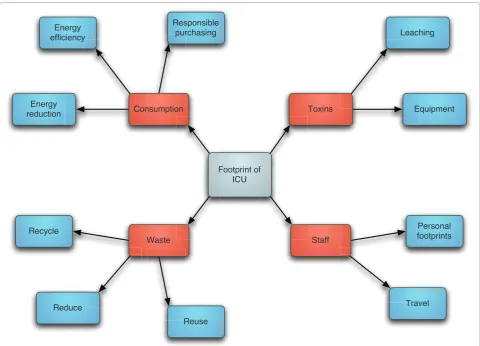
Th ere are at least four areas to consider – consumption, waste, toxins and the personal footprint of staff (Figure 1). Th e mantra in the literature is the Th ree Rs: reduce, reuse and recycle. Application of these principles through-out the ICU is important to reveal hidden oppor tunities.
Consumption Sustainable purchasing
Healthcare facilities purchase thousands of diff erent products requested by dozens of diff erent departments. Often unknowingly, hospitals may purchase items that are toxic to workers or patients, or have serious environ-mental impacts. Environenviron-mentally preferable purchasing is a system that identifi es and mitigates these problems by adopting a more responsible purchasing strategy with the following elements [8]: reducing transportation require ments; encouraging sustainable packaging; avoid-ing savoid-ingle-use products if a suitable alternative exists (impact of reprocessing multi-use products must be
Abstract
Climate change and environmental stewardship are phrases that have been defi ning the past few decades and promoting change in our societies. The sensitivities of intensive care as a specialty make the process of greening an intensive care unit a challenge, but not one that is insurmountable. This paper discusses opportunities for critical care to reduce its environmental impact and provide a framework change. The article includes suggestions of what can be done as an individual, as a unit and as a hospital. Generally, practices in critical care are accepted without questioning the environmental consequences. We believe it is time for change, and critical care should give environmental stewardship a higher priority.
© 2010 BioMed Central Ltd
Greening critical care
Martin Chapman*
1and Alison Chapman
2V I E W P O I N T
*Correspondence: [email protected]
1Department of Critical Care Medicine, Sunnybrook Health Sciences Centre, Rm D108, 2075 Bayview Avenue, Toronto, Ontario, Canada, M4N 3M5 Full list of author information is available at the end of the article
factored into the decision); avoiding products with potential toxins that are used in the manufacturing process (for example, mercury, di(2-ethylhexyl)phthalate, bisphenol A) (Table 1); and choosing products made with recyclable or degradable materials.
Th e contribution that pharmaceuticals make to the overall carbon footprint of a health system is rarely appreciated. In the United Kingdom, it is estimated that 22% of the total carbon emissions from the National Health Service can be attributed to pharmaceuticals [9]. Changing this at a local level is clearly limited but action can be taken by advocating for the unit pharmacy to source from companies that have a legitimate green policy, which many are adopting [10]. It is only when contracts are not renewed that the competitive culture will alter the manufacturing priorities [11]. Various agen cies have produced tools to benchmark manufacturers and aid your local environmentally preferable purchasing system [12].
Reprocessing
In health facilities management, reprocessing refers to the rendering of used devices (multiple-use or single-use
devices) or unused opened devices to be patient ready. Th is concept incorporates all aspects of the Th ree Rs and it has gained attention in the medical literature and by governments keen to explore every strategy for effi cient use of resources [13]. Th e motivation here is twofold: reusing devices leads to a reduction in the output of waste destined for landfi ll sites and to a reduction in operational costs for devices. Th e reprocessed devices are normally sold back to the healthcare provider at 40 to 60% of the original cost. One of the larger independent reprocessing companies in the United States has claimed that their activity diverted over 2,000 tons of waste from landfi ll during 2008. Th e savings from this waste management and the reduced device costs amounted to over US$130 million during that year [14].
[image:2.612.66.547.88.434.2]Th e antagonists of this strategy, however, quote the potential risks to patient safety. Th ese mainly include contami nation/infection, device malfunction and regula-tion of the industry. With regards to safety, the US Food and Drug Administration has issued supportive guide-lines that, along with the Medical Device User Fee and Modernization Act of 2002, formed their federal Figure 1. Reducing the environmental impact of an intensive care unit: four focus areas.
Footprint of ICU
Toxins Equipment
Leaching
Consumption
Responsible purchasing Energy
efficiency
Energy reduction
Waste Recycle
Reduce
Reuse
Staff
legis lation. Th e foundation for this is outlined in a report from the US Government Accountability Offi ce [15]. Th e US Government Accountability Offi ce examined the reported adverse events from devices between 2003 and 2005. Of the 434 adverse events, 65 were in reprocessed devices and all were similar in nature to those in new devices. Th e US Food and Drug Administration stated that the available data ‘does not indicate that reprocessed devices currently in use pose an increased safety threat’. Canada has yet to off er defi nitive guidance, with some voices calling for a complete ban on resterilisation [16]. Euro pean countries vary widely in their approach, from a fully regulated system in Germany to being forbidden in France. In the United Kingdom, the Medicines & Health-care Regulatory Agency has issued a statement warning against reuse of single-use devices [17], citing the reasons of cross-contamination and particularly prion exposure. Further investigation in this area is clearly essential with large gains to be made if a consensus could be achieved.
Health records
Although converting a paper-based ICU to one of electronic health records may seem a solid move for your green profi le, it is an example of how hidden carbon costs may outweigh the more obvious gains in waste reduction. Although there are few data on this area specifi cally, a review of health informatics estimated that the power
consumption for a completely electronic health record system in a large German academic medical centre amounted to 1.7 MW; enough to heat 170 houses in winter [18]. Th is does not even include the carbon foot-print for procuring the infrastructure. Th e compromise is to regard the information technology solution as an integral part of a unit’s footprint, with careful planning and integration required to achieve mutual off sets. Th ere are educational programmes on sustainable information technology that are emerging and will assist with these issues [19].
Energy obligations
Hospitals are heavy users of energy. In Ontario, Canada, 47.3% of the running costs of hospitals can be attributed to their energy supplies, and 50% of those costs can be attributed to electricity [20]. Th e magnitude of this suggests that there could be opportunities to improve on your facility’s effi ciency. Th e mean consumption for Ontario hospitals is 2.59 GJ/m2. Th is can be compared
with Swedish hospitals that, when adjusted for similar operating conditions, had a mean consumption of 1.3 GJ/m2 [21]. Understanding how energy is used and
identifying measures for improving energy effi ciency of existing facilities are key steps.
[image:3.612.65.533.100.373.2]As an example of a large-scale innovation, Harvard Medical School has incorporated an online energy meter Table 1. Known toxins from products commonly found in the critical care environment [24]
Mercury Thermometer Neurotoxin Digital and dot-matrix
Sphymomanometers Aneroid, nonlatex
Brominated fl ame retardants Electronic equipment Neurobehavioural toxicity, thyroid Nonhalogenated retardants
hormone disruption
Patient bedding
Cadmium Biohazard bags Heavy-metal free
Cleaning agents Excess water and cleaning solution Microfi ber mops and cloths
use, occupational injury
DEHP Blood bags, urinary collection kits, Hormone disruption (reproductive DEHP-free PVC materials intravenous tubing, dialysis containers, toxicant to vulnerable populations;
vascular catheters, feeding tubes and for example, neonates) enteral feeding pump kits, TPN bags,
chest drain catheters
Glutaraldehyde General disinfectants and sterilants Respiratory irritant, skin irritant Ortho-phthalaldehyde, hydrogen peroxide, enclosed cleaning technologies
Latex Rubber products Allergen Nitrile-rubber, neoprene (contains chlorine)
PVC Mattress covers, fl uid bags, tubing, During manufacture and disposal, Polyurethane, polyolefi n, silicone electrocardiography electrodes hazardous chemicals (for example,
mercury, chlorine, dioxins) are released
Patient ID bracelets Nonstretch polyester
Offi ce supplies (for example, vinyl Pressboard, polypropylene
binders, colour-coated paper-clips)
Lead Lead apron X-ray shielding Lead and PVC-free aprons
for its various buildings that provides a continuous readout of its energy consumption and trending charts since the programme started [22]. Th is can identify energy-rich times and activities and can provide powerful feedback to encourage important changes in behaviour.
Th e ICU must become responsible for its energy
conservation. Th e interventions chosen can be of varying degrees of complexity, but many require little change: • Choose EnergyStar-compliant electronic equipment
(for example, patient bedside monitors, televisions, refriger ators, computers).
• Set computers to stand-by mode when not in use (switch-ing to a screensaver mode does not reduce consump-tion, and may even increase it with heavy graphics processing).
• Use timers and power bars for equipment that use a standby function to reduce their consumption to zero in quiet periods; use sensors to control lighting in areas of intermittent traffi c and variable daylight. • Use temperature control that is fl exible in both timing
and isolating geographical areas.
Building specifi cations
Acknowledging that brand new facilities are a rarity, even the more restrained retrofi t projects for ICUs can incor-porate many building innovations. Hospital construction now has certifi cation systems, such as the Leadership in Energy and Environmental Design for Healthcare Green Building Rating System [23], to verify that they are designed and built using strategies aimed at improved
performance across a wide range of environ mental
metrics. Th ere are certain key features that set a certifi ed building project apart: sustainable site features (for example, preserving local ecologies); aggressive energy savings for building type; indoor environmental quality (low volatile organic compound emissions, thermal comfort, daylight, views); reduced impacts from choice of materials; water use reduction (for example, low-fl ow taps, nozzles and toilets); green housekeeping; and an alternative transportation incentive programme.
Waste
Waste reduction
In the United States, healthcare is the second highest contributor to landfi ll and incinerators, producing almost 6,000 tonnes of waste a day [21]. It is estimated that 80 to 85% of this waste is nonhazardous. Many of the sterilised items have some paper component to their packaging. Point-of-use separation is probably the easiest strategy and requires a practical choice of receptacle and clear guidance. As always, education needs to be reinforced by feedback and incentives. Th is can be aided by imple-menting waste audits with rolling feedback of the ratio of diverted waste for recycling.
Th ere is an obligatory amount of waste from critical care areas that is biohazard material and sharps. Th ere are no current options for sustainable disposal of this type of waste although the handling process is amenable to a green review. Th ere are waste management services that use recyclable containers to transfer the waste.
Toxins
Modern manufacturing can involve the use of substances with toxic profi les, which either are incorporated in the product or are used or released in the manufacturing process. Th ese substances can be present unknowingly to patients or their carers. Table 1 shows some of the more common substances that may be present in an ICU [24]. Th e connections between these substances and harmful human eff ects vary in their level of evidence. Even in the presence of only animal studies of toxicity, however, there is a philosophical argument for taking a conservative stance, cautioning their use, especially when alternative products are available. Where the concern is over harm-ful byproducts in the manufacturing process, choos ing alternative materials represents a responsible stand to mitigate environmental harm.
As one example, di(2-ethylhexyl)phthalate is a plasti-ciser found in polyvinylchloride products such as feeding tubes, dialysis and extracorporeal membrane oxygenator tubing and blood product bags [25]. In animal studies this plasticiser has been shown to induce cancer of the liver, developmental and reproductive organ abnormali-ties, and renal and lung toxicity. Although to date there are no data demonstrating harm in adults, there are high-risk groups in whom it would be prudent to avoid exposure [26]. Th ese may include critically ill neonates, infants and pregnant women with male foetuses. Adult extracor poreal membrane oxygenation may also be a high-risk procedure for exposure. As alternatives, there are cost-eff ective di(2-ethylhexyl)phthalate-free products.
Staff
Th ere are areas in our personal lives that are associated with high carbon dioxide emissions. Th ese tend to include energy consumption, transportation, food choice, general material consumption and waste [26]. At its simplest, a carbon footprint calculator, such as that from the World Wildlife Fund [27], can help an individual grasp their personal impact and develop a strategy for GHG reduction.
once a month (car-pooling, cycling, public transit or walking) [30].
Material purchase and disposal
Every manufactured item that we purchase has an environmental impact. An animated documentary, the Story of Stuff , concludes that purchasing less may ultimately be the best option. But when we do buy stuff our choices can direct market forces to eff ect positive environmental change. An illuminating survey of market-ing practice is the Seven Sins of Greenwashmarket-ing [31], which explains that not all products in the green aisle at the grocery store are benefi cial for the environ ment and provides a more detailed look at the growing number of unregulated green logos.
Critical care academia
One attendee at a previous European Respiratory Society conference made the observation that the 17,000 dele-gates generated 4,000 tonnes of carbon dioxide from travelling, compounded by the paper consumed in the abstract book and fl yers in the free satchel [32]! Using sustainable means of transport for meetings and confer-ences, replacing meetings by teleconferencing and avoiding wasteful use of media for disseminating work are several changes that can be made. Th e minimum should be to ensure the mandatory use of two-sided printing on recycled paper.
Where to begin
Th e best place to start is by engaging colleagues and staff of the unit. Without their support, success – even incre-mental success – is unlikely.
Practical action
Figure 2 suggests some steps that can be taken by any unit to establish an agenda of environmental stewardship.
Summing up
Th ere is no magic wand to reduce GHG emissions. Any serious eff ort requires resolve, irrespective of whether we run an ICU or work at the bedside. Th e fact that so much of our life is spent in our workplace, in turn, off ers unique opportunities for promoting communal eff ort, and sets it up as an ideal setting for change [33]. Th ankfully, there is a movement all over the world discovering that hospital energy use can be drastically reduced, that poly vinyl-chloride and phthalates are not necessary for patient care and that food can be sustainably sourced.
Th erefore, in an ICU – although connections with climate change may be subtle for many of us – the responsibility still lies with those contributing to the problem, and requires us to participate in the solution.
Useful links
Sustainable Development Unit, NHS [http://www.sdu.nhs.uk/]
Sustainable Hospitals
[http://www.sustainablehospitals.org]
Healthcare Without Harm [http://www.noharm.org/] Campaign for Greener Healthcare
[http://www.greennhs.org/] Th e Climate Connection
[http://theclimateconnection.org/]
World Watch – Vision for a Sustainable World [http://www.worldwatch.org/]
US Environmental Protection Agency – Climate Change: What You can do at the Offi ce
[http://www.epa.gov/climatechange/wycd/offi ce.html] Harvard Medical School Green Program
[http://green.harvard.edu/hms/green-program] Canadian Coalition of Green Healthcare [http://www.greenhealthcare.ca/index.htm]
David Suzuki Foundation [http://www.davidsuzuki.org/] Table 2. Personal energy-saving checklist
Switch to energy-saving bulbs
Turn off appliances and lights (stand-by is not as energy effi cient as off )
Wash your clothes at 30°C or lowera
Turn down your thermostat: for every 1°C you lower your thermostat, you will not only cut your carbon emissions by an average of 330 kg/year but could also save on your heating bill
Insulate – walls, fl oors, loft space, tanks, windows, and so forth
Install energy-saving appliances
Switch to a green energy provider: one that uses renewable sources such as solar, wind and wave energy
Generate your own energy: solar panels, solar photovoltaic cells, ground source heat, and so forth
aFor work uniforms, this may need to be altered to refl ect local infection control regulations. Washing with detergents at 30°C will remove most Gram-positive
Figure 2. Agenda of environmental stewardship.
Audit
This can be achieved in-house using tools
available on the internet or an external consultant may provide a more
systematic evaluation:
• Waste management – current level of recycling • Evaluate inventory of supplies
• Suppliers’ commitment to a green strategy • Disposable versus reusable alternatives
• Specific toxic substance prevalence in the units e.g. DHEP, BPA, mercury
• Staff transport – carbon footprint for workforce travel • Energy consumption – e.g. light fixtures, electronic
equipment • Water use
• Staff awareness level – an indicator for the
appreciation of the issues and their priority will aid in assess the impact of any educational strategy • Engage staff by challenging them to calculate their
own carbon footprint
Education
• Introduce concept of The Three R’s
• Feedback of unit audits to increase awareness of our current level of “greenness”
• Educational projects around the specific goals staff could achieve
• Printed material for staff and public (for ICU waiting / family rooms)
• Dashboard of measured outcomes
Multi-disciplinary
Team
“Green Teams” It is vital that this group be formed of
members from all aspects of the ICU,
including Housekeeping,
Facilities Management, Infection Control,
Pharmacy, Allied Healthcare, Nursing
and Physicians.
• Identify areas for change in the short term
• Recycling and garbage reduction including separation of garbage at the bedside, recycling office supplies (including batteries, toner cartridges)
• Transport – organise car pooling scheme, promote alternative means of transport (provide showering and changing facilities)
• Put ‘Greening’ as standing item on agenda of operational meetings to assess all decisions for impact
• Produce local policy on reprocessing of single-use devices
• Introduce a responsible purchasing policy
• Power OFF promotion for lighting and standby power conservation
Cycle of
change
• Develop incentives to engage staff
• Recognize achievement, e.g. “The Green Carpet awards” at Harvard (http://www.green.harvard.edu/ greencarpet)
• Local sponsorship from local environmental groups
Local and
global
initiatives
• Contact and collaborate with your local network of ICUs
For light relief
Carbon Addict – Medical Management for the Carbon Dependence Syndrome [http://www.carbonaddict.org/]
Abbreviations
GHG, greenhouse gas; ICU, intensive care unit.
Competing interests
AC was a director for Environmental Defence, a Toronto-based environmental action organisation. MC declares that he has no competing interests.
Acknowledgements
Thanks to Dr Neill Adhikari for his editorial comments and counsel.
Author details
1Department of Critical Care Medicine, Sunnybrook Health Sciences Centre, Rm D108, 2075 Bayview Avenue, Toronto, Ontario, Canada, M4N 3M5. 2Freelancer, Department of Critical Care Medicine, Sunnybrook Health Sciences Centre, Rm D108, 2075 Bayview Avenue, Toronto, Ontario, Canada, M4N 3M5.
Published: 15 March 2011
References
1. Copenhagen Accord [http://unfcc.int/fi les/meetingscop_15/application/ pdf/cop15_cph_auv.pdf ]
2. Wilks M: ‘Greenwash’ at the climate change summit in Copenhagen.BMJ
2009, 339:b5616.
3. Rao M: Climate change is deadly: the health impacts of climate change. In
The Health Practitioner’s Guide to Climate Change. Edited by Griffi ths J, Adshead F, Rao M, Thorpe A. London: Earthscan; 2009:33-62.
4. Shuman EK: Global climate change and infectious diseases.N Engl J Med
2010, 362:1061-1063.
5. Greer A, Ng V, Fisman D: Climate change and infectious diseases in North America: the road ahead.CMAJ 2008, 178:715-722.
6. Stern Review on the Economics of Climate Change [http://webarchive. nationalarchives.gov.uk/20100407010852/http://www.hm-treasury.gov.uk/ sternreview_index.htm]
7. India says Kyoto Climate Pact in ‘Intensive Care’ [http://blogs.reuters.com/ krittivas-mukherjee/page/11/]
8. Issues: Green Purchasing [http://www.noharm.org/us_canada/issues/ purchasing/]
9. Sustainable Development Commission, Stockholm Environment Institute:
NHS England Carbon Footprinting Report. London: Sustainable Development Commission; 2008. [http://www.sd-commission.org.uk/publications/ downloads/NHS_Carbon_Emissions_modelling1.pdf ]
10. Roberts Environmental Center: Sustainability Reporting of the World’s Largest Pharmaceutical Companies. Claremont, CA: Claremont McKenna College; 2009. [http://www.roberts.cmc.edu/PSI/PDF/Pharmaceuticals2009.pdf ] 11. Pancheon D: How health services can act. In The Health Practitioner’s Guide to
Climate Change. Edited by Griffi ths J, Adshead F, Rao M, Thorpe A. London: Earthscan; 2009:295-328.
12. P4CR Procuring for Carbon Reduction [http://www.sdu.nhs.uk/page. php?page_id=159]
13. Kwakye G, Pronovost P, Makary M: Commentary: a call to go green in health care by reprocessing medical equipment.Acad Med 2010, 85:398. 14. The Reprocessing Report: Hospitals Benefi t from Sustainability Initiatives
with more than $138 Million in Savings in 2008 [http://www.ascenths.com/ docs/Ascent_Rr_Feb09_SpecialEdition.pdf ]
15. Reprocessed Single-use Medical Devices: FDA Oversight has Increased, and Available Information does not Indicate that use Presents an Elevated Health Risk. Washington, DC: US Government Accountability Offi ce; 2008. [http://www. gao.gov/new.items/d08147.pdf ]
16. Webster P: Canadian hospitals call for restrictions on single-use devices. Lancet 2004, 363:542.
17. Department of Health: Single-use Medical Devices: Implications and Consequences of Reuse. London: Medicines & Healthcare Regulatory Agency; 2006. [http://www.mhra.gov.uk/Publications/Safetyguidance/
DeviceBulletins/CON2024995]
18. Winter A: The future of medical informatics.Methods Info Med 2009,
48:62-65.
19. Strata Green IT certifi cate, CompTIA Inc. [http://www.comptia.org/ certifi cations/strata/ greenit.aspx]
20. Energy Effi ciency Opportunities In Ontario Hospitals [http://www.oha. com/CurrentIssues/Issues/eHealth/Documents/
EnergyEffi ciencyOpportunitiesfeb28.pdf ]
21. Waste Reduction – Why Focus on Waste? [http://cms.h2e-online.org/ee/ waste-reduction/]
22. Harvard Medical School Current Energy Usage [https://facilities.med. harvard.edu/ENERGY]
23. Leadership in Energy and Environmental Design, Canada Green Building Council [http://www.cagbc.org/Content/NavigationMenu/Programs/LEED/ default.htm]
24. Issues: Toxic Materials. Health Care Without Harm [http://www.noharm. org/us_canada/issues/toxins/]
25. Why Health Care is Moving Away from the Hazardous Plastic Polyvinyl Chloride (PVC) [http://www.noharm.org/lib/downloads/pvc/Moving_Away_ from_PVC.pdf ]
26. Safety Assessment of Di(2-ethylhexyl)phthalate (DEHP) Released from PVC Medical Devices. Rockville, MD: Center for Devices and Radiological Health; 2002. [http://www.fda.gov/downloads/MedicalDevices/
DeviceRegulationandGuidance/GuidanceDocuments/UCM080457.pdf ] 27. Footprint calculator, World Wildlife Foundation [http://wwf.panda.org/
how_you_can_help/live_green/footprint_calculator/]
28. Stewart L, Maryon-Davis A: How you can make a real diff erence. In The Health Practitioner’s Guide to Climate Change. Edited by Griffi ths J, Adshead F, Rao M, Thorpe A. London: Earthscan; 2009:197-224.
29. Greenhouse Gas Division, Environment Canada: National Inventory Report: Greenhouse Gas Sources and Sinks in Canada 1990–2005. Gaitineau, Quebec: Government of Canada Publications; 2007. [http://publications.gc.ca/ pub?id=324441&sl=0]
30. Support Alternatives to Owning and Driving a Car [http://www. davidsuzuki.org/what-you-can-do/reduce-your-carbon-footprint/ support-alternatives-to-owning-and-driving-a-car/]
31. Greenwashing Report 2009 [http://sinsofgreenwashing.org/?dl_id=2] 32. Crane J, Caldwell B: Another inconvenient truth?BMJ 2006, 333:1256. 33. Griffi ths J, Reynolds L: How to help organizations to take action. In The
Health Practitioner’s Guide to Climate Change. Edited by Griffi ths J, Adshead F, Rao M, Thorpe A. London: Earthscan; 2009:264-294.
34. Uniforms and Workwear: Guidance on Uniform and Workwear Policies for NHS Employers. Leeds: Department of Health; 2010. [http://www.dh.gov.uk/en/ Publicationsandstatistics/Publications/PublicationsPolicyAndGuidance/ DH_114751]
doi:10.1186/cc9409
![Table 1. Known toxins from products commonly found in the critical care environment [24]](https://thumb-us.123doks.com/thumbv2/123dok_us/8700289.879373/3.612.65.533.100.373/table-known-toxins-products-commonly-critical-care-environment.webp)

