Journal of Chemical and Pharmaceutical Research, 2015, 7(8):425-431
Research Article
CODEN(USA) : JCPRC5
ISSN : 0975-7384
Synthesis, characterization, and evaluation of anti-inflammatory
and anti-diabetic activity of new benzothiazole derivatives
Gnanavel Sadhasivam* and Kannan Kulanthai
Department of Chemistry, Government College of Engineering, Salem, Tamil Nadu, India
_____________________________________________________________________________________________
ABSTRACT
A series of new benzothiazole derivatives were synthesized and evaluated for anti-inflammatory and anti-diabetic activity. The structures of the compounds were confirmed by 1H-NMR,13C-NMR, FT-IR, and LC-MS. Among the all synthesized compounds, 4a showed very good anti-inflammatory activity. The compounds 3a, 3c, 3d, 5b also showed good anti-inflammatory activity. In anti-diabetic studies, the compounds 5a, 5b, and 3d showed moderate alpha-amylase inhibition activity.
Keywords: benzothiazole, anti-inflammatory, alpha-amylase, anti-diabetic
_____________________________________________________________________________________________
INTRODUCTION
In the 1950’s, a number of 2‐aminobenzothiazole derivatives were intensively studied, as the 2-amino benzothiazole scaffold is one of privileged structure in medicinal chemistry [1-2] and reported cytotoxic on cancer cells [3]. It must be emphasized that combination of 2-aminobenzothiazoles with other heterocyclic is a well-known approach to design new drug-like molecules, which allows achieving new pharmacological profile, action, toxicity lowering. Numerous compounds bearing benzothiazole ring are known to possess important of pharmacological activities such as antimicrobial [4-5] anticancer [6-7], antiviral [8], anti-HIV [9], antidiabetic [10]. They are also useful as anti‐allergic [11], antileishmanial [12] and antitubercular [13-14] agents. In addition, the benzothiazole ring is present in various marine or terrestrial natural compounds, which have useful biological activities. Due to their importance in pharmaceutical utilities, the synthesis of different benzothiazole derivatives is of considerable interests.
On the basis of exhaustive literature review, it has been found that benzothiazole derivatives have potential to exhibit anti-inflammatory [15-19]and anti-diabetic activity [20-21]. The present study describes the synthesis of 2,6-disubstituted benzothiazole derivatives and evaluation of in vitro anti-inflammatory and anti-diabetic activity.
EXPERIMENTAL SECTION
2.1. Chemistry
The synthetic starting material, reagents, and solvents were of analytical reagent grade or the highest quality commercially available and were purchased from sigma-Aldrich Chemical Co., Merck Chemical Co. Melting points were recorded by labtronics digital melting point apparatus. The 1H-NMR and 13C-NMR spectra were recorded in DMSO-d6 solvent on Bruker 300 MHz spectrophotometer using tetramethylsilane as an internal reference. The
2.1.1. Synthesis of N-(6-nitro-1,3-benzothiazol-2-yl)acetamide (1)
To a solution of 2-amino-6-nitrobenzothiazole (10 g, 0.051 mol) in 40 ml acetic anhydride, pyridine (12.4 ml, 0.153 mol) was added. The reaction mixture was heated to 90o C for 4 hr, and then allowed to cool. The reaction mass was poured to 200 ml of 2N HCl. The resulting solid was filtered,washed with water and diethyl ether to afford compound 1. Pale yellow solid ; Yield 79%; m.p. 285-286oC; IR (KBr) νmax in cm-1: 3387 (NH), 3091, 2944 (CH ), 1701(C=O), 1554 (NH bend), 1514, 1340 (NO2), 1267 (C-N ), 750 (CH bend); 1H NMR (DMSO-d6) δ ppm: 2.23
(s,3H), 7.84 (d,1H), 8.23 (dd,1H), 8.98 (d,1H), 12.72 (s,1H,NH); 13C NMR (DMSO-d6) δ ppm: 22.7, 118.7, 120.4,
121.7, 132.0, 142.8, 153.3, 163.4, 170.1; LC-MS (ESI) m/z : 236.2(M-H)-.
2.1.2. Synthesis of N-(6-amino-1,3-benzothiazol-2-yl)acetamide (2)
A solution of compound 1(10g, 0.0421mol) in 80 ml 12N HCl, SnCl2 (47.4g, 0.210 mol) was added at RT. The reaction mixture was stirred at RT for 2 hr. The reaction mass was diluted with 300 ml of cold water. The resulting solution was basified to pH 9 with 40% NaOH. The aqueous layer was extracted with ethyl acetate (3x150 mL), washed with water (2x20 mL), Brine (1x250mL) and dried over anhydrous Na2SO4.The organic layer was
concentrated under reduced pressure to give the compound 2. Off-white solid; Yield 82%; m.p 248-249 oC; IR (KBr) νmax in cm-1: 3417, 3298 (NH), 3057, 2916 (CH), 1692 (C=O), 1608 (C=N), 1556 (NH bend), 1272 (C-N), 694 (CH); 1H NMR (DMSO-d6) δ ppm: 2.14 (s,3H), 5.13 (s,2H), 6.69 (dd,1H),6.99 (d,1H), 7.39 (d1H); 13C NMR
(DMSO-d6) δ ppm: 22.6, 104.2, 114.3, 120.7, 132.8, 139.6, 145.6, 153.0, 168.6; LC-MS (ESI) m/z : 206.2 (M-H)-.
2.1.3. Synthesis of N-(2-acetamido-1,3-benzothiazol-6-yl)-2-(1H-indol-3-yl)acetamide (3a)
To a solution of compound 2 (0.4g, 0.0019mol) in 12 mL THF, indole-3-aceticacid (0.45g, 0.0023), EDC.HCl (0.489g, 0.0025m0l) and HOBt (0.260,0.0019 mol) was added. The reaction mixture was cooled to 00C and triethylamine was added. The resulting solution was allowed to RT and stirred for 8 hr. The reaction solution was concentred under reduced pressure and separated between ethyl acetate (50mL) and water (40mL). The combined ethyl acetate layer was washed with 2N HCl (1X25), 10% NaHCO3 (1X25, Brine (1x250mL) and dried over
anhydrous Na2SO4. The resulting ethyl acetate layer was concentred under reduced pressure to afford compound 3a.
Orange solid; Yield 40%; m.p.254-256 oC; IR (KBr) νmax in cm-1: 3358 (NH), 1673 (C=O), 1575 (NH bend), 1273 (C-N), 731 (CH); 1H NMR (DMSO-d6) δ ppm: 2.18 (s,1H), 3.76 (s,2H), 6.98 (t,1H ), 7.07 (t,1H), 7.29 (d,1H),
7.36 (d,1H), 7.55 (dd,1H),7.63 (d,1H), 7.65 (d,1H), 8.30 (d,1H), 10.27 (s,1H), 10.93 (s,1H), 12.28(s,1H); 13C NMR (DMSO-d6) δ ppm: 22.6, 33.7, 108.2, 111.2, 111.7, 118.3, 118.4, 120.3, 120.9, 123.3, 127.13, 131.7, 135.2, 136.0,
144.3, 156.7, 169.1,169.5; LC-MS (ESI) m/z : 365.27 (M+H)+.
2.1.4. Synthesis of N-(2-acetamido-1,3-benzothiazol-6-yl)-3-methoxy benzamide (3b)
Prepared as reported above for 3a,starting from compound 2 and 3-methoxybenzoic acid. This reaction was carried out at room temperature for 6hr. Pale yellow solid; Yield 20%; m.p.257-258 oC; IR (KBr) νmax in cm-1: 3347 (NH), 3074, 2984 (CH), 1698 (C=O), 1621 (C=N), 1575 (NH bend), 1322 (C-N), 1273, 1039 (C-O), 710 (CH); 1H NMR (DMSO-d6) δ ppm: 2.19 (s,3H), 3.84 (s,3H), 7.16 (dd,1H), 7.45 (t,1H), 7.51 (d,1H),7.56 (d,1H), 7.74 (d,1H), 7.70
(d,1H ), 8.41 (d,1H), 10.36 (s,1H), 12.30 (s, 1H); 13C NMR (DMSO-d6) δ ppm: 22.7, 55.3, 112.8, 112.9, 117.2,
119.8, 119.9, 120.2, 129.5, 131.6, 134.9, 136.2, 144.8, 157.1, 159.1, 165.1, 169.2. LC-MS (ESI) m/z : 340.60 (M-H)-.
2.1.5. Synthesis of N-(2-acetamido-1,3-benzothiazol-6-yl)-2-(3-fluorophenyl)acetamide (3c)
Prepared as reported above for 3a, starting from compound 2 and 3-fluorophenylacetic acid. This reaction was carried out at room temperature for 10 hr. Light brown solid; Yield 21%; m.p.274-275 oC; IR (KBr) νmax in cm-1: 3324 (NH), 3256, 3073, 3006 (CH), 1658 (C=O), 1565 (NH bend), 1235 (C-F), 1283 (C-N), 754 (CH); 1H NMR (DMSO-d6) δ ppm: 2.18 (s,3H), 3.75 (s, 2H), 8.27 (d, 1H), 7.66 (d,1H), 7.52 (dd,1H), 7.40 (t,1H), 7.31 (s,1H), 7.18
(d,1H),8.27(s,1H), 10.37 (s,1H), 12.28 (s,1H); 13C NMR (DMSO-d6) δ ppm: 22.6, 36.16, 111.4, 115.0, 118.4, 120.3,
122.7, 122.9, 124.1, 124.2, 128.6, 128.7, 131.8, 134.9,144.4, 156.8, 167.8, 169.1; LC-MS (ESI) m/z : 344.20 (M+H)+.
2.1.6. Synthesis of (2E)-N-(2-acetamido-1,3-benzothiazol-6-yl)-3-(2-furyl)acrylamide (3d)
To a solution of compound 2 (0.4g, 0.019 mol) in 12 mL THF, Triethylamine (0.8mL, 0.0057 mol) was added at 0oC. To the reaction mixture (2E)-3-(furan-2-yl) acryloyl chloride was added. The resulting reaction mass was allowed to RT and stirred for 4hr. The reaction solution was concentrated under reduced pressure and separated between ethyl acetate (50mL) and water (40mL). The combined ethyl acetate layer was washed with 2N HCl (1X30), 10% NaHCO3 (1X40), Brine (1x250mL) and dried over anhydrous Na2SO4. The resulting ethyl acetate layer
was concentrated under reduced pressure to afford compound 3d. Yellow solid; Yield 35%; m.p.257-258 oC; IR (KBr) νmax in cm-1: 3351 (NH), 1669 (C=O), 1605 (C=N), 1469 (CH bend), 1273 (C-N), 1173 (C-O), 748(CH); 1H NMR (DMSO-d6) δ ppm: 2.19 (s,3H), 6.62 (d,1H), 6.65 (1H,d), 6.86 (d,1H ), 7.40 (d,1H), 7.56 (dd,1H), 7.68
118.4, 119.3, 120.5, 127.2, 131.9, 135.2, 144.5, 145.5, 145.1, 150.9, 156.9, 163.2, 169.2; LC-MS (ESI) m/z : 328.27 (M+H)+.
2.1.7. Synthesis of N-(6-{[(4-cyclohexylphenyl)sulfonyl]amino}-1,3-benzothiazol-2-yl) acetamide (4a)
To a solution of compound 2 (0.4g, 0.019 mol) in 10 mL 1,2-dichloroethane, pyridine (0.46mL,0.0057mol) and 4-cyclohexylbenzene-1-sulfonylchloride (0.62g,0.0024 mol) was added. The reaction mixture was heated to 90oC for 7 hr. The reaction mixture was cooled to RT, diluted with 30 mL of ethyl acetate. The combined ethyl acetate layer was washed with 2N HCl (1X30), 10% NaHCO3 (1X40), Brine (1x50mL) and dried over anhydrous Na2SO4. The
resulting ethyl acetate layer was concentrated under reduced pressure to afford compound 4a.White solid. Yield 39%; m.p.267-268oC; IR (KBr) νmax in cm-1: 3312 (NH), 2924, 2852 (CH), 1689 (C=O), 1605 (C=N), 1549 (NH bend), 1470 (CH bend), 1275 (C-N), 1327, 1154 (S=O); 1H NMR (DMSO-d6) δ ppm: 1.29-1.32 (m,5H), 1.64-1.73
(m,5H), 2.16 (s,3H), 2.51 (m,1H), 7.13 (dd,1H), 7.36 (d, 2H), 7.57 (d, 1H), 7.64 (s,1H), 7.66 (d,2H), 10.28 (s,1H), 12.28 (s,1H); 13C NMR (DMSO-d6) δ ppm: 22.6, 25.3, 26.0, 33.3, 43.4, 113.2, 119.8, 120.7, 126.7, 127.4, 132.1,
133.4, 136.9, 145.3, 152.6, 157.4, 169.3; LC-MS (ESI) m/z : 430.27 (M+H)+.
2.1.8. Synthesis of N-(6-{[(2,5-dichloro-3-thienyl)sulfonyl]amino}-1,3-benzothiazol-2-yl) acetamide (4b)
Prepared as reported above for 4a, starting from compound 2 and 2, 5-Dichlorothiophene-3-sulfonyl chloride. This reaction was carried out at 90oC for 8 hr. White solid; Yield 30%; m.p.262-263 oC; IR (KBr) νmax in cm-1: 3410
(NH), 3062, 2973(CH), 1675 (C=O), 1561 (NH bend), 1276(C-N), 1345, 1163 (S=O), 1044(C-Cl), 725(CH bend);
1H NMR (DMSO-d
6) δ ppm: 2.18 (s,3H), 7.16 (dd,1H), 7.31 (s,1H), 7.64 (d,1H), 7.72 (d,1H), 10.70 (s,1H), 12.35
(s,1H); 13C NMR (DMSO-d6) δ ppm: 22.6, 114.4, 120.5, 120.8, 126.3, 126.7, 129.5, 131.9, 132.1, 135.4, 145.9,
157.8, 169.3; LC-MS (ESI) m/z : 423.87 (M+H)+.
2.1.9. Synthesis of N-(6-{[(4-fluorophenyl)carbamoyl]amino}-1,3-benzothiazol-2-yl)acetamide (5a)
To a solution of compound 2 (0.3g,0.015 mol) in 6 mL THF, 4-fluorophenylisocyanate (0.24g,0.0017mol) was added at 0oC. The reaction mixture was allowed to RT and stirred for 1 hr.The reaction mass was concentrated under reduced pressure and separated between ethyl acetate (50mL) and water (40mL). The ethylacetate layer was washed with Brine (1x250mL) and dried over anhydrous Na2SO4. The resulting ethylacetate layer was concentrated under
reduced pressure. Then the crude solid was washed with 20mL of diethyl ether and dried under vacuum to afford 5a. Light brown solid; Yield 25%; m.p.262-263 oC; IR (KBr) νmax in cm-1: 3278 (NH), 3068, 2997 (CH), 1635 (C=O),
1557 (NH bend), 1216 (C-F), 1270 (C-N), 719 (CH bend); 1H NMR (DMSO-d6) δ ppm: 2.21(s,3H), 7.14 (t,2H),
7.44 (dd,1H), 7.49 (1H,d ), 7.52 (1H,d), 8.15 (d,1H), 8.77 (s,1H), 8.83 (s,1H), 12.27 (s,1H); 13C NMR (DMSO-d6) δ
ppm: 23.1, 110.9, 115.7, 118.4, 120.4, 120.9, 132.6, 136.9, 136.50, 144.18, 153.2, 156.5, 159.3, 169.6; LC-MS (ESI) m/z : 345.27 (M+H)+.
2.1.10. Synthesis of N-(6-{[(3-methoxyphenyl)carbamoyl]amino}-1,3-benzothiazol-2-yl) acetamide (5b)
Prepared as reported above for 5a, starting from compound 2 and 3-methoxy phenyl isocyanate. This reaction was carried out at RT for 3hr. Pale yellow solid; Yield 38%;m.p: 245-246 IR (KBr) νmax in cm-1: 3293 (NH), 3039, 2935
(CH), 1705 (C=O), 1644 (C=N), 1549 (NH bend), 1270 (C-N), 1223 (C-O), 712 (CH bend); 1H NMR (DMSO-d6)
δ ppm: 2.21 (s,3H), 3.75 (s,3H), 6.57 (d,1H), 6.97 (d,1H), 7.19 (t ,1H), 7.23 (d,1H), 7.44 (d,1H), 7.66 (d,1H), 8.15 (s,1H), 8.75 (s,1H), 8.83 (s, 1H), 12.27 (s,1H); 13C NMR (DMSO-d6) δ ppm: 23.1, 55.3, 104.3, 107.7, 110.9, 118.4,
120.9, 130.0, 132.6, 136.1, 141.4, 144.1, 153.0, 156.8, 160.1, 169.6; LC-MS (ESI) m/z : 357.33 (M+H)+.
2.1.11. Synthesis of N-(6-{[(4-fluorophenyl)carbamothioyl]amino}-1,3-benzothiazol-2-yl) acetamide (5c)
Prepared as reported above for 5a, starting from compound 2 and 4-fluorophenyl isothiocyanate. This reaction was carried out at RT for 1 hr. White solid; Yield 36%; m.p.231-232 oC; IR (KBr) νmax in cm-1: 3330 (NH), 2931 (CH), 1688 (C=O), 1600 (C=N), 1552 (NH bend), 1265 (C-N), 1220 (C-F), 723(CH bend); 1H NMR (DMSO-d6) δ ppm:
2.21 (s,3H), 7.17 (t,2H), 7.43 (d,1H), 7.48 (d,2H), 7.69 (d,1H), 8.03 (s,1H), 9.75 (s,1H), 9.90 (s1H); 13C NMR (DMSO-d6) δ ppm: 27.9, 120.3, 122.5, 125.3, 128.9, 131.6, 136.7, 140.1, 141.0, 151.1, 162.8, 162.9, 174.5, 185.5;
LC-MS (ESI) m/z : 361.27 (M+H)+.
2.1.12. Synthesis of N-(6-{[(3-methoxyphenyl)carbamothioyl]amino}-1,3-benzothiazol-2-yl) acetamide (5d)
Prepared as reported above for 5a, starting from compound 2 and 3-methoxy phenyl isothio cyanate. This reaction was carried out at RT for 2 hr. White solid; Yield 45%; m.p.241-242 oC; IR (KBr) νmax in cm-1: 3477 (NH), 3022,
2884 (CH), 1693 (C=O), 1600 (C=N), 1552 (NH bend), 1264 (C-N), 723(CH bend); 1H NMR (DMSO-d6) δ ppm:
2.18 (s,3H), 3.71 (s,3H).6.70 (d,1H),7.03 (s,1H), 7.17 (d,1H), 7.20 (t,1H), 7.43 (d,1H), 7.66 (d,1H), 8.01 (s,1H), 9.79 (s,1H), 9.86 (s,1H). 13C NMR (DMSO-d6) δ ppm: 27.9, 60.2, 114.5, 115.0, 120.9, 122.5, 125.3, 128.9, 139.4,
2.2. Biology
2.2.1. In vitro anti-inflammatory activity (Anti-denaturation assay):
The experiment was carried out with minor modification1. The standard drug and synthesized compounds were dissolved in minimum quantity of Dimethyl Formamide (DMF) and diluted with phosphate buffer (0.2 M, PH 7.4). The final concentration of DMF in all solution was less than 2.5%. Test Solution (4ml) containing different concentrations of the drug was mixed with 1 ml of 1mM albumin solution in phosphate buffer and incubated at 37°C in incubator for 15 min. Denaturation was induced by keeping the reaction mixture at 70°C in water bath for 15 min. After cooling, the turbidity was measured at 660 nm. Percentage of Inhibition of denaturation was calculated from the control where no drug was added. The diclofenac sodium was used as a standard drug. The percentage inhibition of denaturation was calculated by using following a formula.
% of Inhibition = 100 x (At - Ac) / At
At = O.D. of test solution, Ac = O.D. of control
2.2.2. In vitro anti-diabetic activity α-amylase assay
α-amylase was dissolved in phosphate buffer saline (PBS, 0.02 mol/L, pH 6.8) at a concentration of 0.1 mg/mL. Various concentrations of sample solutions (0.25 mL) were mixed with α-amylase solution (0.25 mL) and incubated
at 37 °C for 5 min. Then the reaction was initiated by adding 0.5 mL 1.0% (w/v) starch substrate solution to the incubation medium. After incubation at 37 °C for 3 min, the reaction was stopped by adding 0.5 mL DNS reagent (1% Dinitrosalicylic acid, 0.05% Na2SO3 and 1% NaOH solution) to the reaction mixture and boiling at 100 °C for
5 min. After cooling to room temperature, the absorbance (Abs) at 540 nm was recorded by a spectrophotometer. The inhibition percentage was calculated by the following equation:
Inhibition (%) = [(Abs1 − Abs2)/Abs1] × 100
where, Abs1=sample and Abs2 = control.
RESULTS AND DISCUSSION
3.1. Chemistry
The route for the synthesis of the intermediates and target compounds are shown in the scheme (1-3). The Intermediate 1 was prepared by using the reagent acetic anhydride and pyridine. The compound 2 was taken as a common scaffold for the synthesis of the new series of 2,6-disubstituted benzothiazole derivatives.
N S N+ O -O NH O N S N+ O -O NH2 N S N H2 NH O i ii 1 2
Scheme 1. Reagents and conditions: (i). (ACO)2O, Pyridine, 4h,90oC; (ii). SnCl2.2H2O, HCl,2h, RT
The amide derivatives 3a,3b,3c was prepared by using the reagent 1-Ethyl-3-(3-dimethylaminopropyl)carbodiimide(EDCI).The corresponding acid chloride was used for making of amide derivatives for 3d. The synthetic methods are shown in Scheme.2
N S N H2 NH O N S NH NH O R O N S NH NH O R
O RCOCl RCOOH
i ii
R=
N
H O F
3a 3c
3d O
2
3b Scheme 2. Reagents and conditions: (i).TEA, THF, OOC; (ii). THF, EDCI, HOBt, TEA
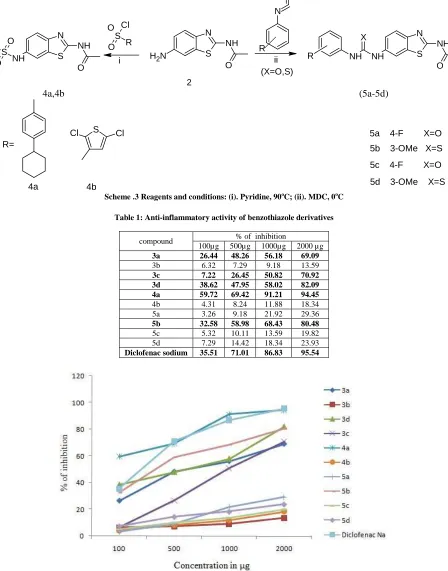
were respectively used to prepare urea and thiourea derivatives 5a,5b,5c, and 5d. The synthetic methods are shown in Scheme.3.
N
S N
H2
NH
O
2
N X
N
S NH
NH
O NH
X
R
(X=O,S) N
S NH
NH
O S
O O R
O S O
Cl
R
i ii
R
4a,4b (5a-5d)
S Cl
Cl R=
4a 4b
5a 4-F X=O
5b 3-OMe X=S
5c 4-F X=O
5d 3-OMe X=S
[image:5.595.82.530.108.679.2]Scheme .3 Reagents and conditions: (i). Pyridine, 90oC; (ii). MDC, 0oC
Table 1: Anti-inflammatory activity of benzothiazole derivatives
compound % of inhibition
100µg 500µg 1000µg 2000 µg
3a 26.44 48.26 56.18 69.09
3b 6.32 7.29 9.18 13.59
3c 7.22 26.45 50.82 70.92
3d 38.62 47.95 58.02 82.09
4a 59.72 69.42 91.21 94.45
4b 4.31 8.24 11.88 18.34
5a 3.26 9.18 21.92 29.36
5b 32.58 58.98 68.43 80.48
5c 5.32 10.11 13.59 19.82
5d 7.29 14.42 18.34 23.93
Diclofenac sodium 35.51 71.01 86.83 95.54
Fig.1. Anti- inflammatory activity of benzothiazole derivatives
3.2. Biology
derivatives. The percentage of inhibition was plotted against concentrations for different samples. The graph is shown below in Fig.1.
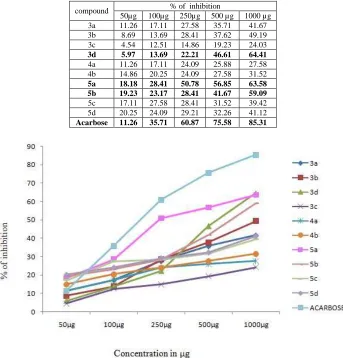
[image:6.595.133.476.193.551.2]Similarly for all the compounds, alpha-amylase assay were carried out by DNS method. The results revealed that only a few compounds showed moderate alpha-amylase inhibition activity. The compound 3d, 5a showed moderate anti-diabetic activity. Anti-diabetic screening data of tested compounds are depicted in table no.2. The percentage of alpha-amylase inhibition was plotted against concentrations for different samples. The graph is shown below in Fig.2.
Table 2: Alpha-amylase activity of benzothiazole derivatives
compound % of inhibition
50µg 100µg 250µg 500 µg 1000 µg 3a 11.26 17.11 27.58 35.71 41.67 3b 8.69 13.69 28.41 37.62 49.19 3c 4.54 12.51 14.86 19.23 24.03
3d 5.97 13.69 22.21 46.61 64.41
4a 11.26 17.11 24.09 25.88 27.58 4b 14.86 20.25 24.09 27.58 31.52
5a 18.18 28.41 50.78 56.85 63.58
5b 19.23 23.17 28.41 41.67 59.09
5c 17.11 27.58 28.41 31.52 39.42 5d 20.25 24.09 29.21 32.26 41.12
Acarbose 11.26 35.71 60.87 75.58 85.31
Fig.2. Alpha-amylase inhibition effect of benzothiazole derivatives
CONCLUSION
A series of new 2,6-disubstituedbenzothiazol derivatives were synthesized, and their inflammatory and anti-diabetic activities were evaluated in vitro. The sulfonamide derivative 4a showed very good anti-inflammatory activity in contrast with 3a,3c,3d,5b that showed moderate activity. On the other hand, in anti-diabetic studies the compounds 3d,5a,5b showed moderate alpha-amylase inhibition activity. These data suggested that the compound 4b may be a powerful inflammatory agent and be worth being further investigated as a potential of an anti-inflammatory agent. Further, the compound 5a may be potent to alpha-amylase inhibition that needs to be further studied.
Acknowledgement
REFERENCES
[1]. VJ Majo; J Prabhakaran; JS Dileep kumar. Tetrahedron letters.; (2003), 44, 8535-37. [2]. AB Nadakarni; R Vijayalaxmi. et al. Indian J of Heterocyclic Chemistry.; (2009), 9, 309-10. [3]. M Maharan; S William; F Ramzy; AM Sembel. Molecules.;(2007), 12, 622-633.
[4]. CJ Sheng; ZW Zhang. et al. Eur J Med Chem,; (2007),Vol. 42, 4, 477–486.
[5]. BS Soni; M Ranawat; R Sharma; A Bhandar. Eur J Med Chem,; (2010),Vol.45, 7, 2938–2942. [6]. VR Solomon; C Hu; H Lee. Bioorg Med Chem Lett.; (2009), Vol. 17, 21, 7585–7592.
[7]. A Kamal; KS Reddy; MN Khan. Bioorg Med Chem.;(2010), Vol. 18, 13, 4747–4761. [8]. PC Sharma; A Sinhmar; H Rajak. et al. J Enzyme Inhib Med Chem,(2003), Vol.28, 240-66. [9]. SR Nagarajan; DA Crescenzo. et al. Bioorg Med Chem.;(2003),Vol.11, 4769– 4777. [10]. VS Patil; KP Nandre; S Ghosh. et al. Eur J Med Chem.;(2013),Vol.59, 304– 309, 2013. [11]. JH Musser; RE Brown; B Love. et al. J Med Chem.;(1984), Vol27, 121-125.
[12]. F Delmas; A Avellaneda; CD Giorgio. et al. Eur J Med Chem.; (2004), Vol.39, 8, 685–690. [13]. VN Telvekar; VK Bairwa.et.al, Bioorg Med Chem Lett.; (2012),Vol.22,1,649–652.
[14]. Y Cho; TR Ioerger; JC Sacchettini. J Med Chem.; (2008),Vol. 51, 19, 5984–5992. [15]. P.Venkatesh; SN Pandeya. International J. ChemTech Research.; 1, 1354 (2009). [16]. B. Gurupadyya; M Gopal; B. Padmashali.et al. Ind. J. Pharmaceut. Sci.; 70,572(2008). [17]. H Kaur; S Kumar; I Singh.et al. Digest J.Nanomaterials and Biostructures.; (2010), 5(1), 67. [18]. K Oketani; N Nagakura ; KT Harada. Eur. J. Pharmacol.;(2001),422, 209.
[19]. R Paramashivappa; KP Phani; PV Rao . Bioorg.Med. Chem. Lett.; (2003), 13, 657. [20]. HM Dıaz et al. Bioorg. & Med. Chem. Lett.; 18, 2871(2008).