International Journal of Emerging Technology and Advanced Engineering
Website: www.ijetae.com (ISSN 2250-2459,ISO 9001:2008 Certified Journal, Volume 3, Issue 1, January 2013)
31
Assessing Pedestrian Crossing Risk at Signalised Intersection
Rizati Hamidun
1, Siti Zaharah Ishak
1,2, Intan Rohani Endut
1,21Malaysia Institute of Transport (MITRANS), Universiti Teknologi MARA (UiTM), 40450 Shah Alam, Selangor, Malaysia.
2Faculty of Civil Engineering, Universiti Teknologi MARA (UiTM), 40450 Shah Alam, Selangor, Malaysia.
Abstract—Pedestrian are most at risk when crossing a road section with a large amount of pedestrian-vehicle interaction. Thus, an understanding of the complex interaction between pedestrian behaviour, signal setting and environment is essential to assess the contribution of these factors to pedestrian accidents. The complexity of these interactions could possibly been described and explored using a powerful and flexible model. The new approach in modelling to produce pedestrian crossing risk index using Petri Nets is introduced in this paper. The proposed model is served as an alternative method to the classical statistical approach in assessing pedestrian crossing risk at signalised intersection. The risk assessment is viewed holistically as an interacting system of subsequent event in an accident process. Observation on the critical signalised crossing and accident history data are used in the development of this risk assessment model.
Keywords— Assessment Model, Crossing Risk, Pedestrian, Petri Nets, Signalised Intersection.
I. INTRODUCTION
Signalised intersections are expected to ensure safety by giving the right of way for traffic movement including pedestrians. Nevertheless, the provision of signalised pedestrian crossing facility may not promise the pedestrian safety due to some reasons such as traffic violation and unsafe signal phasing [1]. Signalised crossing facility located at high speed intersection with turning vehicles may become a hazard to the pedestrian safety [2]. Many studies were highlighting the unsafe condition of signalised intersection due to a high numbers of traffic crashes were occurred and influenced by signalised intersection.
Accident involving vulnerable road user such as pedestrian has become a great concern in traffic safety due to large number of deaths and injuries. The risk of fatality and injury of pedestrian when collide with a vehicle are subjected to the various factors which related to human, engineering and environmental aspects. Identifying and quantifying the impact factors to the risk of severity and fatality in pedestrian crashes have been studied by many researchers around the world [3, 4], however, some factors that are believed associated with the risk of pedestrian crash were overlooked [5].
This paper aims to give an overview of the methodological framework in assessing pedestrian crossing risk using Petri Nets approach. The literature on a variety of factors associated with pedestrian crashes at signalised intersection is highlighted in the first section. Second section briefs an introduction of reliability approach in risk assessment techniques. Lastly, the proposed research design as an alternative approach to assess the pedestrian crossing risk at signalised intersection is presented. Simulating the complex sequence of events in the safety analysis can be perform through the flexibility of Petri nets. Various pedestrian accident factors relate to human, engineering and environment is integrated in a form of hierarchical format of Petri nets model structure.
II. LITERATURE REVIEW
A. Pedestrian crash factors at signalised intersection
Pedestrian-vehicle conflict at signalised intersection happened due to several factors relate to the pedestrian, driver, traffic and environment conditions [6]. Pedestrian behaviour such as crossing against the traffic signal or not in a crosswalk is associated with greater injury risk [7]. There is an evidence saying that the crash risk level will increased eight times when pedestrian adopted an illegal crossing behaviours at signalised intersection [5].
The probability of pedestrian involved with an accident is high while they cross the road particularly with high number of speeding traffic. Crash involving pedestrian and other road users at signalised intersection occur when drivers disrespect red indication by traffic light [8]. Driver attempt to clear the intersection may collide with the pedestrian who has departed from a sidewalk area. A study done by [6] have shown that the demographic factors of a driver is related with the frequency and severity of pedestrian crashes. Male middle age driver involved in vehicle-pedestrian crashes more frequently than other road driver groups.
International Journal of Emerging Technology and Advanced Engineering
Website: www.ijetae.com (ISSN 2250-2459,ISO 9001:2008 Certified Journal, Volume 3, Issue 1, January 2013)
32
Crossing two directions of a signalised intersection practically need a very long clearance times by any pedestrian compared to cross only one traffic direction.
In addition, longer waiting time perceived by pedestrian at signalised intersection will risk the pedestrian who cross a road with unsafe behaviour [1].
The influenced of environmental factors to the risk of crossing pedestrian has been studied by many researcher. Among of them concern on the effect of weather [6], the darkness of crossing location due to poor lighting or night time [9, 10], type of area [11],and the population [12]. All these factors have been proven to be significant with pedestrian crashes through the application of various statistical models.
Summarizing, the factors associated with pedestrian accident deals with multiple interactions between different characteristics of road users, provided engineering control system and environmental factors. Predicting the occurrence of accident requires an understanding of the accident event sequence and it combination factors as a complex system.
B. Reliability in risk assessment
Reliability engineering is a sub discipline under system
engineering which strongly connected to safety
engineering. Reliability measure the probability of successful performance of a system without failure for a period of time.
Reliability assessment in safety analysis considers special techniques in determining risky consequences in a system. Fault tree analysis (FTA) and failure mode and effect analysis (FMEA) are among the popular reliability assessment techniques extensively applied in safety analysis. FTA is useful in identifying the combination events that could lead to major incident. The probability of undesired event can be estimated by analysing the given probability of the events that would terminate the branches of the tree analysis.
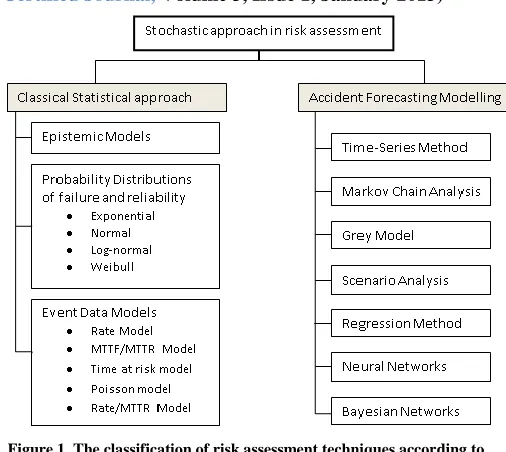
[image:2.612.321.574.114.340.2]Besides, risk assessment deals with the identification of quantitative or qualitative values of risk or hazard of a system using systematic process. Various risk assessment techniques embrace the deterministic and stochastic approach [13]. Stochastic risk assessment techniques have classified into classic statistical approach (CSA) and the accident forecasting modelling (AFM). Probability distribution of failure and reliability is one of the techniques under stochastic risk assessment. The classification of stochastic approach in risk assessment model according to [14] is presented in Figure 1.
Figure 1. The classification of risk assessment techniques according to the stochastic approach
Source: P.K.Marhavilas & D.E Koulouriotis, 2011
Understanding the occurrence of accidents as a failure in engineering system requires the consideration of the relation of it factors [15].The identification of various combinations of failure and hazard in safety studies can be carried out through reliability and risk assessment methods [16]. However, most of the techniques encounter some limitation when used to analyse a complex system due to its elementary theoretical background [17]. Most of existing pedestrian accident modelling have been developed using regression method such as Poisson model [18], logistic regression model [4], mixed logit model [9], ordered probit model [6], generalised linear regression model [3] and negative binomial model [19] have its own limitation. The underlying process in developing pedestrian accident model using statistical approach is relied on the available information in the accident statistics. Yet, the reliance of accident data has been questioning and discussed recently due to several problems [20]. The behavioural information of pedestrian and other road users is seldom available in the accident data.Thus, the reflection of pedestrian behavioural aspect in the existing model development is always missing.
C. Petri nets in Safety Fields
International Journal of Emerging Technology and Advanced Engineering
Website: www.ijetae.com (ISSN 2250-2459,ISO 9001:2008 Certified Journal, Volume 3, Issue 1, January 2013)
33
Petri nets are now used for dynamic systems modelling in a wide range of applications through several new developments such as Stochastic Petri Nets (SPN), Generalised Stochastic Petri Nets (GSPN), Timed Petri Nets (TPNs) or Coloured Petri Nets (CPN) [21].
The application of basic Petri nets and other Petri nets extension is broadly used in the safety field recently. The versatility of Petri nets in translating discrete events in graphical format and simulate complex event sequence create a platform to support risk analysis and accident modelling. Many concepts presently used in risk analysis methods based on event sequence accident theories as reviewed by Vernez, et al. [21] may be implemented in PNs structures. Four possible uses of PNs in safety field can be initiated to accident modelling, objects and modes modelling, state of space modelling and fault and event-tree modelling.
The capability of Petri nets to perform as discrete event simulation tool through dynamic transition firing has turn out to be the utmost interest in safety analysis. Risk assessment model using the extension of Petri Nets allow an integration of qualitative and quantitative analysis through hierarchical format of model structure [22]. The potential of Petri nets to capture the complex interactions influenced by various timing of discrete events make it suitable to be employed for traffic network system [23]. Moreover, Petri nets as a modelling tool is applicable for visualizing the discrete event system behaviour by graphical representation
III. PROPOSED RESEARCH DESIGN
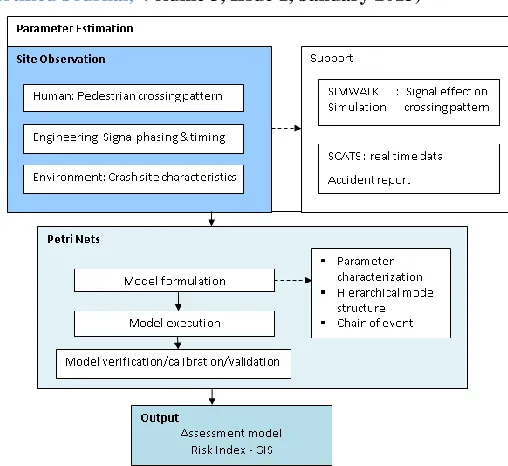
The proposed framework for developing the risk assessment model of signalised pedestrian crossing is illustrates as in Figure 2. This framework provides alternatives modelling approach for further discussion.
[image:3.612.332.586.114.347.2]The method employed for development of risk assessment model start with the parameter estimation which useful for model formulation. Parameter used in this study constitute of direct observation survey data, real time data and the accident past record from police department. The combination of primary data from site observation and secondary data consider three main aspect namely human, engineering and environmental factors which relate to the sequence of events in the pedestrian-vehicle conflict. Real time data for traffic volume, pedestrian crossing volume and signal setting will be obtained from Sydney Coordinated Adaptive Traffic System (SCATS). This system is been used by local authority to adapt the traffic signals timing of the entire road network by utilizing a centralized data centre.
Figure 2. Model development framework
The reaction of human behaviour especially the pedestrian crossing pattern influenced by numerous factors is to be investigated to in this study. Survey data gathered related to the pedestrian crossing behaviour and crossing environment will then be imported to Simwalk. Simwalk is a simulation tool that capable to simulate the changes of geometric design characteristics or the changes of signal setting that may influence the flow of the pedestrians. Variables such as number of agents, walking speed and space, start point, waiting and exit area, socio-demographic parameter need to be identified through site observations.
International Journal of Emerging Technology and Advanced Engineering
Website: www.ijetae.com (ISSN 2250-2459,ISO 9001:2008 Certified Journal, Volume 3, Issue 1, January 2013)
34
This tool will execute specified number of the simulation steps and draws firing graph of the simulation states (marking). Creating and verifying a complex model in assessing safety performance can be accomplished using this tool.
The verification and validation of the model is necessary to ensure of the model developed is useful. Verification process using sensitivity analysis reflects a demonstration that the modelling formalism is correct. Sensitivity analysis is a technique for systematically changing variables in a model to determine the effects of such changes. This analysis is applied to determine the impact the actual outcome of a particular variable if it differs from what was previously assumed. Validation of the model involved performance assessment of the models when compared to real site data of other locations. This process is to prove the model is meet intended requirements in terms of the method employed and the result obtained.
The pedestrian crossing risk assessment model is presented in bipartial graph consists of places, transitions and arcs. The potential risk faced by crossing pedestrian will be obtained from the simulation analysis. The risk index for several pedestrian crossing facilities at signalised intersections are expected to be established and displayed using Geographic Information System (GIS).
IV. DISCUSSION AND CONCLUSION
Pedestrian accident is likely to happen when both of pedestrian and vehicle are arrived simultaneously at a point of the same time and place. The simultaneous arrival of pedestrian and vehicle in the road section involved various sets of multiple interactions of behavioural, engineering and environmental elements. The complexity of these interactions during accident process is possibly to be observed by segregating it into several elementary events [20]. Thus, hierarchical model structure through Petri nets model application is introduced to make this idea be realistic.
This paper outlined the proposed research framework in developing pedestrian risk assessment model using Petri nets approach. This approach considers an accident as a process in stochastic manner. The elementary event in the accident process is representing in hierarchy format to ease the understanding of various interactions within each level of hierarchy. Model in Petri net hierarchical structure will give an overview of an operational system of pedestrian signalised crossing and significant parameter considered in calculating risk index. Applying this approach in the pedestrian crash modelling may give an advantage since it would integrate engineering, human and pedestrian crossing environment factors simultaneously.
The integration of these elements is able to be observed directly from the graphical format of Petri net model. Translation of safety functions into Petri nets formalism can be proficient through places and transitions. The capability of Petri Nets in modelling the complex event sequence for risk analysis is highlighted. The risk index will be displayed in GIS map that visualizes surrounding land use environment with the pedestrian behaviour and accident phenomena in study area. Appropriate measures and alternatives which can enhance pedestrian safety are expected as an output from this framework.
REFERENCES
[1 ] G. Tiwari, S. Bangdiwala, A. Saraswat, and S. Gaurav, "Survival analysis: Pedestrian risk exposure at signalized intersections," Transportation Research Part F: Traffic Psychology and Behaviour, vol. 10, pp. 77-89, 2007.
[2 ] P. Gårder, "Pedestrian safety at traffic signals: A study carried out with the help of a traffic conflicts technique," Accident Analysis & Prevention, vol. 21, pp. 435-444, 1989.
[3 ] L. Leden, "Pedestrian risk decrease with pedestrian flow. A case study based on data from signalized intersections in Hamilton, Ontario," Accident Analysis and Prevention, vol. 34, pp. 457–464, 2002.
[4 ] E. Rosén and U. Sander, "Pedestrian fatality risk as a function of car impact speed," Accident Analysis and Prevention, pp. 536–542, 2009.
[5 ] M. J. King, D. Soole, and A. Ghafourian, "Illegal pedestrian crossing at signalised intersections: incidence and relative risk," Accid Anal Prev, vol. 41, pp. 485-90, May 2009.
[6 ] C. Lee and M. Abdel-Aty, "Comprehensive analysis of vehicle– pedestrian crashes at intersections in Florida," Accident Analysis and Prevention, pp. 775-786, 2005.
[7 ] K. J. Clifton, C. V. Burnier, and G. Akar, "Severity of injury resulting from pedestrian–vehicle crashes: What can we learn from examining the built environment?," Transportation Research, vol. Part D, pp. 425–436, 2009.
[8 ] R. A. Retting, J. F. Chapline, and A. F. Williams, "Changes in crash risk following re-timing of traffic signal change intervals," Accident Analysis and Prevention, vol. 34, pp. 215-220, 2002.
[9 ] J.-K. Kim, G. F. Ulfarsson, V. N. Shankar, and F. L. Mannering, "A note on modeling pedestrian-injury severity in motor-vehicle crashes with the mixed logit model," Accid Anal Prev, vol. 42, pp. 1751-8, Nov 2010.
[10 ]K. E. MacLeod, J. B. Griswold, L. S. Arnold, and D. R. Ragland, "Factors associated with hit-and-run pedestrian fatalities and driver identification," Accid Anal Prev, vol. 45, pp. 366-72, Mar 2011. [11 ]P. Greibe, "Accident prediction models for urban roads," Accident
Analysis and Prevention, vol. 35, pp. 273-285, 2003.
[12 ]M. Wier, J. Weintraub, E. H. Humphreys, E. Seto, and R. Bhatia, "An area-level model of vehicle-pedestrian injury collisions with implications for land use and transportation planning," Accid Anal Prev, vol. 41, pp. 137-45, Jan 2009.
International Journal of Emerging Technology and Advanced Engineering
Website: www.ijetae.com (ISSN 2250-2459,ISO 9001:2008 Certified Journal, Volume 3, Issue 1, January 2013)
35 [14 ]P. K. Marhavilas, D. Koulouriotis, and V. Gemeni, "Risk analysis
and assessment methodologies in the work sites: On a review, classification and comparative study of the scientific literature of the period 2000–2009," Journal of Loss Prevention in the Process Industries, vol. 24, pp. 477-523, 2011.
[15 ]A. K. Verma, S. Ajit, and D. R. Karanki, Reliability and Safety Engineering: Springer, 2010.
[16 ]J. Andrews and B. Moss, Reliability and Risk Assessment. New York: The American Society of Mechanical Engineers (ASME) Press, 2002.
[17 ]D. Vernez, D. Buchs, and G. Pierrehumbert, "Perspectives in the use of coloured Petri nets for risk analysis and accident modelling," Safety Science, vol. 41, pp. 445-463, 2003.
[18 ]R. J. Schneider, R. M. Ryznar, and A. J. Khattak, "An accident waiting to happen: a spatial approach to proactive pedestrian planning," Accident Analysis and Prevention, 2003.
[19 ]L. F. Miranda-Moreno, P. Morency, and A. M. El-Geneidy, "The link between built environment, pedestrian activity and pedestrian– vehicle collision occurrence at signalized intersections," Accident Analysis and Prevention, pp. 1624–1634, 2011.
[20 ]A. Laureshyn, A. Svensson, and C. Hyden, "Evaluation of traffic safety, based on micro-level behavioural data: theoretical framework and first implementation," Accid Anal Prev, vol. 42, pp. 1637-46, Nov 2010.
[21 ]D. Vernez, D. Buchs, and G. Pierrehumberta, "Perspectives in the use of coloured Petri nets for risk analysis and accident modelling," Safety Science, pp. 445–463, 2003.
[22 ] S. Z. Ishak, W. L. Yue, and S. Somenahalli, "An Assessment of Heavy Vehicle Safety at Level Crossing Using Petri Nets: South Australia Case Studies," Journal of the Eastern Asia Society for Transportation Studies, vol. 9, 2011.