International Journal of Emerging Technology and Advanced Engineering
Website: www.ijetae.com (ISSN 2250-2459, Volume 2, Issue 11, November 2012)714
Hybrid Recommendation Techniques for Improving Wireless
Information Delivery
Er. Govind Jhanwar
1, Prof. Kshitij Pathak
2, 1Persuing M.Tech. Mahakal Institute of Technology, Ujjain India 2Proffessor, Mahakal Institute of Technology, Ujjain India
Abstract- Wireless Web is an another important area which is consists of much more complex structures and huge collection of ambiguous data. the wireless portion of the web is also quite different from the traditional web. the information contained in the wireless web is often more concise, more location-specific, and time-critical. the multiplicity of wireless web application among assortment of recommendation aim and technique involve that to gather more and more global recommendation requirements, it is reasonably significant to implement hybrid recommendations for wireless commerce. in this paper, we proposed hybrid recommendation systems in m-commerce, which could integrate multiple association rules together to improve recommendation performance. Our proposed approach based on both straight and meandering rules are attached into one set of global association rules, which might be used for the recommendation of web pages.
Keywords- Personalization, M-commerce, Association rules,
Recommendation systems.
I. INTRODUCTION
Wireless Web faces various advances in hardware technologies; access to application is often very difficult. Most of the application produced for web is not compatible to wireless web due to some constraints. Web pages are not produced for use in mobile devices. Several solutions have been proposed to customize and adapt web pages to mobile access in wireless web. In general, these solutions can be disposed on three categories: Re designing of web sites for use in wireless web environment is the best solution from the usability point of view and it is commonly employed by high popular web sites, like news portals and electronic stores. Its main drawbacks are the cost to create and maintain multiple versions of the same content. Transcoders proxies dynamically retrieve and reformat documents from the web for use in mobile wireless environment. The proposed recommendation system will meets the following requirements:
1. Supports recommendation of standard web pages, in spite of their well formation.
2. Supports the specification of robust recommendation and flexible enough to handle common changes in the source Web page.
Figure1. Personalized wireless device
International Journal of Emerging Technology and Advanced Engineering
Website: www.ijetae.com (ISSN 2250-2459, Volume 2, Issue 11, November 2012)715
After a recommendation is received, the customer can provide information about its accuracy in an Association rules mining is one of the most important and widespread data mining techniques. They reflect regularities in the co-occurrence of the same items within a set of transactions. A
classical example of the associationrule is the discovery of
sets of products frequently purchased together by many independent buyers. In the web location, association rules are characteristically applied to server historical data that contain historical customer sessions. web sessions are meet without any customer involvement and, moreover, they dependably replicate customer behaviour while navigating throughout a web site. For that reason, web sessions can be regarded as an important source of information about customers. Association rules that reveal similarities between web pages derived from customer behaviour can be simply utilized in recommender systems. The main goal of such a recommendation is to suggest to the current customer some web pages that appear to be useful. Classical association rules, here called ―straight‖, replicate associations alive between items that comparatively often co-occur in ordinary transactions. In the web domain, items correspond to pages and transactions to customer sessions. The main idea of the new approach presented is to discover meandering associations existing between pages that rarely occur together but there are other, ―third‖ pages, called transitive, with which they appear relatively frequently. with their important measure—confidence—using pre-calculated straight rules. both straight and meandering rules are joined into one set of global association rules, which may be used for the recommendation of web pages.
performed available techniques could not satisfy all needs.
in our research, we discuss relative issues related to performance and focus on the customization of wireless web interface in commercial applications.
II. RELATED RESEARCHES
At present, there are many researches on how to gain recommendation. In accordance with different data sources, we have divided related work into three categories straight
association rule , meandering association rules, Global
association rules the missing rating based on existing
rating, computing implicit rating based on market basket data, and computing implicit rating based on browsing behavior.
Chengzhi Liu at al[3] In this paper, they was propose hybrid recommendation architecture for mobile commerce system is presented based on agent and ontology technology. Working flow and components of the architecture are described to explain how system components work together.
This architecture is a hybrid algorithm which integrates the results of specific recommendation algorithms. Based on this architecture, a restaurant recommendation system prototype is implemented in an experiment.
Hongwei Liu,[4] in this paper they In this paper they was proposed a novel model, Bayesian network-based implicit rating model, which intends to solve this problem. Browse behavior, marketing basket data, and context information will also be considered in a comprehensive way to construct a Bayesian network.
Chengzhi Liu at al[5] In this paper, they propose a design for open hybrid recommendation systems in mobile commerce, which could integrate multiple recommendation algorithms together to improve recommendation performance. First, three solutions for an open hybrid recommendation approach are discussed in detail, which are generic customer profile, weighted hybrid recommendation algorithm, and mobile device profile creation. After that, we give out a multi-agent architecture design to make the three solutions work together.
Shu Liao at al[6].Nowadays, more and more researches focus on how to provide products for customers based on their interests. Recommendation system in electronic is one of the applications that are based on such mechanism. they designed and implemented an electronic commerce recommendation system used both association rules and sequential rules which is called ASRS(Association rules and Sequential rules based Recommendation System). Compared with conventional methods, more useful results can be found for using the ASRS.
Feng zhang at al[10]Compared with relative recently-reported counterparts, a novel recommender system prototype is implemented. Its efforts focus on the three essential issues as a whole that recommender systems have to handle: data source, data modeling and recommendation strategy. It is based on a common data format and introduces a hybrid-rule model with a strategy of one-round table scanning.
III. METHODOLOGY
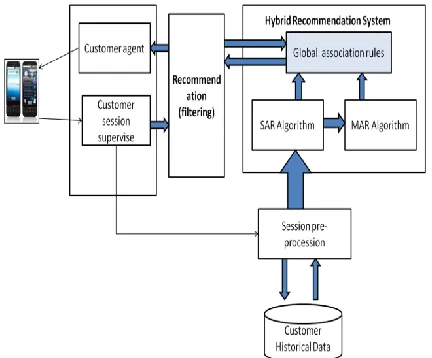
The hybrid recommender system based on association rules was implemented with a distributed architecture (Kazienko, 2004). Each system module might be treated as a software expert-agent that possesses its own characteristic depending on its role in the recommendation process.
Customer Session supervise captures customer HTTP
International Journal of Emerging Technology and Advanced Engineering
Website: www.ijetae.com (ISSN 2250-2459, Volume 2, Issue 11, November 2012)716
Session Preprocessor filters and gathers in its own
[image:3.612.61.277.237.416.2]database finished sessions obtained from customer Session supervise. It also excludes too diminutive sessions, e.g., containing less than two requests. Storing and filtering is performed online. However, Session Preprocessor makes historical customer sessions accessible for off-line association rules mining. Thus, this module works both on-line and off-on-line.
Figure 2. Recommendation process based on the mining of association rules.
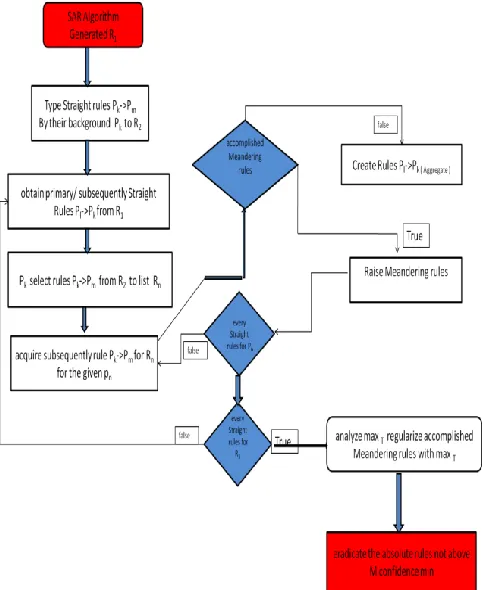
The most important recommendation process is performed off line and involves four modules session preprocessor, straight association rule miner, meandering association rule miner, and global association rule miner. The simply task for session preprocessor is to deliver historical customer sessions to straight association rule miner. Straight association rule miner extracts proper straight association rules from customer sessions using any of wellk nown mining algorithms. The appropriate parameters supmin and conmin are used to include merely rules that seem to be useful meandering association rule miner receives straight association rules from straight association rule miner and calculates meandering association rules using MAR algorithm (fig 2). Similarly to straight association rules, absolute meandering association rules are filtered using the divide minimum confidence threshold iconmin global association rule miner combines into global association rules both straight and meandering rules delivered by straight and meandering association rule miners, respectively (fig2, fig3).
It creates a separate ranking list for each web page based on the obtained global rules global association rule miner function off-line. Recommender is accountable for the conception of the suitable ranking list for every page requested by the active customer. it receives the active customer session data and the requested page (url) from customer session supervise. the requested page is relayed to global association rule miner in organize to obtain the static ranking list for this page based on global association rules. Next, this ranking list is filtered by hyperlink recommender to exclude pages lately visited by the customer according to active customer session data (kazienko and adamski, 2007). m top pages from the filtered ranking list are obtainable to the customer (by means of customer agent). customer agent generates the final web page content for the active
customer.web content includes m hyperlinks
(recommendations) provided by hyperlink recommender. since the web usage patterns tend to change over time, off-line obtained association rules should be periodically recalculated. the knowledge update problem was tackled by the introduction of a special update method into the architecture (kazienko and kiewra, 2003).
IV. STRAIGHT ASSOCIATION RULE
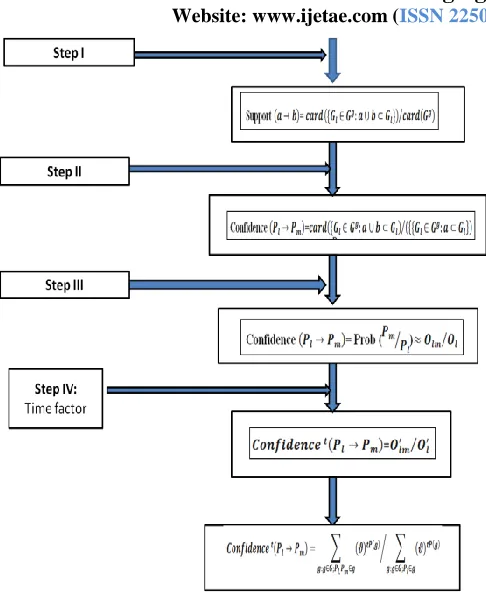
Step I. Let be an independent wireless web page and D a web site content (the web page domain) that consists of
self-determining web pages ∈ D. A set a of pages ∈ D
is called the pageset a. The number of pages in a pageset is called the length of the pageset. A pageset with the length n is denoted as the n-pageset.
Step II. The i-th customer session is the pageset containing all pages viewed by the customer during the i-th
visit on the web site; ⊆ D. G is the set of all customer
sessions gathered by the system, ∈ G G Each session
must consist of at least two pages card( ) ≥ 2. A session Si
contains the pageset a if and only if a ⊆ In a typical data
International Journal of Emerging Technology and Advanced Engineering
Website: www.ijetae.com (ISSN 2250-2459, Volume 2, Issue 11, November 2012) [image:4.612.49.292.117.417.2]717
Figure 3. Straight association rules approach
Step III. A straight association rule is the relationship
a→b , where a ⊆ D, b⊆ D and a ∩ b = ∅. A direct
association rule is described by two measures: support and confidence. The direct association rule a→b has the support The pageset a is the body (or antecedent) and b is the head (or consequent) of the rule a→b.
In this paper we consider dependencies only between 1-pagesets, i.e., single web pages (2-pageset for both sides of
the rule). For that reason, the 1-pageset a including (a =
{ }) will be denoted by and a straight association rule
from to is → . Thus, the rule → is
described by a straight confidence function con( → )
and a straight support function sup( → ). Similarly,
Wang et al. (2002) restricted heads of their straight association rules in a recommender system applied to a distance learning domain. In the context of recommender systems, the support function is used only to exclude weak rules, i.e., only rules that exceed the level of the minimum
straight support ‗supmin‘ are considered for
recommendation.
In other words, support expresses the popularity of a given rule among all others. A straight confidence function
con( → ) denotes with which belief the page may be
recommended to a customer while watching the page
In other words, the straight confidence factor is the
conditional probability P( | ) that a session containing
the page also contains the page : where nlm is the
number of sessions with both and , Nl stands for the
number of sessions that contain .It was assumed that all
pages are statistically independent of one another. But this is not the case. Some pages are connected by links (but most pairs are not), some were recommended by the system while others were not, and some are placed deeper in the web site structure. Hence, from the statistical point of view,
the probability value ( ⁄ ) is only an approximation.
Step IV: Time factor. Some page fads, which have gone a long time ago, cause a significant problem with fig.2 since several customers tend to change their behavior, we should not rely on older sessions with the same confidence
as on newer ones. If a given page was visited together
with a page many times but only in the past, then
should not be recommended so much at present. For that reason, the introduction of the time factor is proposed. The
numbers of sessions nlm and nl in fig. 3 are replaced with
the time weighted numbers of sessions nlm and
irrespectively, as follow where cont( → ) is the time
weighted direct confi- dence, is the constant time
coefficient from the interval [0, 1], ( ) is the number of
time periods since the beginning of the session s until the
processing time. In other words, while calculating nlm and
nl , each session sk, unlike nlm and nl , is counted not as 1
but as ( ) ( )) The time period length—a unit of
measure for ( )—depends on how often customers enter
the web site. The time coefficient denotes the
changeability of the site content and the customers‘ behavior. The more often the site changes, the smaller the value should be. In this way, older sessions have less influence on recommendation results
V. MARALGORITHM
In the distinctive, item-to-item approach to
recommendation based on association rules, ranking lists
are created from the entire set of direct rules → that
exceed minimum confidence and minimum support level
(Chun et al., 2005; Géry and Haddad, 2003). The pages
from all rules → outgoing from are considered at the
creation of recommendation ranking lists for the page .
These rules, and in consequence their consequents , are
International Journal of Emerging Technology and Advanced Engineering
Website: www.ijetae.com (ISSN 2250-2459, Volume 2, Issue 11, November 2012)718
The superior the value of ( → ) for
the page , the higher the position of the page in the
ranking list for the given page . Usually, M top
documents from the ranking list, with the highest value
of ( → ), are recommended on the page
. Since a global rule exists if either a straight or an
meandering association exists, we can expect that the recommendation ranking list based on complex rules will often be longer than typical rankings based exclusively on
direct rules. a little value of α = 0.2 stresses meandering
[image:5.612.49.290.412.707.2]rules that changes the second position in the rankings. Note that ranking lists are static, even though they are occasionally recalculated. their content depends on the behavior of customers visiting the web site in the past but they are not modified to the present customer activities. However, the get candidates for recommendation might be used as the source of further processing, whose aim would be to receive individual lists, additional appropriate for exacting customers. A attractive easy but extremely constructive approach to personalization is the preamble of a alternation method. It eliminates from the ranking list those pages that have previously been recommended to the active customer on the previous page or several pages ago.
Figure 4. Meandering association rule miner approach
VI. GLOBAL ASSOCIATION RULES
To make use of both straight and meandering association rules for the recommendation of web pages, joint and Global association rules are introduced. A Global association rule exists if at least one of two component rules exists, i.e., either straight (Fig. 2 or inclusive meandering (Fig. 3), or both of them (Fig. 3). The major excellence features of both straight and meandering rules— confidences—are combined within Global association rules. The extraction of Global rules is the third stage of the whole process of rule discovery for recommender systems .
A Global association rule → from to exists if a
direct → or a complete indirect →# association
rule from to exists. A Global association rule is
characterized by the Global confidence,
( → ), as follows: ( → )
= ・ con(di→dj)+(1 − α) ・ ( → ),
Process of discovering association rules for
recommendation. where α is the straight confidence
reinforcing factor, α ∈ [0, 1].
( → ) = ( →
). ( → ) Our approach includes a hybrid approach to customer modeling that combines similarity based Straight association rules approach, meandering association rule miner approach and generated Global
association rules. We uniquely identify each customer and
keep a history of the items presented and how the customer interacts with them. Simple rules use this implicit feedback on items to create positive and negative rules examples passed to each Global association rules. The Global
association rules approach are mainly useful in identifying
International Journal of Emerging Technology and Advanced Engineering
Website: www.ijetae.com (ISSN 2250-2459, Volume 2, Issue 11, November 2012)719
[image:6.612.362.540.149.333.2]Personalization provides reimbursement any time there are additional options than simply fit on the screen, and each individual explores only a subset of the available options. many wireless ( mobile) applications are improved by the use of this technology. Downloadable Content a rising trend in the wireless industry is to allow customers to download applications and content such as games, ring tones and images to cell phones. By providing a personalized interface to such a catalog, downloadable items that meet a customer‘s preferences are shown first simplifying mobile web site for applications and increasing the number of downloads Magazine and an interface to magazine enhances the reader‘s knowledge. It makes it easy to follow magazine stories that unfold across several days. When the customer is reading letters to the editor or opinion pages, items related to paper read in the past are displayed. By ensuring that a variety of magazine of impending interest are displayed to the customer, including breaking magazine and lead stories, customers stay informed of important events while pursuing their particular interests.
Figure 5. Recommender link wireless device
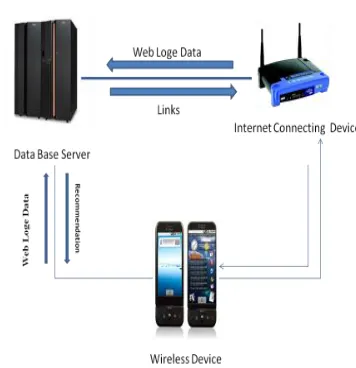
[image:6.612.50.295.387.486.2]Recommends personalized contents based on customers‘ preferences. Customers view recommendations through the wireless devices, using the wireless phone as their remote control. Supports various access networks, such as broadcast cable, mobile network, Internet, and Wi-Fi; such as set-top-boxes and different terminals, wireless internet connected devices and PCs.
Figure 6. Recommender link servers
It‘s an effective convergence platform that analyzes and processes customer info, history, contents and scenes through inference algorithms that recommend the most appropriate content to customers.
VII. CONCLUSIONS
The speedy growth in wireless technology has expanded the opportunity of more wireless device service. The present paper addressed the importance of providing recommendation services to be a focus and we have to proposed hybrid recommendations approach for wireless device using global association rules. However, the study does not address the issue of commitment to the new service provider. This is a crucial problem that most marketing strategists want to resolve.
REFERENCES
[1] K. Chorianopoulos. Personalized and mobile digital tv applications. Multimedia Tools Application, pages 1–10, 2008.
International Journal of Emerging Technology and Advanced Engineering
Website: www.ijetae.com (ISSN 2250-2459, Volume 2, Issue 11, November 2012)720
[3] Hongwei Liu, Zhouyang Liang,‖ Implicit Rating Model inM-commerce Recommendation System‖ 978-1-4244-4507-3/09/ IEEE.- 2009.
[4] Ching-Huang Yun and Ming-Syan Chen, Fellow, IEEE,” Mining Mobile Sequential Patterns in a Mobile Commerce Environment
”-ieee transactions on systems, man, and cybernetics—part c: applications and reviews, vol. 37, no. 2, march 2007.
[5] Chengzhi Liu, Caihong Sun, Jia Yu,‖ The Design of an Open Hybrid Recommendation System for Mobile Commerce‖ ISE 2008. [6] Shu Liao, Tengyue Zou, Huiyou Chang,‖ An Association Rules and
Sequential Rules Based Recommendation System‖ 978-1-4244-2108-4/08-2008 IEEE.
[7] Daniel Gallego and Gabriel Huecas,‖ An Empirical Case of a Context-aware Mobile Recommender System in a Banking Environment‖ Third FTRA International Conference on Mobile, Ubiquitous, and Intelligent Computing- 2012.
[8] M. Hall and E. Frank and G. Holmes and B. Pfahringer and P. Reute-mann and I. H. Witten, The weka data mining software: An update, SIGKDD Explorations, 11:10-18, 2009.
[9] M. Welch and J. Cho,Automatically identifying localizable queries, In 31st annual International ACM SIGIR conference on Research and development in information retrieval, pp. 1185-1186, ACM, 2008.
[10] FENG ZHANG, HUI-YOU CHANG,‖ On A Hybrid Rule Based Recommender System‖ The Fifth International Conference on Computer and Information Technology (CIT‘05).
[11] Guoling Liu, He Jiang, Runian Geng, Huijie Li,‖ Application of Multidimensional Association Rules in Personal Financial Services‖ International Conference On Computer Design And Appliations (ICCDA 2010).
[12] Chellatamilan T. ,Suresh R. M.‖ An e-Learning Recommendation System using Association Rule Mining Technique‖ ISSN 1450-216X Vol.64 No.2 (2011), pp. 330-339.
[13] R. Forsati, M. R. Meybodi, A. Ghari Neiat,‖ Web Page Personalization based on Weighted Association Rules‖ International Conference on Electronic Computer Technology-2009.
[14] M. Kamvar and S. Baluja : Deciphering trends in mobile search. Com- puter, 40(8), 58-62, 2007
[15] Ourdia Bouidghaghen, Lynda Tamine, Mohand Boughanem,‖ Personalizing Mobile Web Search for Location Sensitive Queries‖ 12th IEEE International Conference on Mobile Data Management-2011.
[16] Shuk Ying Ho, Sarah Bull, Customers‘ ―Trust and Intention to Adopt Personalized Mobile Services‖ Journal of Next Generation Information Technology, volume 2, Number 1, February, 2011. [17] Shen, D., Chen, Z., Yang, Q., Zeng, H.J., Zhang, B., Lu, Y., Ma,