Journal of Chemical and Pharmaceutical Research, 2014, 6(3):1242-1248
Research Article
CODEN(USA) : JCPRC5
ISSN : 0975-7384
Formulation and evaluation of Lomefloxacin HCl as semisolid
dosage forms
Sadik Almekhlafi
1and Anes A. M. Thabit
2*
1
Department of Pharmaceutical Chemistry, Faculty of Pharmacy, University of Science & Technology, Yemen
2Department of Pharmaceutics, Faculty of Pharmacy, University of Science & Technology, Yemen
_________________________________________________________________________________________
ABSTRACT
The aim of this work was to formulate lomefloxacin HCl as a semisolid dosage form appropriate for topical dermatological application.Five empirical semisolid formulations were prepared with 1% drug strength in each. Three of those formulations contained hydrophilic bases (w/o cream , hydrophilic gel and a water soluble ointment) while the other two (simple ointment, lanolin ointment) were hydrophobic. The hydrophilic formulations showed better in vitro drug release than the hydrophobic ones. Among hydrophilic formulations, the cream and the water-soluble ointment showed excellent drug release. However, the ointment blank base showed antibacterial activity and was therefore excluded. For optimization of the drug strength in the cream formulation, the cream was reformulated so as to contain lower drug strength including(0.75, 0.5,0.2. & 0.125%)and their antibacterial activities were evaluated. The lowest effective strength of the drug in the prepared cream was 0.125%. Upon comparing with two commercial brands of topical antibacterials, lomefloxacin 0.125% cream formulation was be more potent and more effective antibacterial activity than those brands. Thespreadability, pH and of the cream formulation was accepted. Furthermore, theformulation caused no significant skin irritation on lab animals and its predicted isothermal shelf-life was quite long.
Keywords: Lomefloxacin HCl, semisolid, drug release, cream, 0.125%
_________________________________________________________________________________________
INTRODUCTION
Lomefloxacin hydrochloride [(±)-1-ethyl-6,8-difluoro-1,4-dihydro-7-(3-methyl-1-piperazinyl)-4-oxo-3-quinoline carboxylic acid , monohydrochloride][1] isa second generationfluroqunolone with a broad spectrum activity against gram positive aerobic bacteriain particular Staphylococcus aureus (including methicillin-resistant strains)and gram-negative aerobes such as Haemophilusparainfluenzae, Klebsiellaozaenae Proteus
vulgaris , E.coli and Neisseria gonorrhea[2]. To the best of our knowledge, this drug is not yet available as
topical semisolid dosage forms.
EXPERIMENTAL SECTION
2.1. Materials 2.1.1. Apparatuses
U.V spectrophotometer(6315, Jenway ,UK); Mechanical stirrer (X230D-Labtech, UK.); PH-meter (3510, Jenway , UK); Incubator (D-6450 , Heraeus, Germany). Besides, Aspreadability tester and a dissolution apparatus were constructed in our laboratory according to designs obtained from the literature.
2.1.2. Materials and Reagents
Lomefloxacin HCl standard (potency 99.8 %) was a gift from Pharmacare drug Co., Yemen. Specimens of
staphylococcus auresus was kindly provided by the medical laboratory of Alaqsa hospital, Hodiedah, Yemen.
Propyl paraben was provided kindly by Shifaco co., Yemen. White wax, HCL and potassium hydroxide (Uni-Chem, India); White petrolatum and glycerin (Qualichem, India), Sodium lauryl sulfate, polyethylene glycol 4000 and Potassium monohydrogen phosphate (Himedia, India); Poly ethylene glycol, chloroform, propylene glycol, ethanol , polyethylene glycol 400 and n-hexane (Schardlab, Spain). Wool fat and Vaseline (AL-gmal lab. Yemen); Molar Hinton agar(Remale , India).
2.2. Methods
2.2.1. Preliminary experimentations (i) Standard calibration curves
A stock solution of 1 mg/100 ml of loemfloxacin HCl in phosphate buffer pH 7.4 was prepared. Then, a serial dilution was done to obtain solutions of concentrations ranging from 0.5 to 10 µ g/ml. The UV absorbance of those solutions was measured at 281 nm[6]. The standard calibration curve was then constructed and the regression equation of that curve was determined.
(ii) Antibacterial activity of lomefloxacin HCl
The antibacterial activity of lomefloxacin HCl was investigated against staphylococcus aureus as described in the literature[7]. A stock solution of the drug in methanol (1mg/L) was prepared and serial dilution was performed to obtain five dilute solutions. The disk diffusion method was employed with the use of 6 mm sized pieces of Whatman`s filter paper No.3 as disks. In addition to blank, each solution was applied to saturate one disk. The drug contents per disk were 0, 2.5, 5, 10, 15, 20 µg. The tests were incubated for 24 hours at 37oC ± 1 oC.Then, the inhibition zone around each sample was observed and its diameter was measured in mm.
2.2.2. Preparation of lomefloxacin HCl semisolid formulations
Fivesemisolid formulations were prepared containing 1 % of lomefloxacinHcl in each. Two formulations were hydrophobic ( F1: oleaginous" simple" ointment ) , (F2: lanolin "absorptive"ointment) , while the other three were hydrophilic including : (F3: PEG "water-soluble" ointment), (F4: O/Wcream ) and (F5: PEG gel). The quantities of each excipient used are shown in Table 1 and were in accordance to those reported in the literature. The method used for all preparations was the fusion method in water-bath at 70 oC[4, 5].
Table 1. Amounts of Ingredients (g) to prepare 100 g of semisolid preparation of lomefloxacine HCl 1%
2.2.3. Evaluation of Formulations (i) pH of creams & Gels formulations
An accurately weighed quantity 5± 0.01 g of the formulation was placed in a 100ml beaker. 45 ml of water was added and the cream was dispersed in it. The pH of suspension was determined at 30oC [9].
Ingredient F1 F2 F3 F4 F5
PEG 4000 - - 54.9 - 56.9
White petrolatum 94.9 - - 24.9 -
White wax 4.9 - 24.9 -
Yellow wax - 4.9 - - -
Vaseline - 89.9 - - -
Lanolin - 5 - - -
PEG 400 - - 44.9 - -
Sodium lauryl sulfate - - - 1 -
Propyl paraben 0.2 0.2 0.2 0.2 0.2
Propylene glycol - - - 12 22
Ethanol 96% - - - - 7.5
(ii) Drug content
Drug content in formulations was determined by UV spectrophotometry at 281 nm as reported by Cristiani G.G. & Salgado H.R[10] with slight modification. A quantity of the formulation equivalent to 0.01g of the drug was shaken with 9 ml of phosphate buffer pH 7.4 and then the solution was filtered. 1 ml of the filtrate was diluted up to 10 ml of the same solvent. The solution obtained was alkalinized to pH 12.7 by 1M KOH and transferred into a separated funnel then 15ml chloroform was added and shaken. The separated chloroform layer (lower) was then evaporated to dryness to leave a dry residue. The dry residue was dissolved in 10ml of phosphate buffer pH 7.4 and then the solution was filtered. The absorbance was then measured by UV spectrophotometer at 281 nm using the buffer as blank. For formulations containing oils, fats or waxes (F1, F2 and F4) anprimary step in procedure of assay was carried out to separate oleaginous materials from the formulation by extraction with 10 ml n-hexane.
(ii)In vitro drug release
The dissolution apparatus was constructed as described by Al-Khashab et.al[11]. A small funnel with a diameter of 2.3 cm filled with 5 g of the tested formulation. The mouth of the funnel was covered with filter paper, and was secured in place with a rubber band. This cell was inverted and immersed up to 0. 5 cm in 500 ml of phosphate buffer pH7.4 contained in the flask of the dissolution apparatus . The flask was partially immersed in a large water bath at a constant temperature of 37°C inside the dissolution apparatus. The stirrer was immersed in the collecting medium and the stirring rate was maintained at 100 r. p. m. The flask was partially immersed in a large water bath at a constant temperature of 37°C inside the dissolution apparatus. The stirrer was immersed in the collecting medium and the stirring rate was maintained. The net release of Lomefloxacin HCl was followed by monitoring the receiver medium concentration for 120 minutes. 10 milliliters sample was withdrawn at specific intervaland filtered. Then, 10 ml of the phosphate buffer pH 7.4 was added to 1ml of the filtrate. pH was adjusted to 12.7 to make an alkaline medium and transferred to a separating funnel and 15ml of chloroform was then added and shaken. The separated chloroform layer (lower) was evaporated to dryness at 65oC. The drug residue left was dissolved in 10ml of the same buffer and solution was eventually filtered.
The UV absorbance of the filtrate was measured at 281 nm. The drug release kinetics were studied by fitting the dissolution profile of each formulation to zero order, First order, Higuchi and KoresmeyersPeppa`s models. [12].The similarity factor (f2)was determined between drug release of twoformulations were determined. The two dissolution profile are considered similar if f2is ≥ 50[13].
(iv) Antibacterial activity of the drug in formulations Test procedure
The antibacterial activity of lomefloxacin HCl in the formulations that showed the best in-vitro drug release, was investigated against staphylococcus aureus cultured in molar Hinton agar. The results were also compared to those blank semisolid bases. The method used was the standard cup plate as reported in the literature[14]. In each dish 4 holes (cups) measuring 8.0 mm in diameter were bored into the over-dried agar using a sterile test tube. 0.1g of the tested formulation equivalent was introduced into each hole. The tests were incubated at 37oC ± 1 oC for 24hr and the inhibition zone diameter around each sample was observed and measured in mm.
(v) Optimization & Comparison
Optimization of the drug strength was carried out by preparation of similar formulations containing lower concentrations of the drug including: 0.75, 0.5, 0.25 and 0.125%. The drug content % in these formulation was determined as described earlier. The antibacterial activity of the formulation containing the lowest effective strength was compared to those of two brands of antibacterial creams including fusidic acid 2 %and ciprofloxacin 0.5 %. The antibacterial activity tests for the purpose of optimization and comparison were performed the same way described earlier.
(v) Spreadability
Spreadability was calculated as follows: S= m.l /t; where, S was the spreadability (g.cm/sec), (m) was the weight tied to upper glass slide (g), l was the length moved on glass slide(cm) and t was time (sec).
(vi) Skin irritation test
This test was conducted to evaluate the irritancy of the prepared formulation on the intact skin of animals [16]. The formulation containing the lowest effective strength were tested on Threelab animals (rabbits) as follows: Each animal was kept in a different cage and supplied with fresh food and water during the test period. 24 hours prior to test, the hair from the spine region was shaved to expose sufficient large test area. The test site was cleaned with surgical spirit then 5g from was applied to test area. The test site was observed for erythema and edema for 6, 12 18and 24 hours after application.
(vi) Isothermal stress stability study
The test was carried out as described in the literature [11,17]. Samples, each of 100 grams, of the tested formulation were packaged in tightly closed plastic-containers and kept at refrigerator (2 °C ) , incubator 35°C, and oven at 70°C .Analytical samples were taken at at 0, 1, 3 and 9 weeks thereafter and its stability was evaluated in term of physical changes and chemically in terms of drug content. The order of degradation reaction was determined by fitting data to zero and first-order model. The rate constant of degradation (K) at each storage condition was then determined and used to construct Arrhenius plot of ln K versus I/T where T is the temperature of storage in Kelvin. The shelf-life (t90)was then predicted from the Arrhenius plot as follows [5] :
Ln K25 =ln A – [ (Ea/R) * (1/T25)
t90 = (0.1 * Q 0
)/K25
where in A was the intercept in Arrhenius plot ; Ea was the energy of activation , R was the gas constant , (Ea/R) was the slope of the plot and Q0 was then initial drug content %
RESULTS AND DISCUSSION 3.1. Preliminary experimentations
3.1.1. Standard calibration curve
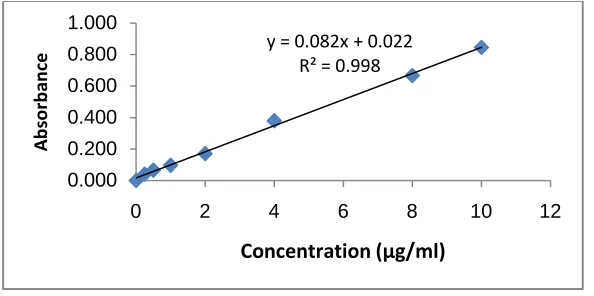
As shown in Fig. 1, the standard calibration curve of lomefloxacin HCl in phosphate buffer pH 7.4 obtained with UV analysis at 281nm, was linear with linearity (R2) of 0.998.
[image:4.595.159.456.497.645.2]The regression equation of the curve was: y = 0.082x + 0.022. In addition, the limit of detection (LOD) and limit of quantitation (LOQ) that were determined from the curve were 0.04 and 0.122 µg/ml, respectively, which indicated the sensitivity of the analytical method used.
Fig 1. Standard calibration curve of UV absorbance at 281 nm of lomefloxacin HCl in phosphate buffer pH 7.4
3.1.2. Antibacterial activity of lomefloxacin HCl
The bacteria showed susceptibility to lomefloxacin HCl disks containing 10µg of the drug with inhibition zone of 23 mm. This result was in compliance to that published in the literature [7].
3.2. Evaluation of formulations
3.2.1. pH of cream and gel formulations
The average pH of the cream and gel formulations were 7.1(±SD : 0.128 ; C.V.: 1.803 %) and 7(±SD : 0.073 ; C.V.: 1.043 %) respectively. pH values of these formulations will be compatible with the human skin pH which raises
y = 0.082x + 0.022 R² = 0.998
0.000 0.200 0.400 0.600 0.800 1.000
0 2 4 6 8 10 12
A
b
so
rb
an
ce
beyond normal values (4.5-6) when a person suffer from a skin problem. For the same reason, the in vitro drug release investigation as shown later, was carried out at pH 7.4[9].
3.2.2. Drug content results
As shown in Table 2, The drug content in all prepared formulations were between 99.8- 100.2 (95% C.l. of 99.5-100.1%) which indicated the absence of significant difference in such parameter among all formulations and would exclude any possible impact of drug content on the drug release investigated thereafter. The result also revealed that excipients employed had no negative influenceon the drug in all tested formulations.
3.2.3. In vitro drug release
Fig. 2 and Table 2 demonstrates the data obtained from in vitro drug release test. All formulations except F5 obeyed zero-order kinetic with highest correlation coefficient toward that order when compared to those obtained when data fitted to first-order (Table 2, ). Data of drug release in all formulations was also fitted to Higuchi equation (correlation coefficient ≥ 0.95) explaining the controlled diffusion mechanism of drug release from the formulations matrices. Furthermore, the diffusion exponent (n) values of all formulations were found to be more than 0.5 indicating non-Fickian diffusion which guarantees the continuous drug release regardless the concentration difference between inside and outside the formulation.
In comparing the drug release form a formulation to another, it was obvious that hydrophilic formulations (F3, F4 and F5) showed better drug release than the hydrophobic ones (F1 &F2) in terms of cumulative drug release 0-120 minutes.However, the highest drug release were obtained with only two hydrophilic formulations F3 ( water soluble PEG ointment) and F4 (W/O cream). These two formulations were the only one that didn`t slowdown the drug release as compared to pure drug (F0) release. Indeed, the formulations had greater cumulative drug release than the pure drug indicating the positive influence of the bases on the drug release. The similarity factor (f2) was estimated to compare the drug release of these two formulations and was found to be 50.9 which indicated that there was no significant difference in their drug release. Consequently, F3 and F4 formulations were selected for the subsequent investigations.
Table 2. Results of evaluation of the prepared lomefloxacin HCl semisolid formulations
[image:5.595.103.509.440.726.2]▲: F0: Pure drug ; SD: standard deviation ; C.V.: coefficient of variation
Fig .2 Drug release profiles of lomefloxacin HCl from different semisolid formulations
0 20 40 60 80 100
0 20 40 60 80 100 120 140
C
u
m
.d
ru
g
r
e
le
a
se
%
Time (min.)
F 0 : Pure drugF 1 : Oleaginous oint F 2 : Absorptive Oint F 3 : water-sol Oint F 4 : O/W cream
F 5 : gel
Code Drug content % (Q
0)
(±SD; CV%)
Drug release Data
Peppa`s (n) cumulative
drug release %
Correlation coefficient zero
order first
order Higucchi Peppa`s
F0▲ 98.8 (± 0.019; 0.019 %) 85.9 0.971 0.794 0.971 0.972 0.783
F1 99.8 (±0.017; 0.017 %) 49.8 0.958 0.835 0.993 0.987 0.722
F2 100.2 (± 0.053; 0.053%) 39.5 0.939 0.805 0.986 0.981 0.825
F3 100.1 (±0.110; 0.110%) 95.3 0.871 0.757 0.965 0.969 0.672
F4 99.1 (±0.416; 0.420%) 92.8 0.913 0.678 0.991 0.959 0.826
3.2.4 Antibacterial activity in drug formulations
The antibacterial activity of lomefloxacin HCl in the two selected formulations (F3: water soluble ointment and F4: w/o cream) was investigated. The bacteria exhibited great susceptibility to both formulations with inhibition zone diameters of an average of 36.3 mm (SD : ± 0.577 ; C.V.: 1.59 %) and 31.3 mm (SD : ± 1.155 ; C.V.: 3.68 %). However, the bacteria also showed susceptibility to F3 blank formulation probably due the antibacterial effect of ointment base. As a result, this formulation wasexcluded from further investigations.
3.2.4. Optimization & comparison
Due to the remarkable antibacterial activity observed with the 1 % cream formulation and in order to determine the lowest effective strength of the drug in formulations, 4 similar formulations of the cream with lower drug strength of 0.75, 0.5, 0.25 and 0.125 %. The drug contents % in the four formulations were 98.95, 100.4, 101.4 and 99.8 %, respectively. It was found that the 0.125 % drug strength formulation was still active against bacteria with an average inhibition zone of 24.7 mm (SD ±0.577 ; C.V.: 2.336%). In other respect, the that formulation was foundto be more potent and more effective in terms of in vitro antibacterial activity than two commercial brands of topical antibacterial creams including ciprofloxacin HCl 0.5 %and fusidic acid 2. The average of inhibition zone diameter in these brands, respectively, were 24.333 mm (SD: ± 0.305 ; C.V. : 1.253 %) and 14.5 mm (SD: 0.109 ; C.V.: 0.752 %) indicating resistance of the bacteria to fusidic acid in that brand.
3.2.5. Spreadability& Skin irritation test
The average spreadability of 0.125 % cream formulation of lomefloxacin HCl was found to 10.6 g.cm/sec (± SD: 0.194 ; CV.: 1.831 %). This result was close to that of a commercial brand of fusidic acid 2 % cream cream of 9.2 g.cm/sec (± SD: 0.206 ; CV.: 2.239 %). The result ensured the product spreadability and hence its convienent use for patients. Regading the skin irritation test, the lomefloxacin cream caused no sign of irritation on the 3 tested rabbits which established the safety of the formulatio . However future investigation on human beings are still to be estimated.
3.2.6. The isothermal stress stability study
[image:6.595.84.529.464.641.2]The kinetic order of the drug degradation at the three storage conditions (2, 35, 70 oC) obeyed the zero-order. The zero-order degradation rate constant K0 in those conditions were 0.034, 0.079 and 0.478 week-1, respectively. The shelf-life (t90) at 25oC storage conditions was predicted from Arrhenius plot (Fig.3) and found to be 2.65 years. Physical stability was alslo confirmed at 2 and 35oC storage condition while melting of the cream was onserved at 70 oC storage. This accepted shelf- life predicted in this study indicated a good stability of the drug in the proposed formulation and its suitability for large-scale productions.
Fig. 3 Prediction of shelf life of lomefloxacin HCl in 0.125% cream formulation by Arrhenius plot
CONCULSION
This study presents a simple formulation of lomefloxacin HCl as topical cream for dermatological purposes. The formulation is characterized by an economic strength of 0.125% and appropriate quality criteria including approved quantitation method, accepted in vitro drug release, spreadability, safety on lab. animals and a long predicted shelf-life. Yet, further investigations are still to be established in particular the skin irritation test on human beings and a long-term stability study.
y = -3631x + 9.6386 R² = 0.9383
-4
-3.5
-3
-2.5
-2
-1.5
-1
-0.5
0
0 0.0005 0.001 0.0015 0.002 0.0025 0.003 0.0035 0.004
ln
K
01/ T
ln A = 9.6389
Slope = Ea/ R = -3631 1/T25 = 0.003356
ln K25 = - 2.546 ; K25 = 0.078 Q0 = 99.8in F4 0.125%
Acknowledgment
The authors are thankful to Pharmacare drug Co., Yemen and to Mr. Mohammed J. Alhadad and Mr. Nabel Alfakeh for their kind assistance to accomplish this study .
REFERENCES
[1].Sweetman S C.Martindale: The complete drug reference, Pharmaceutical Press, 2005; 1555-1556. [2]. Catherine M. Oliphant et.al. Am Fam Physician., 2002, 65(3), 455-465.
[3]. Swarbrick J. Encyclopedia of pharmaceutical technology: Semisloid preparations. 3rdEdition, Informa healthcare Inc.,1990, 5, 3257-58.
[4]. Loyd V Allen . Ansel’s Pharmaceutical dosage Forms and drug delivery Systems, 9th Edition, Wolters Kluwer,
2011, (10), 272-293.
[5].Aulton. M.E. Pharmaceutics: the science of dosage form design, 2ndedition, Churchill Livingstone, 2002, (1)6-7, (7)108-109, (33)504-505
[6]. Sultana Najma et al.Pakistan Journal of Pharmaceutical Sciences, 2005, 18 (3), 59-65 [7]. Amaran M. Shah et al. Bangladesh Pharmaceutical Journal, 2011 (14), 31-35. [8]. Purushotham et al. Der Pharmacia Lettre, 2011, 3(1),103-112.
[9]. Lingan M. Abraham et al. Sci. Revs. Chem. Commun., 2011,1(1), 7-17
[10]. Cristiani G.G. & Salgado H.R., Acta Farm. Bonaerense, 2005, 24 (3), 406-8.
[11]. Al-Khashab Yasir E. Al-Mustansiryah university Journal for pharmaceuticalsciences( AJPS), 2010, 8 (2), 80-95.
[12]. Basak S. C et al. Brazilian Journal of Pharmaceutical Sciences, 2008, 44 (3), 477-483.
[13]. Chow Shein- Chung, Statistical design of stability studies, Taylor & Francis Group, 2007, (11), 213 [14] K. Adeniji Olowosulu et al. Journal of pharmacy and bioresources, 2005 (2),124-130.
[15]. Rajalakshmi G. et al., International Journal of Pharma and Bio Sciences, 2010, 1 (4), 7-16. [16]. H.K.E.S. International Journal of Pharma and Bio Sciences, 2010, 1(3), 1-11.