An ereadiness framework for
construction materials procurement
Adzroe, EK and Goulding, J
Title An ereadiness framework for construction materials procurement Authors Adzroe, EK and Goulding, J
Type Conference or Workshop Item
URL This version is available at: http://usir.salford.ac.uk/30979/ Published Date 2004
USIR is a digital collection of the research output of the University of Salford. Where copyright permits, full text material held in the repository is made freely available online and can be read, downloaded and copied for noncommercial private study or research purposes. Please check the manuscript for any further copyright restrictions.
AN E-READINESS FRAMEWORK FOR CONSTRUCTION MATERIALS PROCUREMENT
KOFI ADZROE, K. and GOULDING, J.
The Research Institute for the Built and Human Environment, University of Salford, M7 1NU, UK
Contact: [email protected] [email protected]
ABSTRACT: The traditional system of construction materials procurement is predominantly a paper-based transaction based on procedural processes. This approach has several limitations, most notably concerning communication difficulties with suppliers, contractors, purchasing departments etc; the nuances of which are exacerbated by transactional delays, delivery time issues, and inadequate communication processes (e.g. product differentiations, semantics etc). These issues therefore need to be addressed, as operating and maintaining an efficient/effective materials procurement system is essential for contractors to remain competitive in today’s environment (Kong et al, 2001). Advances in Information Technology (IT) have had a significant impact on organisations’ core business processes, and numerous companies are now using IT to deliver core business operations. In particular, the proliferations of intranets, extranets, and improved interoperability issues associated with the Internet, have made it possible to take advantage of these technologies (using them as a key driver for information sharing and exchange). Furthermore, managers are now starting to appreciate that understanding IT capability can often help deliver core capability (Feeny and Willcocks, 1998). In this context, this paper introduces an e-readiness framework specifically designed to exploit and maximise the benefits of IT in the materials procurement process, reinforced by the principles of Capability Maturity Models (CMM).
Keywords: E-Readiness; IT; Internet; Materials Procurement; Process Improvement;
1. INTRODUCTION
The rapid growth in the global adoption of Internet technologies has been a stimulus for change in all sectors of the industry, forcing all stakeholders to reconsider how they execute their business (Lockley et al 2002). This wave of global Internet technology has had an impact on construction, and many companies have also undertaken process restructuring in order to automate their business processes in line with modern business trends.
Until recently, the construction industry has had few methodologies or models upon which to base process improvements and innovations. However, industry researchers and academia have now undertaken extensive work in this area developing experience from other industries such as manufacturing (Cooper et al. 1998, Khalfan et al. 2001). Furthermore, Sarshar et al, (2000) observed that “the absence of clear guideline has meant that improvements are isolated and benefits could not be co-ordinated or repeated”. It is therefore clear that UK construction industry is unable to systematically assess process, prioritise improvements towards specific needs, therefore unable to meet targets observed by Egan (1998).
2. THE TRADITIONAL PROCUREMENT APPROACH
2.1 Traditional Materials Procurement Process
In a traditional contractual situation, materials procurement is normally undertaken by the main contractor, and is ostensibly considered as part of the pre-construction stage. Therefore, the contractor tends to focus on how materials will be procured throughout the whole construction period. However, the materials tend to be specified to meet the client/designer’s requirements (which can sometimes cause certain logistical and sourcing problems), and the success of any construction project is greatly dependent upon the source and quality of materials procured. Materials procurement is therefore a crucial stage in the construction process, especially securing the provision of the right materials at the right time, in the right place to an agreed budget Canter (1993).
The materials procurement process in the traditional system encompasses two stages, notably: the tender stage and post-construction stage - as illustrated in Figure 1. Figure 1 shows a systematic sequence in a traditional materials procurement process; for example: when tender documents are received by contractors, they start estimating immediately; send out enquiries to materials suppliers and merchant companies. After receiving quotes from suppliers, contractors will then select the best quotes from the bulk orders received in order to proceed and complete the tender process. If the contract is awarded to the contractor, the procurement functions commence with the re-enquiry and negotiation stage – see Figure 1. The purchasing function reconfirms the validity of the suppliers’ original quotations or negotiations, and revisions to previously received quotations are updated. Once potential suppliers are identified and selected, the next stage in the procurement process is to raise issues and purchase orders with suppliers. This action then constitutes a legal contract when the supplier accepts receipt of the order. In effect, the order becomes a written commitment to accept and pay for goods under an agreed set of terms and conditions. Once notification of dispatch is received, orders will be tracked until materials are received and checked on site (Kong et al. 2001).
Tender Stage Post-Contact Stage
Tender Receipt
Estimating
Look for Suitable Materials
Send out Enquiries to Suppliers
Quotes Received
Analyses
Selection of Best Quotes
Tender Prepared and Submitted
Contract Awarded
Re-Enquiry & Negotiation
Supplier Selection
Records Kept Progress Measured
Order Placed
A purchase order becomes a legally binding document between the buyer and seller only when it is formally accepted by representative of either parties or organisations.
2.2 Flow of Information in the Materials Procurement Process
A smooth flow of information is vital to the materials procurement process in order to prevent ambiguities and misunderstanding in the materials procurement process. This should be achieved from the initial stages of the tender process, through to the acquisition of quotes (from suppliers) to the actual receipt of materials on-site. This flow of information embraces: signing of invoices, numerous different forms of paper-based documents, copying etc - all passed and referenced by different groups of participants in the traditional materials procurement process (Kong et al. 2001).
During the tender stage of any construction project, the estimating teams associated with the contractors bidding for the project obtain materials information from physical catalogues from suppliers. Based on these catalogues information, they compare and select suitable suppliers and send enquiries to them for quotes.
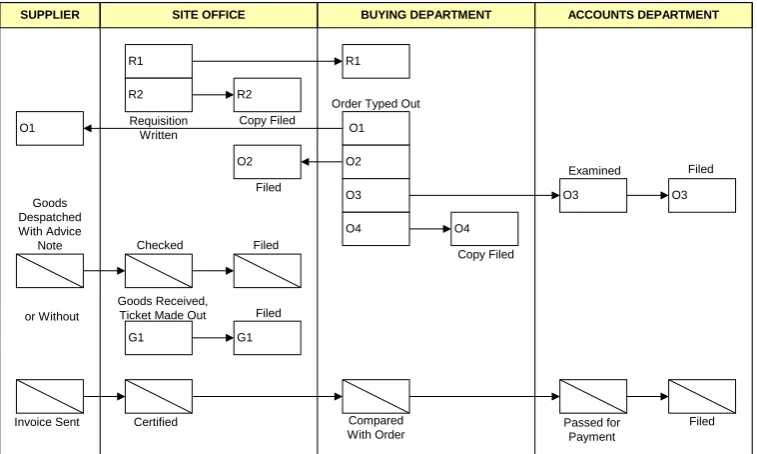
Figure 2 identifies the process of ‘a typical paper-based document system of purchasing functions during the post-contract stage of a project’ (Calvert, 1995). For example, the site office prepares two copies for the requisition of materials required, a copy of which is sent to the buying department and one copy is filed. The buying department then prepares four copies of the purchase order covering the required materials. One copy of each of the purchase orders is sent to the selected supplier and the site office. The accounts department and the buying department each receive a copy each for their records. The site office receives an advice note, and the invoice issued by the materials supplier when the materials arrive on the project site. The buying department then compares the invoice with the purchase orders issued to the supplier by the buying department. After these been confirmed, they are then passed to the accounts department to issue payment.
Requisition Written R1 R2 R1 O3 O3 R2 O1 O2 O3 O4 O2 O1 O4 G1 G1
SUPPLIER SITE OFFICE BUYING DEPARTMENT ACCOUNTS DEPARTMENT
Copy Filed
Order Typed Out
Copy Filed Filed Filed Examined Filed Filed Checked Goods Despatched With Advice Note or Without Goods Received, Ticket Made Out
Invoice Sent Certified Compared With Order
Passed for Payment
[image:4.595.112.491.459.686.2]Filed
2.3 Limitations with the Traditional Materials Procurement Process
Organisational difficulties often exist if processes are not well-defined and established. Whilst well established, the traditional materials procurement process has a number of operational limitations, and is somewhat antiquated in today’s business IT-driven business environment. This is particularly true in the construction industry, where IT is gaining priority and strong strategies for IT/IS is now being developed to support key operations. Two main limitations have been identified regarding materials procurement i.e. geographical regionalism and a high dependence on paper-based transactions.
3. INFORMATION TECHNOLOGY AND E-READINESS
3.1 Information Technology Benefits
Advances in communication technology and the Internet have created new dimensions and approaches for business environments. Organisations are increasing using IT in an attempt to secure existing markets, or gain a competitive advantage (Goulding and Alshawi, 2002). The power of IT can now be exploited to help organisations enhance their performance and create wealth through new business practices. It has also enabled them to move away from traditional approaches that have produced inefficiencies and non-value adding activities. IT can help organisations plan strategically, and assist in developing their core capabilities - to secure competitive advantage. Furthermore, the added capability can transform organisations, enabling them to create new business opportunities.
3.2 Information Technology and Process
Davenpot and Short (1990) define business process as a set of logically related tasks performed to archive a defined business outcome. A process is therefore a structured, measured set of activities designed to produce a specific output for a particular customer or market (Davenpot, 1993). Adopting a process view of business allows activities to be appreciated as a series of structured events, with inputs and outputs, and a mechanism for action (Goulding and Alshawi, 2002).
There are several ways organisations can map out their process improvement strategy to enhance their competitiveness. However, delivering IT solutions requires well organised mature processes and procedures; and organisations should therefore endeavour to restructure their processes in order to achieve the full impact of IT.
3.3 Developments in Information Technology and Procurement
3.4 E-Ready Organisations and Process
It is increasingly evident that many construction organisations have been using the Internet in different ways (including trading with other service providers). A large proportion of these activities comprise purchasing bulk materials and engaging in some form of legal framework agreements with merchant companies. However, there is no one standard form of agreement.
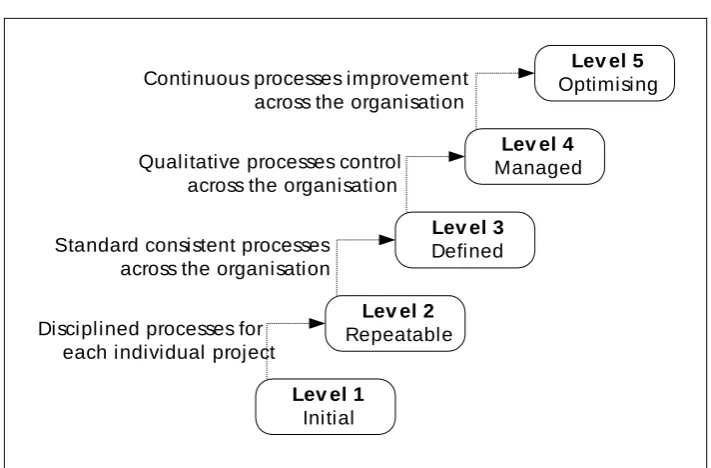
Paulk et al. (1993) developed a capability maturity model (CMM) to improve process. This model has five levels of process maturity, from level 1 (initial) through to level 5 (optimising). Each level provides a stage for incremental progression towards continuous process improvement, and significant benefits have been found using this approach Heston (2001). This work has now been refined by Sarshar et al. (2000) see Figure 3. This framework could be used in the construction industry to map out the sequential steps needed to maximise the sequential steps needed to align IT with core processes in the materials procurement process.
Lev el 1
Initial
Lev el 2
Repeatable
Lev el 3
Defined
Lev el 4
Managed
Lev el 5
Optimising
Disciplined processes for each individual project Standard consistent processes
across the organisation
Qualitative processes control across the organisation
[image:6.595.114.470.312.546.2]Continuous processes improvement across the organisation
Figure 3 The SPICE Framework (Sarshar et al, 2000)
3.4.1 E-Readiness
3.4.2 Organisational Requirements
Specific classifications associated with e-readiness adoption have yet to be formalised. However, ‘typical’ stages and level of activity include such issues as: type and level of computer use; level of intranet, extranet and Internet exploitation (including web presence etc); software process matching e.g. purchasing and sales, marketing, payment and accounting functions, production activities, post sales activities etc. These important requirements must therefore be addressed from an organisational perspective – the details of which should be aligned to the core processes identified.
3.4.3 Other E-Readiness Issues
Other e-Readiness issues include organisation’s level of IT infrastructure. This would naturally embrace a coherent organisational policy on process, systems and strategy that would enable the organisation to exploit the benefits of IT. Organisational culture is another important element of e-Readiness and can be identified in three different types namely; individual culture, team culture and company culture. The impact of these cultures on the entire organisation can affect it in many ways, therefore, must be well integrated to enhance the capabilities of the organisation to effectively exploit the power of IT to improve the organisation’s performance. Organisation’s level of process maturity greatly depends on the systems and procedures that are put in place, which can be constantly referred to for decision making. This would naturally encompass organisation’s level of IT infrastructure and culture.
4. DEVELOPING AN E-READINESS FRAMEWORK
4.1 Research Methodology
This research is currently ongoing and is undertaken in close collaboration with three large construction companies. One pilot study has been undertaken to date.
4.2 Pilot Study
A pilot study was undertaken with three large construction organisations in order to ascertain the core issues associated with process improvement, materials procurement over the Internet. This undertaking used a semi-structured questionnaire to gain detailed understanding of situation being studied (Fellows and Liu 1999). The results from this study will be used at a later date to develop a proposed e-readiness framework for materials procurement.
4.3 Research Findings to Date
4.4 Planned Development
A series of development meetings with domain experts are currently being held, the initial findings of which are tending to favour an e-readiness framework based on five levels (similar to the CMM model identified in Figure 3). This framework would naturally embrace the following five stages:
Level 1 – Initial
At the initial level, the organisation would typically be in an unstable environment, where project visibility and predictability would be poor. In this context, the organisation would have difficulty developing and maintaining a well-coordinated materials procurement process. The processes would not be defined, and a chaotic business environment would be apparent. At this level, there would be a limited use of computers, and the materials procurement process would be undertaken based on personal experience (therefore non-repeatable). Good practice would therefore depend entirely on individual company employees.
Level 2 – Repeatable
At the repeatable level, the organisation would typically be more stable, where project visibility and predictability would be a little more certain. The organisation would have some systems for developing and maintaining a well-coordinated materials procurement process, but these would be limited. Some policies for managing construction materials suppliers and procedures would be established. However, processes would not be defined, and a more orderly business environment would be apparent. At this level, there would be a limited use of computers, but organisations would have installed cost effective ICT ready for limited exploitation. The materials procurement process would still be predominantly undertaken based on personal experience (and the processes would be non-repeatable). Supply relationships would start to be established, along with guidelines for procurement transactions.
Level 3 – Defined
At the defined level, the organisation would typically be very stable, where project visibility and predictability would be very certain. The organisation would have many detailed systems for developing and maintaining the materials procurement process. Well-established policies for managing construction materials suppliers and procedures would be evident (including a strategic outsourcing policy). At this level, there would be a comprehensive network of computers aligned to core business processes, and ICT would be exploited. The materials procurement process would be well established, and a process map would be evident. Supply relationships would be established, along with guides for procurement transactions. The entire procurement process would be well-managed, consistent, stable and repeatable.
Level 4 – Managed
guides for procurement transactions. The entire procurement process would be well-managed, consistent, stable and repeatable.
Level 5 – Optimising
At the optimising level, the organisation would be highly mature and stable. Project visibility and predictability would be very high, with numerous systems and procedures in place for managing the materials procurement process. The formalised policies for IT exploitation would be aligned to the information system strategy, IT strategy and business strategy. Core best practice process maps would be continually updated and refined as part of a well-managed continuous process improvement strategy. The supply-chain relationships would be well-established, along with guides for e-procurement transactions.
5. SUMMARY AND CONCLUSIONS
This paper has identified some of the important factors that need to be considered for developing an e-readiness framework for the construction industry. ICT applications are currently being streamlined to exploit core processes in non-construction areas – the benefits of which can be brought to construction. Motivation for buyers to enter into e-procurement will depend on numerous factors, not least: competition; security; cost; accuracy, availability of information (product details) etc.
From a process perspective, it is important to note that organisations should strive to improve their processes, as this has proven links with improved company performance. An e-readiness framework would help the construction supply chain collaborate and share information, thereby creating many benefits, not least in terms of efficiency (thereby helping to pass any savings on to all stakeholders involved).
Finally, it is important to note that this framework is still in its development stage, and further findings will be presented at a later date.
6. REFERENCES
Cooper, R., Kagiogluo, M., Aouad, G., Hinks, J., Sexton, M., and Sheath, D (1998), The Process Protocol: Developing a Process of Improvement, Global Construct IT Futures, International Meeting, Cumbria UK
Calvert, R., E (1995), Introduction to Building Management, 6th Ed., Butterwoth-Heineman, England
Canter M., R (1993), Resource Management for Construction. Basingstoke, Macmillan Press Davenport, T., H (1993), Process Innovation, Harvard Business School Press, Boston, MA
Davenport, T., H and Short, J., E (1990), The New Industrial Engineering: Information Technology and Business Process Redesign. Sloan Management Review, pp. 11-27
Egan, J (1998), ‘Rethinking Construction’ Available at www.rethinkingconstruction.org Fellows, R and Liu, A (1999), Research Methods for Construction. Aarontype Ltd England
Feeny, D and Willcocks, L.P (1998), Core IS Capabilities for Exploiting Information Technology,
Goulding, S., J and Alshawi, M (2002), Generic and Specific IT Training: A Process Protocol Model for Construction. Journal of Construction Management and Economics. (20), pp. 493-505 Hosten, M., K (2001), Using the Capability Maturity Model for Software to Achieve Business Goals. Outlook Point of View (www.accenture.com)
Kong C.W, Li H and Love P.E.D (2001), An E-Commerce System for Construction Material Procurement, Journal of Construction Innovation, Vol. 1, No. 1, pp 43-54
Khalfan, A., M., M., Anumba, J., C and Carrillo, M., P (2001), Development of Readiness Assessment Model for Concurrent Engineering in Construction. Benchmarking: An International Journal. Vol. 8, No. 3, pp. 223-239
Lockley, R., S., Watson, R and Shaaban, S (2002) Managing E-commerce in Construction – Revolution or E-business as Usual? Journal of Engineering, Construction and Architectural Management. Vol. 9. No. 3, pp. 232-240
McConville, G., J (1993), Managing Construction Purchasing. R.S. Means Company, Inc. USA Paulk, C., M., Curtis, B., Chrissis, B., M and Weber, V., C (1993), The Capability Maturity Model for Software. Software Engineering Institute Carnegie Mellon University, USA