Classification of Selfish and Regular Nodes
Based on Reputation Values in MANET
Using Adaptive Decision Boundary
Amir Khusru Akhtar1, G. Sahoo2
1Department of Computer Science and Engineering, Cambridge Institute of Technology, Ranchi, India 2Department of Information Technology, Birla Institute of Technology, Mesra, Ranchi, India
Email: [email protected], [email protected] Received May 1, 2013; revised June 10, 2013; accepted July 10, 2013
Copyright © 2013 Amir Khusru Akhtar, G. Sahoo. This is an open access article distributed under the Creative Commons Attribution License, which permits unrestricted use, distribution, and reproduction in any medium, provided the original work is properly cited.
ABSTRACT
A MANET is a cooperative network in which each node has dual responsibilities of forwarding and routing thus node strength is a major factor because a lesser number of nodes reduces network performance. The existing reputation based methods have limitation due to their stricter punishment strategy because they isolate nodes from network participation having lesser reputation value and thus reduce the total strength of nodes in a network. In this paper we have proposed a mathematical model for the classification of nodes in MANETs using adaptive decision boundary. This model classifies nodes in two classes: selfish and regular node as well as it assigns the grade to individual nodes. The grade is computed by counting how many passes are required to classify a node and it is used to define the punishment strategy as well as enhances the reputation definition of traditional reputation based mechanisms. Our work provides the extent of nonco-operation that a network can allow depending on the current strength of nodes for the given scenario and thus includes selfish nodes in network participation with warning messages. We have taken a leader node for reputation calculation and classification which saves energy of other nodes as energy is a major challenge of MANET. The leader node finally sends the warning message to low grade nodes and broadcasts the classification list in the MANET that is considered in the routing activity.
Keywords: MANETs; Regular Node; Selfish Node; Adaptive Decision Boundary; Feature Value; Noncooperation
1. Introduction
Ad hoc wireless networks utilize multi-hop radio relay-ing and operate without support of any fixed infrastruc-ture. This makes the routing complex compared to other networks. Nodes must communicate to each other re-garding information about other nodes. A node can trans- mit and receive data, as well as act as a router for routing packets for other nodes. A node forwards packet in an ad hoc network using the routing algorithms presented in [1-7]. Attacks are a challenge for the ad hoc routing pro-tocols. Some of the attacks are modification, fabrication, wormhole attack (tunneling), blackhole attack, denial of service attack, invisible node attack, sybil attack, rushing attack and non-cooperation. To short out these attacks some secured routing protocols are developed these are Ariadne [1], ARAN (Authenticated Routing for Ad hoc Networks) [2,3], SEAD (Secure Efficient Ad hoc Dis-tance vector routing) [4], SRP (Secure Routing Protocol)
to individual nodes. The grade is computed by counting how much passes the algorithm takes to classify a node and it is used to define the punishment strategy as well as enhance the reputation definition of traditional reputation based mechanisms [8-18]. This paper is organized as follows. Section 2 describers the background and related work. Section 3 presents the mathematical model for the classification of nodes in MANET. Section 4 gives the experimental analysis in which we have used indigenous tool written in “C” language for classification of node, grade assignment and punishment definition. We verified it with different experimentations. Section 5 concludes the paper.
2. Background and Related Work
Mobile wireless network, capable of autonomous opera-tion operates without base staopera-tion or infrastructure. In this network nodes cooperate with each other to provide connectivity and operate without centralized administra-tion. But when nodes drop packets of others due to hon-est or malicious causes they are called selfish nodes [19]. A node is called selfish if it drops packets of others due to either honest causes such as collisions, channel errors, or buffer overflows or maliciously such as to save its en- ergy or bandwidth, blackhole or wormhole attack, net-work congestion. A selfish Node degrades efficiency of packet transfer and accelerates the packet delivery time and packet loss rate and finally creates Network Parti-tioning. To enforce cooperation and to minimize battery usage Md. Amir Khusru AKhtar and G. Sahoo [20] pro-posed a novel methodology for securing adhoc network using friendly group model in which they used two NIC cards to partition a MANET into many friendly groups/ subnets. This model enforces cooperation because it mi- nimizes battery usage which is the genuine cause of self-ishness but this model is not suitable for all applications.
For the intrusion detection in MANET a classification algorithms was proposed [21], it is an innovative ap-proach but not validated with real world data. We have other methods [22,23] for the detection of selfish node but these proposed algorithms consumes more energy. Paper [24] defines a secure routing protocol with node selfishness resistance in MANETs but this protocol still consumes more energy.
We have lots of methods to detect selfish nodes that are categorized into incentive-based methods and reputa-tion-based methods. The first mechanism discourages a node to become selfish by giving virtual money/credits when a node forward packets of others. These credits are required when a node want to send or receive its own packets. Another method [17] proposed by Buttayan and Hubaux uses virtual currency, called nuglets to detect a selfish node. In this method a nuglet counter is incre-mented monotonically when it forwards a packet for
oth-ers. When a node wishes to send its own packet, then enough credits are required as the system checks for a certain threshold value otherwise it is not allowed to send packets. The limitation of this method is that it requires tamper proof hardware to maintain the nuglet.
On the other hand, the reputation-based methods de- tect a selfish node and take appropriate action by means of reputation system that detect and defines the rate a selfish node. In these mechanisms reputation is defined on the basis of participation seen by others [16]. The good reputation indicates honest participation in the network activity otherwise it is marked as selfish.
Since we are classifying a MANET on the basis of reputation values that is why we are focusing on “Repu-tation Based Mechanisms”. A survey of trust and reputa-tion management systems in wireless communicareputa-tions [25] shows the current status of reputation based systems and its limitation in terms of energy usage and noncoope- ration.
The first method on detection of routing misbehavior was proposed by Marti et al. called the Watchdog and
Pathrater [8]. It is to be used over the DSR [6] routing protocol to alleviate selfish and malicious routing mis-behavior in MANET. Watchdog module is responsible for neighbor monitoring and identifying malicious and selfish nodes whereas Pathrater module evaluates the overall reputation of nodes and defines route by exclud-ing the selfish or misbehavexclud-ing nodes. In this mechanism a selfish node is rewarded instead of any punishment for the misbehavior.
The CONFIDANT protocol proposed by Buchegger et al. [9,10], in which the first module called Monitor that is
responsible for observing and recording the misbehavior of neighboring nodes. The second module the reputation system is responsible for calculating the reputation of nodes on the strength of direct observation and indirect observation. The third module trust manager is collects warning messages from friends, and finally the fourth module the path manager defines the path for routing by excluding selfish nodes. In this protocol, each node monitors its neighborhood behavior and observed behavior is reported to the reputation system. If the mis-behavior is not tolerable then it is reported to the path manager, and then the path manager excludes the nodes from the routing path and calculates new paths. This method has weaknesses due to inconsistent evaluation problem, for the reason that every node has different eva- luations for the same node and has difficulty to identify correct selfish node. Another limitation is in terms of more battery power consumption for a node located in the center of network in comparison to situated at the periphery of the network.
The CORE protocol [11] proposed by Michiardi et al.,
tional). This mechanism uses reputation table to maintain the reputation value for each node and the watchdog mechanism to observe that a requisite function is per-formed by the requested node or not. The reputation is defined on direct observation and on the basis of infor-mation provided by others nodes. The reputation value will facilitate a node to decide the selfishness of a re-questing node and finally guide whether to serve or to decline the request.
A lot of research work [12-18] shows the usage of re- putation value in the detection and exclusion of selfish node from a mobile adhoc network. All these methods have limitation due to its stricter punishment strategy because they isolate the nodes from routing activity on the basis of lower reputation value and thus reduce the overall strength of nodes in the network. Since a coop-erative network is based on the nodes strength and thus the network does not perform better.
3. Proposed Work
3.1. Adaptive Decision Boundary
In this paper, we are showing a classification model based on Adaptive Decision Boundary [26] that classifies a network into selfish and regular nodes as well as it as-signs grade to individual nodes. The grade is computed by counting how many passes are required to classify a node and it is used to define the punishment strategy as well as enhances the reputation definition of traditional reputation based mechanisms [8-18]. The punishment strategy is defined in section 3.5. This model works fine with the existing routing protocols and solutions. We have assumed a leader node in our work which is respon-sible for defining an adaptive decision boundary ex-plained in section 4.1.
In this work an adhoc network is classified into two classes selfish and regular. The classification of nodes reputation values modeled mathematically using Adap-tive Decision Boundary [26]. We have defined a linear decision boundary to classify nodes reputation values into two classes in which a network has M features. Fea-ture values are taken from reputation values and the dis-criminant function is of the form
0 1 1 M
D w w xw xM (1) The adaptive decision boundary D = 0 is the equation of the decision boundary and lying between the two classes (selfish and regular). The weights are w0, w1, …,
wM are selected for better analysis of the network.
Through this we classify a MANET with reputation val-ues called feature valval-ues obtained from literature [9-16, 19,25]. A network with M feature values X = (X1, X2, …,
XM) is classified in to two classes: regular class with
[image:3.595.312.537.554.721.2]reputation value 1 (if D ≥ 0) and selfish class-1 (if D < 0).
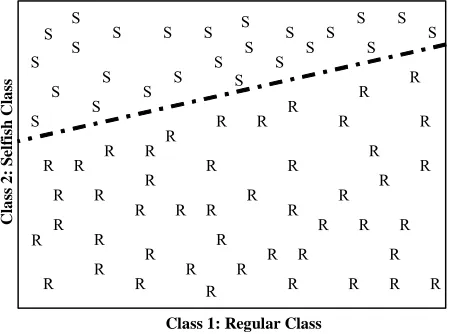
Figure 1 shows the two classes (selfish and regular
de-noted as S and R respectively) which are separated by a straight line.
3.2. Problem Definition and Proposed Solution
In this paper we are classifying the selfish and regular nodes on the basis of reputation values in a MANET us-ing adaptive decision boundary. The existus-ing methods [8-18] have limitation due to its stricter punishment stra- tegy because they isolate nodes from network participa-tion having lesser reputaparticipa-tion value and thus reduce the total strength of nodes in a network. The lesser number of nodes reduces network performance, degrades effi-ciency of packet transfer, accelerates the packet delivery time, enhances packet loss rate and creates Network Par-titioning. That is why we have proposed this classifica-tion technique. The proposed soluclassifica-tion to tackle this pro- blem is described using the following steps
Step 1: Initially we have obtained the reputation values of all nodes in a network using existing reputation system as defined in [8-12].
Steps 2: After that true class or desired value of a node is defined as defined in section 3.3.
Steps 3: Then nodes are classified into selfish and regular classes based on reputation values by using the algorithm 3.4. Further, the number of passes is used to define grade.
Step 4: Finally punishment criteria are defined on the basis of grade. For example we have included medium grade (GMED) selfish nodes in network participation with
proper warning messages and low (GLOW) grade nodes
are excluded form network participation. The punishment criterion is defined in section 3.5.
3.3. Defining True Class or Desired Value
In this model we are assuming the true class or desired value (d) by +1 and by −1. A +1 value indicates a regu-
Cla ss 2 : S elfi sh Cl a ss
Class 1: Regular Class
S S
S S
S
S S
S S S S S S S S S S
S S S
S S S S
S
R
R R R
R R R R R R R R R R R R R R R R R R R R R R R R R R R R R R R R R R R R R R R R R R R
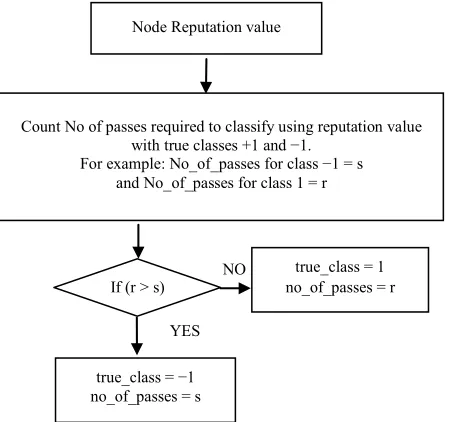
lar class and −1 denotes a selfish class. The true class of a node is defined on the basis of minimum number of passes to classify in true classes +1 or −1 on the basis of nodes reputation value shown in Figure 2.
For example, on the basis of reputation value a node of a MANET takes 20 passes to classify in selfish class and 30 passes for regular class. The selfish class takes mini-mum number of passes to classify, so in this example the node is classified in selfish class and d =
−
1.The classification, true class definition and grade cal-culation is performed by executing adaptive_decision_ boundary() function. This function counts how many passes are required to match the value of d with Dis-criminant “D” and it finds the true class on the basis of minimum number of passes. Then the grade is defined using Table 1 and it is used to define the punishment
criteria explained in section 3.5.
3.4. “C” Language Function for the Classification of Nodes in a MANET Using Single Numeric Feature
In this section we are presenting the adaptive decision boundary algorithm to classify selfish and regular nodes based on reputation values in MANET.
Node Reputation value
Count No of passes required to classify using reputation value with true classes +1 and −1.
For example: No_of_passes for class −1 = s and No_of_passes for class 1 = r
If (r > s)
true_class = −1 no_of_passes = s
true_class = 1 no_of_passes = r
[image:4.595.62.287.392.603.2]YES NO
[image:4.595.59.285.650.737.2]Figure 2. Flowchart showing nodes true class calculation. Table 1. Grade assignment and punishment crieteria.
Number of passes
required to classify Grade Punishment criteria
Less than or equal to 10 GHIGH No
Less than or equal to 30 GMED Warning message
Greater than 30 GLOW Exclude nodes from routing activity
/* Classification using Adaptive decision boundary */
adaptive_decision_boundary() {
do{
for(i=1;i<=2;i++){
if(i%2==1) {++s; j=0;}
else
{++r; j=1;}
d=a[j][2];
x=a[j][1]; D=w0+w1*x; if(D>=0) D=1; else D=-1; if(D!=d){
++r;
w0=w0+c*d*k; w1=w1+c*d*x; } if(r>s)
{tc=-1; pass=s;}
else
{ tc=1; pass=r;} }
}while(D!=d);
if(pass <= 10)
strcpy(grade,"High");
else if(pass <= 30)
strcpy(grade,"Medium"); else if(pass > 30)
Table 2. MANET reputation table. 3.5. Grade Calculation and Punishment Criteria
Grade is calculated by counting how many passes the algorithm takes to classify. Table 1 shows the number of
passes, grade of a node and punishment criteria. where,
GHIGH: High grade
GMED: Medium grade
GLOW: Low grade
4. Experimental Analysis
4.1. Experimental Assumption
The experimental analysis is based on section 3. To find an adaptive decision boundary to classify nodes of a MANET reputation values are taken into consideration. We have taken a network of sixteen nodes with one leader node as given in Figure 3.
The leader node is an intelligent node of the adhoc network, which has good knowledge of the network and having high computation capability to process and main- tain the history of the transaction and responsible for calculation of reputation value in the network. A leader node could be a captain’s laptop in a battle zone. The leader node calculates the adaptive decision boundary to classify a network from the gathered reputation values [8-18] of nodes in the network and then assign grades. On that basis of grade punishment criterion is defined as given in Table 1.
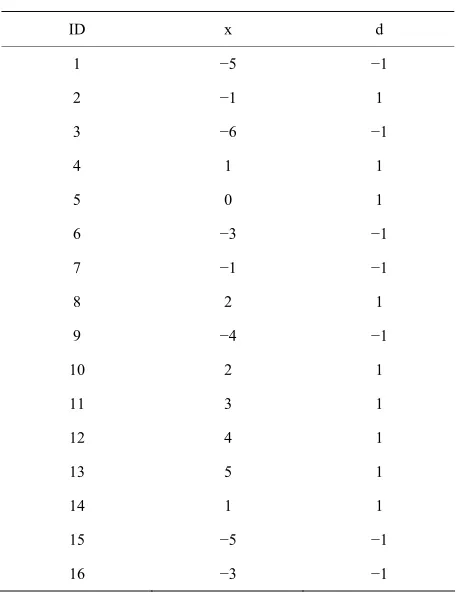
The leader node maintains the reputation table as de- fined in Table 2. We have taken node identification
number (ID), x denotes one dimensional feature or repu- tation value and d is the true class or desired value for a node obtained using the code defined in section 3.4.
4.2. Result and Discussion
We have classified nodes into two classes selfish and re-
[image:5.595.65.278.543.719.2]Mobile Node Leader Node
Figure 3. A MANET of sixteen nodes with a leader node.
ID x d
1 −5 −1
2 −1 1
3 −6 −1
4 1 1
5 0 1
6 −3 −1
7 −1 −1
8 2 1
9 −4 −1
10 2 1
11 3 1
12 4 1
13 5 1
14 1 1
15 −5 −1
16 −3 −1
gular using the solution defined in section 3.2 into two classes using the following parameters.
d: true class or desired value defined in section 3.3. D: discriminant function defined in section 3.1. w0 and w1: small random values used to speedup the
classification.
c: a positive constant that controls the step size for reputation adjustment needed for classification.
k: a positive constant denoting average absolute repu-tation value in the problem required to minimize the number of passes.
Choosing the correct c and k values will minimize number of passes to classify as defined in [26].
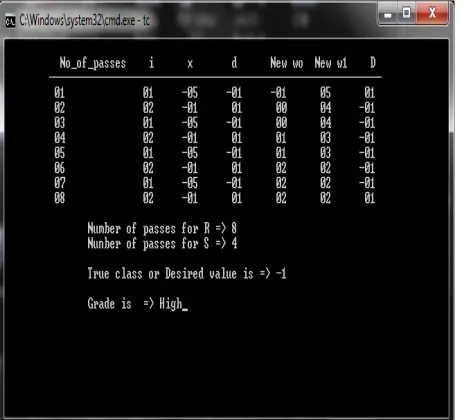
Figure 4 shows the output generated using code given
in section 3.4 by processing Table 2. The constant c and
k both chosen to be 1. Initially the weights for w0 and w1
are initialized with 0. The output shows the classification of first two nodes with attributes No_of_passes, I denote node number, x is the reputation value, d the true class, new w0 and w1 the small random values and the
dis-criminant D. We have also shown how many passes are required to classify a node into regular or selfish classes and the equivalent grade. Further, grade is used to define the punishment criteria as given in Table 1.
5. Conclusion
Figure 4. Output generated using code given in section 3.4.
environment. It has defined how mathematical model has been used to classify selfish nodes in MANETs. We have introduced a mathematical model showing the classifica-tion of nodes (regular and selfish classes) in MANETs. This model is verified by experimentation and gives ac-ceptable accuracy and provides a solution for secured routing also when a network having poor strength of nodes. The major problem with MANET is the node strength because existing solutions have a stricter pun-ishment policy and they isolate the nodes having lesser reputation value and thus reduces the total strength of nodes in a network. Because a cooperative network is based on node strength and thus the network does not perform better. So, this model gives a more accurate clas-sification and provides the extent of noncooperation that a network can allow depending on the current strength of nodes for the given scenario. Thus our model includes medium grade (GMED) selfish nodes in network
participa-tion with proper warning messages and excludes only the low (GLOW) grade nodes.
6. Acknowledgements
The authors are thankful to anonymous referees for their valuable comments and suggestions to improve the qua- lity of the paper.
REFERENCES
[1] Y. Hu, A. Perrig and D. Johnson, “Ariadne: A Secure On-Demand Routing Protocol for Ad Hoc Networks,”
Proceedings of the 8th Annual International Conference on Mobile Computing and Networking, September 2002,
pp. 12-23.doi:10.1145/570645.570648
[2] K. Sanzgiri, B. Dahill, B. Levine, C. Shields and E.
giri, D. LaFlamme, B. Dahill, B. N. Levine, C.
, “SEAD: Secure
Effi-re
ic
-Demand Dis-Belding-Royer, “A Secure Routing Protocol for Ad Hoc Networks,” The 10th IEEE International Conference on Network Protocols (ICNP), 12-15 November 2002, pp.
78-87. [3] K. Sanz
Shields and E. M. Belding- Royer, “Authenticate Routing for Ad Hoc Networks,” IEEE Journal on Selected Area in Communications, Vol. 23, 2005.
[4] Y. Hu, D. Johnson and A. Perrig
cient Distance Vector Routing in Mobile Wireless Ad Hoc Networks,” The 4th IEEE Workshop on Mobile Com- puting Systems and Applications, June 2002, pp. 3-13.
[5] P. Papadimitratos, Z. Haas and P. Samar, “The Secu Routing Protocol (SRP) for Ad Hoc Networks,” 2002. [6] D. Johnson, D. Maltz, and Y.-C. Hu, “The Dynam
Source Routing Protocol for Mobile Ad Hoc Networks (DSR),” IEEE Internet Draft, April 2003.
[7] C. E. Perkins and E. Royer, “Ad-Hoc On
tance Vector Routing,” Proceedings of 2nd IEEE Work-shop on Mobile Computing Systems and Applications,
1999, pp. 90-100.doi:10.1109/MCSA.1999.749281 [8] S. Marti, T. J. Giuli, K. Lai and M. Baker, “Mitigating
odes Bearing Gru-
ger and J. Y. Le-Boudec, “Performance
Analy-A Collaborative
-Based Cooperation
ncing Role-Based Trust
X. Huang and L. T. Yang,
utation Based Routing Misbehavior in Mobile Ad Hoc Networks,” Pro-ceedings of the 6th Annual International Conference on Mobile Computing and Networking (ACM MobiCom
2000), New York, 2000, pp. 255-265. [9] S. Buchegger and J. Y. Le-Boudec, “N
dges: Towards Routing Security, Fairness, and Robust-ness in Mobile Ad Hoc Networks,” Proceedings of the
10th Euromicro Workshop on Parallel, Distributed and Network-Based Processing, Canary Islands, 2002, pp.
403-410. [10] S. Bucheg
sis of the CONFIDANT Protocol (Cooperation of Nodes: Fairness in Dynamic Ad-Hoc Networks,” Proceedings of MobiHOC’02, June 2002, pp. 226-236.
[11] P. Michiardi and R. Molva, “CORE:
Reputation Mechanism to Enforce Cooperation in Mobile Ad-Hoc Networks,” In: J.-B., Borka and K. Tomaz, Eds.,
Advanced Communications and Multimedia Security,
Kluwer Academic Publishers, 2002. [12] S. Bansal and M. Baker, “Observation
Enforcement in Ad Hoc Networks,” Technical Report, Stanford Univ., Standford, 2003.
[13] R. Akbani and T. Korkmaz, “Enha
Management with a Reputation System for MANETs,”
URASIP Journal on Wireless Communications and Net-working 2011, 2011, p. 90.
[14] F. Wang. F. R. Wang, B.
“COSR: A Reputation-Based Secure Route Protocol in MANET,” EURASIP Journal on Wireless Communica-tions and Networking—Special Issue on Multimedia Communications over Next Generation Wireless Net-works Archive, Vol. 2010, 2010, pp. 1-11.
[15] S. R. Zakhary and M. Radenkovic, “Rep
“Self-Policing Mobile [16] S. Buchegger and J.-Y. L. Boudec,
Ad Hoc Networks by Reputation Systems,” IEEE Com-munications Magazine, Ser. 7, Vol. 43, 2005, pp. 101-
107.doi:10.1109/MCOM.2005.1470831
[17] L. Buttyan and J. P. Hubaux, “Stimulating Cooperation in Self-Organizing Mobile Ad Hoc Networks,” Mobile Networks and Applications, Vol. 8, No. 5, 2003, pp. 579-
592.doi:10.1023/A:1025146013151
[18] A. Balasubramanian, J. Ghosh and X. Wang, “A
Reputa-Mechanisms and
ection tion Based Scheme for Stimulating Cooperation in MANETs,” Proceedings of the 19th International Tele-traffic Congress, Beijing, August 2005.
[19] T. Anusas-Amornkul, “On Detection
Their Performance for Packet Dropping Attack in Ad Hoc Networks,” University of Pittsburgh, Pittsburgh, 2008. [20] M. A. K. Akhtar and G. Sahoo, “A Novel Methodology
for Securing Adhoc Network by Friendly Group Model,”
The 4th International Conference on Networks & Com-munications (NetCoM), Chennai, September 2012.
[21] A. Mitrokotsa and C. Dimitrakakis, “Intrusion Det in MANET Using Classification Algorithms: The Effects of Cost and Model Selection,” Ad Hoc Networks, Vol. 11, No. 1, 2013, pp. 226-237.
doi:10.1016/j.adhoc.2012.05.006
[22] E. Hernández-Orallo, M. D. Serrat, J.-C. Cano, C. M. T.
Calafate, and P. Manzoni, “Improving Selfish Node De-tection in Manets Using a Collaborative Watchdog,”
IEEE Communications Letters, Vol. 16, No. 5, 2012, pp.
642-645.doi:10.1109/LCOMM.2012.030912.112482 [23] E. Hernández-Orallo, M. D. S. Olmos, J.-C. Cano, C. T.
ng, “A Secure Rout-Calafate and P. Manzoni, “Evaluation of Collaborative Selfish Node Detection in MANETS and DTNs,” MSWiM’12 Proceedings of the 15th ACM International Conference on Modeling, Analysis and Simulation of Wireless and Mobile Systems, 2012, pp. 159-166.
[24] C.-T. Li, C.-C. Yang and M.-S. Hwa
ing Protocol with Node Selfishness Resistance in MANETs,” International Journal of Mobile Communica-tions, Vol. 10, No. 1, 2012, pp. 103-118.
doi:10.1504/IJMC.2012.044525
[25] H. Yu, Z. Q. Shen, C. Y. Miao, C. Leung and D. Niyato. “A Survey of Trust and Reputation Management Systems in Wireless Communications,” Proceedings of the IEEE,
Vol. 98, No. 10, 2010, pp. 1755-1772. doi:10.1109/JPROC.2010.2059690