ISSN Online: 2331-4249 ISSN Print: 2331-4222
Research on the Product Derivation Method
under the Interaction Design Thinking
Rong Zhang, Guangwei Liang
Beihang University, Beijing, China
Abstract
Explore the new way of product derivation by integrating the interaction design thinking into the product derivation method. It analyzes the thinking mode of inte-raction design, describes how to make the product provide better experience for the user, from the perspective of the four elements of people, activity, context and tech-nology, and shows how to combine interaction thinking for product derivation through the cases. Good products in addition to the realization of the function also need to meet the needs of the user experience. Product derived can get new methods and ideas from the interaction design of systematic thinking, so that products can provide better service for users in the digital era.
Keywords
Interaction Design, Product Derivation, Design Thinking
1. Introduction
With the development of information technology, digital interactive products are play-ing an important role in people’s life. To a certain extent, it changes the way users use the product and the requirements of the product experience. Users want the product to complete the needs and tasks at the same time have a more positive experience. Tradi-tional physical product design cannot just stay in the “useful”, “easy to use” level, but make users “want to use”. Around the user and the product experience, interaction de-sign thinking puts forward the “user-centered dede-sign”, “emotional dede-sign”, “experience design” and other concepts. These ideas have great value in product derivation. The study how the interaction design thinking applied to product derivation helps to pro-vide new product ideas, and create a better product experience.
How to cite this paper: Zhang, R. and Liang, G.W. (2016) Research on the Product Derivation Method under the Interaction
Design Thinking. World Journal of Engi-
neering and Technology, 4, 168-173.
http://dx.doi.org/10.4236/wjet.2016.43D020
2. Interaction Design Thinking
The study of interaction design originated in the 1960s, began to appear in the form of “human-computer interaction”, and later extended to a wider range of areas. In 1984, Bill Moric, the founder of IDEO, called the new design “Soft-Face”, and later changed to “Interaction Design”. He proposed a new concept to describe the design of this in-teractive product system, to make people realize that this kind of design activity is the creation of product use and experience process [1]. The famous interaction design ex-pert Cooper Alan believes that the focus of the interaction design is the traditional de-sign disciplines never discussed: how to dede-sign behavior [2], emphasizing the key beha-vior in the interaction design. Terry Winograd, the author of “the art of software de-sign”, focuses on how the user lives in the space created by the designer, emphasizing the coexistence of the user and the environment. There are also people who believe that interaction designers use new technologies to make products intelligent and emphasize the key role of technology. Donald A. Norman emphasizes the user experience, he said interaction design beyond the traditional product design is that the product has a good interactive function, namely in the use of the product the user can feel a kind of expe-rience, that is due to the two-way exchange of information between people and prod-ucts, with “a strong emotional component” [3].
Although the above viewpoints on interaction design focus are different, but can be concluded that there are four important elements in the interactive system, namely people, activity, context and technology. As the “Designing Interactive Systems” men-tioned, interaction design thinking requires coordination among the various elements of the system with human-centered, using appropriate technology to support the user’s beha-vior and with scene behabeha-vior coordination. These four elements will be here as a starting point to explain how to derive a product from the perspective of interactive design.
3. Product Derivation
Derived, refers to evolve and produce new material obtained from the parent substance. In the design field, it refers to the use of derivative products of different design tech-niques on the same or a similar body to produce a differentiated product, there is a dif-ference between the derived products, but also linked. Product derivation is an impor-tant means to product development, establish a brand image, enhance the competitive-ness of the market.
4. New Product Derivation Methods
Nowadays, with the rapid development of Internet technology, information technology and digital products affect people’s daily life with unprecedented speed and scale. Us-ers’ mental models for the products also quietly changed. For example, the popularity of iPhone, iPad and other smart phones and tablet PCs allow users to have developed a habit of using the touch screen, “screen touch operation” has become widespread user’s mental model. Due to the diversity of products, the application of complex contexts and the strong support of technology, the relationship between people-product-con- text-technology results in a more diverse form and combination [6]. Traditional physi-cal product in the derivative process needs to adapt to the changes in the digital age, the interaction design thinking will be included among the derivative methods, from the people, activity, context, technology and other aspects to explore new product deriva-tive method and improve product experience.
4.1. “User-Centered” Product Derivation
The core of the interaction product is “interactive”, which is more deeply than the tra-ditional product design to understand and analyze the product’s user population [7]. Interaction design thinking take the user as a core role, resulting in a set of “us-er-centered design” concept. This design concept requires the design around the user, starting from the needs of the user to meet the user’s habits, psychological feelings, and even allow users to participate in the design process. “Object oriented design” method proposed by Alan Cooper in “About Face” also stressed the designers to focus on people’s goals and expectations, attitudes, talent, so they can propose both efficient and enjoyable solutions.
Innovative design is not only to design a beautiful shape, sometimes the concept of innovation can be achieved by changing the relationship between the user and the product [8]. In the derivative product design, it is not simply to change of the appear-ance, but should really consider the needs, goal, habit and psychology of the users, so that the new products can serve the users better. Users’ feedback of the product has a high reference value for the derivation. By analyzing user feedback of the existing product, designers can improve the characteristics of the target user groups, create user models, and build up new usage scenarios.
4.2. Design New Interaction Behavior
Interaction behavior refers to the behavior of the user in the process of using the prod-uct. Interaction behavior is common in everyday life. By using a computer to send an e-mail, using a mobile phone to make a phone call, running on a treadmill, etc., we are interacting with the product. Interactive behavior is a vital part of the whole process, through the behavior, the user and the product establish contact with each other. The quality of interactions has a direct impact on the user experience of the product.
his-tory of Apple, which caused a sensation in the market, not only because of its unique appearance, but also thanks to its unique user-friendly operation. The “scroll-wheel” on iPod just need an thumb to complete the operation. The new interaction behavior makes iPod seems unique among other MP3 players. It is a successful product derivation.
4.3. Establish Better Product Usage Context
The product is dependent on usage context. Bill Buxton put forward a theory “design for the wildness”. He believes designers are designing for the reality, for the wildness, not limited to independent objects. Design depends on the system, including material factors, emotional factors, social factors and experience factors [10]. Product is not an independent existence, a good product must be coordinated with the context. How to establish a better product usage context is an important problem to be solved in the process of product derivation.
The information age is the era of a “link”, from individual computer to computer network, from a single product to the Internet of things, ubiquitous computing urges people to understand the service and value of the product in a larger space, to under-stand the user experience and the contained significance in a connection situation [11]. In addition to making the function and operation of the product more in line with the context, the Internet era provides an idea for product derivation: to build a platform. In the field of digital products, the enterprise with the platform is always competitive, and its products are more vitality relying on the advantages of the platform, such as Micro-soft, Apple, Google and other international giants.
The development of the Internet of things technology and the trend of intelligent products make it possible to build the platform of solid products. Many companies that produce smart products have been gradually put into practice the idea of platform. By cooperating with some traditional home appliances manufacturer, MI is gradually building m MI smart home platform. MI now has a router as a smart appliance control and a mobile phone as remote control. The next step it will continue to launch intelli-gent household items, and it has MIUI software advantage, MI company will build a smart home platform as an important direction of development. On the one hand con-venience of the platform is beneficial to provide users with a complete and unified use of experience, on the other hand the collaboration between the product helps to create a harmony context. Platform of products is an important concept of its development and derivation.
4.4. Promote Product Derivation through New Technologies
Figure 1. Interaction behavior.
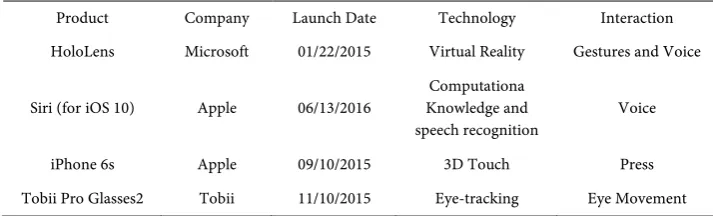
Table 1. Products with new technology
Product Company Launch Date Technology Interaction
HoloLens Microsoft 01/22/2015 Virtual Reality Gestures and Voice
Siri (for iOS 10) Apple 06/13/2016 Knowledge and Computationa
speech recognition Voice
iPhone 6s Apple 09/10/2015 3D Touch Press
Tobii Pro Glasses2 Tobii 11/10/2015 Eye-tracking Eye Movement
General Electric Company released a smart lighting, it is achieved by GE’s new tech-nology Ge align. By controlling the composition of the spectrum, it regulates the body’s natural sleep cycle. During the day, Align technology can simulate the sun to inhibit the production of melatonin, while in the night, it can promote the production of melato-nin the by reducing the blue light. Through a certain technological innovation, the tra-ditional products become intelligent. It is an important way of product derivation.
5. Summary
Digital products are popular in the Internet era, the traditional products not only need to solve problems and achieve intended funtions, but also need to provide good expe-rience for the users. Interaction design thinking provides important ideas and methods for the traditional product derivation. An interaction system of good experience need coordination of people, activity, context and technology. There are four important me-thods of product derivation: “user-centered”, “design new interaction behavior”, “es-tablish better product usage context” and “promote product derivation through new technologies”. The interaction design thinking helps to enhance the experience of de-rived products.
References
[1] Wu, Q. (2014) Information and Interaction Design in the Perspective of Interdisciplinary Research, Art & Design, 12, 16-18.
[2] Cooper, A. (2015) About Face 4: The Essentials of Interaction Design. Publishing House of Electronics Industry, Beijing.
[image:5.595.194.551.212.320.2]Packaging Engineering, 36, 57-61.
[5] Zhang, Y.P. (2013) The Elements of User Experience in the Application of Smart Home Systems Product Design. Art & Design, 4, 141-142.
[6] Peng, Y.F. (2015) Collaborative Design of Product Interaction Design System. Packaging Engineering, 36, 99-103.
[7] Wang, X., Yao, J. and Niu, W.P. (2015) The Method of Interactive Product Design Based on Affordance. Packaging Engineering, 36, 99-103.
[8] An, W. and Wu, J.T. (2015) Interaction Design Thinking in Service and Experience Design. Packaging Engineering, 36, 5-8.
[9] Xin, X.Y. (2016) Interaction Design: From Logic of Things to Logic of Behaviors. Art & De-sign, 1, 58-62.
[10] Buxton, B. (2015) Sketching User Experiences: Getting the Design and the Right Design. Publishing House of Electronics Industry, Beijing.
[11] Wu, Q. (2010) The Field and Boundary of Interaction Design. Art & Design, 1, 34-37.
Submit or recommend next manuscript to SCIRP and we will provide best service for you:
Accepting pre-submission inquiries through Email, Facebook, LinkedIn, Twitter, etc. A wide selection of journals (inclusive of 9 subjects, more than 200 journals)
Providing 24-hour high-quality service User-friendly online submission system Fair and swift peer-review system
Efficient typesetting and proofreading procedure
Display of the result of downloads and visits, as well as the number of cited articles Maximum dissemination of your research work