Relationship between decision making
styles and consumer behavior
Hunjra, Ahmed Imran and Niazi, Ghulam Shabbir Khan and
Khan, Hashim
UIMS-PMAS- University of Arid Agriculture, Rawalpindi, Pakistan,
Quaid e Azam University, Islamabad, Pakistan., Iqra University
Islamabad Campus, Pakistan
2011
Ahmed Imran Hunjra1, Ghulam Shabbir Khan Niazi2, Hashim Khan3
RELATIONSHIP BETWEEN DECISION MAKING STYLES AND CONSUMER BEHAVIOR
The objective of this study is to identify different factors that impact consumer behavior on the basis of a decision making style. The sample size of this study was 250 questionnaires. The data were collected through a 5-point Likert scale questionnaire. SPSS was used to analyze the data. Correlation and multiple regression were performed to measure the relationship between inde-pendent and deinde-pendent variables; indeinde-pendent sample t-test was applied to test the difference between male and female decision making styles. This study concludes there is a significant rela-tionship between male and female decision making style and female respondents are more likely to assert that decision making styles influence consumer behavior. All the independent variables have significant positive relationship with consumer behavior.
Keywords: decision making style; consumer behavior; significant relationship; perfectionism; fashion.
Introduction. The decision making process is directly associated with the needs, wants, attitudes, beliefs and behaviors of a consumer under the problem solving. Consumer decision making styles depend on age, gender, income, lifestyle, percep-tion, personality, psychographic and geographic characterstics (Williams, 1990). A behavior is defined as a combination of complex activities and procedures together with the actions, which govern the decisions of an individual. External factors like environment, interactions, ambience, etc. also impact behavior (Lee, 1983). Decision making styles are essential to determine consumer behavior and are rela-tively constant over time and thus are significant for market segmentation. Understanding the buying decision making behavior of consumers is important for companies' strategic marketing activities.
Decision making is accurate in broad-based gender differences but can not be true in specific cases. It should be also noted that men and women apply different shopping strategy, act differently in negotiations and relationships. Internalized mar-ket relations and gender roles are influenced by customs, though limited in number and location. The research proves that gender affects purchasing behavior. Gender difference in visualization is also known in retail anthropology. The most important aspect is time. The purchase decision is affected by many things: whether people are urgently needed or how products and services will meet the requirements now and in the near future.
Women generally make purchase decisions based mostly on emotions, while men go more with facts and data. Women prefer a description, a story with faces and interaction and the relationships that are occurring increases the effect. The female mind seems to be more multitracked and networked compared to male thinking which is a lot more compartmentalized.
The purpose of this study is to identify different factors that impact consumer behavior on the basis of a decision making style, as well as to evaluate the consumer's
1
corresponding author, Lecturer, UIMS PMAS-University of Arid Agriculture, Rawalpindi; PhD Scholar, Iqra Universi-ty, Islamabad, Pakistan.
2
Assistant Professor, Quaid-i-Azam School of Management Sciences, Quaid-i-Azam University, Islamabad, Pakistan. 3
perception regarding different factors impacting consumer behavior: brand sciousness, perfectionism, variety seeking, novelty-fashion and product quality con-sciousness.
Literature review. Mental and cognitive orientation continues to dominate the concumer's choice in consumer decision making styles to purchase and procurement. Basic idea is that the customers' understanding, brand conscious, quality conscious, brand loyal and impulsive shopping (Sproles, 1985), including basic decision-making procedures are involved in procurement. Consumer decision-making process is a complex phenomenon. There is a large number of factors affecting every decision to purchase goods or services. Consumer decision-making (CDM) is a mental direction to characterize the users' option to choose. Defined broadly, there are 3 types of approaches in the study on consumer decision making styles, i.e. lifestyle approach, the consumer typology approach and the consumer characteristics approach (Sproles and Kendall, 1986). Consumer decision making style is psychological orientation about a user's preferences by means of decision making. Although consumer decision making behavior is focused on the specific pattern of cognitive and affective respons-es (Bennett and Kassarjian, 1972), national culture and attitudrespons-es (Hofstede, 1980) established the highlighting effect.
It also comes up with the attributes of expectations and opinions. A belief can also be defined as a mental idea or an image that influences opinions, perceptions, interactions and emotions of an individual (Shohov, 2002). Attitude refers to a men-tal state or perception of an individual that influences and makes an impact on life sit-uations of that individual. In attitude personal characteristics of a person really count and person thinks independently without the involvement of rational thinking. It has often been observed that people tend to make a specific attitude blindly despite the very strong evidence exists against it (Corman and Guy, 1966). While defining the attitude a person is already having a particular opinion or that individual is predis-posed, because of which he/she acts in a specific and unique way. Therefore, foresight and psyche play a major role in the mind of that individual (Holden, 2007).
A great number of people shop in the Internet (there were more than 600 mln. of them two years ago). However, the recent figures show that number of people shop-ping in the Internet has grown to about nearly 900 mln. Therefore, there is a 40% increase in terms of the Internet shoppers as well as there is an increase in the e-com-merce transactions and online revenues too (Jacques, 2008). Online advertising also increased as well as the web usage, and developed a new decision making style. This can be estimated by the fact that in the UK only last year the online advertising spending was about more than 3 bln. Euro. They also evaluated that online advertis-ing grew to about 16% as compared with the precious year. Usually advertisements related to cinemas and movies were the most to be spent by advertisers (Sweney and Wray, 2008). Many marketers around the world moved towards the web advertise-ments for their products and services. Websites allow advertiseadvertise-ments to be more dis-tinctive, more customized and more personalized, and have special capabilities like constant message delivery, easier selection of an audience, global reach and global exposure of products and services all around the world (E-Marketer, 2001).
The advertiser demand for online video advertising has always been high. The reason is they are highly targeted and could be very effective, cheaper and more
reli-ACTUAL PROBLEMS OF ECONOMICS Vol. 2, #4, 2012
able to reach the target audiences. Video advertisements in the Internet create a big output for advertisers and therefore could be even more helpful in terms of creating awareness about goods and services (Denham, 2005). Also it was concluded that audio and video advertisements online could boost brand awareness as compared to any other available advertisements online. With the help of such kind of video ads there was a possibility that message association with the consumer could boost to 14.5%, the brand loyalty to about 5% and the purchase intent to 4.8% (Denham, 2005).
Figure 1. Theoretical Framework
Hypotheses Statements:
H1: Brand consciousness influences the consumer decision making behavior. H2: Brand perfectionism influences the consumer decision making behavior. H3: Product quality influences the consumer decision making behavior. H4: Variety seeking influences the consumer decision making behavior. H5: Novelty fashion influences the consumer decision making behavior.
Methodology. The sample size of this study was 250. The sample was comprised males and females in twin cities of Pakistan Islamabad and Rawalpindi. Random sampling method was used regardless specific preferences and demographic attributes of the respondents. Data was collected from the primary sources. A questionnaire was used to collect the data. The instrument was retrieved from the published research paper (Mokhlis and Salleh, 2009). The questionnaire was measured on the 5-point Likert scale ranging from strongly disagree to strongly agree. SPSS was used to ana-lyze the data. The casual research method was conducted for this study. Correlation and regression were performed to measure the relationship between independent and dependent variables and independent sample t-test was applied to test the difference between male and female decision making style.
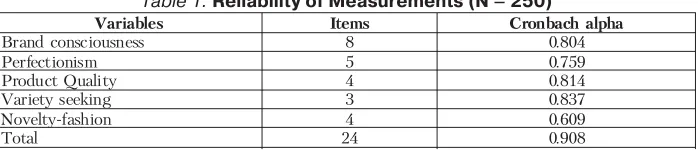
Table 1. Reliability of Measurements (N = 250)
The results in Table 1 demonstrate the reliability of the data, the brand con-sciousness with reliability of 0.804 and the perfectionism of 0.759, the Cronbach
- Brand Consciousness - Perfectionism - Quality Product - Variety Seeking - Novelty Fashion
Consumer Behavior IDVs
Decision Making Styles
DV
Variables Items Cronbach alpha
Brand consciousness 8 0.804
Perfectionism 5 0.759
Product Quality 4 0.814
Variety seeking 3 0.837
Novelty-fashion 4 0.609
[image:4.468.61.410.495.570.2]Alpha for product quality is 0.814, for variety seeking is 0.837, for novelty fashion is 0.609 and the reliability of the whole instrument having 24 items is 0.908.
[image:5.468.57.410.143.208.2]Results and Discussion. The objective of this research is to determine the factors that influence the consumer decision making style, so various tests are performed in this chapter and the results are summarized below (Table 2).
Table 2. Frequency Distribution W R T "Gender and Age"
The result in Table 2 gives the information regarding the gender. Out of total 250 respondents, the participants in this study 149 are male and 101 are female. Table 2 further reveals the information about the respondents' age brackets. Out of 250 respondents 87% were between 20–25 years old, 19 were in between 26–30 years old, whereas 10 respondents were 31–35 years and only 3 respondents were over 35. So, almost 90% of respondents were within 20–25 years old.
Table 3. Consumer behavior of male and female respondents (Independent Sample T-Test) (N = 250)
Independent sample T-test is used to measure the level of response between male and female respondents regarding the decision making behavior. The results in Table 3 depict there is a significant positive relationship between male and female consumer behavior (p < 0.05), and F-Statistics is 5.217. The mean value (3.5069) of female respondents shows that female respondents admitted that decision making styles influence consumer behavior, which means that female are more conscious as com-pared to male respondents regarding the decision making style.
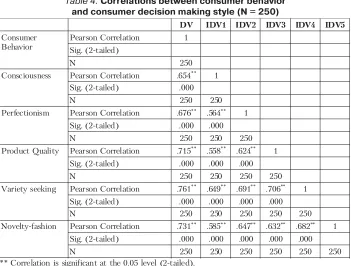
The results of the correlation matrix demonstrate there is a positive significant correlation between all variables and all independent variables are highly correlated with consumer behavior with Pearson correlation value of > 0.50. The results further give the clear picture that at 5% level of significance consumer behavior is highly cor-related with consciousness with a value of 0.654. Based on these results we can argue that the decision making styles influence consumer behavior and consumer behavior is positively and highly correlated with all independent variables that are the con-structs of the decision making styles.
The above table gives the information about the regression analysis. The R-square (0.696) depicts fitness of model and the F-statistics reveals that the model is significant as p-value is 0.000 at 5% of significant level. The result demonstrates a positive and significant relationship between decision making style and consumer behavior. The beta coefficients demonstrate the contribution of each independent variable. So, novelty fashion and product quality contribute 28% and 24%
respective-ACTUAL PROBLEMS OF ECONOMICS Vol. 2, #4, 2012
ACTUAL PROBLEMS OF ECONOMICS Vol. 2, #4, 2012
Gender Frequency Percentage Age Frequency Percentage
Male 149 59.6 20–25 218 87.2
Female 101 40.4 26–30 19 7.6
31–35 10 4.0
> 35 3 1.2
Total 250 100.0 Total 250 100.0
Consumer Decision Behavior
Group Mean Std Dev F-Stat P-Value
Male 3.4273 0.47041 5.217 0.030
[image:5.468.58.409.299.350.2]ly in consumer behavior. All the independent variables have a significant positive rela-tionship with consumer behavior as p < 0.05. So, based on the results, all the hypotheses (H1, H2, H3, H4 and H5) are proved positive and significant, i.e. the consumer decision making style influence the consumer behavior.
Table 4. Correlations between consumer behavior and consumer decision making style (N = 250)
Table 5. Multiple regression coefficients, standard errors in parentheses,
t-values in brackets and p-values in italics
Conclusion and recommendation. The study aims to measure the relationship between decision making style and consumer behavior as well as the importance of each factor of the decision making style regarding consumer behavior. This study also checks the difference between male and female respondents' consumer behavior. Out of total 250 respondents, the participants in this study 149 are male and 101 are female. Almost 90% of the respondents were 20–25 years old. This study concludes that there is a significant relationship between male and female decision making style, and female respondents argue that decision making styles influence consumer behav-ior, which means that female are more conscious as compared to male respondents regarding the decision making styles.
DV IDV1 IDV2 IDV3 IDV4 IDV5
Consumer Behavior
Pearson Correlation 1
Sig. (2-tailed)
N 250
Consciousness Pearson Correlation .654** 1
Sig. (2-tailed) .000
N 250 250
Perfectionism Pearson Correlation .676** .564** 1
Sig. (2-tailed) .000 .000
N 250 250 250
Product Quality Pearson Correlation .715** .558** .624** 1
Sig. (2-tailed) .000 .000 .000
N 250 250 250 250
Variety seeking Pearson Correlation .761** .649** .691** .706** 1
Sig. (2-tailed) .000 .000 .000 .000
N 250 250 250 250 250
Novelty-fashion Pearson Correlation .731** .585** .647** .632** .682** 1
Sig. (2-tailed) .000 .000 .000 .000 .000
N 250 250 250 250 250 250
** Correlation is significant at the 0.05 level (2-tailed).
Constant Conscio-usness
Perfecti-onism
Product Quality
Variety Seeking
Novelty
Fashion R-Square F-Stat
0.149 0.177 0.147 0.248 0.117 0.280 0.696 113.11
(0.140) (0.047) (0.054) (0.051) (0.060) (0.052)
[1.064] [3.788] [2.701] [4.820] [2.938] [5.387]
The results of the correlation matrix demonstrate a positive significant correla-tion between all the independent variables with the consumer behavior with a Pearson correlation value of > 0.50. The decision making styles influence consumer behavior, and consumer behavior is positively and highly correlated with all independent vari-ables that are constructs of the decision making styles. It is also found that there is a positive and significant relationship between decision making style and consumer behavior.
This study helps to investigate and evaluate the behavior, attitudes and beliefs of individuals regarding the decision making styles. By identifying these characteristics from the consumers' perspective, the advertisers will be able to shape up a more effec-tive pattern for online advertisement as well as develop possible solutions for improve-ment.
References:
Bennett, P.D., Kassarjian, H.H. (1972). Foundations of marketing series: Consumer behavior. New Jer sey: Prentice Hall.
Corman, J.R., Guy, L. (1966). Aspects of Attitude Survey. Advanced Management Journal, 31(4): 62–64.
Denham, S. (2005). How effective are online video advertisements? New Media Age Publications. 9 p.
E-Marketers (2001). E-stats, Marketers going for web advertisements. E Marketer Publications. Hofstede, G. (1980). Culture's con sequences: International differences in work-related value. Beverley Hills, CA: Sage Publications.
Holden, E. (2007). Achieving Sustainable Mobility: Everyday and Leisure-time Travel in the EU, Ashgate Publishing Ltd. 118 p.
Jacques, R. (2008). Web advertising bucks credit crunch. VNU NET Publications: http://www. vnunet.com/vnunet/news/2218682/internet-advertising-bucks.
Lee, H. (1983). Consumer Behavior Attributes of Clothing Determining Purchase and Satisfaction. University of Wisconsin Madison. 212 p.
Mokhlis, S., Salleh, H.S. (2009). Consumer Decision-Making Styles in Malaysia: An Exploratory Study of Gender Differences. European Journal of Social Sciences, 10(4): 574–584.
Shohov, P.S. (2002). Creative Belief Systems, Advances in Psychology Research. Nova Publications PVT Ltd. 40 p.
Slama, M.E., Williams, T.G. (1990). Generalizations of the market maven's information provision tendency across product categories'. In: Goldberg, M.E., Gorn, G., Pollay, R.W. (eds). Advances in Consumer Research. Vol. 17. Association for Consumer Research, Provo, UT. Pp. 48–52.
Sproles, G.B. (1985). From perfectionism to faddism: Measuring consumers' decision-making styles'. Proceedings, American Council on Consumer Interests, 31: 79–85.
Sproles, G.B., Kendall, E. (1986). A methodology for profiling consumers' decision-making styles. Journal of Consumer Affairs, 20(2): 267–279.
Sweney, M., Wray, R.B. (2008). Online ad spend reaches record 3 billion Euros. The Guardian Weekly Publications: http://www.guardian.co.uk/media/2008/jun/10/advertising.digitalmedia.
ACTUAL PROBLEMS OF ECONOMICS Vol. 2, #4, 2012