Pig target tracking algorithm based on multi-channel color feature fusion
Longqing Sun
*,
Shuaihua Chen
,
Ting Liu
,
Chunhong Liu
,
Yan
Liu
(College of Information and Electrical Engineering, China Agricultural University, Beijing 100083, China)
Abstract: In the process of tracking the target of the pig, with the change of the size of the tracking target in the video image, the estimated tracking target scale cannot be adaptively updated in real-time, resulting in the low accuracy of the tracking target. In this study, a multi-channel color feature adaptive fusion algorithm was proposed, and the target scale of the pig was updated in real-time by utilizing the contour information of the target pig. Experiments show that the proposed algorithm had a distance precision of 89.7% and an overlap precision of 87.5%, and the average running speed of this algorithm was 50.1 fps. The robustness of the proposed algorithm in tracking target deformation and scale variation were significantly improved, which satisfies the accuracy and real-time requirements of pig target tracking.
Keywords: pig tracking, color feature, correlation filter, ellipse fitting
DOI: 10.25165/j.ijabe.20201303.5346
Citation: Sun L Q, Chen S H, Liu T, Liu C H, Liu Y. Pig target tracking algorithm based on multi-channel color feature fusion. Int J Agric & Biol Eng, 2020; 13(3): 180–185.
1 Introduction
China is a big country for pig breeding. The pig breeding model is developing rapidly in the direction of scale, intelligence and welfare[1]. The monitoring of the growth status of pigs is the key to ensuring the healthy breeding of pigs. At present, it relies on artificial monitoring of the pig breeding process, with low efficiency and high error rate. The application of machine vision technology to monitor live pigs can effectively improve production efficiency. Real-time accurate detection and tracking of pigs is a prerequisite for the behavioral monitoring of pig eating, drinking, and excretion. Therefore, many researchers have done a lot of research on this. Van et al.[2] discussed the feasibility of using a computer vision system to improve livestock production for the low productivity and product quality. McFarlane et al.[3] used the blob edges of the pig in the segmented image to track the piglets in order to monitor the activity of the piglets in farrowing pens. Tillett et al.[4] used point distribution models to identify specific movements such as back bending and head nodding to study the behavioral characteristics of pigs. Perner et al.[5] addresses the occlusion problem in the pig tracking process through an object-oriented method to prevent objects from getting separated or combined by the blocks. Lind et al.[6] tracked target pigs based on a combination of image-subtraction and automatic threshold detection methods. Ahrendt et al.[7] proposed an algorithm for tracking multi-target pigs, using the support map segments to build up a 5D-Gaussian model of the individual pigs, but when the animals move quickly or overlap each other, the method is difficult to achieve accurate tracking. Kashiha et al.[8] painted basic
Receiveddata: 2019-08-21 Accepted date: 2019-12-13
Biographies: Shuaihua Chen, Master student, research interests: video image processing technology, Email: [email protected]; Ting Liu, Master student, research interests: video image processing technology, Email: [email protected]; Chunhong Liu, Associate Professor, research interest: agricultural internet of things research, Email: [email protected]; Yan Liu, Master student, research interests: video image processing technology, Email: [email protected];
*Corresponding author: Longqing Sun, Associate Professor, research interest:
computer technology. China Agricultural University, Beijing 100083, China. Email: [email protected].
patterns on the back of pigs, and used Otsu method and elliptic fitting method to track the target pigs. Li et al.[9] proposed an
improved algorithm based on the adaptive Gaussian mixture model, which overcomes the shortcomings of the traditional Gaussian mixture model in pig detection. Sun et al.[10] proposed an algorithm for multi-target pigs tracking loss correction based on Faster R-CNN. Ju et al.[11] used the YOLO object detector to detect the pig target and found the possible boundary line between the touching-pigs by analyzing the shape. Many algorithms have been proposed in the field of pig target tracking. The problems such as target size change, deformation, occlusion, background clutters and real-time tracking are still not solved well.
Correlation filtering is a kind of high-efficiency target tracking algorithm developed based on the correlation principle of signal processing technology. Bolme et al.[12] applied correlation filtering to the tracking domain based on the Minimum Output Sum of Squared Error (MOSSE). Henriques et al.[13] used Circulant Structure of Tracking-by-detection with Kernels (CSK) to enhance the tracking accuracy of the correlation filter algorithm. In view of the insufficiency of the CSK algorithm feature representation, João et al. used the Kernelized Correlation Filter (KCF)[14] to extend the HOG feature of multi-channel gradients based on CSK. Danelljan uses the Color Name (CN)[15] algorithm to extend the
problem of training in a continuous spatial domain. ECO[21] reduces the dimensions of the convolutional layer filter in the CNN features based on the CCOT algorithm. Recent works[22-25] have shown impressive performance using Siamese networks. Among them, SiameFC[22] employs the same CNN to extract features of two image patches and combine their representations using a similarity metric. In general, depth feature extraction requires more time than traditional feature extraction[26], and the real-time performance of tracking is also limited.
In the process of tracking the target of the pig, as the size of the tracking target changes in the video image, the tracking target scale cannot be adaptively updated in real-time, resulting in a low accuracy of the tracking target. In this paper, a multi-channel color feature adaptive fusion algorithm based on histogram color similarity is proposed to improve the feature representation ability of the algorithm. The target pig's contour information is used for ellipse fitting, and the ellipse's minimum positive circumscribed rectangle is used as the adaptive scale information of the pig target to improve the accuracy of the algorithm in scale estimation. In this paper, the pig tracking evaluation data set is constructed to comprehensively evaluate the tracking performance of the algorithm. The experiment shows that the robustness of the proposed algorithm in the tracking target deformation and scale change is significantly improved.
2 Materials and methods
2.1 Pig tracking data set
The experimental data was collected from a pig farm in Shandong Province, China. On August 12, 2014, four 24-hour videos of pig pens are captured. The image resolution is 640×480 and the frame rate is 25 frames per second. The video capture device is installed above the side of the pens. The captured video images are randomly divided into two groups, the first group is
used for algorithm comparison research, and the second group is used for practical application testing. In order to test the effect of the algorithm on scale variation and deformation, according to the OTB (Online Object Tracking) tracking dataset[27,28] standard,
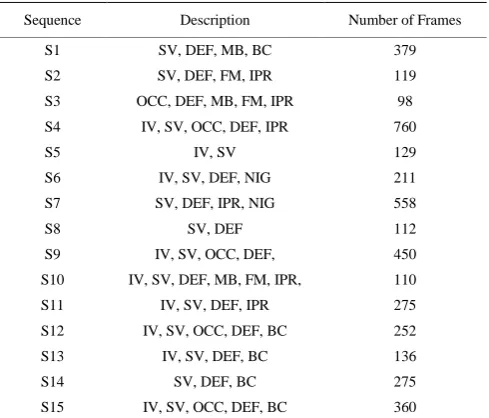
a tracking dataset with 15 fully annotated sequences (numbered S1, S2, ..., S15) is built using the first group of video to the facilitate evaluation of tracking. The dataset contains a variety of factors that affect the accuracy of the target tracking algorithm, such as deformation, occlusion, fast motion, motion blur, and illumination variation. The dataset overview is shown in Table 1, and the partial images with ground-truth annotations are shown in Figure 1.
Table 1 Description of the dataset
Sequence Description Number of Frames
S1 SV, DEF, MB, BC 379
S2 SV, DEF, FM, IPR 119
S3 OCC, DEF, MB, FM, IPR 98
S4 IV, SV, OCC, DEF, IPR 760
S5 IV, SV 129
S6 IV, SV, DEF, NIG 211
S7 SV, DEF, IPR, NIG 558
S8 SV, DEF 112
S9 IV, SV, OCC, DEF, 450
S10 IV, SV, DEF, MB, FM, IPR, 110
S11 IV, SV, DEF, IPR 275
S12 IV, SV, OCC, DEF, BC 252
S13 IV, SV, DEF, BC 136
S14 SV, DEF, BC 275
S15 IV, SV, OCC, DEF, BC 360
Note: IV: Illumination Variation; SV: Scale Variation; OCC: Occlusion; DEF: Deformation; MB: Motion Blur; FM: Fast Motion; IPR: In-Plane Rotation; BC: Background Clutters; NIG: Night
Figure 1 Partial images with ground-truth annotations
2.2 Algorithm principle
2.2.1 Correlation filter tracking principle
The correlation filtering algorithm uses the initial tracking target gray information to train the filter h. Searching for the pixel coordinates of the maximum value in the target candidate region response output g by using the filter, that is the new position of the tracking target; The filter is updated in real-time based on the target tracking results. In order to speed up the operation, the above calculations are computed in the Fourier domain Fast Fourier Transform[29], which is expressed as follows:
F(g)=F(f) ⊙F(h)* (1) The ⊙ symbol denotes element-wise multiplication, * indicates the complex conjugate, g indicates the response output, f indicates
the input image, and h indicates the filter template, F is the fast
Fourier transform.
2.2.2 Color multi-channel feature selection and adaptive weighted fusion algorithm
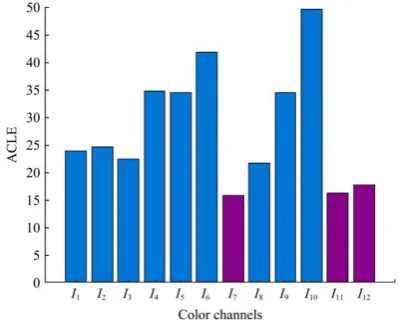
Table 1 is used as the evaluation index of the color feature channel screening, and the calculation is shown in Equation (3). The test results are shown in Figure 2. As can be seen from the figure, the
ACLE of the I7, I11, and I12 color channels is small. The algorithm
extracts the I7, I11, and I12 color channels to enhance the
performance of the algorithm.
1 2 3
4 5 6
7 8 9
10 11 12
( ) / 2 ( ) / 2 ( ) / 2
max( , , ) min( , , ) (max( , , ) min( , , )) / 2
( ) / 3 0.2 * 0.3* 0.5* 0.299 * 0.587 * 0.114 *
I R I G I B
I R G I R B I B G
I R G B I R G B I R G B R G B
I R G B I R G B I R G B
(2) 2 2 1 1 ( ) ( ) n gt gt ij ij ij ij m
j
i
x x y y
n ACLE m
(3)where, m is the number of sequences; n is the number of video frames of the Sm sequence, (xij,yij) is the tracking center coordinate, and ( gt
ij
x , gt
ij
y )is the true ground-truth center coordinate.
Figure 2 Average Center Location Error in 12 color channels In order to further improve the tracking accuracy of the algorithm, the color histogram is used to establish the probability distribution of the tracking target color, and the Bhattacharyya Distance is used to measure the similarity of the color distribution of the target window of two adjacent frames[30]. The pixel value of the target window pixel is represented by {zi}, and the histogram of the t-frame tracking target window is modeled according to Equation (4).
2
1
1, 2,3, ,
( ) ( ) , d i t u i i z z
q C K
h z u u k
(4)where, zt, zi respectively represent the center point pixel and the ith pixel value of the tracking target window; d is the total number of pixels of the tracking target window; u is the number of color gray segments, k is the maximum number of segments of the color gray;
K(||z||2) is the kernel function; h is the bandwidth of the kernel
function; δ[(zi)–u] is the Kronecker pulse function, the function
(zi) maps each pixel into the corresponding feature space; C is a normalization constant. Similarly, the t+1 frame candidate tracking target histogram is modeled as shown in Equation (5), and
zt+1 is the t+1 frame candidate tracking target center pixel value.
2 1
1
1
( ) ( ) , 2,3, ,
d i t u i i u k z z
p C K z u
h
, (5)The similarity between qu and pu is measured by the Bhattacharyya distance, ie
1 k u u u q p
(6)The upper and lower frame similarities ρ7, ρ11 and ρ12 of the I7,
I11, and I12 color channels are calculated by the above equations.
The center coordinate I7(xt+1, y t+1), I11(xt+1, y t+1), I12(xt+1, y t+1)
of the t-th frame were calculated by the three color channels, and then the center position I(xt+1, yt+1) of the tracking target of the t+1th
frame can be calculated as follows:
7
1 1 7 1 1
7 11 12
11 12
11 1 1 12 1 1
7 11 12 7 11 12
( , ) * ( , )
* ( , ) * ( , )
t t t t
t t t t
I x y I x y
I x y I x y
(7)
2.2.3 Adaptive scale update algorithm based on ellipse fitting In order to enhance the robustness of the algorithm to the scale variation in the tracking process, the Otsu method[31] is used to
segment the target pig in the current frame search region, and then the target pig edge contour coordinate G(x, y) is extracted from the segmented image. The ellipse is fitted by the least squares method, and the minimum positive circumscribed rectangle of the ellipse is used as the adaptive scale information of the pig target. The elliptic equation is as shown in Equation (8) and the effect is shown in Figure 3. In order to maintain a robust filter, the filter scale is updated by the nearest neighbor interpolation method while the estimated scale is updated. Experiments show that this method can enhance the robustness of the algorithm to deformation and scale variation.
f(α,X)=αX=Ax2+Bxy+Cy2+Dx+Ey+F=0 (8) where, α is [A, B, C, D, E, F]; Xi indicates the ith contour
coordinate 2 2
[x x y y x yi, i i, i, ,i i,1] ; substituting the edge contour
coordinates G(x, y) of the pig into Equation (8):
2 2 2
1
( , , , , , ) ( )
n
i i i i i i i
f A B C D E F Ax Bx y Cy Dx Ey F
(9)where, n is the total number of edge contour pixels, to minimize the
above formula f f f f f f 0
A B C D E F
.
3 Results and discussion
3.1 Quantitative evaluation
In order to comprehensively evaluate the performance of the tracking algorithm in terms of deformation, scale variation and occlusion, the tracking dataset with 15 fully annotated sequences shown in Table 1 are selected to quantitatively evaluate the proposed method with baseline algorithms of KCF, fDSST, SiameFC and ECO. Two evaluation indices were compared: Distance Precision (DP) and Overlap Precision (OP). DP is the relative number of frames in the sequence where the center location error is smaller than a certain threshold. The threshold (d) is taken from 0 to 50 to draw the precision plot, and the calculation formula is as shown in Equation (10). OP is defined as the percentage of frames where the bounding box overlap exceeds a
threshold a
[0, 1], and the calculation formula is as shown in Equation (11).2 2
1
( ( ) ( ) )
n
gt gt j j j j j
b x x y y d
DP
n
(10)1
( )
gt n
j j gt j j j
r Ir
b a
r Ur OP
n
(11)In the above two formulas, b() is the indicator function, and When is true or false, the value is 1,0 respectively; n is the total number of frames of the video sequence.
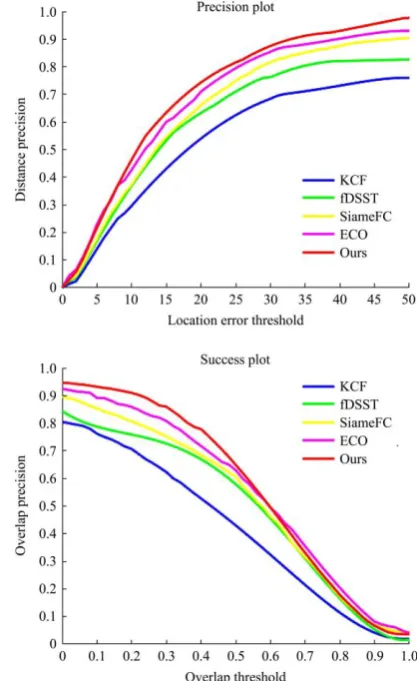
All the experiments are conducted on an Intel i7-6700 CPU (3.40 GHz) PC with 16 GB memory. We implemented the proposed tracker by native Matlab without optimization. The average distance and overlap precision of the algorithm are tested and compared on the 15 tracking sequences shown in Table 1. As shown in Figure 4, and the red curve represents our algorithm, and the blue, green, yellow and magenta curves represent the KCF, fDSST, SiameFC and ECO algorithms, respectively. It can be seen from the figure that the distance precision value and the overlap precision value of our algorithm under different thresholds perform better than other algorithms. The criterion is to use less than 20 pixels as the distance threshold and greater than the overlap threshold of 0.5 as the criterion for judging whether the tracking process is successful[15, 27-28]. On the distance precision (DP), the average precisions of the KCF, fDSST, SiameFC and ECO algorithms on 15 tracking sequences are 54.0%, 63.3%, 66.2% and 71.0%. The average precision of our algorithm is 74.3%, which is 20.3%, 11.0%, 8.1% and 3.3% higher than the KCF, fDSST, SiameFC and ECO algorithms respectively. On the overlap precision (OP), the average precisions of the KCF, fDSST, SiameFC and ECO algorithms on 15 tracking sequences are 42.9%, 57.9%, 60.6% and 62.9%. The average overlap precision of our algorithm is 64.9%, which is 22.0%, 7.0%, 4.3% and 2.0% higher
than the average precisions of the KCF, fDSST, SiameFC and ECO algorithms, respectively. Our algorithm's running speed is 50.1FPS in CPU (Frames Per Second), which can track pig movement in real-time.
Figure 4 DP and OP values of different algorithms on the dataset
3.2 Qualitative evaluation
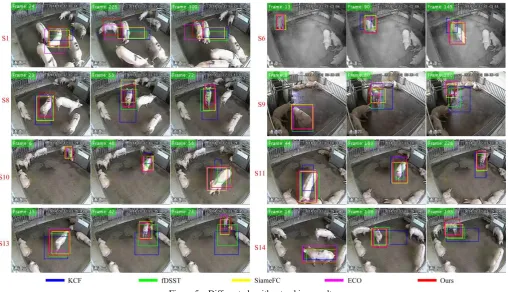
The results of the target tracking section are shown in Figure 5. The red rectangle represents the algorithm of our algorithm, while the blue, green, yellow and magenta rectangles represent the KCF, fDSST, SiameFC and ECO algorithms respectively.
The oversized and undersized scale estimation will cause the tracking failure.
In this paper, the tracking performance of the algorithm under
nighttime or low-light conditions is tested. The tracking performance of our algorithm under low-light conditions is good as shown in the S6 sequence in Figure 5.
Figure 5 Different algorithm tracking results
3.3 Algorithm tracking application
The practical application performance of the algorithm is tested by using the second group of monitoring video data collected in the previous period. Figure 6 records the DP and OP values of the 45000 frame video sequence. It can be seen from the figure that the distance precisions of the KCF, fDSST, SiameFC and ECO algorithms are 63.6%, 77.5%, 82.9% and 86.8%, respectively. Our algorithm can accurately track the target, and the distance
precision is 89.7%, which is increased by 26.1%, 12.2%, 6.8% and 2.9%, respectively. The overlap precisions of the KCF, fDSST, SiameFC and ECO algorithms are 59.2%, 70.6%, 77.3% and 83.2%. The overlap precision of the algorithm is 87.5%, which is increased by 28.3%, 16.9%, 10.2% and 4.3%, respectively, to meet the practical application requirements. The problem of scale variation and deformation is effectively solved, and it has better robustness.
Figure 6 DP and OP values of different algorithms on random video data sets
4 Conclusions
In the process of tracking the target of the pig, as the size of the tracking target changes in the video image, the tracking target scale cannot be adaptively updated, resulting in a low accuracy of the tracking target. In this paper, a multi-channel color feature adaptive fusion algorithm is proposed, which uses the target pig Contour information to realize real-time adaptive pig target scale
update. The main conclusions are as follows:
b) It has good tracking performance on randomly selected actual monitoring data. The distance precision and overlap precisions are 89.7% and 87.5%, respectively, which can meet the practical application requirements of pig monitoring.
Acknowledgements
This work was supported in part by the National Key Research and Development Plan for the 13th Five-Year Plan under Grant 2016YFD0700200. This work was supported in part by the National High Technology Research and Development Program of China (2013AA102306).
[References]
[1] Nasirahmadi A, Sturm B, Olsson A C, Jeppsson K H, Müller S, Edwards S, et al. Automatic scoring of lateral and sternal lying posture in grouped pigs using image processing and Support Vector Machine. Computers and Electronics in Agriculture, 2019; 156: 475–481.
[2] Van der Stuyft E, Schofield C P, Randall J M, Wambacq P, Goedseels V. Development and application of computer vision systems for use in livestock production. Computers and Electronics in Agriculture, 1991; 6: 243–265.
[3] McFarlane N J B, Schofield C P. Segmentation and tracking of piglets in images. Machine Vision and Applications, 1995; 8: 187–193.
[4] Tillett R D, Onyango C M, Marchant J A. Using model-based image processing to track animal movements. Computers and Electronics in Agriculture, 1997; 17(2): 249–261.
[5] Perner P. Motion tracking of animals for behavior analysis. In: Arcelli C, Cordella L P, di Baja G S (Ed.). Visual Form 2001. IWVF 2001. Lecture Notes in Computer Science, Vol. 2059, Berlin, Heidelberg: Springer, 2001; pp.779–786.
[6] Lind N M, Vinther M, Hemmingsen R P, Hansen A K. Validation of a digital video tracking system for recording pig locomotor behaviour. Journal of Neuroscience Methods, 2005; 143(2): 123–132.
[7] Ahrendt P, Gregersen T, Karstoft H. Development of a real-time computer vision system for tracking loose-housed pigs. Computers and Electronics in Agriculture, 2011; 76(2): 169–174.
[8] Kashiha, M, Bahr C, Ott S, Moons C P H, Niewold T A, Ödberg, F O, et al. Automatic identification of marked pigs in a pen using image pattern recognition. Computers and Electronics in Agriculture, 2013; 93: 111–120. [9] Li Y Y, Sun L Q, Zou Y B, Li Y. Individual pig object detection
algorithm based on Gaussian mixture model. Int J Agric & Biol Eng, 2017; 10(5): 186–193.
[10] Sun L Q, Zou Y B, Li Y, Cai Z D, Li Y, Luo B, et al. Multi target pigs tracking loss correction algorithm based on Faster R-CNN. Int J Agric & Biol Eng, 2018; 11(5): 192–197.
[11] Ju M, Choi Y, Seo J, Sa J, Lee S, Chung Y, et al. A Kinect-based segmentation of touching-pigs for real-time monitoring. Sensors, 2018; 18(6): 1746.
[12] Bolme D S, Beveridge J R, Draper B A, Lui Y M. Visual object tracking using adaptive correlation filters. In: 2010 IEEE Computer Society Conference on Computer Vision and Pattern Recognition. San Fancisco: IEEE. 2010; pp.2544–2550.
[13] Henriques J F, Caseiro R, Martins P, Batista J. Exploiting the circulant structure of tracking-by-detection with kernels. In: Fitzgibbon A., Lazebnik S., Perona P., Sato Y., Schmid C (Ed.). Computer Vision- ECCV 2012. Lecture Notes in Computer Science, Vol. 7575, Berlin,
Heidelberg: Springer, 2012; pp.702–715.
[14] Henriques J F, Caseiro R, Martins P, Batista J. High-speed tracking with kernelized correlation filters. IEEE Transactions on Pattern Analysis and Machine Intelligence, 2015; 37(3): 583–596.
[15] Danelljan M, Shahbaz Khan F, Felsberg M, van de Weijer J. Adaptive color attributes for real-time visual tracking. In: The IEEE Conference on Computer Vision and Pattern Recognition (CVPR), 2014; pp.1090–1097. [16] Li Y, Zhu J K. A scale adaptive kernel correlation filter tracker with
feature integration. In: Agapito L, Bronstein M, Rother C (Ed.). Computer Vision-ECCV 2014 Workshops. Lecture Notes in Computer Science, Vol. 8926, Cham: Springer, 2014; pp.254–265.
[17] Danelljan M, Häger G, Shahbaz Khan F, Felsberg M. Accurate scale estimation for robust visual tracking. In: Proceeding of the British Machine Vision Conference, Nottingham: BMVA Press, 2014.
[18] Danelljan M, Häger G, Shahbaz Khan F, Felsberg M. Discriminative scale space tracking. IEEE Transactions on Pattern Analysis and Machine Intelligence, 2017; 39(8): 1561–1575.
[19] Danelljan M, Hager G, Shahbaz Khan F, Felsberg M. Convolutional features for correlation filter based visual tracking. In: The IEEE International Conference on Computer Vision (ICCV) Workshops, 2015; pp.58–66.
[20] Danelljan M, Robinson A, Khan F S, Felsberg M. Beyond correlation filters: Learning continuous convolution operators for visual tracking. In: Leibe B, Matas J, Sebe N, Welling M (Ed.). Computer Vision-ECCV2016. Lecture Notes in Computer Science, Vol. 9909, Cham: Springer, 2016; pp.472–488.
[21] Danelljan M, Bhat G, Shahbaz Khan F, Felsberg M. Eco: Efficient convolution operators for tracking (CVPR). In: The IEEE Conference on Computer Vision and Pattern Recognition, 2017; pp.6638–6646.
[22] Bertinetto L, Valmadre J, Henriques J F, Vedaldi A, Torr P H S. Fully-convolutional siamese networks for object tracking. In: Hua G, Jégou H (Ed.). Computer Vision-ECCV2016 Workshops. Lecture Notes in Computer Science, Vol. 9914, Cham: Springer, 2016; pp.850–865.
[23] Valmadre J, Bertinetto L, Henriques J, Vedaldi A, Torr P H S. End-to-end representation learning for correlation filter based tracking. In: The IEEE Conference on Computer Vision and Pattern Recognition (CVPR), 2017; pp.2805–2813.
[24] Zhang Y H, Wang L J, Qi J Q, Wang D, Feng M Y, Lu H C. Structured siamese network for real-time visual tracking. In: The European Conference on Computer Vision (ECCV), 2018; pp.351–366.
[25] Li B, Yan J J, Wu W, Zhu Z, Hu X L. High performance visual tracking with siamese region proposal network. In: The IEEE Conference on Computer Vision and Pattern Recognition (CVPR), 2018. pp. 8971–8980. [26] Li P X, Wang D, Wang L J, Lu H C. Deep visual tracking: Review and
experimental comparison. Pattern Recognition, 2018; 76: 323–338. [27] Wu Y, Lim J, Yang M H. Online object tracking: A benchmark. In: The
IEEE Conference on Computer Vision and Pattern Recognition (CVPR), 2013. pp.2411–2418.
[28] Wu Y, Lim J, Yang M H. Object Tracking Benchmark. IEEE Transactions on Pattern Analysis and Machine Intelligence, 2015; 37: 1834–1848.
[29] Flannery B P, Press W H, Teukolsky S A. Numerical recipes in C. New York: Press Syndicate of the University of Cambridge, 1992; 24: 78. [30] Comaniciu D, Ramesh V, Meer P. Kernel-based object tracking. IEEE
Transactions on Pattern Analysis and Machine Intelligence, 2003; 25(5): 564–575.