
http://www.scirp.org/journal/jcc ISSN Online: 2327-5227
ISSN Print: 2327-5219
Solving Travelling Salesman Problem with an
Improved Hybrid Genetic Algorithm
Bao Lin1,2, Xiaoyan Sun1, Sana Salous3
1School of Information and Electrical Engineering, China University of Mining and Technology, Xuzhou, China
2School of Electronics and Information, Jiangsu University of Science and Technology, Zhenjiang, China
3School of Engineering and Computing Sciences, Durham University, Durham, UK
Abstract
We present an improved hybrid genetic algorithm to solve the two-dimensional Euc-lidean traveling salesman problem (TSP), in which the crossover operator is en-hanced with a local search. The proposed algorithm is expected to obtain higher quality solutions within a reasonable computational time for TSP by perfectly inte-grating GA and the local search. The elitist choice strategy, the local search crossover operator and the double-bridge random mutation are highlighted, to enhance the convergence and the possibility of escaping from the local optima. The experimental results illustrate that the novel hybrid genetic algorithm outperforms other genetic algorithms by providing higher accuracy and satisfactory efficiency in real optimiza-tion processing.
Keywords
Genetic Algorithm, Hybrid Local Search, TSP
1. Introduction
Travelling Salesman problem (TSP) [1] is a well-known nondeterministic polynomial time (NP-Hard) problem and a typical example in combinatorial optimization re-searched in both operations research and theoretical computer science. TSP can be de-scribed as: Given a finite set of n cities and a cost matrix D=[dij], in which
d
ij denotes the cost (e.g., distance, money, time) of traveling from city i to city j ( ,i j∈{1, 2,, })n , TSP aims to find the optimal tour π π π=( ,1 2,,πn) that visits each city exactly once and eventually return to the starting city. The objective function of this linear programming problem in TSP is minimizing the sum value of the cost inthe valid tour: 1 1
1
, ,
1
min
i i n
n
i
dπ π+ dπ π
−
=
+
∑
.How to cite this paper: Lin, B., Sun, X.Y. and Salous, S. (2016) Solving Travelling Salesman Problem with an Improved Hy-brid Genetic Algorithm. Journal of Com-puter and Communications, 4, 98-106. http://dx.doi.org/10.4236/jcc.2016.415009
TSP and its variants transpire in a large variety of real-world applications such as ve-hicle routing, scheduling problems, integrated circuits designs, graph theory, gene or-dering, and so on. Up to now, many literatures have reported that lots of techniques applied to those problems suffer from exponentially growing complexity for finding out an optimal solution. Various heuristic approaches have been conducted to obtain the global optimum or reasonable suboptimal solutions in solving TSP, such as Genetic Algorithm (GA) [2] [3], Simulated Annealing (SA) [4], Ant Colony Optimization (ACO) [5], Particle Swarm Optimization (PSO) [6], Tabu Search (TS) [7], Neural Net-work (NN) [8], and so on. Among all the evolutional algorithms, GA has paid more at-tention for its effectiveness compared to other algorithms in solving discrete combina-torial optimization problems. Furthermore, there are many researches [9] [10] [11] [12] on combining of GA with other evolutional algorithms to improve accuracy and effi-ciency in solving TSP.
In this paper, a novel hybrid GA (HGA), which incorporates the local search method into GA, is proposed to be as an effective heuristic approach for the two-dimensional Euclidean TSP. The proposed algorithm has the trade-off of preserving population di-versity and preventing the premature convergence in the evolutionary processing. Some mechanisms are specifically designed and constructed to improve the quality of the fi-nal solutions with reasonable time-consuming for TSP, such as the elitist choice strate-gy, the local search crossover operator and the double-bridge random mutation. The proposed HGA is verified with some standard data benchmarks from TSPLIB [13]. In this work, we make the following contributions: 1) We introduce hybrid version of both algorithms with GA and the local search method as a promising method for TSP; 2) We conduct the experimental research to validate the effectiveness and efficiency of the HGA by a comprehensive comparison over other evolutionary algorithms.
The rest of this paper is organized as follows. Section 2 briefly introduces the tradi-tional GA for TSP. Section 3 presents the description of the proposed HGA. Section 4 demonstrates the experimental results. Finally, Section 5 summarizes the paper and de-rives conclusions with the scope of future extension of this work.
2. Background
The basic steps of GA are presented:
Procedure of GA
1 Population Initialization 2 Repeat
3 Parents selection process 4 Crossover operator 5 Mutation operator 6 Survivor selection process 7 Until termination criteria reached 8 Output the final results
End
In solving the small-scale TSP, the traditional GA can provide the satisfactory optim-al solution with an acceptable time-consuming. However, when the number of city nodes increases, the traditional GA is greatly challenged with respect to efficiency be-cause of the stagnation behavior and premature convergence. Therefore, designing the effective operators in GA is considered to be a promising way to solve the me-dium-scale or large-scale TSP.
3. The Proposed Algorithm
In this paper, a novel heuristic HGA, which is a mechanism of combining GA with the local search strategy, is proposed to efficiently solve TSP. The proposed HGA incorpo-rates the local search strategy into GA by the novel updating strategy which is the com-bination of the elitist choice strategy, the local search crossover operator and the double-bridge random mutation. It takes full advantage of exploration ability of GA and exploitation capability of the local search method to improve the quality of the op-timum or sub-opop-timum solutions with reasonable time-consuming.
3.1. Initialization
In permutation encoding of TSP, the individual chromosome representing a feasible solution is encoded as a N dimensional integer vector πl =(π πl1, l2,,πln) (where
1, 2, ,
l l ln
π π π represent N consecutive city nodes in a complete valid tour with 1, 2, ,
3.2. Selection Operator
The mechanism of combing roulette wheel selection and elitist choice strategy is used as selection operator in HGA. These survival chromosomes with the best fitness value will have higher probabilities to be selected from the matting pool of the previous gen-eration. In this paper, the fitness function is used as Equation (1).
1 ( )
1 ( )
F
f π
π =
+ (1)
3.3. Local Search Crossover Operator
Crossover operator is a vital factor which determines the characteristic optimization of HGA. Local search crossover operator, which preserves part of the good edge know-ledge of the selected parent chromosomes obtained with the previous population, im-proves effectiveness and efficiency of HGA by exploring the more promising different regions of the solution space for TSP. The mechanism of the local search crossover op-erator is described in the following:
1) Randomly select two parent individuals (saying πpi=(πpi1,πpi2,,πpin) and
1 2
( , , , )
pj pj pj pjn
π = π π π ) from the matting pool of the previous generation according to crossover probability Pc.
2) From the first parent individual πpi, one gene node is selected randomly as the starting node of the offspring chromosome πqi. For example, the node πpia is se-lected as the start point of the new individual, then all the one-step neighborhood gene nodes of πpia in both the two parents individuals are determined and they are πpi a(−1),
( 1)
pi a
π + , πpj b(−1), πpj b(+1) (the value of the node πpjb in πpj is equal to that of the node πpia in πpi). Comparing the travelling distances between the current node and those one-step neighborhood gene nodes (dπpia,πpi a(−1), dπpia,πpi a(+1), dπpia,πpj b(−1), dπpia,πpj b(+1)) respectively, the nearest node to the current node in the neighborhood is selected and inserted into the sequence of πqi. New added edge heuristically inherit minimum dis-tance sub-path around the neighborhood of the current node from two parent individ-uals. Meanwhile, the added node is set as the current node in πqi. For further expand-ing the searchexpand-ing range, the above neighborhood can be set as two-step or much more steps while the calculation and the computational time will be increasing.
3) Repeating the process of inserting the minimum distance edge around the neigh-borhood of the current node until the neighbor nodes of the current node has already been added the sequence of πqi. Then, the nearest node to the current node will be sought in these remaining nodes that have not been added the sequence of πqi.
4) Repeating the above processing of the local search crossover operator until all of the nodes have been added into the sequence of πqi. Thereby, one complete valid offspring chromosome πqi is produced.
5) Another offspring chromosome πqj is produced by using the same way. Finally, we produce two feasible offspring chromosomes from two parent individuals by local search crossover operator.
indi-viduals are exploited to moderately improve the population quality in approximating the global optimum or sub-optimum solutions as the execution progress.
3.4. Double-Bridge Random Mutation Operator
Double-bridge [14] random mutation operator is used to maintain the diversity of the population in HGA. It perturbs the original individual and increases the probability of generating better offspring through randomly modifying the gene values. Double- bridge random mutation operator plays an important role of avoiding the evolutionary process to trap into the local optimum and exploring an increasingly larger region of the solution space.
The HGA adequately utilizes the global exploring ability of GA and the efficiency of the local search method to obtain the satisfactory final solutions with acceptable time- consuming.
4. Experiments and Results
In these experiments, the computing platform is MATLAB R2012a on 2.30GHz CPU Intel Corei5-6300HQ and 4.00 GB RAM. For the comprehensive analysis of the feasi-bility and validity of the HGA, we carry out experiments on the two-dimensional sym-metric Euclidean TSP instances from the best-known TSPLIB benchmark. Each in-stance is executed 20 times to obtain an average behavior for the method. The parame-ters of HGA are set as following: crossover probability Pc =0.6; mutation probability
0.3 m
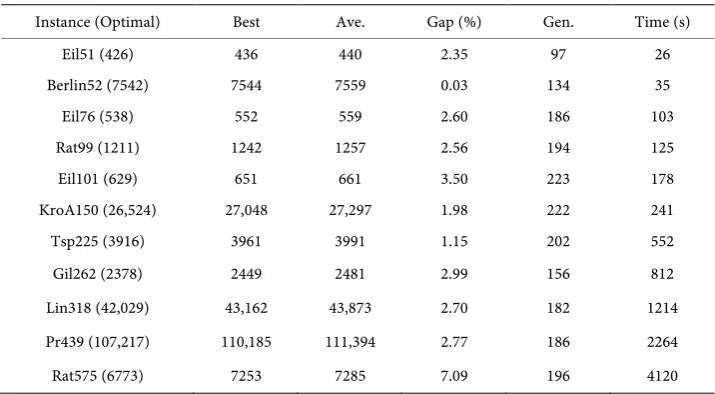
P = . The population size M is roughly equal to the number of cities. Those ex-perimental results are shown in Table 1.
[image:5.595.195.553.509.706.2]In Table 1, the performance indices in these experiments are described as follows: 1) Instance (Optimal): The name of instances and the corresponding length of op-timal tour in parentheses. The name of each TSP instance has a suffix number that represents the number of city nodes of the instance.
Table 1. The experimental results of HGA.
2) Best: The best tour length with the 20 independent executions. 3) Ave.: The total average tour length of 20 trials.
4) Gap (%): The relative error of the length of the best tour to that of the optimal tour, which is formulated as Equation (2):
100(%) best opt
opt
L L
Gap L
−
= × (2)
where Lbest is the best tour length among all the 20 trials and Lopt is the best-known optimal tour length of each instance so far.
5) Gen.: The average numbers of the iteration.
6) Time (s): the average computational time in seconds.
By observing the figures in Table 1, the results show that HGA could mostly works very well on the medium-scale TSP instances with up to 575 nodes. These average solu-tions are also stable and able to reach close to the optimum of each instance. The rela-tive errors between the best tour lengths and TSPLIB optimum tour lengths: For Ber-lin52, Tsp225 and KroA150, HGA obtained better solutions can reach to the optimum solutions with high ratios of0.03, 1.15 and 1.98 respectively. Although the computa-tional time depends on the different data characteristic of each instance, the time-con- suming increases with the increase of the case size to solve TSP in rationale and the bigger the size of a case, the greater the computing time. As the number of cities creases such as Tsp225, Lin318, Pr439 and Rat575, the average computational time in-creases with exponential order such as 552, 1214, 2264 and 4120. This reason is appro-priate that the computational complexity will increase as well in executing local search crossover operator. All aspects of the statistical analysis represent the performances of the HGA including the final solution quality and the computational time. In general, Experimental results demonstrate that HGA can perform effectively and efficiently on the medium-scale TSP instance.
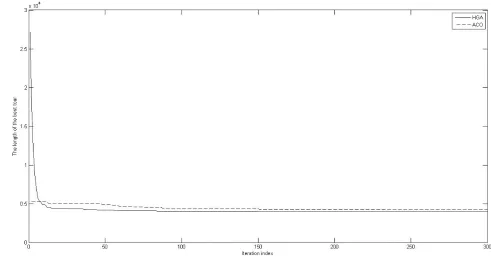
For the comparative experiment, there is an instance Tsp225 of the specific evolutio-nary processing obtained by HGA and the traditional ACO as shown in Figure 1. The diagram plots the lengths of the best tour obtained by those methods as a function of the iteration index.
Figure 1. The comparative experiment of HGA and ACO.
Therefore, HGA performs more effectively and efficiently than the traditional ACO in terms of the convergence rate and the solution quality.
For further to validate the effectiveness of HGA for TSP, we perform the comparative experiments to assess the contributions of HGA and other different algorithms. Table 2 shows the comparative results of HGA and those of the GA introduced in the article [9].
The results in Table 2 indicate that the average best tour lengths and the final tour lengths found by HGA are better than those obtained the GA [9] on the majority of in-stances. Meanwhile, the relative error of the best solution found by HGA is very higher than that of the GA [9] on most of instances. HGA has better solution quality than the GA [9] but suffers from a slightly slow speed. With the increase in the case size of TSP, we test HGA and the GA introduced in the article [10] on these TSP benchmarks with up to 442 cities. Table 3 also shows the comparative experimental results of HGA and the GA [10].
The results in Table 3 show that these improvements in the solution quality are sta-tistically significant. The average solutions, the final solutions and the relative errors found by HGA are better than those obtained the GA [10] on these instances. Therefore, HGA outperforms those Genetic Algorithms in terms of the solution quality. HGA is a heuristic hybrid evolutionary algorithm with efficiency and effectiveness for solving TSP.
5. Conclusion
Table 2. The comparative results of GA [9] and HGA.
Instance(Optimal) GA [9] HGA
Best Ave. Gap (%) Time (s) Best Ave. Gap (%) Time (s) Eil51(426) 438 449 2.82 17 436 440 2.35 26 Berlin52(7542) 7542 8024 0.00 19 7544 7559 0.03 35 St70(675) 700 713 3.70 39 683 686 1.19 81 Eil76(538) 565 577 5.02 50 552 559 2.60 103 KroB100(22141) 22,722 23,195 2.62 115 22,426 22,596 1.29 172 Eil101(629) 670 690 2.62 115 651 661 3.50 178 Pr107(44303) 44,678 45,584 0.85 127 44,661 45,150 0.81 140 Pr124(59030) 59,199 61,041 0.29 218 59,452 59,784 0.71 206
Table 3. The comparative results of GA [10] and HGA.
Instance(Optimal) GA [10] HGA
Best Ave. Gap (%) Best Ave. Gap (%) KroA100(21282) 23,909 24,270 12.34 21,733 21,811 2.12 KroA150 (26524) 28,651 29,418 8.02 27,048 27,297 1.98 KroA200 (29368) 32,646 33,978 11.16 30,014 30,166 2.20 Pr299(48191) 54,104 55,938 12.27 50,419 50,735 4.62 Pcb442(50778) 53,849 55,798 6.05 53,849 54,371 6.05
good symbiotic behavior is proposed and illustrated for the two-dimensional symme-tric Euclidean TSP. The proposed HGA provides much better reasonable structure de-sign to compensate for the balance between global and local search contributes to effi-ciently improve the evolutionary process in terms of the convergence rate and the solu-tion quality. Experimental results demonstrate that HGA is a robust hybrid evolutio-nary algorithm to search the global optimum or sub-optimum solutions within rea-sonable computational time. Meanwhile, HGA works very well on the medium-scale TSP instances and outperforms the other GAs in the 4 section. As future research work, there is a lot of scope for development in HGA with large-scale TSP and their applica-tions. We also plan to investigate extensions of the HGA for other complex optimiza-tion problems.
Acknowledgements
This work is jointly supported by the National Natural Science Foundation of China with grants No. 61473298 and No. 61473299.
References
[1] Lawler, E.L.G., Lenstra, J.K., Rinnooy Kan, A.H.G. and Shmoys, D.B. (1985) The Traveling
[image:8.595.196.555.293.412.2]Simu-lation, and Control—Wiley-Interscience Series in Discrete Mathematics and Optimization.
Wiley Interscience, Chichester, West Sussex, UK.
[2] Holland, J.H. (1975) Adaptation in Natural and Artificial Systems: An Introductory
Analy-sis with Applications to Biology, Control, and Artificial Intelligence. University Michigan Press, Ann Arbor, MI, USA.
[3] Grefenstette, J., Gopal, R., Rosimaita, B. and van Gucht, D. (1985) Genetic Algorithms for
the Traveling Salesman Problem. Proc. Int. Conf. Genetic Algorithms and Their
Applica-tions, July 1985, 160-168.
[4] Kirkpatrick, S., Gelatt Jr., C.D. and Vecchi, M.P. (1983) Optimization by Simulated An-nealing. Science, 220, 498-516. http://dx.doi.org/10.1126/science.220.4598.671
[5] Dorigo, M., Maniezzo, V. and Colorni, A. (1996) The Ant System: Optimization by a
Colo-ny of Cooperating Agents. IEEE Transactions on Systems, Man and Cybernetics Part B, 26,
29-41. http://dx.doi.org/10.1109/3477.484436
[6] Kennedy, J. and Eberhart, R. (1995) Particle Swarm Optimization. Proceedings of IEEE
In-ternational Conferenceon Neural Networks, 4, 1942-1948.
http://dx.doi.org/10.1109/icnn.1995.488968
[7] Glover, F. (1989) Tabu Search, Part I. ORSA Journal on Computing, 1, 190-206.
http://dx.doi.org/10.1287/ijoc.1.3.190
[8] Potvin, J.Y. (1993) The Traveling Salesman Problem: A Neural Network Perspective. ORSA
J. Comput., 5, 328-348. http://dx.doi.org/10.1287/ijoc.5.4.328
[9] Osaba, E., Carballedo, R., Diaz, F. and Perallos, A. (2013) Analysis of the Suitability of
Us-ing Blind Crossover Operators in Genetic Algorithms for SolvUs-ing RounUs-ing Problems. IEEE
International Symposium on Applied Computational Intelligence and Informatics, 17-22.
[10] Chang, P.C., Huang, W.H., Ting, C.J. and Chang, W.J. (2009) A Varietal Genetic Algorithm
by External Self-evolving Multiple-archives for Combinatorial Optimization Problems.
Proceedings of the 11th IEEE International Conference on High Performance Computing
and Communications, 609-614. http://dx.doi.org/10.1109/hpcc.2009.67
[11] Wu, Y., Weise, T. and Chiong, R. (2015) Local Search for the Traveling Salesman Problem:
A Comparartive Study. Proceedings of the 14th IEEE Int1 Conf. on Cognitive Informatics
& Cognitive Computing, 213-220. http://dx.doi.org/10.1109/icci-cc.2015.7259388
[12] Pham, D.T. and Huynh, T.T.B. (2015) An Effective Combination of Genetic Algorithms
and the Variable Neighborhood Search for Solving Travelling Salesman Problem. IEEE
Conference on Technologies and Applications of Artificial Intelligence, 142-149.
[13] Reinelt, G. (1991) TSPLIB—A Traveling Salesman Problem Library. ORSA Journal on
Computing, 3, 376-384. http://dx.doi.org/10.1287/ijoc.3.4.376
[14] Helsgaun, K. (2009) General k-opt Submoves for the Lin-Kernighan TSP Heuristic.
Ma-thematical Programming Computation, 1, 119-163.
Submit or recommend next manuscript to SCIRP and we will provide best service for you:
Accepting pre-submission inquiries through Email, Facebook, LinkedIn, Twitter, etc. A wide selection of journals (inclusive of 9 subjects, more than 200 journals)
Providing 24-hour high-quality service User-friendly online submission system Fair and swift peer-review system
Efficient typesetting and proofreading procedure
Display of the result of downloads and visits, as well as the number of cited articles Maximum dissemination of your research work
![Table 2. The comparative results of GA [9] and HGA.](https://thumb-us.123doks.com/thumbv2/123dok_us/7812637.730486/8.595.196.555.293.412/table-comparative-results-ga-hga.webp)
