Reduction of Delay Propagation in Parallel Architecture
Based on FNT for High Speed Cyclic Convolution
M.Vyshnava Datta
*, Ankit Kumar Jain
**, G. Mohan Bala Krishna
*** *Mechanical, KL Univeristy
**
Electrical and Electronics, KL University
***
Mechanical, KL University
Abstract- This project deals with a cyclic convolution of high speed parallel architecture based on Fermat number transform (FNT). Cyclic convolution architectures are implemented for operands in diminished-1 representation. The code conversion (CC) method is mandatory to convert normal binary numbers into their diminished-1 representation. In this paper we discuss about the FNT (Fermat Number Transform) and IFNT (Inverse Fermat Number Transform) operations which are performed by CCWA (Code Conversion without Addition) & BOWA (Butterfly Operation without Addition). The convolution which is the point wise multiplication is implemented by modulo 2n+1 partial product multipliers (MPPM) and these output partial products are the inputs to the IFNT and modulo 2n+1 carry propagation additions are avoided in the FNT and the IFNT except in their final stages
The reduction of modulo 2n+1 carry propagation addition reduces the execution delay of the parallel architecture. The proposed one has better throughput performance and involves less hardware complexity than the existing cyclic convolution architecture.
Index Terms- Fermat Number Transform (FNT), Code Conversion Method without
-Addition (CCWA), Butterfly Operation without -Addition (BOWA), Modulo 2n+1 Partial Product Multipliers (MPPM).
I. INTRODUCTION
he cyclic convolution based on FFT is a widely used operation in signal processing, which needs to be performed in a complex domain even if both of the sequences to be performed would be real. Additionally, the dynamic range of the numbers varies widely so that one need to use floating point numbers to avoid scaling and quantization problems. Some architecture for efficient cyclic convolution has been developed to overcome the problems based on Number Theory Transform (NTT). They replace the complex domain with a finite field or a finite residue ring and can be defined by the FFT-like formula. All arithmetic operations are performed modulo m and the convolution results are exact without rounding errors. When the modulus in NTT is a Fermat number (Ft=22t+1, tth Fermat; t is an integer), the NTT turns into the Fermat Number Transform (FNT). The multiplication in the FNT and its inverse (IFNT) can be converted into bit shifts when the transform kernel is 2 or its integer power. Though the modulus of the FNT has a strict
relationship with its maximum transform, the cyclic convolution based on FNT is more attractive than the conventional method in some areas.
1.1 Novel Cyclic Convolution Structure
Cyclic convolution architectures based on FNT are implemented for the operands in the diminished-1 representation. Thus the code conversion (CC) stage which converts the normal binary numbers into their diminished-1 representation is compulsory. Other arithmetic operations described originally by Leibowitz includes modulo 2n+1 negation, addition ion, subtraction, multiplication operations in the dimis-nished-1 number system. These operations constitute the butterfly operation (BO) which is the most important element in the FNT. The CC and the BO are both mainly composed of modulo 2n+1 adders of which the fastest one in the diminished-1 number system is proposed by Vergos s so far. The fast modulo 2n+1 adder involves the carry-propagation addition computation and is used in the recent FNT implementations.
In this paper, a code conversion method without addition (CCWA) and a butterfly operation method without addition (BOWA) which take full advantage of the carry-save adder are proposed to accomplish the cyclic convolution with the unity root 2 or its integer power.The modulo 2n+1 partial product multiplier (MPPM) is used to accomplished the point wise multiplication so that the final carry-propagation addition of two partial product in the multiplier is avoided. Thus the execution delay of the architecture is reduced evidently. Model estimations and experiment results show that the proposed architecture is faster than the existing one when the modulus of the FNT is no less than 28+1. For wider modulus, the proposed parallel architecture leads to considerably faster hardware implementations than those presented.
Systolic arrays and distributed arithmetic are widely used for hardware implementation of cyclic convolutions. Distributed arithmetic is slow because of its inherent bit-serial nature. Many different systolic array based designs for the implementation of convolution were presented in, which can be used for implementation of cyclic convolutions.
These designs vary in terms of moving and staying parts (inputs, outputs, and weights) and the number of required delay elements. N-length cyclic convolution, all these designs will need multiplications, additions, and clock cycles.
1.2 Area efficient fault tolerant convolution
An efficient fault tolerant number theoretic transform (NTT) implementation of a convolution using the Redundant
Residue Number System (RRNS). The system is based on a recent method by Conway where a Modified Overlap Save (MOS) technique allows use of transform lengths of differing sizes in an NTT implementation of a convolution without fault tolerance. The proposed scheme adds fault tolerance and shows significant area improvements over RRNS methods combined with the traditional OS method.. The MOS system is then described and then the proposed RRNS MOS system is detailed. The final main Section compares the area of the proposed system with that of the conventional RRNS OS system across a range of convolution sizes.
1.3 Proposed RRNS MOS system:
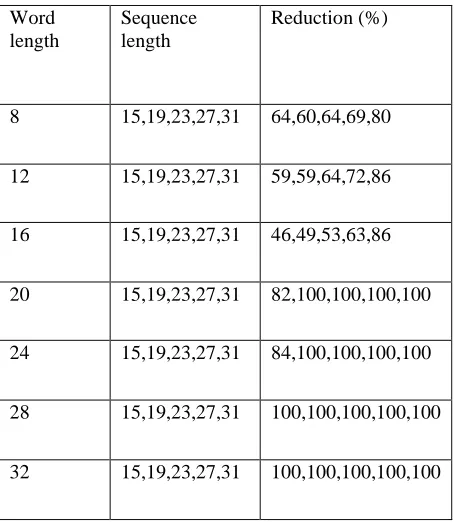
The proposed system uses the MOS method to realize a convolution in the RRNS. The flexibility with respect to transform length provided by the MOS method allows design of a system where a convolution is realized using a combination of Mersenne and generalized Fermat moduli implemented using WSCA and NTTs, respectively. Table 1.1 shows the moduli and transforms lengths used. The outputs are reconstituted using the Chinese Remainder Theorem. A computer program was developed in Matlab to identify the minimum area implementation for the convolution lengths and bit widths shown in Table 1.2 The number of multiplications and additions required for the WSCA is calculated using the method described by Agarwal and Cooley and using the performance figures given in. The areas of the Fermat transforms are calculated on the basis of the number of additions in the NTT and inverse NTT together with the area of the post-multiplication stage. It is assumed that the filter coefficients are pre-computed.
All NTT kernels, v, used are either of the form 2k requiring two additions per butterfly or ±2k (2M/2 + 1) which requires three additions per butterfly. In the latter case, even powers of the kernel are powers of 2 and only one stage in an NTT requires odd powers of v, involving three additions per butterfly.
A sequence of length N has log2 N stages; each stage has N/2 butterflies. Thus, the number of adds for an NTT is calculated as the product of the number of adds per butterfly, the number of stages and the number of butterflies per stage. For example, to implement an NTT with modulus the generalized Fermat number 212 +1 and transform length 16, the more complex kernel, 24(26+ 1) is needed. There are four stages and eight butterflies per stage but one stage has three additions per butterfly and three stages have two additions per butterfly. This gives 3 X 1 X 8 + 2 X 3 X 8= 72 adds for this NTT and a total of 144 adds for the convolution together with 16 multiplications. The gate equivalents (GE) for addition and multiplication modulo 2n ±1 as given in Table 3 are used and the area is calculated on the basis of GEs per unit output. Following, the area per unit output for a channel is calculated as the total area for the channel 1/(N - Q + 1), where N is the transform length associated with the particular modulus used in that channel and Q is the filter length.
Moduli Transform lengths
Moduli Transform lengths
24+1 8,16 228+1 8,16
28+1 8,16,32 232+1 8,16,32,64,128 212+1 8,16
216+1 8,16,32,64 25-1 6,10,15,30 220+1 8,16 27-1 7,14,21,28,35,
42
[image:2.612.321.557.56.250.2]224+1 8,16,32 213-1 15,30,35,42
Table 1.1 Moduli transform lengths and kernel types for proposed system
Word length
Sequence length
Reduction (%)
8 15,19,23,27,31 64,60,64,69,80
12 15,19,23,27,31 59,59,64,72,86
16 15,19,23,27,31 46,49,53,63,86
20 15,19,23,27,31 82,100,100,100,100
24 15,19,23,27,31 84,100,100,100,100
28 15,19,23,27,31 100,100,100,100,100
32 15,19,23,27,31 100,100,100,100,100
Table 1.2 Percentage area reduction achieved in MOS RRNS system.
II. FERMAT NUMBER THEORETIC TRANSFORM The cyclic convolution via the FNT is composed of the FNTs, the point wise multiplications and the IFNT. FNTs of two sequences {ai} and {bi} will produce two sequences {Ai} and {Bi}. Modulo 2n+1multipliers are employed to accomplish the point wise multiplication between {Ai} and {Bi} and produce the sequence {Pi}. The final resulting sequence {pi} can be obtained by taking the inverse FNT of the product sequence {Pi}.Each element in the {pi} is in the diminished-1 representation.
2n+1 Adder.9n/2log2n +n/2+6
Multiplier 8n2+ n-2+adder
[image:2.612.332.559.296.557.2]The FNT of a sequence of length N {xi} (i= 0,1, …N- 1) is defined as :
Xk=
1
0
) (
)
1
....
1
,
0
(
)
mod(
N
i
t ik
N
i
n
F
k
N
x
… (2.1)
where Ft=22t+1, the tth Fermat; N is a power of 2 and α is an Nth root unit (i.e. αNNmod Ft=1 and α
M
N mod Ft ≠1 ,1≤m <N ). The notation < ik > means ik modulo N.
The inverse FNT is given by
xt=
1
0
) (
)
1
....
1
,
0
(
mod
1
Nk
t ik
N
k
F
i
N
x
N
… (2.2)
Where 1/N is an element in the finite field or ring of integer and satisfies the following condition:
(N.1/N) mod Ft=1 …..(2.3)
Parameters α, Ft, N must be chosen carefully and some conditions must be satisfied so that the FNT possesses the cyclic convolution property. In this project, α=2, Ft=22t
+1 and N=2.2t where t is an integer.
Table 1.3 Gate equivalents for implementation of arithmetic modulo 2 n ±1.
III. IMPORTANT OPERATIONS IN CYCLIC CONVOLUTION BASED ON FNT
Important operations of the cyclic convolution based on FNT with the unity root 2 include the CCWA, the BOWA and the MPPM. The CCWA and the BOWA both consist of novel modulo 2n+1 4-2 compressors mainly which are composed of the 4-2 compressor introduced by Nagamatsu. The 4-2 compressor, the novel modulo 2n+1 4-2 compressor and the BOWA are shown in Fig.3.2 (b). In the figure, “X*” denotes the
diminished-1 representation of X, i.e. X* =X-1.
3.1 Code Conversion without Addition
[image:3.612.342.518.60.211.2]The CC converts normal binary numbers (NBCs) into their diminished-1 representation. It is the first stage in the FNT. Delay and area of CC of a 2n-bit NBC are no less than the ones of two n-bit carry propagation adders.
Fig.3.1 Elementary operations of FNT architecture with unity root 2, (a) 4-2 compressor
Fig.3.2 (b) modulo 2n+1 4-2 compressor
To reduce the cost, we propose the CCWA that is performed by the modulo 2n+1 4-2 compressor. Let A and B
represent two operands whose widths are no more than 2n bits. We define two new variables:
A = 2n AH +AL
B = 2n BH +BL (3.1)
And
M0 = (2n - 1) - AH = ĀH M1 = (2n - 1) - BH = BH
M2= (2n - 1) – BL = BL (3.2)
If the subsequent operation of CC is modulo 2n+1 addition, assign AL, M0, BLand M1 to I0, I1, I2, I3 in the modulo 2n+1 4-2 compressor respectively. I0, I1, I2, I3 are defined as follows:
I0 = I0(n-1) I0(n-2)…….I01I00 I1 = I1(n-1) I1(n-2)…….I11I10 I2 = I2(n-1) I2(n-2)…….I21I20
I3=I3(n-1) I3(n-2)…..….I31I30 (3.3)
We obtain the sum vector
*
O
H
and carry vector
* 1
H
in thediminished-1 number system. The most significant bit of
* 1
H
iscomplemented and connected back to its least significant bit. That is to say
*
O
H
= H0(n-1) H0(n-2)……..H01H00
* 1
H
= H1(n-2) ……..H11H10 H1(n-1) …….(3.4)
The result of modulo 2n+1 addition of A* and B* is equal to
the result of modulo 2n+1 addition of
*
O
H
and
* 1
H
in this way,A and B are converted into their equivalent diminished-1
representations
*
O
H
and
* 1
H
.[image:3.612.80.264.582.702.2]
by Leibowitz originally. The CCWA for subsequent modulo 2n+1 addition can be described as follows.
│A*+B*│= │AL+M0+BL+M1│2n+1=│
*
O
H
+
* 1
H
│2n+1 … (3.5)
If the subsequent operation is modulo 2n+1 subtraction, we
assign AL, M0, M2 and BHto I0, I1, I2, I3 respectively. Then
*
O
H
and
* 1
H
in the modulo 2n+1 4-2 compressor constitute theresult of the CCWA. The conversion is described as follows:
│A*-B*│2n+1= │A-B│2n+1= │A+B│2
n
+1=│AL+M0+BL+M1│2 n
+1 … (3.6)
= │
*
O
H
+ *1
H
│2n+1
After CCWA, we obtain the result consisting of two diminished-1 numbers. The result also includes the information of modulo 2n+1 addition or subtraction in the first stage of previous BO.
3.2 Diminished-One modulo 2n +1 Adder Design
Modulo arithmetic has been used in digital computing systems for various purposes for many years. In particular,
modulo 2n+1 arithmetic appears to play an important role in many algorithms. A first application field is in Residue Number Systems (RNS) . In an RNS based application, every number X is represented by a sequence of residues {X1, X2 . . . XM.}
where Xi=X mod pi. The pies, 1
i
M, comprise the base of the RNS and are pair wise relative prime integers. A two operand RNS operation, suppose}, is defined as (Z1, Z2 . . . ZM.)=(X1,X2 . . . XM.)
(Y1, Y2. YM) where Zi = (Xi
Yi). Mod pi. Formost RNS applications
is addition, subtraction, or multiplication. Since the computation of Zi only depends upon Xi, Yi, and pi, each Zi is computed in parallel in a separate arithmetic unit, often called channel. Moduli choices of theform{2n -1,2n,2n+1} have received significant attention because they offer very efficient circuits in the area x time2 product sense Addition in such systems is performed using three
channels that, in fact, are a modulo 2n-1 (equivalently, one’s complement), a modulo 2n, and a modulo 2n+1 adder . The addition delay in an RNS application which uses the above
moduli is dictated by the modulo 2n+1 channel. The latter means that, if we can cut down the time required for modulo
2n+1 addition, we also cut down the addition time in an RNS application.
Modulo 2n+1 adders are also utilized as the last stage adder of modulo 2n+1multipliers. Modulo 2n+1multipliers find applicability in pseudorandom number generation, cryptography, and in the Fermat number transform, which is an effective way to compute convolutions Leibowitz has proposed the diminished-one number system. In the diminished-diminished-one number system, each
number X is represented by X*=X-1. The representation of 0 is treated in a special way. Since the adoption of this system leads
to modulo 2n+1 adders and multipliers of n bits wide operands, it has been used for many residue number system implementations; Efficient VLSI implementations of modulo
2n+1 adders for the diminished-one number system have recently been presented.
The adders although fast, are, according to the comparison
presented, still slower than the fastest modulo 2n adders or the fastest modulo 2n-1 adders.. Therefore, their use in an RNS application would still limit the performance of the system. In this paper, we derive two new design methodologies for
modulo 2n+1 adders in the diminished-one number system. The first one leads to traditional Carry Look-Ahead (CLA), while the second to parallel-prefix adder architectures. Using implementations in a static CMOS technology, we show that the proposed CLA adder design methodology leads to more area and time efficient implementations than those presented, for small operand widths. For wider operands, the proposed parallel-prefix design methodology leads to considerably faster adder implementations than those presented and as fast as the integer or
the modulo 2n+1 architecture presented.
3.3 Butterfly operation without addition
After the CCWA, we obtain the results of modulo 2n+1 addition and subtraction in the diminished-1 representation. Each result consists of two diminished-1 values. The subsequent butterfly operation involves four operands. The proposed BOWA involves two modulo 2n+1 4-2 compressors, a multiplier and some inverters as shown in Fig. 3.3.
Fig.3.3 Butterfly operation without addition
The multiplication by an integer power of 2 in the diminished-1 number system in the BOWA is trivial and can be performed by left shifting the low-order n-i bits of the number by
M*= = =
N*= = =
= … (4.1)
Where ,
3.4 Modulo 2n+1 Partial Product Multiplier
For the modulo 2n+1 multiplier proposed by Efstathiou, there are n+3 partial products that are derived by simple AND and NAND gates. An FA based Dadda tree that reduces the n+3 partial products into two summands is followed. Then a modulo 2n+1 adder for diminished-1 operands is employed to accept these two summands and produce the required product.
In the proposed parallel architecture for cyclic convolution based on FNT, the BOWA can accept four operands in the diminished-1 number system. Every point wise multiplication only needs to produce two partial products rather than one product. The operation can be accomplished by taking away the final modulo 2n+1 adder of two partial products in the multiplier. Thus the final modulo 2n+1 adder is omitted and the modulo 2n+1 partial product multiplier is employed to save the delay and the area.
IV. THE FNTARCHITECTURE
[image:5.612.338.552.439.670.2]In the previous sections, we have presented the reconfiguration at a rather low level. The Butterfly constitutes a high parameterized function level. The fact to have this parameterized function allows designing a reconfigurable operator who’s Butterfly forms the highest level operator.
Fig 4.2 the architecture of FNT operator
V. PARALLEL ARCHITECTURE FOR CYCLIC CONVOLUTION Based on the CCWA, the BOWA and the MPPM, we design the whole parallel architecture for the cyclic convolution based on FNT as shown in Fig.6.1. It includes the FNTs, the point wise multiplication and the IFNT mainly. FNTs of two
input sequences {ai} and {bi} produce two sequences {Ai} and {Bi} (i=1, 2 …N- 1). Sequences {Ai} and {Bi} are sent to N
MPPMs to accomplish the point wise multiplication and produce
N pairs of partial products. Then the IFNT of the partial products are performed to produce the resulting sequence {pi} of the cyclic convolution.
Fig.5.1 Parallel architecture for the cyclic convolution based on FNT
In the architecture, the radix-2 decimation-in-time (DIT) algorithm which is by far the most widely used algorithm is employed to perform the FNT and the IFNT.
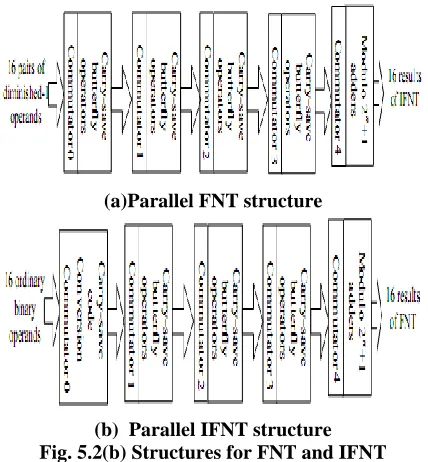
Illustrative examples of the FNT and the IFNT are shown in Fig. 6.2(a) in the case the transform length is 16 and the modulus is 28+1. Commentators in Fig. 6.2 are used to adjust the operand order of every stage of FNT and IFNT according to the radix-2 DIT algorithm.
(a)Parallel FNT structure
(b) Parallel IFNT structure Fig. 5.2(b) Structures for FNT and IFNT
[image:5.612.61.270.475.637.2]results are sent to the next stage of BOWA. After log2N-1 stages of BOWAs, the results composed of two diminished-1 operands are obtained. The final stage of FNT consists of modulo 2n+1 carry-propagation adders which are used to evaluate the final results in the diminished-1 representation. The CCWA stage, the BOWA stage and the modulo 2n+1 addition stage in the FNT involves N/2 couples of code conversions including the information of modulo 2n+1 addition and subtraction, N/2 butterfly operations and N/2 couple of modulo 2n+1 additions respectively.
From the definition of FNT and IFNT in section 2, the only difference between the FNT and the IFNT is the normalization factor 1/N and the sign of the phase factor αN. If ignoring the normalization factor 1/N, the above formula
(Ft=28+1) is the same as that given in the FNT except that all transform coefficients αN ik used for the FNT need to be replaced by αN
-(ik)
for the IFNT computation. The proposed FNT structure can be used to complete the IFNT as well with little modification as shown in Fig. 5.2(b). After the IFNT of N-point bit reversed input data, the interim results are multiplied by 1/N
in the finite field or ring. Then x[j] and x[j+N/2] (j=1,2,…,N/2-1) exchange their positions to produce the final results of the IFNT in natural order. Our architecture for the cyclic convolution gives a good speed performance without requiring a complicated control. Furthermore, it is very suitable for implementation of the overlap-save and overlap adds techniques which are used to reduce a long linear convolution to a series of short cyclic convolutions.
VI. COMPARISON AND RESULTS
In this section, we compare the proposed parallel architecture for the cyclic convolution against that introduced by Conway. The modulo 2n+1 addition for the diminished-1 number system is the crucial operation which contains a standard n-bit carry propagation computation such as a parallel-prefix adder with a carry-logic block and a zero indicator of the diminished-1 operand to determine whether to perform subsequent operations. It produces the longest execution delay and requires large area in the previous solution. The proposed CCWA and BOWA overcome the disadvantage of the carry-propagation adder and don’t require a zero indicator. Thus our architecture is faster and more efficient than the existing one.
This model assumes that each two-input gate excluding XOR is equivalent to one elementary gate for both area and delay. An XOR gate counts for two gates for both area and delay. Thus, a full adder has an area of seven gates and a delay of four gates. This model does not involve the cost of buffering and routing, but achieve a reasonable accuracy for the purpose of comparison.
The delay and the area estimations of modulo 2n+1 adder and modulo 2n+1 multiplier in the cyclic convolution are given in Table 1 as a function of the operand size n. “D(n+3)” in Table
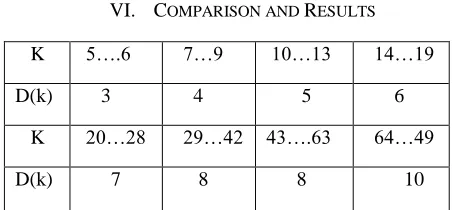
6.1 is defined as shown in Table 6.2
[image:6.612.319.544.157.284.2]Table 6.1 Area and delay estimations for arithmetic modulo 2n+1 “MA” and “MM” represent modulo 2n+1 adder and multiplier respectively.
Table 6.2 D (k) as a function of k
To obtain more accurate results, we describe the proposed parallel cyclic convolution in verilog for Ft=28+1,210+1,232+1.The validated Verilog code is synthesized using a 0.13-μm CMOS standard cells library in the worst operating condition by the Synopsys Design Compiler. The units of area and delay are μm2 and ns respectively. Each design was recursively optimized for speed until the EDA software can’t provide a faster design. The results for the fastest derived implementation are listed in Table 6.3.
Table 6.1 and 6.3 indicate that for values of Ft ≥28+1 the proposed architecture comprising the CCWA and the BOWA require less delay and area than the previous one. The former results in a 12.6% reduction in area and a 26% reduction in delay respectively compared with the latter in the case Ft is 232+1 and the transform length is 64. Moreover, our algorithm will be more and more advantageous with the growth of modulus width.
Table 6.3 Area and delay results of cyclic convolution based on FNT
VII. CONCLUSION AND FUTURE SCOPE
7.1 Conclusion
A novel parallel architecture for the cyclic convolution based on FNT is proposed in the case the principle root of unity is equal to 2 or its integer power. The FNT and the IFNT are accomplished by the CCWA and the BOWA mainly. The point wise multiplication is performed by the modulo 2n+1 partial product multiplier. Thus there are very little modulo 2n+1 carry-propagation addition compared to the existing cyclic convolution architecture.
K 5….6 7…9 10…13 14…19
D(k) 3 4 5 6
K 20…28 29…42 43….63 64…49
D(k) 7 8 8 10
Ft
Area(µm2) Delay(ns)
This project
[3] This project
[3]
28+1 3.5 x 10⁵ 3.5 x 10⁵
8.9 9.9
216+1 1.86 x 10⁶
2.05 x 10⁶
11.6 14.4
232+1 1.08 x 10⁷
1.24 x 10⁷
[image:6.612.53.279.404.509.2]A theoretical model was applied to access the efficiency independently of the target technology. VLSI implementations using a 0.13 um standard cell library show the proposed parallel architecture can attain lower area and delay than that of the existing solution when the modulus is no less than 28+1.
7.2. Future Scope
This is the High speed parallel architecture for cyclic convolution based on FNT. Here in this architecture we used modulo adders and modulo multipliers to reduce the round off errors and also to reduce the delay and also that CCWA and BOWA blocks are used for further reduction of the delay. Based on the number of operands as the butterfly stages generally increases there is no other alternative for finding the convolution. The changes can be made either for the blocks like multiplication by 2n or for modulo adder or for modulo multiplier in order to reduce the size. Also that this can be implemented in low power technology by carefully following the parameters and the circuit elements used for the implementation. So as this is the high speed architecture, we further work on for the size or power consumption and others. VLSI implementations using a 0.13 um standard cell library show the proposed parallel architecture can attain lower area and delay than that of the existing solution when the modulus is no less than 28+1.
REFERENCES
[1] C. Cheng, K.K. Parhi, “Hardware efficient fast DCT based on novel cyclic convolution structures”, IEEE Trans. Signal processing, 2006, 54(11), pp. 4419- 4434
[2] H.C. Chen, J.I. Guo, T.S. Chang, et al., “ A memory efficient realization of cyclic convolution and its application to discrete cosine transform”, IEEE Trans. Circuit and system for video technology, 2005, 15(3), pp. 445-453 [3] R. Conway, “Modified Overlap Technique Using Fermat and Mersenne
Transforms”, IEEE Trans. Circuits and Systems II: Express Briefs, 2006, 53(8), pp.632 – 636
[4] A. B. O'Donnell, C. J. Bleakley, “Area efficient fault tolerant convolution using RRNS with NTTs and WSCA”, Electronics Letters, 2008, 44(10), pp.648-649
[5] H. H. Alaeddine, E. H. Baghious and G. Madre et al., “Realization of multi-delay filter using Fermat number transforms”, IEICE Trans. Fundamentals, 2008, E91A(9), pp. 2571-2577
[6] N. S. Rubanov, E. I. Bovbel, P. D. Kukharchik, V. J. Bodrov, “Modified number theoretic transform over the direct sum of finite fields to compute the linear convolution”, IEEE Trans. Signal Processing, 1998, 46(3), pp. 813-817
[7] L. M. Leibowitz, “A simplified binary arithmetic for the Fermat number transform,” IEEE Trans. Acoustics Speech and Signal Processing, 1976, 24(5):356-359
[8] H. T. Vergos, C. Efstathiou, D. Nikolos, “Diminishedone modulo 2n + 1 adder design”, IEEE Trans. Computers, 2002, 51(12), pp. 1389-1399 [9] M. Nagamatsu, S. Tanaka, J. Mori, et. al. “15-ns 32 × 32-b CMOS
multiplier with an improved parallel structure”, IEEE Journal of Solid-State Circuits, 1990, 25(2), pp. 494-497
[10] C. Efstathiou, H. Vergos, G. Dimitrakopoulos, et al., “Efficient diminished-1 modulo 2n + 1 multipliers”, IEEE Trans. Computers, 2005, 54(4), pp.
491-496
[11] A. Tyagi, “A reduced-area scheme for carry-select adders”, IEEE Trans. Computers, 1993, 42(10), pp. 1163-1170
BOOKS
[1] J. G. Proakis and D. G. Manolakis, Digital signal processing: principles, algorithms, and applications, Prentice Hall, New Jersey, 2007.
[2] Essentials of VLSI Circuits and systems by Kamran Eshraghian, Douglas A. Pucknell, Sholeh Eshraghian.
[3] Modern VLSI Design, System - on - Chip Design Third Edition Wayne Wolf, Pearson Education.
[4] Barbe, D.F. (Ed.) (1982) Very Large Scale Integration – Fundamentals and applications, Springer - Verlag, West Germany / USA.
AUTHORS
First Author – M. Vyshnava Datta, Mechanical Engineering,
4th year, KL University, Email: [email protected]
Second Author – Ankit Kumar Jain, Electrical and Electronics
Engineering, 4th year, KL University, Email: [email protected]
Third Author – G. Mohan Bala Krishna, Mechanical
Engineering, 4th year, KL University, Email: [email protected]
Correspondence Author – M. Vyshnava Datta,
Email: [email protected], Phone: +919940695295
opera tor
Area
Delay This
project
[3] This
project
[3]
MA 14n 9/2nlogn+n/
2+6
8 2logn
+3 MM 8n2
+n-1
9/2nlogn+8n 2+n/2+4
4D(n+3 )+1