Gracefulness of TP-Tree with Five Levels Obtained by
Java Programming
A.Solairaju
1, N. Abdul Ali
2and S. Abdul Saleem
31,2
P.G & Research Department of Mathematics, Jamal Mohamed College, Trichirappalli - 620020
3
P.G & Research Department of Computer Science, Jamal Mohamed College, Trichirappalli - 620020
Abstract- The Gracefulness of Tp-tree with Five levels is obtained by Java Programming.
I. INTRODUCTION
ost graph labeling methods trace their origin to one. There is a function f, a -valuation of a graph with q edges if f is an injective map from the vertices of G to the set {0, 1, 2 ,…,q} such that when each edge xy is assigned the label f(x)-f(y), the resulting edge labels are distinct.
A. Solairaju and K. Chitra [2009] first introduced the concept of edge-odd graceful labeling of graphs, and edge-odd graceful graphs.
A. Solairaju and others [2008] proved the results that(1) the Gracefulness of a spanning tree of the graph of Cartesian product of Pm and Cn,was obtained (2) the Gracefulness of a spanning
tree of the graph of cartesian product of Sm and Sn, was obtained
(3) edge-odd Gracefulness of a spanning tree of Cartesian product of P2 and Cn was obtained (4) Even -edge Gracefulness
of the Graphs was obtained (5) ladder P2 x Pn is even-edge
graceful, and (6) the even-edge gracefulness of Pn O nC5 is
obtained.
Section – I: Preliminaries
Definition 1.1 Let G=(V,E) be a simple graph with p vertices and q edges. A map f:V(G) -> {0,1,2,……,q} is called a graceful labeling if
i) f is one-to-one
ii) The edges receive all the labels (numbers) from 1 to q where the label of an edge is the absolute value of the difference between the vertex labels at its end, a graph having a graceful labeling is called a graceful graph.
Example 1.1 : The graph 5 ∆ P5 is a graceful graph.
Section – II: Tp–(5n, 5n-1) tree
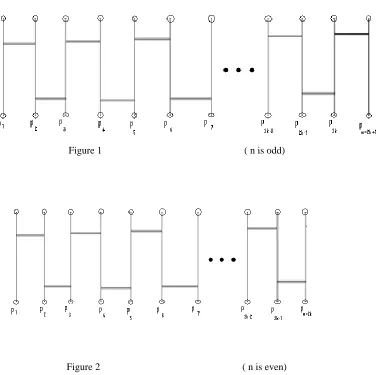
Definition 2.1: n ∆ P5 is a tree, becoming a path by
moving edges between vertices of degree 3 defined in the
following manner only. It is a Tp-tree obtained from n copies of
P5, and connected acyclic in the following manner (figures 1 and
2).
Figure 1 ( n is odd)
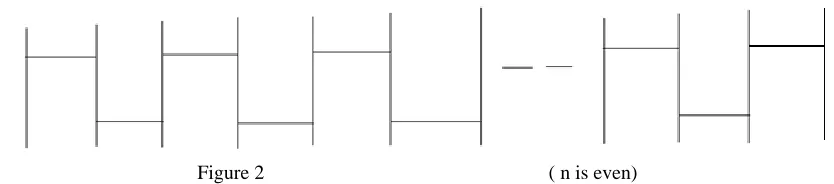
Figure 2 ( n is even)
Main theorem 2.2: The connected graph Tp–tree with p = 5n and q = 5n-1 is graceful where n is any positive integer.
Proof: Due to definition (2.1), Tp–(5n,5n-1) is a connected graph (see figures 1 and 2) according as n is odd or even.
Figure 2 ( n is even)
Case (1):n is odd.
The labelings of vertices and edges for Tp–(5n,5n-1) (Figure 1) are as follows:
Define f: v(G) {0,1,2,…q) by
Define f+ : E(G) {1,2,3..q} by f+ (u,v)= |f(u)-f(v)|, u,v Є E(G).
Hence, the bisection maps f+ for vertices and f for edges in Tp–(5n,5n-1) satisfies all
condition of graceful labeling. Thus Tp–(5n,5n-1) is a graceful if n is odd.
Case (2):n is even.
The labeling of vertices and edges for Tp–(5n,5n-1) (Figure 2) are as follows:
Define f+: E(G) {1,2,3..q} by f+ (u,v)= |f(u)-f(v)|, u,v Є E(G).
Hence, the bisection maps f for vertices and f+ for edges in Tp–(5n,5n-1) satisfies all the conditions of graceful labeling.
Thus, Tp–(5n,5n-1) is a graceful if n is even.
Corollary 2.3: Tp–(5n,5n-1) is a graceful tree
Example 2.1 : The graph5 ∆ P5 is a graceful graph.
Example 2.2: The graph 6 ∆ P5 is a graceful graph.
Section – III: Java programming for the connected graceful tree Tp–(5n,5n-1)
import java.awt.*; import java.awt.event.*; import java.awt.geom.*; import javax.swing.*;
public class GFTree extends JApplet implements ActionListener {
final static Color bg = Color.white; final static Color fg = Color.black; JButton b1,b2;
JLabel l0,l1; JTextField tf;
static JPanel jp1,jp2,jp3,jp4; public void init()
{
l0 = new JLabel("GRACEFUL GRAPH"); l0.setFont(new Font("Serif", Font.BOLD, 40)); l0.setForeground(Color.MAGENTA);
l1 = new JLabel(" Enter the number of terms : "); l1.setFont(new Font("Serif", Font.BOLD, 25)); l1.setForeground(Color.BLUE);
tf = new JTextField(20);
tf.setFont(new Font("Verdana", Font.PLAIN, 25)); tf.setForeground(Color.BLACK);
tf.setText("0");
b1 = new JButton("Submit"); b1.setForeground(Color.darkGray);
b1.setFont(new Font("Verdana", Font.PLAIN, 20)); b1.addActionListener(this);
b2 = new JButton("Exit");
b2.setForeground(Color.darkGray);
b2.setFont(new Font("Verdana", Font.PLAIN, 20)); b2.addActionListener(this);
jp1 = new JPanel(); jp2 = new JPanel(); jp1.add(l0); jp2.setLayout(new GridLayout(2,2)); jp2.add(l1); jp2.add(tf); jp2.add(b1); b1.setBounds(100,100,200,200); jp2.add(b2);
jp3 = new JPanel();
jp3.setLayout(new BorderLayout()); jp3.add(jp1,BorderLayout.NORTH); jp3.add(jp2,BorderLayout.SOUTH); jp4 = new JPanel();
setBackground(bg); setForeground(fg); }
public void actionPerformed(ActionEvent e) {
System.exit(0); }
public void paint(Graphics g) {
g.clearRect(0,135,1024,550); Graphics2D g2 = (Graphics2D) g;
int n = Integer.parseInt((String)tf.getText()); int v= 5*n;
int e = (5*n)-1; int v1[] = new int[v]; int v2[] = new int[v]; for(int i=0;i<v;i++) v1[i]=i;
for(int j=0;j<v;j++) { v2[j]=e;e--; } int j1=0,j11=0,i1=0; for(int i=0;i<n;i++) { g2.draw(new Line2D.Double((i*50)+100,200,(i*50)+100,400)); for(int j=0;j<5;j++) { g2.fillOval((i*50)+98,400-(j*50),5,5); } if(n>1) { if(i%3==0)
{ for(int p=0;p<n-1;p+=2)
g2.draw(new Line2D.Double(100+(p*50),250,150+(p*50),250)); } else { for(int p=1;p<n-1;p+=2) g2.draw(new Line2D.Double(100+(p*50),350,150+(p*50),350)); } } } int o1=0,o11=0,k1=-1,k2=-1; for(int i=0;i<n;i++) { if(i%2==0) { for(int j=0;j<3;j++) { int x = j+j1;
} j1=0 ; for(int i=0;i<n;i++) { if(i%2!=0) { for(int j=0;j<3;j++) { g2.drawString(v2[++o11]+"",(i*50)+105,(j*100)+212); } o11+=5; } else { for(int j=0;j<2;j++) { int x = j+j1;
g2.drawString(v2[x]+"",(i*50)+103,362- (j*100)); o11=x; } j1+=5; } }
g2.drawString(y+"",(i*50)+85,432-(j*50));
} }
} //Inner for loop ends
} //Outer for loop ends } else { for(int i=n-1;i>=0;i--) { for(int j=5-1;j>=0;j--) { y =d[++k]; if(y%5==0) { if(flag) { if(y<v) g2.drawString(y+"",(i*50)+70,(j*50)+362); flag=false; } else { g2.drawString(y+"",(i*50)+70,(j*50)+262); flag=true; } } else {if(flag) { g2.drawString(y+"",(i*50)+85,432-(j*50)); flag=true; } else { g2.drawString(y+"",(i*50)+85,(j*50)+182); } } } } } }
public static void main(String s[]) {
JFrame f = new JFrame("GracefulTree Demo"); JApplet applet = new GFTree();
f.setVisible(true); }
}
Section – IV:
Example 4.2 : The graph 16∆P5 is a graceful graph.
REFERENCES
[1] A.Solairaju and K.Chitra Edge-odd graceful labeling of some graphs, Electronics Notes in Discrete Mathematics Volume 33,April 2009,Pages 1. [2] A. Solairaju and P.Muruganantham, even-edge gracefulness of ladder, The
Global Journal of Applied Mathematics & Mathematical Sciences(GJ-AMMS). Vol.1.No.2, (July-December-2008):pp.149-153.
[3] A.Solairaju, A.Sasikala, C.Vimala Gracefulness of a spanning tree of the graph of product of Pm and Cn, The Global Journal of Pure and Applied
Mathematics of Mathematical Sciences, Vol. 1, No-2 (July-Dec 2008): pp 133-136.
[4] A. Solairaju, C.Vimala,A.Sasikala Gracefulness of a spanning tree of the graph of Cartesian product of Sm and Sn, The Global Journal of Pure and
AUTHORS
First Author – A.Solairaju, P.G & Research Department of
Mathematics , Jamal Mohamed College, Trichirappalli – 620020, email: [email protected]
Second Author – N. Abdul Ali, P.G & Research Department of
Mathematics , Jamal Mohamed College, Trichirappalli – 620020, email : [email protected]
Third Author – S. Abdul Saleem, P.G & Research Department