2017 2nd International Conference on Computational Modeling, Simulation and Applied Mathematics (CMSAM 2017) ISBN: 978-1-60595-499-8
TensorFlow and Keras-based Convolutional Neural
Network in CAT Image Recognition
Ang LI
1,*, Yi-xiang LI
2and Xue-hui LI
3Northeastern University, 11 Wenhua Road, Heping District, Shenyang, China
*Corresponding author
Keywords: Convolutional neural network, Deep learning, Image recognition.
Abstract. As a part of Computer Vision, image recognition and image classification plays an important role in development of Artificial Intelligence. Deep Learning is a new research area of Machine Learning approaches, which is motivated by building and imitating the natural neural network of human beings. It describes the data through similar approaches of human beings, which include images and sounds. We built up a supervised learning model of the given dataset of 209 pictures in RGB, through convolution layers, pooling layers and dense layers, with ReLU activation function, and the outputting sigmoid activation function. Finally, 90.0% of predictions through our model on test dataset are right.
Introduction
Image recognition is a kind of technology which uses computers to process, analyze and understand the image to identify the target and object of different modes. It is a major research direction in the field of computer vision, and plays an important role in the image-based intelligent data acquisition and processing. Using the image recognition approaches, we can effectively deal with the detection and identification of specific target objects (such as face, handwritten characters and goods), image classification, subjective image quality assessment and other issues. [1]
With the development of data mining and deep learning, convolutional neural networks (CNN) with more hidden layers are able to have more complex network structure, and more powerful feature learning and feature expression than traditional machine learning methods. The deep learning model based on convolution neural network has achieved great performance improvement on large-scale image classification task, and has set off the upsurge of deep learning. [2] Convolutional neural network is the first real-time learning algorithm model related to images for successful application of multi-layer neural networks, which has a more obvious advantage when the input of the network is multidimensional. CNN has been applied to different large-scale machine learning problems such as image recognition and natural language processing with the new machine learning upsurge of deep learning. [3]
Convolutional Neural Network
Convolutional neural network is a kind of multi-layer network structure gained from traditional artificial neural network, which is always called multilayer perceptron. It can be rapidly trained by feature extraction and feature mapping with high accuracy on predictions, so it is often applied to image recognition systems. Convolutional neural network includes convolution layer, pooling layer, dense layer and others, which can directly input two-dimensional objects through a number of layers of the convolution and sampling process, and extract the features into the dense layer, so as to get the final recognition results.
analysis and processing. [4] Keras is a high-level neural network API, which is written by pure Python. Keras’ library uses Theano or TensorFlow, which is also called the Keras' backend, and it uses the TensorFlow backend to perform tensor operations by default.
Building the Convolution Layers
For a given training dataset that has been labeled "cat" or "non-cat" and a similar test dataset, a simple image recognition model is created to accurately differentiate the cats' picture from other pictures to classify. Each image has a fixed width and length, and each pixel is represented by an RGB value. The given data contains the training dataset (train_catvnoncat.h5) and the test data set (test_catvnoncat.h5). Between the 2 datasets, train_catvnoncat.h5 contains three groups of data, except the group list_classes for the description, the other two groups are training images and labels, in which train_set_x is a four-dimensional vector space, with each of the 209 images stored as pixels, and each pixel is a triple of RGB values (8-bit, 0-255). Each image (209 of the first dimension) in train_catvnoncat.h5 has its label (train_set_y) corresponding to it. The form of data in test_catvnoncat.h5 is the same. Therefore, according to the image features in the above train_catvnoncat.h5 and test_catvnoncat.h5, we introduce the convolution neural network to extract and learn the features of the image.
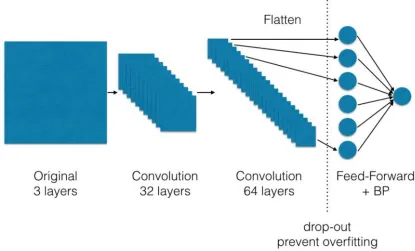
Considering that the overly complicated neural network model will lead to excessive time exceeded, we designed a two-layer convolution layer (each layer with a pooling layer), two layers of common feed-forward layer neural network, and defined the convolution kernel for the 5 × 5
[image:2.595.86.501.441.692.2]size, and used the Python language to write programs with the TensorFlow and Keras framework. The first convolution layer leads to a 32-layer convolution kernel, which is the input to the pooled layer and next convolution layer as part of the extracted feature. The second convolution layer is used to derive the 64-layer convolution kernel, and flatten the convolution kernel through the reshape process. The result of previous process would be imported into the 4096 feed-forward neurons and generate the last result.
Figure 1. General Form of CNN.
Convolution and Pooling
layer. This huge calculation amount is easy to lose control and lead to overfitting of the model. Therefore, we introduce the pooling process to do the statistics of features, reduce the dimension of data, and keep minor effects on the new features generated during the convolution process.
For two matrices involved in the convolution operation
A = [
a11 a12 . . . a1m a21 a22 . . . a2m . . . . am1 am2 . . . amm
] , B = [
b11 b12 . . . b1n b21 b22 . . . b2n . . . . bn1 bn2 . . . bnn
] (1)
(with 𝑚 > 𝑛), the convolution kernel is translated on the two-dimensional plane of the matrix, and each element of the convolution kernel is multiplied by the corresponding position of the convolution image and then summed.
𝐴 ∗ 𝐵 =
[
∑𝑚𝑖=𝑚−𝑛+1∑𝑚𝑗=𝑚−𝑛+1𝑏𝑖𝑗𝑎𝑖−𝑛+1,𝑗−𝑛+1 ∑𝑖=𝑚−𝑛+1𝑚 ∑𝑚𝑗=𝑚−𝑛+1𝑏𝑖𝑗𝑎𝑖−𝑛+1,𝑗−𝑛+2 . . . ∑𝑚𝑖=𝑚−𝑛+1∑𝑚𝑗=𝑚−𝑛+1𝑏𝑖𝑗𝑎𝑖−𝑛+2,𝑗−𝑛+1 ∑𝑖=𝑚−𝑛+1𝑚 ∑𝑚𝑗=𝑚−𝑛+1𝑏𝑖𝑗𝑎𝑖−𝑛+2,𝑗−𝑛+2 . . .
. . . .
∑𝑚𝑖=𝑚−𝑛+1∑𝑚𝑗=𝑚−𝑛+1𝑏𝑖𝑗𝑎𝑖,𝑗−𝑛+1 ∑𝑖=𝑚−𝑛+1𝑚 ∑𝑚𝑗=𝑚−𝑛+1𝑏𝑖𝑗𝑎𝑖,𝑗−𝑛+2 . . .]
(2)
Feed-Forward Neural Network
Artificial Neural Network is imitated from the human beings’ observation of the principles of animals’ neural system working, learning and memory approaches. Scientists first proposed neural network model known as Perceptron, by a number of input data a1, a2, . . . , an, corresponding to multiple weight values ω1, ω2, . . . , ωn, an output threshold t and an output value b.
𝑏 = {1, 𝜔 ⋅ 𝑎 ≥ 𝑡,
0, 𝜔 ⋅ 𝑎 < 𝑡 (3)
Weights are initialized by manually giving the initial value, and adjusted in the process of iterating the training set, by specifying the increase in learning rate (learning rate) and constantly correcting the error (derived value and the actual does not match). The more complex feed-forward neural network structure has a hidden layer of 1 to 2 layers for handling high dimensional input values, which can improve model accuracy and allow multiple output values by softmax activation function.
Meanwhile, in order to avoid the linear-unsolvable problem of the simple perceptron, after accepting the previous layer’s input, the neurons of the hidden layer and the output layer would convert the linear product into a nonlinear division of space by a specific activation function. We used the Sigmoid function
𝑦 = 1
1+𝑒𝜔⋅𝑎 (4)
as the output of the neuron in the last layer.
Establishing Dense Layers of Neural Network Model
To solve this problem, we used a two-layer feed-forward network after the convolution and pooling layers. The first layer is the input layer, which is a hidden layer in the whole network, to receive the input features of the last convolution and pooling layer; the second layer is the final output layer of the entire network, through a neuron output the final 0 or 1.
Calculation through the Entire Network
Iterate through the training data set (train_set_x, train_set_y) in the train_catvnoncat.h5 file. For a single image Am, it is first convoluted with the pre-set 5 × 5 convolution kernel in steps of 1 to
obtain the layer output
A ∗ B = C62×62(1,1) (5) in which C is one of the 32 output layers from the convolution layer. Input the result into the first layer of pooling for max-pooling:
𝒜(1)(C 62×62 (1,1)
) = C32×32(1,2) (6) The second convolution / pooling layer is similar:
C32×32(1,2) ∗ B = C30×30(2,1) (7)
𝒜(2)(C 30×30 (2,1)
) = C16×16(2,2) (8) in which C is one of the 64-layer output of the convolution layer. At this point we completed the convolution and data extraction process.
Expand the 64 layers into a one-dimensional vector
ℬ(64C16×16(2,2) ) = c16384×1(3) (9) In which 16384 = 64 × 16 × 16; and all the dimensions of c(3) are fully connected with the 4096 feed-forward neurons. The first layer of dense neurons will produce output
K(1) = 1
1+eω(3)⋅c(3) (10)
and the final output would be
K(2) = 1
1+eω(4)⋅K(1) (11)
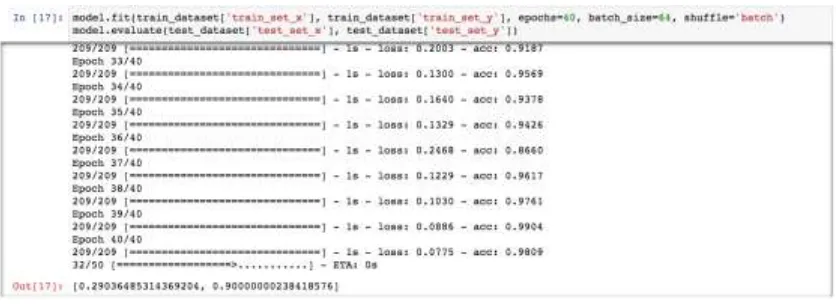
In actual operations, the above process has repeated 40 times in the training dataset to achieve the best results in case of over-fitting.
Results of Experiment
A total of 209 cat images in the given data set are iterated by the CNN. Four layers of convolution, pooling and 2 dense layers were used in the whole process. The 3-channel RGB images were convoluted layer-by-layer into 32 layers, 64 layers, 128 layers, 256 layers, followed by 512 neurons in the dense layers, and using ReLU as the hidden layer activation function, sigmoid as the final output activate function. In the test dataset, the model accuracy rate is 90.0%, meanwhile the mean squared error (loss) is 0.29.
Figure 2. Final Result.
Concluding Remarks
Nowadays, Artificial Intelligence in the research area of computer science has occupied an increasingly important position, and image recognition is a key part of Artificial Intelligence. Based on the convolutional neural network model, 4 layers of convolution layers and two layers of common dense layers are adopted. The convolution layers also adopt the process of pooling, which can be used to statistically reduce the feature dimension with minor effect of the convolution process, avoiding the huge amount of calculation exceeding time, and remaining high image recognition capability. This model can imitate the neural network in the human brain, and through a certain amount of learning, it can directly output the image recognition results. However, it can only deal with the specified format of the static images, and has some limitations and needs further study in depth.
References
[1] Yang Shuying, Pattern Recognition of Images, Tsinghua University Press, Beijing, 2005.
[2] Lu Hongtao, Zhang Qinchuan, Applications of Deep Convolutional Neural Network in Computer Vision, Journal of Data Acquisition & Processing, 31(1) (2016) 1-17.
[3] Y. LeCun, L. Bottou, Y. Bengio, and P. Haffner, Gradient-based learning applied to document recognition, Proceedings of the IEEE, 86(11) (1998) 2278-2324.