Product Overview
Juniper Networks SDN-ready MX104 3D Universal Edge Router is optimized for the aggregation of mobile, enterprise WAN, business, and residential access services. Based on a central office-optimized MX Series chassis supporting a redundant control plane for high availability, the MX104 is temperature hardened to allow deployment in outside cabinets and remote terminals. It also provides services that extend the service edge to the aggregation domain. The MX104 incorporates industry-leading timing and synchronization technology to enhance quality of experience (QoE) for mobile broadband, and is managed through the Junos Space Network Management Platform for rapid service design provisioning and lower TCO.
Product Description
Juniper Networks® SDN-ready MX104 3D Universal Edge Router is Juniper’s response to a
shift in metro network architecture where the aggregation layer is assuming responsibility for the service provider edge. The MX104 simplifies metro architectures by eliminating unnecessary layers, dramatically reducing CapEx and OpEx. Based on the architectural simplification and cost reduction, service providers and enterprises can adopt the new “Edge Anywhere” paradigm enabled by MX104.
The MX104 3D Universal Edge Router is optimized for aggregating mobile, enterprise WAN, business, and residential access services. The MX104 comes in a space-efficient 3.5 RU ETSI-300 mm compliant chassis and supports 80 Gbps of throughput, setting a new benchmark for port density in its product category. The MX104 provides:
• Four Modular Interface Card (MIC) slots support flexible configuration options • Investment protecting support for all MX Series Type 1 and dual width MICs, as well
as the new Multiservices MIC (MS-MIC)
• Redundant control plane and power supplies for high availability
• A temperature hardened design and low power consumption, enabling deployment in extreme temperature situations such as in outside cabinets and remote points of presences (POPs)
• Juniper’s award-winning advanced Trio Chipset and Junos® operating system, which
enable metro aggregation to be the “new distributed edge”
• Services such as Network Address Translation (NAT) and CGNAT, IPsec, firewall and flow monitoring consistent with the MX Series router family
• Highly scalable and reliable hardware-based timing technology that meets the strictest LTE requirements for frequency and phase synchronization to enhance QoE for mobile broadband
• Junos Space Service Activation Director to minimize provisioning and end-to-end solution management costs
Architecture and Key Components
The MX104 is a high-performance router functioning as a universal aggregation platform for mobile broadband and metro Ethernet applications. It also acts as a universal edge platform supporting all types of private WAN, data center interconnect, Internet edge, and business/residential edge services. Powered by Junos OS and the advanced Trio Chipset, the MX104 platform provides a consistent operating environment and improves the availability and performance of all types of supported services.
MX104 3D Universal
Edge Router
Redundant Routing Engines
The MX104 supports hot-pluggable redundant Routing Engines (REs) for control plane redundancy. The RE provides the control plane functions, runs Junos OS, and handles all routing protocol processes as well as the software processes that control the router’s interfaces, chassis components, system management, and user access to the router. These routing and software processes run on top of a kernel that interacts with the Packet Forwarding Engine (PFE).
Modular Design
The MX104 provides four MIC slots for flexible configuration options required to support various applications. The modular design and flexibility provided by these slots also enables a pay-as-you-grow model that provides optimal cost configuration based on traffic growth projections.
Edge Services Capability
The MX104 features Juniper’s award winning Junos Trio ASIC with a full set of edge services typical of the MX Series family. These services include full Layer 2 and Layer 3 VPNs for business edge applications, as well as Dynamic Host Configuration Protocol (DHCP), subscriber management, and multicast support for residential edge applications. In fact, through Junos Trio and Junos OS, the MX104 acts as a full-featured broadband network gateway (BNG) in a compact form factor that is ideal for distributed BNG deployments.
Integrated Timing
The MX104 incorporates highly scalable and reliable hardware-based timing technology that meets the strictest LTE
requirements for frequency and phase synchronization. Providing an accurate timing reference is one of the most significant technical and operational challenges for deployment of LTE radio access technology. MX104 supports Synchronous Ethernet (SyncE) for frequency as well as Precision Timing Protocol (PTP) for both frequency and phase synchronization. Furthermore, the MX104 allows SyncE and PTP to be used in a hybrid mode for the highest level of frequency (10 ppb) and phase (<1uS) accuracy required for LTE-Advanced. Thus, the MX104 is an ideal choice for the aggregation of mobile backhaul traffic.
Features and Benefits
MX104 is powered by the Junos Trio chipset and Junos OS, Juniper’s high-performance operating system for advanced routing and switching. At just 3.5 RU, the MX104 router is designed to help customers drive down the total cost of ownership and increase operational efficiencies in both enterprise and service provider deployments without service compromise. The flexibility and upgradability (mix-and-match of interface types) makes the MX104 ideal for private WAN, data center interconnect, Internet edge, and service provider WAN connectivity deployments.
The wide range of applications enabled by MX104 includes:
• Metro Ethernet Aggregation: In service provider networks, carrier Ethernet switches and routers are typically deployed in central office (CO) locations. Service providers use carrier Ethernet services for a variety of use cases, including connecting the residential access nodes to their respective service delivery nodes at the edge of the network, and site-to-site connectivity for enterprises. These Ethernet services are carried through an aggregation layer to reduce the number of ports required at the universal edge. The compact form factor and high port density of the MX104 makes it an ideal carrier Ethernet aggregation router.
• Mobile Backhaul Aggregation: Mobile backhaul
aggregation is a special case in the general carrier Ethernet category. In addition to other functions, the aggregation router operates as a mobile security gateway and also enables the distribution of timing reference within the radio access network through various mechanisms such as SyncE and PTP.
• Residential and Business Edge: Residential broadband services typically include High Speed Data (HSD), VoIP, IPTV, and video on demand (VoD), while business edge services typically include L2 VPNs, L3 VPNs, NAT, security and monitoring. The advanced capabilities of the MX104, which include the industry’s richest portfolio of VPNs, multicast, subscriber management, DHCP and hierarchical quality of service (QoS), along with its compact size and temperature hardening features, allow it to be a full-featured residential/business edge closer to the access layer for enhanced scale.
• Enterprise WAN: The rich suite of L2 and L3 VPNs and services makes the MX104 an ideal choice for enterprise applications such as private WAN, providing multisite connectivity through a private backbone; data center interconnect, for connecting multiple data centers for disaster recovery; geo clustering and virtualization; and Internet edge, acting as an enterprises Internet gateway.
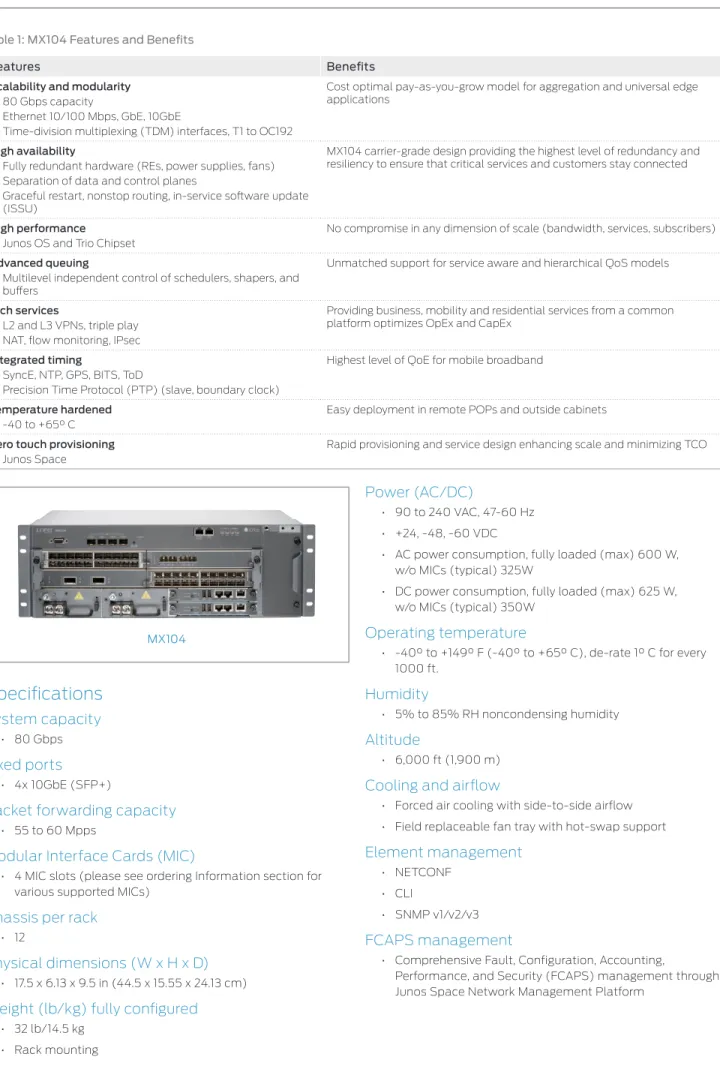
Table 1: MX104 Features and Benefits
Features Benefits
Scalability and modularity • 80 Gbps capacity
• Ethernet 10/100 Mbps, GbE, 10GbE
• Time-division multiplexing (TDM) interfaces, T1 to OC192
Cost optimal pay-as-you-grow model for aggregation and universal edge applications
High availability
• Fully redundant hardware (REs, power supplies, fans) • Separation of data and control planes
• Graceful restart, nonstop routing, in-service software update (ISSU)
MX104 carrier-grade design providing the highest level of redundancy and resiliency to ensure that critical services and customers stay connected
High performance
• Junos OS and Trio Chipset
No compromise in any dimension of scale (bandwidth, services, subscribers) Advanced queuing
• Multilevel independent control of schedulers, shapers, and buffers
Unmatched support for service aware and hierarchical QoS models
Rich services
• L2 and L3 VPNs, triple play • NAT, flow monitoring, IPsec
Providing business, mobility and residential services from a common platform optimizes OpEx and CapEx
Integrated timing
• SyncE, NTP, GPS, BITS, ToD
• Precision Time Protocol (PTP) (slave, boundary clock)
Highest level of QoE for mobile broadband
Temperature hardened • -40 to +65° C
Easy deployment in remote POPs and outside cabinets Zero touch provisioning
• Junos Space
Rapid provisioning and service design enhancing scale and minimizing TCO
Specifications
System capacity
• 80 Gbps
Fixed ports
• 4x 10GbE (SFP+)
Packet forwarding capacity
• 55 to 60 Mpps
Modular Interface Cards (MIC)
• 4 MIC slots (please see ordering Information section for various supported MICs)
Chassis per rack
• 12
Physical dimensions (W x H x D)
• 17.5 x 6.13 x 9.5 in (44.5 x 15.55 x 24.13 cm)
Weight (lb/kg) fully configured
• 32 lb/14.5 kg
Power (AC/DC)
• 90 to 240 VAC, 47-60 Hz • +24, -48, -60 VDC
• AC power consumption, fully loaded (max) 600 W, w/o MICs (typical) 325W
• DC power consumption, fully loaded (max) 625 W, w/o MICs (typical) 350W
Operating temperature
• -40° to +149° F (-40° to +65° C), de-rate 1° C for every 1000 ft.
Humidity
• 5% to 85% RH noncondensing humidity
Altitude
• 6,000 ft (1,900 m)
Cooling and airflow
• Forced air cooling with side-to-side airflow • Field replaceable fan tray with hot-swap support
Element management
• NETCONF • CLI
• SNMP v1/v2/v3
FCAPS management
• Comprehensive Fault, Configuration, Accounting,
Performance, and Security (FCAPS) management through Junos Space Network Management Platform
Common alarm and auxiliary components:
• Four alarm inputs and four alarm output contacts • One management port
• One console port
• Two USB ports, one USB can be used as a recovery port • Timing components:
• External building-integrated timing supply (BITS) timing port
• 10 MHz timing connectors (one input and one output) • 1 pulse per second (PPS) connectors (one input and one
output)
• Time of day (TOD) RS232 port
• 1.544 MHz/2.048 MHz T1/E1 (RJ48) ports for timing input or output
• SyncE support on RJ45/SFP ports as timing input or output • Packet (IEEE 1588-2008) timing includes:
- Timing input when configured as ordinary clock (OC) or boundary clock (BC)
- Timing output when configured as BC
Agency Approvals
Safety • CAN/CSA-C22.2 No. 60950-1 (2007) • UL 60950-1 (2nd Ed.) • EN 60950-1 (2005) • IEC 60950-1 (2005) • EN 60825-1 +A1+A2 (1994) EMC • EN 300 386 V1.3.3 (2005) • EMI (Emission) • FCC Part 15 Class A (2007) • EN 55022 Class A (2006) • VCCI Class A (2007) • BSMI CNS 13438 and NCC C6357 Immunity • EN 55024 +A1+A2 (1998) • EN-61000-3-2 (2006)• EN-61000-3-3 +A1 +A2 +A3 (1995) • EN-61000-4-2 +A1 +A2 (1995) • EN-61000-4-3 +A1+A2 (2002) • EN-61000-4-4 (2004) • EN-61000-4-5 (2006) • EN-61000-4-6 (2007) • EN-61000-4-11 (2004) NEBS
• SR-3580 (2007) NEBS Criteria Levels (Level 3 Compliance) • GR-63-Core (2006) NEBS Physical Protection
• GR-1089-Core (2006) EMC and Electrical Safety • GR-3108-CORE Issue 2, December 2008
ETSI
• ETSI EN 300 019: Environmental Conditions & Environmental Tests
• ETSI EN 300 019-2-1 (2000) – Storage • ETSI EN 300 019-2-2 (1999) – Transportation
• ETSI EN 300 019-2-3 (2003) – Stationary Use at Weather-protected Locations
• ETSI EN 300 019-2-4 (2003) – Stationary Use at Non-Weather-protected Locations
• ETS 300753 (1997) – Acoustic noise emitted by telecommunications equipment
Power Supply Markings
• AC-DC power supplies are K.20 compliant • UL, CSA: UL/CSA 60950-1 (2007) • TUV: EN 60950-1 2nd Edition (2005)
• CE: EN55022 Class B (2006), EN55024 + A1 + A2 (1998), EN60950-1 2nd Edition (2005)
• China CCC
• Argentina IRAM/S-mark
Juniper Networks Services and Support
Juniper Networks is the leader in performance-enabling services that are designed to accelerate, extend, and optimize your high-performance network. Our services allow you to maximize operational efficiency while reducing costs and minimizing risk, achieving a faster time to value for your network. Juniper Networks ensures operational excellence by optimizing the network to maintain required levels of performance, reliability, and availability. For more details, please visit www.juniper.net/us/ en/products-services.
Ordering Information
Model Number Description
Base Unit
MX104-AC-Base MX104 base chassis with 1 AC power supply, fan tray, filter, 1 RE, 4 MIC slots (optics for fixed ports not included, MICs not included)
MX104-DC-Base MX104 base chassis with 1 DC power supply, fan tray, filter, 1 RE, 4 MIC slots (optics for fixed ports not included, MICs not included)
S-MX104-UPG-2x10GE Upgrade license to activate 2 x 10GbE fixed ports
S-MX104-UPG-4x10GE Upgrade license to activate 4 x 10GbE fixed ports
PWR-MX104-AC-S MX104 AC power supply spare PWR-MX104-DC-S MX104 DC power supply spare FANTRAY-MX104-S MX104 fan tray spare FLTR-KIT-MX104-S Filter kit spare
RE-MX104-S Routing Engine spare with 4 GB of DDR3 RAM
S-MX104-SSM-FP L3 Subscriber Service Management Feature Packet License, MX104 S-MX104-Q License to support per VLAN queuing on
MX104
S-MX104-ADV-R License to support full scale L3 route and L3 VPN on MX104
Corporate and Sales Headquarters
Juniper Networks, Inc. 1133 Innovation Way Sunnyvale, CA 94089 USA Phone: 888.JUNIPER (888.586.4737) or +1.408.745.2000 Fax: +1.408.745.2100 www.juniper.net
Copyright 2015 Juniper Networks, Inc. All rights reserved. Juniper Networks, the Juniper Networks logo, Junos and QFabric are registered trademarks of Juniper Networks, Inc. in the United States and other countries.
APAC and EMEA Headquarters
Juniper Networks International B.V. Boeing Avenue 240
1119 PZ Schiphol-Rijk Amsterdam, The Netherlands Phone: +31.0.207.125.700 Fax: +31.0.207.125.701
About Juniper Networks
Juniper Networks is in the business of network innovation. From devices to data centers, from consumers to cloud providers, Juniper Networks delivers the software, silicon and systems that transform the experience and economics of networking. The company serves customers and partners worldwide. Additional information can be found at www.juniper.net.
Model Number Description
MICs
MS-MIC-16G Multiservices MIC with 16GB of memory for the MX5, MX10, MX40, MX80 and MX104 as well as Type 1, Type 2, Type 3 and Type 4 MPCs for the MX240, MX480, MX960, MX2010 and MX2020. supports separately licensed Junos Address Aware (CGNAT); Junos Traffic Vision (flow monitoring) Junos VPN Site Secure (IPsec) and Junos Network Secure (Stateful Firewall) MIC-3D-20GE-SFP 20 ports of 10/100/1000 Ethernet with
small form-factor pluggable transceiver (SFP) interfaces
MIC-3D-20GE-SFP-E 20 ports of 10/100/1000 Ethernet with timing PHY/MACSEC PHY
MIC-3D-20GE-SFP-EH 20 ports of 10/100/1000 Ethernet with timing PHY/MACSEC PHY-hardened MIC-3D-2XGE-XFP 2 10GbE modular interface ports with
10-gigabit extensible small form-factor pluggable transceiver (XFP) interfaces MIC-3D-40GE-TX 40 ports of 10/100/1000 Ethernet with TX
interfaces
MIC-3D-4CHOC3-2CHOC12
Low density 4-port channelized OC3 or 2-port channelized OC12
MIC-3D-8CHOC3-4CHOC12 High density 8-port channelized OC3 or 4-port channelized OC12 MIC-3D-8CHDS3-E3-B 8-port channelized DS3/E3 75 ohm mini
SMB
MIC-3D-8DS3-E3 8-port clear channel DS3/E3 MIC-3D-1OC192-XFP 1-port clear channel OC192
MIC-3D-8OC3OC12-4OC48
High density 8-port clear channel OC3, or 8-port OC12, or 4-port OC48
MIC-3D-4OC3OC12-1OC48
Low density 4-port clear channel OC3, or 4-port OC12, or 1-port OC48
MIC-3D-8OC3-2OC12-ATM 8-port clear channel OC3/STM-1, or 2-port clear channel OC12/STM-4 with ATM
MIC-3D-4CHOC3-1OC12-CE
4-port channelized OC3/STM-1, or 1-port channelized OC12/STM-4 with circuit emulation
MIC-3D-4CHOC3-1OC12-CE-H
4-port channelized OC3/STM-1 or 1-port channelized OC12/STM-4 with circuit emulation – hardened
MIC-3D-16CHE1-T1-CE 16-port channelized T1/E1 with circuit emulation
MIC-3D-16CHE1-T1-CE-H
16 port channelized T1/E1 with circuit emulation – hardened