University of Huddersfield Repository
Mullen, Jane and Hatton, Jean Perplexing Identities
Original Citation
Mullen, Jane and Hatton, Jean (2009) Perplexing Identities. In: 6th Annual Learning and Development in Higher Education Network, 6th 7th March 2009, Bournemouth University. (Unpublished)
This version is available at http://eprints.hud.ac.uk/id/eprint/7091/
The University Repository is a digital collection of the research output of the University, available on Open Access. Copyright and Moral Rights for the items on this site are retained by the individual author and/or other copyright owners. Users may access full items free of charge; copies of full text items generally can be reproduced, displayed or performed and given to third parties in any format or medium for personal research or study, educational or notforprofit purposes without prior permission or charge, provided:
• The authors, title and full bibliographic details is credited in any copy; • A hyperlink and/or URL is included for the original metadata page; and • The content is not changed in any way.
For more information, including our policy and submission procedure, please contact the Repository Team at: [email protected].
Working with discipline based academics
Perplexing Identities
Jane Mullen and Jean Hatton University of Huddersfield
Introduction
The research for this paper was undertaken by an academic skills tutor and a lecturer in youth and community work and is based on interviews undertaken with a group of part time dyslexic mature FdA/BA students. The group could be seen to be ‘emotionally vulnerable’ (Ecclestone and Hayes, 2009:86) where their varied life journeys contribute to their 'diminished self' (xi), but these students have responsible roles in youth work and are often confident and experienced practitioners. Many mature students do not know they are dyslexic until joining the University and have very mixed feeling about seeking help. These students are not the students who Ecclestone and Hayes argue proactively seek help. They have real difficulty seeing dyslexia as a positive personal attribute and consequently may find it problematic to ask for help. What they do struggle with is their new identity as a student and the new literacies expected from them. However, most students on this programme are mature students many of whom did not do well in their formal education. As Ivaniç (1998:68) recognises, ‘most mature students are outsiders to the literacies they have to control in order to be successful in higher education.’
For the purpose of this paper we do not intend to discuss the different views around the existence or nature of dyslexia. We are starting from the assumption that dyslexia is very real for these students and does impact on their studies in many different ways. We do not enter a lengthy discussion on issues surrounding definitions of dyslexia but acknowledge that as McLaughlin (2004:179) shows dyslexia is more than a difficulty with reading and writing:
Dyslexia is a deficiency in the cognitive processes that underlie effective performance in conventional educational settings and workplace settings. It has particular impact on written and verbal communication, as well as organisation, planning and adaption to change.
also an issue with dyslexia not being a ‘well defined construct’ (Weedon & Riddell, 2007:26). This lack of clarity may be a contributory factor to the confusion voiced by the students, plus the fact that dyslexia affects each student very differently.
It is now recognised that dyslexic students are the largest group of disabled students in higher education (Osbourne, Huston and Toman, 2007). The number of dyslexics on record at the University of Huddersfield illustrates a tremendous growth in numbers. In 2006-07 199 new students with dyslexia made contact with the University’s Disability Office; this figure rose to 299 for 2007-08. In the same year the percentage of known dyslexic undergraduate students studying at the University was approximately 4%. This compares with an astonishing 23% on the part time FdA/BA in Youth and Community Work. The academic staff team, as well as the validating body the National Youth Agency (NYA), recognise the high number of dyslexics working in the field, however, this does have implications for the youth work profession and for academics working with students in the HE environment. The timing of our research is important as within this profession there are important academic changes afoot as youth work is becoming a graduate profession. By 2010 people starting on professional training must enrol on a full honours degree. Since about 1993 the professional qualification has been a diploma at HE level (or foundation degree). Prior to this the professional qualification was at HE certificate level. These changes are intended to increase the ability and standing of professional youth and community workers within the field. It could also exclude some good practitioners who might not be able to attain the higher academic level that is nowbeing required.
As well as exploring the students’ opinions on course assessment and general support for their studies this research looks at the impact of socio-cultural factors on the students’ perceptions of the ‘self’ and explore how this may impact on their approach to studying in HE and tries to make comparisons with their perceptions of themselves as youth workers. As Weedon & Riddell (2007:26) highlight:
Socio-cultural factors, it is suggested, are as likely to impact on the students’ views of their experiences as are the actual difficulties the individual students face in relation to their dyslexia.
Methodology
There are four different routes for Youth and Community Work students at the University of Huddersfield (undergraduate and post graduate in-service and pre-service routes). The research has started with the part time in-service undergraduate students; however, there are also high levels of dyslexia in other cohorts. These students are mostly full time employees within the field of youth and community work and many have been working in the field for a number of years. Some have quite extensive experience in the field with supervisory and managerial roles. The ten students who participated in the research were in different years of either the 5 or 3 year course (BA Hons part- time route takes 5 years, the FdA, 3 years).
In-depth semi structured interviews were undertaken with these students to allow them to explore a range of issues connected to their dyslexia and their experiences as learners and youth workers. With the permission of the students these were recorded and later transcribed. We also looked (with permission from students) at their module marks and compared these marks with the average (mean) marks for the cohort in which they studied. Comparing their marks (for intermediate and higher level modules) with their own cohort eliminated variation due to teaching or assessment variation between years and cohorts. Throughout this paper we refer to the interviewed participants as 'students'.
Early development of self
The positioning of the self is a deep seated social experience and hence is complex and the interviews gave the students the opportunity to identify key moments in their formative educational history and reflect on how they now interpreted these life experiences. All the students showed, in varying degrees, their ‘capacity for conscious reflection for the self’ (Stevens, 1996:4). Only one of the students had been diagnosed with dyslexia whilst at school and two had assessments when studying in further education. The educational experiences recounted by the students were radically different, as were their early work experiences, but negative stories dominated their discourse. There were strong feelings that if their dyslexia had been recognised at a much earlier age then their life stories could have been very different.
Common with many dyslexics school was an uncomfortable experience and this undoubtedly affected their self esteem, even now as adults. Two had absconded regularly from school and did not attend the final year.
I didn’t even go in for them (CSEs/O levels) because I was being thrown out of school nearly every week…I was finally expelled when I was 15 (J)
I didn’t go to the last year of school and nobody bothered…I didn’t get any qualifications except a CSE grade 4 in History (C)
Their experiences in school were dominated by tales of embarrassment, which is common amongst dyslexic adults alongside ‘bewilderment, confusion and pain’ (Ott, 1997:342).
My earliest memory of school was of the teacher asking me to come up to the board and do some maths in front of the other children. I felt really uncomfortable and upset at having to do this because I felt so stupid because I couldn’t do it …I remember just being stood there because I didn’t know what to do and when I look back on it, it was a very painful experience (S)
What became evident was the negativity of the positioning or perceptions of the self in their school narratives. The interviews, for some, brought out
On leaving school their career paths appear to relate directly to their sense of self and agency. Some showed surprise at how they began to experience success, perhaps for the first time as they took on new roles that boosted confidence:
I left school on the Friday and started working in a garage on the Monday and did a three year apprenticeship. Strangely enough I completed a BTEC parts 1 and 2 in Motor Vehicle Technology. (R)
However, for others there was a more negative interplay between their changing ‘personal identity’ and ‘social identity’ (Stevens, 1996:19).
I went to work in a sewing machine factory which was all piece work and unfortunately I am not very fast at work and organising. I always felt that I was racing and dragging behind and you can only do that for so long because it is exhausting. (J)
Nevertheless, the whole group did successfully gain a wide range of qualifications related to their jobs these included BTEC diplomas, City and Guilds, NVQs, diplomas in counselling and mentoring, but only one student attended adult literacy classes. The early jobs undertaken by the group included: lorry driver, hairdresser, mechanic, beauty therapist, residential care worker, cleaner, and factory worker. Their reflexiveness regarding their selection of jobs before entering youth work shows that they did not want to challenge, or address, any weaknesses that now they realise may be related to their dyslexia; like so many dyslexics they found creative ways of avoidance.
Perceptions of self within the academic environment
As the experiences of the students within Higher Education were examined it became clear that the accounts given by the students illustrate how
‘memories of the past, both conscious and unconscious, can affect the present’ (Stevens, 1996:23). Students perceive themselves very differently in the two different settings or communities in which they are learners. According to Lave and Wenger they must learn how to participate within both the professional community in which they are a trainee and new member as well as the, may be more threatening, academic community. They can be seen as having ‘legitimate peripheral participation within (both) these communities’
(Lave and Wenger 1991:92). Lave and Wenger suggest that new participants need to learn how ‘to be’ within the community as well as learning the skills needed to be proficient within the ‘professional’ community.
student group we suspect that similar disparities in the levels of confidence amongst students who are not dyslexic would also be found. This clearly needs further investigation.
Until I see the photograph of me with a mortar board I will not see myself as a proper professional (R)
R expected to get marks in the 40s but when he started getting marks in the 60s and 70s he began to question ‘if this was a real university’ ‘My confidence dropped … I began to think that it was too easy’
I struggle with assignments …I have the knowledge … it is putting it down on paper (E)
Low self esteem within the academic environment may be linked to students’
perceptions that they have to try a lot harder than other students ‘Four Times Harder’ according to Preston, (1996) or that they have to read things over and over again before they are able to make sense of what they are reading. Street (2003: 77) discusses how New Literacy Studies (NLS) views literacy as being culturally sensitive and seeing literacy as a ‘social practice … not simply a technical and neutral skill’. This seems to be reflected by the fact that students are comparing their self esteem as learners with other students: ‘I have to work at 150% (J) or ‘I have to run twice as fast to keep up’ (R) and having to recover self confidence in their ability to study.
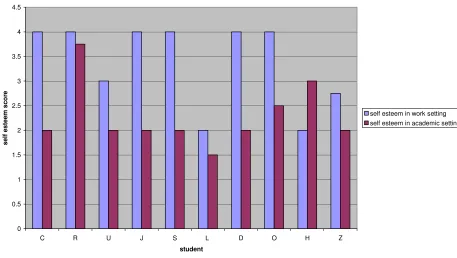
Self esteem ratings (figure 1) in the academic environment are not reflected by lower than average marks for students. Despite the fact that 7 of the 10 students rated their academic self esteem as 2 or less (out of 4) most students got better than average marks over all despite their general lack of confidence in their academic ability.
Research conducted by Fuller et al (2004) concluded that dyslexic students found written assignments most problematic. This is supported by our findings that many of our students claimed not to like the more traditional university assessment of 2,000 or 4,000 word assignments, as this type of assessment seems to take them a lot longer than it does for other students due to the speed they are able to read and write in an academic manner. Examining the marks that were obtained for this more traditional and more commonly used assessment method was therefore surprising as many of them actually performed slightly better than the cohort average (figure 2). Despite their achievements relative to their peers it is impossible to know if they had the potential to achieve higher grades.
The majority of students noted that they found timed tests the most challenging form of assessment, with some students feeling very stressed.
J: being phoned up the night before ‘timed tests’ by supportive fellow students ‘as they know it is a big deal for me’.
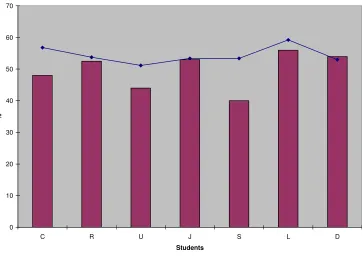
This anxiety about timed tests is concurred by lower achievement in this method of assessment. Compared with their own cohorts only 1 of the 7 students for whom we have marks achieved above average in tests (figure 3). This trend needs further examination as we have a little evidence to suggest that dyslexic students might achieve more in line with the average for their cohorts at foundation level. This may be due to all students struggling with the transition into higher education It is important to note that the dyslexic students may be no different from other students regarding anxiety and stress over this method of assessment, but the dyslexic students do seem to be
‘penalised’ despite being allowed 25 % extra time in tests and the opportunity to use assistive software, or have an amanuensis.
Most of our students claimed to like the assessed presentations best although many talked about having to 'keep it all in your head' (J), or having to read it through lots of times before the presentation. It is interesting to note that this confidence in verbal presentations is not reflected in the marks as most of the students achieved about average marks for presentations (figure 4).
These students do not expect extra consideration from their tutors and are keen not to ask for extensions on deadlines, as they feel that they can 'take our own time to prepare for assignments' (D). Nevertheless, they feel that it takes them a lot longer to do the reading and writing than other students (R,J). The effort exerted on academic study drew the heart felt comment from one student, 'With my assignments I am totally exhausted when I have finished' (J).
Support for studies
Ecclestone and Hayes (2009) assert that university students have become infantilised and ‘mollycuddled’. This they relate to the growth in wide range of support services now offered at universities, which challenge the idea of university as a place of knowledge and independence. They make the unsubstantiated claim that:
Now everyone looks for a difficulty to declare, like the hundreds of students who register themselves as ‘dyslexic’ when the problem, if it exists, is exceptionally rare.
(Ecclestone and Hayes, 2009:89)
These mature students did not show any of the signs of an ‘emotional shift’
software and tutorial support. In fact one student still has all the equipment in boxes unopened! Regarding the process of assessment all the students found it stressful but realised that it was necessary:
When I went for the initial assessment it was the most degrading experience in my entire life, not because of the person who did it…it was me! (D)
It [the assessment] made me realise I am not abnormal…not an alien…I cried when I got it (H)
One of the students found the whole process so mentally and physically tiring that she decided not to apply for any support from her LEA for access to the Disabled Students Allowance (DSA). She knew she was dyslexic but felt that she did not have the right to say this until she had ‘the piece of paper’ and she sought closure at this point. Another student appears to be confused and lost in the paper chase between the LEA and the University and is likely to start the second year of the course with no funded support in place. Most found the whole assessment process confusing, drawn out and involving a roller coaster of emotions that were extremely tiring. Reid and Kirk make the very valid point that ‘in many cases dyslexic adults have to be assertive about their entitlement for support. For some adults this is difficult to achieve’
(2001:153). Some of the students felt disempowered in the academic environment, which may relate to their positioning of their ‘self’ in their previous educational experiences.
Normally I don’t have a problem asking for help, but because I was out of my comfort zone I felt I couldn’t ask for help from anybody because I didn’t want to look a fool (D)
Going through the dyslexia assessment process did facilitate greater metacognition for all the students but how to act on it and become more confident and affective learners remained problematic. This was further compounded by issues surrounding access to support as part time students.
There appears to be a commonly held belief in universities that once dyslexic students gain support by means of computers and software such as Dragon
and Read and Write that their needs have, to a large degree, been
accommodated. However, the students had very mixed attitudes regarding the use of any DSA funded computers, software and devices. Many wanted more training and felt that they could not afford the time to get familiar with new programs, as already their study time was taking up an inordinate part of their ‘free’ time. Most were not fully using the specialist computer programs and they questioned the provision of three hour blocks of training due to their poor short term memories. Other devices aimed to help them study also remained a mystery:
I got a reading pen and a scanning pen but I haven’t managed to work them out. (C)
The University offers support funded by the DSA as advised by the educational psychologist’s assessment. Undoubtedly, a result of this should be the bolstering of the student’s self esteem but it appears that their positioning of the ‘self’ in the academic environment continues to impact on their learning journey.
Conclusion
Emerging themes from this small scale research project have highlighted a wide range of issues surrounding the identities that students with dyslexia bring to the academic environment. For those of us working with mature part time students we need to remember the importance of working with and acknowledging a student’s individual identity rather than labelling them. Sharing positive perspectives on dyslexia with students could assist students in becoming more confident with their developing academic identity.
It used to be my dyslexia and me and certainly over the last few years and hopefully it will continue, we have amalgamated into one and this is who I am and it just lets me get on with my life, so it’s less debilitating I guess. (R)
We have identified the following points that need further consideration or investigation:
•The concept of dyslexia needs reframing. Clarity of definition may assist students in their understanding and ensure the provision of appropriate support.
•In light of Ecclestone and Hayes’(2009) comments on the growing dependency culture amongst students further research needs to be undertaken to examine the experiences, attitudes and positioning of the self for the younger dyslexic full time students and their attitudes towards support in HE.
•The dyslexia assessment process needs to be reviewed to make it a more positive and empowering experience for students
References
Chapman, J. & Turner, W. (2003) Reading Difficulties, reading related perceptions and strategies for overcoming negative self beliefs Reading and Writing Quarterly 19 pp.5-24
Eccleston, K. and Hayes, D. (2009) The Dangerous Rise of Therapeutic
Education. Abingdon: Routledge
Fuller, M. Healey, M. Bradley, A. and Hall.T. (2004) ‘Barriers to Learning: a systematic study of the experience of disabled students in one university’
Studies in Higher Education, 29:303-18
Gee, J. P. (2000a) Discourse and Sociological Studies in Reading Reading
Online 4 (3) [online] Available at:
http://www.readingonline.org/sarticles/art_index.asp?HREF=/articles/handboo k/gee/index.html (accessed 12/02/09)
Gee, J. P. (2000b) The New Literacy Studies: from ‘socially situated’ to the work of the social In: Barton, D. Hamilton, M & Ivanic, R. eds Situated Literacies: reading and writing in context London: Routledge
Ivaniç, R. (1998) Writing and Identity: The discoursal construction of identity in
academic writing. Amsterdam: John Benjamins Publishing
Josselson, R. & Lieblich, A. (1993) The Narrative Study of Lives. London: Sage Publications
Lave, J. & Wenger, E. (1991) Situated Learning. Cambridge: University Press
Lifelong Learning UK (2008) Professional and National Occupational Standards for Youth Work [online] Available at: www.lluk.org.uk (accessed 11.7.08)
McLaughlin, D. (2004) ‘Dyslexia in the workplace: policy for an inclusive society’ In Reid, G and Fawcett, A (eds) Dyslexia in Context: Research,
Policy and Practice. London: Whurr Publishing
National Working Party on Dyslexia in Higher Education (1999) Dyslexia in Higher Education: Policy, Provision and Practice. Hull: University of Hull
Osbourne, M. Huston, M. & Toman, N. (2007) The Pedagogy of Lifelong
Learning. Abingdon: Routledge
Ott, P. (1997) How to Detect and Manage Dyslexia. Oxford: Heinemann
Preston, M. (1996) Four Times Harder. Birmingham: The Questions Publishing Company
Reid, G. and Kirk, J. (2001) Dyslexia in Adults: Education and Employment.
Riddell, S. and Weedon, E. (2006) ‘What Counts as reasonable Adjustment? Dyslexic students and the concept of fair assessment’ International Studies in
Sociology of Education vol16, No 1 June 2006 pp57-73
Stevens, R ed (1996) Understanding the Self. London: Sage
Street, B. (2003) ‘What’s new in New Literacy Studies? Critical approaches to literacy in theory and practice’Current Issues in Comparative Education vol.5 (2) pp 77-91[Accessed electronically 28.1.09]
Weedon, E and Riddell, S. (2007) ‘To those that shall be given? Differing expectations of support among dyslexic students’ In Osbourne, M. Huston, M. & Toman, N. (2007) The Pedagogy of Lifelong Learning. Abingdon: Routledge
Widdershoven, G. (1993) ‘The Life Story: Hermeneutic perspectives on the relationship between narrative and history’ In Josselson, R & Lieblich, A (1993) The Narrative Study of Lives. London: Sage Publications
Figure 1: self esteem in different settings
0 0.5 1 1.5 2 2.5 3 3.5 4 4.5
C R U J S L D O H Z
student
s
e
lf
e
s
te
e
m
s
c
o
re
[image:14.595.104.487.482.742.2]self esteem in work setting self esteem in academic setting
Figure 2: Comparison of marks for written assignments
0 10 20 30 40 50 60 70 80
C R U J S L D
student
% students' marks
Figure 3: Comparison of test scores with cohort mean
0 10 20 30 40 50 60 70
C R U J S L D
Students
% Actual Test Score
[image:15.595.103.489.449.706.2]Mean Cohort Test Score
Figure 4: Comparison of presentation marks with cohort mean
0 10 20 30 40 50 60 70
C R U J S L D
student
% Actual presentation mark