Munich Personal RePEc Archive
Structured Finance Influence on
Financial Market Stability – Evaluation
of Current Regulatory Developments
Schuetz, Sebastian Alexander
University of Lueneburg - Department of Economics
30 June 2010
Online at
https://mpra.ub.uni-muenchen.de/23574/
Structured Finance Influence on Financial Market Stability
–
Evaluation of Current Regulatory Developments
Sebastian A. Schuetz*
This version:
“
Preliminary draft
”
June 2010
In 2007 the world faced one of the biggest financial crises ever. It was the third important
financial crisis in the last 12 years. Spillovers to the real economy and moral hazard
behaviour of carpetbaggers resulted in enormous pressure on worldwide political institutions
to approve a more rigorous regulation on financial institutions and predict financial crises via
early warning systems. We analyzed the performance of structured finance ratings and
structured finance issuance/outstanding to detect the main shortcomings of the subprime
crisis. Afterwards we explain the behaviour of market participants with theoretical models and
a survey of institutions involved in securitization. With the conclusions of this analysis we
evaluate the EU regulation on credit rating agencies and current Basel II enhancements.
Finally we can determine that most regulatory enhancements are in accordance with our
analyzed shortcomings. Some approaches like the introduction of a leverage ratio are
counterproductive and a danger for worldwide economic growth.
Key words: structured finance, ratings, regulation, subprime crisis, Basel II, leverage ratio
JEL-Code: G01, G21, G24, G28
*Lüneburg-Wolfsburg chamber of industry and commerce, Am Sande 1, 21335 Lüneburg, Germany, email:
[email protected], phone: +49 4131 742-176, fax: + 49 4131 742-345
Table of contents
Abbreviations ... iii
Figures ... iv
1 Introduction ... 1
2. Financial market stability and early warning systems for financial crises ... 2
3. Stylized facts from structured finance rating behavior and issuance ... 4
3.1 Structured finance ratings ... 4
3.2 Structured finance ratings transition... 6
3.2.1 USA ... 7
3.2.2 Europe ... 10
3.2.4 Structured finance ratings summary ... 11
3.3 Structured finance issuance and outstanding... 12
3.3.1 USA ... 13
3.3.2 US structured finance issuance and outstanding summary ... 18
4. Was banking behavior rational? ... 19
5. Banking regulation and structured finance enhancements ... 24
5.1 EU-regulation on credit rating agencies ... 26
5.2 Basel II enhancements ... 29
5.3 Basel III consultation paper ... 31
6. Summary ... 36
Abbreviations
ABS – Asset Backed Securities
ABCP – Asset Backed Commercial Paper CCF – Credit Conversion Factor
CDO – Collateralized Debt Obligation CEPS – Centre for European Policy Studies
CESR – Committee of European Securities Regulators CMBS – Commercial Mortgage Backed Securities CRA – Credit Rating Agency
EAD – Exposure at Default
ECAI – External Credit Assessment Institution
EU-Repo – European Sale and Repurchase Agreements FSAP – Financial Services Action Plan
FSB – Financial Stability Board
GSE – Government Sponsored Enterprises
HUD – Department of Housing and Urban Development IAA – Internal Assessment Approach
IOSCO – International Organization of Securities Commissions IRB – Internal Ratings Based Approach
LGD – Loss Given Default
LTCM – Long Term Capital Management LTV – Loan to Value
MBS – Mortgage Backed Securities
NBER – The National Bureau of Economic Research NPL – Non-performing Loan
PD – Probability of Default
RMBS – Residential Mortgage Backed Securities SEC – US Securities and Exchange Commission SF – Structured Finance
SA – Standard Approach
SFA – Supervisory Formula Approach
Figures
Figure 1 –Performance of the Nasdaq Composite Index
Figure 2 – Global Structured Finance One-Year Gini Coefficients
Figure 3 – US Structured Finance Downgrades
Figure 4 – US Structured Finance Downgrade Average
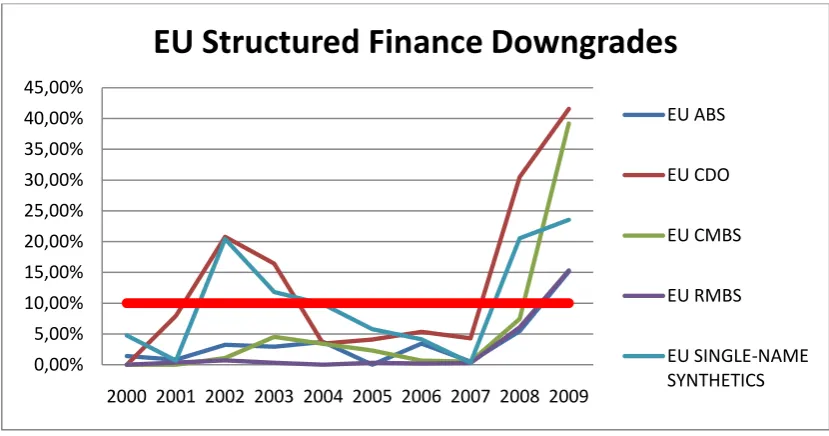
Figure 5 – EU Structured Finance Downgrades
Figure 6 – EU Structured Finance Downgrade Average
Figure 7 – US Structured Finance Issuance
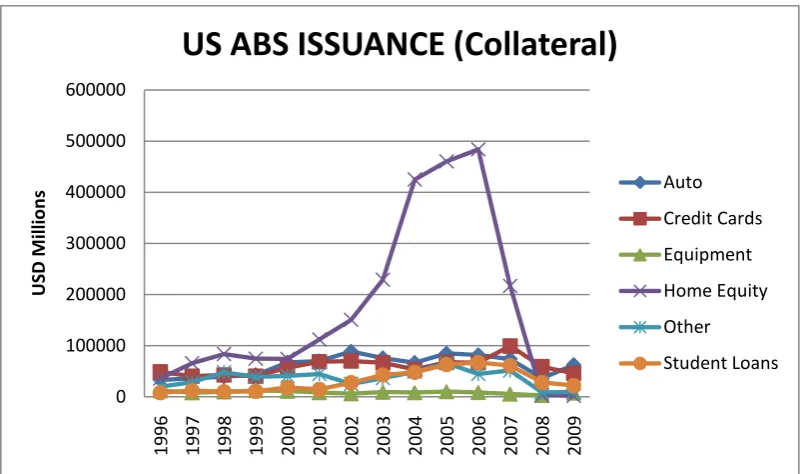
Figure 8 – US ABS Issuance (Collateral)
Figure 9 – US Mortgage-Related Structured Finance Issuance
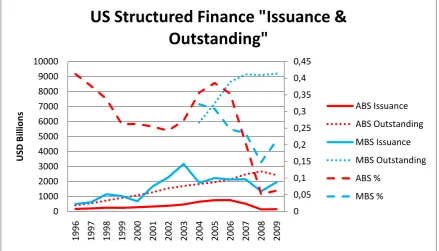
Figure 10 – US Structured Finance Issuance & Outstanding
Figure 11 – US CDO Issuance (Collateral)
Figure 12 – Mortgage Related Structured Finance Amplifiers for the Subprime Crisis
Figure 13 – Global Structured Finance Speculative-Grade Annual Default Rates
Figure 14 – Subprime Crisis Securitization Cycle
Figure 15 – Subprime Crisis Securitization/Liquidity Cycle
1
1 Introduction
Since mid 2007 the world has faced one of the biggest financial crises ever.
The subprime crisis was the third important financial crisis in the last 12
years. Due to the very complex and intransparent structure of structured
finance products and their incalculable systemic relevance, large writedowns
and ongoing mistrust is inherent in nearly all financial markets until today.
This mistrust led to a drying-out of important treasury markets like the
interbank money market or the secondary market. Even with massive
bail-outs (€1.873 billion by mid-October 2008) and enhanced money market tender programs (like US-TALF or EU-Repo) a spillover to the real economy
could not be avoided but lead to a partial stabilization of international
financial markets and a temporary decrease of secondary market spreads.
But as is noted in the CEPS Task Force Report (Lannoo (2008)) there was
no European response to the crisis and from a national point of view this is
comprehensible since the impact on European countries has been
heterogeneous. Even if this crisis was not a European crisis, one of the
hallmarks of the EU´s Financial Services Action Plan (FSAP) is questioned:
disintermediation and therewith securitization which is a very important factor
for the development of a mature capital market beside the financial
intermediaries. The integration process of EU financial markets and financial
intermediaries proceeds much faster than EU regulation and supervision.
And as it was noted in Lannoo (2008) the EU realized this shortcoming ten
years ago and reacted, beside of the start of the monetary union and the
launch of the FSAP, with the implementation of Lamfalussy Committee
proposals. But even if this reform brought some remarkable results, it was
crafted during good market conditions and seems not to be capable of stormy
times. More and more experts got the result that we have probably reached
the limits of what is possible under the current system and that we need a
major step in EU wide financial regulation and supervision reform. Also the
politicians are under pressure to adopt a stronger banking regulation and
foresee crises with early warning systems. We want to analyze the previous
2 developments for major structured finance markets in the last two crises. By
documentation of the major shortcomings in the present regulatory
framework which especially stand out through the last two years of financial
distress we evaluate actual regulatory approaches and show the
consequences for the world economy. In chapter two we define financial
market stability and give a short literature review about early warning
systems for financial crises. In chapter three we show in detail the rating
behavior of US and European structured finance instruments and detect
stylized rating facts. Afterwards we explore the US structured finance
issuance and outstanding to detect possible moral hazard intentions that
could be prevented through new regulatory approaches. In chapter four we
take the findings of chapter two and three and try to find the motivation for
the behavior of market participants to originate and invest in structured
finance instruments. We do this with the Bearingpoint securitization survey
(2009) and with theoretic economic approaches. In chapter five we
summarize the findings of the three former chapters and evaluate the actual
EU regulation on credit rating agencies, Basel II enhancements and the
Basel III consultation paper to differentiate between necessary regulations
and possible overregulation.
2. Financial market stability and early warning
systems for financial crises
Before we start discussing the possibility of an early warning system to
prevent financial crises it is useful to define financial market stability. We will
do this by the negative proof. DeBandt and Hartmann (2002) define a
“systemic crisis” as occurring when a shock affects “a considerable number
of financial institutions or markets […], thereby severely impairing the general
well-functioning (of an important part) of the financial system. The well
functioning of the financial system relates to the effectiveness and efficiency
with which savings are channeled into the real investments promising the
highest returns. Financial market instability is inherent if major losses are
realized during a short time period and if central money markets, like the
3 In the last 15 years the world mentioned three major financial crises. In 1998
the financial markets were shocked through the collapse of the hedge fund
LTCM. Like often in financial crises the central bank, in this case the Federal
Reserve, organized a $3.5 billion rescue package to prevent a more
damaging spillover to systemic important banks and therewith at least also to
the real economy. Only three years later, in 2001, the financial distress was
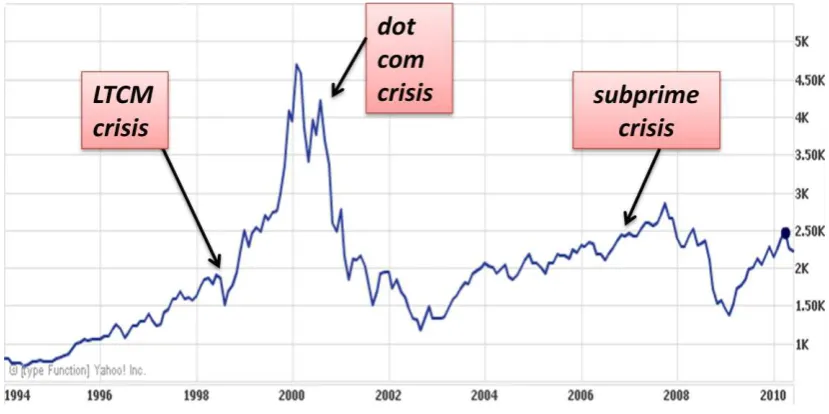
[image:8.595.113.528.226.433.2]due to the “dot-com bubble”.
Figure 1: Performance of the Nasdaq Composite Index based on calculations of Yahoo Finance
An incredible overheating of stock markets related to an incredible growth in
the internet sector and related business.
After both crises the world economy slowly recovered and with initiatives like
the rework of Basel I there were also initiatives to make the banking system
less sensitive to financial crises. In 2007 the “subprime crises” appeared and
is the most intense crisis since the Great Depression. Of course after every
crisis there were impulsive actions to develop “early warning systems”
consisting of lots of financial indicators to forecast future financial crises.
Before we present a short literature review have a look at figure 1. Figure 1
shows the development of the Nasdaq Composite Index between 1994 and
2010. Three crisis, three different reactions of the Nasdaq. This should give
us a first indication that every crisis is different and that it is very difficult to
forecast financial crises. It is supported by Borio and Drehmann (2009) who
noted that the construction of reliable quantitative tools to inform
4 elusive. Davis (1995, 1999, 2002) mentioned that some features are common
to all crises. Borio and Lowe (2002a,b) tested a lot of indicators focusing on
the behavior of credit and asset prices. The in sample performance was quite
good but has just limited advantages. Only if the same indicators perform as
well out of sample they can be considered to indicate systematic risk. Borio
and Drehmann (2009) tested the out of sample performance of the indicators
to the subprime crisis but without special indicators for securitization. Barrel
et al. (2009) used an early warning system with measures of bank capital and
liquidity adequacy and of property price growth. They showed that they
outperform traditional variables such as GDP growth, inflation and real
interest rates. Davis and Karim (2008) used logit and binomial tree
approaches that have been successful in predicting banking crises (Karim
(2008)). Overall, the different early warning systems were just partially helpful
to predict the subprime crisis. It shows that the sub-prime crisis was different
compared to other crises and makes regulation even more difficult.
The challenge of this paper is to analyze the behavior of structured finance
rating movements, issuance and outstanding. We want to detect stylized
facts and reasons for the subprime crisis to evaluate actual regulatory
approaches and show possible early warning indicators.
3. Stylized facts from structured finance rating
behavior and issuance
As noted in Loeffler (2004) rating agencies are important for the stability of
financial markets. Ratings are used to price risky debt, to compute economic
and regulatory capital, or to calibrate internal ratings of banks. Ratings should
give an orientation for default probabilities of the rated assets. They should
be stable and assign the same default probability over all asset classes. But
is this also true for financial innovations like structured finance instruments?
3.1 Structured finance ratings
It is important to understand that every structured finance product is just as
good as the underlying assets. To understand the major losses due to
structured finance products one step is to analyze if the ratings indeed
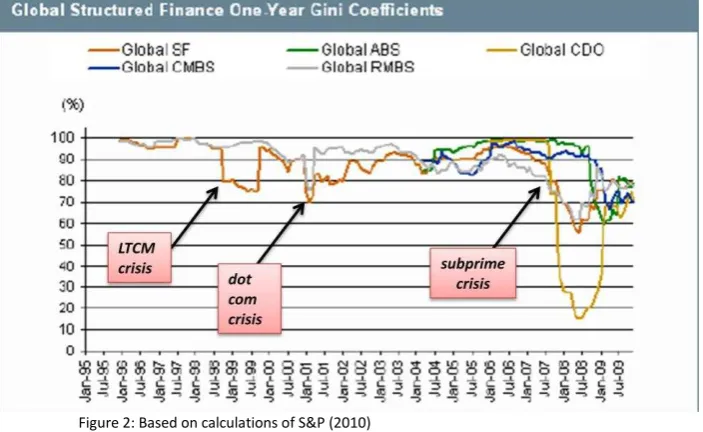
5 Standard and Poor´s (2010) calculated the Gini coefficients for different
structured finance products. The higher the Gini coefficient the greater is the
correlation between the ratings and the structured finance instruments default
behavior. As can be seen in the next chart the Gini coefficients were in the
90% area for each product before 2006 which is a good indicator that the
[image:10.595.145.497.209.425.2]ratings matched the expected defaults.
Figure 2: Based on calculations of S&P (2010)
The three financial crises (LTCM collapse, „dot com“ bubble, subprime crisis)
marked in the chart led to lower Gini coefficients. But the decrease of the Gini
coefficient due to the last crisis led to significant downturns. Especially the
decrease of the Gini coefficient for CDOs to 15% in 2008 questions the
ratings methodology. This has direct application to the financial market
stability because the whole financial system (especially Basel II, rating
trigger) is related to ratings. If the ratings expected default probability differs
from the realized defaults enormous consequences for the whole financial
system and its stability have to be considered. Ratings are based on a
statistical database that no market participant could have in this detail. If
market participants do not trust in ratings or in rating agencies they will
reduce their interaction with market participants (see also chapter 4). After
this first indication we want to analyze the rating transition behavior for
6
3.2 Structured finance ratings transition
As estimated by the NBER Business Cycle Dating Committee (2001, 2003,
2008) the US expansion ended in March 2001. After just eight months the
trough marks the end of the recession and introduced an expansion of the
US economy which last until December 2007. We should keep these
business cycle facts in mind if we analyze the rating behavior.
Normally rating agencies use through-the-cycle ratings (Altman and Rijken
(2005)) that are more resistant against business cycle fluctuations. Therewith
we should expect nearly constant up- and downgrade probabilities for all
rated financial instruments. Of course during an economic downturn there are
more downgrades but they should not exceed a threshold value. But if you
have a look at the downgrade frequency of Standard & Poor´s global
structured finance ratings (S&P (2010)) we see in 2008 and 2009 two outliers
with 38% and 54% that raise again the question if the rating methodology for
structured finance instruments is correct.
In general we can determine that the structured finance ratings reacted in
average with a one or two year lag in downgrades to the recession. As a
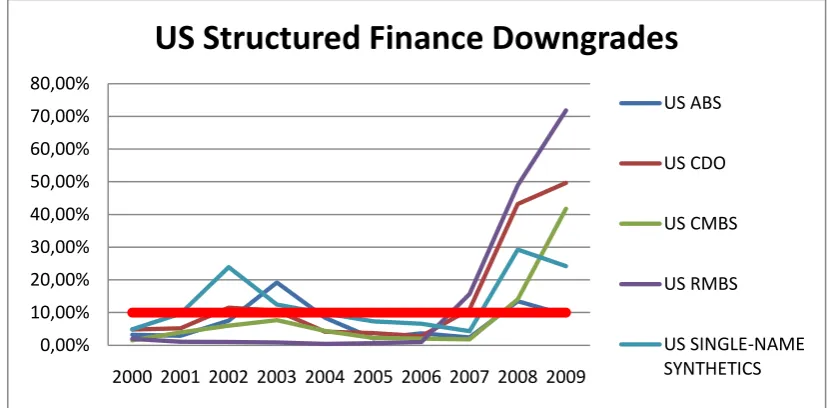
crises threshold value we define in dependence on Fitch (2010) a 10 %
downgrade rate. This threshold is based on the historical rating changes
statistic for global financial institutions. A downgrade rate higher than 10%
shows an extreme economic downturn. Another reason is that the rating
methodology for corporates and corporate bonds is validated. Therewith an
extreme exceeding of the 10% threshold in combination with a high spread
between structured finance and corporate downgrades provides evidence
that the structured finance rating methodology is inappropriate, i.e. a
corporate “AAA” is not equivalent to a structured finance “AAA”. After this global structured finance rating overview we want to analyze the structured
7 3.2.1 USA
Figure 3: Based on calculations of S&P (2010)
The defined 10% threshold is violated in 2002/2003 with massive
downgrades of US ABS and US Single-Name Synthetics. These downgrades
are explainable through the “dot com” bubble, which was an economic crisis
of the tertiary sector. The companies needed a lot of liquidity and the
investors who provided liquidity wanted protection through single-name
synthetics. As the bubble imploded the quality of the underlying deteriorate
and therewith the single-name synthetics. A spillover to other sectors of the
real economy, the rise of unemployment involved from 3.9% (Q4/2000) to
6.1% (Q3/2003), the 9/11 shock and the amazing advance in prices for crude
oil beginning afterwards explain the weak performance of ABS underlyings
leading to a 20% downgrade rate in 2003. As a first result we can determine:
The performance of structured finance instruments depends
enormous on the performance of the underlying assets. The time
lag in downgrades depends on the economic crisis, the strength
and the range of the shock.
The structured finance ratings reacted much stronger in the
subprime crisis compared to the „dot com“ bubble.
Equivalent rating categories (e.g. “AAA”) for complex structured finance products, e.g. CDO², and for standard products like
corporate bonds lead to an underestimation of the risk inherent
in the structured financial instrument.
0,00% 10,00% 20,00% 30,00% 40,00% 50,00% 60,00% 70,00% 80,00%
2000 2001 2002 2003 2004 2005 2006 2007 2008 2009
US Structured Finance Downgrades
US ABS
US CDO
US CMBS
US RMBS
8
Structured finance ratings are more volatile and just limited
comparable to ratings of other asset classes.
At the beginning of the subprime crisis the most structured finance ratings
stayed constant. The US CDOs and the US RMBS were even in 2007
massively downgraded. The US RMBS downgrades are related to the
underlying mortgages that have floating interest components. Especially the
large increase of the US Federal Funds rate starting in January 2005 led to
an increasing default rate of US residential mortgages. The increase in CDO
downgrades is explainable with CDOs with MBS as underlying also called
resecuritisations. With the deterioration of the US economy the situation for
US mortgage owners got worse and the downgrades for US RMBS and US
CDOs increased in an unprecedented manner. The deterioration of the US
economy led also to a decline of commercial real estate demand and
therewith automatically to higher default rates in commercial mortgages
resulting in higher downgrade rates. The commercial mortgage market
seems to be more robust, explaining the one year lag in downgrades
compared to US RMBS. One reason could be that corporates have higher
reserves and could withstand economic downturns for a longer period.
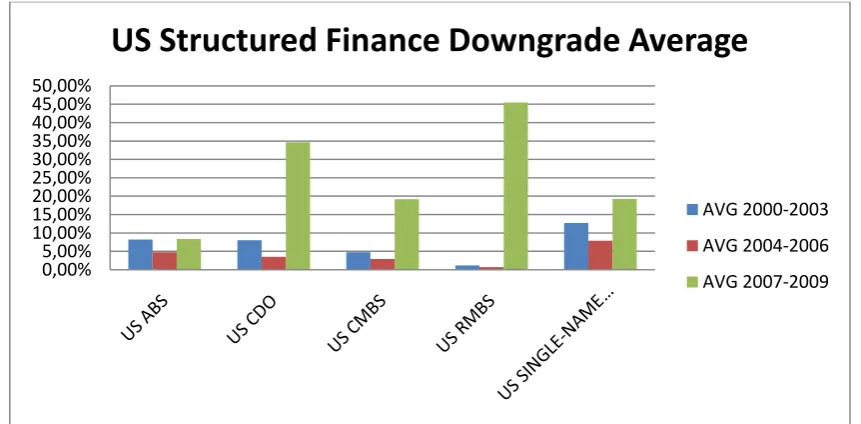
[image:13.595.110.541.513.725.2]Let us have a look to the US structured finance ratings in more detail.
Figure 4: Based on calculations of S&P (2010)
0,00% 5,00% 10,00% 15,00% 20,00% 25,00% 30,00% 35,00% 40,00% 45,00% 50,00%
US Structured Finance Downgrade Average
AVG 2000-2003
AVG 2004-2006
9 In figure 4 we compare the US structured finance downgrade averages. The
2000-2003 average covers the “dot com” bubble. The 2004-2006 average
shows an average for a period with good economic conditions and the
2007-2009 average describes the average for the subprime crisis. For US ABS the
2007-2009 average is nearly on the same level as for the period of
2000-2003. This gives us an indication that the US ABS were not hit harder in the
subprime crisis than in the economic downturn in 2001. In contrast the US
RMBS have very low downgrade rates between 2000 and 2006. In average
there is no statistical significant difference of the 2000-2003 and the
2004-2006 average. But the 2007-2009 downgrade average marks the all time
high for downturns. We can conclude:
Structured finance ratings are not able to predict financial crises
because ratings react with a time lag. The downgrade average of
US RMBS between 2000-2006 gives no indication for the crisis.
Important systemic assumptions of structured finance rating
methodologies are wrong (e.g. correlation).
Long term structured finance ratings are highly volatile and have
not the stability expected from a through-the-cycle rating.
The volatility of the structured finance ratings must be due to
biased rating methodologies and to incentives to issue
structured finance instruments. These incentives could led to
moral hazard problems to generate enough underlyings.
After we analyzed the US structured finance ratings behavior we want to
10 3.2.2 Europe
Figure 5: Based on calculations of S&P (2010)
In Europe we should expect lower downgrade rates because of a lower
structured finance issuance. The assumption is based on a less developed
market for securitization and therewith a higher screening of the securitized
underlying. Keys et al. (2009) gives an indication that high issuance of
structured finance instruments could lead to less monitoring effort and lax
screening. In contrast to the USA the 10% threshold seems to be too high,
nevertheless the 10% burden was exceeded in both crises. After the “dot com” bubble we see high downgrade rates for EU CDOs and EU single
-name synthetics. The high downgrade rate for EU CDOs could be due to a
high risk inherent in the underlying (maybe US structured finance
instruments). There are no important downgrades for EU ABS which support
the assumption that structured finance issuance is very restrictive and
indicates a high underlying quality of the European assets.
The downgrades after the subprime crisis show some differences to the US.
We see the highest downgrade rate for EU CDOs with more than 40%
downgrades. This rate is the third highest compared to US downgrades.
Interestingly the downgrade rate for EU CMBS is nearly on the same level as
for the US. Also the downgrades for EU single-name synthetics are in the
range of the US values. The rise of the EU RMBS downgrades is due to lax
screening in the Spanish mortgage market. 0,00%
5,00% 10,00% 15,00% 20,00% 25,00% 30,00% 35,00% 40,00% 45,00%
2000 2001 2002 2003 2004 2005 2006 2007 2008 2009
EU Structured Finance Downgrades
EU ABS
EU CDO
EU CMBS
EU RMBS
11
The higher developed the structured finance market the higher is
the range of structured finance instruments and the risk of lax
[image:16.595.118.532.92.374.2]screening of the underlying.
Figure 6: Based on calculations of S&P (2010)
European ABS performed well in the period 2000-2009. The EU CDOs and
EU single-name synthetics show high rating volatility in both economic
downturns. Remarkable is the amazing increase in downgrade rates for EU
MBS. In the period 2000-2006 as in the USA nearly all European structured
finance ratings give no indication for a financial crisis.
The relatively low downgrade rates compared to the US
structured finance market are due to less investor confidence in
structured finance products.
One reason for the low European structured finance issuance is
the high developed Pfandbrief market and the investor
confidence in this instrument.
3.2.4 Structured finance ratings summary
The low Gini coefficient for CDOs in the subprime crisis was a first indication
that the structured finance rating methodology is wrong. Empirically this was
supported by the huge downgrade rates for the US and European structured
finance instruments. The structured finance ratings gave no indication for the 0,00%
5,00% 10,00% 15,00% 20,00% 25,00% 30,00%
EU Structured Finance Downgrade Average
AVG 2000-2003
AVG 2004-2006
12
subprime crisis and reacted completely different compared to the „dot com“
bubble, which makes the development of an early warning system for
financial crisis more complicated. Even in May 2007 Moody´s showed in their
full-year 2006 report no expected changes for the securitization market
(Moody´s (2007)). If we consider the enormous dependence of the banking
system on ratings, financial stability is in danger if the banks´ dependence is
high for structured finance instruments used for secondary market
refinancing. Structured finance ratings react different compared to ratings of
other asset classes. The European structured finance market seems to be
more conservative and therewith gives an important indication that there
have to be exogenous motivations for structured finance issuance. It is not
just the simple completion of financial markets. Motivations like the decrease
of regulatory capital, regulatory arbitrage or more general economic factors
like monetary policy could have amplified the US structured finance issuance
leading to the subprime crisis.
Therefore we want to analyze the issuance and outstanding to find the main
motivations for the crisis and could therewith evaluate actual regulatory
enhancements.
3.3 Structured finance issuance and outstanding
In the last chapter we analyzed the rating performance and behavior.
International banking regulation frameworks, like Basel II, use external
ratings as a proxy for risk and therewith for the determination of regulatory
capital. As a next step we want to analyze the structured finance issuance
and outstanding. This is necessary to draw conclusions why structured
finance instruments were issued. Afterwards we complete the findings to
13 3.3.1 USA
Figure 7: Based on calculations of SIFMA
The US structured finance market is the most developed in the world and the
most complex structured finance instruments were issued in the USA. The
subprime crisis is primary based on US structured finance instruments that
were traded and repackaged all around the globe. If we analyze the
structured finance issuance in more detail we see clear differences.
The US ABS issuance has a healthy growth rate between 1996 and 2003.
The high increase between 2004 and mid 2007 is due to the economic
recovery of the “dot com“ bubble and the investor acceptance of structured finance products. The growth in the ABS market did not lead to the
international financial crisis. The reason is the diversified portfolio of ABS
underlyings like leasing-, credit card- or student loan receivables. 0
500000 1000000 1500000 2000000 2500000 3000000 3500000
US
D
M
il
li
o
n
s
US Structured Finance Issuance
ABS
MBS
14
Figure 8: Based on calculations of SIFMA
The detailed US ABS Issuance figure shows normal growth rates for all
securitized underlyings but home equity loans. The interaction of MBS, home
equity loan ABS and resecuritisations amplified the granting of mortgages
and home equity loans which became an important danger for financial
market stability. Agarwal et al. (2006) noted that home equity loans are loans
with home equity as collateral. The loans require a very good credit history
and the magnitude of the loans is limited to the value of the home equity. It is
often used as a short to mid term loan to finance major expenses like college
education or home repair. The issuance of ABS with home equity collateral
seems good protected against default risk because of the relevant credit
history and the collateral itself. Amplified was the issuance also because of
the rising real estate prices, e.g. the median sales prices of new homes sold
in the US nearly doubled between 1995 and 2007 (Census (2010)).
The US ABS issuance has normal growth rates for nearly all instruments but home equity ABS. These structured finance
instruments had no significant impact for the formation of the
worldwide financial crisis.
The investor trust in home equity loan ABS amplified the
issuance of home equity loans and home equity loan ABS in an
unprecedented manner. The issued volume increased from $74.4
0 100000 200000 300000 400000 500000 600000
1996 1997 1998 1999 2000 2001 2002 2003 2004 2005 2006 2007 2008 2009
USD
M
il
li
o
n
s
US ABS ISSUANCE (Collateral)
Auto
Credit Cards
Equipment
Home Equity
Other
15
billion in 2000 to $483,9 billion in 2006, i.e. a growth of more than
650% in 6 years!
Due to the rising real estate prices the home owners with good
credit history could get additionally to their mortgage a home
equity loan. The rising US interest level led to increased defaults
in home equity loans and therewith also in mortgages in the Alt-A
[image:20.595.114.534.240.487.2]and A scoring worsening the situation on the MBS market.
Figure 9: Based on calculations of SIFMA
If we have a look at the US mortgage-related structured finance issuance
we see an important activity through US agencies. Even if the non-agency
issuance nearly doubled between 2004 and 2005, which is clearly
incompatible with an economic related growth rate, it must be primarily
CMBS issuance, since the US agencies issued an enormous volume of
RMBS. This thesis is supported because the downgrade rates of the CMBS
are more resistant against economic fluctuations than RMBS. The dominant
players in the agency sector were government-sponsored enterprises (GSE)
like Fannie Mae, Freddie Mac and the Federal Home Loan Bank. Of course,
one reason for the high issuance was the investor overreliance on high rated
structured finance instruments. According to Holmes (1999) we believe that
the main reason was the policy the GSE were restricted to through the US
Department of Housing and Urban Development (HUD). Since the early 0
500 1000 1500 2000 2500 3000
US
D
B
il
li
o
n
s
US Mortgage-Related Structured Finance
Issuance
Agency
16 1990s the HUD relaxed the conditions for the allocation of mortgage loans
until in 2006 the HUD directed the GSEs that 56% of their loans have to be
provided to borrowers with income below the median in their area.
Additionally the HUD restricted that 12% of the GSEs mortgage financing
have to be special affordable loans. These loans were provided to borrowers
with an income less than 60% of their median´s income. The yearly agency
MBS issuance was in the range of $440 billion. The peak was reached in
[image:21.595.114.554.249.500.2]2003 with an issued agency MBS volume of over $2.7 trillion.
Figure 10: Based on calculations of SIFMA
This led to an increasing outstanding volume of MBS with its peak in 2009
with nearly $9.2 trillion. As noted before the ABS (beside of home equity
loans) issuance and also the ABS outstanding have normal growth rates,
beside of the fact that the difference increased over the years. The difference
could be seen as indicator for systemic risk and possibly be integrated into
early warning systems. Less structured finance issuance means that
economic conditions dampened or the investors trust in structured finance
instruments worsen. If there is additionally a high structured finance
outstanding, the default probability could increase with not predictable effects
to collateral default correlation and systemic risk observed in the subprime
crisis. For the sake of completeness we see the ratio of structured finance 0 0,05 0,1 0,15 0,2 0,25 0,3 0,35 0,4 0,45 0 1000 2000 3000 4000 5000 6000 7000 8000 9000 10000
1996 1997 1998 1999 2000 2001 2002 2003 2004 2005 2006 2007 2008 2009
US D B il li o n s
17 issuance and outstanding as indicator for repayment speed or revolving
frequency. Even if the agency MBS issuance was worrisome the immense
MBS outstanding is even more. The magnitude of $9.2 trillion MBS
outstanding indicates that enormous positions must be held by investors all
around the globe. It was grossly negligent from investors risk management to
disregard these indicators and careless from the worldwide regulation
authorities.
A main reason for the incredible growth rate in the MBS market
was the policy driven MBS issuance by US GSEs with a
maximum of $2.7 trillion.
A higher spread (outstanding vs. issuance) indicates less
investor confidence and market uncertainty.
The issuance/outstanding ratio could be seen as indicator for the revolving speed of structured finance instruments.
The systemic risk due to US agency MBS issuance was grossly
neglected by the worldwide supervision authorities and in the
regulation frameworks.
And even more dangerous the picture become if we see the enormous
and disproportional issuance of US CDOs backed by structured finance
instruments: $307.8 billion.
0 50000 100000 150000 200000 250000 300000 350000
US
D
M
il
li
o
n
s
US CDO Issuance (Collateral)
High Yield Bonds
High Yield Loans
Investment Grade Bonds
Mixed Collateral
Other
Other Swaps
18
Figure 11: Based on calculations of SIFMA
[image:23.595.140.491.135.387.2]3.3.2 US structured finance issuance and outstanding summary
Figure 12
If we neglect for this chapter the question why financial institutions invested
in structured finance instruments, we see clear differences in structured
finance issuance. We can state that there is dependence between high
issuance and high downgrades. This fact may be random for structured
finance instruments but reveal the former noted rating methodology failures.
According to that we could determine clear motivations for structured finance
issuance, especially for mortgage related instruments. Due to the
combination of low US interest rates, social policy, the economic recovery of
the “dot com” bubble and the apparently unlimited demand for structured
finance instruments, the mortgage supply also seems unlimited. Figure 10
describe the interaction that leads to the crisis. Home equity loan ABS and
RMBS were the main underlyings for CDOs (figure 9). If they stagger the
CDOs also will stagger. The RMBS with subprime underlyings staggered as
the FED increased the main interest rates. But for most of the high quality
RMBS this increase was not dramatic. It became dramatic because
additionally many people also had home equity loans. Due to that home
19 crisis was perfect. Together with important failures of the rating
methodologies for structured finance instruments and the drying-out of the
important interbank markets the world faced one of the biggest financial
crises ever.
As a consequence we could say that with a regulation of credit rating
agencies, higher risk weights, better banking supervision on risk- and liquidity
management and more intensive banking due diligence the crisis could have
been prevented. Before we evaluate if the mentioned aspects are
incorporated in actual regulatory enhancements or consultation papers, we
want to analyze if the banking behavior was rational although the facts and
failures were so obvious.
4. Was banking behavior rational?
The Bearingpoint securitization survey from December 2009 shows valuable
insights into the motivation of securitization. Before the subprime crisis one
main motivation was the control of assets on the balance sheet to release
regulatory capital. It was also possible to gain regulatory arbitrage due to the
change to the securitization framework. Other important reasons were better
conditions compared to unsecured refinancing, risk transfer and the
diversification of liquidity channels. We will support the study by some
theoretical approaches.
Due to structured finance issuance a bank had the advantage of possible
regulatory gains, gains from securitization and the sale of the tranches, lower
20
Figure 13: from S&P (2010)
The first theoretical approach describes a cycle that explains the “originate
-to-distribute” behavior of banks and the nearly unlimited investor demand for
structured finance instruments. If we have a look at the low default rates of
speculative grade structured finance instruments before the subprime crisis
in figure 11 and the enormous issuance due to nearly unlimited investor
demand, it was rational on a micro-level to originate structured finance
instruments. The reasons for the nearly unlimited investor demand for
structured finance instruments will be explained later. Nevertheless the risk of
a too capital market orientated refinancing strategy was neglected. The
worldwide supervision authorities ignored that and underestimated the risks
and complexity of structured finance instruments for banks and for the whole
financial system.
Especially the risk increased due to the high demand for securitizations
because banks could not generate enough underlyings with their standard
business procedures. The consequence was a reduction of bank lending
standards. Kiff and Mills (2007) showed that securitization could lead to lax
screening and less monitoring effort. Franke (2005) mentioned that beside
the moral hazard problem also the danger for adverse selection rises.
Together with the high motivation of hedge funds to invest in structured
finance instruments a dangerous cycle started. But why had hedge funds and
other market participants such a high demand for structured finance
21
Figure 14: “originate-to-distribute” securitization subprime cycle
Cole, Feldberg and Lynch (2007) showed that hedge funds managed over
$1.426 trillion in 2006. Since 1995 this was an incredible growth rate of more
than 700%. From an economic point of view the growth of the hedge fund
industry led to decreasing returns per fund. To reach the required returns
hedge funds had to use higher leverage and invest in more risky financial
instruments (Papademos (2007)). Therewith hedge funds bought
non-performing loans directly from banks, invested in junior structured finance
pieces or bought mezzanine structured finance tranches and originated
resecuritisations (CDO²).
Bundesbank (1999) mentioned that the high demand for hedge funds is
explainable because hedge funds have no investment restrictions and
therewith complement the portfolio of institutional investors. The cycle ends
with the shareholder of hedge funds: the institutional investors. So, banks are
shareholder of hedge funds and expected high returns. Due to the enormous
growth of the hedge fund industry the accepted risks increased. The hedge
fund demand for structured finance instruments increased and banks
generated enormous underlyings with less and less due diligence to fulfill the
demand (figure 14). Amplified was the cycle with the high ratings of credit
rating agencies that suggest default protection and cheap money due to low
22 originate structured finance instruments and to use more capital market
orientated funding from a bank point of view.
From a macro perspective this had to lead to a financial crisis. As the crisis
occurred in 2007 the demand for structured finance instruments dried up, the
banks had to provide liquidity facilities, fulfill margin calls and guarantee for
the hedge fund losses which ended in a liquidity crunch. These systemic
risks were predictable and a main failure of worldwide supervision and
regulation authorities. The reasons for the drying-out are shown in the
liquidity crunch cycle in figure 15. Banks relied to heavy on cheaper
secondary market funding. As the subprime crisis started the ABCPs of the
banks own conduits were bought by the originating banks to avoid the draw
of liquidity facilities. As this was not enough the liquidity facilities were drawn
which led to rating triggers and downgrades for the structured finance
instruments and for the originating bank. Both traditional funding and
secondary market funding got more expensive or temporary impossible
leading to a liquidity crunch. The banks dependence on secondary market
funding via structured finance instruments depends on the incorporation of
[image:27.595.204.419.466.719.2]future gains and losses.
23 To prevent future crises it is necessary that banks see the origination of
structured finance instruments not as a one-time game that lead to moral
hazard behavior. If they see the origination as an infinitely repeated game
they also have to incorporate future gains and losses into their decision and
will support financial stability with their more conservative behavior. In the
actual discussion about banking regulation the regulator has to reduce the
bank dependence on secondary market funding in a way that the cycle
shown in figure 15 will not be critical for the liquidity positions of banks. As
explained before the discount factor of future gains and losses influence the
decision of banking behavior. Many banks struggled in the subprime crisis
with liquidity problems which could easily be explained with game theory.
Especially the uncertainty due to biased structured finance ratings led to a
drying-out of the interbank market. The behavior of the banks could be easily
explained with game theoretic approaches like the prisoner´s dilemma
(Gibbons (1992)).
Bank 1 (vertical axis) /Bank 2
lending not lending
ß, ß δ, α
α, δ γ, γ
with α > ß > γ > δ.
figure 16: prisoners dilemma from Gibbons (1992).
If there is high uncertainty in the interbank market banking group one and two
play maximin strategies to prevent losses and reach the equilibrium (γ, γ). This “not lending” behavior lead to higher spreads and in extreme to a
situation where all banks do this tradeoff. The result is a complete drying-out
of the interbank market (Brunnermeier (2009)). This has already enormous
24 this game is also played between banks and investors regarding commercial
paper sales. If also the commercial paper market is close to a drying-out
there is no other chance to prevent a collapse of the financial system with
state guarantees and central bank initiatives. This phenomenon could be
observed since the financial crisis 2007.
Analyzing the banking behavior we could determine that banking behavior
was rational on a micro-level and in short to mid-term. Three conclusions
follow: it is important that banks´ dependence on secondary market liquidity
and the regulatory disregarding of off-balance sheet positions are limited.
Rating agencies should be regulated with an international framework to
guarantee that the expected default probabilities are highly correlated with
the realized defaults. All three aspects are very important to restore
confidence in financial markets. Before we evaluate actual regulatory
approaches regarding these aspects, we give a short introduction to banking
regulation.
5. Banking regulation and structured finance
enhancements
Financial market stability is very important for a growing real economy. But
strong international competition, shadow banking and moral hazard behavior
make financial markets more complex and interdependent. For prevention
banking regulation is very important.
Banking regulation restricts the financial markets and because of that every
regulation initiative has to be well considered. Regulation is adequate if
depositors and states are prevented from losses. It is important to
understand that the goal of regulation is not to prevent losses in general, but
to prevent moral hazard behavior. Bhattacharya et al. (1998) provides a good
overview of regulation literature. Some aspects to highlight are the possibility
for passive money creation which has direct effects to the money supply of
an economy and to price stability. Some authors are of the opinion that the
banking system has a tendency for instability. In this context keywords like
25 We have to question why the last three crises could not be prevented or at
least led to lower defaults. One reason is the innovation speed. In the last 30
years the technical possibilities and the international dependence increased
with an amazing rate, leading to a stronger competition worldwide. The
pressure for higher returns led to a lot of financial innovations like hedge
funds or securitization that of course have positive effects for financial
markets but could also lead to serious problems like the LTCM crash in 1998
or the subprime crisis beginning in 2007. These new players and instruments
are often not regulated or fall out of the existing regulatory framework. The
key question is whether the structured finance instruments complete financial
markets and rise financial market efficiency of if they just circumvent
regulation and are moral hazard intended. Another problem is that the
international regulation reacts heterogeneous and with a high time lag to
these innovations. Regulation could lead to lower returns and so the banking
system tries to circumvent the regulation. This is a normal profit maximizing
behavior and not critical if the regulation authorities respond fast. But the last
crisis showed that there were lots of problems that are not implemented in
actual regulation frameworks (e.g. resecuritisations). First of all the regulatory
structure pictures the state of three independent financial sectors: banks,
securities firms and insurance companies. Even if there is the tendency to
merge the three supervising authorities to one supervision authority on a
national level (Masciandaro et al. (2009)), regulators find that their jurisdiction
does not match the activities of the entities they are regulating.
In 2009 and 2010 there was and still is enormous international political
pressure to implement as soon as possible new regulation frameworks like
the “European regulation on credit rating agencies”, “Basel II enhancements” or the “Basel III consultation paper”. These enhancements and consultations
are necessary but the danger is that proposals are discussed that were
developed too fast. The whole Basel regulation was developed and
implemented within 5-10 years. Of course there are failures that are obvious
which could be corrected in a very simple way, but there are other
interdependencies that are not seen today, leading to possible overregulation
that did not prevent crises but have important consequences for economic
26 critical. Therefore we want to have a look at actual regulation consultation
papers and evaluate it with respect to the findings of the last chapters.
5.1 EU-regulation on credit rating agencies
As noted before credit rating agencies (CRA) have a high systemic
relevance. Therefore the European Parliament and the Council of the
European Union passed the regulation (EC) No 1060 in September 2009 on
CRA [EU 2009]. The regulation is based on the proposal of the Commission
and the opinion of the European Economic and Social Committee and the
European Central Bank to guarantee credit ratings that are independent,
objective and of adequate quality. We show you the main characteristics of
the proposal.
The regulation tries to prevent blind trust in credit ratings and to encourage
the banks own due diligence procedures. There are explicit remarks that no
financial institution should only invest in financial instruments that have a
rating according to this regulation.
If a prospectus is published for a security the prospectus should contain
detailed information that the CRA is registered under this regulation. But this
is a minimal requirement and should not prevent CRAs to offer more and
detailed information about the security. So the CRAs have also self-interest
in the short to mid-term to restore confidence and therewith stabilize their
own business. To support this, the regulation suggests the CRAs to apply to
the IOSCO Code. This voluntary suggestion is obligatory for the CRAS
because the Committee of European Securities Regulators (CESR) monitors
the compliance with the IOSCO Code and report back to the Commission
annually.
In general the European Parliament wants to set quality standards and
demarcate CRAs and ratings within the EU and provide additional
requirements for CRAs and ratings in third countries. Ratings issued outside
of the EU could also be used for regulatory purposes, but only if they comply
with the requirements of the regulation 1060/2009. The CRA has to monitor if
the ratings of this third country CRA are as stringent as those provided for the
27 unconditional responsibility for the credit ratings through the EU CRAs. More
detailed information about the criteria that third country CRAs have to meet
or the certification process, could be found in the regulation, but is over the
scope of this paper.
Basel (2009b) mentioned that the rating agencies had an incentive to
produce good ratings and neglect cliff risks. To prevent this possibly
dangerous behavior the CRA are not allowed to provide consultancy or
advisory services. This means especially the recommendations for the
architecture of structured finance instruments that could create potential
conflicts of interest with the issuing of credit ratings.
As shown in the second chapter the expected and realized structured finance
defaults differ in a significant way. Basel (2009a,b) provide enhancements to
the existing regulation framework to strengthen banks due diligence
activities. Complementary this framework regulates that CRAs do their own
due diligence. They should use rating methodologies that are rigorous,
systematic, continuous and be subject to validation (back-testing). The
issued ratings should be monitored and reviewed in frequent manner. Also
CRAs have to provide now information about their rating methodologies and
their changes (also mathematical or correlation assumptions) with an amount
adequate for an investor to understand the credit ratings and to perform their
own due diligence. Of course the disclosure should not contain sensitive
business information, but ratings should be easily comparable between
different CRAs.
If a rating could not fulfill the requirements due to a lack of reliable data or
the complexity of the structure, the CRAs should not provide a credit rating or
withdraw an existing credit rating. To rise transparency and disburden the
investors due diligence CRAs should use own rating categories for structured
finance instruments and mark them specially.
To restore confidence in CRAs the CESR should maintain a central
repository where information on the past performances of CRAs and
28 should write an annual report and publish summarized information on the
main CRA developments.
To prevent moral hazard behavior the regulation prescribes intensive
compliance policies. To avoid potential conflicts administrative board
members should not get business dependent compensation. Analysts and
other employees of CRAs should rotate to guarantee a gradual change in
analytical teams and credit rating committees. CRAs are subject to
registration (CESR is receiving applications) in order to ensure a high level of
investor and consumer confidence (additional to Directive 2006/48/EC).
CESR subcommittees should be established for each asset class rated by
CRAs to identify possible risks at an early stage. Also the CRAs were
supervised by colleges like in the European banking supervision and should
share on supranational base information with other European supervision
authorities. The CESR should ensure coherence in the application of the
regulation. Even if this regulation approach is a step in the right direction, the
current supervisory structure should not be considered as a long-term
solution. In order to achieve the necessary level of European supervisory
convergence and cooperation we refer to the findings of the “De Larosiere
Report (2009)”.
The regulation on CRAs is in force since the mid of December 2009. Nearly
all credit institutions have to use EU credit ratings for regulatory purposes.
This regulation shall apply from 7 December 2010. If a registered CRA wants
to endorse a rating from a third country, the CRA of the third country have to
be registered and supervised in that country. Additionally the third country
CRA have to be independent. The third country supervision authority has to
ensure comprehensive cooperation arrangements. These regulations shall
apply from 7 June 2011.
The EU Commission should report to the European Parliament and to the
Council the progress of this regulation application and the regulatory reliance
on credit ratings. Also a report should be submitted to the European
Parliament and to the Council to discuss alternative approaches to the
`issuer pays´ model. One alternative is the creation of a public Community
29 the regulatory and supervisory framework of third countries and evaluate the
effects of those developments to the actual supervision framework and
financial markets stability.
Summarizing the regulation of CRAs is a step in the right direction and
picked up the weaknesses showed in the third chapter. Maybe the subprime
crisis could not have been avoided but at least attenuated. More supervision,
transparency and disclosure covenants are necessary to regain investor
confidence and strengthen financial stability. The EU regulation is in line with
the new regulation of CRAs in the USA proposed by the US Securities and
Exchange Commission (SEC). Positive is the coordinating function of the
CESR. It has ensured that the EU regulation is in line with the revised Basel
frameworks for the recognition as external credit assessment institution
(ECAI). One aspect is very critical: the non-providing of ratings for new
financial instruments. If the historical data is not adequate ratings should not
be provided. This is overregulation and prevents innovation and growth in the
financial industry. We propose a new rating category for financial innovations
which could be linked with higher risk weights. Then institutional investors
could decide whether they want to invest in these new financial instruments.
5.2 Basel II enhancements
After we evaluated the regulation of CRAs, we want to have a look at the
regulation initiatives of the Basel Committee. As a first reaction to the
financial crisis the Basel Committee presented “Enhancements to the Basel II framework” (Basel 2009a) in July 2009. Banks should comply with the revised requirements by 31 December 2010. We summarize the main
changes.
In the actual credit risk securitisation framework is no differentiation between
securitisations and resecuritisations under the IRB approach. So paragraph
541 (i) was supplemented. Basel (2009a) defined that “even if only one of the
underlying exposures is a securitisation exposure, any tranched position
exposed to that pool is considered a resecuritisation exposure”. This is also
in force for credit derivatives or ABCP programmes which is a debatable
extension. As a result the resecuritisation exposures got own risk weights for
30 Based on the empirical work for the estimation of IRB resecuritisation risk
weights also standardised approach (SA) resecuritisation risk weights were
introduced. The SA risk weights are in the average of the risk weight bands
for the IRB approach and in line with the philosophy of the standard Basel II
approach.
Another important safety net is margin calls. Ratings have direct
consequences to rating triggers and are directly linked to reputational risk.
Brunnermeier (2009) showed the liquidity drying-out in the last crisis. This
drying-out was an enormous problem for many conduits that refinanced their
exposures via short term ABCP programmes. Instead of drawing the conduits
liquidity facility the originating bank decided to buy by itself the ABCPs and
paradoxical availed from that opportunity. Basel (2009a) noted that the bank
“benefited from the external rating on the commercial paper when assigning
a risk weight to that paper, even though the rating was due in large part to
the bank´s own support of the conduit in the form of the liquidity facility”.
Banks should not benefit any more from lower risk weights due to self
guarantees because there is no additional support that legitimate that lower
minimal capital requirements, i.e. just regulatory arbitrage. The Basel
Committee added therefore paragraph 565(g)(i), 565(g)(ii) and 565(g)(iii).
As shown before the banks securitisation due diligence was fragmentary.
Now banks have to verify their understanding of their securitisation
exposures. Basel (2009a) added the paragraphs 565 (i,ii,iii,iv) and limited the
use of the securitisation framework to banks that provide key risk data for
off-and on balance sheet securitisation exposures. On one hand detailed
information like default rates, prepayment rates, ltv, or geographic
diversification are needed. On the other hand also structural information has
to be provided like waterfall-related triggers or credit enhancements. The
parameters must also be collected for the original underlying exposures of
resecuritisations to better estimate the risk characteristics of complex
structured finance instruments.
To estimate the EAD for traditional off-balance sheet commitments a credit
conversion factor (CCF) is needed. For short/long term commitments the
31 like liquidity facilities. Now the paragraph 579 was changed so that for short
and long term facilities the CCF is 50%. This is valid for the SA. If a bank
uses the IRB approach liquidity facilities are treated as any other
securitisation exposure and receive a CCF of 100%. As noted before the
bank could also use an external rating for a liquidity facility if it is no self
guarantee. Basel (2009a) mentioned that most of the guarantees have no
rating. The bank then has to apply either the IAA or the SFA if the necessary
data is available or has to deduct it completely. Additional explanations were
added to paragraph 613 (c) as clarification. In the Basel II framework
guarantees that could be drawn only in the case of market disruptions were
preferred with a 0% CCF under the SA securitisation framework or 20%
under the SFA in the IRB securitisation framework. Paragraph 580 and 638
were eliminated.
Summarizing the rest of the enhancements there were also changes to Pillar
2 and Pillar 3 guidance. As noted in Basel (2009a) Pillar 1 capital
requirements are minimum requirements and should be supplemented with
Pillar 2 capital support to strengthen banks against unanticipated shocks.
Additionally there were also lots of changes to banks risk management
procedures in the supervisory review process and disclosure requirements in
the context of securitisation that are over the scope of this paper. Obvious
failures occurred by the development of Basel II, shown trough the subprime
crisis, were corrected. The enhancements are necessary and not disputable.
They will prevent possible cycles like shown in figure 12 but will not affect the
standard structured finance issuance. The enormous policy pressure to
develop more rigorous banking supervision frameworks is dangerous. In the
subprime crisis regulatory faults were used to create regulatory gains. This
was still possible despite the long development time of Basel II. Therefore
actual regulatory consultation papers have to be considered and evaluated
carefully.
5.3 Basel III consultation paper
After the financial crisis begun in mid 2007 the Basel Committee started to
32 Basel II framework and the actual consultation paper are set up in
coordination with the developments endorsed by the Financial Stability Board
(FSB) and the G20 leaders. BIS (2009b) mentioned that the proposed
introduction of these regulatory enhancements will be implemented by end
2012. This is very fast if we see the development time of Basel II. Hopefully
the proposed changes are based on empirical evidence and not only on
political pressure.
As noted in BIS (2009b) the consultative document presents the Basel
Committee´s proposals to strengthen global capital and liquidity regulations
with the goal of promoting a more resilient banking sector. One main goal is
to make the financial system more shock resistant and to prevent systemic
important crises. But also risk management procedures and supranational
supervisory structures were discussed.
BIS (2009b) summarized the main problems of the financial crisis. Many
banks in many countries had built up excessive on- and off-balance sheet
leverage. This was amplified by a worsening quality of the capital base and
insufficient liquidity buffers. As described before in the game theoretic
interbank market approach, the market loss confidence in the solvency and
liquidity of many banking institutions. This resulted in a unique bail-out from
public sectors worldwide and large spillovers to the real economy that have
to be prevented in the future.
BIS (2009b) abstract the five important areas of change to the Basel II
framework that are in consultation.
1.) The quality, consistency, and transparency of the capital base will be
raised.
2.) The risk coverage of the capital framework will be strengthened. As
showed before in BIS (2009a) for the risk coverage from trading book
and securitization exposures.
3.) Introduction of a leverage-ratio.
4.) Introduction of a series of measures to promote the build up of capital
buffers in good times to reduce the existing Basel II procyclical