Munich Personal RePEc Archive
Trade through Endogenous
Intermediaries
Kilenthong, Weerachart and Qin, Cheng-Zhong
University of the Thai Chamber of Commerce, University of
California Santa Barbara
13 April 2010
Online at
https://mpra.ub.uni-muenchen.de/22046/
Trade through endogenous intermediaries
Weerachart T. Kilenthong∗
University of the Thai Chamber of Commerce
and
Cheng-Zhong Qin†
University of California at Santa Barbara
April 13, 2010
Abstract
We apply an intermediation game of Townsend (1983) to analyze trade in an
ex-change economy through endogenous intermediaries. In this game, each trader has the
opportunity to become an intermediary by offering to buy or sell unlimited quantities of
the commodities at a certain price vector and for a certain group of customers subject
to feasibility constraint. An intermediary will not be active unless some of its customers
subsequently choose to trade with it. We introduce an “intermediation core” and show
that the subgame-perfect equilibrium allocations of the intermediation game are
con-tained in the intermediation core, similar to the inclusion of competitive equilibrium
allocations in the core usually studied. We also identify, in terms of the supporting
intermediary structures, intermediation core allocations which are also subgame-perfect
equilibrium allocations of the intermediation game. These results provide both a
char-acterization and welfare properties of subgame-perfect equilibrium allocations of the
intermediation game.
1
Introduction
Fundamental to the Walrasian model of exchange is the requirement that trade be governed
by a uniform price system. If commodities pass between two consumers in a certain ratio,
then they cannot pass between two other consumers in a different ratio. However, prices in
the Walrasian model are givenex machina and are not responsive to the consumers’ buying
and selling decisions. A theory is therefore needed to give an account of how prices are
formed.
In the literature, several approaches to price formation in general equilibrium settings
have been proposed. In this paper, we follow the approach by Townsend (1983). Under this
approach, consumers trade through endogenous intermediaries. The approach is described
by a two-stage intermediation game. One variant of this game works as follows. In the first
stage, each trader individually and simultaneously offers to buy or sell unlimited quantities
of the commodities at a certain price vector and for a certain group of other customers
subject to feasibility constraint. A trader may be chosen to be customers of more than
one intermediaries. However, each trader must subsequently choose to trade with at most
one intermediary in the second stage. Furthermore, a trader is obligated to act as an
intermediary at the announced terms should some customers of his group choose to trade
with him; otherwise, he is free to act as a customer of an intermediary that includes him.1 The subgame-perfect equilibrium (SPE in short) is chosen as the solution concept for the
intermediation game. Notice that a trader’s second stage choices may depend on what the
other traders choose. For this reason, the social equilibrium in Debreu (1952) is applied to
the subgames in stage 2.
The subgame-perfect equilibrium of the intermediation game has the following
proper-ties. First, each non-intermediating trader maximizes utility by choosing an intermediary
with whom to trade and the amount to trade. Second, traders partition themselves into
disjoint trading cooperatives, such that there is an active intermediating trader within each
cooperative who specifies the terms of trade. Third, there is no incentive for entry of new
1
intermediaries nor change of strategies by existing intermediaries. It follows that the
equi-librium has both cooperative and non-cooperative aspects. However, unlike competitive
equilibrium, a SPE allocation is not necessarily contained in the core usually studied. This
is largely due to the restricted feasibility of the allocations as imposed by intermediation.
The reader is referred to Townsend (1983) for detailed equilibrium analysis of the
interme-diation game.
The core of an economy is based on coalitional improvements that depend on what
each coalition can achieve by its own members. The core usually studied is based on the
assumption that any reallocation of a coalition’s total endowments among its members
is feasible for the coalition. However, it is not clear under this formulation of feasible
coalitional allocations how players organize themselves into coalitions and how they carry
out the trade.
The purpose of this paper is twofold. First, we apply the idea of intermediation to
modify the core of an economy by reformulating feasible allocations for coalitions and for the
economy. Specifically, for an allocation to be feasible for a coalition, it must be achievable
by having one member behave as an intermediary while the other members act as
price-taking customers of the intermediary. Thus, at any feasible allocation of a coalition, all
members but the intermediating trader maximize utility subject to budget constraint. For
an allocation to be feasible for the economy (i.e., for the grand coalition), however, we
allow for the possibility that trade is carried out in multiple disjoint intermediaries (see the
discussion below Definition 3). Hence, we require that there exist a partition of all traders
into disjoint sub-coalitions, such that the restriction of the allocation to any sub-coalition
is achievable by having some trader in the sub-coalition act as an intermediating trader
for the rest of the sub-coalition. We call the resulting core the intermediation core. The
intermediation core is explicit about how traders organize themselves into coalitions, and
how trade gets carried out.2 2
Second, we compare the SPE allocations of the intermediation game with allocations
in the intermediation core. We show that SPE allocations of the intermediation game are
contained in the intermediation core under general conditions. Furthermore, we identify, in
terms of the supporting intermediary structures, intermediation core allocations which are
also SPE allocations of the intermediation game. Our result implies that an intermediation
core allocation can be supported as a SPE allocation of the intermediation game whenever
all intermediaries in the supporting intermediary structure have at least two customers.
This stability of the intermediation core allocations resembles the contestability notion in
industrial organization (Baumol et al., 1982). In particular, the two-customers requirement
ensures that, for any active intermediary, there is always a contestable intermediary who
stands ready to serve the other customers at the same terms. These results help to
char-acterize equilibrium allocations of the intermediation game and to analyze their welfare
properties.
The rest of the paper is organized as follows. Section 2 introduces the intermediation
game, its subgame-perfect equilibrium, and the intermediation core. Section 3 establishes
the main results and Section 4 concludes. The appendix contains an example showing an
unequal treatment of at an intermediated core allocation.
2
The Economy
We consider an exchange economy with finite ℓphysical commodities. Let N be the set of
traders. A traderi∈N has an initial endowmentωi ∈Rℓ
++ and consumption setXi∈Rℓ+.
His preferences are represented by a strictly increasing utility function Ui :Xi → R. The
economy is described by the listE ≡ Xi, Ui, ωi
i∈N.
2.1 A Intermediation Game
Following Townsend (1983), we consider a non-cooperative intermediation game with
en-dogenous intermediaries. A trader can try to gain market power by offering to intermediate
competition between intermediaries. Specifically, the game has the following two stages
Stage-1
Each traderiannounces a subset Ci⊆N withi∈Ci and a price vectorpi ∈Rℓ
+. The pair
si= (pi, Ci) represents traderi’s offer to buy or sell unlimited quantities at price vector pi
for customers inCi
−i =C\ {i}. We use si =∅ to denote the announcement withC−ii =∅,
in which case, traderiforgoes the opportunity to act as an intermediary.
Stage-2
Given Stage-1 announcements s= (s1,· · ·, sn), trader i’s feasible choices are as follows.
(i) si=∅
In this case, traderican either choose to trade with an intermediary offered by a trader
in
j∈N :i∈Cj or stay autarkic. Denote this choice by di(s). Here, di(s) = j
means that ichooses to trade with j while di(s) = 0 means that he chooses to stay
autarkic. Whendi(s) =j, traderialso chooses a net-trade vector zi(s) such that
pj·zi(s) = 0 andzi(s) +ωi∈Xi, (1)
wherej=di(s). The resulting bundle for traderi is
xi(s) =
zi(s) +ωi ifdi(s)6= 0,
ωi ifdi(s) = 0. (2)
(ii) si6=∅
In this case, if dk(s) 6= i for all k ∈ Ci
−i, trader i can act as if si = ∅. If dk(s) = i
for some k∈Ci
−i, however, traderimust act as an intermediary characterized by his
Stage-1 announcement. The resulting bundle for iis
xi(s) =ωi− X {k:dk(
s)=i}
If the bundle in (3) does not belong toXi, then it is not feasible forito act as an
interme-diary for the group
k:dk(s) =i . In that case, traderiwill act as ifsi=∅.
Observe that traders’ feasible choices in the second stage depend on each others’ choices
within this stage. Because of this, we apply the social equilibrium in Debreu (1952) to this
stage in our determination of subgame-perfect equilibrium of the two-stage game.
Definition 1. Asubgame-perfect equilibrium is a strategy profile (s∗i, d∗i, z∗i)
i∈N such that
for each traderi
(i) (d∗i(s), z∗i(s))
i∈N is maximal for all Stage-1 choicess, given (d∗j, z∗j)j6=i; and
(ii) s∗i is maximal, given (s∗j)
j6=i and given (d∗j, z∗j)j∈N.
2.2 Intermediation Core
We modify the feasibility of an allocation for a coalition by requiring that the allocation
be achieved with one member behaving as an intermediary for the rest of the coalition’s
members. The intermediating member is the organizer of both the coalition and the trade
behind the allocation. Formally,
Definition 2. GivenC ⊆N, a C-allocation xi
i∈C is feasible for coalition C if
X
i∈C
xi=X
i∈C
ωi (4)
and there a price schedulep such that, xi solves
max
xi U
i xi
subjectto p·xi ≤p·ωi (5)
for all i∈C except for at most one member inC.
The set of all C-feasible allocations is denoted by F(C). The trader whose bundle
does not maximize utility subject to budget constraint is the intermediating member. The
rest of the members are the customers of the intermediary. In case each member’s bundle
maximizes utility subject to budget constraint, any one of them can be considered as the
Definition 3. An allocation ¯xi
i∈N is in the intermediation core if there exists a partition
{C¯k}m
k=1ofN such that (¯xi)i∈C¯k ∈F( ¯Ck), fork= 1,2,· · ·, m, and there does not exist any
coalitionC ⊆N such thatUi(xi)> Ui(¯xi), ∀i∈C, for someC-allocation (xi)
i∈C ∈F(C).
We call the collection {(¯p1,C¯1),· · · ,(¯pm,C¯m)}, with ¯pk a supporting price vector for
¯
Ck for all k, a supporting intermediary structure for the allocation ¯x = (¯xi)ni=1. To be in the intermediation core, we allow an allocation to be achievable through multiple disjoint
intermediaries in stead of just one grand intermediary. Notice also that the intermediation
core remains the same if for any coalition C, we modifyF(C) by allowing trade between
members in coalition C be achievable though multiple disjoint intermediaries.
Since coalitional improvements through intermediation are more restrictive and since
competitive equilibrium allocations are in the core usually studied, it follows that
com-petitive equilibrium allocations are in the intermediation core. We summarize this result
in the following lemma whose proof is omitted. An implication of this lemma is that the
intermediation core of an economy is non-empty under general conditions.
Lemma 1. Competitive equilibrium allocations are intermediation core allocations.
3
Main Results
We begin with a result that shows that competition between endogenous intermediaries is
strong enough to make SPE allocations of the intermediation game intermediation core
allo-cations. We then establish a partial converse of this result; namely, an intermediation core
allocation is also a SPE allocation of the intermediation game whenever all intermediaries
in the supporting intermediary structure have at least two customers.
Theorem 1. The SPE allocations of the intermediation game are intermediation core
al-locations.
Proof. Let (¯xi)
i∈N be an allocation resulting from a SPE, (s∗i, d∗i, z∗i)i∈N, of the
and (xi)i∈C ∈F(C) such that
Ui xi
> Ui x∗i
, ∀i∈C. (6)
Letpbe the price schedule that supports xi
i∈C. Choose j∈C whose bundle x
j does not
maximizeUj subject to budget constraint.3 Now, considersj = (p, C). By (6), each trader
i∈C withi6=j chooses to trade withj. That is, eachi∈C−j chooses
d∗i sj,s∗ −j
=j, ∀i∈C\ {j}. (7)
Since (x)i∈C ∈F(C) and sincepis the supporting price vector, (7) implies thatxi(sj, s∗−j) =
xi for all i∈C
−j; hence,xj(sj, s∗−j) = xj. By (6), (x∗i)i∈N cannot be a SPE allocation of
the intermediation game, which is a contradiction.
We now establish a partial converse of Theorem 1.
Theorem 2. Let x∗ = (x∗i)i∈N be in the intermediation core with supporting intermediary
structure {(p∗1, C∗1),· · ·,(p∗m, C∗m)}. If |C∗k| ≥ 3 for all k = 1,2,· · · , m, then x∗ is a
SPE allocation.
Proof. For each k = 1,2,· · ·, m, let jk
1 ∈ C∗k be the intermediating trader for the other
members of C∗k and j2k, j3k ∈C∗k be two other members. Now, consider players’ strategies
s∗jk1 =
p∗k, C∗k, k = 1,2,· · ·, m, (8)
s∗i=
p∗k, C∗k\ {jk
1}
, ∃k:i=jk
2 orj3k;
∅, otherwise,
(9)
and
d∗i(s∗) =
∅, ∃k:i=jk
1;
jk
1, ∃k:i∈C∗k and i6=j1k.
(10)
Since (x∗i)i∈N is an intermediation core allocation, it follows form (8) and (9) that d∗(s∗)
in (10) is maximal. In addition, any strategy profile that that has (s∗, d∗(s∗)) as the path
of play can implement allocation x∗. Thus, it suffices to show that (s∗, d∗(S∗)) is a SPE
path.
3
To this end, notice that considering (s∗, d∗(s∗)) as candidate SPE path, we only need to
specify traders’ choices at the off-equilibrium path in the events, in which a single trader
deviates. For any traderj and for any sj = (p, C)6=s∗j, defined∗i(sj, s∗
−j) for i6=j by
d∗i(sj, s∗−j) =
0, d∗k(s
j, s∗−j) =i,
j, i∈C, Ui(xi(p))> Ui(x∗i), d∗k(sj, s∗
−j)6=i,∀k,
jk ∈J∗k
−ij, i∈C∩C∗k, U(xi(p))≤Ui(x∗i), d∗k ′
(sj, s∗
−j)6=i, ∀k′,
jk ∈J∗k
−ij, i∈C∗k\C, d∗k ′
(sj, s∗
−j)6=i, ∀k′,
(11)
whereJ∗k ={jk
1, j2k, j3k},J−∗kij =J∗k\ {i, j}, and defined∗j(sj, s∗−j) by
d∗j(sj, s∗−j) =
0, if ∃k:d∗k(sj, s∗ −j) =j,
d∗j(s∗), otherwise. (12)
By (11) and (12),d∗i(sj, s∗
−j) is maximal for alli. Thus, it only remains to show that trader
j has no incentive to deviate froms∗j= (p∗j, C∗j) to sj = (p, C).
Since x∗ is in the intermediation core, either j or some member i ∈ C−j such that
d∗i(s
j, s∗−j) = j must not be strictly better off. However, by (11), the members in C
who choose to transact with j must be strictly better off. It follows that j, the deviator,
cannot be strictly better off. This shows that traderj does not have has any incentive to
unilaterally deviate in Stage 1 given the State-2 maximal choices in (11) and (12) and the
others’ Stage-1 choices in (8)-(10).
The three-members restriction ensures that, for any active intermediary, there is always
a contestable intermediary who proposes to serve all customers at the same price. If there
are at least two active intermediaries one of which has only one customer, the intermediating
trader of the one-customer intermediary could have beneficially proposed a different price
vector for perhaps a different set of customers. This is shown in Example 1 below, in which
an intermediation core allocation need not be a SPE allocation.
Example 1. Consider an exchange economy with two physical commodities and N =
{1,2,3}. Traders’ preferences are representable by utility functionUi(x
1, x2) = min{x1, x2}
show that the allocation ¯x= (¯x1,x¯2,x¯3) with ¯x1 = (5.5,4.5), ¯x2= (4.5,4.5), and ¯x3= (1,0)
is in the intermediation core. Notice that (¯x1,x¯2) ∈ F({1,2}) and ¯x3 ∈ F({3}). Notice also that no single trader alone can improve upon the allocation. Since neither trader 1 nor
trader 3 is endowed with good 2, they together cannot improve upon the allocation. Trader
2 and trader 3 cannot join together and improve upon the allocation since the maximum
amount of good 1 that trader 2 can have is 1 unit. Trader 1 and trader 2 cannot together
improve upon the allocation because their bundles consist of a Pareto optimal allocation
for them.
Let (x1, x2, x3) ∈ F(N). Observe that it is infeasible trader 3 to intermediate for the other two because of his endowment. Suppose first that trader 1 intermediates with relative
priceρ=p2/p1. Then,
x2 = ( 9ρ 1 +ρ,
9ρ
1 +ρ) and x
3 = ( 1
1 +ρ, 1
1 +ρ)⇒x
1=
10 + 2ρ 1 +ρ ,
8 1 +ρ
.
Thus, forU2(x2)> U2(¯x2), it must be ρ >1. However, with ρ >1,
U1(x1) = 8
1 +ρ <4< U
1(¯x1).
Suppose now that trader 2 intermediates. Then,
x1 = ( 10 1 +ρ,
10
1 +ρ) andx
3 = ( 1
1 +ρ, 1
1 +ρ)⇒x
2=
11ρ 1 +ρ,
9ρ−2 1 +ρ
.
Thus, forU1(x1)> U1(¯x1), it must be ρ <11/9. However, with ρ <11/9,
U2(x2) = 9ρ−2
1 +ρ <4.05< U
2(¯x2).
In summary, the grand coalition cannot improve upon allocation ¯x.
We now show that ¯x cannot be a SPE allocation. To this end, consider any strategy
profile (si, di, zi)
i∈N that results in allocation ¯x. Note that the prices of the intermediating
trader must be strictly positive.4 Because of this, trader 3 cannot intermediate for both 4
trader 1 and trader 2. The reason is as follows. Trader 3 is endowed with 1 unit of good 1
only. Thus, it is not feasible for him to act as an intermediary for trader 1 or trader 2 alone.
On the other hand, if both traders 1 and 2 are customers of trader 3, then they will demand
at price vectorpfor a total quantity of (10p1+ 9p2)/(p1+p2)>9 units of each good. Since
total endowment of good 2 is 9 units, it is not feasible for trader 3 to intermediate for both
traders 1 and 2. Notice also that trader 3 cannot be a customer of either trader 1 or trader
2, because otherwise he would have demanded for a bundle different from ¯x3.
Consider a deviating strategy ˜s1 = (˜p,C) with ˜˜ C ={1,2,3} and ˜ρ= ˜p2/p˜1 <1. Since
trader 2 cannot be a customer of trader 3, d2(˜s1, s−1) = 1. In that case, trader 1 is bound
to intermediate. Thus,d3(˜s1, s−1) = 1 and
x1 = (11,9)−
9˜ρ 1 + ˜ρ,
9˜ρ 1 + ˜ρ
−
1 1 + ˜ρ,
1 1 + ˜ρ
=
10 + 2˜ρ 1 + ˜ρ ,
9 1 + ˜ρ
.
As a result, trader 1’s utility level is
U1 x1
= min
10 + 2˜ρ 1 + ˜ρ ,
9 1 + ˜ρ
= 9
1 + ˜ρ >4.5 =U
1 x¯1
.
4
Conclusion
In this paper we followed the approach by Townsend (1983) to consider trading in an
ex-change economy through endogenous intermediaries. Under this approach, each consumer
can form an intermediary by offering to buy and sell unlimited quantities of the commodities
at a certain price vector for a group of other consumers. We introduced an intermediation
core by reformulating coalitional feasible allocations. Like the inclusion of the
competi-tive equilibrium allocations in the core, we showed that the subgame-perfect equilibrium
allocations are contained in the intermediation core. Furthermore, we showed that
condi-tions exist with which the subgame-perfect equilibrium allocacondi-tions fill up the intermediation
core. This paper contributes to the literature on intermediation by providing tools for
char-acterizing the subgame-perfect equilibrium allocation of the intermediation game and for
A
Unequal Treatment Property of Intermediation Core
Consider an economy in which there are three types of traders,a, bandc, each of which
con-sists of two identical traders. We name them asa1, a2, b1, b2, c1, c2. Preferences and
endow-ments of type-b and type-c traders are given by Ub(x
1, x2) = min 12x1, x2
, Uc(x
1, x2) =
min x1,12x2, ωb = (1,0), ωc = (0,1). The type a’s endowment is ωa = (10,10) and its
preferences will be precisely described later.
We consider an allocation achievable by having the two type a’s traders as the
interme-diating traders. In particular, we let 12 ≤p≤ 2
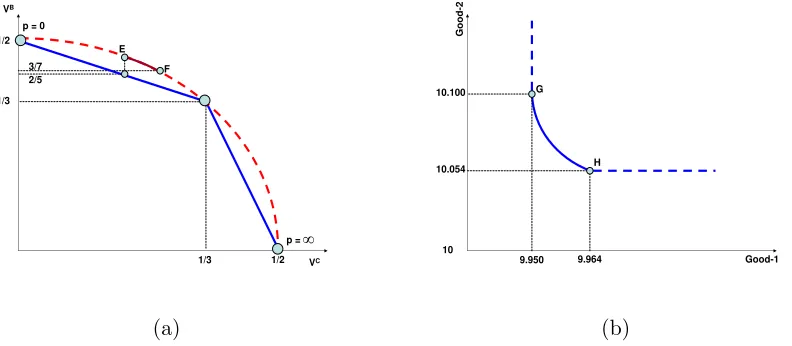
3 be the price ratio and{bi, ci} be the set of
customers for the intermediary trader ai is willing to offer. i= 1,2. See Figure 1(a). The
dash-curve is the utility frontier of the two customers in each intermediary, which is
ob-tained as the price ratio of the intermediary changes within the range of 12 ≤p≤ 23. when they are customers in the same intermediary, while the bold-curve is the utility frontier
obtainable by themselves.5
Notice that each type a trader receives the following bundle from intermediating with
price ratio 12 ≤p≤ 23 and customer set {b, c}:
10 + p(p−1)
(1 + 2p)(2 +p),10 +
1−p (1 + 2p)(2 +p)
(13)
The locus of these bundles is presented by theG−H curve in Figure 1(b).
We now demonstrate that the allocations achieved with the preceding range of price
ratios and intermediary structure are intermediation core allocations. Let C ⊆N be any coalition.
(i) C = {bi, cj}: The utility level of b in this coalition is at most equal to 25, which is
lower than 37, the utility level ofbat the candidate allocation.
(ii) C = {ai, b1, b2, cj}: In order to make both traders of type b strictly better off the
price ratio must be smaller than p. This will certainly make an trader type-c worse
5
This utility frontier when both of them are customers is represented byVb(p) =1−2Vc
2−3Vc, while the frontier
when both of them form an intermediary is represented byVb=1 2−
Vc
2 when 0≤p≤1, andV
b
= 1−2Vc
VB
VC p = 1/2
1/3
1/2 1/3
E p = 0
∞
F 2/5
3/7
Good-1 10.100
Good-2
10.054
10
G
H
9.950 9.964
(a) (b)
Figure 1: (a) A candidate allocation is on E−F arc, with 12 ≤p≤ 23. (b) An indifference curve of a trader type-a. The portion G−H corresponds to the consumption function of an intermediary typeA in (13) given that 12 ≤p≤ 23.
off. Hence, C cannot improve upon the candidate allocation. The similar argument
applies to coalitions: {a, b, c1, c2}, {a, b1, b2, c1, c2},{a1, a2, b1, b2, c1, c2},{b1, b2, c} or
{b, c1, c2}.
(iii) C = {ai, bj}: As Figure 1(b) shows, trader ai must receive at least 10.054 units of
good-2 (see the indifference curve of an ai in Figure 1(b)). This will leave bj with at
most 10−10.054 =−0.054, which is not feasible.
(iv) C ={a1, a2, bi}: To make bi better off, the net endowments left after satisfying bi is
at most20 +2+pp,20−2+1p. Hence, the maximum consumption level of good-2 for a type atrader is strictly less than 10.054. This implies that none of the type acan
be better off.
(v) C={a1, a2, bi, cj}: Suppose a1 is the intermediating trader. To induce one trader of
type b and one trader of type c, the proposed price must be 12 ≤p ≤ 2
3. See Figure
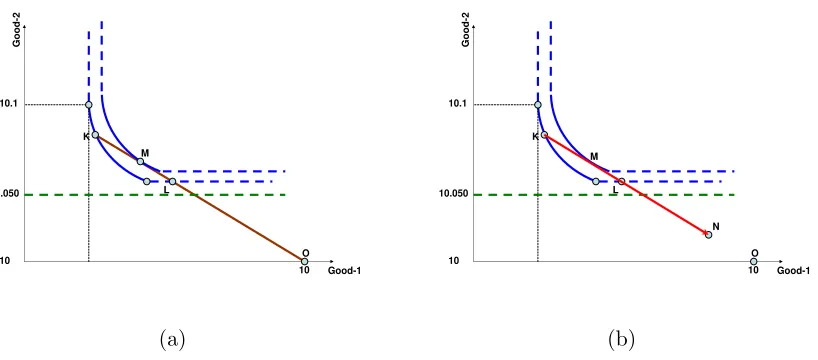
2(a)-2b. Let pointKin Figure 2(a) denote the net endowment of typeatraders after
[image:14.612.119.515.150.323.2]The customer type a will choose allocation M. To achieve such allocation, her
net-trade is given by segmentO-M. Consequently, the opposite trade position relative to
an allocationK will be the net trade of the intermediating trader (see Figure 2(b)).
Using a simple geometric argument, the segmentO-Mis always longer than segment
K-M. As a result, the consumption bundle of the intermediating trader (allocation
N) is always below the original indifference curve of a(shown in Figure 2(b)). This
implies that the intermediating trader is worse off. The similar argument applies to
cases wherebi orcj is the intermediating trader.
Good-1 10.1
10
Good-2
10
K
L 10.050
M
O
Good-1 10.1
10
Good-2
10
K
L 10.050
M
O N
(a) (b)
Figure 2: (a) The budget line and optimal consumption allocation for a customer type a.
(b) The final allocation of the intermediary typea.
References
Baumol, W., J. Panzar, and R. Willig (1982). Contestable Markets and the Theory of
Industrial Structure. Hartcourt Brace Javanovich, New York.
Boyd, J. and E. Prescott (1986). Financial Intermediary-Coalitions. Journal of Economic
[image:15.612.116.525.313.493.2]Boyd, J., E. Prescott, and B. Smith (1988). Organizations in economic analysis. Canadian
Journal of Economics, 477–491.
Debreu, G. (1952). A social equilibrium existence theorem. Proceedings of the National
Academy of Sciences of the United States of America 38(10), 886.
Mas-Colell, A. (1975). A model of equilibrium with differentiated commodities. Journal of
Mathematical Economics 2(2), 263–295.
Qin, C., L. Shapley, and K. Shimomura (2006). The Walras core of an economy and its
limit theorem. Journal of Mathematical Economics 42(2), 180–197.
Townsend, R. (1978). Intermediation with Costly Bilateral Exchange. Review of Economic
Studies 45(3), 417–425.
Townsend, R. M. (1983). Theories of intermediated structures. Carnegie-Rochester