© 2017, IRJET | Impact Factor value: 5.181 | ISO 9001:2008 Certified Journal | Page 2023
Comparative study of mono leaf spring for different materials
Using Solid work
Amit Kaimkuriya
1, Sanjay Singh
2, Yasir Baig
31
M.Tech Student, Department of Mechanical Engineering, Sagar Institutes of Science & Technology, (SISTec),
Bhopal, RGTU University, Bhopal, India
2
Associate Professor, Department of Mechanical Engineering, Sagar Institutes of Science & Technology, (SISTec),
Bhopal, RGTU University, Bhopal, India
3
Assistant Professor, Department of Mechanical Engineering, Sagar Institutes of Science & Technology, (SISTec),
Bhopal, RGTU University, Bhopal, India
---***---
Abstract- The main intention of introducing this thesis is to achieve the optimization of mono leaf spring by comparison of different material at constant load and same thickness. We use parameter for comparison are Stress, Strain, Displacement, Natural frequency and percentage of weight reduction and for analysis we use the FEM method and solid works software and finally find the which one ,material is better and satisfy all condition and give best result which is required. After analyzing mono leaf spring for all material the following result were observed. Maximum stress for Steel EN-45 121Mpa,E-Glass 122 Mpa ,Kevlar 121 Mpa and Carbon fiber 123 Mpa,. Maximum Strain for all material Steel EN-45 38.7,E-Glass 16.7 ,Kevlar 82.9 and Carbon fiber 36.3 ,. Maximum Displacement of all material Steel EN-45 8.36mm,E-Glass 3.72 mm ,Kevlar 1.74 mm and Carbon fiber8.00 mm ,Natural frequency in all case are Steel EN-45 67.4Hz,E-Glass 13.3 Hz ,Kevlar 15.9 Hz and Carbon fiber
15.2 Hz.
Key Words: Steel, Stress, Strain, Displacement, Natural frequency and percentage of weight reduction, FEM method and solid
works software.
1.
INTRODUCTIONAn automobile industry consists of number of parts and each part having some importance characteristics. Leaf spring is one of them and used for the suspension system. In 1901 Mors of pairs shock absorbers introduce in automobile for suspension. The main intention is to introduce suspension system to prevent higher shock vibration transformed to passenger. . The suspension system also uses to pickup stabilities of automobile and minimize jerk effect transfer to body and engine and suspension use to absorb impacts and dampers to control spring motion. Generally the nature of spring is to stored kinetic energy in the form of strain energy. Spring release this strain energy into environment without producing any kinds of effects. Mono leaf spring- Mono-leaf springs have one arc-formed steel strip that is thicker in the middle and thin on the ends. They are usually branded as low-rate thin leaf springs that work in locating rear ends. Basically, they substitute the Pan hard bars and trailing arms used in three and four links systems. Mono-leaf springs provide lesser spring rates that hold a vehicle up. They also offer lesser stiffness in terms of bending and controlling the axle wrap-up. A vehicle’s design should include extra leaf springs, third link, and lift bar system for added support in controlling accelerating forces that rotate the rear ends.
Applications of mono leaf spring
A number of manufactures have produced vehicles or concepts utilizing independent front or rear suspensions supported by transverse leaf springs that have an anti-roll effect.
Chevrolet Corvette
GM E platform cars: Eldorado, Tornado, Riviera, Regatta
Volvo XC90
Mercedes-Benz Sprinter vans
Indigo 3000, a Swedish made, low volume roadster
The Fiat 128, Ford cars.
Methodology- First selects the material after that Create the solid model then doing analysis of mono leaf spring.
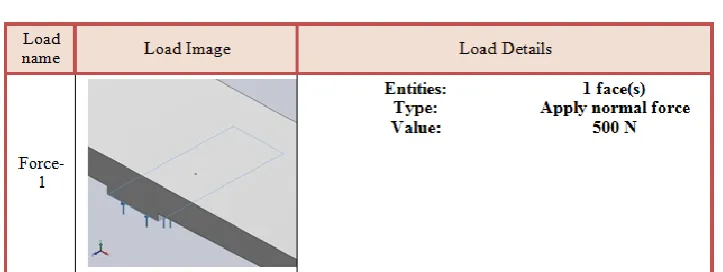
Boundary condition- Select the parameter for boundary condition by which we can resolve the Problem. One end is hinged and other end is free. On Second end in X-direction movement can be allows and in Y and Z direction movement doesn’t allow. Load is applied at mid of the mono leaf which is 500N.
© 2017, IRJET | Impact Factor value: 5.181 | ISO 9001:2008 Certified Journal | Page 2024
of these modeling schemes, the programmer can insert numerous algorithms (functions) which may make the system behave linearly or non-linearly. Linear systems are far less complex and generally do not take into account plastic deformation. Non- linear systems do account for plastic deformation, and many also are capable of testing a material all the way to fracture.Solid work -Solid Works is a solid modeler, which create models and assemblies. Parameters refer to constraints whose values determine the shape or geometry of the model or assembly. Parameters can be either numeric parameters, such as line lengths or circle diameters, or geometric parameters, such as tangent, parallel, concentric, horizontal or vertical, etc. Numeric parameters can be associated with each other through the use of relations, which allow them to capture design intent.
Result and Discussion
Result and discussion are based on parameter like Stress, Displacement, strain, natural frequency and weight reduction. For that four material are selected which are N-45, E-glass/Epoxy, Kevlar, and Carbon fiber. To develop and analysis of mono leaf spring solid work software is used. In which first prepared solid model and after that mesh model crated .And do analysis of mono leaf spring and compare all the parameter after analysis. Model for static analysis for all the material in which thickness is 10 mm and load is 500N.
Model Information
Figure 1
[image:2.595.128.474.495.797.2]Condition for design and analysis of mono leaf spring
© 2017, IRJET | Impact Factor value: 5.181 | ISO 9001:2008 Certified Journal | Page 2025
[image:3.595.117.479.110.246.2]Boundary condition for design and analysis of mono leaf spring
Table 2
[image:3.595.137.477.282.473.2]Mesh modal of mono leaf spring
Figure 2
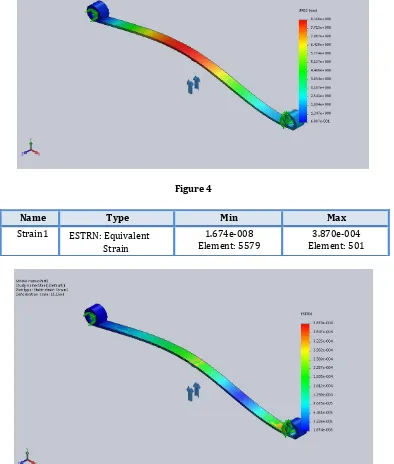
Static analysis shows that stress, deflection and strain for steel EN-45
Name Type Min Max
Stress1 VON: von Mises Stress 9.218e+002N/m^2 Node: 11923
1.219e+008N/m^2 Node: 454
[image:3.595.106.489.519.763.2]© 2017, IRJET | Impact Factor value: 5.181 | ISO 9001:2008 Certified Journal | Page 2026
Name Type Min Max
Displacement1 URES: Resultant Displacement
6.007e-001mm Node: 13317
[image:4.595.97.496.66.331.2]8.360e+000mm Node: 7855
Figure 4
Name Type Min Max
Strain1 ESTRN: Equivalent Strain
1.674e-008 Element: 5579
3.870e-004 Element: 501
Figure 5
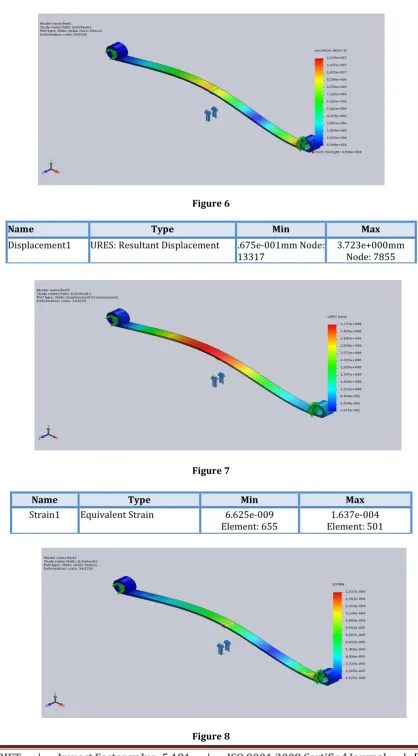
Static analysis shows that stress, deflection and strain for Epoxy
Name Type Min Max
Stress1 VON: von Mises Stress 8.944e+001N/m^2
[image:4.595.104.498.162.626.2]© 2017, IRJET | Impact Factor value: 5.181 | ISO 9001:2008 Certified Journal | Page 2027
Figure 6
Name Type Min Max
Displacement1 URES: Resultant Displacement 2.675e-001mm Node:
[image:5.595.86.505.57.814.2]13317 3.723e+000mm Node: 7855
Figure 7
Name Type Min Max
Strain1 ESTRN: Equivalent Strain 6.625e-009
Element: 655 Element: 501 1.637e-004
© 2017, IRJET | Impact Factor value: 5.181 | ISO 9001:2008 Certified Journal | Page 2028
Static analysis shows that stress, deflection and strain for Kevlar
Name Type Min Max
Stress1 VON: von Mises Stress 1.450e+003N/m^2
[image:6.595.92.498.102.656.2]Node: 221 1.219e+008N/m^2 Node: 454
Figure 9
Name Type Min Max
Displacement1 URES: Resultant Displacement 1.254e+000mm Node: 13317
1.745e+001mm Node: 7855
Figure 10
Name Type Min Max
Strain1 ESTRN: Equivalent Strain 3.638e-008
© 2017, IRJET | Impact Factor value: 5.181 | ISO 9001:2008 Certified Journal | Page 2029
Figure 11
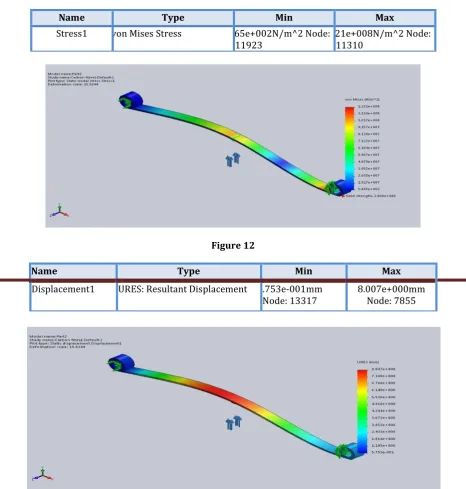
Static analysis shows that stress, deflection and strain for Carbon fiber
Name Type Min Max
Stress1 VON: von Mises Stress 5.665e+002N/m^2 Node:
[image:7.595.64.531.280.770.2]11923 1.221e+008N/m^2 Node: 11310
Figure 12
Name Type Min Max
Displacement1 URES: Resultant Displacement 5.753e-001mm
Node: 13317 8.007e+000mm Node: 7855
© 2017, IRJET | Impact Factor value: 5.181 | ISO 9001:2008 Certified Journal | Page 2030
Name Type Min Max
Strain1 ESTRN: Equivalent Strain 1.546e-008
[image:8.595.87.509.66.319.2]Element: 3118 3.633e-004 Element: 501
Figure 14
Boundary condition for natural frequency of mono leaf spring (Table 3)
© 2017, IRJET | Impact Factor value: 5.181 | ISO 9001:2008 Certified Journal | Page 2031
Figure 15
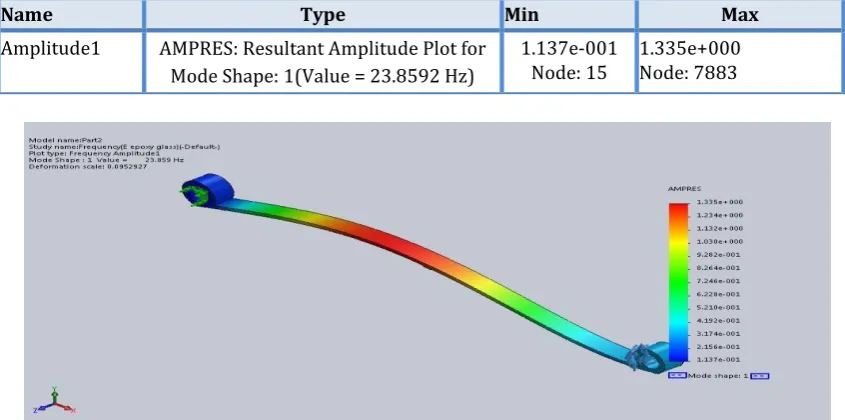
Natural frequency in Y-direction of Steel Epoxy
Name Type Min Max
Amplitude1 AMPRES: Resultant Amplitude Plot for Mode Shape: 1(Value = 23.8592 Hz)
1.137e-001
[image:9.595.77.515.265.759.2]Node: 15 1.335e+000 Node: 7883
Figure 16
Name Type Min Max
Amplitude1 AMPRES: Resultant Amplitude Plot for Mode
Shape: 1(Value = 41.632Hz) 1.360e-001 Node: 15 1.596e+000 Node: 7883
[image:9.595.87.510.282.492.2]© 2017, IRJET | Impact Factor value: 5.181 | ISO 9001:2008 Certified Journal | Page 2032
Natural frequency in Y-direction of Carbon fiber
Name Type Min Max
[image:10.595.86.515.89.357.2]Amplitude1 AMPRES: Resultant Amplitude Plot 1.297e-001 1.522e+000 for Mode Shape: 1(Value =58.6322Hz) Node: 15 Node: 7883
Figure 18
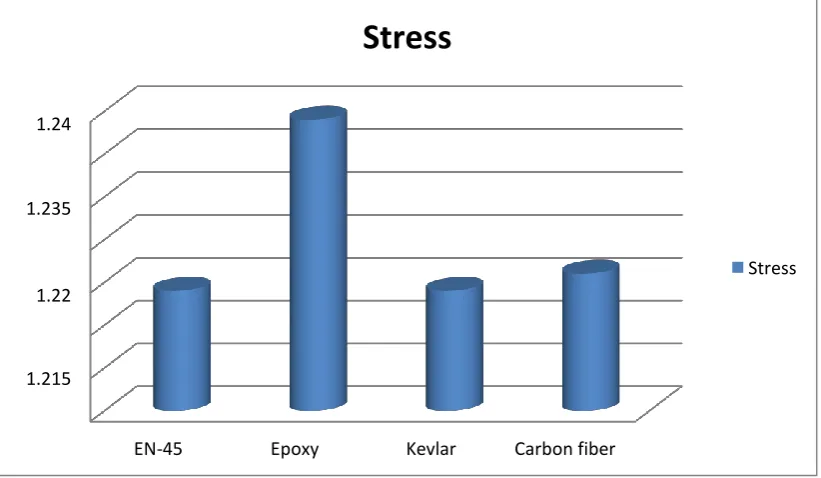
Graph- Graph show stress variation of all material with respect to constant load
Figure 19
Stress
1.24
1.235
1.23
1.225
Stress 1.22
1.215
1.21
1.205
[image:10.595.102.513.423.662.2]© 2017, IRJET | Impact Factor value: 5.181 | ISO 9001:2008 Certified Journal | Page 2033
[image:11.595.90.508.93.288.2]Graph show Displacement variation of all material with respect to constant load
Figure 20
[image:11.595.81.505.342.545.2]Graph show strain variation of all material with respect to constant load
Figure 21
Graph show Natural frequency variation of all material with respect to constant load
Figure 22
Displacement
9 8 7 6 5 4 3 2 1 0 DisplacementEN-45 Epoxy Kevlar Carbon fiber
Strain
9 8 7 6 5 4 3 2 1 0 StrainEN-45 Epoxy Kevlar Carbon fiber
Natural frequency
7 6 5 4 3 2 1 Natural frequency 0 [image:11.595.77.511.591.773.2]© 2017, IRJET | Impact Factor value: 5.181 | ISO 9001:2008 Certified Journal | Page 2034
[image:12.595.77.516.97.357.2]Graph show % of weight reduction of all material with respect to constant load
Figure 23
[image:12.595.104.495.361.446.2]Table shows comparison of all parameter
Table 4
Material Stress Displacement Strain Natural frequency % of Weight reduction
EN-45 1.219 8.36 3.87 6.743
Epoxy 1.239 3.723 1.673 1.335 74
Kevlar 1.219 1.745 8.293 1.596 82
Carbon fiber 1.221 8.007 3.633 1.522 80
[image:12.595.74.539.487.662.2]Graph shows stress, displacement, strain, and natural frequency variation of all material with respect to constant load
Figure 24
Conclusion
It was developed that after analysis the stress of E- Glass 1.64% , Kevlar stress no change and Carbon fiber stress 0.164% increased with respect to Steel (EN-45).We saw in our study that the displacement of E-Glass 55.4%, Kevlar 79.12% and Carbon fiber 4.22% decreases when was compare to Steel (EN-45).We also noted that the strain also decreased in E-Glass 57.70%,in Kevlar 114.28%,and carbon fiber 6.12% when was compare to Steel (EN-45).We also see in our study that natural frequency decreased for E-Glass 80.20%,Kevalar 76.33% and Carbon fiber 77.42% when was compare to Steel (EN-45).We have observed that the weight reduction was 74.59% of E-Glass, 82.23% of Kevlar, and in case of carbon fiber 80.46% when was compare to Steel (EN-45).From the analysis, it is observe that Carbon fiber material provides better stress because few change, and
% of weight reduction
90 80 70 60 50 40 30 20 10 0
% ow weight reuction
EN-45 Epoxy Kevlar Carbon fiber
10 8 6 4 2 0 EN-45 Epoxy Kevlar
Stress Carbon fiber
Displacement Strain
Natural
© 2017, IRJET | Impact Factor value: 5.181 | ISO 9001:2008 Certified Journal | Page 2035
Displacement is near to Steel which is required to design, Strain also be few decreased, Natural frequency decreased more but it was not give any problem to satisfy load or bearing load because resonance condition was not occur, percentage of weight reduction was more in E-Glass but other parameter was not good for design mono leaf spring so that weight reduction of carbon fiber was also be bête then other material. So we can say that the carbon fiber is better to design a mono leaf spring comparatively other martial basis stress which is under failure, Strain is less than other material and deflection is more as comparatively other composite material and it is comfortable for passengers and weight reduction is also better than other material.Future scope
The above mentioned analysis can b also behave following future work. In place of mono leaf spring multi leaf spring can b used. Material can be changed for design of leaf. Take the different thickness and load also be change or gradually apply. Parameter for comparison can be take other.
References:
1. RoselitaFragoudakis,GeorgiosSavaidis, NikolaosMichailidis. Optimizing the development and manufacturing of 56SiCr7 leaf spring International Volume, October 2017, KrishanKumar, M.L.Aggarwal. Optimization of Various Design Parameters for EN45A Flat Leaf Spring Volume, 2017.
2. AlexanderSavaidis,MichailMalikoutsakis,GeorgiosSavaidis,,ChristophErtelt,FranzSchwaiger .Design, analysis and multi-disciplinary optimization of high-performance front leaf springs Theoretical Volume, June 2016
3. SushilB.Chopade1, Prof.K.M.Narkar2, Pratik K Satav3 Design and Analysis of E-Glass/Epoxy Composite Monoleaf Spring for Light Vehicle ijsret 2016.
4. Mahmut Duruş, Levent Kırkayak, Aykut Ceyhan Fatigue Life Prediction of Z Type Leaf Spring and New Approach to Verification Method Procedia EngineeringVolume 101, 2015.
5. Krishan Kumar, M. L. Aggarwal.Finite element analysis and optimization of a mono parabolic leaf spring using CAE software ISSN 2291-8752 (Online) - ISSN 2291-8744 Volume 3 Issue 2 pp. 85-92 , 2015.
BIOGRAPHIES
AMIT KAIMKURIYA has Pursuing M.Tech degree from Sagar Institutes of Science & Technology, (SISTec), and Bhopal in the Department of Mechanical Engineering.
“Sanjay Singh has pursuing PhD from MANIT Bhopal in the Department of Mechanical Engineering. He received M.Tech (Design & Production of Hydro Electric Equipment) degree from MANIT Bhopal in the year 2003 while he completed BE in the year 1999. He has many publications in international journals and international conference. At present he is Associate Professor, in Department of Mechanical Engineering, Sagar Institutes of Science & Technology, (SISTec), Bhopal, and RGTU University Bhopal, India.