© 2017, IRJET | Impact Factor value: 5.181 | ISO 9001:2008 Certified Journal
| Page 1952
GRID SIDE SYNCHRONIZING BY USING
PLC PROGRAMMING AND MATLAB SIMULINK ANALYSIS
MALOTH HUSSEN
1, JARAPALA SIVA NAIK
21
Assistant Professor, Dept.of.EEE, Noble College of Engineering & Technology for Women (NETW)
2Assistant Professor, Dept.of.EEE, Noble College of Engineering & Technology for Women (NETW)
---***---
Abstract
- This
project paper is of Thermal power plants controlling by plc ladder logic and synchronizing of different units of a plant . Thermal power plant consist of many important equipment such as boiler ,coal conveyer belt ,ash handling plant ,cooling system etc which are required for the generation of power. These equipment requires continuous inspection and monitoring .this paper outlines the automation of boiler &coal conveyer Automation leads to greater efficiency &reliability .The automation is achieved by using PLC .Analysis of thermal power plant is achieved with help of MATLAB simulation. Different sensors are used for measuring the temperature of boiler, coal input and turbine action for generation, these sensors sent required data by continuous monitoring to plc controlling program. In this project we outlining ease of controlling and synchronizing the thermal plant by ladder logic programming using plc for a plant and power analyzing of different unit of plant by using mat lab simulation.Key words: Programmable Logic Controller (PLC)
1,ladder logic diagram2 ,Power Plant3, mat lab simulation4,Control room5 etc..
1. INTRODUCTION:
At initial stages of powergeneration and its distribution to consumers is very complex and required of continuous attention of men and their role is very crucial .though under the supervision of once the chance of making mistakes in various sector is quite observable. In order to make the work getting done in perfect and safe environment we need some devices jointly with technology, where getting job done with ease[1].
so considering running of a thermal plant under superior supervision such it eliminate the faulty condition in generation and protects the equipment such that boiler, coal conveyor ,ash handling ,generated steam handling, synchronizing of different units ,by using of Programmable Logic Controller (PLC) with ladder logic diagram. and also analyzing the amount of power that has been being generated ,delivered to load from feeders.
Now a days, it has become a necessity to maintain synchronism because the system is expanding day-by-day and these results in installation of larger machines so in this project we are making synchronism of different units of plant taking NTTPS as example with plc.
1.1 OBJECTIVE:
In order provide continuous supply ofpower to the load centers and making to find the fault and clearing it in low time so that it can establish continuous supply. mainly securing the quality of supply , by removing the causes of discontinuity by plc ladder logic and establishing the much more sophisticated synchronization . Analyzing power being used through mat lab simulation.
1.2 What is PLC?
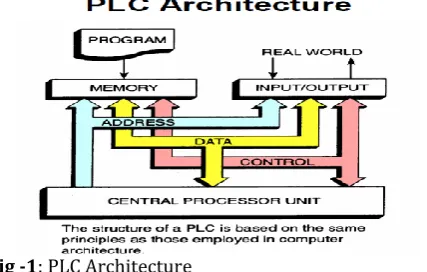
PLC is Programmable Logic Controller PLC is a software that acts as a controlling mediator or treated as signaling acting between the field and scada. SCADA (Supervisory Control and Data Acquisition) applications are created as a main tool for performing management.
1.3 NEED FOR PLC:
Hardwired panels were very time consuming to wire , debug and change. developed to offer the same functionality as the existing relay logic systems. programmable, reusable, reliable. could with stand harsh
[image:1.595.322.536.601.737.2]© 2017, IRJET | Impact Factor value: 5.181 | ISO 9001:2008 Certified Journal
| Page 1953
Fig -2: Types of switches1.4 AND OPERATION
A
B
C
0
0
0
0
1
0
1
0
0
1
1
1
Chart -1: And operation
A and B are switches C -OUTPUT
output comes when A and B are 1
1.5 OR OPERATION:
A
B
C
0
0
0
0
1
1
1
0
1
1
1
1
Chart -2: OR operation
OUTPUT C comes or glows for 1 for A or
1.6
NOT OPERATION:
A
C
0
1
1
0
Chart -3: Not operation
so initially at switch on .
2. EQUIPMENT THAT ARE NEEDED TO
CONTROL OR AUTOMATION
:
1)coal conveyor 2)boiler
3) turbine action 4) supply to load
2.1 COAL CONVEYOR AUTOMATION:
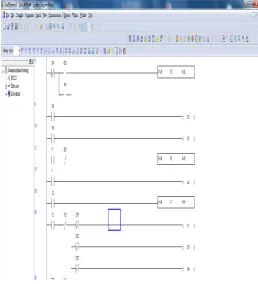
coal is fed as input to the thermal plants. there will be continuous need of coal for giving temperature to boiler for steam production. the needed coal is conveyed to combustion chamber through conveyor belts . the coal is monitored through IR sensor, proximity sensor, humidity sensor and temperature sensor in the operation of Siemens PLC.**ladder logic for automation coal with time constant to reach the combustion chamber.
Fig -3: Indication for coal input fed
2.2
AUTOMATION OF BOILER:
In boiler we need continuous monitoring of water level and temperature. Here monitoring with sensors is very much advantages because monitoring of temperature continuously manual is dangerous due to high
[image:2.595.35.551.45.776.2]© 2017, IRJET | Impact Factor value: 5.181 | ISO 9001:2008 Certified Journal
| Page 1954
ladder logic for automation of boiler with time constantfor generation of steam signal of coal is fed time steam generation.
.
Fig -4: indication of steam is ready
2.3 AUTOMATION TURBINE WORKING:
As above ladder gives signal output as steam is generated. That steam ready for flowing on to turbine blades .mostly different types of turbines are used depending on steam flow. This turbine shaft is coupled to generator. The generator can supply power at synchronous speed. to get into synchronous speed some time is required for the generator. The below is implementation of ladder logic.
Fig -5: ladder logic for generation automation with time constant time required for getting into synchronous speed.
2.4 SUPPLY TO LOAD:
Power that has beengenerated at synchronous is now supplied to load centers with normally closed switches in ladder logic .through with these normally closed switches one can easily disconnect load from feeder during servicing or at faulty operation. the below logic diagram shows the connection of feeder to load centers[2].
Fig -5: ladder logic diagram for connection from feeder to load feeder circuit breakers load centers
3. LADDER LOGIC DIAGRAM OF SINGLE UNIT
(NTTPS) USING PLC.
Fig -6: complete unit circuit control using plc
[image:3.595.314.551.101.259.2] [image:3.595.37.276.145.324.2] [image:3.595.316.575.332.617.2] [image:3.595.37.271.475.638.2]© 2017, IRJET | Impact Factor value: 5.181 | ISO 9001:2008 Certified Journal
| Page 1955
from fig1 we controlled unit by each equipment [image:4.595.312.560.59.408.2]protection. it has been simple mode of circuit that show the unit operation safely having ease of control towards generation.
Fig -6.1:
ladder logic diagram total nttps units
implementation:
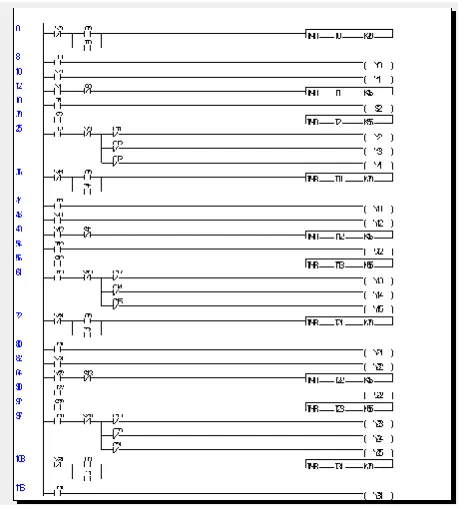
In above ladder logic circuit diagram of 8 units we made controlling at each where equipment for its safe
operation and we also synchronized those eight units for good load scheduling[4].
[image:4.595.38.271.162.417.2]figure is showing successful load scheduling of units with two of units are in shut down condition generating the power required by the load centers.
Fig -6.2:
ladder logic diagram total nttps units
implementation
[image:4.595.316.509.456.680.2]© 2017, IRJET | Impact Factor value: 5.181 | ISO 9001:2008 Certified Journal
| Page 1956
Fig -7: logic of eight units synchronizing circuit in plc [image:5.595.313.565.119.381.2]software.
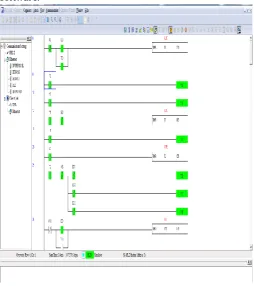
Fig -8: output result of a single unit in plc software
Fig -9: output result of a All unit in plc software
4. MATLAB ANALYSIS& SIMULATION:
[image:5.595.36.291.387.674.2]© 2017, IRJET | Impact Factor value: 5.181 | ISO 9001:2008 Certified Journal
| Page 1957
Fig -8: eight units of Narla Thatharao Thermal PowerStation (NTTPS).
[image:6.595.314.573.51.374.2]From the figure first six units of 210mw have been synchronized sticking to the basic laws of synchronism. Remaining two are 500mw and 800 mw they are shown of supplying to industrial purpose. With both of them are synchronized.
[image:6.595.38.278.87.369.2]Fig -10:VOLTAGE and CURRENT of 500 mw unit
Fig -11:result of total real and reactive power taken by load centers
[image:6.595.319.572.421.662.2] [image:6.595.37.270.498.727.2]© 2017, IRJET | Impact Factor value: 5.181 | ISO 9001:2008 Certified Journal
| Page 1958
5. FUTURE SCOPE:
For further advancement of project, the project can be implemented more efficiently by integrating both matlab and plc .With this the controlling is made more reliable And security of the plant has been increased being more advantageous to the plant operator.
The plant operator can control more easily from any place any time with online view by using ETHERNET connection. And with further advanced the plant can be more efficiently viewed in scada implementation for plant integrating with plc and matlab combination .where one can observe plant working easily and safely.
6. CONCLUSION:
In this Paper ,we obtainted continuity of power supply with low time of clearing of disturbances, further clearing of fault with ease by programming it plant operation in plc implementation and analyzing through mat lab simulation. Finally it all made the operation and control of plant with in safe region of operation by using plc software and math works.
REFERENCES:
[1] Petruzella, F. D., Programmable Logic Controllers, McGraw Hill, 2005
[2] Johnson, C. D., Process Control Instrumentation Technology, Prentice Hall, 2006
[3] Hassapis, G., “An interactive electronic book
approach for teaching computer
implementation of industrial control systems”, IEEE Transaction on Education, Vol. 46, pp. 177 – 184, Feb. 2003
[4] Kamen, E. W., Gazarik, M. J., “A course in industrial controls and manufacturing for EE students and other engineering majors”, Proceeding of the 1997 American Control Conference, Vol. 5, pp. 3160 – 3165, June 1997 [5] Anderson, J. C., “Design a flexible industrial
controls lab module”, 32nd Annual Frontiers in Education, Vol. 1, pp. 17 – 22, Nov 2002
[6] Saygin, C., Kahraman, F., “A Web-based
programmable logic controller laboratory for
manufacturing engineering education”, The
International Journal of Advanced Manufacturing Technology, Vol. 24, No. 7-8, pp. 590-298.
BIOGRAPHIES:
MALOTH HUSSEN is an Asst. professor in noble college of engineering and technology for women (JNTUH) within the University of Hyderabad, Telangana. is completed his
B,Tech in electrical and electronic
engineering in JNTUH. He is currently doing M.Tech in JNTUH. His research interests include the areas of PLC and SCADA