© 2017, IRJET | Impact Factor value: 5.181 | ISO 9001:2008 Certified Journal | Page 3190
Tribological Investigation and Development of Tin Based Babbit
Composite Material
Rajkumar S. Gujar
1, Dr. R.R. Navthar
21
PG Scholar, Dept. of Mechanical Engineering, D.V.V.P. college of Engineering,
Ahmednagar, Maharashtra, India.
2
Professor, Dept. of Mechanical Engineering, D.V.V.P. college of Engineering,
Ahmednagar, Maharashtra, India.
---***---Abstract -
In this research work the stir casting method isused to fabricate babbit metal matrix composite by reinforcing silicon carbide with 2%, 4%, 6% respectively. Wear test was conducted at ambient temperature by using lubricating oil. Pin on disc apparatus was used to conduct wear test by considering different affecting parameters i.e. Normal load, sliding velocity, sliding distance. The specimen pins of composite materials were tested against EN8 disc. Result of wear test is studied and compared with existing babbit. The babbit+2% SiC composite possesses minimum wear rate. The microstructure of composite material after conducting wear test is studied by using Scanning Electron Microscopy. By addition of 2% SiC in Babbit alloy, microstructure get refined which leads to increase in wear resistance. From this study it is concluded that wear resistance is increases by addition 2% silicon carbide as compared to the existing babbit alloy and other composition of material.
Key Words: Wear test, B83 Babbit, Pin on Disc, Composite material, Scanning Electron microscopy, Tribology, Metal matrix composites
1. INTRODUCTION
The metal matrix composite (MMC) is generally an alloy, not a pure metal. A metal matrix composite is a composite material in which at least two constituent materials, one being a metal. The other material may be a different metal or another material, such as a ceramic material i.e. silicon carbide. The necessity of composite materials has increased, due to the improved physical and mechanical properties. A composite material is a material consisting of two or more physically or chemically distinct phases. The composite generally has good characteristics than those of each of the individual components. The reinforcing component is distributed in the matrix material. Russian grade B83 Babbit is the most popular material for fabrication of journal bearings in Russian engineering. B83 babbit has best bearing material properties such as rapid conformability, good thermal conductivity, high impact viscosity, and compatibility with lubricating oil. However, low fatigue strength and moderate wear resistance decrease the operating life Babbit bearings. Currently, alloys of the Sn–Sb-Cu are widely used as the material for sliding bearings that
operate in oil i.e. bearings used in sugar industry. They are also applied in hydroelectric power plants to support hydraulic turbines and electric generators. A bearing operates in the steady mode when a lubricating film of a required thickness is formed and retained between the shaft and the bearing. However, under inadmissibly heavy loads and at high velocities of the rotation of the shaft, damage to the bearing often occurs, especially if no oil film of a sufficient thickness appears between the shaft and the bearing. Under these conditions, the shaft and the bearing lining made from a babbit metal can come into partial contact in the course of sliding friction.
2. LITERATURE REVIEW
I.E. Kalashnikov, L.K. Bolotova, P.A. Bykov, L.I. Kobeleva, I.V. Katin, R.S. Mikheev, and N.V. Kobernik has developed the fabrication method to B83 babbit using powder metallurgy. The result of resesrch is that structure of the matrix B83 alloy is dispersed and microstructure is changed. [1]
D. Venkata rao, M. V. S. Babu, K. Santa rao and P. Govinda rao has experimentally investigated the mechanical behaviour of tin alloy based particulate metal matrix composites. In the present work, Tin alloy based particulate Metal Matrix Composite (MMC) with SiC as reinforcements were prepared. Stir casting was used for fabrication of composite material. Mechanical properties of composite are checked by conducting tensile test and hardness test. [3]
Bhaskar Chandra Kandpal, Jatinder Kumar, Hari Singh has reviewed on challenges in manufacturing of metal matrix composites by using stir casting method. The quality of components manufactured by casting can be improved by controlling various parameters of stir casting process which is stirring temperature, stirring speed, stirring time, preheating time, selection of matrix and reinforcements. [8]
© 2017, IRJET | Impact Factor value: 5.181 | ISO 9001:2008 Certified Journal | Page 3191 phase. The wear resistance is increased by producing babbit
by liquid forging method. [10]
A. Kh. Valeeva, I. Sh. Valeev, R. F. Fazlyakhmetov, and A. I. Pshenichnyuk have experimentally investigated on the Running in during Wear Tests of a Babbit. Wear mechanism at the running in stage of B83, which is reduced to the spalling off of coarse particles of the intermetallic β phase, pressing in of the cleaved particles into the soft plastic matrix, and the formation of a fairly homogeneous coating uniformly paved by small, hard particles [16]
3. PROBLEM STATEMENT
The boiler feed pump must be reliable and it can operate for desired life period without failure. Bearing failure due to excessive wear is one of the important reasons for failures of boiler feed pump. In sugar industry failure of feed pump can stop subsequent operations which lead to heavy financial loss. To ensure the desired life of bearing element it must posses low friction coefficient, high wear resistance, good fatigue strength considering varying loads, rapid conformability, good thermal conductivity, high impact viscosity, and compatibility with oils. The single base material not possesses all this good operating properties, so the properties of base material can be improved by addition with ceramic particles. This problem can eliminate by reinforcing metal matrix composites by silicon carbide particles which can improve the base material in terms of wear resistance, damping properties and mechanical strength.
3.1 Objectives
The main purpose in accomplishing of this project is: 1. To conduct wear test on B83 Babbit and B83
Babbit-SiC composite materials of different compositions at varying loads and sliding speeds. 2. To Study tribological properties of babbit and there
composite materials of different compositions to select best composite material for boiler feed pump bearing on the basis of wear.
3.2
Scope of work
Babbit alloy is used as bearing lining material in boiler feed pump bearing. Babbit material has low fatigue strength and moderate wear resistance at alternating loads which lead to decrease in operating life of bearings made of it. This can be overcome by reinforcing silicon carbide in to babbit alloy. The introduction of Silicon Carbide particles into a matrix alloy can increase the the wear resistance ability of composite materials. The scope of this project work is fabricate composite material by reinforcing 2%, 4% and 6% silicon carbide respectively in to babbit alloy to study its wear behaviour at different loading conditions and find new composite material for boiler feed pump bearing. Also to
study the microstructure of composite material as it affects the wear rate.
4. EXPERIMENTATION
4.1 Fabrication of Composite Material
[image:2.595.339.531.609.736.2]The fabrication of composite material by using stir casting is done in Advance material Laboratory of Mechanical Engineering Department at Dr. Vitthalrao vikhe patil college of Engineering, Ahmednagar. Stir casting method of composite materials fabrication is used for fabrication of composite material, in which silicon carbide is mixed with a molten babbit metal matrix by using mechanical stirring. Stir casting process has been used to fabricate the Babbitt metal and silicon carbide composites. An electric furnace was used for melting the Babbitt alloy in casting furnace. The melting of Babbitt takes place at 240°C. Initially 500°C temperature is set and which is to be achieved in 60 minutes. After achieving the 500°C temperature furnace is kept on constant temperature of 500° for 30 minutes. Preheated SiC particles were added in molten metal through funnel. Silicon carbide particles were preheated and added 2%, 4% and 6% by weight in melted Babbitt to form different compositions. Graphite stirrer was used for stirring purpose which mixes the molten solution of composite for proper mixing. After SiC addition, the liquid metal-reinforcements mixture was stirred for 30 minutes.
Table No. 1. Composition of Babbit Composite Materials
Sr. No Materials % of Silicon Carbide
1 Material- 1 0
2 Material- 2 2
3 Material-3 4
4 Material-4 6
Finally composites were poured in preheated metal moulds at 500°C. The melt was allowed to solidify in the mould.
© 2017, IRJET | Impact Factor value: 5.181 | ISO 9001:2008 Certified Journal | Page 3192 The prepared specimen sample was ready for processing; it
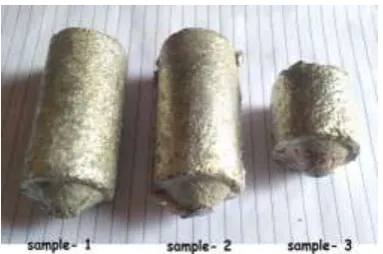
is to be machined on lathe after cutting on power hack saw. The sample turned on lathe to get required dimensions and finishing. The required dimension of Ø10×30 mm is obtained on lathe. In this way the specimen of different compositions were ready for wear test. The counterpart is selected with consideration of application i.e. centrifugal pump.
Figure No. 2. Specimen pin for wear test
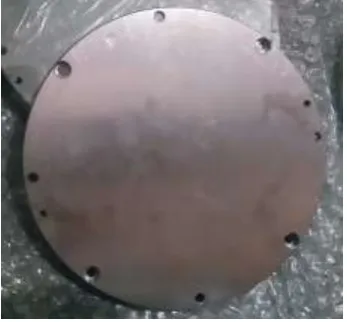
[image:3.595.61.262.192.305.2]Generally the outer race of journal bearing is made up of stainless steel and grey cast iron. So counterpart i.e. shaft material is also selected as made up of same material. Disc material selected as steel with grade EN8. The main aim of selection of counter surface of EN8 is, generally the rotating shaft inside the pump are used of EN8 grade.
Figure No. 3. EN8 Disc
4.2 Wear Test
The prepared samples were used for tribological test on Wear and friction monitor at PG Laboratory, Department of Mechanical Engineering in Dr. Vitthalrao vikhe patil college of Engineering, Ahmednagar. The pin on disc is an apparatus used to determine Tribological properties of composite materials. The composite material sample pin is placed on a rotating disc which rotating at a variable RPM. The basic aim of the wear test to minimize the wear rate of existing bearing material of boiler feed pump. The specimen pin 10 mm diameter and 30 mm long was run against the disc of grade EN-8. The sliding velocity is calculated by pump motor rpm and shaft diameter
Figure No. 4. Pin on Disc Apparatus (TR20PHM400
After that the track diameter of disc is taken from 140 mm to 80 mm. according to track diameter the speed for each track diameter is calculated. The wear test is conducted at wet conditions by using lubricating oil of SAE 20W40 oil.
The Normal load for wear test is 49.05N, 68.67N and 88.26N is selected. Before conducting wear test on pin-on disc apparatus, some calculations were done. The sliding velocity (Vs) is calculated from equation V= π × D× N / 60. The Shaft
[image:3.595.75.249.403.564.2]diameter and Speed is taken as 50 mm and 2900 rpm respectively from pump specification data. The respective speed corresponding to Track diameter is calculated by above equation. The test was conducted at Wet condition by using SAE 20W40 lubricating oil. The wear test was conducted on each specimen samples by varying load of 49.05 N, 68.67 N & 88.29 N. The track diameter is set before starting the test. At each loading conditions the Wear Vs Time and Temperature Vs Time graph is generated, these graphs are used for result and its analysis.
Table No. 2 - Operating parameters
Sliding velocity(mm/sec) 7592.18
Normal Loads(N) 49.05 to 88.29
Test Duration (Sec) 900
RPM 1035-1812
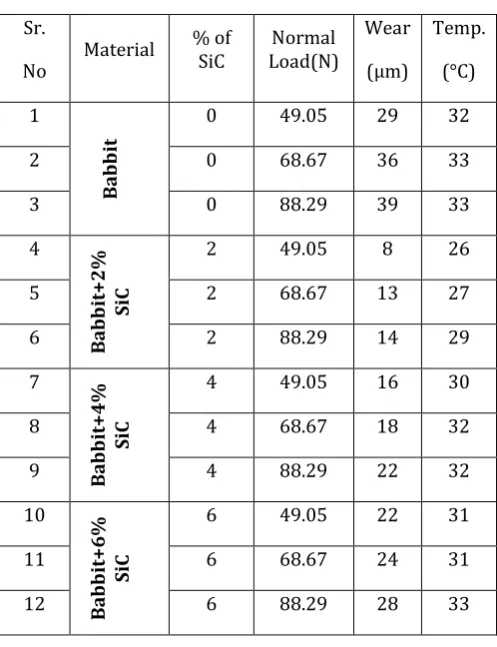
© 2017, IRJET | Impact Factor value: 5.181 | ISO 9001:2008 Certified Journal | Page 3193 Table No. 3 Observation table of wear test
5. RESULTS & DISCUSSIONS
After conduction of were test on pin-on disc apparatus for different loading conditions, The Wear vs. Time and Temperature vs. Time graph is generated. This graph is used for comparison of different composition at same load. This comparison graph is used to analysis of wear rate of different compositions. For all the four materials, the wear was compared by considering effect of the affecting parameters i.e. Normal Load and Temperature.
5.1 Wear vs. Time
(a)
(b)
(c)
Figure No. 5. Wear vs. Time at (a) 49.05N (b) 68.67N & (c) 88.29N Load
Graph obtained from wear test is compared by considering affecting parameters i.e. Normal load, % of silicon carbide in babbit and sliding speed for all four material compositions. The Wear vs. Temperature graph plot at different loading condition. Highest wear was observed in babbit for all loading conditions. At 88.26 N the babbit shows highest wear which is also highest comparing to all materials. Silicon carbide shows minimum wear for all loading conditions. The minimum wear observed is 8 micrometer at 49.05 Normal load. The Babbit+4% SiC shows highest wear than Babbit+4% SiC but which is low as compare to Babbit+6% SiC and Babbit for all normal loads. The nature of increasing wear is almost linear except 88.29 N load. At 88.29 N load the wear plot vs. Time instances shows peak and drop of wear. From above Wear vs. Time plot it is seen that Babbit+2% SiC material composition possesses minimum wear compared to other all other material. The wear rate is increases with increasing silicon carbide percentage in material composition.
Sr.
No Material
% of
SiC Load(N) Normal
Wear
(μm)
Temp.
(°C)
1
Ba
bb
it
0 49.05 29 32
2 0 68.67 36 33
3 0 88.29 39 33
4
Ba
bb
it
+
2%
SiC
2 49.05 8 26
5 2 68.67 13 27
6 2 88.29 14 29
7
Ba
bb
it
+
4%
SiC
4 49.05 16 30
8 4 68.67 18 32
9 4 88.29 22 32
10
Ba
bb
it
+
6%
SiC
6 49.05 22 31
11 6 68.67 24 31
[image:4.595.31.280.122.446.2]© 2017, IRJET | Impact Factor value: 5.181 | ISO 9001:2008 Certified Journal | Page 3194
5.2 Wear vs. Normal Load
Figure No. 6. Wear vs. Normal Load
The Wear vs. Normal load plot is shown in Figure No. 6. The wear is increased with increase in normal load. The Babbit material shows highest wear at all normal loads. The minimum wear is observed in Babbit+2% SiC composite material.
5.3 Wear vs. Pin Temperature
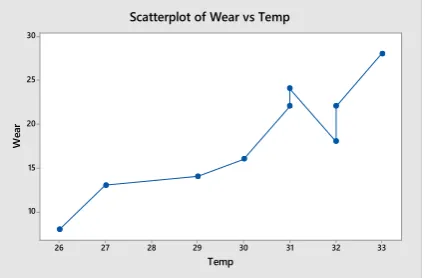
The plot of Wear vs. Pin temperature is shown in Figure No. 7. From graph it is observed that pin temperature is increases with increase in wear of material. Lowest temperature is 26 °C and the highest temperature observed is 33 °C
33 32 31 30 29 28 27 26 30
25
20
15
10
Temp
W
ea
r
Scatterplot of Wear vs Temp
Figure No. 7. Wear vs. Pin Temperature
5.4 Wear vs. Sliding distance
The plot of wear vs. sliding distance is shown in Figure No. 8. For 900 Second test duration the average sliding distance is 6830 m. Babbit alloy has highest wear and babbit+2% SiC has minimum wear considering sliding distance. The wear rate is increases with increase in silicon carbide percentage for all normal load conditions. The wear is increasing linearly in case of Babbit and Babbit+6% SiC. In case of
[image:5.595.308.562.145.284.2]Babbit+4% SiC and Babbit+2% SiC this relationship is not linear with sliding distance, there is drop in wear at 4000m sliding distance.
Figure No. 8. Wear vs. Sliding distance
5.5 Pin Temperature vs. Sliding distance
Figure No. 9. Wear vs. Pin Temperature
From comparison plot it is observed that Babbit possesses highest pin temperature considering average sliding distance of 6830 m. Babbit+6% SiC material is below that of babbit. The Babbit+2% SiC possesses minimum pin temperature among all materials by considering 49.05N, 68.68N and 88.29 N normal load.
6. SCANNING ELECTRON MICROSCOPY
[image:5.595.307.567.334.500.2] [image:5.595.56.269.489.628.2]© 2017, IRJET | Impact Factor value: 5.181 | ISO 9001:2008 Certified Journal | Page 3195 Figure No. 10. Prepared samples for SEM
6.1 SEM Images of Babbit Alloy
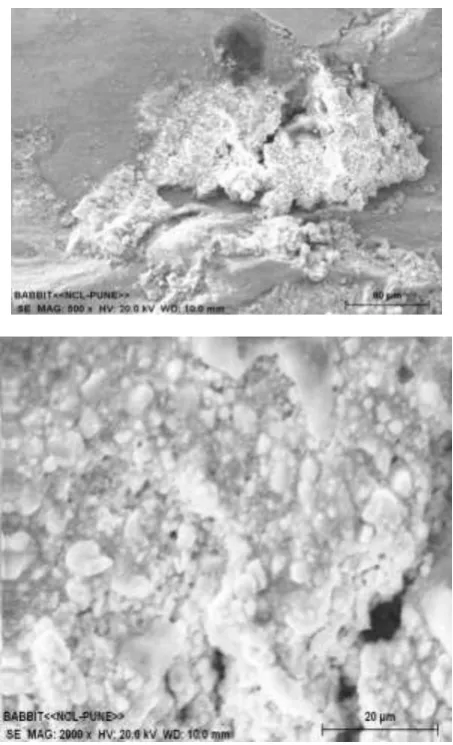
From SEM analysis of babbit alloy it is seen that larger β-phase β-phase of the Sn-Sb compound. The structure is heterogeneous which creates stress concentrations in the material which leads to increase in wear rate.
6.2 SEM Images of Babbit+ 2% SiC Composite
Material
The SEM analysis for Babbit+2% SiC is shown in above Figures. From wear test it is clear that the wear is minimum in Babbit+2% SiC. Due to refinement of microstructure of Babbit+2% SiC the stress concentration is less which leads to high wear resistance and improved fatigue strength.
© 2017, IRJET | Impact Factor value: 5.181 | ISO 9001:2008 Certified Journal | Page 3196
6.4 SEM Images of Babbit+ 6% SiC Composite
Material
As we know that the hardness of babbit is increases with increase in percentage of silicon carbide. There is improvement in microstructure compare to existing babbit alloy. From SEM analysis test it is clear that there is refinement in microstructure of Babbit+2% SiC material composition which lead to lower wear rate.
7. CONCLUSIONS
The wear test is conducted on babbit & there composites material at different normal loads and sliding speeds, from wear test it is concluded that the wear increases with increase in Normal loads and pin temperature.
From wear test it is concluded that Wear is Minimum in Babbit+ 2 % silicon carbide composite material as compared to the existing Babbit, Babbit+4% SiC and Babbit+6% SiC composite materials.REFERENCES
1. I.E. Kalashnikov, L.K. Bolotova, P.A. Bykov, L.I. Kobeleva, I.V. Katin, R.S. Mikheev, and N.V. Kobernik, Tribological Properties of the Babbit B83– Based Composite Materials Fabricated by
Powder Metallurgy, Russian Metallurgy (Metally), Vol. 2016, No. 7, pp. 669–674.
2. Venkata Rao, M. V. S. Babu, K. Santa Rao and P. Govinda Rao, Experimental investigation of mechanical Behaviour of tin alloy based particulate Metal matrix composites, Int. J. Chem. Sci.: 14(3), 2016, 1730-1736 ISSN 0972-768X.
3. Riccardo Casati and Maurizio Vedani, Metal Matrix Composites Reinforced by Nano-Particles—A Review, Metals, 2014, 4, 65-83.
4. L.I. Kobeleva, L.K. Bolotova, I.E. Kalashnikov, I.V. Katin, P.A. Bykov, Composite Granules of Tin_Based Alloy, Inorganic Materials: Applied Research, 2016, Vol. 7, No. 3, pp. 395–401.
5. Bhaskar Chandra Kandpal, Jatinder Kumar, Hari Singh, Manufacturing and technological challenges in Stir casting of metal matrix composites- A Review, Materials Today: Proceedings, 2214-7853 (2016) Elsevier Ltd.
6. L.G. Korshunov, N.I. Noskova, A.V. Korznikov, N.L. Chernenko and N.F. Vil’danova, Effect of Severe Plastic Deformation on the Microstructure and tribological Properties of a babbit B83, The Physics of Metals and Metallography, 2009, Vol. 108, No. 5, pp. 519–526.
7. A.Kh. Valeeva, I.Sh. Valeev, R.F. Fazlyakhmetov, Effect of Structure of B83 Babbit on Its Wear, Journal of Friction and Wear, 2014, Vol. 35, No. 4, pp. 311–315. 8. F.A. Sadykov, N.P. Barykin, I.Sh. Valeev, and V.N. Danilenko, Influence of the Structural State on Mechanical Behavior of Tin Babbit, JMEPEG (2003) 12:29-36.
9. A. Kh. Valeeva, I. Sh. Valeev, and R. F. Fazlyakhmetov, Microstructure of the β-Phase in the Sn11Sb5.5Cu Babbit, Physics of Metals and Metallography, 2017, Vol. 118, No. 1, pp. 48–51.