
1
Swati Yadav ,
2Ajay Phulre
1M-Tech Scholar, 2Asst. Professor 1,2 CSE Department, SBITM, Betul, M.P., India
---***---Abstract - Today's era is of data science and this data
science is applied on many of the area like image analysis, transportation analysis, big data analysis and many more .Out of these area image is one of the biggest area on which various data analysis methods has been developed to find the different outcomes. So our proposed work is also on the image area where we will mainly consider the face image because we have seen many difficulties in recognizing face when there are variations in the images due to lighting and other disturbing conditions. In this work we mainly consider faces based on eigen vectors and we will apply feature selection method i.e. Principal Component Analysis, this approach is mainly applied to reduce the dimension of the feature vector. This approach mainly selects the best feature vectors which increase the classification accuracy. After that we will apply classification by using SVM to get the desired result.Key Words: Eigen faces, PCA, SVM, Facial
INTRODUCTION
Over the past 40 years numerous face recognition papers have been published in the computer vision community; a survey can be found in [4]. The number of real world applications (e.g. surveillance, secure access, human computer interface) and the availability of cheap and powerful hardware also lead to the development of commercial face recognition systems. Despite the success of some of these systems in constrained scenarios, the general task of face recognition still poses a number of challenges with respect to changes in illumination, facial expression, and pose. In the following we give a brief overview on face recognition methods. Focusing on the aspect of pose invariance we divide face recognition techniques into two steps: (i) Feature Extraction (ii) Dimensionality reduction.
A variety of facial feature extraction method and face recognition system that is a combination of classifier have their own strengths and weaknesses in
computational complexity and recognition performance. Face recognition systems are built on the idea that each person has a particular face structure, and using the facial symmetry, computerized face-matching is possible. The work on face recognition has begun in the 1960’s, the results of which are being used for security in various institutions and firms throughout the world. The images must be processed correctly for computer based face recognition. The face and its structural properties should be identified carefully, and the resulting image must be converted to two dimensional digital data. An efficient algorithm and a database which consists of face images are needed to solve the face recognition problem. In this paper, Eigenfaces method is used for face recognition. In the recognition process, an eigenface is formed for the given face image, and the Euclidian distances between this eigenface and the previously stored eigenfaces are calculated. The eigenface with the smallest Euclidian distance is the one the person resembles the most. Simulation results are shown. In this category a single feature vector that represents the whole face image is used as input to a classifier. Several classifiers have been proposed in the literature e.g. minimum distance classification in the eigenspace , Fisher's discriminant analysis [13], and neural networks [6]. Global techniques work well for classifying frontal views of faces. However, they are not robust against pose changes since global features are highly sensitive to translation and rotation of the face. To avoid this problem an alignment stage can be added before classifying the face. Aligning an input face image with a reference face image requires computing correspondences between the two face images. The correspondences are usually determined for a small number of prominent points in the face like the centre of the eye, the nostrils, or the corners of the mouth. Based on these correspondences the input face image can be warped to a reference face image. In [I21 an affine transformation is computed to perform the warping. Active shape models are used in [10] to align input faces with model faces. A semi-automatic alignment step in combination with SVM classification was proposed in [9].
The face recognition system is similar to other biometric systems. The idea behind the face recognition system is the fact that each individual has a unique face. Similar to the fingerprint, the face of an individual has many
EIGENFACES METHOD FOR THE SOLUTION OF FACE RECOGNITION PROBLEM
[image:2.595.308.571.66.380.2]The basis of the eigenfaces method is the Principal Component Analysis (PCA). Eigenfaces and PCA have been used by Sirovich and Kirby to represent the face images efficiently [11]. They have started with a group of original face images, and calculated the best vector system for image compression. Then Turk and Pentland applied the Eigenfaces to face recognition problem [12]. The Principal Component Analysis is a method of projection to a subspace and is widely used in pattern recognition. An objective of PCA is the replacement of correlated vectors of large dimensions with the uncorrelated vectors of smaller dimensions. Another objective is to calculate a basis for the data set. Main advantages of the PCA are its low sensitivity to noise, the reduction of the requirements of the memory and the capacity, and the increase in the efficiency due to the operation in a space of smaller dimensions. The strategy of the Eigenfaces method consists of extracting the characteristic features on the face and representing the face in question as a linear
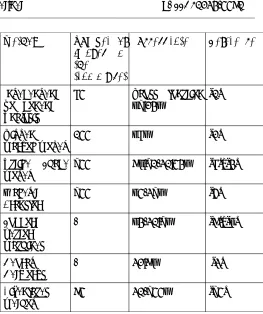
Table 1. Comparison of some work related to face recognition
Ψ
=
1
M
∑
I=1M
Γi
(1)where Ψ average image, M: number of images, Γi : image vector.
Method Number of images in the
training set
Success rate Reference
Independent Component Analysis
40 Gauss function 81.35% [2]
Hidden
Markov Model 200 84% [3] Active Shape
Model 100 78.12-92.05% [4], [5] Wavelet
Transform 100 80-91% [6] Support
Vector Machines
- 85-92.1% [7], [8]
Neural
Networks - 93.7% [9]
Eigenfaces
Method 70 92-100% [10]
combination of the so called ‘eigenfaces’ obtained from the feature extraction process. The principal components of the faces in the training set are calculated. Recognition is achieved using the projection of the face into the space formed by the eigenfaces. A comparison on the basis of the Euclidian distance of the eigenvectors of the eigenfaces and the eigenface of the image under question is made. If this distance is small enough, the person is identified. On the other hand, if the distance is too large, the image is regarded as one that belongs to an individual for which the system has to be trained.
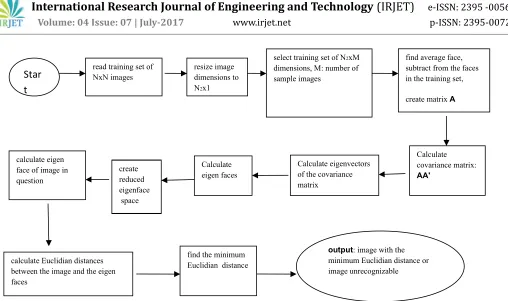
The flowchart of the algorithm is shown in Fig. 1.
As a starting point, the training images of dimensions N*N are read and they are converted to N2 *1 dimensions. A
training set of N2 *M dimensions is thus created, where M
is the number of sample images. The average of the image set is calculated as:
structures and features unique to that individual. An automatic face recognition system is based on facial symmetry. Face authentication and face identification are challenging problems. The fact that in the recent past, there have been more and more commercial, military and institutional applications makes the face recognition systems a popular subject. To be reliable, such systems have to work with high precision and accuracy. In a face recognition system, the database consists of the images of the individuals that the system has to recognize. If possible, several images of the same individual should be included in the database. If the images are selected so that they account for varying facial expressions, lighting conditions, etc., the solution of the problem can be found more easily as compared to the case where only a single image of each individual is stored in the database. A face recognition algorithm processes the captured image and compares it to the images stored in the database. If a match is found, then the individual is identified. If no match is found, then the individual is reported as unidentified.
The challenges of face recognition are:
1) Shifting and scaling of the image,
2) Differences in the facial look (different angle, pose, hairstyle, makeup, mustache, beard, etc.),
3) Lighting, 4) Aging.
Fig 1. Lifecycle of Image processing
The eigenfaces corresponding to the highest eigenvalues are retained. Those eigenfaces define the face space. The eigenspace is created by projecting the image to the face space formed by the eigenfaces. Thus the weight vectors are calculated. Dimensions of the image are adjusted to meet the specifications and the image is enhanced in the pre-processing steps of recognition. The weight vector of the image and the weight vectors of the faces in the database are compared.
Average face is calculated and subtracted from each face in the training set. A matrix (A) is formed using the results of the subtraction operation. The difference between each image and the average image is calculated as
Ψ Γ =
Φi i (ii)
where
Φ
i is the difference between the image and theaverage image. The matrix obtained by the subtraction operation (A) is multiplied by its transpose and thus covariance matrix C is formed:
C
=
A
TA
where A is formed by the difference vectors, i.e.,
Φ Φ ,ΦM
=
A 1, 2,..
The dimensions of the matrix C is N*N. M images are used to form C. In practice, the dimensions of C is N*M. On the other hand, since the rank of A is M, only M out of N
eigenvectors are nonzero. The eigenvalues of the covariance matrix is calculated. The eigenfaces are created by using the number of training images minus number of classes (total number of people) of eigenvectors. The selected set of eigenvectors are multiplied by the A matrix to create a reduced eigenface subspace. The eigenvectors of smaller eigenvalues correspond to smaller variations in the covariance matrix. The discriminating features of the face are retained. The number of eigenvectors depends on the accuracy with which the database is defined and it can be optimized. The groups of selected eigenvectors are called the eigenfaces. Once the eigenfaces have been obtained, the images in the database are projected into the eigenface space and the weights of the image in that space are stored. To determine the identity of an image, the eigen coefficients are compared with the eigen coefficients in the database. The eigenface of the image in question is formed. The Euclidian distances between the eigenface of the image and the eigenfaces stored previously are calculated. The person in question is identified as the one whose Euclidian distance is minimum below a threshold value in the eigenface database. If all the calculated Euclidian distances are larger than the threshold, then the image is unrecognizable.
The reasons for selecting the eigenfaces method for face recognition are:
1) Its independence from the facial geometry, 2) The simplicity of realization,
3) Possibility of real-time realization even without special hardware, 4)
4) The ease and speed of recognition with respect to the other methods,
Star t
read training set of NxN images
resize image dimensions to N2x1
select training set of N2xM
dimensions, M: number of sample images
find average face, subtract from the faces in the training set,
create matrix A
Calculate covariance matrix:
AA'
Calculate eigenvectors of the covariance matrix
Calculate eigen faces calculate eigen
face of image in question
calculate Euclidian distances between the image and the eigen faces
find the minimum Euclidian distance
output: image with the minimum Euclidian distance or image unrecognizable create
5) The higher success rate in comparison to other methods. The challenge of the eigenfaces face recognition method is the computation time. If the database is large, it may take a while to retrieve the identity of the person under question.
SUPPORT VECTOR MACHINE
The key to solve problem is to design a nice classified after getting effective characteristics. The common face-identified classifier included the nearest distance classifier and the artificial neural network classifier.
The support vector machine based on the theories of statistics is a way of learning machine. It is an important breakthrough in the field of statistics after neural network[8]. The neural network model which has been used by some scholars in some areas can solve non-linear problems and model system of prediction. However, neural network lacking in unified mathematical theory and depending on a numerous data sample in certain network structure or setting a model or identifying weight is easy to get the local optional solution. Moreover it makes training model complicated and leads to “over studying “, according to principle of minimal risk. From perspective of structural risk of minimization support vector machine improves the generalization ability of model. The final decision function of SVM is determined by a few support vectors and the complexity of the calculation depends on the number of support vectors rather than the space dimension of the samples. When it comes to optimization problems and calculating discriminate function, just calculate the kernel function instead of needing to calculated nonlinear mapping SVMs are binary classifiers, that is – they give the class which might be 1 or -1, so we would have to modify the representation of faces a little bit than what we were doing in that previous post to make it somewhat more desirable. In the previous approach that is “a view based or faces space approach”, each image was encoded separately. Here, we would change the representation and encode faces into a difference space. The difference space takes into account the dissimilarities between faces. In the difference space there can be two different classes.
1. The class that encodes the dissimilarities between different images of the same person,
2. The other class encodes the dissimilarities between images of other people. These two classes are then given to a SVM which then generates a decision surface.
ISSUES IN FACE RECOGNITION
Traditionally Face recognition can be thought of as a K class problem and face authentication can be thought of as a K instances two class problem. To reduce it to a two class problem we formulate the problem into a difference space as we have already mentioned. Now consider a training set T = { t1...tM }having M training images belonging to K
[image:4.595.323.556.257.392.2]individuals. Each individual can have more than one image, that means M > K of course. It is from T that we generate the two classes which mentioned above. The Principal Components(or Eigenvectors) basically seek directions in which it is more efficient to represent the data. This is particularly useful for reducing the computational effort. To understand this, suppose we get 60 such directions, out of these about 40 might be insignificant and only 20 might represent the variation in data significantly, so for calculations it would work quite well to only use the 20 and leave out the rest. This is illustrated by this figure 2 [14] :
Figure 2. Performance of PCA [14]
Such an information theory approach will encode not only the local features but also the global features. Such features may or may not be intuitively understandable. When we find the principal components or the Eigenvectors of the image set, each Eigenvector has some contribution from each face used in the training set. So the Eigenvectors also have a face like appearance. These look ghost like and are ghost images or Eigenfaces. Every image in the training set can be represented as a weighted linear combination of these basis faces.
The number of Eigenfaces that we would obtain therefore would be equal to the number of images in the training set. Let us take this number to be M. Like we mentioned one paragraph before, some of these Eigenfaces are more important in encoding the variation in face images, thus we could also approximate faces using only the K most significant Eigenfaces.
EXPERIMENT RESULTS & ANALYSIS
eigenvector (50, 100, 200, 500) are selected. The classifiers are trained and tested with each feature set separately. The classification accuracy is calculates using the formula. Classification Accuracy = (Total No. of samples taken – No. of samples misclassified) / Total No. of samples taken. The performance of the classifiers used in this study is described in the Table I. In both the classifier the classification accuracy is higher when the feature set contains less number of eigenvector which has high eigen values. This shows that the eigenvectors with highest eigenvalues will give better classification results when using the face images with homogeneous background and lighting conditions.
Expected results for the top 5 most represented people in the dataset:
avg / total 0.83 0.82 0.82 322
CONCLUSION
The Eigenfaces method is applied to a very large database consisting of 3040 images. The challenging details, such as background, eye-glasses, beard, and mustache are dealt with. Simulation results show that sometimes failure occurs. The success rate is calculated as 94.74%. To increase the success rate, the eigenfaces method can be fortified with the use of additional information, such as the face triangle. The future work will focus on increasing success rate for very large databases.
REFERENCES
1. B. Karaduman, Relevant Component Analysis, M. S. Thesis, Yıldız Technical University, Turkey, 2008.
2. I. Yazar, H. S. Yavuz, and M. A. Çay, Face Recognition Performance Comparisons by Using Tanh and Gauss Functions in the ICA Method, IATS'09, Karabük, Turkey, 2009.
3. F. S. Samaria and A. C. Harter, Parameterization of a Stochastic Model for Human Face Identification, Proc. of the 2 nd IEEE Workshop on Applications of Computer Vision, Sarasota, Florida, 1994.
4. Ç. Tırkaz and S. Albayrak, Face Recognition using Active Shape Model, SIU2009, Kayseri, Turkey, 2009. 5. F. Kahraman, B. Kurt and M. Gökmen, Face Recognition Based on Active Shape Model, SIU2005, Antalya, Turkey, 2005.
6. A. Özdemir, Recognition of Frontal Face Images by Applying the Wavelet Transform, M. S. Thesis, Kahramanmaraş Sütçü İmam University, Turkey, 2007. 7. B. Kepenekci and G. B. Akar, Face Classification with Support Vector Machines, SIU2004, Kuşadası, Turkey, 2004.
8. F. Karagülle, Face Finding Using Support Vector Machines, M. S. Thesis, Trakya University, Turkey, 2008. 9. H. Ergezer, Face Recognition: Eigenfaces, Neural Networks, Gabor Wavelet Transform Methods, M. S. Thesis, Başkent University, Turkey, 2003.
10. İ. Atalay and M. Gökmen, Face Recognition Using Eigenfaces, SIU1996, Antalya, Turkey, 151-156, 1996. 11. L. Sirovich and M. Kirby, Low-Dimensional Procedure for the Characterization of Human Faces, Journal of the Optical Society of America, A 4 (1987) 519-524.
Ariel Sharon 0.57 0.62 0.59 13 Colin Powell 0.75 0.85 0.80 60 Donald Rumsfeld 0.69 0.74 0.71 27 George W Bush 0.90 0.90 0.90 146 Gerhard Schroeder 0.79 0.76 0.78 25 Hugo Chavez 0.73 0.53 0.62 15 Tony Blair 0.90 0.78 0.84 36
precision recall f1-score support Ariel Sharon 0.67 0.92 0.77 13 Colin Powell 0.75 0.78 0.76 60 Donald Rumsfeld 0.78 0.67 0.72 27 George W Bush 0.86 0.86 0.86 146 Gerhard Schroeder 0.76 0.76 0.76 25 Hugo Chavez 0.67 0.67 0.67 15 Tony Blair 0.81 0.69 0.75 36
avg / total 0.80 0.80 0.80 322
Observed Results
12. M. Turk and A. Pentland, “Eigenfaces for Recognition,” Journal of Cognitive Neuroscience, Vol. 3, No. 1 (1991) 71-86.
![Figure 2. Performance of PCA [14]](https://thumb-us.123doks.com/thumbv2/123dok_us/8158454.804900/4.595.323.556.257.392/figure-performance-of-pca.webp)
