How to cite this paper: Gode, D.B. (2014) Complex Number Theory without Imaginary Number (i). Open Access Library Journal, 1: e856. http://dx.doi.org/10.4236/oalib.1100856
Complex Number Theory without Imaginary
Number (i)
Deepak Bhalchandra Gode
Directorate of Census Operations, Mumbai, India Email: [email protected]
Received 26 July 2014; revised 20 September 2014; accepted 23 October 2014
Copyright © 2014 by author and OALib.
This work is licensed under the Creative Commons Attribution International License (CC BY).
http://creativecommons.org/licenses/by/4.0/
Abstract
In this paper new method is introduced for complex numbers; this method does not include im-aginary number “i” but produces the same results that occur in Addition, Subtraction, Multiplica-tion & Division of complex numbers, also proof of Eluer Formula eiθ and De Moivre theorem with-out using imaginary number “i”. Furthermore placing the light on the square root of a negative number, the square root of a negative number is equal to the square root of the same positive real number but with an angle of 90 degree to real line. The intention is that there’s nothing mystical about imaginary number “i”. The square root of minus one is just as real as any other number. Complex numbers exists without imaginary number “i”. This paper is limited to the results which are already established.
Keywords
Addition, Subtraction, Multiplication, Division, Eluer Formula, De Moivre Theorem, Square Root of Negative Number
Subject Areas: Mathematical Analysis, Mathematical Logic, Foundation of Mathematics
1. Introduction
An algebra of real number is not enough to solve the equations like 2 1 0
X + = . To avoid this, concept of com-plex number was introduced; it is a combination of real numbers and imaginary number i, where i is equal to square root of minus one −1. Since then it was used to solve the equation which has no solution in real num-ber theory and also established its use in different disciplines like electronics, quantum theory etc. But since
1
− has no exact value & meaning, it is a fact that an injudicious use of this symbol often leads to mutually contradictory and absurd conclusions ([1], p. 1).
OALibJ | DOI:10.4236/oalib.1100856 2 October 2014 | Volume 1 | e856
contradiction, since we don’t know the exact value of square root of −1 (i.e. i= −1). So it is better to have a number system which does not involve “i” but gives all the benefits of complex number system.
Herewith complex number without imaginary number is being introduced; it is a combination of real numbers & trigonometric functions i.e. cos(θ), sin(θ). Any number in complex number theory without “i” is represented by acos
( )
θ +bsin( )
θ where a & b are real numbers and θ =tan−1( )
a b . It has direction and altitude/mod- ulus same as complex number but without “i”. In graphical representation, acos( )
θ represents X axis and( )
sin
b θ represents Y axis.
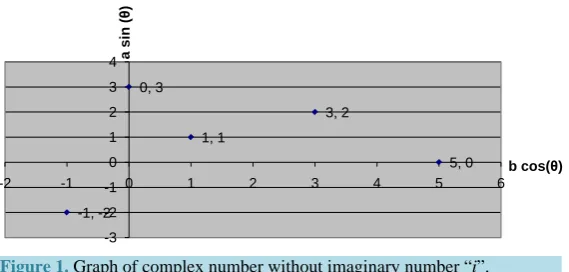
This is a simple graph, X axis represents combination of real number “a” and cos(θ), whereas, Y axis represents combination of real number “b” and sin(θ) where 1
( )
tan a b
θ= −
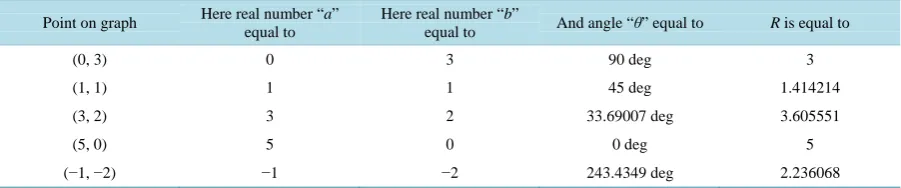
. Points shown inFigure 1 are ex-plained below
Point on graph Here real number “a” equal to
Here real number “b” equal to
Angle “θ” equal to tan‒1(a/b).
Corresponding complex number without imaginary number “i” is
(0, 3) 0 3 90 deg 3sin(90)
(1, 1) 1 1 45 deg cos(45) + sin(45)
(3, 2) 3 2 33.69007 deg 3cos(33.69007) + 2sin(33.69007)
(5, 0) 5 0 0 deg 5cos(0)
(−1, −2) −1 −2 243.4349 deg −1cos(243.4349) − 2sin(243.4349)
Note: 1) Here onwards short form “CNWOI” is used in place of complex number without imaginary number i;2) The value of angle θ is taken in de-grees; 3) The cos(θ) & sin(θ) can have angle from 0 to 360 degrees; 4) The tan(θ) can have angle from −180 to 180 degrees.
Every CNWOI is interlinked with its members i.e. the real numbers a & b, the angle θ and the length R from origin (i.e. radius or modulus).
Let a+ib be any complex number then its equal CNWOI is
( )
( )
cos sin
a θ +b θ where θ =tan−1
( )
a bRadius or Modulus R: R is calculated by putting values of cos & sin for θ tan 1
( )
a b θ0−
= = (some angle) in CNWOI i.e.
( )
0( )
0 cos sin R=a θ +b θExample: For a point (0, 3) in aboveFigure 1, θ = 90 deg so
( )
0( )
0( )
( )
cos sin 0 cos 90 3 sin 90 0 3 1 3
R a b
R
θ θ
= + = × + ×
= + × =
This R is same as modulus of complex number i.e. R= a2+b2. Calculated R for points shown inFigure 1 is given in table
Point on graph Here real number “a” equal to
Here real number “b”
equal to And angle “θ” equal to R is equal to
(0, 3) 0 3 90 deg 3
(1, 1) 1 1 45 deg 1.414214
(3, 2) 3 2 33.69007 deg 3.605551
(5, 0) 5 0 0 deg 5
(−1, −2) −1 −2 243.4349 deg 2.236068
Coefficients a & b: If “R” and “θ0” are given then coefficients a & b are equal to
( )
0 &( )
0cos sin
a=R θ b=R θ ([1], pp. 11 & 12 and [2], p. 11).
Example: Suppose “R” and “θ0” are 2.236068 and 243.4349 deg respectively then
(
)
(
)
(
)
(
)
2.236068cos 243.4349 2.236068 0.44721 1 2.236068sin 243.4349 2.236068 0.89443 2 a
b
= = × − = −
[image:2.595.88.539.540.634.2]OALibJ | DOI:10.4236/oalib.1100856 3 October 2014 | Volume 1 | e856
Figure 1. Graph of complex number without imaginary number “i”.
This is how “R”, “θ”, “a” & “b” are interlinked to each other.
2. Addition of CNWOI
There are two CNWOI( )
11 1 1
cos sin where tan
a θ +b θ θ = − a b and ccosθ2 dsinθ2whereθ2 tan 1
( )
c d−
+ =
Then the addition is
(
)
(
)
1(
(
) (
)
)
3 3 3
cos sin where tan
a c+ θ + +b d θ θ = − a c+ b d+
3. Subtraction of CNWOI
There are two CNWOI( )
11 1 1
cos sin where tan
a θ +b θ θ = − a b and ccosθ2 dsinθ2whereθ2 tan 1
( )
c d−
+ =
Then the subtraction is
(
)
(
)
1(
(
) (
)
)
3 3 3
cos sin where tan
a c− θ + −b d θ θ = − a c− b d−
4. Multiplication of Two CNWOI
There are two CNWOI( )
11 1 1
cos sin where tan
a θ +b θ θ = − a b and ccosθ2 dsinθ2whereθ2 tan 1
( )
c d−
+ =
Putting angle of θ1 in first number will gate a number which is equal to
2 2
a +b let’s say this number is R1, similarly putting angle of θ2 in second number will gate a number which is equal to
2 2
c +d let’s say this number R2 then multiplication of this number is equal to
(
)
(
)
1 2cos 1 2 cos 3 1 2sin 1 2 sin 3
R R θ θ+ θ + R R θ θ+ θ
(
)
(
)
(
)
1
3 1 2 1 2 1 2 1 2
where tanθ = − R R cos θ θ+ R R sin θ θ+
Related multiplication rule for two complex numbers by De Moivre is z z1 2 =r r12
(
cos(
θ θ1+ 2)
+isin(
θ θ1+ 2)
)
([1], p. 14 & [2], p. 13).Example
Square of a number 1cosθ1 2 sinθ1whereθ1 tan 1
( )
1 2−
+ = here angle θ1 =63.43495 and R1 = 2.236068 for first number and since it is a product of same number (i.e. square of a number) angle and R are same, so product is equal to
(
)
(
)
(
)
[
]
3 3
3 3
2.236068 2.236068 cos 126.8699 cos 2.236068 2.236068 sin 126.8699 sin 2.236068 2.236068 0.6 cos 2.236068 2.236068 0.8 sin
θ θ
θ θ
× × + × ×
× × − + × ×
1, 1
3, 2 0, 3
5, 0
-1, -2 -3 -2 -1 0 1 2 3 4
-2 -1 0 1 2 3 4 5 6
a
s
in
(θ
)
OALibJ | DOI:10.4236/oalib.1100856 4 October 2014 | Volume 1 | e856
This is equal to
(
)
1
3 3 3
3cosθ 4sinθ whereθ tan− 3 4
− + = −
This is identical to square of complex number
(
1 2 .+ i)
5. Division of CNWOI
There are two CNWOI
( )
11 1 1
cos sin where tan
a θ +b θ θ = − a b and ccosθ2 dsinθ2where tanθ2 1
( )
c d−
+ =
Then for division of acosθ1+bsinθ1 ccosθ2+dsinθ2.
First find R and angle θ for both numbers as did in multiplication calculation, then the division is equal to
(
) (
)
(
) (
)
(
) (
) (
) (
)
(
)
1 2 1 2 3 1 2 1 2 3
1
3 1 2 1 2 1 2 1 2
cos cos sin sin
where tan cos sin
R R R R
R R R R
θ θ θ θ θ θ
θ − θ θ θ θ
− + −
= − −
Related division rule for two complex number by De Moivre is z z1 2=r r1 2
(
cos(
θ θ1− 2)
+isin(
θ θ1− 2)
)
. ([1], 14 & [2], p. 14).Example
Division of two CNWOI
( )
11 1 1
1cosθ +2sinθ where θ =tan− 1 2 So angle θ1 = 63.43495 and R1 = 2.236068 for first number
( )
12 2 2
2 cosθ +3sinθ whereθ =tan− 2 3 So angle θ2 =56.30993 and R2 = 3.60551 for second number.
Now 1cosθ2+2 sinθ2 divided by 2 cosθ2+3sinθ2 is equal to
(
) (
)
(
) (
)
(
)
(
)
(
)
(
)
1 2 1 2 3 1 2 1 2 3
3 3
3 3
cos cos sin sin
2.236068 3.60551 cos 63.43495 56.30993 cos 2.236068 3.60551 sin 6 0.620174 cos 7.125016 0.620174 sin 7.125016
0.62
3.43495 56.30993 sin
cos si
0174 0.9922
n
R R θ θ θ R R θ θ θ
θ θ
θ θ
× ×
− + −
× − + × −
+ ×
[
]
3[
]
33 3
cos s
78 0.620174 0.124035 0
in
cos sin
.615385 0.076923
θ θ
θ + θ
× +
This is equal to
(
)
1
3 3 3
cos sin wh
0.615385 θ +0.076923 θ ereθ =tan− 0.615385 0.076923
This is identical to the division of above complex numbers using imaginary number i, i.e. equal to 8 13 1 13 .+ i
6. Proof of Eluer Formula
i( )
( )
i
e
θ=
cos
θ
+
sin
θ
[1]-[4]
Let a+bi is any complex numberIts equivalent complex number without imaginary number i (CNWOI) is
( )
( )
1( )
cos sin where tan
a θ +b θ θ= − a b
Now
[ ]
cos( ) sin( )[ ]
cos( )1[ ]
sin( )2ea θ+b θ = ea θ eb θ since we have parted it into two complex numbers, there are two cases each for these two parted CNWOI
ab-OALibJ | DOI:10.4236/oalib.1100856 5 October 2014 | Volume 1 | e856
solute value of “a”. Similarly for second CNWOI θ2 may be 90 deg or 270 deg depend on the +ve or −ve value of “b” and its R is equal to absolute value of “b”, solving these cases one by one we get
For first CNWOI if θ1 is equal to 0 deg i.e. “a” is any positive number on X axis, then
[ ]
cos 0( ){
( )
(
( )
)
2(
( )
)
3(
( )
)
4}
ea = +1 acos 0 1!+ acos 0 2!+ acos 0 3!+ acos 0 4!+
Using product rule of CNWOI for terms with power greater than one and taking R is equal to absolute value of “a” we get
[ ]
( ){
( )
{
(
)
( )
(
)
( )
}
(
)
( )
(
)
( )
{
}
(
)
( )
(
)
( )
{
}
}
( )
( )
( )
( )
{
}
cos 0 2 2
1 1
3 3
2 2
4 4
3 3
2 3 4
1 2 3
e 1 cos 0 1! cos 2 0 cos sin 2 0 sin 2!
cos 3 0 cos sin 3 0 sin 3!
cos 4 0 cos sin 4 0 sin 4! 1 cos 0 1! cos 2! cos 3! cos 4!
a
a a a
a a
a a
a a a a
θ θ
θ θ
θ θ
θ θ θ
= + + × + ×
+ × + ×
+ × + × +
= + + + + +
And using addition rule of CNWOI
( )
( )
2 3 4
1 a1! a 2! a 3! a 4! cos α e cosa α
+ + + + + =
So if “a” is any positive number on X axis
[ ]
cos( )1( )
ea θ =e cosa α
It is same as complex number with imaginary number i.
Now if θ1 is equal to 180 deg i.e. “a” is any negative number on X axis then
[ ]
cos 180( )( )
(
( )
)
2(
( )
)
3(
( )
)
4e−a = −1 acos 180 1!+ −acos 180 2!+ −acos 180 3!+ −acos 180 4!+
Using product rule of CNWOI for terms with power greater than one and talking R is equal to absolute value of “a” we get
[ ]
( ){
( )
{
(
)
( )
(
)
( )
}
(
)
( )
(
)
( )
{
}
(
)
( )
(
)
( )
{
}
}
( )
( )
( )
( )
{
}
cos 180 2 2
1 1
3 3
2 2
4 4
3 3
2 3 4
1 2 3
e 1 cos 180 1! cos 2 180 cos sin 2 180 sin 2!
cos 3 180 cos sin 3 180 sin 3!
cos 4 180 cos sin 4 180 sin 4! 1 cos 180 1! cos 2! cos 3! cos 4!
a
a a a
a a
a a
a a a a
θ θ
θ θ
θ θ
θ θ θ
−
= − + × + ×
+ × + ×
+ × + × +
= − + − + +
Using addition rule of CNWOI
( )
( )
2 3 4
1 a1! a 2! a 3! a 4! cos α e−acos α
− + − + + =
So if “a” is any negative number on X axis
[ ]
cos( )1( )
e−a θ =e−acos α It is same as complex number with imaginary number i.
Now for second CNWOI if θ2 is equal to 90 deg i.e. “b” is any positive number on Y axis then
[ ]
sin 90( )( )
(
( )
)
2(
( )
)
3(
( )
)
4eb = +1 bsin 90 1!+ bsin 90 2!+ bsin 90 3!+ bsin 90 4!+
OALibJ | DOI:10.4236/oalib.1100856 6 October 2014 | Volume 1 | e856
[ ]
( ){
( )
{
(
)
( )
(
)
( )
}
(
)
( )
(
)
( )
{
}
(
)
( )
(
)
( )
{
}
}
[ ]
( ){
( )
{
( )
( )
( )
( )
}
sin 90 2 2
1 1
3 3
2 2
4 4
3 3
sin 90 2 2
1 1
3
e 1 sin 90 1! cos 2 90 cos sin 2 90 sin 2!
cos 3 90 cos sin 3 90 sin 3!
cos 4 90 cos sin 4 90 sin 4!
e 1 sin 90 1! cos 180 cos sin 180 sin 2!
c
b
b
b b b
b b
b b
b b b
b θ θ θ θ θ θ θ θ = + + × + × + × + × + × + × + = + + + +
(
)
( )
(
)
( )
{
}
(
)
( )
(
)
( )
{
}
}
( )
( )
( )
( )
3 2 2 4 4 3 32 3 4
1 2 3
os 270 cos sin 270 sin 3!
cos 360 cos sin 360 sin 4!
1 sin 90 1! cos 2! sin 3! cos 4!
b
b b
b b b b
θ θ
θ θ
θ θ θ
+ + + + = + − − + +
Using addition rule of CNWOI
( )
( )
( )
( )
( )
( )
2 4 3
1 2! 4! cos 1! 3! sin
cos cos sin sin
b b b b
b b α α α α = − + + + − + = +
So if “b” is any positive number on Y axis
[ ]
sin( )2( )
( )
( )
( )
eb θ =cos b cos α +sin b sin α
It is same as complex number with imaginary number, that is
[ ]
eib =cos( )
b +isin( )
b .Remember that a complex number with i is equal to a + ib and its equivalent CNWOI is acos
( )
α +bsin( )
α . Now if θ2 is equal to 270 deg i.e. “b” is any negative number on y axis then[ ]
sin 270( )(
)
(
(
)
)
2(
(
)
)
3(
(
)
)
4e−b = −1 bsin 270 1!+ −bsin 270 2!+ −bsin 270 3!+ −bsin 270 4!+
Using product rule of CNWOI for terms with power greater than one and talking R is equal to absolute value of “b” we get
[ ]
( ){
(
)
{
(
)
( )
(
)
( )
}
(
)
( )
(
)
( )
{
}
(
)
( )
(
)
( )
{
}
}
[ ]
( )(
)
(
)
( )
(
)
sin 270 2 2
1 1
3 3
2 2
4 4
3 3
sin 270 2 2
1
e 1 sin 270 1! cos 2 270 cos sin 2 270 sin 2!
cos 3 270 cos sin 3 270 sin 3!
cos 4 270 cos sin 4 270 sin 4!
e 1 sin 270 1! cos 540 cos sin 540
b
b
b b b
b b
b b
b b b
θ θ θ θ θ θ θ − − = − + × + × + × + × + × + × + = − + +
( )
{
}
{
( )
( )
( )
( )
{
}
(
)
( )
(
)
( )
{
}
}
[ ]
( ){
(
)
{
( )
( )
( )
( )
}
( )
( )
( )
( )
{
}
(
)
1 3 3 2 2 4 4 3 3sin 270 2 2
1 1
3 3
2 2
4
sin 2!
cos 810 cos sin 810 sin 3!
cos 1080 cos sin 1080 sin 4!
e 1 sin 270 1! cos 180 cos sin 180 sin 2!
cos 90 cos sin 90 sin 3!
cos 360 cos
b
b b
b b
b b b
b b b θ θ θ θ θ θ θ θ θ θ − + + + + + = − + + + + +
( )
(
)
( )
{
}
}
(
)
( )
( )
( )
4 3 32 3 4
1 2 3
sin 360 sin 4!
1 sin 270 1! cos 2! sin 3! cos 4! b
b b b b
θ
θ θ θ
+ + = − − + + +
Using addition rule of CNWOI
( )
( )
( )
( )
( )
( )
( )
( )
2 4 3
2 4 3
1 2! 4! cos 1! 3! sin
1 2! 4! cos 1! 3! sin
cos cos sin sin
b b b b
b b b b
OALibJ | DOI:10.4236/oalib.1100856 7 October 2014 | Volume 1 | e856
So if “b” is any negative number on Y axis
[ ]
sin( )2( )
( )
( )
( )
e−b θ =cos b cos α −sin b sin α
It is same as complex number with imaginary number i, that is
[ ]
e−ib =cos( )
b −isin( )
b .7. De Moivre Theorem (for Finding Power of Complex Number)
In complex number if n is a positive integer, then( )
( )
( )
( )
cos θ +isin θ n =cos nθ +isin nθ
([2], p. 15]
Proof of this theorem in complex number theory without “i” (CNWOI) is as follows Let a+ib is any complex number
Its equivalent CNWOI is acos
( )
θ +bsin( )
θ now we have to prove that( )
( )
( )
( )
cos sin n cos sin
a θ +b θ =c nθ +d nθ
(1)
where c=Rncos
( )
nθ & d=Rnsin( )
nθ are the numbers came out after multiplying same CNWOI “n” times and θ=tan−1( )
c d .Formula for multiplication of two CNWOI is
(
)
(
)
1 2cos 1 2 cos 1 2sin 1 2 sin R R θ θ+ α+ R R θ θ+ α
where
(
)
(
)
(
)
1
1 2 1 2 1 2 1 2
tan R R cos R R sin
α= − θ θ+ θ θ+
Since we were multiplying same CNWOI “n” times
1 2 3 n
R =R =R ==R =R (some modulus/radius associated with given CNWOI)
1 2 3 n
θ =θ =θ ==θ =θ (some angle associated with given CNWOI)
So product is
( )
( )
(
)
(
)
( )
( )
( )
( )
cos sin cos cos sin sin
cos sin cos cos sin sin
n
n n n
a b R R R R R R
a b R n R n
θ θ θ θ θ α θ θ θ α
θ θ θ α θ α
+ = × × × + + + + × × × + + +
+ = +
where
( )
( )
(
)
1
tan Rncos n Rnsin n
α = − θ θ
α will be equal to nθ.
Putting this in Equation (1) we get
( )
( )
( )
( )
cos sin n cos sin
a θ +b θ =c nθ +d nθ
where
[ ]
ncos( )
and[ ]
nsin( )
c= R nθ d= R nθ
Example
Let 6 8i+ is any complex number. Now we find out its cube using De Moivre theorem of CNWOI i.e.
( )
( )
( )
( )
cos sin n cos sin
a θ +b θ =c nθ +d nθ
(
)
36 8i+ is equal to 6 cos
( )
θ +8sin( )
θ 3 in CNWOI( )
1tan 6 8 53.1301
OALibJ | DOI:10.4236/oalib.1100856 8 October 2014 | Volume 1 | e856
(
)
(
)
6 cos 53.1301 8sin 53.1301 6 0.6 8 0.8 3.6 6.4 10 10
R
R R
= +
= × + × = + =
=
Now using De Moivre theorem
( )
( )
( )
(
)
( ) ( )
(
)
( )
(
) (
)
( ) (
) (
)
( )
(
)(
)
( ) (
)(
)
( )
( )
( )
(
)
( )
3 3 3
1
6 cos 8sin 10 cos 3 53.1301 cos 10 sin 3 53.1301 sin 1000 cos 159.3903 cos 1000 sin 159.3903 sin
1000 0.936 cos 1000 0.352 sin 936 cos 352 sin
tan 936 352 159.3903 3 6 cos 8s
θ θ α α
α α
α α
α α
α θ
θ −
+ = × + ×
= +
= − +
= − +
= − = =
+
( )
3( )
( )
in θ = −936 cos 3θ +352 sin 3θ
This is equal to cube of 6 8 .+ i
8. De Moivre Theorem (for Finding Root of Complex Number)
For finding root of complex number take compliment of De Moivre theorem (for finding power of CNWOI). If n is a positive integer, then nth root for any CNWOI acos
( )
θ +bsin( )
θ is equal to( )
( )
1( )
( )
cos sin n cos sin
a θ +b θ =c θ n +d θ n
where c=R1ncos
( )
θ n & d=R1nsin( )
θ n and θ=tan−1( )
c d =θ n.Example
Let −936+i352 is any complex number. Now find out its cubic root using De Moivre theorem of CNWOI
( )
( )
1( )
( )
cos sin n cos sin
a θ +b θ =c θ n +d θ n
(1)
where
( )
( )
1 1
cos & sin
n n
c=R θ n d=R θ n and θ=tan−1
( )
c d =θ n (2)( )
( )
1 3936 cos θ 352 sin θ
− +
Here θ =tan−1
(
−936 352)
=159.3903.Putting value θ in CNWOI −936 cos
( )
θ +352 sin( )
θ we get R(
)
(
)
(
)
(
)
936 cos 159.3903 352 sin 159.3903 936 0.936 352 0.352 876.096 123.904 1000
− + = − × − + × = + =
1000 R= Putting this R and θ in Equation (2) we get c & d
(
)
1 3(
)
(
)
1000 cos 159.3903 3 10 cos 53.1301 10 0.6 6
c= = × = × =
and
(
)
1 3(
)
(
)
1000 sin 159.3903 3 10 sin 53.1301 10 0.8 8
d= = × = × =
Putting these values of c & d in Equation (1) we get
(
)
(
)
1 3(
)
(
)
936 cos 159.3903 352 sin 159.3903 6 cos 53.1301 8sin 53.1301
− + = +
OALibJ | DOI:10.4236/oalib.1100856 9 October 2014 | Volume 1 | e856
9. Solution of Quadratic Equation Using CNWOI
Quadratic equations(
ax2+bx c+ =0)
for which b2−4ac<0.First find out θ (i.e. angle/argument) and R (i.e. modulus/radius), which are equal to
[
]
(
(
)
)
1 2
tan b a2 abs b 4ac 2a
θ = − − −
(
2) ( )
cos(
(
2 4)
)
2 sin( )
R= −b a θ + abs b − ac a θ
Hence roots for quadratic equation are
( )
( )
(
cos sin)
R θ + θ and R
(
cos( )
θ −sin( )
θ)
9.1. Example 1
Let 2
1 0
x + + =x for which b2−4ac<0, then
(
−b 2a)
= −1 2= −0.5 and(
)
(
2)
4 2 0.8660254.
abs b − ac a=
θ i.e. angle/argument and R i.e. modulus/radius are equal to
(
)
(
(
)
)
(
)
1 2 1
tan b2a abs b 4ac 2a tan 0.5 0.8660254 120
θ = − − − = − − =
(
) ( )
(
(
)
)
( )
( )
( )
(
) (
)
2
2 cos 4 2 sin 0.5 cos 120 0.8660254 sin 120
0.5 0.5 0.8660254 0.8660254 0.25 0.75 1
R= −b a θ + abs b − ac a θ = − +
= − × − + × = + =
Hence roots for quadratic equation are
( )
( )
(
cos 120 +sin 120)
&(
cos 120( )
−sin 120( )
)
Putting first root in quadratic equation we get
( )
( )
( )
( )
(
)
(
)
( )
( )
(
) (
)
2
cos 120 sin 120 cos 120 sin 120 1 cos 240 sin 240 cos 120 sin 120 1 0.5 0.8660254 0.5 0.8660254 1 1 0 1 0
+ + + + = + + + +
= − + − + − + + = − + + =
Putting second root in quadratic equation we get
( )
( )
( )
( )
(
)
(
)
( )
( )
(
)
2
cos 120 sin 120 cos 120 sin 120 1 cos 240 sin 240 cos 120 sin 120 1 0.5 0.8660254 0.5 0.8660254 1 1 0 1 0
− + − + = − + − +
= − + + − − + = − + + =
9.2. Example 2
Let 2
10 40 0
x − x+ = for which b2−4ac<0, then
(
−b 2a)
=5 and(
(
2)
)
4 2 3.8729833.
abs b − ac a= θ i.e. angle/argument and R i.e. modulus/radius are equal to
(
)
(
(
)
)
(
)
1 2 1
tan b2a abs b 4ac 2a tan 5 3.8729833 37.761244
θ = − − − = − =
(
) ( )
(
(
2)
)
( )
(
)
(
)
2 cos 4 2 sin 5 cos 37.761244 3.8729833sin 37.761244 5 0.7905694 3.8729833 0.6123724 3.9528471 2.3717082 6.3245553
R= −b a θ + abs b − ac a θ = +
= × + × = + =
Hence roots for quadratic equation are
(
)
(
)
(
)
OALibJ | DOI:10.4236/oalib.1100856 10 October 2014 | Volume 1 | e856
(
)
(
)
(
)
(
)
(
)
(
)
(
)
(
)
(
) (
)
(
(
)
(
)
)
(
) (
)
2
6.3245553 cos 37.761244 sin 37.761244 10 6.3245553 cos 37.761244 sin 37.761244 40
40 cos 75.522488 sin 75.522488 63.245553 cos 37.761244 sin 37.761244 40 10 38.729833 50 38.729833 40 40 40 0
+ + − ×
× + +
= × + + − × + +
= + + − + − + = − + =
Putting second root in quadratic equation we get
(
)
(
)
(
)
(
)
(
)
(
)
(
)
(
)
(
) (
)
(
(
)
(
)
)
(
) (
)
2
6.3245553 cos 37.761244 sin 37.761244 10 6.3245553 cos 37.761244 sin 37.761244 40
40 cos 75.522488 sin 75.522488 63.245553 cos 37.761244 sin 37.761244 40 10 38.729833 50 38.729833 40 40 40 0
− + − ×
× − +
= × − + − × − +
= − + − − − + = − + =
9.3. Example 3
Let 2
3x −4x+ =2 0 for which 2
4 0
b − ac< , then
(
−b 2a)
=0.6666667 and(
)
(
2)
4 2 0.4714045.
abs b − ac a=
θ i.e. angle/argument and R i.e. modulus/radius are equal to
(
)
(
(
)
)
(
)
1 2 1
tan b 2a abs b 4ac 2a tan 0.6666667 0.4714045 35.26439
θ= − − − = − =
(
) ( )
(
(
2)
)
( )
(
)
(
)
2 cos 4 2 sin 0.6666667 cos 35.26439 0.4714045sin 35.26439 0.6666667 0.8164966 0.4714045 0.5773503 0.5443311 0.2721655 0.8164966
R= −b a θ + abs b − ac a θ = +
= × + × = + =
Hence roots for quadratic equation are
(
)
(
)
(
)
0.8164966× cos 35.26439 +sin 35.26439 & 0.8164966×
(
cos 35.26439(
)
−sin 35.26439(
)
)
Putting first root in quadratic equation we get(
)
(
)
(
)
( )
(
)
(
)
(
)
(
)
2
3 0.8164966 cos 35.26439 sin 35.26439 4 0.8164966 cos 35.26439 sin 35.26439 2
0.6666667 1.8856181 2.6666667 1.8856181 2 2 2 0
× × + + − ×
× + +
= + + − − + = − + =
Putting second root in quadratic equation we get
(
)
(
)
(
)
( )
(
)
(
)
(
)
(
) (
)
2
3 0.8164966 cos 35.26439 sin 35.26439 4 0.8164966 cos 35.26439 sin 35.26439 2
0.6666667 1.8856181 2.6666667 1.8856181 2 2 2 0
× × − + − ×
× − +
= − + − − − + = − + =
9.4. Example 4
Let −4x2+2x− =7 0 for which b2−4ac<0, then
(
−b 2a)
=0.25 and(
)
(
abs b2−4ac)
2a= −1.2990381.θ i.e. angle/argument and R i.e. modulus/radius are equal to
(
)
(
(
)
)
(
)
1 2 1
tan b a2 abs b 4ac 2a tan 0.25 1.2990381 79.106605 280.89339
θ= − − − = − − = − =
OALibJ | DOI:10.4236/oalib.1100856 11 October 2014 | Volume 1 | e856
(
) ( )
(
(
)
)
( )
(
) (
) (
)
(
) (
)
2
2 cos 4 2 sin 0.25 cos 280.89339 1.2990381 sin 280.89339
0.25 0.1889822 1.2990381 0.9819805 0.0472456 1.2756301 1.3228757
R= −b a θ + abs b − ac a θ = + −
= × + − × − = + =
Hence roots for quadratic equation are
(
)
(
)
1.3228757 cos 280.89339 +sin 280.89339 & 1.3228757 cos 280.89339
(
)
−sin 280.89339(
)
Putting first root in quadratic equation we get
(
)
(
)
(
)
(
)
(
)
2
4 1.3228757 cos 280.89339 sin 280.89339 2 1.3228757
cos 280.89339 sin 280.89339 7
6.5 2.5980762 0.5 2.5980762 7 7 7 0
− × × + + ×
× + −
= + + − − = − =
Putting second root in quadratic equation we get
(
)
(
)
(
)
(
)
(
)
2
4 1.3228757 cos 280.89339 sin 280.89339 2 1.3228757
cos 280.89339 sin 280.89339 7
6.5 2.5980762 0.5 2.5980762 7 7 7 0
− × × − + ×
× − −
= − + + − = − =
9.5. Example 5
Let 2 1 0
x + = for which b2−4ac<0, then
(
−b 2a)
=0 and(
abs b(
2−4ac)
)
2a=1. First find out θ i.e. angle/argument and R i.e. modulus/radius which are equal to(
)
(
(
)
)
( )
1 2 1
tan b 2a abs b 4ac 2a tan 0 1 90
θ= − − − = − =
(
2) ( )
cos(
(
2 4)
)
2 sin( )
0 cos 90( )
1sin 90( )
1R= −b a θ + abs b − ac a θ = + =
Hence roots for quadratic equation are
( )
( )
1×cos 90 +sin 90 & 1×cos 90
( )
−sin 90( )
Putting first root in quadratic equation we get
( )
( )
(
)
( )
( )
(
)
2 1 cos 90 sin 90 1
1 cos 180 sin 180 1 1 0 1 0
× + +
× + + = − + + =
Putting second root in quadratic equation we get
( )
( )
(
)
( )
( )
(
)
2 1 cos 90 sin 90 1
1 cos 180 sin 180 1 1 0 1 0
× − +
× − + = − − + =
10. About Square Root of Negative Real Number
Imaginary number i= − = −1
( )
11 2 where −1 is a negative real number. Its modulus or radius is equal to 1 and angle is equal to 180 degrees, so using De Moivre theorem of CNWOI( )
( )
1( )
( )
cos sin n cos sin
a θ +b θ =c θ n +d θ n
OALibJ | DOI:10.4236/oalib.1100856 12 October 2014 | Volume 1 | e856
( )
(
)
( )
1 2
1 cos 180 2
cos 90 0
c
c
=
= =
and
( )
(
)
( )
1 2
1 sin 180 2
sin 90 1
d
d
=
= =
So putting values of c & d in above formula we get
( )
( )
( )
( )
( )
( )
( )
1 2
1 2
1 2
1 0 cos 90 1 sin 90 1 0 sin 90
1 sin 90
− = × + ×
− = +
− =
It is equivalent to the graphical position and value of imaginary number “i”.
So the square root of negative number is equal to the square root of same positive real number but with an an-gle of a 90 deg to real line.
Why the square root of negative number is at 90 deg to real line? It is in the roots of rules of multiplication where
Positive Positive× =Positive Positive Negative× =Negative Negative Negative× =Positive
These rules build a limitation when we come across a situation where we need square root of negative number. There is no negative number multiplied by itself will give a negative number.
Complex number is an answer to this limitation. Complex number is nothing but an interaction of two mu-tually opposite number systems, particularly in multiplication rules. Their individual and combine behavior un-der multiplication operation are given below.
10.1. When Only X Axis Is Considered It Gives
Positive Negative× =Negative
i.e. acos(0) × −bcos(180) using multiplication rule of CNWOI is equal to [−abcos(180)] and
Negative Negative× =Positive
i.e. −acos(180) × −bcos(180) using multiplication rule of CNWOI is equal to [abcos(0)].
10.2. When Only Y Axis Is Considered It Gives
Positive Negative× =Positive
i.e. asin(90) ×−bsin(270) using multiplication rule of CNWOI is equal to [abcos(0)] and
Negative Negative× =Negative
i.e. −a sin(270) × −bsin(270) using multiplication rule of CNWOI is equal to [−abcos(180)].
10.3. But Jointly They Give Back Traditional Results Such As
Positive Negative× =Negative
OALibJ | DOI:10.4236/oalib.1100856 13 October 2014 | Volume 1 | e856
−acos (180) × bsin(90) using product rule of CNWOI is equal to −absin(270) and
Negative Negative× =Positive
i.e. −acos(180) × −bsin(270) using product rule of CNWOI is equal to absin(90).
11. Final Reflection
As said earlier in graphical representation of complex number, the length of i shown on vertical axis is equal to 1; it is a contradiction since value of imaginary number i is not known. Also division process is not smooth, for di-viding one complex number with other needs to multiply it by conjugate of divisor. But in CNWOI theory it looks smooth and exactly opposite to the process of multiplication.
If addition, subtraction, multiplication, division, power and root can be found/calculated without imaginary number “i”, presented in this paper, so there is nothing mystical or imaginary about imaginary number “i”. Complex numbers exist without imaginary number “i”.
References
[1] Narayan, S. and Mittal, P.K. (2005) Theory of Functions of a Complex Variable. S. Chand & Company Ltd., New Delhi.
[2] Schneider, C. (2011) De Moivre’s Theorem—A Literature and Curriculum Project on Roots, Powers, and Complex Numbers. Department of Mathematics and Statistics, Portland State University.
[3] Bogomolny, A. (1996-2014) Cut the Knot! An Interactive Column Using Java Applets.
http://www.cut-the-knot.org/arithmetic/algebra/ComplexNumbers.shtml